ISSN (e): 2250-3021, ISSN (p): 2278-8719
Vol. 09, Issue 4 (April. 2019), ||S (III) || PP 38-43
Energy Efficiency Using DVFS in Cloud Computing
Prachi Patel
1, Prof. Rutvik Mehta
2, Assistance. Prof. Yask Patel
31Information Technology Parul Institute of Engineering &Technology Vadodara, India 2Information Technology Department Parul Institute of Engineering& Technology Vadodara, India
3Information Technology Department Parul Institute & Technology Vadodara, India
Corresponding Author: Prachi Patel
Abstract- cloud computing is vast area now a day. In this cloud there have many issues occur, virtual machine
management, security of the task, resource management so we have to solve it. In this paper we talk about the energy efficiency. In terms of efficiency we have consume the power cost of the datacenter and according that we manage the response time applying some algorithms and techniques. Dynamic voltage frequency scaling is a main algorithmof this research.Apply methodology,using that we manage the power.First we balance the request then making a group after that migrate the task according to the resources of the particular virtual machine.Keywords: Cloud Computing, Response Time, Energy Efficiency, data center, virtualization.
--- --- Date of Submission: 12-04-2019 Date of acceptance: 27-04-2019 --- ---
I.
INTRODUCTION
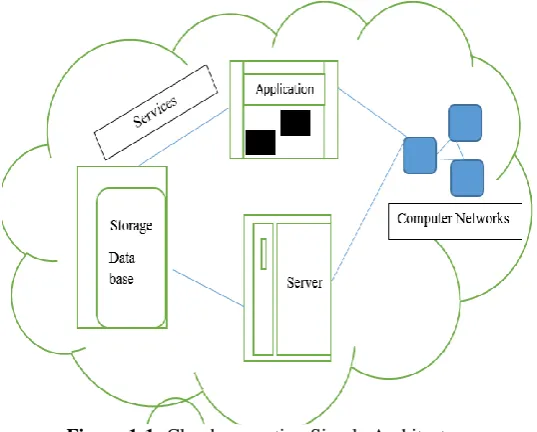
Cloud Computingis generally used to delineate another class of system based registering that happens over the web fundamentally a stage on from utility figuringan accumulation/ gathering of coordinated and arranged equipment programming and web foundation called a stage. Utilizing the web for correspondence and transport gives equipment programming and systems administration administrations to customers these stages conceal the intricacy and details. Of the fundamental framework from clients and applications by giving extremely basic graphical interface or programming interface (Applications Programming Interface). In cloud computing Hardware services, software services, on-demand services, pay-per-use services to other variety of services in the datacenters. Cloud computing architecture see infigure1.
Figure 1-1: Cloud computing Simple Architecture
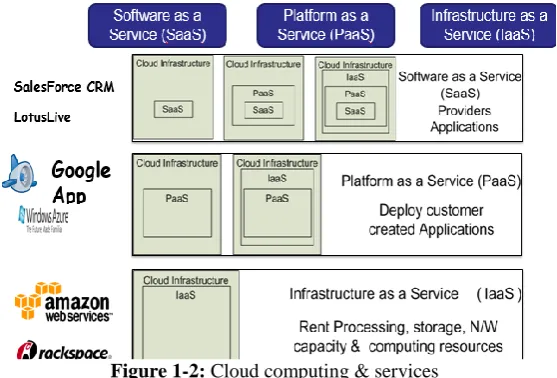
Figure 1-2: Cloud computing & services
A cloud service has been classified into three types:-
a. IaaS (Infrastructure as a service): It provides the basic level of service. It provide access to essential assets such as physical machine, network capacity, rent processing storage. In IAAS service provider provides resources to users without disclosing details of location and hardware. Example of this IAAS is Amazon Web Services.
b. PaaS (Platform as a service): It provides runtime environment for the application and the deployment of different tools to execute user applications. They have omitted the issues of handling the particulars virtual machines. Example of PAAS is Google App Engine [14].
c. SaaS (Software as a service): It supplies services and application to user as on demand. Service provider and vendors allow the user to use software application as a service. Example of SAAS is Google Maps for navigation. Conventionally, data storage and data processing are done at the user's own computer, using that computer's storage system and processor.An alternative to this method is cloud computing, which is internet-based computing that enables users at home or office.Computers to transfer data to a remote datacenter for storage and processing done at cloud side.
II.
RELATED WORK OF ENERGY EFFICIENCY IN CLOUD COMPUTING
In a decade ago, with significantly growth of the user requesting for web application. Multiple request can’t be handle by the particular one server so we requiremultiple servers and for managing them we need one place or particular room for that all connected servers, and various tools who connected with each other for handing all request.
The paper centers on adjusting the outstanding task at hand productively and re-disseminates it according to stack. Re-appropriation of the remaining burden thinks about three elements, physical machines state after relocation, cost of movement and anticipated outstanding task at hand. Tune et al [9].
Utilized virtualization innovation to utilize cloud datacenter assets on the run-time and to utilize servers effectively for green computing. It proved that the Variable Item Size Bin Packing (VISBP) calculation has better execution in problem areas relocation when contrasted with the then existing calculations. Han et al [10].
Utilized the idea of putting virtual machine to few has and exchanging inactive machines of. In spite of the fact that extensive number of combinations of VMs may result in high SLA infringement. Wang et al [11].
Proposed an assignment planning strategy which dispatches the errands to the dynamic or running servers by utilizing servers as less as could be expected under the circumstances and concentrated on altering the execution recurrence of processors of relative centers to spare vitality. It likewise proposed a processor-level relocation calculation to re-plan the rest of the undertaking among processors on an individual server. Wajid et al [12].
Proposed the framework to limit the vitality utilization in the cloud Data Centers by sending the undertakings to the vitality productive server farm and furthermore running the virtual machine at required recurrence utilizing improved weighted DVFS component.
A. LOAD BALANCING TECHNIQUE
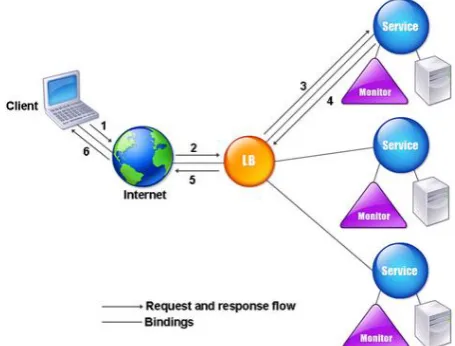
A load balancing setup includes a load-balancing virtual server and multiple load-balanced application servers. The virtual server gets approaching customer demands utilizes the heap adjusting calculation to choose an application server and advances the solicitations to the choseapplication server. The accompanying applied illustration shows a commonplace burden adjusting arrangement. Another variation involves assigning a global HTTP port [8].
The heap adjusting virtual server can utilize any of various calculations (or techniques) to decide how to disseminate load among the heap adjusted servers that it manages. The default load adjusting strategy is the least association technique, in which the NetScaler appliance forwards each incoming client connection to whichever load-balanced application server currently has the fewest active user connection.
Figure 1-3: Load Balancing Architecture
Imagine that 100TB has three servers dedicated to servicing the same high-volume client. Now imagine that nine users simultaneously request data from that client's website or online resources. A human would view it as legitimate to separate these solicitations equally between the servers. Be that as it may, it probably won't be sensible to the PC equipment. Without burden adjusting apparatuses, each of the nine solicitations may finish up being overhauled by a similar server. That would put an overwhelming handling trouble on this gadget, while save limit stood inert close-by [8].
B. ENERGY EFFICIENCY
Energy efficiency, is the objective to diminish proportion of imperativeness required to give items and administrations vitality. Energy efficiency means utilize less energy. Percentage of total energy input to a machine or load of the particular datacentre many techniques and framework are used in cloud computing equipment that is consumed in useful work and not wasted as useless heat, energy affect the environment and also some resources like CPU, Memory, some storage device etc. for managing the energy we need bigger servers and plates to process them faster. In cloud computing energy efficiency that have mainly two level occur: software and hardware. For managing the energy consumption.
1. DVFS (Dynamic Voltage Frequency Scaling)
Dynamic Voltage Frequency Scaling is adjustment of power and speed. It successfully used in energy management of real-time system domain. DVFS is technique that aim at decreasing the dynamic power utilization by progressively altering voltage and recurrence of a CPU.
fundamentally expected and structure for vitality effectiveness in embedded system. DVFS methods generally consider homogeneous physical machine while less intrigue is appeared by analyst toward heterogeneity [7].
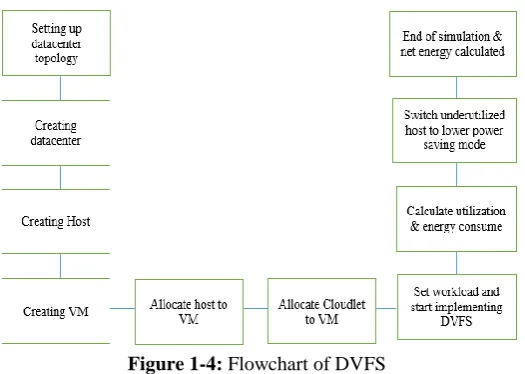
Figure 1-4: Flowchart of DVFS
According to this flowchart of DVFS techniques it can be creating a host and then crated virtual machine on host, balance the load of the user request and allocated host to virtual machine. After completed this process calculating the energy then get proper result according that result it automatically shut down host and consume the energy.
Strategies utilizing DVFS systems for the most part consider homogeneous physical machine while less intrigue is appeared by scientist toward heterogeneity. In [4]Jacob Leverich recommend a strategy to influence on a portion of the assets and perform take a shot at them while the rest ought to be in off state to spare vitality. The contrast among solidification and DVFS is that union is connected all in all in any case DVFS which is neighborhood [9]. In any case, Wilies lang propos that running every one of the assets will play out the work in not so much time but rather more vitality will be spared. Vitality effectiveness accomplished through DVFS rely upon the kind of SLA either severe SLA lead to low vitality sparing 1.11% while increasingly viable in loosen up SLA 6.69% [3].
DVFS can be viably utilized in CPU serious assignment while it isn't appropriate in memory and Input yield concentrated errand [10]. A history table is kept up when a solicitation is gotten it is looked at against the table to find out whether it is CPU or I/O intensive. After this calcification the frequency is adjusted.
2. ENERGY AWARE RESOURCE ALLOCATION
Resource management is the way toward choosing PC assets, for example: computing, storage, network intelligently and allocating against the single or set of request received to meet performance objective of the user. Resource management assume featuring job in vitality productivity.. Identifying the type of request assigning the best possible resources in term of performance and price by looking at SLA. Management is basically the scheduling of resource. At the point when a solicitation is gotten the scheduler recognize an ideal asset distribution by looking and breaking down the present condition of the framework. Booking generally include with Virtual Machine the board. Virtual machine the executives manages VM relocation. VM movement performed for three things execution, load adjusting and vitality effectiveness.
III.
PROPOSED METHODOLOGY
Consume the energy and manage the resource that two techniques used DVFSand also apply the energy aware resource scheduling allocation. Now thisenergy aware resource scheduling allocation methods is for manage the power and it will take less response time
Step: 1 Client send’s request to the data center controllerRn=R1+R2+R3+...+Rn Input: Resources (VM) [i=1....n] Requests (R) [j=1....n]
Step: 2 Datacenter will check whether the HTTP, FTP, SMTP type request is valid or not. And now let consider no of VM on a host
Step: 3 Calculate the individual CPU utilization of all VM, Calculate Capacity of each VM Vc[i] = VM Capacity in MIPS.
Step: 4 Again find out the capacity of VMs that how much, CPU utilization is left I.e. VM capacity utilization = Total capacity – VM CPU utilization.
First of all decide the threshold (static) If CPU Utilization > 10% the under loaded If CPU Utilization > 30% the Balance If CPU Utilization > 80% the Over loaded Sort the priority of VMs on the balanced node
Step: 5 Grouping the VMs as per the CPU utilization and calculating the Task Execution Time for each Request to VM
Ex_Time[i] [j] =RL[j] / VC[i] Seconds.
Arranging the assignment in climbing request and figure the CPU usage after execution of the undertaking.
Step: 6 If the VMs CPU utilization > 50% then we have to migrate the load to another VMs.Applying VM selection policy for finding out the suitable VMs.
Step: 7 Apply Priority on VMs. After suitable VM will be selected for VM migration, on this stage apply the DVFS algorithm.After applying this techniques calculate the VM migration time and CPU utilization.
Step: 8 after migration check again how much load are on VMs, again calculate CPU utilization of another VMs and get result.
Step: 9 check the result, according them we identify the load and after that transmitted data to VMs and another VMs are shutdown so consume power. After the result we get how much energy consuming by that VMs and according that identify the whole datacenter energy.
Figure 1-5: Represent Power Consumption (watt)
After performing both the algorithm in cloud sim we get the appropriate result which has been shown in above graph. By the help of DVFS algorithm consuming power ratio is high. As it is clearly shown as number of VMs increases then power consumption will be higher in energy aware resource allocation.
IV.
CONCLUSION
REFERENCES
[1]. Ali Aghababaeipour and Shamsollah Ghanbari,“A New Adaptive Energy-Aware Job Scheduling in Cloud Computing”, springer International Publishing AG 2018.
[2]. Ado Adamou Abba Ari, Irepran Damakoa, Chafiq Titouna, Nabila Labraoui and Abdelhak Guerou “Efficient and scalable ACO-based task scheduling for green cloud computing environment” 2017 IEEE International Conference 2017.
[3]. Fatima Shakeel, seema sharma, “Green Cloud Computing: A review on Efficiency of Data Centres and Virtualization of Servers”, International Conference on Computing, 2017 IEEE.
[4]. S. Tamilselvi, S. Baskar, L. Anandapadmanaban, V. Karthikeyan, S. Rajasekar, “Multi objective evolutionary algorithm for designing energy efficient distributionTransformers” springer2017.
[5]. Zhou Zhou, Zhigang Hu, and Keqin Li, “Virtual Machine Placement Algorithm for Both Energy-Awareness and SLA Violation Reduction in Cloud Data Centers” Scientific Programming, Volume 2016. [6]. Shaden M. AlIsmail, Heba A. Kurdi “Green Algorithm to Reduce the Energy Consumption in Cloud
Computing Data Centres” SAI Computing Conference 2016 July 13-15, 2016.
[7]. Andrew paplinski, Md anit khan, abdul malik khan,rajkumar buyya, “Dynamic Virtual Machine Consolidation Algorithms for Energy Efficient Cloud Resource Management: A Review”, 842, 2016 Australia.
[8]. Anureet kaur, Bikrampal Kaur, “Load Balancing in tasks using Honey bee Behavior Algorithm in Cloud Computing”, 2016 IEEE.
[9]. Sanjeevi P, Viswanathan P,” A green energy optimized scheduling algorithm for cloud data centers”, Conference on Computing and Network Communications 2015.
[10]. Nguyen Trung Hieu,Mario Di Fransesco, “A virtual machine placement algorithm for balanced resource utilization in cloud datacenter”,7th International Conference 2014.
[11]. https://phys.org/news/2010-10-energy-efficient-cloud.html
[12]. https://perspectives.mvdirona.com/2014/02/energy-efficiency-of-cloud-computing [13]. https://www.google.co.in/search?q=vm+placement+topology&source
[14]. https://searchcloudcomputing.techtarget.com/definition/Platform-as-a-Service-PaaS