Review Article
CODEN: IJPNL6
EXPANDING THE ROLE OF COMMUNITY PHARMACY: AN EVALUATION OF
GENERIC DRUG DISCOUNT PROGRAMS, PHARMACY BASED IMMUNIZATION
SERVICES AND CONVENIENT CARE CLINICS
Jeffrey C. Keimer and Shaker A. Mousa*
Albany College of Pharmacy and Health Sciences, One Discovery Drive, Rensselaer, NY,
12144, USA
*Corresponding author e-mail:
[email protected]
ABSTRACT
We evaluated the clinical and economic impact of generic drug discount programs (GDDPs), pharmacy based immunization services and convenient care clinics (CCCs) based upon existing literature, reviewing original research and case study reports using library databases, primarily MEDLINE and EBSCOHost. Keywords used included “generic discount list,” “four dollar generic,” “pharmacy immunization,” “flu shot,” “pharmacist immunizer,” “convenient care clinic,” “retail health clinic,” and “minute clinic.” We then added other terms such as “clinical impact,” “cost-effectiveness,” “outcomes,” and “perceptions.” While all 3 programs have the potential to clinically benefit patients and provide some level of cost-effectiveness, there are also concerns that need to be addressed. Some concerns include: a) GDDPs have the potential to cause fragmentation of care owing to patients going to other pharmacies in search of lower prices and prescription claims data not being captured by patients’ pharmacy benefit managers, b) GDDPs may be less cost effective in pharmacies with less purchasing power compared to larger chains, c) pharmacy based immunization services still face legal and social barriers that prevent pharmacists from being recognized as legitimate vaccine administrators, d) some insurance carriers still don’t pay for pharmacist-administered vaccinations, e) CCCs may not currently be located in areas that could best benefit from their services, f) CCCs may disrupt a patient’s continuity of care with their primary care physicians, and g) CCCs may hinder the efforts of pharmacists to expand their own professional roles by lessening the need for them to do so. Expanding the roles of community pharmacies has the potential to improve patient care by increasing patients' access to healthcare services. While strong evidence exists to support pharmacist-delivered immunizations, less is known regarding GDDPs and CCCs. More studies are required to assess the clinical and economic questions raised regarding these types of programs.
Keywords:
Community pharmacy, retail pharmacy, generic drug discount, pharmacists, immunizations, convenient care clinic, retail clinic and urgent careINTRODUCTION
Over the past decade, the demand and total amount spent for healthcare services such as prescription drugs has steadily increased despite a recession 1. According to the National Association of Chain Drug Stores (NACDS), the number of prescription drugs dispensed in the US has increased at a rate of approximately 1.9% every year since 2003 with total prescriptions dispensed in 2009 reaching approximately 3.6 billion 2. Yet one study showed
that pharmacy owners’ general perception is that reimbursement rates from both private and public insurance carriers are falling. Furthermore, drop in reimbursement rates has been cited as the reason for many pharmacies, particularly independents, closing 3
. Taken together this means that despite increased demand for prescription drugs, there is less profitability in dispensing them.
On the patient’s side, these increased healthcare expenditures have led to larger monthly premiums,
International Journal of Pharmacy
increased plan deductibles, and more limitations on patients’ access to healthcare, i.e. plan-only physicians, stricter formularies, tier co-pay structures, and high deductible plans. This has forced many patients to stringently assess how much they spend on healthcare for themselves and their families. It can also lead to foregoing medical care as a cost saving strategy 4.
Faced with this situation, the US retail pharmacy industry has responded by further expanding the role of its community pharmacies outside of their traditional role as a dispensary. Some of the most prevalent programs are generic drug discount programs (GDDPs), pharmacy-based immunization services and convenient care clinics (CCCs). However, these types of programs have the potential to decrease patient utilization of other, better established areas of healthcare. Hence, the implementation of programs such as these in community pharmacy has caused quite a bit of controversy in both the pharmacy and greater healthcare communities. As such, it is important that we take a deeper look at these programs in terms of their clinical and economic impact as well as their potential problems.
GENERIC DRUG DISCOUNT PROGRAMS
The marketing of generic drugs has historically been the subject of much controversy in the healthcare industry. Most arguments against generic substitutions center on perceptions of generics being inferior to their brand counterparts despite showing bioequivalence. However, the cost savings benefits of generic medications in the marketplace are incontrovertible. In the period between 2000 and 2009, it was estimated that generic drugs saved the US healthcare system $824 billion 5. To reap the benefits of such savings, most insurance carriers have instituted tiered co-pay structures for their subscribers in order to “push” patients toward preferred drugs by using higher co-payments for non-preferred drugs. This tactic has been shown to reduce spending on prescription drugs, but may cause additional spending due to inadequate therapy 6. This observation is backed up by data that support a correlation between medication non-adherence and increased cost 7. Therefore, it is important that this issue be addressed in order for patients to have the best possible clinical outcomes. GDDPs have been an increasingly popular way for most pharmacy chains to attract new business from people who have no prescription drug coverage or who struggle to pay high or multiple copayments every month. The first large scale implementation of a GDDP came in 2006,
when a major mass merchant introduced a list of generic medications that would be available without insurance for $15 for a 90 day supply 8. Later that year, another mass merchant came out with a program that offered 30 day supplies on select generics for $4 without insurance or additional fees 8. The popularity of the latter program has since caused most other major pharmacy chains and some independents to create programs of their own. Although all programs offered aren’t the same, they all offer a similar service: lower cost options that expand access to prescription drugs to patients otherwise unable to afford them. Table 1 lists the top 10 prescription drugs on the market and their availability in a GDDP.
But how can this type of program be seen as expanding the role of the community pharmacy? The answer is simple: GDDPs function much like a supplementary insurance plan. Although GDDPs are technically not insurance, it stands to reason that a patient could use a GDDP to supplement their existing coverage or possibly forgo prescription coverage entirely. According to one field study, GDDPs represented an option for seniors who fell into the “donut hole” in their Medicare coverage to continue getting their medications at a reasonable rate 9. GDDPs may also serve the interests of pharmacy
benefit managers (PBMs) by decreasing the number of claims paid out for generic medications and therefore pass major savings to PBMs 9. However, whether or not these savings will translate to lower premiums for subscribers is still unclear.
There are however, some concerns attached to GDDPs. Mainly, these concerns have to do with the incentive GDDPs give to patients to shop different pharmacies for better prices. A 1996 Canadian study showed that patients receiving medications from more than one pharmacy were at higher risk for possibly inappropriate drug combinations 11. Since then it has become widely accepted that patients visiting multiple pharmacies that don’t share medication records put themselves at higher risk for medication related problems. In fact, one of the main reasons that the 340B pharmacy in the aforementioned study implemented a GDDP was that patients were visiting other pharmacies, compromising their continuity of care 10. And pharmacists aren’t the only ones concerned with GDDPs. An article published in The New England Journal of Medicine in 2010 identified GDDPs as potentially dangerous because prescription claim data aren’t submitted to the patient’s PBM 12. According to the article, pharmacy claims data are used for pharmaceutical quality improvement in large populations. Pharmacy chains that have GDDPs may be unintentionally undermining this process because claims aren’t submitted to the PBMs 12
. However, while the cause for concern with these programs for these reasons is legitimate as of right now, this is all speculation. More studies are needed to assess the impact GDDPs have on medication misuse.
PHARMACY BASED IMMUNIZATION
SERVICES
According to the CDC, vaccines are considered one of the top 10 great public health achievements of the 20th century 13. Traditionally, these immunizations have been administered solely by physicians and nurses in settings such as their own offices, clinics, hospitals or other similar conventional immunization providers. However, since 1984, there has been a dramatic increase in the number of patients being immunized at “non-traditional” sites such as community pharmacies, supermarkets and nursing homes 14. A survey taken in 2005 estimated that 30% of all influenza vaccinations were administered at these “non-traditional” sites 15. Also, it’s been shown that younger, working aged patients tend to prefer these types of sites over conventional ones. This is most likely due to the convenience of being able to walk in to one of these settings without an appointment 16. Pharmacists have long been advocates of immunizations and since 1994 have also had the privilege of being facilitators 14, 17. And, as of September 12, 2009, all 50 states with the exception of the District of Columbia now permit pharmacists
to immunize 18. Expanding pharmacy practice to include administration of vaccines has largely been accepted as a benefit to public health. In a position paper published in 2002, the American College of Physicians stated that pharmacist-delivered immunizations stand to decrease antibiotic resistance and increase adult immunization owing to the greater accessibility patients have to pharmacists compared to physicians 19. This will undoubtedly become very important given the call from the CDC to expand influenza vaccinations to all patients 6 months of age or older 20. While some states allow pharmacists to administer any vaccine, most only allow pharmacists to administer influenza and pneumococcal vaccines 21. Given that, this review will focus primarily on
influenza and pneumococcal immunizations.
Annual influenza vaccination has been shown to be clinically beneficial to patients regardless of age, and cost beneficial to patients over the age of 65 22-24. But what data exist to support pharmacist-delivered influenza vaccination? Immunizations at “non-traditional” sites administered by pharmacists were shown to be cost saving or relatively cost effective in healthy adults aged 18-64 and in adults 65 and older 25
. These findings can be attributed to the fact that patients didn’t need to go out of their way to schedule an appointment, which can be burdensome for patients unable to do so during normal working hours. Also, net cost per person associated with procuring a vaccination from the pharmacist was almost 10-fold lower on average than vaccinations administered at traditional settings and almost half that of vaccinations administered at other public places by a non-pharmacist 25. However, the conclusions made in this study were based on data with a relatively low sample size of 12 sites. More studies regarding cost effectiveness of pharmacy based immunization with larger sample sizes are needed in order to make a more solid conclusion regarding the cost-benefit of pharmacist-delivered immunizations.
pharmacists. While other methods may exist, a few tactics used to combat this problem are: treating the immunization just like another prescription, offering immunizations only at certain times during the day and asking that patients call ahead to schedule a time. However, while the last two methods certainly ease the burden on workflow, they also decrease patient access. More studies are needed to determine the optimal method of incorporating immunization services into daily pharmacy workflow while at the same time maintaining a high level of access for patients.
In addition to potential workflow issues, there are other problems with the expansion of pharmacist- delivered immunization services. First, there are the remaining legal barriers for pharmacists to immunize. Beyond the aforementioned limitation on types of vaccines administered by pharmacists, some states also have an age requirement for pharmacist- administered immunizations. For example, New York currently limits this service to patients 18 years and older 21. While earlier studies have hinted that the general public has had some uneasiness regarding pharmacists delivering immunizations to children 27, it is important to note that the choice of provider is still left up to the patient or their legal guardian. Provided with adequate training, there shouldn’t be any reason to deny pharmacists the authority to administer vaccines to children and adolescents. The other issue is the out of pocket cost for the patient. While Medicare and Medicaid cover flu shots, other insurance carriers may not. Also, some plans require that patients receive the vaccination at their physician’s office. This leaves many patients still unable or unwilling to pay for vaccination and they are not getting vaccinated despite expanded access.
CONVENIENT CARE CLINICS
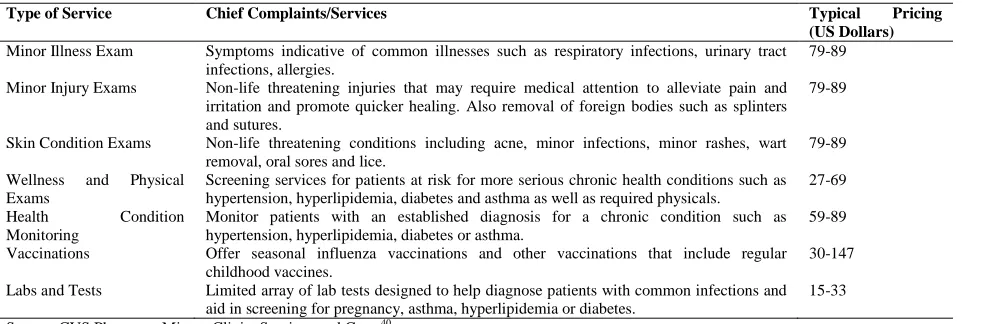
A common problem that many Americans face is what to do when dealing with a minor ailment that still requires professional medical attention. Traditionally, options included a visit to the patient’s primary care physician’s office, an urgent care clinic or the emergency department at a local hospital. However, since 2000, a new option has emerged: the convenient care (CCC). Also known as retail health clinics or store-based health clinics, a CCC is an urgent care facility that’s located in a retail facility such as a drug store or supermarket. Such facilities cater to patients seeking care for a limited variety of common ailments that require treatment or immunizations (Table 2). CCCs are staffed by midlevel practitioners, mostly nurse practitioners who usually have collaboration with or oversight by
an offsite physician. However, because licensed physicians aren’t present at CCCs, the scope of services offered is often limited. Patients who complain of more serious acute ailments or chronic medical problems are referred to a primary care provider.
But what evidence is there to support the continued existence of CCCs? Mainly, supporters of CCCs cite increased accessibility and decreased cost compared to other healthcare sites. According to a fact sheet from the Convenient Care Association (CCA), most CCCs are open 7 days a week with extended weekend hours and don’t require an appointment 28
. This increased accessibility has been shown to be advantageous for CCCs. The appointment wait time was shown to be the major driver for patients when deciding from whom (physician or non-physician) to receive care for minor illnesses 29. These findings represent a clear advantage for CCCs over other care sites in terms of patient preference. However, a 2007 survey indicated that approximately 98% of Americans have never used a CCC 30. This can be attributed to the fact that CCCs are not widespread. The CCA reports that approximately 1,200 CCCs are in operation in 32 states across the country 31. By comparison, the American Academy of Urgent Care Medicine reports that there are approximately 8,000 urgent care facilities and hospital emergency department serving as sites of urgent care 31. In addition, CCCs are primarily located around economically advantaged neighborhoods in major metropolitan areas. Given this geographical distribution, one study concluded that CCCs may currently lack the ability to extend healthcare access to the underserved and uninsured 32. Simply put, CCCs may currently be situated in markets that may not be very demanding of their services. However, it’s difficult for CCCs to penetrate underserved markets because by definition, these areas may lack the existing infrastructure necessary to accommodate a CCC (i.e. pharmacies and supermarket).
important concern: Will lower costs for urgent care services increase demand and by consequence increase overall healthcare spending? More studies are needed to answer this question because care from CCCs currently doesn’t comprise a significant share of total US healthcare spending.
Besides potential economic issues with CCCs, other concerns have also been raised. Some of the primary clinical concerns physicians may have with CCCs have been outlined. Most notable was the potential for patients to lack continuity of care 35. This concern was based on the theory that patients who frequent CCCs are unlikely to seek out a primary care physician. Also, the author expressed concerns that potentially serious conditions could be overlooked by midlevel practitioners at CCCs 35. However, no studies have specifically addressed these concerns and any potential for patient harm for these reasons is still theoretical at this time. Another potential issue with CCCs relates to the pharmacists who often work alongside these clinics. Concern about sharing pharmacy space with other healthcare providers has been expressed 36, stating that CCCs may serve as either a barrier or an avenue for expanding the clinical roles of pharmacists. If other healthcare providers set up shop in the pharmacy, pharmacists may have problems securing additional space for other direct patient care services such as medication therapy management. Yet, despite the potential for a “turf war” in the pharmacy, CCCs may serve as a gateway for pharmacists into expanded clinical roles. In states that allow pharmacists prescribing authority, it’s feasible that these CCCs could be run by pharmacist clinicians 36. Such a role could position pharmacists to take on other collaborative practice agreements with physicians and further legitimize
pharmacists as members of the overall healthcare team. Either way, it’s still uncertain what impact, if any, CCCs will have on expanding the roles of community pharmacists.
CONCLUSION
Expanding the role of the community pharmacy has the potential to benefit patients by increasing their access to healthcare. This is achieved by lowering costs sustained by patients as well as providing some services such as immunizations and acute care, at extended hours compared to other healthcare facilities. However, despite increasing access to healthcare a number of concerns still exist regarding the clinical and economic outcomes of these types of services. While there is strong evidence to support pharmacy based immunization services, it is still relatively unclear whether GDDPs and CCCs are both clinically and economically beneficial. More studies regarding GDDPs and CCCs will be necessary as both simply lack the histories from which to derive extensive data. However, while there may be advantages and disadvantages to each of these programs, patients only stand to benefit if they know about them. Educating patients about the opportunities of such programs is essential if these programs are to be successful. While often overlooked or dismissed as an afterthought by many clinicians, the patient’s capacity to pay for or access healthcare is crucial. If a patient can’t afford or doesn’t have the time for care, they won’t pursue it. This principle has guided the programs discussed herein. Though much is uncertain regarding the future of US healthcare, expanding the roles played by community pharmacies seeks to improve patient access and lower costs.
Table 1: GDDPs and the Top 10 Prescription Medications
Drug Name Generic Availability? Present in a GDDP?
Clopidogrel 75mg (Plavix) No No
Hydrochlorothiazide 25mg (Hydrodiuril) Yes Yes
Omeprazole 20mg (Prilosec) Yes No
Furosemide 40mg (Lasix) Yes Yes
Amlodipine 5mg (Norvasc) Yes Yes
Esomeprazole 40mg (Nexium) No No
Alendronate 70mg (Fosamax) Yes Yes
Atorvastatin 10mg (Lipitor) No No
Simvastatin 20mg (Zocor) Yes Yes
Furosemide 20mg (Lasix) Yes Yes
Table 2: Example of Typical Services and Prices Offered by CCCs
Type of Service Chief Complaints/Services Typical Pricing
(US Dollars)
Minor Illness Exam Symptoms indicative of common illnesses such as respiratory infections, urinary tract infections, allergies.
79-89
Minor Injury Exams Non-life threatening injuries that may require medical attention to alleviate pain and irritation and promote quicker healing. Also removal of foreign bodies such as splinters and sutures.
79-89
Skin Condition Exams Non-life threatening conditions including acne, minor infections, minor rashes, wart removal, oral sores and lice.
79-89
Wellness and Physical Exams
Screening services for patients at risk for more serious chronic health conditions such as hypertension, hyperlipidemia, diabetes and asthma as well as required physicals.
27-69
Health Condition
Monitoring
Monitor patients with an established diagnosis for a chronic condition such as hypertension, hyperlipidemia, diabetes or asthma.
59-89
Vaccinations Offer seasonal influenza vaccinations and other vaccinations that include regular childhood vaccines.
30-147
Labs and Tests Limited array of lab tests designed to help diagnose patients with common infections and aid in screening for pregnancy, asthma, hyperlipidemia or diabetes.
15-33
Source: CVS Pharmacy Minute Clinic: Services and Costs40
REFERENCES
1. Bureau UC. Personal Heathcare Expenditures by Object and Source of Payment: 2008. [Spreadsheet] 2008 [cited 2011 02/28/2011]; Available from:
http://www.census.gov/compendia/statab/2011/tables/11s0136.pdf
2. Bureau UC. Retail Prescription Drug Sales: 1995 to 2009. [Spreadsheet] 2009 [cited 2011 02/28/2011]; Available from: http://www.census.gov/compendia/statab/2011/tables/11s0155.pdf
3. Goyal RK, Patel JG, Sansgiry SS. Pharmacists’ Perceptions of Drug Reimbursement Rates and Processing Times Among Managed Care Plans. Drug Benefit Trends, 2010; 22(4): 5.
4. Pummer C. Foregoing Medical Treatment: A Dangerous Way to Cut Costs. CBS MoneyWatch – Long View 2009 [cited 2011 3/1/2011]; Available from: http://moneywatch.bnet.com/economic-news/blog/real-time-money/foregoing-medical-treatment-a-dangerous-way-to-cut-costs/101/
5. Liberman JN, Roebuck MC. Prescription drug costs and the generic dispensing ratio. J Manag Care Pharm, 2010; 16(7):502-6.
6. Landon BE, Rosenthal MB, Normand SL, Spettell C, Lessler A, Underwood HR, Newhouse JP. Incentive formularies and changes in prescription drug spending. The American Journal of Managed Care, 2007; 13(6 Pt 2):360-9.
7. Briesacher BA, Gurwitz JH, Soumerai SB. Patients at-risk for cost-related medication nonadherence: a review of the literature. J. Gen. Intern. Med., 2007; 22(6):864-71.
8. Walker T. Generic medication discounts from retailers seek to limit patients' out-of-pocket cost-sharing. Formulary, 2006; 41(11):600-2.
9. Patel HK, Dwibedi N, Omojasola A, Sansgiry SS. Impact of Generic Drug Discount Programs on Managed Care Organizations. The American Journal of Pharmacy Benefits, 2011; 3(1):9.
10. Bright DR, Adams AJ, Akala FO, Lengel AJ, Martin SJ, Powers MF. Implementation of a $4 generic drug program in a 340B pharmacy. Am. J. Health. Syst. Pharm., 2010; 67(11):929-31.
11. Tamblyn RM, McLeod PJ, Abrahamowicz M, Laprise R. Do too many cooks spoil the broth? Multiple physician involvement in medical management of elderly patients and potentially inappropriate drug combinations. Can. Med. Assoc. J., 1996; 154(8):1177-84.
12. Choudry NK, Shrank WH. Four Dollar Generics - Increased Accesibility, Impaired Quality Assurance. The New England Journal of Medicine, 2010; 363(20):1885-7.
13. CDC. Ten Great Public Health Achievements - United States, 1900-1999. Morb. Mortal. Weekly Rep., 1999; 48(12):241-3.
14. Grabenstein JD. Pharmacists as vaccine advocates: roles in community pharmacies, nursing homes, and hospitals. Vaccine, 1998; 16(18):1705-10.
15. Singleton JA, Poel AJ, Lu PJ, Nichol KL, Iwane MK. Where adults reported receiving influenza vaccination in the United States. Am. J. Infect. Control, 2005; 33(10):563-70.
17. Hogue MD, Grabenstein JD, Foster SL, Rothholz MC. Pharmacist Involvement with Immunizations: A Decade of Professional Advancement. J Am Pharm Assoc (2003), 2006; 46(2):168-82.
18. Traynor K. With Maine on board, pharmacists in all 50 states can vaccinate: H1N1 prompts emergency vaccination rules for pharmacists. Am. J. Health. Syst. Pharm., 2009; 66(21):1892-4.
19. Keely JL. Pharmacist Scope of Practice. Ann. Intern. Med., 2002; 136(1):79-85.
20. CDC. Recommended Adult Immunization Schedule - United States, 2011. Morb. Mortal. Weekly Rep., 2011; 60(4):1-4.
21. Carpenter L. Pharmacist-Administered Immunizations: Trends in State Laws. Drug Store News, 2009:1-2. 22. Bridges CB, Thompson WW, Meltzer MI, Reeve GR, Talamonti WJ, Cox NJ, Lilac HA, Hall H, Klimov
A, Fukuda K. Effectiveness and Cost-Benefit of Influenza Vaccination of Healthy Working Adults. The Journal of the American Medical Association, 2000; 284(13):1655-63.
23. Prosser LA, Buxton Bridges C, Uyeki TM, Hinrichsen VL, Meltzer MI, Molinari N-AM, Schwartz B, Thompson WW, Fukuda K, Lieu TA. Health Benefits, Risks, and Cost-Effectiveness of Influenza Vaccination of Children. Emerging Infect. Dis., 2006; 12(10):1548-58.
24. Jefferson T, Rivetti D, Rivetti A, Rudin M, Di Pietrantonj C, Demicheli V. Efficacy and effectiveness of influenza vaccines in elderly people: a systematic review. Lancet, 2005; 366(9492):1165-74.
25. Prosser LA, O'Brien MA, Molinari NM, Hohman KH, Nichol KL, Messonnier ML, Lieu TA. Non-Traditional Settings for Influenza Vaccination of Adults: Cost and Cost Effectiveness. Pharmacoeconomics, 2008; 26(2):163-78.
26. Grabenstein JD. Daily versus single-day offering of influenza vaccine in community pharmacies. J Am Pharm Assoc (2003), 2009; 49(5):628-31.
27. Ernst ME, Bergus GR, Sorofman BA. Patients' acceptance of traditional and nontraditional immunization providers. J Am Pharm Assoc (2003), 2001; 41(1):53-9.
28. CCA. Convenient Care Clinics: Increasing Access. [Factsheet] 2010 [cited 2011 03/21/2011]; Available from: http://www.ccaclinics.org/images/stories/downloads/factsheets/cca_facsheet_increasing_access.pdf 29. Ahmed A, Fincham JE. Physician office vs retail clinic: patient preferences in care seeking for minor
illnesses. Annals of Family Medicine, 2010; 8(2):117-23.
30. Tu HT, Cohen GR. Checking Up on Retail Health Clinics: Is the Boom Ending? The Commonwealth Fund, 2008(48):1-11.
31. AAUCM. Know Where to Go. 2011 [cited 2011 03/19/2011]; Available from: http://aaucm.org/Patients/SelectUrgentCareCenter/default.aspx
32. Pollack CE, Armstrong K. The Geographic Accessability of Retail Clinics for Underserved Populations. Arch. Intern. Med., 2009; 169(10):945-9.
33. Mehrotra A, Liu H, Adams JL, Wang MC, Lave JR, Thygeson M, Solberg L, McGlynn EA. Comparing Costs and Quality of Care at Retail Clinics With That of Other Medical Settings for 3 Common Illnesses. Ann. Intern. Med., 2009; 151(5):321-8.
34. Thygeson M, Van Vorst KA, Maciosek MV, Solberg L. Use and costs of care in retail clinics versus traditional care sites. Health Aff., 2008; 27(5):1283-92.
35. Bohmer R. The Rise of In-Store Clinics - Threat or Opportunity? The New England Journal of Medicine, 2007; 356(8):765-8.
36. Farley JF, Devine JW, Hadsall RS. Professional implications of the expansion of pharmacy-based medical clinics. J Am Pharm Assoc (2003), 2007; 47(3):410-4.
37. State of New York Elderly Pharmaceutical Insurance Coverage Program (EPIC) Annual Report to the Governor and Legislature. [Report] 2009 [cited 2011 03/22/2011]; Available from:
http://www.health.state.ny.us/health_care/epic/annual_report/2008_2009/docs/annual_report_2008-2009.pdf
38. Walmart. Retail Prescription Program Drug List. 2011 02/08/2011 [cited 2011 03/22/2011]; Available from: http://i.walmartimages.com/i/if/hmp/fusion/customer_list.pdf
39. Rite-Aid. Directory of Generic Medications Eligible for Rx Savings Program Flat Fees. 2011 [cited 2011 03/22/2011]; Available from:
http://www.riteaid.com/www.riteaid.com/w-content/images/pharmacy/RA_RXSavings_Directory_081710.pdf