Copyright © 2015 IJTEEE.
Behavior Of Low Compressive Strength Short
Columns Strengthened With External GFRP
Strips/Jacket Techniques
Sameh Yehia
Assistant Professor, Higher Institute of Engineering, El-Shorouk Academy, Egypt, Cairo Email:[email protected]
Abstract: This paper presents a study on behavior of short columns strengthened with GFRP techniques. Relatively recent materials like fiber reinforced polymers (FRP), have been used to strengthen circular short columns. Glass fiber external sheets were used in the circumferential direction to confine circular columns. Six specimens were tested under an axial load. The main concentric purpose of this study is to evaluate the effect of GFRP confining with different techniques in strengthening deficient columns (low compressive strength concrete). This study achieved comparison between GFRP strengthened columns (strips/jacket) and control columns. Two techniques were used external confinement, using external strips of GFRP wraps and GFRP jackets. Test results revealed that the two techniques enhances the axial load carrying capacity of the columns significantly for both reinforced and unreinforced specimens. Test results, comparisons and analysis are shown herein.
Keywords: Confinement Behavior, Strengthened RC Column, GFRP Strips and Jacket.
1.
INTRODUCTION
Nowadays, some of the concrete structures those are built in the past years were inadequate to carry service loads. This insufficient load carrying capacity has resulted from poor maintenance, increasing in legal load limit, insufficient reinforcement, excessive deflections, structural damages or steel corrosion, which leads to cracks. Repair, retrofitting and rehabilitation of existing concrete structures have become a large part of the construction activity by some estimates. The money spent on retrofitting of existing structures in recent years has exceeded that spent on new structures. There is no doubt that the problem of cracked concrete structures has become one of the most pressing problems that must join hands in efforts to reach a solution. One of the most important reasons for this problem is the lack of enough awareness among engineers for reasons of cracking to be avoided, and therefore the result of lack of knowledge in necessary ways for the treatment of cracking structures. Confinement of reinforced concrete columns using externally applied FRP wraps significantly enhances the performance under axial load, bending and shear, because of the increase in concrete compressive strength, ductility, shear strength and the higher resistance against buckling of steel reinforcement in compression. Due to lateral confinement FRP confinement may be achieved by means of externally applied wraps for existing column, or as a formwork for new constructed column so that, the aim of this research was generated from this points.
2. OBJECTIVE
The objective of this research focused on the behavior,
failure mechanism of RC circular short columns
strengthened using external GFRP sheets/strips under effect of axial load. The study includes studies proposed parameters, which are stated as follow:
1- The effect of different techniques in strengthening of circular short columns (Strips/Jacket).
2- The effect of main reinforcement (Plain/Reinforced).
3- Compatibility of weak concrete (Fcu=200kg/cm2).
4- Strain in main reinforcement bar.
5- Type of Failure and Crack pattern.
3.1. EXPERIMENTAL WORK PROGRAM
Six circular short columns were casted. specimens were divided into two category, the first category is three specimens without main steel reinforcement, the second one is three specimens with main steel reinforcement (6Y12) and have mild steel stirrups (R8/15cm). Each group strengthened with GFRP strips and jacket. Constant parameters, like compressive strength of concrete
(Fcu)=200kg/cm2 (weak concrete), crosssection of
Copyright © 2015 IJTEEE.
3.2. MANUFACTURING PROCEDURES OF SPECIMENS
In this step, coarse aggregate firstly followed by fine aggregate then cement, finally water putted in (Rotary Mixer) which make 50 cycles per min (traditional process). Mixing process started and the time of mixing was 2 minutes. Specimens are casted vertically and to obtain a well compacting concrete a vibrator rod is used to make a good compaction and prevent segregation or honey comb to take-place. After the plastic tube mold is filled with concrete, trowel is used to get a smooth and leveled surface of column specimen. circular columns are removed 2 days after casting, then specimens are covered with wet canvas / plastic sheet for 7 days, see Figures (1), (2), (3), (4) and (5) shows the procedures of specimens manufacturing.
3.3. INSTALLATION OF GFRP STRIPS/JACKET
Copyright © 2015 IJTEEE.
3.4. TEST SETUP
Specimens were tested using universal machine with capacity 200 ton. Strain meter connected with strain gauge to record stain in main reinforcement and two LVDT used to determine axial shortening. Steel column head also installed at the upper and lower of circular short column to prevent failure at the upper/lower head of specimen. See Figure (10) for final test setup.
3.5. TESTING STAGES
Specimens were carried to universal machine to start the process of testing. Load was applied in increment of 2 ton. Axial shortening and strain in main reinforcement were recorded. Also cracking and ultimate load were observed. Cracks are detected and marked. Specimens were tested as hingedhinged column.
4.1. RESULTS, ANALYSIS AND DISCUSSIONS
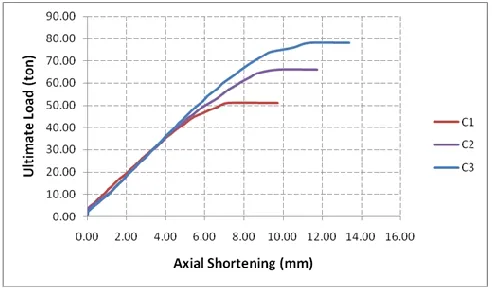
The cracking and ultimate load of tested specimens in addition to strain and axial shortening of circular short column tested in the experimental work are present in Table (2).
With refer to Figure (11), it shown that specimens C1, C2 and C3 (plain concrete) have the strengthened with GFRP strips/jackets shows higher cracking and ultimate loads than control specimens. Although strengthened specimens showed almost the same behaviour as the control specimen (C1) on up to cracking of the control specimen (C1) but they showed better behaviour in post cracking stage and failed in better mode respect to control specimen (C1). Specimen (C3) with GFRP jackts have the highest stiffness in compare to specimens C1 and C2 due to preimeter confinement (jacket). The failure in specimen (C2/C3) started due to rupture in GFRP strips/jacket followed by debonding.
Copyright © 2015 IJTEEE. In the reinforced concrete specimens with different
strengthening techniques (strips/jacket), the ultimate load in the control specimen (C4) was 70 ton and maximum strain in the main reinforcement bar was 490μs. Strengthened specimen with GFRP strips (C5) recorded ultimate load equal 77 ton with maximum strain 494μs. Specimen (C6) which is strengthened with GFRP jacket have ultimate load equal 86 ton and maximum strain equal 497μs. Strain in main reinforcement bar take the behavior of elastic zone (no yield). See Figure (13) which accentuate the relationship between ultimate load and strain in main reinforcement bar. Figure (14) shows the different crack pattern for specimens C1,C2,C3,C4,C5 and C6. The failure generally classified as brittle failure with some ductility (semi-ductile) due to the presence of GFRP sheets (strips/jacket).
5.1. CONCLUSIONS
Based on the test results presented herein the following conclusions are drawn:
1- For plain concrete circular short columns, Specimens with external GFRP increased capacity of column by 29% for GFRP strips and by 53% for GFRP jacket compared to control column.
2- For reinforced concrete circular short columns,
Specimens with external GFRP increase capacity of column by 24% for GFRP strips and 44% for GFRP jacket compared to control column.
3- The main reinforcement in specimens increased the
capacity of the circular short columns by 18% in case of non strengthened column, by 12% in case of strengthened with GFRP strips and by 10% in case of
strengthened with GFRP jacket.
4- For specimens strengthened with externally glass fiber
sheets (strips/jacket), the failure starts by rupture in glass fiber sheets then failure took place. It is observed that external GFRP sheets enhance the failure mode from brittle to ductile failure because the failure of these specimens gives suitable alarm before fail under compression.
6.1. ANALYTICAL ANALYSIS
The study also included verification of experimental results by using ACI code [1],[2], which is represent the design equations for both short columns without/with external GFRP strips/jackets. The following Equation (1) and (2), for
nonprestressed members with tie reinforcement
without/with GFRP wrapping, respectively are used to obtain the verification.
The following Figure (14) shows that the variation between experimental and analytical results nearby the same and in the zone of acceptance.
7.1. RECOMMENDATIONS
It was recommended that to investigate the following parameters in the further work:
1. Usage of CFRP instead of GFRP.
2. Decrease distance between strips.
3. Using different width of strips.
4. Using epoxy resin instead of polyester resin.
REFERENCES
[1] ACI 440.2R-02, “Guide for the Design and
Construction of Externally Bonded FRP Systems for Strengthening Concrete Structures,” ACI Committee 440, American Concrete Institute.
[2] Building Code Requirements for Structural
Concrete (ACI 318-14) and Commentary,”ACI Committee 318, American Concrete Institute.
Copyright © 2015 IJTEEE. aspect ratio on the strength of CFRP-confined
rectangular concrete columns”, Engineering
Structures 32(2010)
[4] Rahul. P. Raval. “Behavior of RC columns of
different shapes confined with GFRP composite wrap”, M. Tech. dissertation, Nirma University, India,(2012).
[5] HU, H., “Development of a new constitutive model
for FRP-and steel-confined concrete”, MS thesis,
Department of Civil, Construction and
Environmental Engineering, North Carolina State University, (2011).
[6] CHASTRE, C., and SILVA, M.A.G., “Monotonic
axial behavior and modeling of RC circular columns confined with CFRP”, Engineering Structures.(2011).
[7] LEE, J.Y., YI, C.K., JEONG, H.S., KIM, S.W., and KIM, J.K., “Compressive response of concrete confined with steel spiral and FRP composites”, Journal of Composite Materials.(2011).
[8] Ruili He1), Lesley H. Sneed1),*, and Abdeldjelil Belarbi2), “Rapid Repair of Severely Damaged RC Columns with Different Damage Conditions: An Experimental Study” (Received December 31, 2012,Accepted February 13, 2013).
[9] Halil Sezen and Eric A.Miller, “Experimental
Evaluation of axial behavior of strengthened circular reinforced -Concrete Columns”, Journal of Bridge Engineering, (2011)