Design and Performance Analysis of Solar Oven
With Multi Reflector Arrangement by using
Microcontroller
Manjunatha S C Prasanna Kumar
Assistant Professor Student
Department of Electrical & Electronics Engineering Department of Electrical & Electronics Engineering
SJMIT, Chitradurga, Karnataka, India SJMIT, Chitradurga, Karnataka, India
Manmohan Reddy Sheeba Khan
Student Student
Department of Electrical & Electronics Engineering Department of Electrical & Electronics Engineering
SJMIT, Chitradurga, Karnataka, India SJMIT, Chitradurga, Karnataka, India
Abstract
Baking with sun and a solar oven should be easy. After a few experiences, you will see how readily you can adapt your present cooking and baking to this oven .Using the solar oven can actually reduce the total amount of effort in meal preparation. Using solar oven outside in the summer allows you to eliminate the extra heat in the house, which is advantageous especially with regard to foods that require long cooking times with solar cooking, you prepare your meals early in the day and then relax, in the late afternoon when you’re tired after the day of work the sun will have cooked your food. Most food, with the expectation of cookies and open faced cheese sandwiches, are cooked in the containers with the lids on. The dark, porcelain coated round and oven roasters are the best for most of the cooking and baking in the solar oven. Be sure to use hot pads when removing the pots from the oven food will be hot!
Keywords: solar oven, baking, porcelain
________________________________________________________________________________________________________
I. INTRODUCTION
The parabolic type solar oven is made up of flat-plate collector or the absorber plate whose function is to absorb solar radiation and convert it to heat; the glazing or window part which can be glass or other highly transparent material that can stand the oven temperature; casing which comprises of inner and outer walls separated by lagging material to reduce heat loss by conduction; and reflector which can be plain mirror or any reflective surface .A solar oven functions on the principle of greenhouse effect, whereby radiation from the sun, primarily in the form of visible light, . This is made possible through the use of glass or plastic, which is permeable to visible light but reflects radiation in the infra- red range.
Once visible light has passed through the glass or plastic barrier, it is converted into thermal energy through absorption by a dark object. Dark objects appear dark because they absorb visible light; however, they emit the energy they have absorbed in the form of heat. A solar oven therefore includes both a glass or plastic panel and some type of dark object or surface on the interior for the conversion of light into heat.
This creation of heat inside the oven, given appropriate insulation on the exterior, allows the oven’s interior to increase in temperature, often quite quickly. The oven may then be used to heat food, boil water, or perform most other activities generally possible in conventional ovens.
II. OBJECTIVES
1) To study the effect of change in different design parameter efficiency and performance of the solar oven 2) To Integrate the thermal energy storage to store energy for longer and better heat distribution in the solar oven 3) This application will prevent oven from losing heat during drop of solar radiation due to change in weather condition 4) Solar oven project is to study the characteristics and performance of the system. After the fabrication process done 5) Measurement of temperature using microcontroller
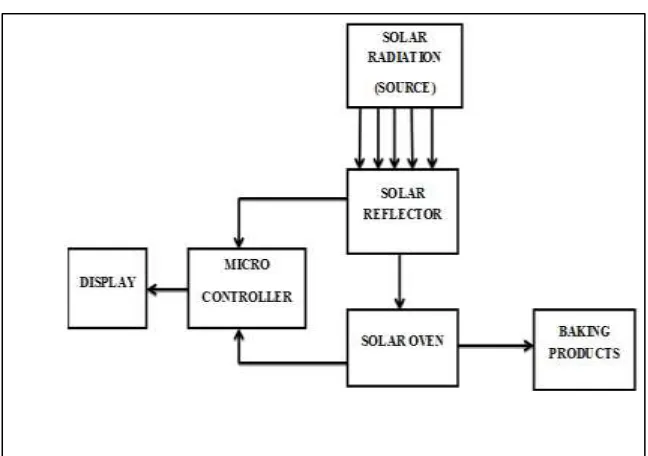
III. BLOCK DIAGRAM
IV. SCHEMATIC DIAGRAM
Fig. 2: Practical Design model of Solar Oven
V. MATERIALS
Solar oven was constructed with locally available materials such as, Aluminium sheet-(6*4)
Steel vessel-22guage L –angular -1 inch MS pipe-1 inch Metal rod-10mm Flat metal-3/4 inch Black paint Bolt and nut
VI. DESIGN AND CONSTRUCTION
A reflective surface plays a vital role in making a solar oven. It is generally made of aluminium sheet or foil. This helps in trapping sunlight and directing it towards the pot (steel vessel) inside the oven. The pot that is dark in colour i.e. black is used because dark objects attract heat. If not that then you can place a black metallic sheet at the bottom of the oven and then place the pot above it. You need to cover the oven with a plastic or glass sheet which again helps in trapping the rays of the sun and helps to cook food faster. Covering the solar oven well from all sides also reduces the cooking time.
You can make a solar cooker at home itself as it is very easy to make. There are many solar cookers available and you can either choose to buy one which is the cheapest and the best or make one on your own according to your own convenience and requirement. However you must make sure you have all the necessary equipment that is required to make a solar cooker. Also there should be good insulation inside the cooker so that thework takes place efficiently. Make sure you get the best one that will help you cook food early and easily.
The initial plan for a multi reflector solar oven was to use a parabolic surface referring to the optic section of “University Physics” state book and RES (renewable energy source) by G D.RAI. Quite some time was spent on trying to find a way to orient the reflector section at the proper angle about the inner surface of the oven. After conducting more research on solar energy collection and solar oven.
The decision was made to attempt to build the parabolic multi reflector solar oven. In parabola all of the incoming rays from the light source (in this case sun) are reflected back to the focal point of the parabolic.
The frame for the reflector was made up of aluminium sheet (6*4 feet) it would be attached to the pot(steel vessel) of 22 gauges the entire vessel is small enough to allow for easy manual adjustment for solar tracking. The collector chosen was simple stainless steel, painted black to observe more incident radiation.
VII. WORKING METHODOLOGY
The sun’s heat actually does not help in heating the food but it is the rays derived from the sun which converts into heat energy and cooks the food. A lid is used to cover the food kept inside a pot (steel vessel) so that the heat energy does not escape. An effective solar cooker thus helps in capturing heat and cooks food.
Solar oven harness the suns energy to maximize the efficiency of their cooking process. The basic purpose of a solar oven is to heat things up-to cook food using the free energy of the sun without having to cut, carry and burn wood or obtain their fuel.
Maximizing the sun reflectors, the energy of the sun is the interior of solar ovens. Sun light, both direct and reflected, enters the solar pot through the aluminium sheet reflectors. The more directly the reflectors faces the sun, greater the solar heat gain. Single or multiple reflectors can be added to bounce additional sun light through the reflector to increase the internal temperature.
Heating the oven, inside the oven the sun light is either absorbed by dark pots and dark absorber late underneath the pots or passes back out through the reflectors. The sun light which is absorbed by the pots which is converted into heat energy that radiates from the interior materials.
VIII. WORKING PRINCIPLE
Concentrating sunlight:
The reflectors are used to concentrate light from the sun onto a small cooking area. Depending on the geometry of the surface, sunlight can be concentrated by several orders of magnitude producing temperature high enough to melt salt and smelt metal. For most household solar cooking applications, such high temperature is not really required. Solar cooking products thus are typically designed to achieve temperatures of 65 c (baking temperature) to 400 c(grilling)
Converting light energy to heat energy:
Solar oven concentrate sunlight on to a receiver such as reflector. The interaction between the light energy and the receiver material (reflector) converts light to heat. This conversation is maximised by using materials that conduct and retain it. Pot (steel vessel) and reflector used on solar oven should be matte black in colour to maximise the absorption.
Trapping heat energy:
It is important to reduce convection by isolating the air inside the oven from the air outside the oven. Solar des have to trap are retain heat in order to work effectively; otherwise the temperatures would only rise so for and would not be sufficient to actual cooking food.
IX. ADVANTAGES AND DISADVANTAGES
Advantages
Inexhaustible free energy source:
our sun is middle aged star which, while having lived over 3 billion years already, as 3 billion years left to go. This gives the solar oven an advantage over other portable and stationary ovens. All the solar oven needs is access to the sun to cook meat or vegetables and bake bread or biscuits
Zero emission:
One characteristic of all solar powered items is that the solar oven produces no harmful emission during its operation. This means it will not damage the plant or even diminish the natural odors of the campsite with gas or charcoal fumes.
Safer for children’s:
while gas oven and charcoal grills maybe portable and design for the champ ground ,their open flames or not designed for child safety. The solar oven hot inside, but it is not hot as an open flame making it safer for children to use.
No over cooking:
solar ovens cook by focusing heat into a chamber but do not produce flame this significantly reduces the gems of over cooking and eliminate chance of burning or charring items.
The light is collected and concentrated by reflectors on the outside of the oven. These reflectors heat the area inside the oven, where black colored walls absorbed the light turning it to heat
It’s a flame proof; a solar oven can be used in a parks that ban open flame cooking. There is never any danger of fire or of burning food.
Fossil fuel free, the sun comes up every morning, and harnessing the sun for cooking does not deplete the earth of its resource
DISADVANTAGES
When solar oven are used to baking food over the period of several hours someone must be present to reposition the solar collector to follow the sun as it moves across the sky.
The largest barrier to use solar oven is however the perception is that solar cooking is in efficient.
Using solar oven in the winter when sun light levels are lower decreases oven temperature and increases the cooking time. We can’t get the required temperature.
Efficiency is very low.
X. APPLICATION
For domestic applications
1) Bakingthe food 2) Boiling water 3) Frying of palm oil 4) Food dryer 5) Drying of pepper
For commercial purpose
1) Heating 2) Boiling 3) Melting
XI. RESULT ANALYSIS
Tabular Column
Angleoftilt :00
Sl.no Timings Ambient temperature Observer temperature Reflector Temperature te
1 10:30 330c 380c 430c
2 11:00 380 c 500c 440c
3 11:30 400 c 530c 450c
4 12:00 400c 550c 460c
5 12:30 400 c 580c 490c
6 01:00 400 c 600c 500c
7 03:00 400 c 440c (cloudy) 410c
8 03:30 340 c 450c 410c
9 04:00 350 c 500c 480c
10 04:30 340 c 480c 460c
11 05:00 340 c 460c 440c
Tabular Column
Angleoftilt:50
Sl.no Timings Ambient temperature Observer temperature Reflector temperature
1 10:30 340c 450c 410c
2 11:00 360c 520c 450c
3 11:30 330c 570c 490c
4 12:00 350c 580c 500c
5 12:30 340c 590c 510c
6 1:00 350c 590c 520c
7 1:30 350c 600c 530c
8 3:00 340c 530c 480c
9 3:30 340c 540c 490c
10 4:00 340c 450c 420c
11 4:30 320c 440c 410c
12 5:00 320c 420c 410c
Plot 2: Time v/s Temperature
Tabular Column
Angleoftilt:100
Sl.no Timings Ambient temperature Observer temperature Reflector temperature
1 9:30 280c 450c 410c
2 10:00 320c 470c 410c
3 10:30 320c 520c 450c
4 11:00 330c 540c 470c
5 11:30 330c 540c 480c
6 12:00 340c 550c 490c
7 12:30 340c 550c 490c
8 1:00 350c 590c 540c
9 1:30 340c 370c 340c
10 3:00 340c 360c 350c
11 3:30 330c 360c 350c
12 4:00 350c 420c 390c
Plot 3: Time v/s Temperature
Tabular Column
Angleoftilt:150
Sl.no Timings Ambient temperature Observer temperature Reflector temperature
1 9:30 270c 400c 350c
2 10:00 27 0c 420c 350c
3 10:30 290c 430c 370c
4 11:00 290c 440c 380c
5 11:30 290c 440c 380c
6 12:00 320c 450c 390c
7 12:30 320c 490c 390c
8 1:00 330c 520c 420c
9 1:30 330c 530c 480c
10 2:00 330c 550c 500c
11 2:30 320c 500c 460c
12 3:00 340c 420c 450c
13 3:30 350c 400c 350c
14 4:00 270c 350c 300c
From graph stand tables we concluded the following results
Observer temperature is higher compare to reflector temperature
The maximum temperature is recorded between 12 noon to 1 p.m. and is 70 for observer temperature, 59 for reflector
temperature and ambient temperature is 380c at 00c angle of tilt Minimum temperature is recorded at 9:30 a.m. is 300c
The maximum temperature is recorded at 12:30 noon is 54 for observer temperature 60 for reflector temperature and ambient temperature is 400cat 50cangle of tilt.
Minimum temperature is recorded at 5:00 p.m. is 380c
The maximum temperature is recorded between 12:30 p.m. to 2:30 p.m and is 68 for observer temperature, 72 for reflector
temperature and ambient temperature is440c at 100cangle of tilt Minimum temperature is recorded at 9:30 a.m. is 360c
The maximum temperature is recorded between 2:00 p.m. to 3:00 p.m and is 66 for observer temperature, 69 for reflector
temperature and ambient temperature is 420c at 150cangle of tilt
XII. CONCLUSION
In this paper we have designed and implemented a solar oven with multi reflector and parabolic arrangement which is controlled by microcontroller based temperature sensor. The thermal analysis has been done by keeping the solar oven under the sunlight. The heat energy absorbed by the solar oven is measured twice a day and monitored at a regular interval of 30 minutes. It is concluded that the microcontroller based solar oven gives an accurate measurement of heat energy absorbed during the sunlight. The solar oven is very much helpful to conserve the electricity and eco-friendly for baking, drying and heating the food products and the solar oven initial cost is less
XIII. FUTURE SCOPE
The solar oven can be positioned according to the sun direction by the method of solar tracking this can be implemented in the future for the better efficiency.
By using motor we can rotate the solar oven and it is useful for automatic operation of solar oven. By placing the solar oven in the hilly region during summer season we can get high efficiency
REFERENCES
[1] Brooks, M. J. 2006. Application of a ring array concentrator in design of a solar oven. In Proceedings of the 4th International Energy Conversion Engineering Conference (IECEC), San Diego
[2] “HIGH-EFFICIENCY SOLAR OVEN FOR TROPICAL COUNTRIES” by Jebaraj S. and SrinivasaRaoP.Department of Mechanical Engineering, University Technology petronas, Perak, Malaysia
[3] “CONSTRUCTION AND TESTING OF ONE-REFLECTOR SOLAR OVEN FOR SOLAR PANEL LAMINATION” by Ohajianya, A, Abumere, Osarolube, Madu, C
[4] “DESIGN OF SOLAR OVENS FOR USE IN THE DEVELOPING WORLD” by Rachel Martin Junior, Department of Civil & Environmental Engineering Cornell University Ithaca, NY 14850