VOLUME 3, ISSUE 7, July-2017
COMPARATIVE STUDY OF TECHNIQUES FOR IMAGE COMPRESSION
SACHIN.R.PRASAD,
UG Student, BNMIT, Bangalore, India
SUNIL RAJ.H,
UG Student, BNMIT, Bangalore, India
AKSHATH.K
UG Student, BNMIT, Bangalore, India
PRADEEP.M.R
UG Student, BNMIT, Bangalore, India
PRIYA.R.SANKPAL
Assistant Professor, Dept. of telecommunication, BNMIT, Bangalore, India
ABSTRACT:
Now a day’s image storage and transmission has become one of the biggest concerns due to shortage of storage and delay in transmission. Therefore image compression is very much needed for faster transmission and saving of space. The existing technologies have a number of limitations like loss of information, lower compression ratios, lower PSNR and high compression time. Fractal image compression using quad tree decomposition and Huffman coding has been designed and used on a set of standard images like Lena, cameraman and baboon. The results obtained yield good compression ratio and PSNR. The method is also applied to set of fractal images and satellite images. The results obtained are found to be better for fractals and satellite images compared to other existing methods.
KEYWORDS: fractals, compression ratio, PSNR, satellite images.
I. INTRODUCTION:
Images are pictorial representation of required information. Internet is one of the major sources to store all the images. With the advancement of the information age the need for mass information storage and retrieval grows. The capacity of commercial storage devices, however, has not kept pace with the proliferation of image data. Any real time application requires the information size to be less for efficient processing. Thus image compression plays an important role in efficient use of time and space for data processing.
Fractals are naturally occurring patterns that can be analyzed easily compared to regular images.
There are many image compression techniques available using standard algorithms. However, there are limitations for these methods.
Fractal image compression uses iterated function system where in each pixel is compressed using suitable coding technique. Compression happens iteratively. At standard compression ratios like 50:1, fractal compression provides similar results as compared to existing methods like JPEG. But at higher compression ratios, the fractal image compression provides very good results compared to the existing methods.
II. EXISTING SYSTEM:
In this survey, the aim is to identify different image compression techniques available. There are three different image compression techniques identified. Those are JPEG, wavelet, VQ compression and fractal compression. JPEG is based on quantizing the DCT blocks in the image and then compressing the blocks using Huffman coding. Wavelet compression is based on converting each of the image components into wavelets and processing them. VQ compression deals with the image displayed as a vector and quantizing each vector for encoding and decoding operation. Fractal compression deals with natural textures and images with repetitive pattern. [13]
VOLUME 3, ISSUE 7, July-2017 calculation of Peak signal to noise ratio (PSNR), Mean
Square error (MSE) and compression ratio (CR) and Bits per pixel (BPP) of the compressed image by giving 512×512 input images and also the comparison of performance analysis of the parameters with that above algorithms is done. The result clearly explains that Fractal algorithm provides better Compression ratio (CR) and Peak Signal to noise ratio (PSNR). [12]
In this paper, the proposed method is an attempt to reconstruct and image using inverse halftone and Huffman coding. The importance of transmission of audio and video data over certain devices using multimedia application has increased. Biometry, content based image retrieval and CCTV footage require a lot of memory to store the information. Thus inverse half tone and Huffman coding is very much useful to reduce the memory space required to store these information. To achieve high compression ratios, lossy halftone and lossless Huffman coding is combined and used. This technique can be used for low bit rate video transmission and mass image storage. [6]
In this paper, the proposed method is an attempt to use one of the basic methods for fractal image compression. The whole idea is to determine the probability of error for each image data and apply suitable technique to reduce the mean square error (MSE) of the image blocks. However, there is a limitation for fractal image compression as the coding time in more compared to the decoding time. This paper proposes a method to reduce the coding time by classifying the blocks according to an approximate error measure. It proposes the use of a preset block with can be used to time the range or domain blocks thereby reducing the comparing time. This process is efficient for bit rate variations and computing time variations of the blocks. [9]
Block truncation coding (BTC) is one of the basic and standard methods used for satellite image compression. The traditional method involves computation of a high mean and the low mean to replace the original pixel values. Here the first and the second moments are preserved and the bit rate is a constant value approximately 2 bits per pixel. The disadvantage with this method is the blocking attributes increases as the block size increases. Many methods have been evolved in order to improve the compression ratio and also to reduce the bit rate. In this paper an improved block truncation coding algorithm along with an adaptive lossless compression scheme is proposed to improve on the compression ratio and Peak signal to noise ratio. The computational complexity is also further reduced and the blocking artifacts which are inherent in the traditional BTC are also minimized to a great extent. [11]
III.FRACTALIMAGECOMPRESSION:
Veena Devi s. V and a. G. Ananth proposed a method which is more secure than the existing techniques available. Fractal image compression using quad tree decomposition and Huffman coding provides better compression ratio than some of the available methods. The time taken for compression is less thereby saving delay in transmission of digital images. The size of the decompressed image is almost 50% lesser than the original image size for standard set of images like Lena, baboon, cameraman. The proposed system is further implemented for fractal images which have repetitive pattern. The values of PSNR and compression ratios obtained for fractals are high. The information loss in the proposed system is very much less (almost negligible) when compared to the existing system. Proposed system yields in complete information retrieval as when compared to other existing system when satellite images are used. Satellite images also provide better decompression size when the proposed method is used for compression.. The compression and decompression yields to almost 80-90% reduction in the size of the original data, thus it can be used for efficient transmission. In the proposed method, the image is first converted to blocks. Each block is further applied with Huffman encoding algorithm and reduced to a code word. Each code word is then processed using Huffman decoding to get back the original data blocks. All the blocks are combined to get back the original decompressed image.
WORKING:
Fig.1: Block Diagram of Proposed System
Input data in the form of digital image is fed into the system. The input image is divided into a set of square blocks using quad tree decomposition. The image is divided into two types of blocks namely range and domain blocks. The blocks are compared for matching of information. If the information in both the blocks is matching, then the input pixels are mapped onto the corresponding blocks.
Each block is further applied with encoding. Here Huffman encoding algorithm is used. Huffman encoding assigns probabilities for each blocks and arranges the
Input image
Quad treedecomposition Huffman
encoding
Compressed image Huffman
decoding Decompre
VOLUME 3, ISSUE 7, July-2017 blocks in descending order. The last two probabilities are
then added and the resulting probability is places back in the table in its suitable position. The last two probabilities that are added are assigned with a binary value of 0 or 1. This process is repeated until the output reduced to a single code words with a string of 0’s and 1’s.
At the decoding stage, the code word is fed into the decoding block. Huffman decoding algorithm is used to get back the original blocks of data. The first bit is read, if it is 0 follow the bottom edge of the tree. If the first bit is 1 then follow the top edge of the tree to get back the original block. The blocks are combined later to get back the original image in the decompressed form.
The quad tree decomposition uses affine transformation where the image is tilted by an angle of 45 degrees so that after block conversion the information is properly mapped onto the blocks. Affine transform is used to prevent loss of information at the boundaries and edges of the image. Huffman coding algorithm uses Iterated Function System (IFS) in order to encode and decode the given data. The compression ratio is used to measure the ability of data compression by comparing the size of the image being compressed to the size of the original image. Peak signal to noise ratio (PSNR) is given by the formula,
PSNR (db) = 20 log ((signal power)/(noise power))
IV. EXPERIMENTAL RESULTS:
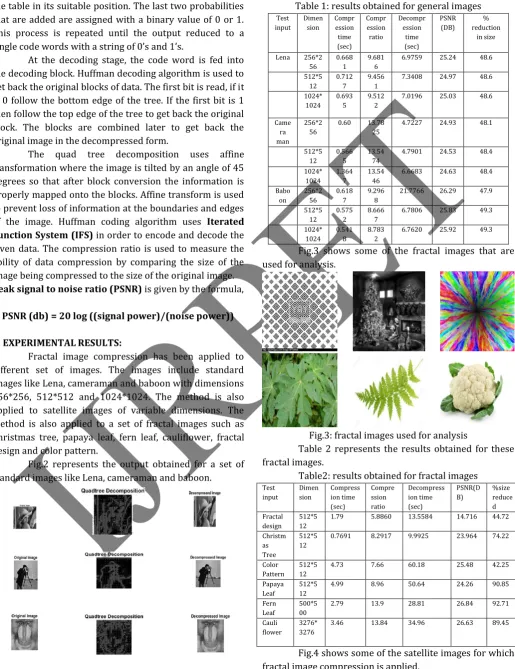
Fractal image compression has been applied to different set of images. The images include standard images like Lena, cameraman and baboon with dimensions 256*256, 512*512 and 1024*1024. The method is also applied to satellite images of variable dimensions. The method is also applied to a set of fractal images such as Christmas tree, papaya leaf, fern leaf, cauliflower, fractal design and color pattern.
Fig.2 represents the output obtained for a set of standard images like Lena, cameraman and baboon.
Fig.2: output obtained for general images
Table 1 shows the results obtained for these images before and after compression.
Table 1: results obtained for general images
Test input Dimen sion Compr ession time (sec) Compr ession ratio Decompr ession time (sec) PSNR (DB) % reduction in size
Lena 256*2 56
0.668 1
9.681 6
6.9759 25.24 48.6
512*5 12 0.712 7 9.456 1
7.3408 24.97 48.6
1024* 1024 0.693 5 9.512 2
7.0196 25.03 48.6
Came ra man
256*2 56
0.60 13.78 25
4.7227 24.93 48.1
512*5 12 0.566 5 13.54 74
4.7901 24.53 48.4
1024* 1024 1.364 7 13.54 46
6.6683 24.63 48.4
Babo on 256*2 56 0.618 7 9.296 8
21.7766 26.29 47.9
512*5 12 0.575 2 8.666 7
6.7806 25.83 49.3
1024* 1024 0.541 8 8.783 2
6.7620 25.92 49.3
Fig.3 shows some of the fractal images that are used for analysis.
Fig.3: fractal images used for analysis
Table 2 represents the results obtained for these fractal images.
Table2: results obtained for fractal images
Test input Dimen sion Compress ion time (sec) Compre ssion ratio Decompress ion time (sec) PSNR(D B) %size reduce d Fractal design 512*5 12
1.79 5.8860 13.5584 14.716 44.72
Christm as Tree
512*5 12
0.7691 8.2917 9.9925 23.964 74.22
Color Pattern
512*5 12
4.73 7.66 60.18 25.48 42.25
Papaya Leaf
512*5 12
4.99 8.96 50.64 24.26 90.85
Fern Leaf
500*5 00
2.79 13.9 28.81 26.84 92.71
Cauli flower
3276* 3276
3.46 13.84 34.96 26.63 89.45
VOLUME 3, ISSUE 7, July-2017
Fig.4: satellite images used
Table 3 represents the results obtained for the satellite images used.
Table3: results obtained for satellite images
Test input
Dime nsion
Compr ession time (sec)
Compr ession ratio
Decompres sion time(sec)
PSNR (DB)
%size reduced
City 156* 157
0.860 6.598 10.4101 20.216 77.88
Crater 500* 500
0.867 7.528 9.0497 23.869 96.78
Fig.5 shows the output obtained for JPEG image compression for Lena image.
Fig.5: JPEG compression output
Fig.6 shows the plot of number of DCT co-efficient taken for compression versus the PSNR values obtained for different co-efficient.
Fig.6: DCT co-efficient vs PSNR values
Table 4 represents the results obtained for JPEG image compression for Lena image.
Table4: JPEG compression results
Method(Lena image)
PSNR(db) Compression ratio
%compression
JPEG 45.5 10.456 <45
Fig.7 shows the DCT compression output.
Fig.7: DCT compression output
Table 5 shows the results obtained for DCT compression.
Table5: DCT compression results
Method(Lena image)
PSNR(db) Compression ratio
%compression
DCT 23.1452 1.0949 <10
Fig.8 shows the output obtained for satellite image compression using BTC technique.
Fig.8: BTC output
Fig.9 shows the output for same image using proposed method.
Fig.9: proposed method output
It is evident from figures 8 and 9 that fractal image compression will not have any information loss when compared to BTC technique. Also the gray levels are not reduced for processing rather it is maintained at the same levels.
V. COMPARISON OF METHODS:
Table 6 represents the comparison between the existing methods and the proposed method.
Table 6: results comparison
Method used for Lena image
PSNR Compression ratio
%compression
Fractal image compression (FIC)
25.24 9.6816 48.61
JPEG compression 45.5 10.456 <45 DCT compression 23.1452 1.0949 <10
From the table 6, it is seen that the results obtained for FIC is far more superior when compared to the basic DCT technique. But the results obtained for JPEG image compression is higher than the FIC technique. Thus the performance of FIC technique lies between DCT and JPEG technique when it comes to Lena image.
VOLUME 3, ISSUE 7, July-2017 The blocks which exist above the 64 mark are not
processed as it is limited by DCT. But in fractal image compression the blocks of any size can be processed without re-sizing the blocks.
Coming to satellite images, the compression ratio obtained for the image considered (8 *8 blocks) for BTC technique (approx. 20) [11] is almost twice the compression ratio obtained for FIC technique. The PSNR values obtained are also more when compared to the FIC technique. But the loss of information is very less in the FIC technique when compared to the BTC technique. Also the gray levels in the image need not be modified in the FIC technique.
VI. CONCLUSION:
Fractal image compression using quad tree decomposition and Huffman coding has been applied to set of standard images like Lena, cameraman and baboon for various dimensions like 256*256, 512*512 and 1024*1024. The compressed images gave almost no loss of information as when compared to standard JPEG image compression algorithm. The method is also applied to satellite images and natural textures and fractals (repetitive pattern) and it is found that the results obtained for these images are much efficient when compared to standard DCT and JPEG compression.
The results have been compared for standard Lena image of 256*256 dimensions with existing JPEG and DCT algorithms. It is evident from the results shown that JPEG provides better compression ratios and PSNR values when compared to the proposed method. But the compressed image has more information loss when compared to proposed method.
The higher frequency components of the image that are less sensitive to the human eye are discarded using DCT or JPEG technique. But in our method the higher frequency components are given the same priority as the lower frequency components there by reducing the loss of information. The quantization levels are reduced to a block size of 64 (8*8) in the JPEG technique. But in our method the block size can be varied according to the user. Also our method can be used in any dimension, size and format (JPG,GIF,TIFF,PNG etc..) thus being more flexible for processing when compared to the existing methods.
In our project we have compared the satellite image results with the existing block truncation coding (BTC). Our method provides no information loss when
compared to BTC where the information at higher gray levels is discarded.
REFERENCES:
1) Veena Devi S. V and A. G. Ananth “fractal image compression using quad tree decomposition and huffman coding”, SIPIJ, vol. 3.no.2, April 2012.
2) Fischer Y “Fractal image compression: theory and application”, New York, Springer- Verlag, 1995.
3) Arnaud E. Jacquin “Fractal image coding”, Proceedings of IEEE, vol. 81.no.10, pp. 1451-1465, October 1993 4) Bohong Liu and Yung Yan “Improved fractal image
coding based on the Quad tree”, IEEE 3rd International
Congress on image and signal processing, pp. 529-532, 16-18 October 2010.
5) Dr. Muhammed Kamran, Amna Irshad Sipra and Muhammd Nadeem “A novel domain optimization technique in fractal image compression”, IEEE proceedings on 8th world congress on intelligent
control and automation, pp. 994-999, 7-9 july 2010. 6) H. B. Kekre, Tanuja S. Sarode, Sanjay R. Sange “image
reconstruction using fast inverse halftone and huffman coding technique”, IJCA, vol. 27.no.6,pp. 34-40, august 2011.
7) Manoj Aggarwal and Ajai Narayan “Efficient Huffman decoding”, IEEE Trans, pp. 936-939, 2010.
8) Hui Yu, Li Li, Dan Liu, Hongyu Zhai, Xiaoming Dong “Based on quad tree fractal image compression improved algorithm for research”, IEEE Trans., pp. 1-3, November 2010.
9) Riccardo Dastasi, Michele Nappi and Daniel Riccio “A range or domain approximation error based approach for fractal image compression”, IEEE Trans. On image processing, vol. 15.no.1, pp. 89-97, 12 December 2005. 10)Veena Devi S. V and A. G. Ananth “Fractal image
compression of satellite imageries, IJCA, vol. 30.no.3, pp. 33-36, September 2011.
11)S. Chandravadana and N. Nithyanandam “Compression of satellite images using lossy and lossless coding Coding techniques”, IJET, vol. 6.no.1, February 2014.
12)R. Praisline Jasmi, B. Perumal and M. Pallikonda Rajashekaran “Comparison of image compression techniques Using Huffman coding, DWT and fractal algorithm, ICCCI, January 2015.