Research Article
CODEN: IJPNL6
DEVELOPMENT AND VALIDATION OF RP-HPLC METHOD FOR THE
ESTIMATION OF SERATRODAST IN BULK AND TABLET DOSAGE FORM
J. Raghuram
JJTU University, Jhunjhunu, Rajasthan, India
*Corresponding author e-mail: [email protected]
ABSTRACT
A simple, precise, rapid and accurate reverse phase HPLC method was developed for the estimation of Seratrdast in tablet dosage form.ZobraxEclipseXDB-C18, 150x4.6 mm 5 μm partical size, with mobile phase consisting of water: acetonitrile in the ratio of 30:70 v/v was used. The flow rate was 1.0 ml/min and the effluents were monitored at 265 nm. The retention time& Recovery time was 8.07min&3.273. The detector response was linear in the concentration of 15-180 mcg/ml. The respective linear regression equation being Y= 32147.7x+58628. The limit of detection and limit of quantification was 0.015mcg and 0.03mcg/ml respectively. The percentage assay of Seratrodast was 99.43 %. The method was validated by determining its accuracy, precision and system suitability.
Keywords: Seratrodast, RP-HPLC, Estimation, and Tablets
INTRODUCTION
Seratrodast is a thromboxane A2 (TXA2) receptor (TP receptor) antagonist used primarily in the treatment of asthma. It was the first TP receptor antagonist that was developed as an anti-asthmatic drug and received marketing approval in Japan in 1997. Seratrodast is an orally active quinone derivative and a potent TXA2 receptor antagonist used in the prophylactic management of asthma. Chemically Sertrodast is 7-phenyl-7-(2, 4 ,5-trimethyl-3,6-dioxocyclohexa-1,4-dien-1-yl)heptanoic acid. Seretra is indicated in prophylactic management of mild to moderate asthma.
EXPERIMENTAL
Instrumentation: Quantitative HPLC was performed on the Waters Alliance 2695 Separations Module is a high performance liquid chromatographic system with a quaternary, low-pressure mixing pump and inline vacuum degassing. Flow rates from50 uL/min to 5 mL/min can be generated for use with 2.1 mm ID columns and larger. The auto-sampler has a maximum capacity of 120 vials (12x32, 2-mL) with programmable temperature control from 4 to 40°C. A
heated column compartment provides temperatures from 5 degrees above ambient to 65°C. The detector is a photodiode array (model 2996) with a wavelength range of 190-800 nm and sensitivity settings from 0.0001-2.0000 absorbance units.Zorbax Eclipse XDB-C18 Column (150x4.6 mm i.d; particle size 5 μm) was used. The HPLC system was equipped with LC solution software.
chemicals and solvents: Seratrodast was provided as gift sample by Hetro Labs, Hyderabad, India. All the
chemicals potassium dihydrogen
phosphateorthophosphoricacid were of AR grade and acetonitrile of HPLC grade were purchased from Merck Specialities Pvt. Ltd., Mumbai, India. Commercial tablets of Seratrodast were purchased from local market.HPLC grade water obtained from Milli-Q water purification system was used throughout the study.
Preparation of Standard drug solution: A standard stock solution of the drug was prepared by dissolving 300 mg of Seratrodast in 100 ml volumetric flask containing 30 ml of mobile phase, sonicated for about 15 min and then made up to 100 ml with mobile phase to get approximately 3000µg/mL.
International Journal of Pharmacy
Working Standard Solution: 5ml of the primary standard stock solution of 3000µg/mL was taken in 10 ml volumetric flask and thereafter made up to 50 ml with mobile phase to get a concentration of 300µg/ml.
Preparation of Sample solution: 20 film coated tablets of Seratrodast (Seretra® 80 mg, Film coated tablets, Zuventus) were and then powdered. A sample of the powdered tablets, equivalent to 300 mg of the active ingredient, was mixed with 70 ml of mobile phase in 100 ml volumetric flask. preparation of sample solution: Twenty tablets (Seretra) were weighed, and then powdered. A sample of the powdered tablets, equivalent to 10mg of the active ingredient, was mixed with 5 ml of water in 10 ml volumetric flask. The mixture was allowed to stand for 1 hr with intermittent sonication to ensure complete solubility of the drug, and then filtered through a 0.45 μm membrane filter, followed by adding water up 10 ml to obtain a stock solution of 1mg/ml. 3ml of the above stock solution was taken in 10 ml volumetric flask and thereafter made up to 10 ml with mobile phase to get a concentration of 300µg/ml.
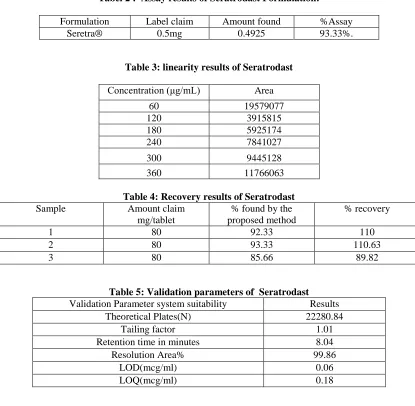
Methodology: The HPLC system was stabilized for thirty minutes by passing mobile phase, detector was set at 215 nm, flow rate of 0.8 mL/min to get a stable base line. One blank followed by six replicates of a single standard solution was injected to check the system suitability. Six replicates of each standard solutions 60,120,180,240,300&360μg/mL were injected. Calibration graph was plotted by concentration ofSeratrodast on X-axis and peak area on Y-axis and linearity curve was shown in Figure 2. The amount of drug present in sample was computed by calibration graph. Chromatographic conditions for estimation of Seratrodast were described in Table 1.
Pharmaceutical formulations: Prepared dilution of (Seretra® 80 mg, Film coated tablets, Zuventus) is injected and the procedure described under bulk samples was followed. The amount of drug present in sample was computed in calibration graph. The assay results in commercial formulations of Fingolimod
were described in Table 2.
RESULTS AND DISCUSSION
The objective of the present work is to develop simple, precise and reliable HPLC method for the analysis of Seratrodast in bulk and pharmaceutical dosage forms. This is achieved by using the most commonly employed
ZobraxEclipseXDB-representative chromatogram indicating Seratrodast is shown in Figure 3.
Parameter Fixation: In developing this method, a systemic study of effects of various parameters was under taken by varying one parameter at a time and controlling all other parameters. The following studies were conducted for this purpose.
Stationary phase characteristics: Based on nature and solubility characteristics of, reverse phase mode of HPLC was selected Seratrodast for chromatography. Among different RP-HPLC stationary phases tried ZobraxEclipseXDB-C18,150x4.6mm was found to be optimum
Mobile phase characteristics: In order to get sharp peak with base line separation from interfering peaks carried out a number of experiments by varying the composition of solvents and mobile phase flow rate. To have an ideal separation of the drug under isocratic conditions, mixtures of solvents like acetonitrile with different buffers in different combinations were tested as mobile phase. A mixture oforthophosphoricacid:Acetonitrile buffer in the ratio 30:70 (v/v) was proved to be the most suitable of all the combinations, since the chromatographic peak obtained was better defined and resolved and almost free from tailing.
Linearity: Aliquots of standard Seratrodast stock solution were taken in different 10 ml volumetric flasks and diluted up to the mark with the mobile phase such that the final concentrations of Seratrodast are in the range of 60-360 μg/ml. Each of these drug solutions (20 μL) was injected three times into the column, and the peak areas and retention times were recorded. Evaluation was performed with PDA detector at 265 nm and a Calibration graph was obtained by plotting peak area versus concentration of Seratrodast (Fig 2).
The plot of peak area of each sample against respective concentration of Seratrodast was found to be linear in the range of 60-360 µg/ml with correlation coefficient of 0.9999. Linear regression least square fit data obtained from the measurements are given in table I. The respective linear regression equation being Y= 32147.7x+58628 The regression characteristics, such as slope, intercept, and %RSD were calculated for this method and given in Table I.
found to be 0.05 which are well within the acceptable criteria of not more than 0.01.
Inter-Day Precision: To study the inter-day precision, six replicate standard solutions (300 ppm) of Seratrdast were injected. The percent relative standard deviation (%RSD) was calculated and it was found to be 0.05 which are well within the acceptable criteria of not more than 0.01.
Specificity: The effect of wide range of excipients and other additives usually present in the formulation of Seratrodast in the determinations under optimum conditions were investigated. Chromatographic parameters maintained are specific for Seratrodast. ruggedness: The ruggedness of the method was determined by carrying out the experiment on different instruments like Shimadzu HPLC, Agilent HPLC and Water’s Breeze HPLC by different operators using different columns of similar type like XDB C18, Hibar C18, Kromasil C18 and Symmetry C18 didn’t show any significant change.
Limit Of Detection And Limit Of Quantification:
The detection limit of the method was investigated by injecting standard solutions Seratrodast into the HPLC column. By using the signal-to-noise method the peak-to-peak noise around the analyte retention time is measured, and subsequently, the concentration of the analyte that would yield a signal equal to certain value of noise to signal ratio is estimated. A signal-to-noise ratio (S/N) of 3 is generally accepted for estimating LOD and signal-to-noise ratio of 10 is used for estimating LOQ. This method is commonly applied to analytical methods that exhibit baseline noise. The limit of detection (LOD) and limit of quantification (LOQ) for Seratrodast were found to be 0.015µg/ml and 0.03 µg/ml respectively.
Accuracy: The accuracy of the method was determined by standard addition method. A known amount of standard drug was added to the fixed amount of pre-analyzed standard solution. The standard addition method was performed at 120%, 100% and 80% level of 10 ppm. The solutions were analyzed in triplicate at each level as per the proposed method. The percent recovery and %RSD was calculated and results are presented in Table 4. Satisfactory recoveries ranging from 92.33% 93.33% to 110% were obtained by the proposed method. This indicates that the proposed method was accurate.
Robustness: Robustness of the method was determined by making slight changes in the chromatographic conditions. It was observed that there were no marked changes in the chromatograms, which demonstrated that the RP-HPLC method developed is robust
System Suitability: A system suitability test was performed to evaluate the chromatographic parameters (number of theoretical plates, tailing of the peak) before the validation runs. The results of system suitability parameters were given in Table 5. The analytical method validation was carried out as per ICH method validation guidelines.
CONCLUSION
The proposed HPLC method is rapid, sensitive, precise and accurate for the estimation of Seratrodast and can be reliably adopted for routine quality control analysis of Seratrodast in its tablet dosage forms.
Figure 2: Linearity curve of Seratrodast
Figure 3: Typical chromatogram of Seratrodast
Tabel 1 : Optimized chromatographic conditions of Seratrodast Parameters
Parameters Condition
Mobile phase orthophosphoricacid:Acetonitrile buffer
(30:70 v/v)
pH 2.5
Diluent Acetonitrile
Column ZobraxEclipseXDB-C18,150x4.6mm
Column temperature 30°C
Wave length 265 nm
Injection volume 20 μL
Flow rate 1.0 mL/min
Run time 15 min
Tabel 2 : Assay results of Seratrodast Formulation:
Formulation Label claim Amount found %Assay
Seretra® 0.5mg 0.4925 93.33%.
Table 3: linearity results of Seratrodast
Concentration (μg/mL) Area
60 19579077
120 3915815
180 5925174
240 7841027
300 9445128
360 11766063
Table 4: Recovery results of Seratrodast
Sample Amount claim
mg/tablet
% found by the proposed method
% recovery
1 80 92.33 110
2 80 93.33 110.63
3 80 85.66 89.82
Table 5: Validation parameters of Seratrodast
Validation Parameter system suitability Results
Theoretical Plates(N) 22280.84
Tailing factor 1.01
Retention time in minutes 8.04
Resolution Area% 99.86
LOD(mcg/ml) 0.06
LOQ(mcg/ml) 0.18
REFERENCES:
1. Ohta R1, Amano T, Yamashita K, Motohashi M. J Chromatography. 1997 Dec 19;704(1-2):325-31.
2. V Mohan Goud, A Srinivasa Rao, S V Phanindra, S PragatiRanjan, Asian journal of research in chemistry 2013; 6(1-3).
3. J. Bousquet and N. Khaltaev (Eds).. Anon. Chronic Respiratory Diseases. WHO library Publication, 2007.