www.pharmascholars.com
80
Original Article
CODEN: IJPNL6
FORMULATION, OPTIMIZATION AND EVALUATION OF CYCLOBENZAPRINE
HCl PELLETS FOR EXTENDED RELEASE
Sarada Anepu
1*, Balasubrahmanyam A.V.S
2, Lohithasu Duppala
1,3, Anu Pravallika.J
11
A. U.College of Pharmaceutical Sciences, Andhra University, Visakhapatnam, Andhra Pradesh,
India.
2
Maharajah’s College of Pharmacy, Phoolbaugh, Vizianagaram, Andhra Pradesh, India.
3Department of Pharmaceutics, GITAM Institute of Pharmacy, GITAM University,
Visakhapatnam, Andhra Pradesh, India.
*Corresponding author e-mail: [email protected]
Received on: 10-02-2016; Revised on: 11-04-2016; Accepted on: 20-06-2016
ABSTRACT
The aim of the present study is to formulate and evaluate the cyclobenzaprine hydrochloride extended release pellets by using commercially available sugar pellets by powder layer (using fluidized bed coater) process using different polymers like ethyl cellulose N-50, hydroxyl propyl methyl cellulose (HPMC), and eudragit E-100. FTIR studies of the F6 formulation indicating no chemical interaction between cyclobenzaprine HCl and excipients. In order to get the optimized formulation, the various process parameters were adjusted. The various evaluations for formulations were carried out, that to based on the in-vitro drug release studies of F6 formulation shows better drug release profile than other formulations. The results conclude that trial F6 has met the objective of extended release, cost effective as once day of drug.
Keywords: Cyclobenzaprine hydrochloride, extended release pellets, ethyl cellulose N-50, hydroxyl propyl methyl cellulose (HPMC), eudragit E-100.
INTRODUCTION
Pellets are small, free flowing spherical or semispherical solid unit particulates manufactured by the agglomeration of fine powders or granules of drug substances and excipient using appropriate processing technologies (layering of the drug solution, suspension or powder on the inactive cores, extrusion, spheronization and agglomeration in rotogranulators or rot processors, compression, spray drying and spray congealing) from about 0.5-2 mm usually intended for oral administration. They aid in preparation of modified release multiple dosage form with different release patterns such as immediate and sustained release pattern, taste masking of the drugs, gastro retentive floating and self-emulsifying. The various advantages of pellets which includes to produce the sustain release of drug, minimize side
effects without lowering bioavailability and increases the patient acceptance [1-5].
Cyclobenzaprine HCl is chemically known as 3-(5H-dibenzo [a,d] cyclohepten-5-ylidene)-N,N-dimethyl-1-Propanamine hydrochloride (molecular formula is C20H21N·HCl). It is an tricyclic antidepressant like
amitriptyline and imipramine and may be helpful for sleep and pain control in fibromyalgia. It is useful for quick relief (back pain, neck pain, and muscle spasms. It directly acts on the skeletal muscle by inhibition of the release of calcium from the sarcoplasmic reticulum, which inhibits muscle contraction. Skeletal muscle relaxants with antispastic properties are used to relieve musculoskeletal pain. It has a melting point of 217 °C, and a pKa of 8.47 at 25 ° C. It is freely soluble in
International Journal of Pharmacy
www.pharmascholars.com
81
water and alcohol, sparingly soluble in isopropanol,and insoluble in hydrocarbon solvents [6-9].
The objective of the present study is to development of extended release pellets of cyclobenzaprine HCl to reduce the dosing frequency, enhancement of patient compliance and also study the physicochemical characterization of drug in pellet formulation.
MATERIALS AND METHODS
Materials: Cyclobenzaprine hydrochloride was provided by Orchid chemicals and pharmaceuticals (Chennai, India). Sugar spheres (24#30), poly ethylene glycol -6000, talc was obtained as gift samples from SD fine Chemicals Ltd. Ethyl cellulose N-50 obtained from Dow chemicals, hydroxyl propyl methylcellulose-E5 obtained from Feicheing lab’s, polymethacrylate (Eudragit-E100) obtained from Biogen extracts India ltd. All other reagents and chemicals were of analytical grade.
METHODS:
Determination λmax of cyclobenzaprine HCl: Determination of max of cyclobenzaprine HCl by
Ultraviolet absorption spectrophotometer (Hitachi-U2000, Japan) based on the measurement of absorbance at spectral range of 260-400 nm of U.V. region by using methanol as medium.
Calibration curve of cyclobenzaprine HCl
Primary stock solution preparation: The standard solution was prepared by dissolving 100 mg of Cyclobenzaprine HCl in 100 ml of 0.1 N HCl in volumetric flask.
Preparation of secondary stock solution: From the primary stock solution 5ml of solution was pipette out and then it was made up to 100ml using0.1 N HCl in 100 ml volumetric flask.
Preparation of suitable concentrations: From the secondary stock solution 1ml, 2ml, 3ml, 4ml, 5ml of solution were pipette out ,taken in 10ml of volumetric flasks and volume was made up to 10ml using 0.1 N HCl, in order to get the solution concentrations of 5, 10,15,20,25 µg/ml. The absorbance of those dilutions was measured in Hitachi-U2000 spectrophotometer at 290 nm against 0.1 N HCl as blank. The linear regression analysis was carried on absorbance data points.
Pre-formulation studies:
The pre-formulation studies are performed such as melting point, solubility, drug excipient-compatibility studies. Melting point API was determined by
capillary method by using Mel-Temp melting point apparatus. The solubility of drug can be determined as, weighed accurately about 1gm of pure drug and dissolved each in 1ml of the solvent system i.e. water, chloroform, IPA, dichloromethane, n-hexane, ethanol, methanol, acetone, isopropyl myristate in a well closed air tight containers. Then add the successive amount of the solvent in to the containers containing drug until the solution became saturated solution.
Drug-excipient compatibility studies: Fourier Transform Infrared analysis (FT-IR) measurements of pure drug and drug-loaded pellet formulations were obtained using a Perkin- Elmer system 200 FT IR spectrophotometer. The pellets were prepared on KBr-press under hydraulic pressure of 150kg/cm2; the spectra were scanned over the wave number range of 4000 to 400 cm-1 at the ambient temperature. Physical properties [10]
Bulk density: Bulk density is defined as a mass of a powder divided by the bulk volume. Accurately weighed (weighing balance-Essae, DS-852 series) amount of powder was introduced in 100 ml graduated cylinder. The volume of the material was noted on graduated cylinder. The bulk density was calculated by using the formula,
Bulk density (ρ0) = M/Vo; Where, M = mass of the powder; Vo = volume of the powder.
Tapped Density: Tapped density is defined as a mass of powder divided by tapped volume. Accurately weighed amount of powder was filled in 100 ml graduated cylinder. The cylinder was equipped to USP tapdensity tester, it was subjected to 300, 500 taps/min from height of 14±2mm, note down the volume occupied by powder. The difference in volume after each taps is 300,500 taps is more than 2%, then repeat the taps to 750, 1200 taps until the difference between succeeding measurements is less than 2%. It is expressed in g/ml and is calculated by using the formula,
Tapped density (ρt) = M/Vf ; Where, M = weight of sample powder ; Vf = tapped volume.
Compressibility Index: Tapped density and bulk density were measured and the compressibility index
was calculated by the using the formula, % Compressibility index = [(ρt - ρo)/ ρt] X 100;
Where ρt = Tapped density; ρo = Bulk density. Hausner’s ratio: Tapped density and bulk density were measured and the Hausner’s ratio was calculated by using the formula,
www.pharmascholars.com
82
Angle of repose: Accurately weighed quantity ofpowder is poured in funnel and the height of funnel is adjusted to a height of 2.5cm and the radius of the circle is measured by taking the diameter values of average of four values and the half of the diameter is the radius. It can be calculated by using the formula, θ = tan-1 (h/r); Where, h = Height of the funnel; r =Radius of circle
Formulation development [11-14]: Formulation steps
Drug Loading: Dispense the remaining materials as per manufacturing formulae and pulverize the cyclobenzaprine HCl. Dissolve drug in sufficient amount of water, remaining ingredients. Dissolve PVPK-30 in IPA and stir well still to get the clear solution, then mix the both solutions. Transfer the basic core sugar pellets into conventional coating pan, and then spray the binder solution prepared above. Over wetting of the cores to be avoided as it may cause agglomeration. The pellets are then dried in a tray drier at about 450 C-550 C to attain the moisture content less than 2.5%. The dried pellets are sized on a sifter to remove agglomerates, broken pellets and fine powder. The pellets were ready for first coating.
Coating pellets: Take isopropyl alcohol into a vessel and add Ethyl cellulose N-50 and HPMC E-5 slowly till it is dissolved. Take water into another vessel, and add PEG 6000 to dissolve completely. Then this solution added to earlier solution. Continue the stirring (Remi motors, Mumbai) till to get the clear solution Transfer the drug loaded pellets into the FBC and coat with the above prepared Coating solution. Adjust the spray rate, inlet air temperature are in such a way that the drug coated pellets reaches a temperature of about 370 C-420 C. Over wetting of the drug coated pellets to be avoided as it may cause agglomeration. After complete quantity of the coating solution is consumed, reduce the fluidization for a brief post-drying period. The dried pellets are sized on a sifter to remove agglomerates, broken pellets and fine powder. After checking the weight of the pellets and noting down the yield it should be packed in double polythene bags, labeled, and securely tied and it is ready for second coating.
Sub coating: Take isopropyl alcohol into a vessel and add eudragit E-100 and Ethyl cellulose E-5 slowly till it is dissolved. Take water into another vessel, and add PEG 6000 to dissolve completely. Then this solution added to earlier solution. Continue the stirring till to get the clear solution. Transfer the drug loaded pellets into the FBC and coat with the above prepared Coating solution. Adjust the spray rate, inlet air temperature are in such a way that the
drug coated pellets reaches a temperature of about 370 C-420 C. Over wetting of the drug coated pellets to be avoided as it may cause agglomeration. After complete quantity of the coating solution is consumed, reduce the fluidization for a brief post-drying period. The dried pellets are sized on a sifter to remove agglomerates, broken pellets and fine powder. After checking the weight of the pellets and noting down the yield it should be packed in double polythene bags, labeled, and securely tied and it is ready for second coating. Same procedure is followed for all formulations.
Controlling of critical parameters in drug loading process: The various parameters in drug loading process are,
Drug Loading Process: The drug loading process was identified as a critical step in the manufacturing process, as this step directly impacts upon size of pellets as well as the content uniformity of final product. The critical process parameters and optimum settings for the drug loading process were identified based on prior knowledge on a similar product in which the drug substance is coated on sugar spheres of the same size distribution. In addition, laboratory scale studies (1 kg batches) were performed in an 18 inch coating pan at the optimized and extremes (low and high) for the identified critical process parameters. The critical process parameters identified for the drug layering step were the uniformity and particle size distribution of the drug, the rate of powder application, binder solution spray rate, product bed temperature and atomizing pressure. These studies established that a proper balance of binder solution spray and the drug powder application was important for the size uniformity and surface characteristics of the drug-layered pellets.
The range of process parameter results showed an expected influence on the drug release profile of the coated drug product attributed to variations in coating thickness and coating membrane integrity, based on the range of process parameters. All process parameters were found to have some effect on the coating efficiency, with the maximal effect observed when spray rate and atomizing pressure were varied in the process.
Evaluation of pellets
www.pharmascholars.com
83
Determination of Sieve analysis (%): To determinethe sieve analysis, arrange the sample collector, #20ASTM (American Society of Testing and Materials) sieve, #16ASTM sieve, Weigh and transfer around 100g of the sample into #16 ASTM sieve and sieve shaker was operated at 60 amplitude for 5min. Collect and weigh the retains from #16 , #20 ASTM sieves respectively. The % retains and passing’s can be calculated by using the formula.
Determination of Moisture Content (% w/w): Take suitable quantity of Methanol in titration flask of Karl Fischer Titrator and titrate with Karl Fischer reagent to end point. Then add 200 mg of sodium tartarate dihydrate to the titration flask and titrate with Karl Fischer reagent to end point and note the titrant value.
Grind the pellets to fine powder in a dry mortar, weigh accurately about 0.5 g of the sample, transfer quickly to the titration flask, dissolve by stirring and titrate with Karl Fischer reagent to end point. The percentage of moisture content can be determined by using the formula.
Where, F = Factor of Karl Fischer reagent; V = Volume in ml of Karl Fischer reagent consumed for sample titration.
Determination of percentage drug entrapment of efficiency: A known amount of drug was loaded in pellets during preparation. It was centrifuged and the supernant was diluted suitably with distilled water and the absorbance of resulting solution was measured at 290 nm on UV-VIS spectrophotometer to determine the amount of cyclobenzaprine present in the supernant .Drug entrapment was calculated by using the formula,
X100
Where, w1= Total amount of drug added to the system; w2= Drug present in the solution outside.
Estimation of drug content: Accurately weighed quantity of the pellets equivalent to about 30.0mg of cyclobenzaprine HCl in a 50 ml volumetric flask add
40ml of 0.1 N HCl dissolve and dilute to the volume with0.1NHCl and take 5ml of above solution in 50ml volumetric flask and dilute to the volume with0.1NHCl and again take 5 ml of above solution in 50 ml volumetric flask and dilute to volume with 0.1NHCl and analyzed spectrophotometrically at 290 nm, drug content calculated using regression equation derived from the standard graph. All the experiments are done in triplicate (n=3).
Determination of drug release by UV -Vis spectrophotometer: The In-vitro dissolution studies were carried out in a USP Apparatus-II(Paddle- Electro lab, India) type dissolution assembly. cyclobenzaprine HCl extended pellets equivalent to 30mg of drug introduced into 900ml of the dissolution medium (0.1N HCl) and stirred at 50 rpm at 37 ± 0.5ºC. At different time intervals (2nd, 4th, 6th, 8th, 12th, 16th) solution is withdrawn and the same quantity fresh dissolution medium is replaced. Determine the amount of cyclobenzaprine HCl release in UV absorption at the wavelength of maximum absorbance at about 290nm on filtered portions of the solution under test, suitably diluted with Dissolution medium, if necessary in comparison with a standard solution having a known concentration of cyclobenzaprine HCl standard in the same medium. The percentage of drug release is calculated by using the regression equation as derived from the standard graph. All the experiments are
done in triplicate (n=3).
Kinetics of drug release: The analysis of the mechanism of drug release from pharmaceutical dosage form is an important but complicated problem .The dissolution data obtained was fitted to zero order, first order, Higuchi, erosion and exponential equation to understand the order and mechanism of drug release from the pellets [11-15].
Zero order release kinetics: It defines a linear relationship between the fraction of drug released versus time.
Q = kot
where, Q is the fraction of drug released at time t and ko is the zero order release rate constant.A plot of the
fraction of drug released against time will be linear if the release obeys zero order release kinetics.
www.pharmascholars.com
84
ln (1-Q) = k1twhere, Q is the fraction of drug released at time, (t) and k1 is the first order release rate constant.Thus, a
plot of the logarithm of the fraction of drug remained against time will be linear if the release obeys first order release kinetics.
Higuchi equaiton: It defines a linear dependence of the active fraction released per unit of surface (Q) on the square root of time.
Q = k2t½
where, k2 is the release rate constant. A plot of the
fraction of drug released against square root of time will be linear if the release obeys Higuchi equation[15].
Erosion equation: This equation defines the drug release based on erosion alone.
Q = 1-(1-k3t)3
where, Q is the fraction of drug released at time t, k3
is the release rate constant. Thus, a plot between [1-(1-Q)1/3] against time will be linear if the release obeys erosion equation.
RESULTS AND DISCUSSION
Determination of max of Cyclobenzaprine HCl: The standard solution was prepared as per the method described in methodology section and scanned by UV-visible spectrophotometer. The UV absorption spectrum of cyclobenzaprine HCl shows highest peak at 290.0 nm against reagent used blank and the same was used for further analysis.The absorbance of the standard solution of cyclobenzaprine hydrochloride at 5-25 µg/ml were plotted as absorbance versus concentration which gave a straight line passing through the origin with regression coefficient 0.999. So it followed Beer’s-Lambert’s law at the concentration range of 5-25 µg/ml.
The calibration curve and data obtained by the procedure described in methodology section and are given in Figure No1. The data had a correlation coefficient of 0.999 and the equation for regression line is depicted as below; y = 0.034x + 0.002.
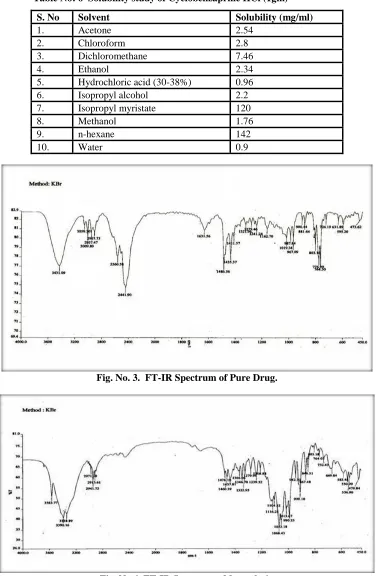
Pre-formulation studies: The following pre-formulation studies were performed on cyclobenzaprine HCl and excipients. The melting point of cyclobenzaprine HCl was found to be in the range 217°C-219°C by using melting temperature apparatus, which complied with USP standards, indicating purity of the drug sample. The solubility study of pure cyclobenzaprine HCl were summarized in Table No. 6 and it indicate that the pure drug cyclobenzaprine HCl was freely soluble in water, alcohols such as methanol, ethanol and isopropyl
alcohol as well as in chloroform, dichloromethane, acetone also acids like HCl when compared to the n-hexane, isopropyl myristate and and it indicates that the pure drug cyclobenzaprine HCl was freely soluble in water, alcohols such as methanol, ethanol and isopropyl alcohol as well as in chloroform, dichloromethane, acetone also acids like HCl when compared to the n-hexane, isopropyl myristate.
Drug-excipient compatibility: FT-IR spectra of cyclobenzaprine HCl and formulation containing all excipients were recorded. The cyclobenzaprine HCl present in the formulation was confirmed by FT-IR as shown above. Compatibility study of drug and excipient was conducted by employing I.R. spectral studies. The IR spectrum of cyclobenzaprine hydrochloride and its physical mixture is showing Fig Nos. 3 and 4. the following characteristic peaks were observed with cyclobenzaprine HCl. Ar. C-H (stretching) 3010 cm-1 ,Ali. C-H (stretching) 2954 cm-1, Ali C=C (stretching) 1645 cm-1, Ar.C=C(stretching) 1481 cm-1,C-N (stretching)1247 cm-1. As identical peaks observed in all the cases, hence it shall be confirmed that interactions do not exist between drug and excipients.
Physical properties
The bulk density values of all formulations varied from 0.700 g/cm3 to 0.786 g/cm3. The tapped density values of all formulations ranges from 0.729 g/cm3 to 0.795 g/cm3. The compressibility index for all formulations was determined by the equation given for compressibility index in methodology section. The compressibility index for all formulations lies within the range of 1.13 to 3.97; and hence they are showing good compressibility. The hausner’s ratio values obtained by using the formula as described in the methodology section. The hausner’s ratio values for all formulations varied from 1.00 to 1.04, which is nearer to optimum hausner’s ratio of 1.11, which indicates excellent flow of powder. The angle of repose values obtained by using the formula as described in the methodology section. The angle of repose values for all formulations varied from33.69o to 37.99o, which indicates moderate flow.
www.pharmascholars.com
85
method described in the methodology section and thevalues of all formulations varied from 95% to 101%.
In-vitro drug release studies : From the observed data that F1, F2,F3 and the reference formulation release were found to be 68.10%, 72.02%,78.05% and 96.78 % respectively, which shows release up to 16hrs, From the observed data that all three formulations were showing less drug release profile when compared to reference product. From the observed data that F4, F5, F6 and reference the drug release were found to be 75.67 %, 91.25%, 98.05% and 96.78%, which shows drug release up to 16hrs, from the observed data that all three formulations are showing better drug release than reference product. From the observed that F7 formulation drug release was found to be 98.70% within 12 hrs, from the observed that it is showing burst release than reference product. From all the observations F6 formulation was considered as best formulation and optimized one.
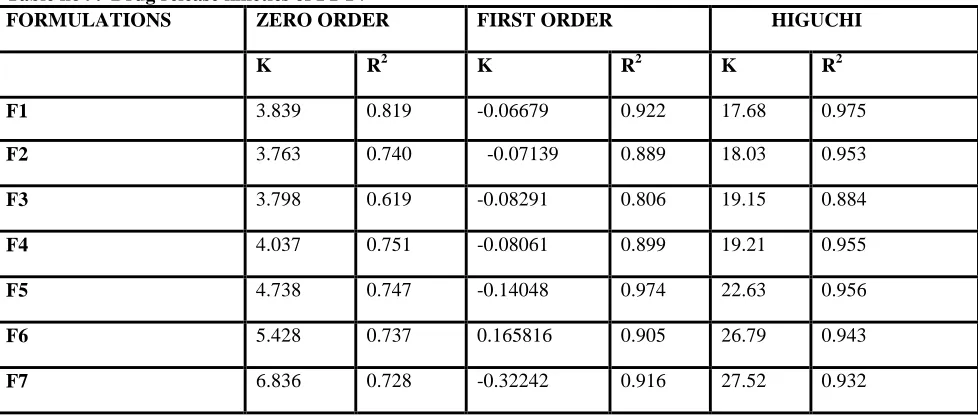
Drug release kinetics: In order to describe the release kinetics of all formulations the corresponding dissolution data was fitted in various kinetic dissolution models like zero order, first order and Higuchi respectively. The regression co-efficient values for all the formulations are mentioned in Table no 9, from which it is concluded that all the formulations along with optimized formulation F6 and the reference product was showing best fit towards Higuchi model.
Drug release kinetics: To analyze the mechanism of drug release from the formulation, the dissolution profile of optimized batches were fitted to zero order,
first order and Higuchi to ascertain the kinetic modeling of drug release.
CONCLUSION
The pre-formulation studies like melting point, solubility of cyclobenzaprine hydrochloride were complied with standard. The FTIR spectra revealed that, there was no interaction between excipients and drug. Hence concluded this excipients are compatible with drug. The blends of all formulations and formulated pellets were found to be various physical properties such as micromeritic properties,% drug content, % drug entrapment, % moisture content and
in-vitro drug release. As per the results of dissolution study formulationsF1, F2, F3, F4, F5 and F6 showed 68.10%, 72.02%, 78.05%, 75.67%, 91.25% and 98.05% % drug release respectively. This showed that the drug release from the pellets was extended for 16hrs, but F7 formulation showed drug release 98.75% at 12hrs. Based on the mathematical data revealed from models, it was concluded that the release data was fitted to higuchi equation. As from the drug release studies F6 formulation is considered to be the best formulation and shows drug release 98.05% upto 16 hrs, which follows higuchi model.
ACKNOWLEDGEMENT
The authors acknowledge GITAM Institute of Pharmacy, GITAM University for necessary support and also thankful to Sankar. R, Associate director, Orchid healthcare, Chennai, India for giving valuable information during this research work.
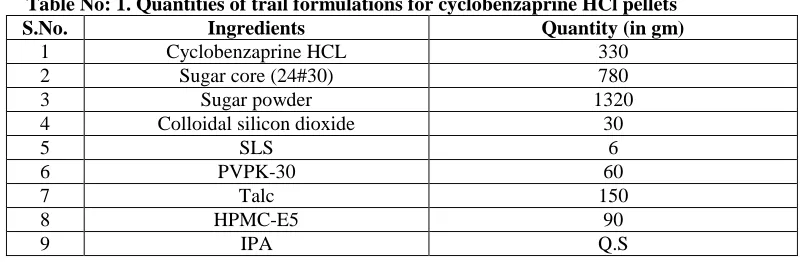
Table No: 1. Quantities of trail formulations for cyclobenzaprine HCl pellets
S.No. Ingredients Quantity (in gm)
1 Cyclobenzaprine HCL 330
2 Sugar core (24#30) 780
3 Sugar powder 1320
4 Colloidal silicon dioxide 30
5 SLS 6
6 PVPK-30 60
7 Talc 150
8 HPMC-E5 90
www.pharmascholars.com
86
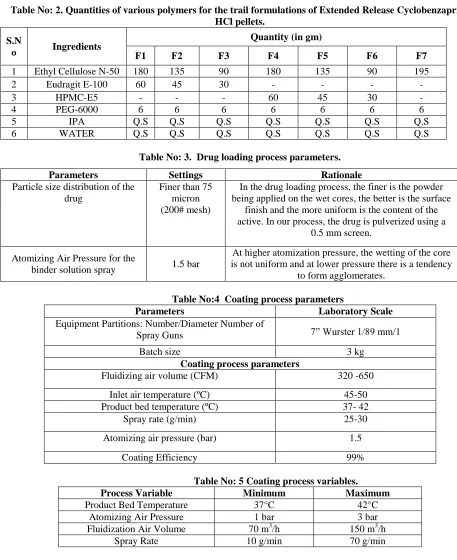
Table No: 2. Quantities of various polymers for the trail formulations of Extended Release CyclobenzaprineHCl pellets.
S.N
o Ingredients
Quantity (in gm)
F1 F2 F3 F4 F5 F6 F7
1 Ethyl Cellulose N-50 180 135 90 180 135 90 195
2 Eudragit E-100 60 45 30 - - - -
3 HPMC-E5 - - - 60 45 30 -
4 PEG-6000 6 6 6 6 6 6 6
5 IPA Q.S Q.S Q.S Q.S Q.S Q.S Q.S
6 WATER Q.S Q.S Q.S Q.S Q.S Q.S Q.S
Table No: 3. Drug loading process parameters.
Table No:4 Coating process parameters
Parameters Laboratory Scale
Equipment Partitions: Number/Diameter Number of
Spray Guns 7” Wurster 1/89 mm/1
Batch size 3 kg
Coating process parameters
Fluidizing air volume (CFM) 320 -650
Inlet air temperature (ºC) 45-50
Product bed temperature (ºC) 37- 42
Spray rate (g/min) 25-30
Atomizing air pressure (bar) 1.5
Coating Efficiency 99%
Table No: 5 Coating process variables.
Process Variable Minimum Maximum
Product Bed Temperature 37°C 42°C
Atomizing Air Pressure 1 bar 3 bar
Fluidization Air Volume 70 m3/h 150 m3/h
Spray Rate 10 g/min 70 g/min
Parameters Settings Rationale
Particle size distribution of the drug
Finer than 75 micron (200# mesh)
In the drug loading process, the finer is the powder being applied on the wet cores, the better is the surface
finish and the more uniform is the content of the active. In our process, the drug is pulverized using a
0.5 mm screen.
Atomizing Air Pressure for the
binder solution spray 1.5 bar
At higher atomization pressure, the wetting of the core is not uniform and at lower pressure there is a tendency
www.pharmascholars.com
87
Table No: 6 Coating equipment parametersParameter Settings Rationale
Fluidizing Air Volume
80–100 m3/hr
Lower and higher than optimum range led to poor fluidization patterns and loss of coating efficiencies.
Product Bed
Temperature 37–42°C
Lower than optimum led to poor evaporation and pellet agglomeration. Higher than optimum led to case hardening of the pellets (trapping moisture in the product matrix), poor adherence of the CR membrane,
and rapid drug release.
Spray Rate 30–40 g/min
Lower spray rates decreased droplet size, enhancing evaporation resulting in poor coating efficiency and rapid drug release. Faster spray
rates increased the droplet size leading to low yield due to product agglomeration.
Atomizing Air
Pressure 1.5 Bar
At the optimized spray rate of 25-30 g/min, the atomizing air pressure generates a 30µm droplet size that is critical to ensure adequate CR coating. Atomizing air pressures exceeding 3.0 bars should be avoided due to excessive pellet attrition.
Coating Solids 5 % w/v
Lower coating solids led to less viscous coating suspension which affected spray rate. Higher coating solids resulted in a too viscous suspension that was difficult to spray without maximum air pressure utilization
Inlet Air
Temperature 45-55 °C
Calculated using the drying/humidity chart of the Wurster. This is a dependent process variable that is calculated based upon consideration of spray rate, fluid bed temperature, fluidizing air volume, incoming air RH%, and outlet air temperature/RH% to ensure sufficient evaporative capacity.
FigNo: 1 Absorption maxima of cyclobenzaprine HCl
www.pharmascholars.com
88
Table No: 6 Solubility study of Cyclobenzaprine HCl (1gm)Fig. No. 3. FT-IR Spectrum of Pure Drug.
Fig. No.4 FT-IR Spectrum of formulation
S. No Solvent Solubility (mg/ml)
1. Acetone 2.54
2. Chloroform 2.8
3. Dichloromethane 7.46
4. Ethanol 2.34
5. Hydrochloric acid (30-38%) 0.96
6. Isopropyl alcohol 2.2
7. Isopropyl myristate 120
8. Methanol 1.76
9. n-hexane 142
www.pharmascholars.com
89
Table No:7 Micromeritic Studies of blend
Where,*All values are shown as mean±SD (n=3).
Table no: 8 Evaluation of pellets
Batch code F1 F2 F3 F4 F5 F6 F7
Sieve analysis(g)
98 ±0.85 97±0.65 99±0.74 99±0.45 98±0.48 99±0.61 98±0.21
% Moisture content
1.3±0.00 1.4±0.00 1.3±0.01 1.3±0.00 1.36±0.00 1.5±0.00 1.5±0.05
% Drug entrapment
99.84±0.2 95.23±0.1 97.92±0.4 95.07±0.7 96.46±0.3 98.38±0.2 97.46±0.3
% Drug content
98±0.05 95±0.05 97±0.10 96±0.10 95±0.15 101±0.17 98±0.01
Where,*All values are shown as mean±SD (n=3). In-vitro drug release studies
Figure No. 5. Comparison in-vitro dissolution profile of various formulations (F1-F7)
S.No Batch code
Bulk density g/cm3
Tapped density g/cm3
Hausner’s
ratio Carr’ index
Angle of repose
1. F1 0.743±0.016 0.762±0.008 1.01±0.0016 1.24±0.0124 34.87±0.081 2. F 2 0.700±0.002 0.729±0.016 1.04±0.0014 3.97±0.1632 37.99±0.039 3. F3 0.777±0.008 0.795±0.002 1.02±0.0008 2.26±0.0163 34.87±0.021 4. F4 0.744±0.007 0.760±0.008 1.02±0.0024 2.10±0.0124 37.14±0.028
5. F5 0.729±0.009 0.744±0.007 1.00±0.0021 2.01±0.0136 36.32±0.052
www.pharmascholars.com
90
Table no 9. Drug release kinetics of F1-F7FORMULATIONS ZERO ORDER FIRST ORDER HIGUCHI
K R2 K R2 K R2
F1 3.839 0.819 -0.06679 0.922 17.68 0.975
F2 3.763 0.740 -0.07139 0.889 18.03 0.953
F3 3.798 0.619 -0.08291 0.806 19.15 0.884
F4 4.037 0.751 -0.08061 0.899 19.21 0.955
F5 4.738 0.747 -0.14048 0.974 22.63 0.956
F6 5.428 0.737 0.165816 0.905 26.79 0.943
F7 6.836 0.728 -0.32242 0.916 27.52 0.932
Where,*All values are shown as mean±SD (n=3).
REFERENCES
1. Harisha KM, Samatha K, Balaji A, Umashankar MS. Int J Pharm Sci Res, 2013; 4(10): 3803-3822. 2. Jalal IM, Malinowski HJ, Smith WE. J Pharm Sci, 1972;61: 1466-790.
3. Malinowski HJ, Smith WE. J Pharm Sci, 1974; 63: 285-288. 4. Bechgaard H, Neilson GH. Drug Dev Ind Pharm, 1978; 4:53-67. 5. Vervaet C, Baert L, Remon JP. Int J Pharm 1995; 116: 131–146.
6. Philip TRH, David AY, Arthur BS, Marvin CM. J Liq Chrom & Rel Technol, 1993;16(5):1163-1171. 7. Spell JC, Stewart JT. J Pharm Biomed Anal, 1998; 18 (3): 453-460.
8. Constanzer M, Chavez C, Matuszewski B. J Chrom B: Biomed Sci and Appl, 1995;666(1): 117-126. 9. Mandava VB, Reddy BCK, Srinivasarao T, Sivanadh M. Res J Pharm Bio Chem Sci, 2010; 1(3): 315-319. 10. Kammela KC, Mohammad Y, Shahidulla S, Saivenkatavedavyas P. Int J Drug Dev Res, 2012; 4 (4):
257-264.
11. Rao PSS, Babu GR, Praveen TK, Surekha PS, Shekhar MC. Int J Pharm Sci Res, 2014; 5(5): 2074-83. 12. Deb R, Ahmed AB. Int Res J Pharm, 2013; 4(4): 90-95.