
Wa r d , R a c h el Lo ui s e a n d Mill er, P a ul K. ( 2 0 1 3 ) D e p r e s sio n ,
p h y si c al a c tivi ty a n d m e n t a l h e a l t h : a n i n t e r p r e t a tiv e
p h e n o m e n ol o gi c al a n a ly si s of g e n e r a l p r a c ti tio n e r s’ e x p e ri e n c e s
of e x e r ci s e r ef e r r a l s c h e m e s in t h e N o r t h We s t. C u m b r i a
P a r t n e r s h i p Jo u r n a l of R e s e a r c h , P r a c ti c e a n d L e a r n i n g , 3 ( 1).
p p . 1 3-1 9 .
Do w n l o a d e d fr o m : h t t p ://i n si g h t . c u m b r i a . a c . u k /i d/ e p ri n t/ 1 4 4 7 /
U s a g e o f a n y i t e m s f r o m t h e U n i v e r s i t y o f C u m b r i a’ s i n s t i t u t i o n a l r e p o s i t o r y
‘I n s i g h t ’ m u s t c o n f o r m t o t h e f o l l o w i n g f a i r u s a g e g u i d e l i n e s .
Any it e m a n d it s a s s o ci a t e d m e t a d a t a h el d i n t h e U niv e r si ty of C u m b r i a ’s in s ti t u ti o n al
r e p o si t o r y I n si g h t ( u nl e s s s t a t e d o t h e r wi s e o n t h e m e t a d a t a r e c o r d ) m a y b e c o pi e d ,
di s pl ay e d o r p e rf o r m e d , a n d s t o r e d i n li n e wi t h t h e JIS C f ai r d e a li n g g ui d eli n e s ( av ail a bl e
h e r e
) fo r e d u c a t i o n al a n d n o t-fo r-p r ofi t a c tiviti e s
p r o v i d e d t h a t
• t h e a u t h o r s , ti tl e a n d full bi blio g r a p h i c d e t ail s of t h e it e m a r e ci t e d cl e a rly w h e n a n y
p a r t
of t h e w o r k is r ef e r r e d t o v e r b a lly o r i n t h e w ri t t e n fo r m
• a h y p e rli n k/ U RL t o t h e o ri gi n al I n si g h t r e c o r d of t h a t it e m is i n cl u d e d i n a n y
ci t a ti o n s of t h e w o r k
• t h e c o n t e n t is n o t c h a n g e d i n a n y w a y
• all fil e s r e q ui r e d fo r u s a g e of t h e it e m a r e k e p t t o g e t h e r wi t h t h e m a i n it e m fil e.
Yo u m a y n o t
• s ell a n y p a r t of a n it e m
• r e f e r t o a n y p a r t of a n it e m wi t h o u t ci t a ti o n
• a m e n d a n y it e m o r c o n t e x t u ali s e it i n a w a y t h a t will i m p u g n t h e c r e a t o r ’s
r e p u t a t i o n
• r e m ov e o r a l t e r t h e c o py ri g h t s t a t e m e n t o n a n it e m .
T h e full p oli cy c a n b e fo u n d
h e r e
.
Depression, physical activity and mental health: An interpretative
phenomenological analysis of general practitioners’ experiences of exercise
referral schemes in the North West
Rachel L. Ward & Paul K. Miller
CITATION
Ward, R. L.; Miller, P. K. (2013). Depression, physical activity and mental health: An
interpretative phenomenological analysis of general practitioners’ experiences of
exercise referral schemes in the North West.
Cumbria Partnership Journal of
RESEARCH REPORTS
Depression, physical activity and mental health: An
interpretative phenomenological analysis of general
practitioners' experiences of exercise referral schemes in the
North West
Rachel L. Ward & Paul K. Miller
Abstract
While there is compelling evidence which demonstrates that physical exercise can have beneficial impacts on
mild-to-moderate cases of depression, and strong beneficial impacts on subthreshold depressive symptoms,
rates of referral to exercise-based programmes in the UK remains low, particularly when compared to the use
of other avenues of treatment. This paper reports findings from an interpretative phenomenological study of
semi-structured interviews with a small sample (N=4) of General Practitioners (GPs) in the North West, exploring
their experience-based attitudes and assumptions pertaining to the status and value of formal exercise referral
schemes.
Keywords
depression; exercise referral; professional attitudes; interpretative phenomenological analysis
Introduction
Depression is, today more than ever, a profoundly
serious public health concern in the UK, impacting upon
the lives of individuals from all social backgrounds and
strata (NICE, 2009; Tylee & Jones, 2005). The national
statistics are striking. The percentage of individuals
aged 18+ suffering from any form of depression
(bar postpartum) in 2009-2010 (see British Medical
Association (BMA), 2009, pp.94-100) was an estimated
12.82% in the North West of England, above the
national average of 11.19% (NEPHO, 2012a; NEPHO,
2012b), with Cumbria experiencing a rate of 12.87%
(NEPHO, 2012a), and Lancashire faring slightly worse
at 13.67% (NEPHO, 2012b). Moreover, according to
the BMA's Quality and Outcomes Framework "
The total
annual cost of adult depression in England has been
estimated at over £9 billion, of which £370 million
represents direct treatment costs.
" (BMA, 2009, p.94).
Consequently, a number of commentators argue for the
more concerted exploration of a variety of prevention,
treatment, and rehabilitation strategies to address this
widespread and multifaceted problem, at both local and
national levels.
Although recent studies suggest that exercise
(structured or otherwise) has minimal impact on more
severe forms of depression (Chalder
et al.
, 2012),
there is a growing body of evidence which indicates
that structured physical activity can be effective in
the rehabilitation of many individuals with mild-to-
moderate depression (Callaghan
et al.,
2011; Carter
et
al.
, 2012), not least in terms of enhancing happiness
with physical appearance and providing venues
for positive social interaction (Daley
et al.
, 2007;
Johnson & Taliaferro, 2011). Even the traditionally
(and necessarily) conservative NICE guideline on the
treatment and management of depression in primary
care summarises findings in this domain affirmatively:
Taken together, these studies suggest a benefit for
physical activity in the treatment of subthreshold
depressive symptoms and mild to moderate depression,
and, more specifically, a benefit for
group-based physical activity. Physical activity also has the
advantage of bringing other health gains beyond just
improvement in depressive symptoms.
(NICE, 2009,
p.211.)
As a corollary of widened academic interest in the
efficacy of exercise for the treatment of a range of
health complaints, formal Exercise Referral Schemes
(ERSs) have been developed throughout the UK to
provide access to tailored programmes of physical
activity (Carter
et al.
, 2012): "
many of which include
depression as a referral criterion
" (Lawlor & Hopker,
2001, p.1).
This paper, following the call from Moore
et al.
(2011) for greater qualitative investigation of the views
of healthcare professionals on ERSs, uses interpretative
phenomenological analysis (Pringle
et al.
, 2011;
Smith
et al.
, 2009) to explore the experiences of a
small sample of GPs in the North West of England. It
should be noted at this point that the authors do not
claim a study of this form can evidence - in anything
other than an anecdotal manner - the propositional
'effectiveness' of ERS use as a rehabilitative strategy for
depression. Rather, through the inductive examination
of the experience of four GPs with practical knowledge
of the schemes, it is intended to explore concomitant
issues as they are conceptualised, connected, and rationalised by the participants themselves. This can help add additional dimensions to the understanding of existing concepts, and also sketch new ones for further exploration (Smith et al., 2009; Vachon et al., 2011).
Method Framework
Interpretative phenomenological analysis (IPA) is a relatively new methodology within the arsenal of qualitative research, providing a structured means of exploring in detail "how participants are making sense of their personal and social world, and the main currency for an IPA study is the meanings particular experiences, events, states hold for participants" (Smith & Osborn, 2008, p.51). IPA has, in recent years, found a broad array of applications in healthcare contexts, predominantly in terms of mapping service users' experiences of a variety of conditions (Hamill et al., 2010; Todd et al., 2010), including the experience of depression itself (Rhodes & Smith, 2010). There is, however, a growing body of work in the field dedicated to exploring the experiences of healthcare professionals (Arvinen-Barrow et al., 2010; Vachon et al., 2011).
Participants
IPA studies typically use small samples to facilitate higher definition investigation of the particular, with some commentators actually advocating a single- case method (Smith et al., 2009). In this paper, and following procedures in line with institutional ethical guidelines, a small sample (N=4) of GPs was
Table 1: Subordinate themes
purposively recruited. All participants, at time of writing, were practicing in the North West of England and had practical experience in the use of exercise referral schemes.
Procedure
As recommended by Smith and Osborn (2008) data were collected using semi-structured interviews, and largely open questioning, either in person (at a venue of the participant's choosing) or via the telephone. All interviews, with participant consent, were digitally recorded and transcribed in full. Data were anonymised at the point of transcription. The average interview duration was 25 minutes.
Data analysis
Analysis proceeded in line with the standard idiographic techniques of IPA, in which an initial free textual analysis is condensed into linked (subordinate) themes, and finally into a smaller number of master (superordinate) themes that hold across the data corpus (see Smith & Osborn, 2008; Smith et al., 2009). Analytic themes were initially developed by the first author, revised by the second, and reviewed by a third academic with strong qualitative analysis experience, in a process of triangular consensus validation (Patton, 1990).
Results and discussion
Analysis revealed 16 subordinate themes, as displayed in Table 1 (below).
The overlapping, cross-cutting nature of these subordinate themes gives rise to three superordinate themes, outlined below.
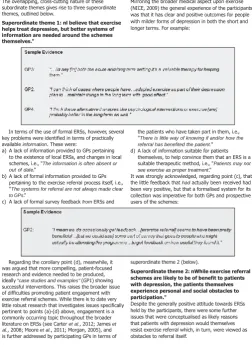
Superordinate theme 1: nl believe that exercise helps treat depression, but better systems of information are needed around the schemes themselves."
In terms of the use of formal ERSs, however, several key problems were identified in terms of practically available information. These were:
a)A lack of information provided to GPs pertaining to the existence of local ERSs, and changes in local schemes, i.e., "The information is often absent or out of date."
b)A lack of formal information provided to GPs pertaining to the exercise referral process itself, i.e., "The systems for referral are not always made clear to GPs."
c)A lack of formal survey feedback from ERSs and
Mirroring the broader medical aspect upon exercise (NICE, 2009) the general experience of the participants was that it has clear and positive outcomes for people with milder forms of depression in both the short and longer terms. For example:
the patients who have taken part in them, i.e., "There is little way of knowing if and/or how the referral has benefited the patient." d)A lack of information suitable for patients
themselves, to help convince them that an ERS is a suitable therapeutic method, i.e., "Patients may not see exercise as proper treatment."
It was strongly acknowledged, regarding point (c), that the little feedback that had actually been received had been very positive, but that a formalised system for its collection was imperative for both GPs and prospective users of the schemes:
Regarding the corollary point (d), meanwhile, it was argued that more compelling, patient-focused research and evidence needed to be produced, ideally "case studies and examples" (GP1) showing successful interventions. This raises the broader issue of difficulties promoting patient engagement with exercise referral schemes. While there is to date very little robust research that investigates issues specifically pertinent to points (a)-(d) above, engagement is a commonly occurring topic throughout the broader literature on ERSs (see Carter et al., 2012; James et al., 2008; Moore et al., 2011; Morgan, 2005), and is further addressed by participating GPs in terms of
superordinate theme 2 (below).
Superordinate theme 2: nWhile exercise referral schemes are likely to be of benefit to patients with depression, the patients themselves experience personal and social obstacles to participation."
Despite the generally positive attitude towards ERSs held by the participants, there were some further issues that were conceptualised as likely reasons that patients with depression would themselves resist exercise referral which, in turn, were viewed as obstacles to referral itself.
Perhaps the most striking of the meta-themes to emerge from the interviews related to the manner in which participants experienced a 'cultural' pressure to use particular kinds of strategies in treating depression. Reflecting concerns endemic in medical literature on the topic (see Hyde et al., 2005), this pressure was taken to manifest in two key ways. The first related
to the notion of bucking medical trends, i.e., the experienced difficulty in prescribing treatments that are not as yet regarded "mainstream" (which is to say not fully "clinically proven") when there are more conventional approaches (usually antidepressant medications) available:
As noted by Moore et al. (2011) the motivation of many patients, including those with depression, to join a public and/or social activity such as an ERS can be coloured by serious and obstructive anxieties. These can be exacerbated by potentially unfamiliar environments such as gymnasia and leisure centres (Wormald & Ingle, 2004). To similar ends, and conversant with the findings of Carter et al. (2012), James et al. (2008) and Callaghan et al. (2011)
participants in the current study spoke extensively of the barriers to motivation that depression itself can erect with regards to such involvement (see sample evidence above).
Strikingly, however, while counselling was seen as a potentially effective strategy in facilitating initial motivation to exercise and socially engage, and for overcoming more general social anxieties, it was also seen as a latent 'double-edged sword':
The second, and closely related to the first, was a perceived and ongoing lack of institutional support (generally fiscal) for the use of therapies that do not
provide a 'quick fix', even when those therapies may save money overall:
Moreover, motivation was viewed not only as an obstacle to initial entry into an ERS (as described above), but also to participating patients sustaining independent involvement in exercise itself once structured supervision (i.e., the formal scheme) was no longer available (see also Moore et al., 2011). This was, in part, attributed to a need among depressed
In short, finances often obstructed long-term use of the scheme and, without the scheme, motivation often obstructed independent exercise. As also evidenced by James et al. (2008), the former was partially explicated by participants as being due to many patients from poorer socio-economic backgrounds simply not being able to afford to participate in formal initiatives once subsidies were no longer available. However, it was
individuals for external regulation to supplement their own motivational difficulties. However, given that ERSs are often free or heavily discounted to patients only in the earlier stages of their involvement, financial barriers were deemed to be significant issues in maintaining adherence to the supervised phase of physical activity itself.
further observed that many persons with depression are often either signed off from work in the long term, or unable to work in a full-time capacity, thus compounding their own financial restrictions.
Superordinate theme 3: Obstacles in the contemporary culture of medicine itself can inhibit my referring patients with depression to exercise schemes."
Since exercise referral was neither seen as a quick fix, nor as a mainstream approach in the treatment of depression (despite having been in use for over a decade), participants thus felt a particular constraint in using it (despite their own stated positive experiences).
These putatively contradictory attitudes, in particular, highlight an issue of circularity stemming from entrenched proof procedures in medical science itself. Across a range of quantitative studies, the efficacy of ERSs for a variety of interventions is deemed largely ambiguous, not due to a lack of evidence per se, but a lack of a very particular type of evidence - that emergent of randomised controlled trials (Lawlor & Hopker, 2001, p.6). However, while randomised controlled trials (RCTs) provide evidence par excellence for the monitored assessment of pharmacological treatments, they are rather less appropriate for investigating interventions such as exercise where issues of effect are inextricably bound up with sociological and psychological questions pertaining to uptake, adherence, and interaction. RCTs are, simply, "not designed to answer such questions as they lack the external validity necessary to faithfully replicate practice" (James et al., 2008, p.218). The upholding of RCTs as the singular gold standard of research by medical culture effectively obviates the possibility that a community-oriented treatment for depression - such an ERS - could attain a truly 'proven' status within that medical culture. This, in turn, has the potential to cyclically perpetuate (a) the difficulties in referring for
individual healthcare professionals described above; (b) the corollary tokenistic funding also described; and (c) ultimately, still fewer robust academic investigations. As originally recommended by the Department of Health (2001), formal academic evaluation of exercise referral schemes should not confine itself to use of the RCT format; to these ends, a much wider array of research forms should be considered if more three-dimensional understandings of impact in this domain are to be generated (Carter et al., 2012; James et al., 2008; Moore et al., 2011).
Conclusions and recommendations
In the inductive analysis above, participants can be seen to raise a number of issues closely allied to those arising in extant literature, but also some hitherto given limited attention. The primary novelty to emerge relates to the links between research, information, culture, and attitude. At the level of broader academic research, and as discussed above, it has for some time been noted that the use of particular quantitative methods alone may prove something of a blunt instrument for the investigation of ERSs on the grand scale (James et al., 2008). However, the manner in which the participants weave together key matters relating to ERSs and depression rehabilitation both implies and directly calls for attention to the character of research and dissemination at the local level: 1.Formalised systems of structured feedback from
patients with depression who have taken part in ERSs - ideally in survey form - would provide GPs
with more robust and systematic evidence with which to inform their own future treatment decisions, and potentially improve their confidence in local decision-making by making available local (rather than general) data.
2.For cases in which referral to an ERS is deemed suitable by a GP, the production of qualitative case- study data could prove invaluable in allaying patient scepticism and also patient anxiety. 'Humanising' the schemes through the dissemination of previous participants' own stories, giving a voice to others 'in the same boat', may help form a valuable bridge between knowing about a scheme and actually feeling ready to take part in it.
Such observations further speak to the production of foundational knowledge bases upon which the grander, multi-method assessments of ERSs called for by the Department of Health (2001) can be constructed.
Affiliations
Rachel L. Ward & Dr Paul K. Miller, University of Cumbria
Contact information
Dr Paul K. Miller, [email protected]
Acknowledgements
The authors would like to thank Adam Benkwitz at the University of Cumbria for his proofreading and feedback.
References
Arvinen-Barrow, M., Penny, G., Hemmings, B., & Corr, S. (2010). UK chartered physiotherapists' personal experiences in using psychological interventions with injured athletes: An interpretative phenomenological analysis. Psychology of Sport & Exercise, 11, 58-66.
BMA. (2009). Quality and outcomes framework guidance for GMS contract 2009/2010. London: British Medical Association.
Callaghan, P., Khalil, E., Morres, I., & Carter, T. (2011). Pragmatic randomised controlled trial of preferred intensity exercise in women living with depression. BMC Public Health, 11, 465-465.
Carter, T., Callaghan, P., Khalil, E., & Morres, I. (2012). The effectiveness of a preferred intensity exercise programme on the mental health outcomes of young people with depression: A sequential mixed methods evaluation. BMC Public Health, 12, 187-187. Chalder, M., Wiles, N. J., Campbell, J., Hollinghurst, S. P., Haase, A. M., Taylor, A. H., ... Lewis, G. (2012). Facilitated physical activity as a treatment for depressed adults: Randomised controlled trial. BMJ (Clinical Research Ed.), 344, e2758-e2758. Daley, A. J., MacArthur, C., & Winter, H. (2007). Brief report: The role of exercise in treating postpartum
depression: A review of the literature. Journal of Midwifery and Women's Health, 52, 56-62. Department of Health. (2001). Exercise referral systems: A national quality assurance framework. London: Department of Health.
Hamill, R., Carson, S., & Dorahy, M. (2010). Experiences of psychosocial adjustment within 18 months of amputation: An interpretative phenomenological analysis. Disability & Rehabilitation, 32(9), 729-740.
Hyde, J., Calnan, M., Prior, L., Lewis, G., Kessler, D., & Sharp, D. (2005). A qualitative study exploring how GPs decide to prescribe antidepressants. British Journal of General Practice, 55(519), 755-762.
James, D. V. B., Johnston, L.H., Crone, D., Sidford, A. H., Gidlow, C., Morris, C., & Foster, C. (2008). Factors associated with physical activity referral uptake and participation. Journal of Sports Sciences, 26(2), 217-224. Johnson, K. E. & Taliaferro, L. A. (2011). Relationships between physical activity and depressive symptoms among middle and older adolescents: A review of the research literature. Journal for Specialists in Pediatric Nursing, 16(4), 235-251.
Lawlor, D. A. & Hopker, S. W. (2001). The effectiveness of exercise as an intervention in the management of depression: Systematic review and meta-regression analysis of randomised controlled trials. BMJ (Clinical Research Ed.), 322(7289), 763-767.
Moore, G. F., Moore, L., & Murphy, S. (2011). Facilitating adherence to physical activity: Exercise professionals' experiences of the national exercise referral scheme in wales: A qualitative study. BMC Public Health, 11, 935-935.
Morgan, O. (2005). Approaches to increase physical activity: Reviewing the evidence for exercise-referral schemes. Public Health, 119(5), 361-370. NICE. (2009). Depression. The NICE guideline on the treatment and management of depression in adults, (updated ed.). Clinical guideline 90. London: National Institute for Health and Clinical Excellence. NEPHO (2012a). Community mental health profile 2012: Cumbria. (No. E10000006-16). North East Public Health Observatory. http://www.nepho.org.uk/cmhp/ index.php?pdf=E10000006
NEPHO. (2012b). Community mental health profile 2012: Lancashire. (No. E10000017-30). North East Public Health Observatory. http://www.nepho.org.uk/ cmhp/index.php?pdf=E10000017
Patton, M. Q. (1990). Qualitative evaluation and research methods, (2nd ed.). London: Sage. Pringle, J., Drummond, J., McLafferty, E., & Hendry, C.(2011). Interpretative phenomenological analysis: A discussion and critique. Nurse Researcher, 18(3), 20-24.
Rhodes, J., & Smith, J. (2010). "The top of my head came off"': A phenomenological interpretative analysis of the experience of depression. Counselling Psychology Quarterly, 23(4), 399-409. Smith, J. A., Flowers, P., & Larkin, M. (2009). Interpretative phenomenological analysis: Theory, method and research. London: Sage. Smith, J. A. & Osborn, M. (2008). Interpretative phenomenological analysis. In J. A. Smith (Ed.), Qualitative psychology: A practical guide to methods (pp.51-80). London: Sage.
Todd, D., Simpson, J., & Murray, C. (2010). An interpretative phenomenological analysis of delusions in people with Parkinson's disease. Disability &
Rehabilitation, 32(15), 1291-1299.
Tylee, A. & Jones, R. (2005). Managing depression in primary care. British Medical Journal, 330(7495), 800-801.
Vachon, M., Fillion, L., Achille, M., Duval, S., & Leung, D.(2011). An awakening experience: An interpretative phenomenological analysis of the effects of a meaning- centered intervention shared among palliative care nurses. Qualitative Research in Psychology, 8(1), 66-80.
Wormald, H. & Ingle, L. (2004). GP exercise referral schemes: Improving the patient's experience. Health Education Journal, 63(4), 362-373
![Shape Prediction for Supramolecular Organic Nanostructures: [4+4] Macrocyclic Tetrapods](data:image/gif;base64,R0lGODlhAQABAIAAAP///wAAACH5BAEAAAAALAAAAAABAAEAAAICRAEAOw==)