
Metabolic changes in some acclimation phenomena
K A R I LAGERSPETZ
Department of Zoology, University of Turku, Turku, Finland
KURZFASSUNG: Stoffwechselver~inderungen bei einigen Akklimatisierungsphlinomenen. Schon in friiheren Untersuchungen wurde nachgewiesen, dal~ die Akklimatisierung yon Ratten an konstante niedrige Temperaturen yon stoffwechselphysiologischen Ver~inderungen im Be- reich der Zetlen begleitet werden. Nach unseren Untersuchungen verursacht Anpassung an kon- stante niedrige Temperaturen auch bei Laboratoriumsm~iusen eine Abnahme der Intensit~it des Muskelzitterns in der K~ilte, einen Anstieg der Stoffwechselrate des Tieres sowie der Aktivit~t des Sukzinodehydrogenase-Komplexes in Leber und Skelettmuskeln. Die Sukzinodehydro- genaseaktivit~t in der Leber m~innlicher M~use zeigt eine Abh~ngigkeit yon der Anpassungs- teraperatur, zuraindest tiber den Bereich yon 50 his 320 C. M~iuse k~Snnen ferner daran angepa~t werden, dag sie wlrksamer auf kurzfristige Kiilteeinwirkungen reagieren. Derartige Anpas- sungen beeinflussen jedoch nicht die Stoffwechselrate oder die Aktivit~it des Sukzinodehydro- genase-Komplexes in der Leber, sondern verursachen eine gesteigerte stoffwechselphysiologische Reaktion auf injiziertes i-Noradrenalin. Die induzierte Widerstandsf~ihigkeit gegeniiber der temperatursenkenden Wirkung des Phenothiazinderivates Promazin entfaltet sich bei M~iusen in einer thermoneutralen Umgebung langsamer als bei Zimmertemperatur. Dieser Umstand deutet auf Nhnlichkeiten hin, weIche bei den ersten Stadien der Promazintoleranz und der Akklimatisierung an kurzfristige K~ilteeinwirkungen bestehen.
I N T R O D U C T I O N
Acclimation phenomena occur as relatively slow regulatory responses to several different types of external variations. The animals can thus compensate for changes in ambient temperature, oxygen content, osmotic pressure, etc. Repeated administration of chemical compounds, just as some drugs and insecticides may also induce a tolerance to their effects in animals. As examples of acclimation phenomena which are accom- panied by metabolic changes, two topics will be considered in this paper: (t) the tem- perature acclimation in homoiotherms, especially in small mammals, and (2) the devel- opment of induced tolerance to the drug promazine in these animals.
Metabolic changes in acclimation 489 revealed the large increase in heat production of mammals and birds during experi- menta! acclimation to constant cold. HA~T, HgROV~X and DEVOCAS in Canada have extensively studied the nature of thermogenesis in cold-acclimated rats. In a cold environment muscle shivering is the most important method of thermogenesis in ani- mals acclimated to a temperature of about 30 ° C. However, during prolonged stay in cold, muscle shivering is replaced by a so-called non-shivering thermogenesis, which occurs in visceral, but mostly in non-visceral tissues, probably in the skeletal muscle (DEPoCAS 1958, 1960) and also in the brown adipose tissue, as has been reported by Dr. SMITH during this symposium. Cotd acclimation in the rat involves an increase in the calorigenic effect of noradrenaline
(HSlEH
& CARLSON 1957, DEVOCAS 1960). Hence, noradrenaline is at present considered the most probable mediator of the meta- bolic effects of cold acclimation.Several changes in cell metabolism have been observed to occur during cold accli- mation (SMITH ~x~ t-IoIJER 1962). You & SELLERS already in 1951 demonstrated the increase of oxygen consumption of various tissues during cold acclimation. In a series of studies, HANNON & VAImHAN (1960a, b) and HANNON (1959, 1960) have shown that the activities of several enzymes in the liver and in the skeletal muscle in rats change during cold acclimation. Especially obvious is the increase of the succinic dehydrogenase activity in the liver (for review see DEVOCAS 1961 and SMITH & HoII~R 1962). The P/O ratio in liver mitochondria seems also to be lowered (SMITH & FAIRHURST 1958, PANACOS et al. 1958), thus indicating a decrease in the efficiency of the oxidative phosphorylation and an increased escape of chemical energy as heat. In our laboratory, some studies on the cold acclimation are in progress. Albino laboratory mice have been used as experimental animals. In a cold environment (80 to t0 ° C) the animals which were previously acclimated to 5 o C for 4 to 14 days showed less muscle shivering than mice kept at 24 o C, and the latter less than animals kept at 32 ° C (LAGERSVETZ 1963b). Oxygen consumption of the cold-acclimated animals was almost doubled (authors unpublished observations). The activity of the succinic de- hydrogenase complex in liver homogenates was measured using the method of KUN & A~OOD (1949). Enzyme activity in mice acclimated to 5 ° C for a week was signifi- cantly higher than that in mice kept at 24 ° C
(LAGE~SWTZ
et al. 1962). Thus earlier observations on rats were confirmed by us, using mice as test animals.RESULTS A N D D I S C U S S I O N
490 K. LAGERSI'ETZ
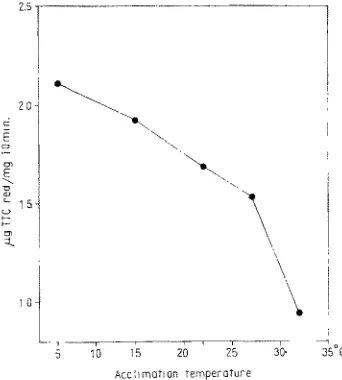
An attempt to acclimate mice to various constant environmental temperatures for one week was also made. The activity of the succinic dehydrogenase complex in the liver homogenates was determined. As can be seen from Figure 1, enzyme activity in these conditions was found to be dependent on the acclimation temperature.
The total energy production of the liver is relatively small when compared with the large mass of skeletal muscle. Since skeletal muscles seem to be especially important also in the non-shivering thermogenesis, studies on changes in the enzyme pattern in
2.5 ¸
2 0 " d
g
F g
I Q
\ \
\
- 4b lg ... % 2s 3F
A C C ',I f~J~i O n te~rlpeFG?uFe
Fig. 1: Activity of the succinic dehydrogenase complex in liver homogenates of male mice as a function of acclimation temperature. Acclimation interval: 7-8 days; 7 animals in each group
muscle would be very interesting. The only observation we have hitherto made is that the activity of the succinic dehydrogenase complex also increases during cold acclima- tion in muscle homogenates from mice (TAr, I~KONEN unpublished). In several papers, HART, HkRoux and DEVOCAS have pointed out that there are important physiological differences between rats acclimated to constant cold in the laboratory and those accli- mated to outdoor winter conditions. In contrast to the experiments described above, some observations were also made concerning a third type of acclimation to cold, the acclimation to short cold exposures.
Metabolic changes in acclimation 49t
any differences in the activity of the succinic dehydrogenase complex in liver homoge- nares.
The metabolic response to a single injection of 1-noradrenaline was also studied using animals acclimated to short coid exposures. This was done by narcotising the animals slightly through intraperitoneal injections with sodium pentobarbital (45 mg/ kg) and by measuring their oxygen consumption using an open circuit Pauling para-
o e
4 0 . . . .
/
~1.5 u" / i
2,//`
3 0 ~ ... v - E --~ 1 3 . . . ~ 5 r - ... ~ - - z g Days
Fig. 2: Acclimation of male mice to daily short-term exposures to cold. Graph C: mean colonic temperature before cold exposure. Time in hours from the beginning of cold exposure
is indicated le~ of each graph; 8 test animals
Table 1
The effect of 1 mg per kg I-noradrenaline (NA) on the oxygen consumption (ml/g • h) of mate mice acclimated to daily short cold exposures during eight days. Pentobarbital narcosis
(45 mg per kg I. P.)
Before NA injection A~er NA injection
Time in minutes 0-15 0-10 10-20 20-30
Controls (8) 1.35 2.23 2.27 2.03
Acclimated (8) 1.40 2.77 3.10 2.71
magnetic oxygen analyzer system. During narcosis, 1 mg/kg 1-noradrenaline was in- jected intraperitoneally and oxygen consumption again measured for 30 minutes at 240 C. The results are shown in Table 1. It appears that the animals acclimated to short cold exposures are more responsive to noradrenaline than the controls, the dif- ference in the oxygen consumption values being statistically significant (p < 0.01). The increased sensitivity to noradrenaline is a feature also common to both white rats acclimated to constant cold (Dm~ocAs 1960) and to wild N o r w a y rats captured during winter (H~t~oux 1962). Hence increased metabolic responsiveness to noradrenaline seems to be a common denominator for the different types of cold acclimation and seasonal winter acclimatization whi& have been studied.
492 K . L A G E R , S P E T Z
humans. COURVOISIER et al. (1953) in their pioneer study on the pharmacology of phenothiazines observed the prominent hypothermisant effect of these drugs in small mammals. Already in rather small doses (5 mg/kg) promazine causes a drop in body temperature of mice (LAGERSWTZ & TmRI 1958). The decrease in body temperature
C J ~ r r r - - C
37 I- 37
[
36 t- 36
3 5 / ~ - ~ ... ~ 3 5
/
37 - 37
3 4 3 4
3 3 3 3
3 2 ~- i 3 2
I
31 t -- 31
3 0 L i 1 I k 1_ 3 0
1 5 10 15 20
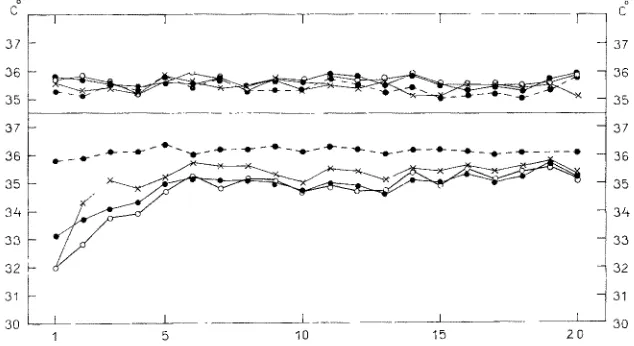
Fig. 3: Development of induced tolerance to promazine. Mean colonic temperatures of mice before injection (bla& dots with interrupted line), and respectively 0.5 (bla& dots), 1 (open circles) and 3 hours (crosses) after injection of Ringer's solution (upper part of Fig.) or of 10 mg promazine per kg (lower part of Fig.). Horizontal: time in days after beginning of daily
administration; 20 animals in both groups
Table 2
Differences between the colonic temperatures measured before and one hour aecer the injection of Ringer's solution (controls) or 10 mg promazine per kg (experimental). The values of t have
been calculated according to the method for dependent measures
Day of treatment
1 6 15
Controls (15) - - 0.3 _+ 0.2 - - 0.3 +_ 0.2 0.0 _+ 0.1 Experimental (15) - - 3.2 +_ 0.4 - - 1.4 +_ 0.2 - - 1.2 +_ 0.2
t 4.14 0.56
p 0.001 n.s.
is of course dependent on the external temperature (LAc~I~sl, ETZ & T m e , i 1958, Ltm~RSVETZ 1963b). We observed that daily administrations of promazine induce a tolerance to its effect on body temperature (LAGEttSWTZ & TIRRI 1961, LAG~I~SVETZ 1963a). I f the colonic temperature of the animals is measured daily before injection, and again say one hour after it, the decrease in body temperature caused by promazine diminishes in about 5 to 6 days (LAorttse~Tz 1963a). This result is shown in Figure 3 and in Table 2.
Metabolic changes in acclimation 493 seems to indicate that the tolerance to the hypothermisant effect of promazine would be, at least for the most p a r t , onty a cold acclimation phenomenon, similar to that which occurs in response to short cold exposures during which the body temperature also decreases.
However, animals which had received promazine daily for one week at 24 o C and thus were tolerant to its hypothermisant effects were not able to keep their body tem- perature higher than the controls when animals of both groups were subjected to an ambient temperature of about 2 ° C individually in small containers. Hence we feel that the induced tolerance to promazine is not merely comparable to acclimation to short cold exposures but is a more specific phenomenon. Several enzymes have been shown earlier to be inhibited by promazine. Our attempts to correlate promazine tolerance with changes in the activities of some of these enzymes in brain homogenates were un- successful (LAG~RSPETZ & Tn~r,I 1963). No significant differences were found in the succinic dehydrogenase complex activity, in the cytochrome c oxidase activity or in the FAD concentration in brain homogenates from tolerant and control mice. At pre- sent the work on promazine tolerance in mice is directed to the excretion of promazine and to the effects of catecholamines in tolerant and control animals.
In conclusion, the scattered observations presented above are more of a working program than a ready basis for interpretations. However, they seem to point out the special importance of two approaches in the study of the physiological variations of metabolism. First, attempts are needed to correlate biochemical data of tissue metab- olism with the physiology of cell organelles, e. g., the mitochondria. Secondly, the importance of the nervous system and the neurohumours, especially of the catechota- mines as mediators of acclimative metabolic responses in vertebrates, should be stressed.
SUMMARY
t. Acclimation to constant cold also causes in mice a decrease in the intensity of muscle shivering in cold and an increase in the metabolic rate of the animal and in the succinic dehydrogenase complex activity in the liver and skeletal muscles.
2. The succinic dehydrogenase complex activity in the liver depends on the acclimation temperature at least over a range from 50 to 32 o C.
3. Acclimation of mice to short-term exposures to cold does not affect metabolic rate of the animals or the succinic dehydrogenase complex activity in the liver but causes an increase in the metabolic response to injected 1-noradrenaline.
4. The induced tolerance to the hypothermisant effect of promazine in mice develops slower in a thermoneutral environment than at room temperature.
LITERATURE CITED
COURVOISlER, S., FOUI~NEL, J., DUCROT, R., KOLSKY, M. & KOETSCHET, P., 1953. Propri6t6s pharmacodynamiques du chlorhydrate de chtor-3(dimethylamino-3 propyl)-10 ph6nothia- zine. Arch. int. Pharmacodyn. 92, 305-361.
D~vocAs, F., 1958. Chemical thermogenesis in the functionally eviscerated cold-acclimated rat.
494 K. LAGERSPETZ
- - 1960. The calorigenic response of cold-acclimated white rats to infused noradrenatine.
Canad. J. Biochem. Physiol. 38, 107-114.
- - 1961. Biochemical changes in exposure and acclimation to cold environments. Brit. rned.
Bull. 17, 25-31.
GELINEO, S., 1934. Influence du milieu thermique d'adaptation sur la thermogen6se des hom6o-
thermes. Ann. physiol, physicoch~rn, biol. 10, 1083-Ii15.
- - 1955. TempErature d'adaptation et production de chaIeur &ez Ies oiseaux de petite tailIe.
Arch. Sci. physiol. 9, 225-243.
HANNON, J. P., 1959. Effect of prolonged coId exposure on oxidative phosphorylation and
adenosinetriphosphatase activity of rat liver tissue. Am. J. Physiol. 196, 890-892.
- - 1960a. Effect of prolonged cold exposure on components of the electron transport system.
Am. J. Physiol. 198, 740-744.
- - 1960b. Tissue energy metabolism in the cold-acclimatized rat. Fed. Proc., Pat. II, 19,
139-144.
- - & VAUOHAN, D. A., 1961. Effect of exposure duration on selected enzyme indexes of cold
acclimation. Am. ]. Physiol. 200, 94-98.
HI~Roux, O., 1962. Seasonal adjustments in captured wild Norway rats. If. Survival time,
pelt insulation, shivering, and metabolic and pressor responses to noradrenaline. Canad.
J. Biochern. Physiol. 40, 537-545.
HSI~H, A. C. L. & CARLSON, L. D., 1957. Role of adrenali/le and noradrenaline in chemical
regulation of heat production. Am. J. Physiol. 190, 243-246.
KUN, E. & ABOOD, L. G., 1949. Colorimetric estimation of succinic dehydrogenase by tri-
phenyltetrazolium &loride. Science 109, 144-146.
LAG~SI,~Tz, K., 1963a. The induction of physiological tolerance to promazine in mice. II. The
development of induced tolerance. Ann. reed. exp. Fenn. 41, 214-219.
- - 1963b. Temperature acclimation and experimental temporary poikilothermia in mice. Ann.
rned. exp. Fenn. 41, 202-213.
- - TARKKOI~EN, H. & TIR~t, R., 1962. Effect of cold acclimatization on the succinic dehydro-
genase activity in the liver and brain tissues of mice. Experientia 18, 552.
- - & TIRRI, R., 1958. The production of temporary poikilothermia in mice by promazine
hydrochloride and the effect of insulin on the body temperature of mice. Arch. Soc. zool.-
hot. ~enn. Vanamo 12, 185-194.
- - , - - 1961. The induction of physiological tolerance to promazine in mice. Ann. reed. exp.
Fenn. 30 (suppl. 5), 1-24.
- - - - 1963. The induction of physiological tolerance to promazine in mice. III. Respiratory
enzymes in the brain in induced tolerance. Ann. reed. exp. Fenn. 41, 315-318.
PANAGOS, S., BEXE~, R. E. & Masor~o, E. J., 1958. Oxidative phosphorylation in liver mito-
chondria prepared from cold-adapted rats. Biochern. biophys. Acta 29, 204-205.
SMITH, JR. E. 82 FAIRHURST, A. S., 1958. A mechanism of cellular thermogenesis in cold-adap-
tation. Proc. nat. Acad. Sci., Wash. 44, 705-711.
- - & t-IOIJER, D. J., 1962. Metabolism and cellular function in cold acclimation. Physiol. Rev.
4 2 , 60-142.
You, R. W. & SrLLEt~S, E. A., 1951. Increased oxygen consumption, and succinoxidase activity
of liver tissue after exposure of rats to cold. Endocrinology 49, 374-378.
Discussion following the paper by LAGERSI'ETZ
GRAINGER: A student of mine, Miss Cecily JoYcz, has found that by warming one ear and cooling the other ear of the same rabbit, the succinic dehydrogenase activity of the isolated skin from these ears reaches the same levels as are found in warm and cold adapted rabbits respectively, thus showing that in some mammalian tissues, environmental temperature has a direct effect in bringing about adaptive changes in enzymes.
![5 Hydroxy 6,7 dimethoxy 2 [(E) 1 (4 methoxyphenyl)methylidene] 3,4 dihydro 2H napthalen 1 one](data:image/gif;base64,R0lGODlhAQABAIAAAP///wAAACH5BAEAAAAALAAAAAABAAEAAAICRAEAOw==)