R E S E A R C H A R T I C L E
Open Access
Can coffee or chewing gum decrease
transit times in Colon capsule endoscopy?
A randomized controlled trial
Maria Magdalena Buijs
1,2*, Morten Kobaek-Larsen
1, Lasse Kaalby
1and Gunnar Baatrup
1,2Abstract
Background:A high rate of complete colon capsule endoscopy (CCE) investigations is required for a more widespread use of CCE. The objective of this study was to assess if coffee or chewing gum can increase excretion of the colon capsule within battery life time (excretion rate).
Methods:One hundred eighty six screening participants with a positive immunochemical fecal occult blood test were included in this single-centre randomized controlled trial with blinding of the investigators to the randomization. Participants received instant coffee, chewing gum or nothing in addition to the standard bowel preparation.
Results:The intention was to include 57 participants in the coffee group, 61 in the chewing gum group and 60 in the control group, on 8 participants data were missing. A total of 165 participants were included in a per protocol analysis. Exclusion was due to not receiving the allocated intervention (8 coffee, 4 chewing gum) and technical failure of the capsule (1 coffee). The excretion rate was 58% in the coffee group (n= 48), 63% in the chewing gum group (n= 57) and 55% in the control group (n= 60,p >0.2). Transit times were similar in all groups. The excretion rate was low in participants who had transit times over 10 h (14%). A strong correlation was found between adequate cleansing and excretion of the capsule.
There were no serious adverse events related to the interventions or CCE investigations.
Conclusions:Chewing gum and coffee did not improve excretion rate in this study. An effect of chewing gum could not be proven, possibly due to sample size. Since chewing gum might improve excretion rates, is cheap and has no known side effects, it needs to be considered in future bowel preparation trials for CCE.
Trial registration:NCT02303756, registered on December 1st 2014.
Keywords:Colon capsule endoscopy, Transit time, Excretion rate, Bowel preparation, Coffee, Chewing gum, Bowel cleansing
Background
Colon capsule endoscopy (CCE) was introduced in 2006 as a new imaging technique of the colon [1]. CCE does not require sedation or analgesia and the patient can stay at home during the investigation. The European Society of Gastrointestinal Endoscopy has approved the use of CCE in average risk patients, after an incomplete colonoscopy and in patients who refuse or have contraindications for a
colonoscopy [2]. In recent years CCE has been studied in colorectal cancer screening participants with promising results [3–5]. CCE might improve the screening program by selecting participants with proven neoplasia for thera-peutic colonoscopy, since the low sensitivity of the immu-nochemical fecal occult blood test (iFOBT) induces a substantial number of false negative results [6]. Limiting factors for the use of CCE are the cleanliness of the colon during the investigation and the number of capsules that are not excreted within battery life time [1]. In a recent meta-analysis a completion rate of 90.5% (95% CI: 88.3– 92.4%) was calculated for CCE, which is similar to the rate of complete screening colonoscopies in Denmark of 89%
* Correspondence:[email protected]
1Department of Clinical Research, University of Southern Denmark, Winsløwsparken 19, 3rd floor, 5000 Odense, Denmark
2Department of Surgery, Odense University Hospital, Baagøes Allé 15, Forskningshus, 5700 Svendborg, Denmark
[7, 8]. Multiple studies have assessed bowel preparation and boosters for CCE in order to enhance cleanliness and reduce transit times [9–14]. According to Danish guide-lines all screening participants should receive a standard polyethylene glycol-electrolyte (PEG) based bowel prepar-ation, which leads to low excretion rates. The use of boosters other than PEG was not allowed and therefore nonmedical interventions were considered as an alterna-tive to improve completion rates. Coffee and chewing gum have been reported to reduce transit time in small bowel capsule endoscopy and after abdominal surgery [15–17]. Some clinics already use coffee or chewing gum as part of their CCE bowel preparation, but their effect has not been studied in CCE as yet. The objective of this study was to investigate if addition of either coffee or chewing gum to the standard CCE bowel preparation can increase excretion during battery life time.
Methods
Study design
This study was a sub study within the Care for Colon study in which home delivered CCE was investigated in iFOBT positive screening participants (ClinicalTrialst.gov: NCT02303756) [18]. This study was conducted as a single-center randomized controlled trial, with blinding of the investigators to the randomization. Randomization in three equal groups was achieved by closed envelops with allocated interventions, which were opened by an inde-pendent research nurse prior to the ingestion of the colon capsule. Participants had the possibility to decline the intervention, which lead to exclusion from analysis. The primary endpoint was the excretion rate of CCE in the dif-ferent intervention groups. Secondary endpoints were total transit time, colon transit time, the number of cap-sules retained before the cecum and bowel cleansing qual-ity in the different intervention groups.
Study population
Participants of the Care for Colon study were recruited from the national screening program on the island of Funen, Denmark, which includes average risk individuals between 50 and 74 years of age. In case of a positive iFOBT they were invited to participate in the trial and were in-cluded after obtaining informed consent. Exclusion criteria included previous bowel surgery (except for appendec-tomy), inflammatory bowel disease, ostomy and clinical symptoms of bowel obstruction in the last three months, diabetes mellitus and vomiting during the preparation.
Interventions
All groups received standard bowel preparation with PEG (Moviprep®) and PEG boosters after ingestion of the colon capsule, as described in the Additional file1: Table S1. All participants were assisted with ingestion of the colon
capsule by a study nurse. The intervention was timed based on an alarm that went off when the capsule left the stomach. The coffee group was asked to drink one cup of instant coffee (57 mg caffeine) three hours after the cap-sule left the stomach. The chewing gum group chewed two pieces of sugar free chewing gum to chew for at least 30 min after the capsule left the stomach. The control group did not receive any intervention.
CCE analysis
All CCE investigations were performed with a second gen-eration CCE (PillCam2®, Given Imaging, Israel). The CCE images were analyzed by experienced gastroenterologists who selected the first cecum image and last (rectal) image, which contained time stamps corresponding to the time since intake of the capsule. Bowel cleansing quality was assessed by the gastroenterologist based on the Leighton-Rex scale as either adequate or inadequate [19].
Data collection
Basic characteristics including sex and age were collected prospectively. Data on the capsule as excretion of the cap-sule, capsules retained before the cecum, total transit time, colon transit times and bowel cleansing quality were col-lected prospectively from the CCE evaluation reports.
Sample size calculation and statistics
This study was designed with the assumption that the best intervention would yield an excretion rate of 90%, the next 75% and the last group 60%. Based on this as-sumption and a power of 90%, a total of 49 participants should be included in each group. Adjusting for a drop-out rate of 10% each group needed to include 54 participants. We decided on including 60 participants in each of the three groups.
The results were analyzed by a per protocol analysis, in order to reliably assess the effect of the interventions [20]. Basic characteristics are presented as means with standard deviations for continuous variables and percentages for bin-ary variables. Transit times are presented as medians with range, after proving absence of normality with the Shapiro-Wilk test. Significance was tested using Chi2 test and Fishers Exact Test for binary variables and Kruksal Wallis test for non-normal distributed continuous variables. In addition, a univariate and multivariate regression analysis on variables effecting excretion rate was conducted. Statis-tical analyses were performed using Stata IC 15.0.
Results
All 12 participants that refused their allocation (8 coffee and 4 chewing gum) were excluded from the per proto-col analysis. In the coffee group one study was incom-plete due to technical failure of the colon capsule three minutes after ingestion and therefore excluded from per protocol analysis.
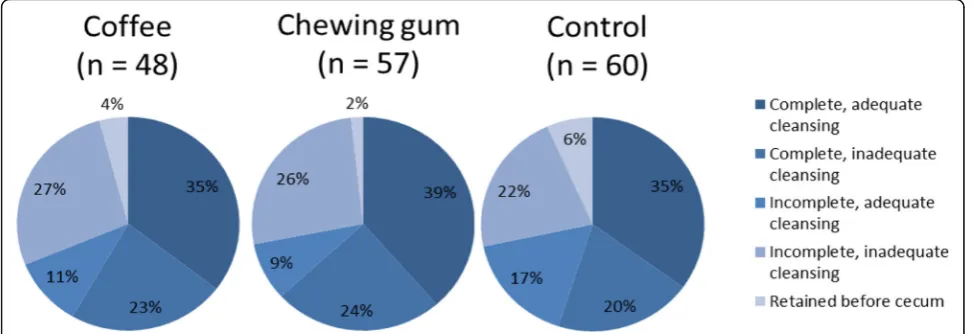
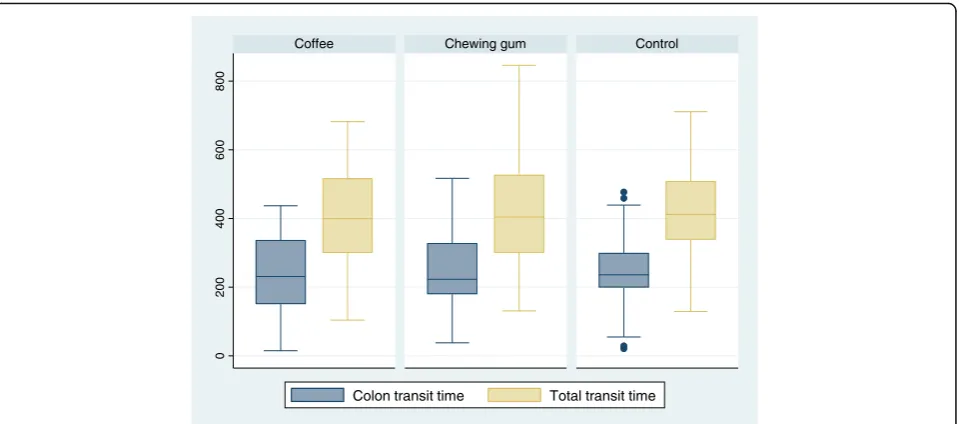
Sixty-six % (n= 109) of participants were male and their average age was 64 ± 7 years. The age of participants was similar in all groups, but there was a trend towards more male participants in the chewing group (77% vs 55 and 63% in respectively the coffee and control group, p= 0.052). The excretion rates, bowel quality and amount of capsules that was retained before the cecum are displayed in Fig. 1. There were no significant differences between the groups, even though the chewing gum had the highest excretion rate of 63% (95% CI: 49–76) in comparison to coffee (58%; 95% CI: 43–72) and controls (55%; 95% CI: 42–68). Chewing gum had also the lowest number of cap-sules retained before the cecum. Colon and total transit times were similar in all groups (Fig.2). Previous studies generally presented the total transit time in categories, which are presented in Additional file1: Figure S1.
A sub analysis was performed to analyze possible fac-tors that influenced excretion rate (Table1).
Both young age and an adequate bowel cleansing were correlated to improved excretion rates, but in a multi-variate analysis none of these factors significantly influ-enced excretion.
Technical failures did not seem to influence battery life time, since the average total transit time in the in-complete group was almost 15 h. The two participants with an incomplete investigation and a transit time of less than 10 h; respectively 6.5 and 9.5 h did have black-outs during the video. The majority of participants with a transit time of less than 10 h had a complete investiga-tion, contrary to the group with a longer transit time (98% vs 14%).
There were no serious adverse events related to the in-terventions or CCE investigations.
Discussion
In order to avoid unnecessary diagnostic colonoscopies by the use of CCE, a high excretion rate is essential. In this randomized controlled trial addition of chewing gum to the standard protocol improved excretion rates and decreased the number of capsules that were retained before the cecum. This effect was not significant, which might be due to a type II error. The effect of coffee was inferior to that of chewing gum in this study. A sub ana-lysis showed that a younger age and adequate bowel cleansing quality had a strong correlation with excretion of the capsule within battery life time, but a causal effect could not be demonstrated.
One study reported an excretion rate of 76% with a similar preparation asused in this study [11]. Our excre-tion rate of 58% might be explained by differences in the protocols: 1) bowel preparation in the study by Hart-mann et al. was started one day instead of two days prior to the investigation; 2) PEG boosters were administered two and 6 h after ingestion of the capsule instead of dependent on the moment the capsule left the stomach; 3) Hartmann et al. performed a pilot study including 49 patients; and 4) our study was performed as an out clinic instead of in clinic procedure.
Methodologic limitations of this study are the exclusion of participants after randomization and unclear allocation of intervention in eight objects, which caused the coffee group to be smaller than the other groups; and the ab-sence of a sample size calculation. The sample size of this study was not powered to prove a difference of 8%, there-fore a significant effect cannot be demonstrated. This study might lack effect because the interventions were ap-plied only once, whereas previous studies distributed the intervention multiple times [15–17,21]. Additionally, the
interventions were dependent on passage through the stomach, instead of planned on set times after ingestion of the capsule.
The exact physiologic effects of coffee and chewing gum on the bowel are still unknown. A study in healthy volun-teers indicates that coffee increases the rectosigmoid mo-tility in about a third of the individuals [22]. Coffee has been shown to reduce time to first bowel movement after colorectal and gynecologic surgery by 9.4–15.4 h on aver-age [17, 23, 24]. A recent meta-analysis on the effect of chewing gum on postoperative ileus after colorectal sur-gery, including 1736 patients from 18 RCTs, observed a reduction of 16.4 h (95% confidence interval: −22.7; − 10.2) of time to first bowel movement [25]. One of the two studies in small bowel capsule endoscopy found a sig-nificant reduction of transit time. However this study was conducted as a pilot study without a sample size calcula-tion [15]. Both studies distributed chewing gum immedi-ately after ingestion of the capsule and every 2 h afterwards. If coffee and chewing gum would have been applied immediately after ingestion of the capsule and re-peated every 2–3 h afterwards, the effect of these inter-ventions might have been stronger than demonstrated in this study.
Conclusions
Increasing the rate of complete CCE investigations is necessary for the implementation of CCE in clinical routine diagnostics. Chewing gum did improve the ex-cretion rate in this study (not significantly), is cheap and has no known side effects; therefore the addition of chewing gum should be considered in future bowel preparation studies. The strong correlation between ad-equate bowel cleansing quality and complete investiga-tions, suggests that an effective bowel preparation will improve both cleansing quality and completion rate and inspires to continue investigating bowel prepara-tions for CCE.
Additional file
Additional file 1:Table S1.Bowel preparation with timing of PEG
cleansing and boosters.Figure S1.Total transit time in categories of CCE
investigations by intervention. (DOCX 31 kb).
Abbreviations
CCE:Colon Capsule Endoscopy; iFOBT: Immunochemical fecal occult blood
test; PEG: Polyethylene glycol-electrolyte
Acknowledgements
Anne-Kirstine, Dyrvig, for assisting in designing the study and proofreading earlier versions of this manuscript.
Funding
Medtronic® provided financial support in the purchase of the colon capsules; but had no final influence on the study design and manuscript. Independent financial support was also obtained from the Danish Cancer Society, OUH research fund and the Region of Southern Denmark. There are no other relationships or activities that could appear to have influenced the submitted work.
0
200
400
600
800
Control
Coffee Chewing gum
Colon transit time Total transit time
Fig. 2Colon and total transit time in complete CCE investigations by interventionTransit times in minutes presented as a boxplot with median, quartiles and outliers (dots).
Table 1Univariate analysis on excretion of capsules
Non-excreted (n= 68)
Excreted
(n= 97) P Age (years) 66.0 (64.3–67.6) 62.7 (61.2–64.2) < 0.01
Sex (male) 62% (49–73) 69% (59–78) > 0.2
Bowel cleansing (adequate) 30% (19–42) 62% (51–72) < 0.001
Availability of data and materials
All data analysed during this study are included in this published article and its supplementary information files.
Authors’contributions
GB and MKL have designed this study and also read and approved the final manuscript. Collection of data, statistical analysis and writing the manuscript was mainly done by MMB. Assistance with statistical analysis and critical proofreading of the manuscript were done by LKM. All authors read and approved the final manuscript.
Ethics approval and consent to participate
All participants received written and oral information about the Care for Colon study and signed informed consent. They could withdraw from the study at any time without consequences for their treatment. Participants were not financially motivated to participate in the study. The National Ethical Committee and the Data Protection Agency approved the Care for Colon study and the ethical committee (S20140141) approved this sub study as part of the Care for Colon study.
Consent for publication
Not applicable.
Competing interests
The authors declare that they have no competing interests.
Publisher’s Note
Springer Nature remains neutral with regard to jurisdictional claims in published maps and institutional affiliations.
Received: 13 April 2018 Accepted: 14 June 2018
References
1. Spada C, Barbaro F, Andrisani G, Minelli Grazioli L, Hassan C, Costamagna I,
Campanale M, Costamagna G. Colon capsule endoscopy: what we know and
what we would like to know. World J Gastroenterol. 2014;20(45):16948–55.
2. Spada C, Hassan C, Galmiche JP, Neuhaus H, Dumonceau JM, Adler S,
Epstein O, Gay G, Pennazio M, Rex DK, et al. Colon capsule endoscopy: European Society of Gastrointestinal Endoscopy (ESGE) guideline.
Endoscopy. 2012;44(5):527–36.
3. Holleran G, Leen R, O’Morain C, McNamara D. Colon capsule endoscopy as
possible filter test for colonoscopy selection in a screening population with
positive fecal immunology. Endoscopy. 2014;46(6):473–8.
4. Rondonotti E, Borghi C, Mandelli G, Radaelli F, Paggi S, Amato A, Imperiali G,
Terreni N, Lenoci N, Terruzzi V, et al. Accuracy of capsule colonoscopy and computed tomographic colonography in individuals with positive results from the fecal occult blood test. Clin Gastroenterol Hepatol: Offic Clin Pract
J Am Gastroenterol Assoc. 2014;12(8):1303–10.
5. Rex DK, Adler SN, Aisenberg J, Burch WC Jr, Carretero C, Chowers Y, Fein SA,
Fern SE, Fernandez-Urien Sainz I, Fich A, et al. Accuracy of capsule colonoscopy in detecting colorectal polyps in a screening population.
Gastroenterology. 2015;148(5):948–57. e942
6. Allison JE, Sakoda LC, Levin TR, Tucker JP, Tekawa IS, Cuff T, Pauly MP,
Shlager L, Palitz AM, Zhao WK, et al. Screening for colorectal neoplasms with new fecal occult blood tests: update on performance characteristics.
JNCI: J Natl Cancer Inst. 2007;99(19):1462–70.
7. Spada C, Pasha SF, Gross SA, Leighton JA, Schnoll-Sussman F, Correale L,
Gonzalez Suarez B, Costamagna G, Hassan C. Accuracy of first- and second-generation Colon capsules in endoscopic detection of colorectal polyps: a systematic review and meta-analysis. Clin Gastroenterol Hepatol: Offic Clin
Pract J Am Gastroenterol Assoc. 2016;14(11):1533–1543.e1538.
8. Rasmussen M. Dansk tarmkræftscreeningsdatabase årsrapport 2015. In:
København: Dansk tarmkræftscreeningsdatabase (DTS); 2016.
9. Spada C, Riccioni ME, Hassan C, Petruzziello L, Cesaro P, Costamagna G.
PillCam colon capsule endoscopy: a prospective, randomized trial comparing
two regimens of preparation. J Clin Gastroenterol. 2011;45(2):119–24.
10. Spada C, Hassan C, Ingrosso M, Repici A, Riccioni ME, Pennazio M, Pirozzi GA,
Pagano N, Cesaro P, Spera G, et al. A new regimen of bowel preparation for PillCam colon capsule endoscopy: a pilot study. Dig Liver Dis : Offic J Italian
Soc Gastroenterol Italian Assoc Stud Liver. 2011;43(4):300–4.
11. Hartmann D, Keuchel M, Philipper M, Gralnek IM, Jakobs R, Hagenmuller F,
Neuhaus H, Riemann JF. A pilot study evaluating a new low-volume colon
cleansing procedure for capsule colonoscopy. Endoscopy. 2012;44(5):482–6.
12. Kakugawa Y, Saito Y, Saito S, Watanabe K, Ohmiya N, Murano M, Oka S,
Arakawa T, Goto H, Higuchi K, et al. New reduced volume preparation regimen
in colon capsule endoscopy. World J Gastroenterol. 2012;18(17):2092–8.
13. Singhal S, Nigar S, Paleti V, Lane D, Duddempudi S. Bowel preparation
regimens for colon capsule endoscopy: a review. Ther Adv Gastroenterol.
2014;7(3):115–22.
14. Togashi K, Fujita T, Utano K, Waga E, Katsuki S, Isohata N, Endo S, Lefor AK.
Gastrografin as an alternative booster to sodium phosphate in colon capsule endoscopy: safety and efficacy pilot study. Endosc Int Open. 2015;
3(6):E659–61.
15. Apostolopoulos P, Kalantzis C, Gralnek IM, Liatsos C, Tsironis C, Kalantzis N.
Clinical trial: effectiveness of chewing-gum in accelerating capsule
endoscopy transit time–a prospective randomized, controlled pilot study.
Aliment Pharmacol Ther. 2008;28(4):405–11.
16. Ho YM, Smith SR, Pockney P, Lim P, Attia J. A meta-analysis on the effect of sham
feeding following colectomy: should gum chewing be included in enhanced
recovery after surgery protocols? Dis Colon Rectum. 2014;57(1):115–26.
17. Muller SA, Rahbari NN, Schneider F, Warschkow R, Simon T, von
Frankenberg M, Bork U, Weitz J, Schmied BM, Buchler MW. Randomized clinical trial on the effect of coffee on postoperative ileus following elective
colectomy. Br J Surg. 2012;99(11):1530–8.
18. Kobaek-Larsen M, Kroijer R, Dyrvig AK, Buijs MM, Steele RJC, Qvist N, Baatrup
G. Back-to-back colon capsule endoscopy and optical colonoscopy in
colorectal cancer screening individuals. Color Dis. 2018; 20(6):479–85.
https://doi.org/10.1111/codi.13965.
19. Leighton JA, Rex DK. A grading scale to evaluate colon cleansing for the
PillCam COLON capsule: a reliability study. Endoscopy. 2011;43(2):123–7.
20. Giorgi Rossi P. Screening: the information individuals need to support their
decision: per protocol analysis is better than intention-to-treat analysis at quantifying potential benefits and harms of screening. BMC medical ethics. 2014;15:28.
21. Ou G, Svarta S, Chan C, Galorport C, Qian H, Enns R. The effect of chewing
gum on small-bowel transit time in capsule endoscopy: a prospective,
randomized trial. Gastrointest Endosc. 2014;79(4):630–6.
22. Brown SR, Cann PA, Read NW. Effect of coffee on distal colon function. Gut.
1990;31(4):450–3.
23. Dulskas A, Klimovskij M, Vitkauskiene M, Samalavicius NE. Effect of coffee on
the length of postoperative ileus after elective laparoscopic left-sided colectomy: a randomized, prospective single-center study. Dis Colon
Rectum. 2015;58(11):1064–9.
24. Gungorduk K, Ozdemir IA, Gungorduk O, Gulseren V, Gokcu M, Sanci M.
Effects of coffee consumption on gut recovery after surgery of gynecological cancer patients: a randomized controlled trial. Am J Obstet
Gynecol. 2017;216(2):145.e141–7.
25. Liu Q, Jiang H, Xu D, Jin J. Effect of gum chewing on ameliorating ileus
following colorectal surgery: a meta-analysis of 18 randomized controlled