New Proposal on the Development of Machine Protection
Functions for ITER Diagnostics Control
∗
)
Tsuyoshi YAMAMOTO
1,2), Eiichi YATSUKA
1), Takaki HATAE
1), Kazuya OTA
2),
Yasunori HASHIMOTO
2), Kitaru NAKAMURA
2), Tatsuo SUGIE
3), Masaki TAKEUCHI
1),
Sin-iti KITAZAWA
1), Hiroaki OGAWA
1), Yasunori KAWANO
1)and Kiyoshi ITAMI
1)1)Japan Atomic Energy Agency, Naka-shi, Ibaraki 311-0193, Japan∗∗) 2)Japan Expert Clone Corporation, Shinjuku-ku, Tokyo 160-0022, Japan
3)Nippon Advanced Technology Co. Ltd., Tokai-mura, Ibaraki 319-1112, Japan
(Received 30 November 2015/Accepted 25 August 2016)
There is a need to develop ITER instrumentation and control (I&C) systems with high reliabilities. Interlock systems that activate machine protection functions are implemented on robust wired-logic systems such as pro-grammable logic controllers (PLCs). We herein propose a software tool that generates program code templates for the control systems using PLC logic. This tool decreases careless mistakes by developers and increases reli-ability of the program codes. A large-scale engineering database has been implemented in the ITER project. To derive useful information from this database, we propose adding semantic data to it using the Resource Descrip-tion Framework format. In our novel proposal for the ITER diagnostic control system, a guide words generator that analyzes the engineering data by inference is applied to the hazard and operability study. We validated the methods proposed in this paper by applying them to the preliminary design for the I&C system of the ITER edge Thomson scattering system.
c
2016 The Japan Society of Plasma Science and Nuclear Fusion Research
Keywords: ITER, machine protection, inference, program code template, HAZOP DOI: 10.1585/pfr.11.2405114
1. Introduction
ITER is an international experimental nuclear fusion device with challenging technological requirements [1]. Machine protection is an important function for maintain-ing high reliability and safe operation in large experimen-tal facilities such as ITER. Therefore, the ITER instrumen-tation and control (I&C) system requires high reliability. The ITER I&C system comprises the control system, in-terlock system, and safety system [2]. The inin-terlock and safety systems are implemented on wired-logic systems and are responsible for machine protection and safety, re-spectively. The control system, which is a software-based system, controls and monitors the plant. In this paper, we focus on consistency between the designs of the control and interlock systems.
The interlock system, which performs protective ac-tions for the ITER plant systems, is implemented with ro-bust controllers such as programmable logic controllers (PLCs). However, the control system is implemented with industrial computers. To ensure interoperability between the interlock and control systems, we propose a method to convert an interlock logic described by the PLC code into author’s e-mail: [email protected]
∗)This article is based on the presentation at the 25th International Toki
Conference (ITC25).
∗∗)Current affiliation: National Institutes for Quantum and Radiological
Science and Technology
another programming language for the control system. As an example implementation, we applied this method to the design of the ITER edge Thomson scattering (ETS) sys-tem, which is being developed in Japan. ETS is a diagnos-tic system for measuring electron densities and tempera-ture profiles of ITER plasmas using a high-energy laser [3]. The ETS system must protect the vacuum window and other devices from laser hazards. Therefore, our method can be validated through ETS development.
A large-scale engineering database has been imple-mented in the ITER project [4, 5]. This database has the potential to produce useful information for the design of the I&C system [6, 7]. We developed a new method to add semantics data to the engineering database via information technology. We validated this method by applying it to the hazard and operability (HAZOP) study [8], a risk analysis approach being used in the development of the ETS sys-tem.
In this paper, we propose a source code generation tool and the application of the engineering database to the development of a highly reliable I&C system for the ITER.
2. Automatic Generation of the
Con-trol System Software
Automatic code generation has become a major devel-opment approach in recent years. This approach decreases
c
2016 The Japan Society of Plasma
careless mistakes by developers and increases reusability and reliability of software. We applied automatic code generation to the development of the ITER I&C diagnostic system. We developed a software tool to generate a tem-plate of the program codes for the control system.
The interlock system should be reliable. Interlock sys-tems have previously been implemented as hardwired cir-cuits such as relay circir-cuits. With advances in microcom-puter technology, such hardwired circuits have been re-placed with programmable logic controllers (PLCs). Ma-chine protection logic can be described using an inter-lock binter-lock diagram (IBD) (Fig. 1 (A)). A PLC can be pro-grammed using six different programming languages de-fined in international standard IEC 61131-3 [9]. In the case of functional block diagram (FBD), one of the six languages, machine protection logic can be expressed as
Fig. 1 Examples of an interlock block diagram (A) and a func-tional block diagram (B). Both diagrams have similar
ex-pressions but differ in their symbols.
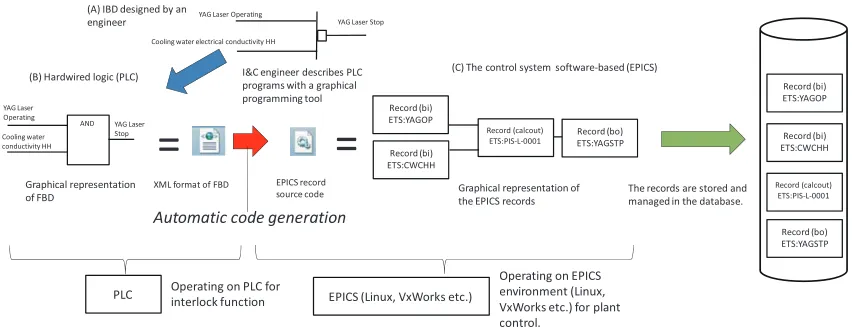
Fig. 2 (A) IBD is used in the design phase. (B) Control system engineer describes PLC logic based on IBD. PLC logic formatted in XML format can be converted into other software languages, including EPICS source code. (C) EPICS codes are executed in a major industrial computer. The ITER Organization recommends EPICS.
the circuit diagram in Fig. 1 (B). We therefore selected FBD for the PLC programming language. FBD can be described in the extensible markup language (XML) for-mat [10]. PLCopen, an international organization active in industrial control, has defined an XML format for FBD. We used the XML format for FBD to generate the software codes from FBD because XML is easy to handle using var-ious programming languages and because we have already demonstrated the use of the XML format for PLC develop-ment [11].
Figure 2 shows the procedure used to generate the pro-gram code template. Interlock logic (Fig. 2 (A)) designed by a process engineer is implemented in a PLC using FBD (Fig. 2 (B)). In most cases, a program code in the control system is developed by a software engineer working inde-pendently of the process engineer. The program code tem-plate generation tool converts the FBD code to the program code. In the ITER project, the experimental physics and in-dustrial control system (EPICS) [12] is recommended as a software infrastructure for the development of control sys-tems. Input or output signals used for the control systems are managed as a “record” of the database in the EPICS environment. Input or output for controlling a device can be used to read a value from or write a value to the record, respectively. In addition, complex control logic can be im-plemented to link several records (Fig. 2 (C)). The program code template generation tool generates the definition of the records and links between the records automatically.
EPICS source codes, which describe the definition of the records and the links of the records, on the basis of re-lationship data analyzed by the XML parser. The EPICS source codes generated by the tool can be executed in the EPICS environment on various operating systems, includ-ing Linux and VxWorks.
3. Proposed Application of the
Infor-mation Technologies for Design of
Machine Protection
3.1
Engineering data analysis
In the ITER project, design activities over several years produce a large volume of engineering data. The en-gineering data are stored in the enen-gineering database. Cur-rently, the engineering data are used for managing com-ponents [5]. We believe that the engineering database has the potential to generate useful design information. To en-able efficient use of the engineering database, meta-data, which explain the engineering data, must be added to the database. We previously proposed that meta-data for the engineering database be described using the resource de-scription framework (RDF) [13]. RDF is a simple set of
Fig. 3 An example of a graphical representation of RDF. This example consists of two expressions. One means compo-nent “Pipe #0001” is used for transferring cooling water. The other means cooling water has electrical conductivity as a property.
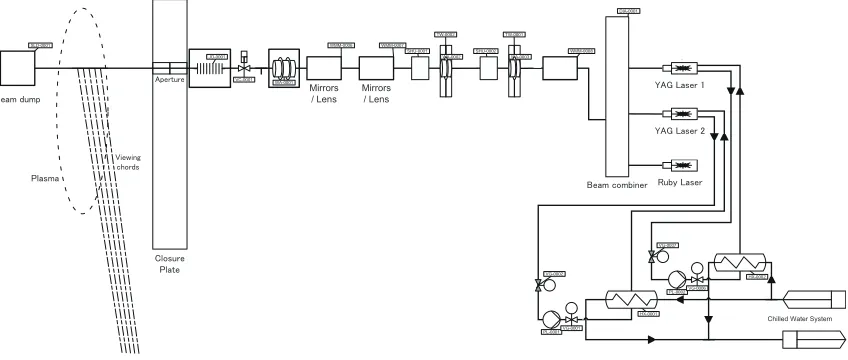
Fig. 4 Preliminary process diagram of a laser system for the ITER ETS.
three data (i.e., subject, predicate, and object) based on predicate logic. Most database management systems can store RDF data.
A graphical representation of the RDF is shown in Fig. 3. A set of subject, predicate, and object is called a Triple. The Triples shown in Fig. 3 indicate that Pipe num-ber 0001 transmits cooling water and that cooling water is electrically conducting. Notably, the vocabulary, known as
ontologyin information science, should be defined in ad-vance.
3.2
Application to ETS and validation of the
results
We defined simple predicates for diagnostic systems to validate our concept. The predicates were applied to pre-liminary design the laser system for ETS [14]. A schematic of the process flow diagram of the laser system is shown in Fig. 4. Two YAG laser systems are cooled by chilled water. The beams from the YAG lasers are combined and injected into a plasma. The beam is terminated by the beam dump installed in the vacuum vessel [3]. A ruby laser is also connected to the beam combiner for calibration.
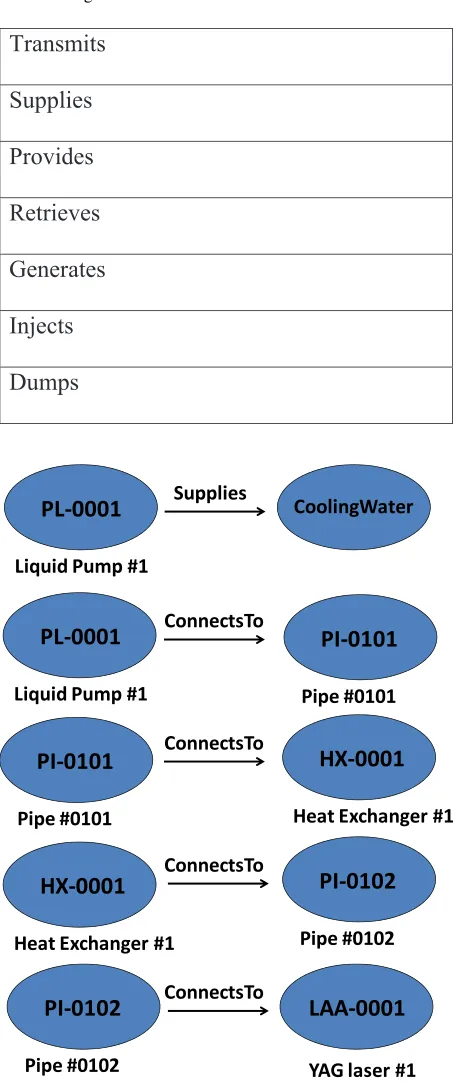
Functional modeling of a plant based on ontological engineering was studied by Kitamuraet al.[6, 7]. We ap-plied three points of view—physical relationship, function, and attribute—to describe the RDF for the process flow diagram according to the previous studies. The predicate “connect” is a typical predicate used to represent a physi-cal relationship. The function expresses the behavior of a component. Predicates of the function used in the RDF for the process flow diagram are listed in Table 1. Tempera-ture, flow rate, and electrical conductivity are examples of attributes. A portion of the RDF for the process diagram is shown in Fig. 5.
Table 1 Predicates of the function used in RDF for the process diagram.
Fig. 5 A part of the RDF for the process diagram of a prelim-inary ITER ETS laser system design. This figure shows liquid flow from the chilled water pump to the YAG laser.
a major premise. The second term, “Some pipes transmit cooling water” is a minor premise. The logical conclusion “Cooling water must be monitored at the pipe” is derived from the major and minor premises.
We applied the inference rules to the RDF for the pro-cess flow diagram of the laser system for ETS. The
soft-Fig. 6 An example of an inference. This example shows a sim-ple syllogism. General (first) and specific (second) state-ments are mentioned; a conclusion is then derived.
ware tool cwm [15] was used for this inference. Table 2 shows inference rules and results. The inference rules in-cluded “If conductivity of cooling water exceeds the limit, related components must be stopped.” The cwm tool gen-erated the inference results listed in Table 2. The results also included “Controller triggers digital outputs addressed C3S0 and C3S1” (the digital outputs are signals to stop the device). We note that the ETS RDF data are just a set of Triples. We concluded that the inference derives meaning-ful results.
3.3
Risk analysis by the HAZOP
HAZOP is a method used to identify hazards and risks in the system [8]. In HAZOP, guide words, which indicate potential risks, must be determined in advance according to analysis of the precedents. A hazard analyst investigates the likelihood of the risks based on guide words assigned to the process.
As discussed in Section 3.1, piping, instrumentation, and other plant characteristics can be described in the RDF files. We proposed a guide-word generator using inference rules. Guide words are associated with the characteris-tics of the process (e.g., flow, pressure, and temperature). Therefore, an inference rule that describes the relationship between process types and guide words is needed to gen-erate guide words for the system.
Our generating method has the following advantages. 1) Because guide words are generated in accordance with predefined rules, they are generated systematically, reduc-ing the number of missed guide words. 2) Knowledge of experts can be reused because the knowledge is described in the inference rules. 3) The quality of HAZOP assess-ment using generated guide words is easily maintained.
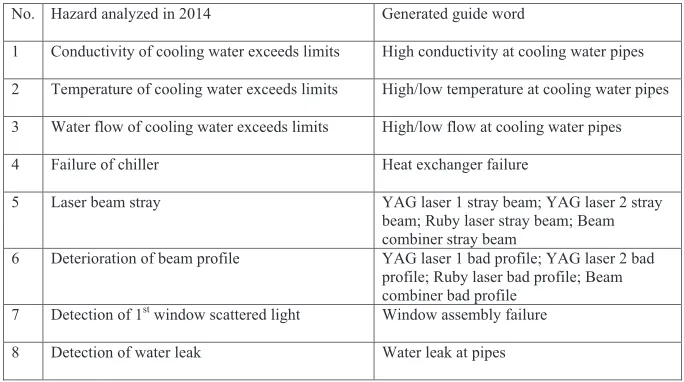
We also applied our method to the RDF data for the ETS laser system mentioned in Section 3.1 and compared the results with our hazard analysis performed in 2014. The results of this comparison are reported in Table 3. The generated guide words were equivalent to our hazard analysis. The results of this comparison indicate that our method produces adequate guide words. We plan to apply this method to risk analysis for other diagnostic systems procured by Japan.
4. Summary
Table 2 Rules and results of inferences.
Table 3 Comparison of hazards between analyses performed in 2014 and generated guide words.
RDF meta-data to automatically produce useful infortion from the engineering database for design of the ma-chine protection function. We also proposed a new HA-ZOP guide-words generator to generate guide words from the engineering database. These proposals will be applied to the development of ITER I&C diagnostic systems.
Acknowledgments
The authors would like to thank Dr. S. Simrock and staff of the ITER Organization for fruitful discussions about ITER control system and design methodology.
Disclaimer
The views and opinions expressed herein do not nec-essarily reflect those of the ITER Organization.
[1] S. Kitazawaet al., Fusion Eng. Des.89, 88 (2014).
[2] A. Wallanderet al., Fusion Eng. Des.85, 529 (2010).
[3] E. Yatsukaet al., J. Instrumentation8, C12001 (2013).
[4] L. Abadieet al., Fusion Eng. Des.87, 2213 (2012).
[5] J. Sonaraet al., Fusion Eng. Des.96-97, 957 (2015).
[6] Y. Kitamuraet al., Trans. Jpn. Soc. Artificial Intelligence
17, 61 (2002).
[7] Y. Kitamuraet al., Trans. Jpn. Soc. Artificial Intelligence
17, 73 (2002).
[8] T. Kletz,Hazop&Hazan:Identifying and Assessing
Pro-cess Industry Hazards, 4th edition (Institute of Chemical Engineers, Rugby UK, 1999).
[9] IEC 61131-3: 2013. Programmable controllers–Part 3: Programming languages.
[10] Extensible Markup Language (XML), https://www.w3.
org/XML/
[11] T. Yamamotoet al., Fusion Eng. Des.96-97, 1012 (2015).
[12] Experimental Physics and Industrial Control System,
http://www.aps.anl.gov/epics/
[13] Resource Description Framework (RDF), http://www.w3.
org/RDF/
[14] T. Hataeet al., Rev. Sci. Instrum.83, 10E344 (2012).