39
Newton Homotopy Continuation
Method for Solving Nonlinear
Equations using Mathematica
W Zuria Aizan W Ismail1 , Hafizudin Mohamad Nor2, Shahrul Nizam Ishak3 1,2
School of Mathematical Sciences, Universiti Sains Malaysia, 11800 Gelugor, Penang, Malaysia.
3
Faculty of Computer and Mathematical Sciences, Universiti Teknologi Mara Permatang Pauh,
13500 Permatang Pauh, Penang, Malaysia. *Corresponding email: [email protected]
Abstract
40 1. INTRODUCTION
The root-finding problem is one of the oldest known approximation problems. However the research of this area still continues nowadays. Solving root-finding problems is one important aspect of nonlinear equations. Nonlinear equations consist of several categories such as nonlinear algebraic, trigonometric, exponential, and logarithmic equations. Nonlinear equations can be expressed as
( ) 0
f x (1)
where x.
There are several methods to solve nonlinear equations such as Newton’s method, secant method, bisection method and et cetera. Newton method is also known as Newton-Raphson method. According to Burden and Faires (2011), Newton’s method is one of the powerful and well-known numerical methods for solving linear and nonlinear equations. It is already well-known have locally quadratic convergent [1].
There is a major drawback with the Newton’s method; hence we need to find the derivative of the function given. This can cause problem if f '(x) is more difficult to calculate than f(x) that already given. The Newton’s method does not work when
0 ) ( ' x0
f or f '(x0)0 in which this will lead to the divergence problem or slowly
convergence. In this case, homotopy continuation method (HCM) provide a useful approach to find the zeros of each function in term of convergent way in finding the approximate solutions. Homotopy methods will construct a hard or complicated problem into a simpler one with the easier calculation zeros function, f(x)0 [2]
2. METHODOLOGY
Homotopy refers to the homotopy function, H(x,t) and continuous refer to embed the nonlinear equation in a one-parameter family, t , of problems which runs over the interval t
0,1 [3].) ( ) ( ) 1 ( ) ,
(x t t g x tf x
H . (2)
Since our goal is to solve theH(x,t)0 , therefore we have the following conditions:
0 ) ( ) 0 ,
(x g x
H (Initial start system) (3)
0 ) ( ) 1 ,
(x f x
H (Target solution) (4)
There are several ways to identify the auxiliary homotopy function g(x) such as Newton function, fixed-point function and affine function. In this paper, we choose point function as our auxiliary homotopy function. Mathematically, the fixed-point function is written as
0 ( )
g x x x (5)
41
There are also several HCMs such as Newton-HCM, secant-HCM and Adomian-HCM as described in Wu (2005, 2006, 2007) [4,5,6]. For basic learning purpose, we choose Newton-HCM as our method to solve nonlinear equations. The formula of Newton-HCM can be written as follows
1 ( , ) , '( , ) i i i i
H x t
x x
H x t
(6)
where i0,1, 2,...,k1 and t[0,1]. To increase the accuracy of approximate solutions, we use a technique from Palancz et al. (2010)[7].
1 NewtonRaphson( ( , 1),{ , })
i i i
x H x t x x (7)
where xi is the initial value for calculating next xi1. However, we are only iterate three times for each ti1.
ALGORITHM 2.1
To find a solution of f(x)0 by using Newton Homotopy Continuation Method, starting with one initial guess
Input : Function of f(x), Auxiliary function, g(x), Homotopy function,H(x,t)
Initial guess, x0
Output : Approximate solution, x.
Step 1 Set t = 0, k = 1 (Initialize Accumulator). Step 2 Set
1 1
( , )
, ( , ) '( , )
i
i i i
i
H x t
x x f x t x
H x t
Step 3 Looping part
[t x ]
Step 4 Display result: xk, Steps else Break Step 5 OUTPUT (xk)
42
3. NUMERICAL EXAMPLE AND DISCUSSION
In this section, we test several examples of scalar of nonlinear equations. The stopping
criterion used is 6
( k) 10 .
f x The equations tested as follows (i) f x( )x28x 9 0 [7] ;
(ii) 1 3 1 2
( ) 6 2 0
3 2
f x x x x [5] ;
(iii) f x( )x46x400 [8] ; (iv) f x( )x5x4x27x 4 0
(v) f x( ) x cosx0 [1] ;
(vi) ( ) sin cosh 0.5 0
1000
x
f x x [9] ;
(vii) f x( )excosx0 [10]
The pseudo code of the equation (i) are shown using Mathematica 7.0 as follows;
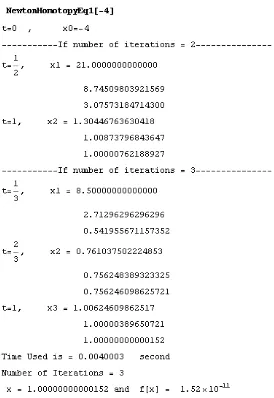
43 Then, the output is as follows
44
We now take other initial guess x0 3 for solving Equation (i). The result is shown in Table 1.
Table 1: Performance of Newton’s method and Newton-HCM
Newton’s method Newton-HCM
0 3
x
1 9
x
2 3.4615384615385
x
3 1.4060269627280
x
4 1.015247601945
x
5 1.000023178254
x
6 1.000000000054
x
0 3
x
1 0.706347413598374
x
2 1.00000000000702
45 Graphically, it can represented as follows
Figure 1: Performance of number of iterations required for Newton’s method and Newton-HCM achieve the stopping criterion specified.
The results from Table 1 and Figure 1 show the performance of Newton’s method and Newton-HCM when both methods are implemented at x0 3. Newton’s method requires six iterations whilst Newton-HCM needs only two iterations to converge to the actual root x1.Other actual root x 9 can be obtained with other initial value as described in Palancz et al. (2010) [7]. From two initial guesses selected, it show the advantage of Newton-HCM over the Newton’s method. However there is not sufficient enough to make a comprehensive conclusion with only one example. Therefore, several equations have been selected and the result shown in Table 2.
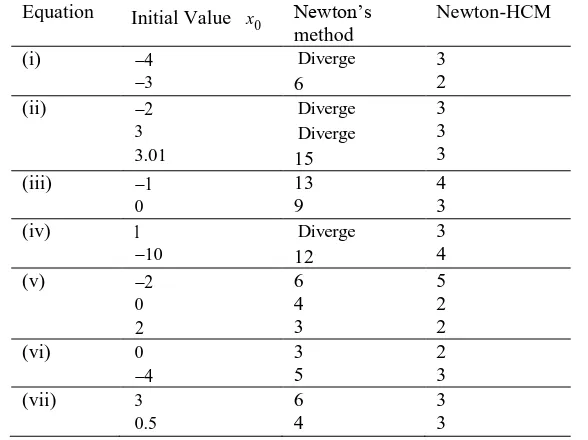
Table 2: Comparison between Newton-HCM and Newton’s method
Equation Initial Value
0
x Newton’s method
Newton-HCM
(i) 4 3 Diverge 6 3 2 (ii) 2
3 3.01 Diverge Diverge 15 3 3 3 (iii) 1
0
13 9
4 3 (iv) 1
10 Diverge 12 3 4 (v) 2
0 2 6 4 3 5 2 2 (vi) 0
4 3 5 2 3 (vii) 3
0.5
6 4
3 3
1 2 3 4 5 6
Number of Iterations
46
The same behavior occurs when we do this implementation to the other initial values and equations. Table 2 shows the advantages of the use of Newton-HCM in order to solve nonlinear equations. The advantages are the Newton-HCM can solve the divergence problem at the point of bad initial guess as in Wu (2005) [4]. Furthermore, Newton-HCM has lesser number of iterations rather than classical Newton’s method.
4. CONCLUSION
Based on the results for seven examples of nonlinear equations, Newton homotopy continuation method can solve the drawback of Newton’s method. Notice that Newton homotopy continuation method can solve the divergence problem for nonlinear equations and it has lesser number of iterations. The number of iterations required is measured based on stopping criterion specified. The best method is measured based on which method has lesser number of iterations. Obviously, we can see this benefit from the result of Newton homotopy continuation method.
ACKNOWLEDGMENTS
Part of this research has been supported by a scholarship from the Kementerian Pengajian Tinggi Malaysia.
REFERENCES
[1] Burden, R.L. & Faires, J.D. Numerical Analysis, 9th International Edition, Brooks/Cole, Cencag Learning . 2011.
[2] Decarolis F., Mayer R. & Santamaria M. (2002), Homotopy continuation methods, http://home.uchicago.edu/~fdc/H-topy.pdf [Accessed 26 Nov 2013] [3] Kincaid, D. & Cheney, W. (2002), Numerical Analysis: Mathematic of
Scientific Computing, 3rd edn. Pacific Grove: Thomson Learning Academic Resource Center.
[4] Wu T.M. (2005) “A study of convergence on the Newton-Homotopy continuation method” Applied Mathematics and Computation 168 , pp. 1169-1174.
[5] Wu T.M. (2006) “A new formula of solving nonlinear equations by Adomian and homotopy methods” Applied Mathematics and Computation 172 , pp. 903-907.
47
[7] Palancz B. Awange J. L. Zaletnyik P. & Lewis R. H. (2010) “Linear Homotopy Solution of Nonlinear Systems of Equations in Geodesy” Journal of Geodesy 84, pp.79-95.
[8] Abd. Rahman N. H. Ibrahim A. & Jayes M.I. (2011) “Newton Homotopy Solution for Nonlinear Equations using Maple14” Journal of Science and Technology 3 (2). pp. 69-75.
[9] Rahimian, S.K., Jalali, F., Seader, J. D. & White R. E (2011). “A new homotopy for seeking all real roots of a nonlinear equation”, Computers and
Chemical Engineering 35, pp. 403-411.