1
Modeling and Statistical Optimization
of Dilute Acid Hydrolysis of Corn
Stover Using Response Surface
Methodology
Amenaghawon Nosakhare Andrew1,*, Ighodalo Henrietta1, Ogbeide Samuel E1, Okieimen Charity O1, and Agbonghae Elvis O2
1
Department of Chemical Engineering, Faculty of Engineering, University of Benin, PMB 1154, Benin City, Nigeria.
2
School of Process, Environmental and Materials Engineering (SPEME), University of Leeds, LS2 9JT, Leeds, United Kingdom
*Corresponding email: [email protected]
Abstract
Response surface methodology (RSM) was employed for the analysis of the simultaneous effect of acid concentration, pretreatment time and temperature on the total reducing sugar concentration obtained during acid hydrolysis of corn stover. A three-variable, three-level Box-Behnken design (BBD) was used to develop a statistical model for the optimization of the process variables. The optimal hydrolysis conditions that resulted in the maximum total reducing sugar concentration were acid concentration; 1.72 % (w/w), temperature; 169.260C and pretreatment time; 48.73 minutes. Under these conditions, the total reducing sugar concentration was obtained to be 23.41g/L. Validation of the model indicated no difference between predicted and observed values.
2
1. INTRODUCTION
The inevitable depletion of the world’s crude oil reserves, increasing prices of petroleum products, and environmental concerns regarding fossil fuel usage have motivated the development of sustainable alternative sources of energy [1-4]. Bioethanol as liquid fuel for road transportation has received most of the attention in recent years.
First generation bioethanol is produced from starch containing feedstock such as corn, cassava, wheat, potatoes etc [5]. However, there are ethical concerns relating to the use of potential food resources for biofuel production [6]. Bioethanol produced from lignocellulosic feedstocks is potentially sustainable as lignocellulosic materials which are mainly agricultural and forestry residues have the potential to be an economical source of feedstock as a result of its widespread availability, sustainable production and low cost [7, 8]. Lignocellulosic biomass such as corn stover is recognised as one of the most abundant of all naturally occurring feedstock for cellulosic ethanol production [9]. The conversion of corn stover to ethanol is more challenging due to the complex structure of the plant cell wall. It is necessary to pretreat the corn stover to alter its structural and chemical composition to facilitate rapid and efficient hydrolysis of carbohydrates to fermentable sugars [1, 10, 11,12]. Amongst the pretreatment methods often adopted, dilute acid hydrolysis has been extensively studied and used for pretreating lignocellulosic biomass [13-17].
The yield of fermentable sugars during acid hydrolysis is affected by factors such as pretreatment time, particle size, pretreatment temperature, acid concentration etc. The classical method of optimization involves varying one factor at a time and keeping the others constant. This is often useful but does not elucidate the effect of interaction between the various factors under consideration. Response surface methodology is an empirical statistical technique employed for multiple regression analysis of quantitative data obtained from statistically designed experiments by solving the multivariate equations simultaneously [18, 19]. By making use of design of experiment for response surface methodology, the input levels of each factor as well as the level of the selected response can be quantified. The central composite, Box-Behnken and Doehlert designs are among the common designs used for response surface methodology.
3
2. MATERIALS AND METHODS 2.1 Substrate
The corn stover used in this study was obtained from a farm in the Nigerian Institute for Oil Palm Research (NIFOR), Benin City, Edo State, Nigeria. The corn stover was washed thoroughly with tap water to remove sticky clay and then air-dried. The dried corn stover was milled and screened to 2 mm particles to increase its surface area and make the cellulose readily available for hydrolysis. It was then stored at room temperature for subsequent use.
2.2. Dilute Acid Hydrolysis
Acid hydrolysis of corn stover was carried out in an autoclave with a solid-liquid ratio of 5% (g dry weight to g solution). The sulphuric acid concentration range was 0.4-2.0 % (w/w), the pretreatment temperature range was 140–200oC and the pretreatment time range was 5–60 minutes. After acid hydrolysis, the solid residue was separated by centrifugation and the pH of the resulting supernatant was adjusted to 11 using 2N Ca(OH)2 .The resulting precipitate was centrifuged off and the supernatant was adjusted to neutral pH using 2N HCl [20].
1.3. Analytical Methods
The total reducing sugar content of the final hydrolysate was determined by the colorimetric method using the UV-Vis spectrophotometer, (Cecil 1000) at 540nm using 3,5- dinitrosalicylic acid (DNS reagent) with glucose as standard [21].
2.4 Design of Experiment
4
i o i
i X X x
X
(1)
Where xi and Xi are the coded and actual values of the independent variable respectively.
Xo is the actual value of the independent variable at the center point, and ΔXi is the step change of Xi. A second degree polynomial was fitted to the experimental data using the statistical package Design Expert® 7.0.0 to estimate the response of the dependent variable and predict the optimal point. The second degree polynomial was expressed as follows:
2 2 2
1 1 2 2 3 3 12 1 2 13 1 3 23 2 3 11 1 22 2 33 3 o
Y b b X b X b X b X X b X X b X X b X b X b X (2)
Where Y is predicted response, X1, X2 and X3 are independent variables, b0 is offset term,
b1, b2, b3 are linear effects, b11, b22, b13 are interaction terms.
Table 1: Coded and actual levels of the factors for three factor Box-Behnken design Independent
Variables Symbols
Coded and Actual Levels
-1 0 +1
Acid Concentration (%w/w) X1 0.4 1.2 2.0
Temperature (°C) X2 140 170 200
Time (min) X3 5 33 60
Table 2: Three factor Box-Behnken design with experimental as well as predicted responses of dependent variable (total sugar concentration, g/L)
Runs
Factors Response
Coded values Actual values Total sugar concentration (g/L)
X1 X2 X3 X1 X2 X3 Observed Predicted
1 0 0 0 1.2 170 33 20.57 20.47
2 +1 0 +1 2.0 170 60 21.15 22.91
3 +1 +1 0 2.0 200 33 21.09 22.91
4 +1 0 -1 2.0 170 5 8.53 9.03
5 +1 1 0 2.0 140 33 20.89 20.31
6 0 0 0 1.2 170 33 20.97 20.47
7 -1 1 0 0.4 200 33 15.88 16.66
8 0 -1 -1 1.2 140 5 6.33 6.01
9 -1 0 +1 0.4 170 60 20.36 20.08
10 0 +1 +1 1.2 200 60 20.62 19.71
11 0 0 0 1.2 170 33 23.13 22.47
12 -1 0 -1 0.4 170 5 7.11 6.56
13 -1 -1 0 0.4 140 33 15.70 17.17
14 0 -1 +1 1.2 140 60 20.90 20.32
15 0 0 0 1.2 170 33 19.77 20.47
16 0 +1 - 1 1.2 200 5 8.24 8.62
5 3. RESULTS AND DISCUSSION
3.1. Statistical Analysis
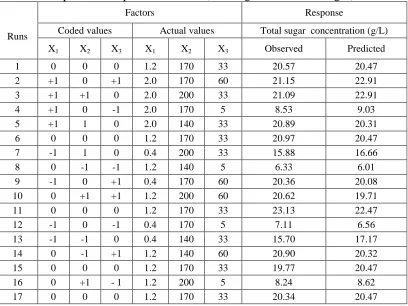
The results obtained from the 17 experimental runs carried out according to the Box-Behnken design are summarised in Table 2. The proposed second degree polynomial was fitted to the data presented in Table 2 using multiple linear regressions to determine the optimum conditions for the acid hydrolysis of corn stover that resulted in the maximum value of total reducing sugar concentration. The effects of acid concentration, pretreatment time and pretreatment temperature were quantitatively evaluated using response surface curves. By applying multiple regression analysis on the experimental data, the following second degree polynomial was found to represent the relationship between the total reducing sugar produced and acid concentration, pretreatment time and pretreatment temperature adequately.
1 2 3 1 2 1 3
2 2 2
2 3 1 2 3
50.309 2.157 0.588 0.842 0.000272 0.00722
0.0000668 1.794 1.644 7.377
Y X X X X X X X
X X X X X
(3)
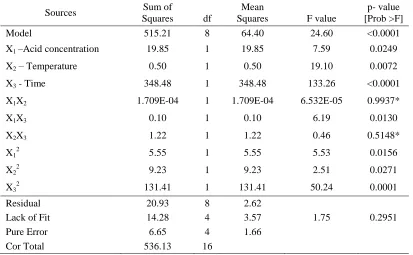
The predicted levels of total reducing sugar using Equation (3) are given in Table 2 along with experimental data. The significance of the fit of the second-order polynomial for the concentration of total reducing sugar was assessed by carrying out analysis of variance (ANOVA) as shown in Tables 3 and 4.
Table 3: Statistical information for ANOVA
Source Response Value
R-Squared 0.971
Adjusted R-Squared 0.935
Standard Deviation 1.480
C.V % 8.640
6
Table 4: Analysis of variance (ANOVA) for quadratic model for total sugar concentration
Sources Sum of
Squares df
Mean
Squares F value
p- value [Prob >F]
Model 515.21 8 64.40 24.60 <0.0001
X1 –Acid concentration 19.85 1 19.85 7.59 0.0249
X2 – Temperature 0.50 1 0.50 19.10 0.0072
X3 - Time 348.48 1 348.48 133.26 <0.0001
X1X2 1.709E-04 1 1.709E-04 6.532E-05 0.9937*
X1X3 0.10 1 0.10 6.19 0.0130
X2X3 1.22 1 1.22 0.46 0.5148*
X12 5.55 1 5.55 5.53 0.0156
X22 9.23 1 9.23 2.51 0.0271
X32 131.41 1 131.41 50.24 0.0001
Residual 20.93 8 2.62
Lack of Fit 14.28 4 3.57 1.75 0.2951
Pure Error 6.65 4 1.66
Cor Total 536.13 16
*not significant
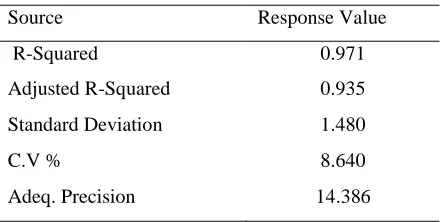
The coefficient of determination (R2) of the model was 0.971 (Table 3), which indicated that the model adequately represented the real relationship between the variables under consideration. An R2 value of 0.971 means that 97.1% of the variability was explained by the model and only 2.90% was as a result of chance. The coefficient of variation (C.V.) obtained was 8.64%. The Coefficient of Variation (C.V) indicates the degree of precision with which the treatments were carried out. A low value of C.V suggest a high reliability of the experiment [19,22]. Adequate precision value (14.386) measures the signal to- noise ratio, and a ratio greater than 4 is generally desirable [23].
7
3.2. Optimization of Dilute Acid Hydrolysis
In order to optimise the variables that influence the acid hydrolysis of corn stover, response surface plots were generated from the regression model. The three-dimensional (3D) plots were generated by keeping one variable constant at the centre point and varying the others within the experimental range. The resulting response surfaces showed the effect of acid concentration, temperature, and pretreatment time on the total reducing sugar concentration.
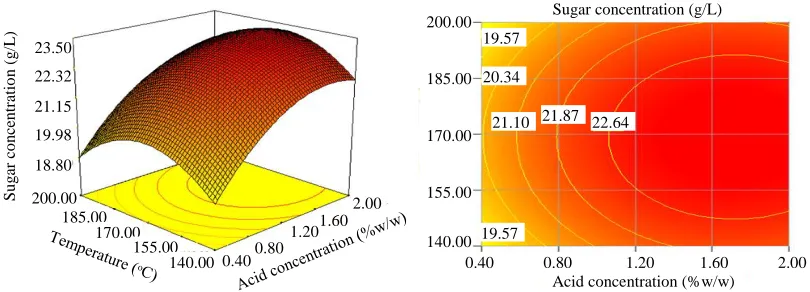
Figures 1 to 3 represent the response surface and contour plots for the optimization of acid hydrolysis of corn stover. Figure 1 shows the response surface and corresponding contour plots for total sugar concentration as a function of acid concentration and pretreatment temperature.
Figure 1: Response surface plot and the corresponding contour plot showing the effects of temperature and acid concentration on total reducing sugar concentration
Figure 2: Response surface plot and the corresponding contour plot showing the effects of pretreatment time and acid concentration on total reducing sugar concentration
Acid concentration (%w/w)
0.40 0.80 1.20 1.60 2.00 200.00
185.00
170.00
155.00
140.00
Sugar concentration (g/L) 19.57
20.34
21.10 21.87 22.64
19.57 23.50 22.32 21.15 19.98 18.80 S u g ar co n cen tratio n ( g /L ) 2.00 1.60 1.20 0.80 0.40 200.00 185.00 170.00 155.00 140.00
Acid concentration (%w/w) 0.40 0.80 1.20 1.60 2.00 60.00 46.25 32.50 18.75 5.00 T im e (m in )
Sugar concentration (g/L)
20.49
14.67 17.58
11.76 8.85
8
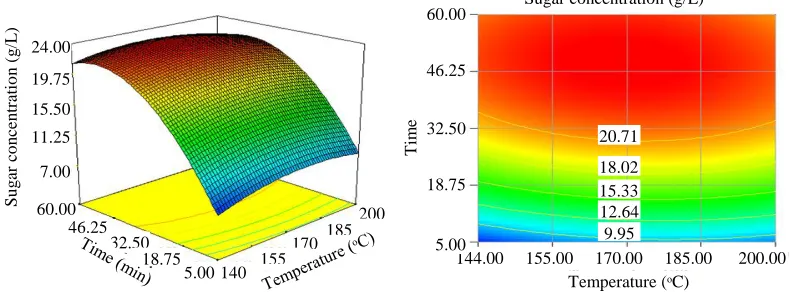
Figure 3: Response surface plot and the corresponding contour plot showing the effects of pretreatment time and temperature on total reducing sugar concentration
An increase in the acid concentration with temperature resulted in an increase in the total reducing sugar concentration until an optimum value of about 23.41 g/L i.e., 169.26oC temperature and 1.72% (w/w) acid concentration. Any further increase in the acid concentration was found to be unfavourable for the production of reducing sugar as explained by the decreasing trend observed.
The effect of pretreatment time and acid concentration on the total sugar concentration is presented in Figure 2. An increase in pretreatment time along with a steady increase in acid concentration resulted in an increase in total reducing concentration until an optimum value of about 23.41 g/L i.e., 48.73 minutes pretreatment time and 1.72% (w/w) acid concentration. Further increase had a reverse effect on product formation as explained by the slight decline in trend observed.
Figure 3 shows the effect of the interaction between pretreatment time and temperature on total sugar concentration. The centre point of Figure 3 reveals the optimal values of pretreatment time and temperature that may be combined to obtain optimal concentration reducing sugar. This was revealed to be 48.73 minutes pretreatment time and 169.26 oC temperature. Any further increase in both the pretreatment time and temperature led to no appreciable effect on the production of reducing sugars.
In order to select the optimum conditions and their respective levels, the model was analysed. The maximum response predicted from the model was a total reducing sugar concentration of 23.41 g/L. The final optimised hydrolysis conditions obtained with RSM were 1.72 % (w/w) (acid concentration), 169.260C (temperature) and 48.73 minutes (pretreatment time).
The validity of the results predicted by the regression model, was confirmed by carrying out repeated experiments under optimal hydrolysis conditions (i.e. acid concentration; 1.72 % (w/w), temperature; 169.260C and pretreatment time; 48.73
Temperature (ᵒC)
144.00 155.00 170.00 185.00 200.00 20.71 18.02 15.33 12.64 9.95 60.00 46.25 32.50 18.75 5.00 T im e (m in )
Sugar concentration (g/L)
9
minutes). The results obtained from three replications demonstrated that the average of the maximum total sugar concentration (23.04 g/L) obtained was close to the predicted value (23.41g/L). The excellent correlation between the predicted and measured values of these experiments justifies the validity of response model.
4. CONCLUSION
In this work, the variables that could contribute to reducing sugar production from acid hydrolysis of corn stover were assessed in the preliminary studies of which three critical ones were identified. They include acid concentration, pretreatment time and temperature. A three variable Box-Behnken design was used to identify the optimal levels of these variables that can result in optimal yields of reducing sugar. 17 experimental runs were carried out according to the Box-Behnken design and a second degree polynomial model equation was fitted to the experimental data. Using response surface plot generated from the model equation, the optimum total reducing sugar concentration obtained by solving the equation was 23.41 g/L. This was close to the value (23.04 g/L) obtained from repeated experiments carried out under the optimised conditions i.e. 1.72 % (w/w) (acid concentration), 169.260C (temperature) and 48.73 minutes (pretreatment time).
REFERENCES
[1] Hosseini, S.A., and Shah, N. (2009) Multiscale modelling of biomass pretreatment for biofuels production. Chemical Engineering Research and Design, 87(9), pp.1251–1260.
[2] Hahn-Hagerdal, B., Galbe, M., Gorwa-Grauslund, M.F., Liden, G. and Zacchi, G., (2006). Bioethanol: The fuel of tomorrow from the residues of today. Trends in Biotechnology, 24, pp.549–556.
[3] Mohan, P.R. and Reddy, O.V.S. (2012) Production and Optimisation of Ethanol from Pretreated Sugarcane Bagasse using Saccharomyces bayanus in Simultaneous Saccharification and Fermentation. Microbiology Journal, 2(2), pp.52–63.
[4] Mosier, N., Wyman, C., Dale, B., Elander, R., Lee, Y.Y., Holtzapple, M. and Ladisch, M. (2005) Features of promising technologies for pretreatment of lignocellulosic biomass. Bioresource technology, 96(6), pp.673–686.
10
[6] Rass-Hansen, J., Falsig, H., Jorgensen, B. and Christensen, C.H. (2007) Bioethanol: fuel or feedstock? Journal of Chemical Technology and Biotechnology, 82, pp.329–333.
[7] Sakar, N., Ghose, S.K., Banerjee, S. and Aikat, K. (2012) Bioethanol production from agricultural wastes: An overview. Renewable Energy, 37, pp.19–27.
[8] Shi, J., Sharma-Shivappa, R.R., Chinn, M. and Howell, N. (2009) Effect of microbial pretreatment on enzymatic hydrolysis and fermentation of cotton stalks for ethanol production. Biomass and Bioenergy, 33(1), pp.88–96.
[9] Fang, H., Zhao, C. and Song, X. (2010) Optimization of enzymatic hydrolysis of steam-exploded corn stover by two approaches: Response surface methodology or using cellulase from mixed cultures of Trichoderma reesei RUT-C30 and Aspergillus niger NL02. Bioresource Technology, 101, pp.4111–4119.
[10] Ballesteros, I., Ballesteros, M., Manzanares, P., Negro, M.J., Olivia, J.M. and Saez, F. (2008) Dilute sulphuric acid pretreatment of cardoon for ethanol production. Biochemical Engineering Journal, 42(1), pp.84–91.
[11] Chang, V.S. and Holtzapple, M.T. (2000) Fundamental factors affecting biomass enzymatic reactivity. Applied Biochemistry and Biotechnology, 84(1), pp.5–37.
[12] Galbe, M. and Zacchi, G. (2007) Pretreatment of lignocellulosic materials for efficient bioethanol production. Biofuels, pp.41–65.
[13] Martin, C., Alriksson, B., Sjode, A., Nilvebrant, N. and Jonsson, L.J. (2007) Dilute sulphuric acid pretreatment of agricultural and agro-industrial residues for ethanol production. Applied Biochemistry and Biotechnology, 137, pp.339–352.
[14] Mussatto, S.I. and Roberto, I.C. (2004) Alternatives for detoxification of diluted-acid lignocellulosic hydrolysates for use in fermentative processes: a review.
Bioresource Technology, 93(1), pp.1–10.
[15] Saha, B.C., Iten, L.B., Cotta, M.A. and Wu, Y.V. (2005) Dilute acid pretreatment, enzymatic saccharification and fermentation of wheat straw to ethanol. Process Biochemistry, 40(12), pp.3693–3700.
11
[17] Zhao, X.B., Wang, L. and Liu, D.H. (2008) Peracetic acid pretreatment of sugarcane bagasse for enzymatic hydrolysis: a continued work. Journal of Chemical Technology and Biotechnology, 83(6), pp.950–956.
[18] Khuri, A.I. and Cornell, J.A. (1987). Response Surfaces: Design and Analysis, New York, Marcel Dekker.
[19] Montgomery, D.C. (2005) Design and Analysis of experiments 6th ed., New York, John Wiley & Sons, Inc.
[20] Chandel, A.K., Rudravaram, R., Narasu, M.L., Rao, L.V. and Ravindra, P. (2007) Economics and environmental impact of bioethanol production technologies: an appraisal. Biotechnology and molecular biology review, 2(1), pp.14–32.
[21] Miller, G.L. (1959) Use of Dinitrosalicylic Acid Reagent for Determination of Reducing Sugar. Analytical Chemistry, 31(3), pp.426–428.
[22] Mason, R.L., Gunst, R.F. and Hess, J.L. (1989) Statistical Design and Analysis of Experiments, New York, John Wiley & Sons, Inc.