University of South Carolina
Scholar Commons
Theses and Dissertations
1-1-2013
"The Constellations were in a Different Place":
Using Blogs to Understand Student Learning
During Study Abroad
Leslie Pitman
University of South Carolina
Follow this and additional works at:https://scholarcommons.sc.edu/etd Part of theHigher Education Administration Commons
This Open Access Thesis is brought to you by Scholar Commons. It has been accepted for inclusion in Theses and Dissertations by an authorized administrator of Scholar Commons. For more information, please [email protected].
Recommended Citation
! ! "!
“
THE CONSTELLATIONS WERE IN A DIFFERENT PLACE”:
U
SINGB
LOGS TOU
NDERSTANDS
TUDENTL
EARNINGD
URINGS
TUDYA
BROADby
Leslie V. Pitman
Bachelor of Arts
Queens University of Charlotte, 2011
Submitted in Partial Fulfillment of the Requirements
For the Degree of Master of Education in
Higher Education and Student Affairs
College of Education
University of South Carolina
2013
Accepted by:
Dr. Christian Anderson, Thesis Chair
Dr. Jennifer Engel, Committee Member
Dr. Kara Brown, Committee Member
! ! ""!
! ! """!
ACKNOWLEDGEMENTS
I must first thank my Thesis Committee, whose support, criticism, and
encouragement have made this study possible. Dr. Christian Anderson (Chair), Dr.
Jennifer Engel, and Dr. Kara Brown not only assisted me in the writing process, but also
inspired me daily with their individual dedication to the field of international education. I
would also like to thank Dr. Julie Rotholz and Dr. Jennifer Bloom, whose guidance
reminded me that this accomplishment was attainable.
To my fellow graduate students in the Higher Education & Student Affairs
program, I wish to say thank you for inspiring and encouraging me as professionals,
peers, and friends. To my colleagues in the USC Study Abroad Office, your support from
my first day at work has been one of my greatest assets, and this project would not have
been possible without your interest and enthusiasm.
I am indebted to the students whose blogs were used in this study; reading about
your study abroad experiences was an adventure and reminded me why I chose to
research this particular topic. Thank you for taking the time to write publicly about your
time abroad, and I hope that your blog is now part of the beginning of a future body of
research. It may not have always been easy to document your experiences, but I am so
very grateful that you did.
Finally, to my family and friends: your unwavering support, unconditional love,
and ongoing patience have not gone unnoticed. I thank my parents, Jere Pitman and
! ! "#!
education, believing in my abilities from a young age, and being examples of lives well
lived. To my high school teacher and now friend, Heather Sylvia, who instilled in me an
early love of writing and research, and to my best friend and fellow research buff,
Victoria Jackson—my appreciation for both of you is too great to express. There are
hundreds of people I could thank for being a part of this journey with me, so I will
conclude by saying thank you to all those who have crossed my path, in large or small
! ! #!
ABSTRACT
While a great deal of research has been done on the pedagogical implications and
uses of blogging, and even more research has been done on the effects of study abroad,
few studies has investigated the use of blogging as a way that learning is processed
during study abroad. This study sought to understand how students use blogs during a
study abroad semester and the ways in which the blogs reveal evidence of learning.
Eleven blogs, written by students at the University of South Carolina (USC) during their
respective semesters abroad, were read, coded, and analyzed in order to answer the
research questions. Nine major themes of learning emerged: culture, food, travel,
transportation, language, academics, people, reflection, and acknowledgement of
learning. These written experiences were then compared with the known effects of study
abroad, and also juxtaposed with the USC Study Abroad Learning Outcomes. Based on
what is already known about student learning during study abroad and on USC’s Study
Abroad Learning Outcomes, it was revealed that study abroad students write extensively
and in surprising ways about their learning experiences on their personal blogs. Blogs
may offer an alternative to the post-study abroad evaluations, instead capturing the
student learning as it is occurring during the crux of the study abroad journey, and
! ! #"!
TABLE OF CONTENTS
ACKNOWLEDGEMENTS ... iii
ABSTRACT ... v
LIST OF TABLES ... ix
LIST OF FIGURES ... x
CHAPTER I:INTRODUCTION TO STUDY ... 1
INTRODUCTION ... 1
STUDY ABROAD IN 2012 ... 3
THE BLOGOSPHERE IN 2012 ... 5
STUDY ABROAD AND BLOGGING ... 7
CHAPTER II:REVIEW OF THE LITERATURE ... 11
INTRODUCTION ... 11
DEFINITION OF TERMS ... 11
STUDY ABROAD:KNOWN EFFECTS ... 16
BLOGGING:BACKGROUND AND RECENT RESEARCH ... 22
STUDY ABROAD BLOGGING ... 28
CHAPTER III:METHODOLOGY ... 29
PURPOSE OF STUDY ... 29
DATA SELECTION ... 30
THE USCBLOGGER ... 32
! ! #""!
LIMITATIONS ... 38
CHAPTER IV:RESULTS ... 43
BLOG PROFILES ... 46
ALICE ... 48
ASHLEY ... 49
ELLEN ... 51
HENRY ... 52
KEVIN ... 53
LYNNE ... 55
NANCY ... 56
NATALIE ... 58
NICOLE ... 60
TOM ... 61
YVONNE ... 63
DISCUSSION OF RESULTS ... 65
CULTURE ... 68
FOOD ... 72
TRAVEL ... 76
TRANSPORTATION ... 83
LANGUAGE ... 86
ACADEMICS ... 90
PEOPLE ... 95
! ! #"""!
SUMMARY ... 105
CHAPTER V:SUMMARY,CONCLUSIONS,&RECOMMENDATIONS ... 107
SUMMARY ... 107
CONCLUSIONS ... 111
RECOMMENDATIONS FOR FURTHER RESEARCH ... 114
CONCLUSION OF STUDY ... 118
REFERENCES ... 119
APPENDIX A–USCSTUDY ABROAD LEARNING OUTCOMES ... 125
APPENDIX B–IRBEXEMPTION APPROVAL ... 126
APPENDIX C–LISTERV EMAIL TEXT ... 127
APPENDIX D–FOLLOW-UP EMAIL TO VOLUNTARY PARTICIPANTS ... 128
APPENDIX E–USCBLOGGER SOLICITATION EMAIL ... 129
APPENDIX F–USCBLOGGER FOLLOW-UP EMAIL ... 130
! ! "$!
LIST OF TABLES
Table 1.1 Basic Description of Sample ... 9
Table 3.1 Detailed Description of Sample ... 35
Table 4.1 Detailed Description of Sample ... 46
Table 4.2 Relationship Between Themes of Learning and Frameworks
! ! $!
LIST OF FIGURES
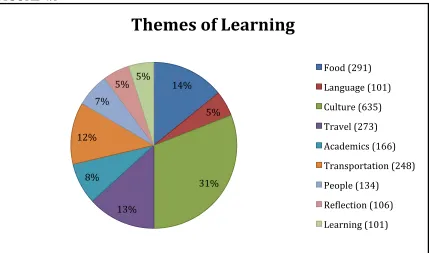
Figure 4.1 Themes of Learning ... 45
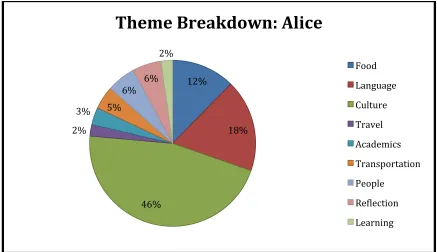
Figure 4.2 Theme Breakdown: Alice ... 49
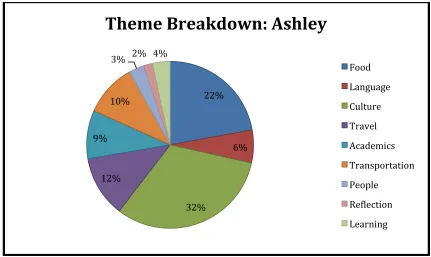
Figure 4.3 Theme Breakdown: Ashley ... 50
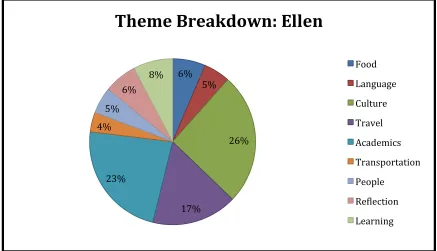
Figure 4.4 Theme Breakdown: Ellen ... 52
Figure 4.5 Theme Breakdown: Henry ... 53
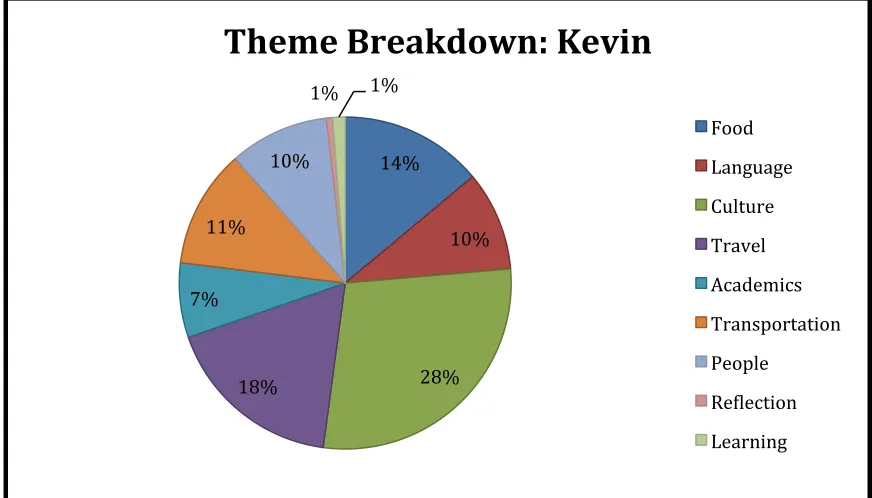
Figure 4.6 Theme Breakdown: Kevin ... 54
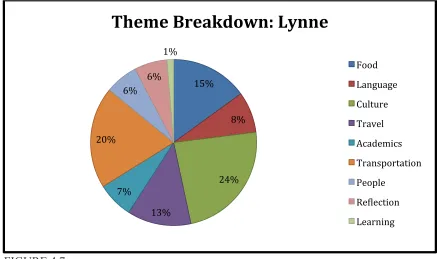
Figure 4.7 Theme Breakdown: Lynne ... 56
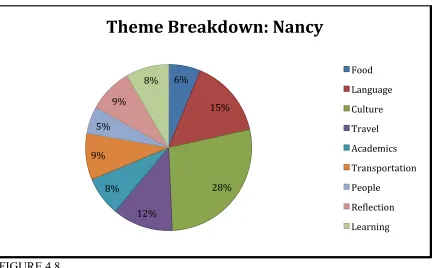
Figure 4.8 Theme Breakdown: Nancy ... 58
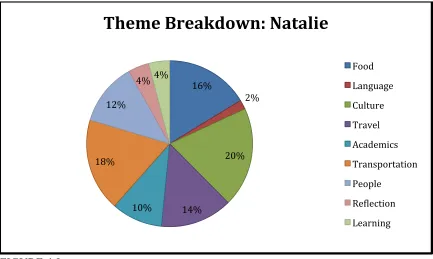
Figure 4.9 Theme Breakdown: Natalie ... 59
Figure 4.10 Theme Breakdown: Nicole ... 61
Figure 4.11 Theme Breakdown: Tom ... 63
Figure 4.12 Theme Breakdown: Yvonne ... 64
! ! %!
CHAPTER I:INTRODUCTION TO STUDY
Introduction
Although many studies have been conducted on the ways in which study abroad
affects students, these studies primarily ask students to recall his or her previous program
and the accompanying encounters (Cooley, E., & Savicki, V., 2011; Dolby, N., 2004;
Ellwood, C., 2011; Franklin, K., 2010; Gesinski, B., English, L., & Tyson, L. E., 2010;
Gillepsie, J., Braskamp, L, & Dwyer, M., 2009; McKeown, 2009; Savicki, V., 2010).
There is an obvious disadvantage, though, to asking a student to evaluate his or her study
abroad experience upon return to the United States. The temporal focus of student
reflection has been lodged primarily in the post-study abroad period of a student’s life;
the before and during stages have not been fully explored. While a student may be able to
articulate a concrete way that study abroad has impacted her personal life—she might say
she has become more independent—there is much more going on beneath the surface of
such a response. And, if the student is asked to elaborate, she may, again, merely brush
the tip of a much larger phenomenon, because she will be recounting an incident from
weeks or months ago.
What if we could read about students’ experiences as they were occurring, or at
least within hours or days? What if there were a way to read the journals of study abroad
students, to follow their learning, transitions, growth, and challenges through personal
writings, photographs, and videos? Because this is the twenty-first century and because
! ! &!
such a tool exists. Blogs cannot be considered the same as a private journal; however, the
primary purpose is the same: a medium through which to write down one’s thoughts,
feelings, happenings, opinions, stories, and virtually anything else the author wishes.
There could be changes occurring within a student that he or she does not even recognize,
but the development or learning might be assessed through a well-articulated blog post.
The online journals written by students who are traveling abroad are important
because they might reveal how students are actually achieving the learning outcomes
(Andergassen, et al., 2009; Chan, et al., 2012; Ducate & Lomicka, 2008; Halic, et al.,
2010; Lee, 2011; Paulus, 2009; Xie, & Sharma, 2011). Ten or twenty years ago, students
who studied overseas were keeping a private journal, snapping some pictures for a coffee
table scrapbook, or sending update emails to their closest family and friends. Now, with
the introduction of the blog, these same students can write about their journey to a
potential audience of millions. Not only that, but readers have access to thousands of
student stories at the mere click of a button. A recent Google search for “study abroad
blog” revealed over 11,000,000 results, the top hit being “The Study Abroad Blog,”
which claims to be “the ultimate study abroad resource” (Nault, 2012). If students are
studying abroad and inviting the world to join in on their journey, then perhaps these
first-hand student accounts are more valuable to the higher education community than
they seem.
While there is a fairly large body of research on the pedagogical advantages to
blogging (Andergassen, et al., 2009; Chan, et al., 2012; Ducate & Lomicka, 2008; Halic,
et al., 2010; Lee, 2011; Paulus, 2009; Xie & Sharma, 2011), only one of these studies
! ! '!
experience. Lee (2011) conducted a study with 16 undergraduate students who were
participating in a semester-long study abroad program. These students were also
participating in a blog program through which they were encouraged to practice their
language skills and assigned writing topics by a teacher. The study focuses on regulated
and directed blogging, albeit during a study abroad semester, rather than on the ways in
which a student directs himself in the writing and learning process through the blog. With
only limited knowledge of how travelers utilize the blogosphere independently, without
teacher prompting, there is an even larger gap in terms of the student traveler—and more
specifically, the study abroad student.
Study Abroad in 2012
In 2007, the United States government was asked to see and support study abroad
among US university students as a national imperative when the Senator Paul Simon
Study Abroad Foundation Act of 2007 was introduced. In order to ensure “that more
United States students have the opportunity to acquire…language skills and international
knowledge through significantly expanded study abroad” (H.R.1469, March, 2007;
S.991, March, 2007), a goal of at least one million university students studying abroad
every year by 2017 was proposed (Gemignani, 2009, p. 3). Although reintroduced in
2009 (S.473, February, 2009), this bill has still not been signed into a law as of 2013;
NAFSA: Association of International Educators and many other higher education and
educational exchange organizations, including the University of South Carolina, the
University of Missouri, Northern Illinois University, and the Council on International
Educational Exchange (CIEE), have publicly supported the legislation (Kostiuk, 2007;
! ! (!
plans to reintroduce the bill, recognizing that global competence among American
students is an “absolute imperative” for the future of our nation (Durbin, 2011, p. 1).
According to the 2011 Open Doors Report, published by the Institute of
International Education and funded by the US Department of State, only 270,604
university students in the US studied abroad for academic credit during the 2009-2010
school year. While this is a 3.9% increase over the previous year, and participation in
study abroad among US students has more than tripled in the past twenty years, these
numbers are thought to continue to increase due in large part to the charge set forth by the
aforementioned Simon Act (Institute of International Education, 2011; Picard, et. al.
2009).
Some institutions have incorporated study abroad into mandatory curriculum. For
example, USC’s widely recognized international business program requires students to
participate in a semester abroad at one of over 20 exchange partner universities, while
Goucher College requires that every student, regardless of major, participates in study
abroad in order to graduate (Fischer, 2008). Provosts and presidents are finding support
among their boards of trustees for making study abroad an institutional priority, “even at
public universities where it often comes at the cost of generating tuition revenue” (Lewin,
2009, xiii).
Evidence for this nationwide institutional support can be found in the Shared
Futures: Global Learning and Social Responsibility program developed by the
Association of American College and Universities (AACU), of which thirty two colleges
and universities are a part. Shared Futures, a multi-project initiative, claims that its
! ! )!
communities, their nation, and the larger world. Global learning is the pathway through
which students become prepared to fulfill these responsibilities” (AACU, n.d.). The 2011
Open Doors Report, which relies on the data compiled from universities and colleges
across the country, reveals that more of these institutions are carefully tracking data,
developing strategic marketing campaigns, and utilizing former study abroad students
both in and out of the study abroad office (Institute for International Education, 2011).
The Provost of the University of South Carolina (USC), Dr. Michael Amiridis,in
2012 charged the Office of International Programs with an institutional goal: send at least
2000 students studying abroad every year by 2016. The USC Study Abroad Office
oversaw 984 students’ education abroad experiences—including study, internship,
volunteering, and research—in the 2010-2011 school year, so the Provost’s goal means
more than doubling this number in four years. Annually, the Study Abroad Office
compiles a Post-Study Abroad Program Evaluation Report (PSAPER), which documents
the academic, personal, and cultural outcomes of study abroad, as well as student
satisfaction with their program, through a voluntary survey sent to returnees. The
questions on the survey are based on the study abroad learning outcomes that USC has
identified (Appendix A). Similar reports, discussed further in Chapter II, are being
compiled across the US by institutions and studies that are seeking to capture and explain
the student learning that occurs during study abroad.
The Blogosphere in 2012
Simultaneous to the growth of study abroad among American university students
is the rapid growth of technology and internet use around the world. According to a
! ! *!
WordPress and Tumblr alone by the end of 2011 (Royal Pingdom Blog, 2012). This
figure does not include the myriad other blog domains, including Google’s Blogger,
whose undisclosed number of users published over half a billion posts in 2010 (Blogger
Buzz, 2011). Blogs, which have arguably been around since the early 1990s, have
become a platform for millions of people across the world to write and share anything
that they feeling like sharing. The implications that this mass move to self-publication has
on the journalism field as well as the definition of literature has been widely discussed
since blogs’ popularity skyrocketed in the post-9/11 United States(Barlow, 2008;
Lindemann, 2010; Mooney, 2003; Pudliner, 2007; Rosenberg, 2009; Singh, 2008).
A graduate student in history at The Johns Hopkins University, W. Caleb
McDaniel, presented a well-crafted argument for the case of “why bloggers belong in the
history of reading” (McDaniel, 2005, subtitle) in his article “Blogging in the Early
Republic.” Comparing the dawn of the printing press in an antebellum America to the
twenty-first information age, McDaniel (2005) concludes that blogging and the resulting
phenomenon is quite similar to the sudden “unprecedented access to reading material”
that nineteenth century Americans experienced (par. 22). McDaniel’s unique comparison
caught the attention of The Chronicle of Higher Education, which subsequently published
a review of the article, concluding that, “by sharing their thoughts and interests with
like-minded readers, bloggers are also creating reading communities similar to ones that
formed two centuries ago” (Breslow, 2005, par. 4). McDaniel’s argument is significant
because it recognizes the value of blog writing as a part of the way that we process
! ! +!
McDaniel (2005) calls blogging (par. 6), it has become an integrated and important facet
of our culture of writing.
Unaccounted for in McDaniel’s claim is the ease, and therefore multiplicity, with
which a writer can self publish his or her own thoughts, musings, or ideas. In a concept
that is now known as “oversharing,” or “the compulsion to tell the online world too much
about yourself,” (Rosenberg, 2009, p. 17) blogging, online journaling, and social media
have become a part of daily life in the twenty-first century. Sites like Tumblr, Blogger,
Facebook, and Twitter make it possible for anyone with internet access—34.3% of the
world population in 2012 (Miniwatts Marketing Group, 2012)—to share personal
information with anyone else who has internet access. Not only is personal information
being passed from IP address to IP address at the click of a button, but also the student
experience is broadcast through the easily accessible writings of someone in another part
of the world.
Study Abroad and Blogging
As these two twenty-first century realities, study abroad and blogging,
simultaneously develop into trends within higher education, they also continue to become
more and more important to each other. As more US college students go abroad, more
users are signing up for a Tumblr or Blogger site in order that they might have a platform
from which to share their meaningful experiences. In the Facebook or “oversharing”
generation, experiences—especially the ones that involve learning—are not always kept
personal, merely scribbled absentmindedly in a spiral notebook at the end of a long week.
Rather, these events may be thoughtfully and intentionally described through some
! ! ,!
The potential for study abroad blogs to impact the future of higher education is, as
of yet, unknown. However, Myers (2010) summarizes the recent and still developing
acceptance of general blogs as valid and reliable:
…after years of being about to be really big, blogs now really are very big.
Newspapers seriously discuss the influence of bloggers on the selection of the last
US Democratic Presidential candidate; newspaper and broadcast journalists have
their own blogs; and many of the best blogs lead to book publication…And they
are now regularly the topic of academic conference papers and PhD dissertations
(p. 2).
So it follows that, if blogs are used for documentation of national events and possible
publication, then students may be using them to process and make meaning of important
learning opportunities. Blogs of university students who are articulating their study
abroad experiences should not only be read, but recognized as contributing, even in small
ways, to the broader process of student learning. Glicker (2010) articulates this necessity
in his case study of the student blogger: “We can honor the voice of our students by
listening to them and valuing individual differences in their expressions of ideas” (p.24).
Furthermore,
Educational blogging is about continually seeking to foster social interaction.
Educational blogs become a web through which people around the world can
exchange cultural perspectives and increase their appreciation for the infinite
diversity that is the human story (Glicker, 2010, p. 24).
While Glicker (2010) makes a strong point for the student blogger, his claim is not
! ! -!
advertising tools, these student travel narrations are, among the academe, largely ignored,
or at the least, are seen as important merely to the moment or to the individual, but not to
the student learning and meaning-making process during study abroad.
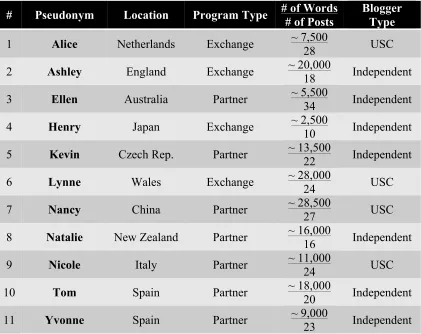
TABLE 1.1 Basic Description of Sample
The problem, then, is quite clear. There are nearly 300,000 US college students
studying abroad every year, with a proposed national goal of 1,000,000 by 2017. At the
same time, there are over 100 million blogs, each one being used as a platform for a
voice. Current university students, as part of the generation who has grown up in the
technology and internet boom, are no doubt asserting their presence in the blogosphere,
but the lack of data available on just how many study abroad students utilize a blog
during their overseas study and, more importantly, what can be learned by the students
who do, points to a gap in the research. This study will seek to identify the most common
themes that students choose to write about in their study abroad blogs, how these themes
point to USC’s study abroad learning outcomes, and whether or not evidence of student
learning, based on these outcomes, can be identified. The research questions for this
study are:
# Pseudonym Location # of Words Blogger Type
1 Alice Netherlands ~ 7,500 USC
2 Ashley England ~ 20,000 Independent
3 Ellen Australia ~ 5,500 Independent
4 Henry Japan ~ 2,500 Independent
5 Kevin Czech Rep. ~ 13,500 Independent
6 Lynne Wales ~ 28,000 USC
7 Nancy China ~ 28,500 USC
8 Natalie New Zealand ~ 16,000 Independent
9 Nicole Italy ~ 11,000 USC
10 Tom Spain ~ 18,000 Independent
! ! %.!
1. What do study abroad participants choose to write about in their blogs while they
are studying abroad?
2. Do these various stories document the known effects of study abroad, and if so,
how?
3. How is student learning—cultural, personal, and academic—evident in the study
abroad blog, if at all?
Through a qualitative analysis of 11 study abroad blogs, this study answers these
questions. Table 1.1 provides a snapshot of the sample used in this study. These blogs,
written by students at the University of South Carolina (USC) during their respective
study abroad semesters between Spring 2011 and Fall 2012, have been thoroughly read,
coded, and analyzed in order to reveal the most common themes that emerge, specifically
! ! %%!
CHAPTER II:REVIEW OF THE LITERATURE
Introduction
There is very little, if any, formal research on study abroad blogs. Apart from
Pudliner’s (2007) examination of the tourist traveler’s weblog and the implications these
sites have on the tourist industry, a limited amount of research has been conducted on the
students who choose to journal publicly about their overseas experiences, and specifically
their overseas academic experiences. Because of the lack of research on my specific topic
area, this literature review will highlight research done in the areas that surround my
research questions: study abroad, blogging, and travel blogging. Through articles and
research, I reveal the gaps in the literature, and the questions that have emerged as a
result. Since this study looks specifically at the student learning that occurs during a
study abroad program, I define and explain student learning as it will be applied in this
context. I also present literature through the definition of additional terms that are used
throughout this study.
Definition of Terms
STUDENT LEARNING: For the purposes of this study, student learning will be
defined based on David Kolb’s (1984) Theory of Experiential Learning and the USC
Study Abroad Learning Outcomes (Appendix A). The USC Study Abroad Learning
Outcomes is a comprehensive list of the knowledge or skills a student should have
acquired after studying abroad across three categories: academic, cultural, and personal.
! ! %&!
purposes, and also to encourage participants to consider the purpose and goals of their
study abroad experience.
Learning, defined by Kolb (1984) is “the process whereby knowledge is created
through the transformation of experience” (p. 38). In his Cycle of Learning, Kolb (1985)
describes four stages that make up this transformation: concrete experience, reflective
observation, abstract conceptualization, and active experimentation. The concrete
experience implies active involvement and participation in learning; reflective
observation implies the introspective thoughts about these experiences; abstract
conceptualization refers to the forming of ideas that come from the previous reflections;
and active experimentation is the processing of these ideas into actual actions or new
experiences. Based on Kolb’s (1984, 1985) Theory of Experiential Learning, student
learning, in this study, refers to the experiences that a student undergoes during which he
or she acquires new knowledge, ideas, or opinions.
STUDY ABROAD: Gemignani (2009) uses definitions of study abroad and other
related terms as presented by Peterson, Engle, Kenney, Kreutzer, Nolting, & Ogden
(2007) to be universalized for the purpose of outcomes projects. I include some of
Peterson, et al.’s definitions, but also bring in other researchers where more depth or
explanation is needed. Peterson, et al. define study abroad as “Education abroad that
results in progress toward an academic degree at a student’s home institution” (Peterson
et al., 2007, p. 176). McKeown provides a definition from the strictly American
perspective, calling study abroad “an academic experience, whether short term (as short
! ! %'!
the United States to engage in college study, cultural interaction, and more in the host
country” (2009, p. 11).
There are some study abroad programs for high school students and for
postgraduate students, but this study will be referring solely to higher education study
abroad programs in an undergraduate context. Some undergraduate education abroad
programs are not for academic credit, which I will not consider as study abroad, since the
academic basis of non-credit programs is inconsistent. Lewin (2009) offers a helpful
breakdown of applicable terms in this topic area, which I include for clarification:
Over the past decade, professionals in the field have questioned the term study
abroad as the most felicitous description. Many have opted to replace it with
education abroad on grounds that the latter term better captures the holistic nature
of the experience that undergraduates undergo. Some prefer international
education, and today we hear more frequent references to global studies and
global education. No doubt, each of these terms has its strengths, and we could
spend hours going back and forth as to which is best (p. xviii).
Study abroad, in this study, refers to any overseas programs that students attend at some
point during their undergraduate career, while enrolled at a U.S. institution, and during
which students earn academic credit toward their degrees at that same U.S. institution.
All participants in this study were enrolled in a study abroad program during the time the
submitted blog was written. When other terms, such as education abroad, are used, they
refer to the larger context of international education, which encompasses for-credit
! ! %(!
preparation to fill large civic duties is achieved through some type of overseas experience
(Peterson, et al., 2007; AACU, n.d.).
STUDY ABROAD PROGRAM: For the purposes of this study, a study abroad
program refers to the specific host university, area of study, and courses that an
individual student has selected. Some students will enroll directly at a foreign university,
some will participate in university-sponsored reciprocal exchange, and others will use a
third-party provider to facilitate their enrollment at a foreign institution or take
university-level courses abroad as part of a “study center” model. The various types of
programs will be distinguished when necessary.
STUDY ABROAD RETURNEE: A study abroad returnee is a student or
graduate who has previously attended a study abroad program.
HOST COUNTRY/UNIVERSITY: A host country or host university will be used
to describe the country or non-US university in which the student is studying.
INTERNATIONAL EXPERIENCE: International experience is defined by
Peterson et al. (2007) as the “broad, sweeping term for any opportunity undertaken by a
US student that occurs outside the United States…it should not be used interchangeably
with education abroad or study abroad” (qtd. in Gemignani, 2009, p. 12).
LEARNING OUTCOMES: Learning outcomes, specifically those used for study
abroad, can be explained as
1) The knowledge, skills, and abilities an individual student possesses and can
demonstrate upon completion of a learning experience or sequence of learning
experiences (e.g. course, degree, education abroad program). In the education
cross-! ! %)!
cultural competence, discipline-specific knowledge, research skills, etc. 2)
Advance statements about what students ought to understand or be able to do as a
result of a learning experience (qtd. in Gemignani, 2009, p. 12).
The USC Study Abroad Learning Outcomes (Appendix A) is the framework of learning
used throughout this study, and provides an excellent example of a clear and descriptive
set of learning outcomes for study abroad.
BLOG: A blog, derived from the term weblog, is a personal webpage typically
used as a platform for linkage, opinion, narration, or information sharing (Barlow, 2008;
Blood, 2000; Myers, 2010; Paulus, et al., 2009; Rosenberg, 2009). Halic, O., Lee, D.,
Paulus, T., & Spence, M. (2010) describe a blog as a “text-based online environment
which allows for embedding links to other online resources, and in which the author’s
posts appear in reverse chronological order” (p. 206). This ordering implies that the
newest object is the most important; however, blogs also serve as their own archives, so
that previous posts going back to the start of the webpage can be found and read. Paulus,
et. al (2009) considers blogs to be
the most recent iteration of personal web pages. These are characterized by
frequent updates, which are displayed with most recent posts at the top of the blog
page…Personal journals are the most common genre of blogs (p. 3).
BLOG POST: A blog post refers to each individual and dated entry that the blog
writer creates. Posts may contain text, links, videos, photos, or other forms of media.
BLOGGER: The blogger is the creator and author of the blog itself, sometimes
! ! %*!
BLOGOSPHERE: Hundreds of millions of blogs make up what is cleverly known
as the blogosphere. As is the case with most terms in this topic area, the creator of this
term is in question, but it has come to mean “the entire global conversation space” that
had emerged with the popularity of blogging (Rosenberg, 2009, p. 205). As Rosenberg
(2009) explains, there are many different spheres of the blogosphere, potentially
separated into the political, the personal, the business, the scholarly, and so on. For the
purposes of this study, blogosphere will refer to the general community of blogs and
bloggers; within this community falls the subgenre that I will be examining: the study
abroad blog.
Study Abroad: Known Effects
Although the ways in which a study abroad experience affects a student will vary
greatly from individual to individual, there are a number of commonly known effects for
which researchers have found evidence (Brecht & Robinson, 1993; Dolby, 2004;
Ellwood, 2011; Franklin, 2010; Gesinski, et al., 2010; Kitsantas, 2004; Kline, 1998;
Kolb, 2009; Lee, 2011; Lewin, 2009; Martinsen et al., 2010; McKeown, 2009; Savicki,
2010; Savicki & Cooley, 2011; Sutton & Rubin, 2004; Wolf, 2007). Second language
acquisition during study abroad is a heavily researched area; researchers have found, not
surprisingly, that a student’s ability to become competent in a second language is
increased by studying in a country where the second language is spoken (Brecht &
Robinson, 1993; Martinsen, et al., 2010; Kline, 1998; Wanner, 2009; Wilkinson, 2000).
One study found that this result occurred even when courses were taught in English and
! ! %+!
Other commonly researched effects include a change in identity and
self-awareness (Dolby, 2004; Gesinski et al., 2010; Ellwood, 2011; Savicki & Cooley, 2011),
multicultural competence (Ellwood, 2011; Franklin, 2010; Kitsantas, 2004; Kolb, 2009;
Lee, 2011; Picard et al., 2009; Sutton & Rubin, 2004; Wolf, 2007), life enhancement
(Fry, et al., 2009) and intellectual development (McKeown, 2009; Lee, 2011). Some
combination of these effects creates another frequently researched outcome: professional
or career applicability (Lewin, 2009; Franklin, 2010; Gesinski et al., 2010). NAFSA:
Association of International Educators considers study abroad to be a “learning
opportunity” which is,
uniquely capacitated to enable students to develop critical skills needed to
compete in today’s global economy, including foreign language fluency, strong
problem-solving and analytical capability, a tolerance for ambiguity, and
cross-cultural competence...Study abroad contributes in vital ways to preparing students
for the competitive global environment into which they will graduate… (NAFSA,
2013, par. 2).
These various effects may manifest themselves differently for each student, both in and
out of the classroom, but current research is generally concerned with the larger
implications of study abroad rather than with the individual result. Dr. Steven Trooboff,
The President and CEO of the Council on International Educational Exchange,
introduced the 2009 report titled “Study Abroad and its Transformative Power” and made
these important points about study abroad:
All study abroad is not the same. There is a good deal more to the experience than
! ! %,!
outside the familiar, ‘outside their own skin,’ and asks them to see and experience
the world in new and different ways…Study abroad makes for a more informed,
more tolerant, more patient citizenry, one that appreciates that you don’t have to
be like ‘us’ to be OK…Study abroad offers each student a personal learning
experience. Students return more confident in their ability to cope, more capable
of dealing with uncertainty, and with a greater sense of purpose than before they
left. It’s not only what they find out about the world and those around them that’s
important. In the end, what might be most important is what they find out about
themselves (Trooboff, 2010, p. viii-ix).
The development of students’ cross-cultural communication skills and
multicultural competency are also of concern to researchers. Studies have shown that not
only did students’ global competencies increase after study abroad participation, but
students’ perceptions of this growth followed particular patterns (Gemignani, 2009;
Kitsantas, 2004; Lee, 2011; Sutton & Rubin, 2004). Kitsantas (2004) found that
cross-cultural competence increased based on students’ personal goals in this particular area,
while Gemignani (2009) found that study abroad students perceived their cultural
understanding to have come primarily from interaction with locals or other international
students.
Perhaps most significant to this study is the research that has recognized the
shifting and deepening identities of study abroad students (Dolby, 2004; Ellwood, 2011;
Gesinski, et al., 2010; Savicki & Cooley, 2011). University of Alabama at Birmingham
(Gesinski, et al., 2010) sought to understand the student perceptions of identity
! ! %-!
evaluations, researchers found that, when encouraged to pay attention to their individual
multicultural and professional identity, the students were able to clearly define the ways
in which these facets of their identity had shifted (Gesinski, et al., 2010). In terms of
national identity, the research found that study abroad increased students’ commitment to
the exploration of national identity, and confirmed previous psychologists’ claims that
psychological well-being is related to American identity (Savicki & Cooley, 2011). A
study conducted almost immediately following the events of September 11, 2001,
claimed that, while study abroad students experienced “renewed nationalistic fervor in
the United States,” they also returned to their home country with an understanding of
America as a “postnational formation that is grounded in multiplicity and openness”
(Dolby, 2004, p. 152).
The September 11, 2001 attacks had an important influence on study abroad
among US university students. A number of studies conducted after 9/11 refer to the
direct effect the events had on both higher education in the United States as well as to
education abroad (Kolb, 2009; Picard, et al., 2009; McKeown, 2009). Despite the
“heightened security restrictions, family and student safety and security concerns, and the
increased expense of studying abroad coupled with tight family finances,” study abroad
has continued to increase by the thousands every year since the attacks (Picard, et al.,
2009, p. 321). International education professionals agree that this post-9/11 increase is
due in part to both the US government’s recognition of global citizenship as a national
imperative, as well as the US public’s support of the same idea (Kolb, 2009).
Evidenced by the research of the impact and the current state of study abroad, it is
! ! &.!
understanding, and thus a national imperative which contributes to national security, as
Senator Durbin articulated in his speech to NAFSA (Durbin, 2011). As technological
advances lead to the flattening of the world, to borrow from Friedman (2005), the
internationalization of higher education curricula becomes increasingly more important.
Research suggests that students who spend periods of their post-secondary education
overseas are returning to the United States with a renewed sense of national identity, but
also an increased awareness of multiculturalism and open-mindedness (Dolby, 2004;
Ellwood, 2011; Franklin, 2010; Gesinski et al., 2010; Kolb, 2009; Lee, 2011; Picard et
al., 2009; Savicki & Cooley, 2011; Sutton & Rubin, 2004; Wolf, 2007).
The research on the effects of study abroad is extensive and continual. Many
universities, including the University of South Carolina, yearly assess their study abroad
programs by surveying students upon returning from their term abroad. The
aforementioned studies follow a similar methods pattern, collecting data once a student
has completed his or her study abroad program and returned to the United States. In both
single-institutional and multi-institutional assessments of study abroad, students are asked
to reflect or recall their experiences based on guiding questions. The responses and
results that come from these post-study abroad studies are not only important, but also
imperative to a continued belief in the importance of global education. However, due to
their reliance on the students’ recall of information, they cannot possibly capture the
extensive student learning that occurs during a study abroad term.
Recent studies focus on students during their pre- and post-study abroad phases,
but there is very little research done on students while they are in the crux of their
! ! &%!
during their program, but none of the studies follow students throughout the duration of
their programs. Instead, research is gathered when the students have returned, and they
are asked to recount their experiences from memory—some of which may be quite
distant. My study seeks to capture the student learning experience through blog posts
about particular events, experiences, or situations within days of the occurrence. Unlike
current research, I rely primarily on what the students choose to write about and share
with the public, as opposed to only asking them to respond to directed questions.
The importance of filling in the gap of study abroad blogs in the literature is to
determine what changes, developments, experiences, and attitudes students deem
important to write about during a study abroad program, and if these writing choices
show evidence of student learning, according to institutional learning outcomes. By using
study abroad students’ blogs as a basis for my study, I attempt to capture student learning
as it is occurring, and thus incorporate a factor that is absent in current studies. Zilcosky
(2008) makes a distinction between writing and story telling, insisting that telling
“demanded… community...Whereas communal storytelling was part of the journey and
enriched the plot, writing down narratives often implied the voyage’s end” (p. 4).
Investigating student narratives is important for this reason, because it is within these
narratives that the core, or action, of the journey—instead of the memories of the
voyage—can be found.
Student blogs written during a study abroad term may provide further insight into
the known effects of study abroad. A student chooses what to write about in his or her
online journal, as opposed to answering the purposeful questions found in a post-study
! ! &&!
without cognizant recognition that they are, in fact, learning. These various stories,
written and read by students, may reveal the process by which a second language is
acquired, a change in identity occurs, multicultural competence is developed, and the
intellect is challenged.
Blogging: Background & Recent Research
Before Facebook, Twitter, YouTube, and FourSquare, there were weblogs. What
came to be known as “blogs,” these online platforms for personal narratives, political
opinions, link sharing, current event discussions, and virtually anything else, exploded in
popularity among users of all ages. In order to better understand how and why these
online self-publication websites became mainstream, it is helpful to understand from how
and why blogs originated.
In 1994, the still early days of the World Wide Web, Justin Hall developed a
personal webpage, “Justin’s Links from the Underground,” where he collected and shared
the newest and most interesting website finds (Rosenberg, 2009). In a pre-Google world,
such a resource proved valuable and popular. As Rosenberg notes, this popularity was
due not only to the unusual and hard-to-find links but also to the “lively personality” and
“never boring” writing that came to distinguish Hall’s web log of links from the others
that came before, or even after, “the Underground” (Rosenberg, 2009, p. 22).
Most blog histories, many of them informal, cite the beginning of weblogs with
Hall, whose site began in 1994 (Barlow, 2008; Blood, 2000; Cho, 2004; Rosenberg,
2009). The term “weblog” was coined by Jorn Barger on his blog in 1997, and shortened
to “blog” in 1999 by Peter Merholz. By 2003, “weblog” was added to the Oxford English
! ! &'!
2004, par. 4). Despite the vastness of the blogosphere and the scope of topic areas
covered, the reason for this increase in popularity in the United States is not widely
debated. In fact, it is most often pinpointed to the same historical event which marks an
increase in US study abroad participation.
In just one commonality between the areas of research in study abroad and
blogging, the tragic events of September 11, 2001 are often attributed to the sudden
acceptance and usage of blogs in the twenty-first century (Barlow, 2009;Hourihan, 2002;
McDaniel, 2005; Mooney, 2003;Rosenberg, 2009). Rosenberg (2009) describes, in
detail, how New York journalist James Marino described the attacks on his blog as he
watched from his office window. At 8:56 am, only minutes after submitting a post on the
latest Broadway buzz, Marino posted the following:
Something very terrible just happened at the World Trade Center. I think a plane
crashed into the north-western tower. It is horrible and stunning to look at. –james
(qtd. in Rosenberg, 2009, p. 1).
Marino’s post is likely the first web reference to the World Trade Center attacks, and it
became the first of many blog posts written and published about September 11. The
aforementioned Justin Hall was not far behind Marino, posting later that morning about
the types of media that are valuable in such a crisis: email and TV, he said (Rosenberg,
2009).
Rosenberg (2009) continues to detail the ways in which the blogosphere exploded
with references to the attacks, including a “page that automatically collated postings
about the attacks from Blogger users across the Web and listed them in chronological
! ! &(!
Blogger, and Dave Winer who posted the answer to a New York Times reporter on his
blog when he could not reach her by phone; Amy Harmon was, on the afternoon of 9/11,
gathering information for a story on how the web was utilized during the attacks
(Rosenberg, 2009). The internet, and blogs in particular, were suddenly a source for
information—not just information, but accurate and up to date information. While the
media was highly selective in what they shared with consumers, bloggers, it seemed,
were less selective—or perhaps simply less censored. Rosenberg (2009) recalls that
At that moment of crisis, many of us looked to the Web for a sense of connection
and a dose of truth…people felt the urgent necessity to express themselves and be
heard as singular individuals. Those who posted felt the gravity of the moment
and the certainty that stepping forward to record their thoughts had quantifiable
but unmistakable value (p. 7).
Certainly, every blog post is not about a national tragedy. However, what is
evident in the bloggers’ reaction to 9/11 is the overwhelming sense of community that
was created, virtually, across the country. Weinberger described this coming together as
the world talking with itself, “doing what humans do when the innocent suffer: cry,
comfort, inform, and most important, tell the story together” (qtd. in Rosenberg, 2009, p.
7). The community within the blogosphere is not only an important aspect of blogging,
but is one of the features that distinguish it from other forms of writing entirely (Barlow,
2009; Halic, et al., 2010; McDaniel, 2005; Rosenberg, 2009). Zilcosky (2008) considers
community to be the difference between story telling and story writing, which is perhaps
the distinction between submitting a blog post and publishing a journal article. Within the
! ! &)!
three participants make up the blog community, which is imaginatively divided up by
interests, subject, topic, or intended audience (McDaniel, 2005; Rosenberg, 2009). This
interaction between reader and writer, due to the uncensored nature of blogs and the
ability to comment on posts, makes blogging particularly interesting to educators.
Higher education is beginning to recognize, utilize, and experiment with blogging
and other forms of social media as admissions recruiting tools and pedagogical
instruments both in and out of the classroom (Barnes & Lescault, 2011; Barnes &
Matson, 2010; George & Dellasega, 2011; Sharma, 2010). Blogging has been found to be
a successful way to better understand students’ learning processes, their information
retention, and the gaps in the knowledge based on Stahl’s (2006) social theory of
computer-supported collaborative learning, which suggests that knowledge is acquired or
created through human interaction and conversation (Paulus, et al., 2009).
The body of empirical studies on blogging in educational contexts is limited but
growing. Initial studies show that blogging can support reflective thinking, critical
thinking, and collaboration, allowing students to take ownership of their learning
(Bouldin, et al., 2006; Boulous, et al., 2006; Oravec, 2003). Research suggests that
people tend to be more candid and reflective when using these tools (Joinsen, 2001; Shaw
& Pieter, 2000).
When combined with stated learning outcomes and student/instructor interaction,
blogging as a course requirement has the potential to be an effective tool for learning
(Halic, et al., 2010). Additionally, students who blog develop ownership of their
knowledge and creativity, and feel inspired to use their individual voices (Martinez,
! ! &*!
changes and growth in thinking, which in turn allowed them to better reflect on their
learning” (Sharma, 2010, p. 136). Sharma (2010) claims that blogs
offer a convenient mechanism for students to journal their learning processes, and
if used appropriately this technology has the potential to facilitate reflection and
learning. Most importantly, Weblogs support students in recording and revisiting
experience, which is an important aspect of reflective learning (Boud et al., 1985).
Weblogs can allow students to view the progress of their thinking over time
(Ellison & Wu, 2008)…(p.129)
However, her study of a comparison between two groups of student bloggers—one that
writes freely and independently and another that is given guidelines and support
throughout the writing process—finds that the latter group of bloggers more commonly
utilized reflection during the blogging experience. Sharma’s (2010) study may also
suggest that a required blog, or a blog being written for academic credit, has its certain
limitations, one of which would be the intended audience of professor. Making a blog
voluntary versus compulsory could reveal different results in terms of effectiveness, since
a student would be choosing whether or not to write about a particular experience in a
voluntary situation.
Other studies on blogging in higher education have focused on foreign language
learning and the role that blogging can play in this process. Ducate & Lomicka (2008)
guided foreign language students in a year-long study in which students spent a semester
reading blogs written by native speakers of the studied foreign language (French or
German), and then a semester writing their own blog in the foreign language. Results
! ! &+!
semester period in order to practice language, but also developed a sense of community,
both with their classmates and with native speakers who commented on the student blogs
(Ducate & Lomicka, 2008).
There is a small, limited amount of research on travel blogs and travel bloggers,
but these studies examine tourists, rather than the study abroad student (Azariah, 2011;
Banyai & Glover, 2011; Pudliner, 2007; Wenger, 2008). Pudliner (2007) uses canonical
literature and literary figure’s journals to set a precedent of travel writing. Arguing that
this genre emerged long ago, she uses the characteristics of literature to reveal the worth
of travel blogs. Specifically, she discusses the blog of Canadian Carol Watson, who
travels around the United States and shares her adventures with the blogosphere. Pudliner
(2007) finds her writing to be
…characteristic of weblogs; short and concise commentaries to entice future
exploration. But her pictures capture more information for the reader to
disseminate, adding depth, texture and structure to what she is writing about. She
describes and depicts an intimacy with the landscape visited at a certain moment
in time. Her comment implies the ‘moment’, suggesting that future visitors may
not be able to capture that particular unique display of the landscape (51).
Other researchers on this topic have argued for similar claims, that the blogging of
travelers reveals much about the tourist experience, and can be used to encourage the
traveling of others (Azariah, 2011; Banyai & Glover, 2011; Wenger, 2008). And yet,
these studies are absent of examinations of the study abroad student blog, which, unlike
the tourist blog, could be rich with evidence of learning and meaning-making from the
! ! &,! Study Abroad Blogging
Despite the expanding numbers of study abroad participants and the growing
population of the blogosphere, little research on the study abroad blog exists. Lee (2011)
studies the pedagogical uses of a blog for language learning during study abroad, but the
bloggers in her sample respond to prompts and assignments. Before the days of blogging,
Taylor (1991) provides a guide to professors on how to use the student travel journal as a
means for assessment of study abroad learning; however, like Lee’s study, Taylor
suggests a guided, regulated approach, rather than simply allowing the students to write
organically.
With extensive research done on the educational and personal benefits of study
abroad, and with a growing body of research on the pedagogical possibilities for student
blogging, a study that seeks to understand the relationship between these two twenty-first
century trends is both logical and necessary. If students are learning, growing, and
developing during study abroad programs—and indeed they are—and if these same
students are documenting their experiences in a public and social arena, then perhaps the
process of this learning can be better understood. The more students who study abroad
and the more students who document these experiences on a blog, the wider the gap in
the literature becomes. This study is merely the beginning of what should become a large
and fascinating area of research that will certainly evolve with an increase in national
! ! &-!
CHAPTER III:METHODOLOGY
Purpose of Study
This study looked for evidence of student learning using travel blogs from
undergraduate students at the University of South Carolina (USC). I chose to research
this particular population because I have extensive knowledge of the USC study abroad
processes and programs; furthermore, their publicly available learning outcomes
showcase the commitment to student learning and development as it occurs during study
abroad. I read, coded, and analyzed blogs from the Spring of 2011 through the Fall of
2012. To eliminate extraneous variables, only student bloggers from the University of
South Carolina were studied. Through careful readings of the sample blogs, I drew
conclusions about the following questions:
1. What do study abroad participants choose to write about in their blogs while they
are studying abroad?
2. Do these various stories document the known effects of study abroad, and if so,
how?
3. How is student learning—cultural, personal, and academic—evident in the study
abroad blog, if at all?
The framework of my study was based on the known effects of study abroad, as
described in Chapter II, and the USC Study Abroad Learning Outcomes (Appendix A).
Research question number two was answered through a comparison between the known
! ! '.!
the instances of learning, as defined by Kolb (1984), to USC’s Study Abroad Learning
Outcomes. Kolb’s (1984) Theory of Experiential Learning, which considers the learning
process to be only possible through experience, was used to define and articulate the
types of learning I looked for in the study abroad blogs.
I submitted my research proposal to the USC Institutional Review Board for
approval. Approval for exemption status was granted (Appendix B).
Data Selection
Blogs for the study were selected one of two ways: through voluntary submission
and through intentional selection. The following criteria was considered for both those
submitted voluntary and those selected from the USC Study Abroad Office blog archives:
1. Substance: that a blog have no fewer than 10 posts
2. Term abroad: the student must have blogged for one semester between Spring
2011 and Fall 2012
3. Location: that there be no more than two bloggers studying in the same
country
4. Type of student: must have been a traditionally-aged undergraduate in any
major during the study abroad program for which the blog was written
The criteria served to diversify the sample as much as possible within the confines of
specific variables. Blogs needed to have at least 10 posts with text in order to be
considered substantial and valuable to the study. The type of student and term abroad
narrowed the sample and limited the possibility of unwanted extraneous variables. Since
all students used in the study were undergraduates who spent a semester abroad, a more
! ! '%!
was the same for all sample blogs, a variance in location was used to strengthen the
external validity of the study. Although five of the voluntarily submitted bloggers studied
in Spain, only two were used in the sample. One blog was eliminated because it
contained too few posts; of the remaining four that met the sample criteria, Tom’s and
Yvonne’s blogs were chosen based on the order that the blogs were submitted.
Students who went abroad during Spring of 2011, Fall of 2011, Spring of 2012, or
Fall of 2012 received an email sent from the USC Study Abroad Office inviting them to
submit their blogs for this research study (Appendix C). This email informed them of the
study, and invited them to voluntarily participate; the number of participants was limited
to 10, but only seven of the 22 submitted blogs met the prescribed criteria. Students who
volunteered and met the initial criteria were sent a personal follow-up email with further
details of the research project and instructions on the information I needed from them
(Appendix D). Not all students who were sent the follow-up email were included in the
research; some students who initially expressed interest never sent me the URL to their
blog, some students had too few posts (fewer than 10), and some were eliminated as part
of the location criteria, which was included in order to diversify the sample and increase
external validity.
Blogs which met the prescribed criteria and were publicly available on USC’s
study abroad website were selected from the blog archive as part of the intentional
selection sample. These students had previously volunteered to be an “official blogger”
for the USC Study Abroad office. Although this role was entirely voluntary, they were
asked to write weekly posts, cover appropriate topics, and consider the USC student body
! ! '&!
Gender and ethnicity were not considered in the selection of the sample.
However, 27.3 % of the sample was male and 72.7% were female. This percentage
breakdown closely reflects the gender demographics in study abroad, since according to
the Open Doors Report 2012, 35.6 % of study abroad participants in 2010-2011 were
male, and 64.4% were female (IIE, 2012). The information about individual bloggers
used and presented in this study is solely the information that was available in the student
blog. With the exception of student name, term abroad, and blog URL, all other
information was found through the analysis of the respective blogs. I did not solicit
students for gender or ethnic information. The study abroad location, although my criteria
eliminated from the sample more than two bloggers in the same host country, was not
considered in initial sample selection or in the blog analysis. In selecting my sample, I
was not looking for bloggers in specific locations, but merely for a diverse range. My
sample of 11 bloggers covered nine countries (with England and Wales counted as one
country, under the United Kingdom); every country represented in this sample fell into
the top 25 study abroad destinations for US students, according to the Open Doors Report
2012 (IIE, 2012).
The USC Blogger
Every semester, including summer, the USC Study Abroad Office features blogs
under the “Student Blogs” section of the website. All past blogs are archived, and
although the student bloggers and their profiles are visible as far back as 2008, only the
2011-2012 blogs can be read by the general public. It is from these archives, located at
www.studyabroad.sc.edu, that I selected my sample blogs. Though the students featured
! ! ''!
included in this study did, the USC bloggers did volunteer prior to their study abroad
program to be a featured blogger on the Study Abroad Office.
Prior to the Fall of 2012, students were contacted on the Study Abroad Listserv (a
large email distribution list to which students who apply to study abroad are
automatically added) and given brief details on the USC Study Abroad blogger program.
Students who studied abroad in the Fall of 2012 were contacted more directly, using the
USC study abroad database to send this interest email only to upcoming study abroad
students. In this initial solicitation email (Appendix E), students are asked to contact the
office and provide the following information: study abroad program, personal interest in
blogging, and any past experience with blogging. The Study Abroad Office uses this
information to informally—that is, without a formal or official criteria—select
approximately five featured bloggers for the semester.
Bloggers for the semester are selected only after looking holistically at all those
who volunteered. The Study Abroad Office seeks to consider gender, ethnicity, location,
and program type in the selection process, with a final goal of diversity and originality.
Males, many majors (such as engineering, education), minority populations, and locations
(such as Latin America) are underrepresented in study abroad programs at USC. By
selecting bloggers who fall into some of these categories, USC hopes to increase
participation from these various demographics. Those students who exhibit prior
experience with blogging are also given priority, although most students who volunteer
have not previously blogged.
Once the bloggers have been selected, they are sent a follow-up email with further
! ! '(!
answer questions for a profile, so that readers can learn more about the bloggers. In
addition, these bloggers also sign a contract agreeing to blog once to twice a week (as
their schedule allows), include only appropriate content, be creative with photos and
videos, and write a reflection post at the end of their respective program (Appendix G).
The Study Abroad Office does not have a way to enforce the requests to blog frequently,
so the contract serves more as a potential motivating factor; however, a student’s blog
will be removed from the USC website if inappropriate content is posted. About halfway
through the semester of their study abroad term, the students in this study were sent a
email of encouragement, reminding them that students, teachers, parents, and others were
reading their blogs and to keep posting updates. Apart from this halfway-point email,
students were not prompted or reminded to post. About half of the students from each
term do not fully participate, a problem that made many blogs ineligible for this study,
based on my sample criteria.
At the end of the semester, students are sent a final email thanking them for their
participation, inviting them to come by the office for a small gift, and reminding them to
post a reflection entry, if they have not already done so.
Data Collection
After blogs were volunteered, selected, and narrowed based on sample criteria, I
had 11 total blogs to code and include in this study. The following information was
entered into a spreadsheet for tracking purposes: first name, last name, pseudonym, term
abroad, program type, host country, host city, email, USC or independent blogger, blog
! ! ')!
independent blogger information will be included in this report. A second sheet in this
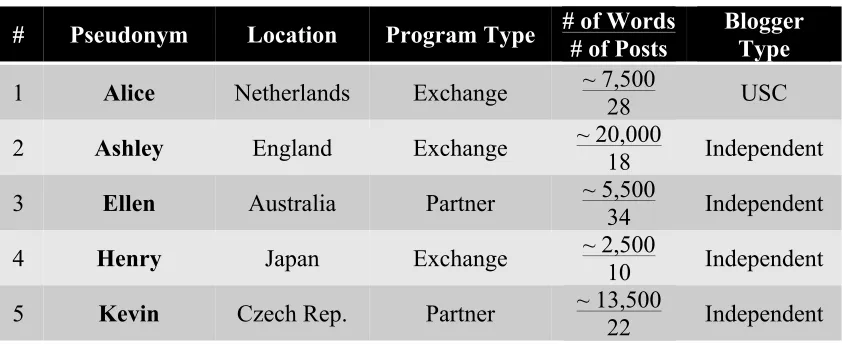
spreadsheet file was created to track data. Table 3.1 shows details of the final sample.
TABLE 3.1 Detailed Description of Sample
Each blog was copied from its internet host and put into an individual Microsoft
Word document. Posts were read in consecutive order, from earliest post to the most
recent—through the end of the respective study abroad program, including the return to
the US. I read and coded each blog once through, allowing themes and patterns to
organically emerge and then compiling these themes into a spreadsheet database. For
consistency and accuracy, I then read and coded each blog again. Blogs were read from
the computer and coded using the “Review” feature in Microsoft Word. Highlights over
post segments and annotations denoting the particular theme or themes that these
# Pseudonym Location Program Type # of Words # of Posts Blogger Type
1 Alice Netherlands Exchange ~ 7,500
28 USC
2 Ashley England Exchange ~ 20,000 18 Independent
3 Ellen Australia Partner ~ 5,500
34 Independent
4 Henry Japan Exchange ~ 2,500
10 Independent
5 Kevin Czech Rep. Partner ~ 13,500 22 Independent
6 Lynne Wales Exchange ~ 28,000
24 USC
7 Nancy China Partner ~ 28,500 27 USC
8 Natalie New Zealand Partner ~ 16,000
16 Independent
9 Nicole Italy Partner ~ 11,000
24 USC
10 Tom Spain Partner ~ 18,000 20 Independent
11 Yvonne Spain Partner ~ 9,000