Preparation and Characterization of Microfiltration
Membrane Embedded with Silver
Nano-Particles
Madaeni, Sayed Siavash*
+Membrane Research Center, Department of Chemical Engineering, Razi University, Kermanshah, I.R. IRAN
Akbarzadeh Arbatan, Tina
Department of Chemistry, Tarbiat Moalem University, Tehran, I.R. IRAN
ABSTRACT: The microfiltration 0.2 µm Cellulose Acetate (CA) membrane was modified by embedding antibacterial silver nano-particles in the membrane pores. This novel technique was developed to enhance the capability of the microfiltration membrane for removing microorganism including bacteria. The prepared membrane was characterized using Scanning Electron Microscopy (SEM), Energy-Dispersive X-ray Spectroscopy (EDS), water contact angle measurement and Differential Scanning Calorimetry (DSC). Membrane performance was elucidated by flux and rejection measurements using water samples from the pond of a public recreational park in Tehran. For rejection capability of the membrane, the availability of filament and c-shaped species of the phyla Actinobacteria and Spirochetas in the permeate side of the membrane was estimated. Contrary to virgin membrane, the modified membrane was able to remove 100% of Actinobacteria and Spirochetas species from the infected water. Moreover, the wettability of the modified membrane was remarkably changed leading to higher water flux. A potential application of the modified Ag-CA membrane is “sterile filtration” of temperature sensitive fluids.
KEY WORDS: Microfiltration, Membrane, Nano-particle, Microorganisms, Sterile filtration.
INTRODUCTION
A vital application of membranes in general and Micro Filtration (MF) in particular is sterilization of temperature sensitive solutions such as biologic liquids which cannot undergo usual sterilization methods like autoclaving. However, microfiltration membranes are not able to remove all microorganisms from a solution. This has been shown in many published papers. For instance Hahn isolated some microorganisms after sample filtration through a 0.22 µm cellulose acetate membrane [1].
He employed “Filtration Acclimatization Method” to culture the specific species [2]. The possible passage of Spirochetes through a 0.2 µm membrane was confirmed by Hahn and others [1-4]. Some researchers reported the isolation of Betaproteobacteria and Actinobacteria [5, 6] and Hylemonella gracilis [7, 8], from filtered freshwater samples.
Nano-structured materials such as nano-particles and nano-tubes possess interesting features. Nano-silver is a commercialized antibacterial agent which affects a wide
* To whom correspondence should be addressed. +E-mail: [email protected]
range of bacteria [9, 10] and HIV virus [11]. Combination of membrane filtration and antibacterial capability of nano-silver is a solution for performance optimization of microfiltration process.
Different types of “template methods” have been discussed by researchers for preparation of nano-tube membranes [12, 13]. This procedure may be carried out via various techniques including electrochemical deposition, sol-gel, chemical vapor deposition, chemical polymerization and electro-less plating. The latter is chemically covering the pores and the surface of a membrane by a desired material. This alters the properties of the membrane. Martin and coworkers produced gold nano-tubule membranes with both cation and anion permselectivity [14], chemical transport selectivity [15] or optical property [16]. The other researchers prepared silica/titania nanorods / nanotubes composite [17], carbon nano-tube [18] or silver nano-particle membranes. The template method is a general procedure for synthesis of nano-tubes, nano-cables and nano-rods [20-28].
In the current study, nano-silver embedded cellulose acetate membranes were prepared using electro-less plating. This is a novel technique for modification of membrane structure leading to superior performance. The membranes were characterized via various techniques such as SEM, EDS, contact angle measurement and DSC. Flux and rejection of virgin and modified membranes were estimated by microfiltration of water containing bacteria. The presence of Actinobacteria and Spirochetas in the permeate side of the membrane was determined for rejection calculation.
EXPERIMENTAL SECTION
Materials
Two microfiltration membranes were employed in this work, 0.2 µm Cellulose Acetate (CA) membrane from Whatman Inc and 0.22 m Cellulose Tri-Acetate (CTA) membrane from Membranesolution. Tin (II) chloride (98%), silver nitrate (99%), trifluoroacetic acid (99%), methanol (99.99%), nitric acid (68–70%), and ammonia (28–30%) were all purchased from Merck (Germany).
Medium used for isolation and maintenance of bacteria was Nutrient broth Soyotone Yeast extract (NSY). NSY medium consists of an inorganic basal medium. 1L of the medium consists of 75 mg of MgSO4.7H2O,
43 mg of Ca(NO3)2.4H2O, 16 mg of NaHCO3, 5 mg of
KCl, 3.7 mg of K2HPO4.3H2O, 4.4 mg of Na2EDTA, 3.2 mg
of FeCl3.6H2O, 1.0 mg of H3BO3, 0.2 mg of MnCl2 .4H2O,
0.02 mg of ZnSO4.7H2O, 0.01 mg of CuSO4.6H2O, 0.01 mg
of CoCl2.6H2O, 0.006 mg of Na2MoO4.2H2O and 0.1 mg
of NiCl2 .6H2O at pH 7.2. This was supplemented with
equivalent amounts of nutrient broth, soyotone, peptone, and yeast extract (all from Difco). The modifications of NSY medium were restricted to the concentrations of the organic supplements and the composition of the inorganic basal medium was kept constant. For initial dilution in the isolation experiments the inorganic basal medium was used. For the later isolation procedure NSY media containing increasing concentrations of the organic supplements were used and for preservation of the isolated strains solid (15% agar) was employed.
Membrane preparation
Two steps of electroless plating/ deposition reaction were consequently performed to prepare 1, 3, and 5% Ag-CA membranes. The procedure for deposition of Ag nano-particles on the membrane surface and pores was similar to the published technique in literature [11]. First the cellulose acetate membrane was immersed in tin chloride solution bath with concentrations of 1, 3 and 5 wt.% Ag. The immersion in solution was continued for 30 min to modify the membrane surface and pore by tin adsorption. This leads to a complexion reaction between tin (II) ions, a well known reducing agent and carbonyl groups in the membrane structure. Tin ions play the role of Lewis acid and make fully octet complex with carbonyl groups of cellulose acetate membrane. The lone pair of electrons in this complex is available for bonding. The complex is able to act as a Lewis base or ligand. In the second stage of the reaction, Ag+ undergoes a redox reaction and deposits on the tin (II)- bound membrane surface.
The partly modified membrane was taken out and rinsed with methanol. This was followed by immersion into silver nitrate solution containing ammonia for 2 min. The second bath contained 1, 3 and 5 wt.% Ag of AgNO3
and NH3·H2O to load silver nano-particles as a homogeneous
coating onto the membrane pores. The prepared membrane was subsequently rinsed by distilled water and air-dried.
Membrane characterization
were obtained usingCambridge Vega Tescan Obducat CamScan. The samples must be electrically conductive. They were placed in a specific chamber and gold particles weresputteredon the surfacetoobtain anultra-thindepositedlayer.
As a consequence of the interaction of electrons with the sample, X-Rays are produced while taking images using scanning electron microscope. The beams can be used for Energy-Dispersive X-ray Spectroscopy (EDS). The resulted graph is interpreted automatically to clarify the present elements in the sample.
The contact angle goniometer (G10 contact angle measurement system from Krüss) was employed to measure the angle when a droplet of water falls down from a nozzle on the membrane surface. A camera is utilized to capture the image. The connected computer measures the contact angle.
Differential Scanning Calorimetry (DSC) elucidates the thermal characteristics of a sample. Using this technique, fusion, crystallization and glass transition temperatures can be measured. In DSC the difference in the quantity of required heat to raise the temperature of a sample and reference are measured as a function of temperature. In this work DSC 200 F3 Maia, NETZSCH (Japan) was employed. The quantity of 15,350 mg of 5% Ag-CA and 14,780 mg of virgin CA membranes were placed in DSC cell. The scanning was carried out in the range of 0-200°C at a heating rate of 20°C/min.
For estimation of membrane performance a dead-end cell was utilized. The membrane surface area was 15.2 cm2. The required pressure was applied using nitrogen gas The dead-end cell was connected to a nitrogen cylinder. A pressure gauge monitored the applied pressure. The cell was connected to the feed container via valves and hoses. The flux was estimated by recording the required time for passing a specific volume of the feed through the membrane.
For elucidation of rejection capability of the membrane, the permeate was collected and assayed for the presence of the proposed microorganism.
RESULTS AND DISCUSSIONS
Membrane characterization
The SEM images clearly exhibit the deposition of silver nano-particles on the membrane pores (Fig. 1). These micrographs confirm the establishment of membrane modification.
Moreover the EDS analysis proves the presence of Ag in the modified membranes (Fig. 2). The system automatically analyses the elements on the basis of the wavelength of the peaks appear in the graph. The presence of Ag is clearly shown in the spectrum.
Water contact angle was measured for both modified and virgin membranes (Fig. 3) to elucidate the possible alteration in membrane wettability. Increasing silver concentration leads to an improvement in contact angle i.e. higher hydrophobicity. Since the surface of the membrane is homogenously covered by silver, the membrane may be considered as a metal thin film with the same behavior. The bonds between water molecules are stronger than the bonds between Ag and water molecules, i.e. the membrane does not adsorb water contrary to highly hydrophilic cellulose acetate membrane.
DSC was carried out to investigate the glass transition temperature (Tg) and melting point (Tm) of both CA and 5 wt% Ag-CA membrane. The results are presented in Fig. 4.
DSC was carried out for both virgin and 5% Ag modified membranes. The latter with the highest amount of additive, is expected to exhibit highest Tg (glass
transition temperature) and Tm (melting temperature)
(a) (b)
(c) (d)
Fig. 1: SEM micrographs of (a) virgin CA membrane (b) Ag coated CA membrane (c) Ag coated CTA membrane (d) Ag coated CTA membrane (higher magnification).
Fig. 2: EDS spectrum of the Ag-CA membrane.
Membrane performance
The pure water flux was measured for virgin and modified membranes in various transmembrane pressures of 0.2, 0.5, 0.9 and 2 bar using a dead-end filtration cell (Fig. 5). Apparently increasing the transmembrane pressure or driving force enhances the water flux.
Fig. 3: Membrane contact angle versus concentration of silver nano-particles.
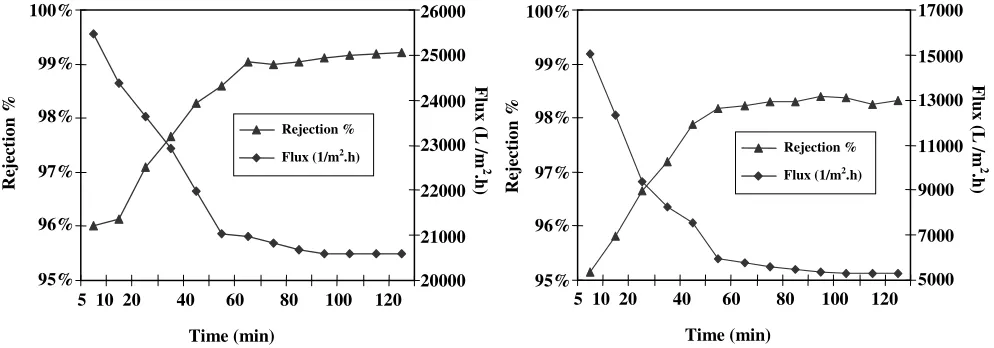
Filtration of a real wastewater containing bacteria was carried out to investigate the capability of the modified membrane for application in real wastewater treatment. Water samples from Mellat Park pond containing Actinobacteria and Spirochetes were obtained and passed through the virgin and modified membranes. The results
0 2 4 6 8 10 12 14 16 18 20 0% 1% 2% 3% 4% 5%
Ag concentration (wt%) 120
100
80
60
40
20
0
Wa
te
r
co
n
ta
ct
a
n
g
le
(
Fig. 4: DSC thermograms of virgin CA membrane and Ag-CA membrane.
Fig. 5: Pure water flux versus Ag concentration in various transmembraene pressures.
Fig. 6: Typical flux and rejection versus time using real contaminated water under 2 bars, (a) Flux (b) Rejection.
for flux and rejection during time are presented in Fig. 6. Flux and rejection are key factors for evaluation of membrane performance. The results (Fig. 7) indicate that the modified membrane with 1% silver nano-particles demonstrates highest flux and rejection.
Introducing silver nano-particles into the cellulose acetate membrane improved membrane hydrophobicity (see Fig. 3) and meanwhile enhanced the water flux for purified (Fig. 5) or contaminated (Fig. 6) water. In general increasing the membrane hydrophobicity leads to a decline in flux. This unique behavior may be explained due to the nature of silver nano-particles. The friction factor of metals such as silver is less than polymers including cellulose acetate. Accordingly there is less interaction between water molecules and silver nano-particles. In other words the surface or pores of modified membrane are more “slippery” for water. This leads to higher flux. The flux for modified membranes with 3 and
5% Ag was low compared to 1%. The deposited silver particles on the membrane (Fig. 1) provide resistance against the passage of water due to the blocking of membrane pores. Obviously higher deposition (5%) of particles establishes higher resistance and diminishes the flux. However the fluxes for all treated membranes were elevated compared to the original membrane due to the slippery nature of the deposited metal particle versus water molecules.
The FAM culturing method was applied to examine if any microorganism can pass alive through the 1% Ag-CA and the virgin membranes. All the test equipments and the membranes were sterilized before performing any trial. No living microorganism was found in the filtered water. This proves the membrane capability for complete removal of proposed species. The rejection test was performed for virgin and 1% Ag membranes. The latter was selected on the basis of highest permeability. Temperature (°C)
0
-0.1
-0.2
-0.3
-0.4
-0.5
-0.6
H
ea
t
fl
o
w
(
m
W)
Virgin membrane 5%wt. Ag-CA membrane
30000
25000
20000
15000
10000
5000
0
F
lu
x
(
L
/
m
2 .h
)
0% 1% 2% 3% 4% 5% Ag (wt%)
30000
25000
20000
15000
10000
5000
0
F
lu
x
(
L
/
m
2 .h
)
0 10 20 30 40 50 60 70 80 90 Time (min)
100%
98%
96%
94%
92%
90%
R
ej
ec
ti
o
n
(
%)
0 10 20 30 40 50 60 70 80 90 100 110 120 Time (min)
Virgin membrane 1% wt. Ag Membrane Virgin membrane 1% Ag-CA
3% Ag-CA 5% Ag-CA
Fig. 7: Flux and rejection versus time under 2 bars, (a) Ag-CA membrane (b) virgin CA membrane.
Complete microorganism removal feature of the modified membrane can be explained by anti-bacterial property of Ag nano-particles.
The contact between bacteria and nano-silver adversely influences microorganism cellular metabolism and inhibits the cell growth. Various mechanisms have been suggested to explain the nano-silver antibacterial property. Since nano-silver particles possess extremely large surface area, their contact with bacteria is excessive and they undergo substitution reaction with the HS- bands in microorganism's membrane and result in AgS- bands. Consequently denaturizing happens and the microorganisms die [9, 10]. Moreover, nano-silver, as a catalyst, changes oxygen in air or water into active oxygen. This acts as an antibacterial agent [11].
CONCLUSIONS
Cellulose acetate membranes were modified using silver nano-particles to improve the capability of microfiltration membranes for complete removal of specific filament and c-shaped microorganisms with proven passage through the unmodified membrane. The impregnated membrane with enhanced hydrophobicity exhibited higher flux due to the slippery nature of the deposited metal particle versus water molecules.
The filtration of a real sample containing Actinobacteria and Spirochetes through the modified membrane proved that no living microorganism was found in the filtered water. Accordingly the modified Ag-CA membrane is an appropriate choice for sterilize filtration of temperature sensitive solutions, where a complete removal of microorganisms is desired.
Received : Jan. 1, 2010 ; Accepted : July 20, 2010
REFERENCES
[1] Hahn M.W., Broad Diversity of Viable Bacteria in ‘Sterile’ (0.2 m) Filtered Water, Res. Microbiol.,
155, p. 688 (2004).
[2] Hahn M.W., Stadler P., Wu Q.L., Pockl M., The Filtration Acclimatization Method for Isolation of an Important Fraction of not Readily Cultivable Bacteria, J. Microbiol. Meth., 57, p. 379 (2004) [3] Breznak J.A., Canale-Parola E., Morphology and
Physiology of Spirochaeta Aurantia Strains Isolated from Aquatic Habitats, Arch. Microbiol, 105, p. 1 (1975). [4] Braun J.L., Diesch S.L., McCulloch W.F., A Method
for Isolating Leptospires from Natural Surface Waters, Can. J. Microbiol., 14, p. 1011 (1968). [5] Hahn M.W., Lunsdorf H., Wu Q., Schauer M., Hofle
M.G., Boenigk J. and Stadler P., Isolation of Novel Ultramicrobacteria Classified as Actinobacteria from Five Freshwater Habitats in Europe and Asia, App. Environ. Microbiol., 69, p. 1442 (2003).
[6] Hahn M.W., Isolation of Strains Belonging to the Cosmopolitan Polynucleobacter Necessarius Cluster from Freshwater Habitats Located in Three Climatic Zones, App. Environ. Microbiol., 69, p. 5248 (2003). [7] Canale-Parola E., Rosenthal S.L., Kupfer D.G., Morphological and Physiological Characteristics of Spirillum Gracile, J. Antonie van Leeuwenhoek, 32, p. 113 (1966).
[8] Gerhardt H., Murray R.G.E., Wood W.A., Krieg N.R., “Methods for General and Molecular Bcteriology”, American Society for Microbiology, Washington, DC, (1994). 100% 99% 98% 97% 96% 95% R ej ec ti o n % 100% 99% 98% 97% 96% 95% R ej ec ti o n % 26000 25000 24000 23000 22000 21000 20000 F lu x ( L /m 2 .h ) F lu x ( L /m 2 .h )
5 10 20 40 60 80 100 120
Time (min)
5 10 20 40 60 80 100 120
Time (min)
Rejection % Flux (1/m2.h)
[9] Sondi I., Salopek-Sondi B., Silver Nanoparticles as Antimicrobial Agent: a Case Study on E. Coli as a Model for Gram-Negative Bacteria, J. Colloid. Interf. Sci., 275, p. 177 (2004).
[10] Duran N., Marcato P.D., De Souza G.I.H., Alves O.L., Esposito E., Antibacterial Effect of Silver Nanoparticles Produced by Fungal Process on Textile Fabrics and Their Effluent Treatment, J. Biom. Nanotechno., 3, p. 203 (2007).
[11] Elechiguerra J.L., Burt J.L., Morones J.R, Camacho-Bragado A., Gao X., Lara H.H., Yacaman M.J., Interaction of Silver Nanoparticles wit HIV-1, J. Colloid. Interf. Sci.,275, p. 177 (2004).
[12] Hulteen J.C., Martin C.M., A general Template-Based Method for the Preparation of Nano-Materials, J. Mater. Chem., 7, p. 1075 (1997). [13] Wirtz M., Parker M., Kobayashi Y., Martin C.R.,
Template Synthesized Nano-Tubes for Chemical Separations and Analysis, J. Chem.- A Europ. J., 8, p. 3572 (2002).
[14] Martin C.M., Nishizawa M., Jirage K., Kang M., Investigation of the Transport Properties of Gold Nano-Tubule Membranes, J. Phys. Chem., 105, p. 1925 (2001).
[15] Hulteen J.C., Jirage K.B. and Martin C.R., Introducing Chemical Transport Selectivity Into Gold Nanotubule Membranes, J. Am. Chem. Soc.,
120, p. 6603 (1998).
[16] Foss C.A., Hornyak G.L., Stockert J.A., Martin C.R., Optical Properties of Composite Membranes Containing Arrays of Nanoscopic Gold Cylinders, J. Phys. Chem. 96, p. 7497 (1992).
[17] Zhanga H., Quan X., Chena S., Zhao H., Zhao Y., The Removal of Sodium Dodecylbenzene Sulfonate Surfactant from Water Using Silica/Titania Nanorods/ Nanotubes Composite Membrane with Photocatalytic Capability, J. Alloy. Compd., 426, p. 281 (2006).
[18] Cong H., Zhang J., Radosz M., Shen Y., Carbon Nanotube Composite Membranes of Brominated Poly(2,6-Diphenyl-1,4-Phenylene Oxide) for Gas Separation, J. Membr. Sci. 294, p. 178 (2007). [19] Lv Y., Liu H., Wang Z., Liu S., Hao L., Sang Y., Liu D.,
Wang J., Boughton R.I., Silver Nanoparticle-Decorated Porous Ceramic Composite for Water Treatment, J. Membr. Sci., 331, p. 50 (2009).
[20] Ku J.-R., Vidu R., Talroze R. and Stroeve P., Fabrication of Nanocables by Electrochemical Deposition Inside Metal Nanotubes, J. Am. Chem. Soc., 126, p. 15022 (2004).
[21] Che G., Lakshmi B.B., Martin C.R., Fisher E.R., Chemical Vapor Deposition Based Synthesis of Carbon Nanotubes and Nanofibers Using a Template Method, Chem. Mater. 8, p. 1739 (1996).
[22] Yang S.M., Chen K.H., Yang Y.F., Synthesis of Polyaniline Nanotubes in the Channels of Anodic Alumina Membrane, Synthetic Meter., 152, p. 65 (2005).
[23] Hornyak G.L., Template Synthesis of Carbon Nanotubes, "Forth International Conference on Nanostructured Materials", Gdansk, Poland, (2007). [24] Choi Y.C., Kim J. and Bu S.D., Template-Directed Formation of Functional Complex Metal-Oxide Nanostructures by Combination of Sol-Gel Processing and Spin Coating, Mater. Sci. Eng., 133, p. 245 (2006).
[25] Wang W., Li N., Li X., Geng W. and Qiu S., Synthesis of Metallic Nanotube Arrays in Porous Anodic Aluminum Oxide Template Through ElectrolessDeposition, Mater. Res. Bull., 41, p. 1417 (2006).
[26] Zhu W., Wang W., Xu H. and Shi J., Fabrication of Ordered SnO2 Nanotube Arrays Via a Template
Route, Mater. Chem. Phys., 99, p. 127 (2006). [27] Zhai T., Gua Z., Maa Y., Yang W., Zhaoa L., Yao J.,
Synthesis of Ordered ZnS Nanotubes by MOCVD-Template Method, Mater. Chem. Phys., 100, p. 281 (2006).