PRACTICAL IMPLEMENTATION OF STRENGTH
TRAINING TO IMPROVE THE PERFORMANCE OF
WORLD-CLASS CROSS-COUNTRY SKIERS
Øyvind Sandbakk
Centre for Elite Sports Research, Department of Neuromedicine and Movement Science,
Norwegian University of Science and Technology, Trondheim, Norway
Commentary UDC: 796.015.52:796.92
Abstract:
Current scientific evidence suggests that sport-specific heavy strength training could be successfully included in elite endurance athletes’ training program. In fact, positive effects of short-term interventions, without any negative side-effects, have been shown repeatedly. However, there is a lack of long-term stud-ies investigating the concurrent development of strength and endurance capacitstud-ies, and there is a limited un-derstanding of the mechanisms underlying the complex mix of strength and endurance training in the daily training plan of elite endurance athletes. In this context, cross-country skiers have shown a unique ability to build up and sustain a relatively large and strong muscle mass whilst, at the same time, having developed some of the highest maximal oxygen uptakes ever measured in humans. Accordingly, this study explores and discusses how world-class cross-country skiers implement strength training in their long-term endur-ance training schedule. The presented examples provide support to the scientific evidence from short-term studies, with heavy strength training being included approximately two times per week to build up strength in the preparation period and once per week to maintain strength in the competition period. Furthermore, individualized, movement-specific strength programs aiming to improve skiing technique, exercise econo-my/efficiency and to delay fatigue is employed. However, the systematic use of core/stabilization exercises by the best skiers has lack of scientific support, which is also the case for the placement of strength sessions within the weekly training puzzle, the order of strength exercises during a session, as well as the influence of mental abilities and technical execution during strength sessions.
Key words: Endurance performance, exercise economy/efficiency, heavy strength training, maximal oxygen uptake, maximum strength
Introduction
The requirements of strength for endurance per-formance in sport depend on the competition du-ration and format, as well as on the exercise mode employed in a given sport. Indeed, endurance train-ing is an essential stimulus for endurance athletes and they do traditionally not prioritize high volumes of strength training (i.e., training aimed to increase muscles’ ability to generate maximum force). How-ever, short-term intervention studies in a variety of sports have shown that aerobic capacity and en-durance performance can be enhanced through the implementation of strength training, mainly due to improved exercise economy/efficiency and delayed onset of fatigue (Ronnestad & Mujika, 2014).
The current evidence suggests that sport-spe-cific heavy strength training could be successfully included in elite endurance athletes’ training
power output (Ronnestad, Hansen, Hollan, Spencer, & Ellefsen, 2016). This is highly interesting in rela-tion with the periodizarela-tion of strength training over the annual training cycle. Thus, in the long-term pe-riodization of strength training for endurance ath-letes, “maintenance training” seems to be required (Ronnestad, Hansen, & Raastad, 2010). However, in order to avoid overtraining, implementation of strength training will lead to reduced amount of other types of training in highly trained athletes with already full training schedules.
Since the majority of experimental training in-terventions lasted only 8-12 weeks (Beattie, Kenny, Lyons, & Carson, 2014), caution is advisable when long-term effects are considered. Hence, much of what we know about neurological and structural ad-aptations induced by strength training derives from short-term interventions, and often in relatively un-trained or inexperienced subjects. Consequently, there is lack of long-term studies investigating the concurrent development of strength and endurance capacities of athletes. Furthermore, there is a lim-ited understanding of the mechanisms underlying the complex mix of strength and endurance train-ing puzzled together in a daily traintrain-ing plan of elite endurance athletes. For example, rowers and cross-country (XC) skiers have built up and sustain a rel-atively large and strong muscle mass whilst, at the same time, having developed the highest maximal oxygen uptakes ever measured in humans (Hau-gen, Paulsen, Seiler, & Sandbakk, 2017). The real-ity is that science has probably not caught up with the sophistication of modern training and recovery techniques used by the best athletes. Hence, un-derstanding how strength training is successfully implemented in an endurance-training regime in such athletes would provide a framework for gen-erating new hypotheses in this area. Accordingly, this study will explore and discuss world-class XC skiers’ implementation of strength training in their long-term endurance training schedule.
Requirements of strength in XC skiing
Cross-country skiing involves relatively long lasting competitions across varying terrain employ-ing whole-body exertion while gearemploy-ing between the different sub-techniques of the classical and/or skat-ing styles (Holmberg, 2015; Sandbakk & Holmberg, 2017). Indeed, XC skiers need a well-developed en-durance capacity and the best XC skier exhibited some of the highest reported maximal oxygen up-take values to date (Haugen, et al., 2017). At the same time, a high level of strength and power is needed to produce and transfer forces efficiently in the various skiing techniques and especially in the many competitions decided in a finish-sprint. These demands are exemplified by the abilities of male skiers with 85 mL min-1 kg-1 of maximal
aer-obic power who, at the same time, are able to
pro-duce peak double poling forces as high as 430 N within 0.05 seconds, as well as forces greater than 1600 N during leg push-offs when skating (Stoggl & Holmberg, 2016; Stoggl, Muller, Ainegren, & Holmberg, 2011). Similar demands are present for women, although women possess relatively lower upper- than lower-body strength and endurance ca-pacities than men. Accordingly, XC skiers need to design their training to concurrently improve their aerobic endurance capacity and their upper- and lower-body strength and power.
Annual training of XC skiers
The major component of an elite XC skier’s training is endurance, and 85-90% of the 750-950 hours of annual training is normally endurance training (Sandbakk & Holmberg, 2017). In the best skiers, this include approximately 80% of the total training time spent in low-intensity, 4-5% in mod-erate- and 5-8% in high-intensity endurance train-ing. The remaining 10% of the total training time is dedicated to strength and/or speed training. In practice, this includes approximately 75 strength-training sessions per year (i.e., 10-15% of the total sessions), normally distributed as two sessions per week in the 6-month preparation period (May to October) and one weekly session in the competitive season. Although there are limited scientific find-ings on long-term effects of concurrent strength and endurance training, practical experience allow us to hypothesize that, for athletes who perform exten-sive endurance training, additional strength training would help to develop and/or maintain muscle mass and power. Furthermore, this seems to be particu-larly important in the upper-body that is less stimu-lated through other training modes, and in women who often need to put extra emphasis on strength and endurance training of the upper-body (Hegge, Myhre, Welde, Holmberg, & Sandbakk, 2015; Sand-bakk, Solli, & Holmberg, 2017).
Strength training in elite XC skiers
power to enhanced aerobic capacity and endurance performance needs to be evaluated together with the abovementioned components.
Training to improve strength
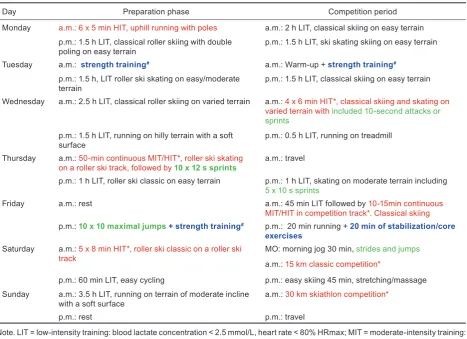
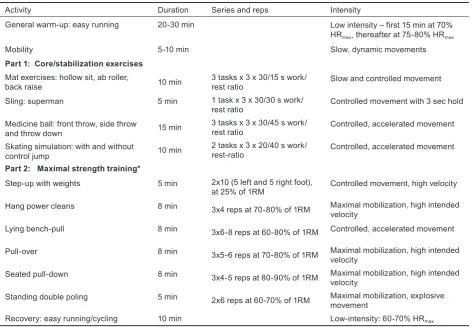
The preparation phase for a XC skier includes an initial period where strength is progressively built up, from May to August. After the first cou-ple of weeks have assured familiarization and learn-ing of a proper technique, the load of the weights are added until the point where athletes struggle to maintain a good technique and fully clear lifts in the planned number of repetitions. Hopefully, the athlete will gradually be able to lift heavier weights throughout this period and can thereby in-crease the load of each lift week-by-week. Moni-toring the load of lifts is also a good way to track progress of the training, although increased strength should not negatively influence the development of endurance and coaches and athletes need to assure that strength improvements can be transferred to better technique and higher skiing speed. In Table 1, you can see how strength training is included
in the daily puzzle of a typical training week for a successful XC skier in the preparation period, whereas Table 2 illustrates a typical strength ses-sion. From my own personal experience, I recom-mend to compose the training plan in a way that en-sures a “fresh” and well-fueled musculature during the strength sessions in this period. In addition, a specific focus on technical execution is of particu-lar importance to optimize the development dur-ing this period and thereby provide a physical and technical foundation for further progress in the fol-lowing period.
This is followed by a second period, from Au-gust to October, where the strength training pro-gramme is maintained relatively similar, with only some minor modifications in the exercises to make the movements more ski-specific and the execution more explosive. Since athletes are then familiar-ized with the exercises, it costs less to perform the sessions and reduced recovery times are feasible. Hence, a greater focus can be placed on optimiz-ing the key endurance sessions performed in this period. While many high-level athletes do not get
Table 1. Typical training weeks for a world-class cross-country skier during the preparation and competition periods
Day Preparation phase Competition period
Monday a.m.: 6 x 5 min HIT, uphill running with poles a.m.: 2 h LIT, classical skiing on easy terrain p.m.: 1.5 h LIT, classical roller skiing with double
poling on easy terrain p.m.: 1.5 h LIT, ski skating skiing on easy terrain Tuesday a.m.: strength training# a.m.: Warm-up + strength training#
p.m.: 1.5 h, LIT roller ski skating on easy/moderate
terrain p.m.: 1.5 h LIT, classical skiing on easy terrain Wednesday a.m.: 2.5 h LIT, classical roller skiing on varied terrain a.m.: 4 x 6 min HIT*, classical skiing and skating on
varied terrain withincluded 10-second attacks or sprints
p.m.: 1.5 h LIT, running on hilly terrain with a soft
surface p.m.: 0.5 h LIT, running on treadmill Thursday a.m.: 50-min continuous MIT/HIT*, roller ski skating
on a roller ski track, followed by10 x 12 s sprints a.m.: travel
p.m.: 1 h LIT, roller ski classic on easy terrain p.m.: 1 h LIT, skating on moderate terrain including
5 x 10 s sprints
Friday a.m.: rest a.m.: 45 min LIT followed by 10-15min continuous MIT/HIT in competition track*. Classical skiing
p.m.: 10 x 10 maximal jumps+ strength training# p.m.: 20 min running + 20 min of stabilization/core
exercises Saturday a.m.: 5 x 8 min HIT*, roller ski classic on a roller ski
track MO: morning jog 30 min, strides and jumps
a.m.: 15 km classic competition*
p.m.: 60 min LIT, easy cycling p.m.: easy skiing 45 min, stretching/massage Sunday a.m.: 3.5 h LIT, running on terrain of moderate incline
with a soft surface a.m.: 30 km skiathlon competition*
p.m.: rest p.m.: travel
Note. LIT = low-intensity training: blood lactate concentration < 2.5 mmol/L, heart rate < 80% HRmax; MIT = moderate-intensity training: blood lactate concentration 2.5-4.0 mmol/L, heart rate 80-90% HRmax; HIT = high-intensity training: blood lactate concentration >4.0 mmol/L, heart rate > 90% HRmax.
* Competitions and HIT sessions routinely included approximately 30-45 min of LIT, followed by 10-15 min of MIT/HIT. Cool-down involves 15 min of LIT.
large improvement in strength in this period, the hy-pothesis is that strength maintenance through two high-quality weekly sessions with high quality is important to transfer the effects of strength to en-durance performance and that a longer “strength pe-riod” will facilitate better maintenance of strength in the following competition period. Still, my opin-ion is that strength sessopin-ions’ quality is more impor-tant than their quantity during this period, regard-ing both the number of sessions and the number of exercises and series within each session.
The two strength sessions included in Table 1 are from different time points of the training pro-gram. On Tuesday, a strength training session with relatively heavy loads and low number of repetitions is done in the morning, with a low-intensity training planned both in the evening before and in the fol-lowing afternoon. The reason for this is that an easy session after the high-intensity session on Monday morning would allow the athlete to be physical-ly and mentalphysical-ly prepared for the strength session. Furthermore, it seems like light loads in the subse-quent sessions facilitate good recovery and strength adaptations, thereby reducing a negative inference from endurance training on strength-training ad-aptations. The second strength session is placed on Friday afternoon, and follows an easy evening
ses-sion on Thursday and rest or an easy morning jog Friday morning. After a warm-up and some jumps, this session will be more focused on explosiveness compared to the Tuesday session (i.e., slightly lower loads and higher velocities of movement execution). The same exercises are mainly used, but one or two tasks are sometimes modified to enhance explosive-ness. The session is placed in the afternoon since explosive movements training quality seems to be better in the afternoon (athletes feel being more fresh and awake, can jump higher and lift faster, etc.) and the session facilities an optimal muscle tension for the subsequent high-intensity session on Saturday morning, which is a key session of the week. However, although this is a general pattern, some athletes might respond different than others which coaches and athletes must be aware of when making individual plans.
The information provided above on this topic is purely descriptive and current advises are mainly based on not yet systematized personal experienc-es. However, the development of sensors, tools and training diaries that collect and systematize data from training and competitions/tests is accelerating. By using data-driven machine learning algorithms (so-called neural networks) or artificial intelligence on such “big” data, on both one athlete through time Table 2. Example of a strength training session for a world-class cross-country skier during the preparation period with the goal of concurrently develop strength and endurance
Activity Duration Series and reps Intensity
General warm-up: easy running 20-30 min Low intensity – first 15 min at 70% HRmax, thereafter at 75-80% HRmax
Mobility 5-10 min Slow, dynamic movements
Part 1: Core/stabilization exercises Mat exercises: hollow sit, ab roller,
back raise 10 min 3 tasks x 3 x 30/15 s work/rest ratio Slow and controlled movement Sling: superman 5 min 1 task x 3 x 30/30 s work/
rest ratio Controlled movement with 3 sec hold Medicine ball: front throw, side throw
and throw down 15 min 3 tasks x 3 x 30/45 s work/rest ratio Controlled, accelerated movement Skating simulation: with and without
control jump 10 min 2 tasks x 3 x 20/40 s work/rest-ratio Controlled, accelerated movement Part 2: Maximal strength training*
Step-up with weights 5 min 2x10 (5 left and 5 right foot),
at 25% of 1RM Controlled movement, high velocity Hang power cleans 8 min 3x4 reps at 70-80% of 1RM Maximal mobilization, high intended
velocity
Lying bench-pull 8 min 3x6-8 reps at 60-80% of 1RM Controlled, accelerated movement
Pull-over 8 min 3x5-6 reps at 70-80% of 1RM Maximal mobilization, high intended velocity
Seated pull-down 8 min 3x4-5 reps at 80-90% of 1RM Maximal mobilization, high intended velocity
Standing double poling 5 min 2x6 reps at 60-70% of 1RM Maximal mobilization, explosive movement
Recovery: easy running/cycling 10 min Low-intensity: 60-70% HRmax
and between athletes, we can probably reveal inter-esting patterns that are positively and/or negatively related to an athlete’s or a group’s development. I predict that such methods, when combined with the-ory-hypothesis-driven studies, will have the poten-tial to drive future research further in such complex areas. This also includes the way in which training is scheduled and “timed” towards important compe-titions, often called tapering, which is also a highly complex field to study experimentally since various factors may have influence on the outcome. Training to maintain strength
This leads us to the competition period, starting in November, where one weekly session of strength training seems to be sufficient to maintain strength throughout the season. This session should contain the most important components of the programme developed in the preparation period. However, less training volume (reduced number of exercises and sets) is normally practised, whereas quality/inten-sity needs to be on a high level. This includes high (intended) movement velocity and relatively high loads, as well as fine-tuned technical execution. In the competition-free periods with 2-3 weeks of a high-volume training during the winter, a weekly “full strength session”, similar to those used in the preparation period, is used to stress the strength component extra.
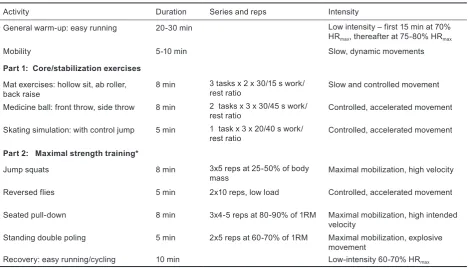
In Table 1 one can see a typical training week for a successful XC skier in the competition period and Table 3 illustrates a typical strength session in
the competition period. In the competition period, a strength session is typically performed on Tues-day morning. This session is built on the sessions performed in the preparation phase, but bears less overall load. In addition, shorter sessions of sta-bilization/core exercises and jumps on Friday and Saturday are used to optimize muscle tension and mobilization abilities before the competitions in the weekend. Overall, the strategies used before com-petitions are highly individual and an unexplored scientific area. Due to my experience, the optimal strategy might differ between days with high versus low muscle tension before warm-up, and I think it is crucial that each athlete strive to developing op-timal routines for a given situation.
Individualization of strength training programmes
Similar procedures as described in Table 1 are used by many of the top XC skiers, although each athlete needs to find his/hers own pattern of how to optimally puzzle the strength and endurance com-ponents of their training programme, as well as the optimal preparation pattern for competitions. The same applies for the typical strength training sessions of a world-class cross-country skier pre-sented in Tables 2 and 3. While these programmes are representative for skiers at the elite level in XC skiing, each athlete needs to modify his/hers pro-gramme to their individual needs. First, the train-ing programme should be set so to avoid the possi-ble molecular interference of concurrent strength-
Table 3. Typical strength training session for a world-class cross-country skier during the competition period with the goal of maintaining strength and optimize endurance performance
Activity Duration Series and reps Intensity
General warm-up: easy running 20-30 min Low intensity – first 15 min at 70% HRmax, thereafter at 75-80% HRmax
Mobility 5-10 min Slow, dynamic movements
Part 1: Core/stabilization exercises Mat exercises: hollow sit, ab roller,
back raise 8 min 3 tasks x 2 x 30/15 s work/rest ratio Slow and controlled movement Medicine ball: front throw, side throw 8 min 2 tasks x 3 x 30/45 s work/
rest ratio Controlled, accelerated movement Skating simulation: with control jump 5 min 1 task x 3 x 20/40 s work/
rest ratio Controlled, accelerated movement Part 2: Maximal strength training*
Jump squats 8 min 3x5 reps at 25-50% of body
mass Maximal mobilization, high velocity Reversed flies 5 min 2x10 reps, low load Controlled, accelerated movement
Seated pull-down 8 min 3x4-5 reps at 80-90% of 1RM Maximal mobilization, high intended velocity
Standing double poling 5 min 2x5 reps at 60-70% of 1RM Maximal mobilization, explosive movement
Recovery: easy running/cycling 10 min Low-intensity 60-70% HRmax
and endurance-training by training planning with awareness and by including optimal nutrition plan. How skiers respond to endurance training after a strength session is highly individual, which also ap-plies to the recovery time needed to fuel and pre-pare muscles for strength training after high loads of endurance training. Second, different mecha-nisms (overloading force component, power, tim-ing of force production/application, etc.) should be triggered in different individuals, depending on the relationship between the individual’s current ca-pacity for a given movement/exercise and the de-mands of XC skiing. These subsequently influence the choice of load, series, repetitions and type of exercises. Thus, there is no “ideal” strength train-ing program for XC skitrain-ing, but rather main princi-ples and a toolbox that coaches and athletes should choose from in a given context. In my opinion, this individualized way of using training principles is a main area where the best XC skiers distinguish from those at a lower standard level. A possibility for future studies in this area could be to screen individual requirements of an athlete, and thereaf-ter compare general strength training programmes with the individualized, more targeted ones. Execution of strength sessions
As illustrated in Tables 2 and 3, most XC skiers perform a relatively long warm-up of approximate-ly 30 min. This is pureapproximate-ly due to tradition in endur-ance sports and it can be discussed whether such a long general warm-up is really needed. However, these athletes are highly endurance trained, and a 30-min warm-up does not exert any fatiguing ef-fects on the subsequent strength part of the session. Thereafter, some minutes of dynamic mobility is common practice, followed by 20-40 min of core/ stabilization exercises before the main part with heavy strength training.
The core/stabilization exercises aim to 1) mo-bilize the muscles involved in force transfer dur-ing the specific ski movements, such as shoulders, trunk, hip, and knee muscles; 2) improve these muscles’ ability to stabilize and move these seg-ments functionally while skiing, and 3) prevent in-juries. It is highly important that this section of the strength sessions is individualized for each ath-lete, so that the individual’s “weak links” for opti-mal skiing technique and performance are target-ed. Many of these submaximal exercises are per-formed with relatively slow movements and control in the initial phase of using a new exercise, whereas the movement speed and load can gradually be in-creased. There are hundreds of different exercises that can potentially be useful, performed with own body mass, weights, slings/redcords, elastic bands, swissballs, medicine balls, etc. In addition, there are many different ways to organize and perform the exercises. However, they should all be
organ-ized so the intended effect is targeted and in ac-cordance with the overall load/fatigue placed on the athlete, especially if the section is performed be-fore heavy strength training. The athlete should not lose physical or mental power needed for the subse-quent heavy strength part of the session. While this part makes some athletes more ready to mobilize in the heavy strength exercises, others would rather perform these as own sessions or after the heavy strength session. Overall, there is lack of scientific information about this type of training and its ef-fects on performance and the underlying factors. As a coach, I would recommend most XC skiers to include such training and we know the best athletes in many other sports have used it for decades. How-ever, it sorely needs further examination.
The heavy strength training exercises need to be movement-specific, but at the same time per-formed in exercises where athletes are able to mo-bilize maximally during the concentric phase. Men-tally and technically (at least at the level of muscle recruitment and mobilization) a XC skier should feel that he/she is doing the exercises as they al-most would be when “skiing on snow”. This feeling assures improved transfer effects to skiing. Since the legs get more strength stimulus during jumps, sprinting and other activities during other types of training than the arms/upper-body, there is a main emphasis on the upper-body during strength train-ing in XC skiers. However, the focus on upper-body strength also reflects the role of the upper-body in skiing, with the briefest, explosive push-offs and long recovery times where the poles are reposi-tioned for the next poling cycle. The legs work all the time, especially during skating, and need to con-stantly carry the skier’s body mass. Hence, more ex-plosive movements are required in the upper- than in the lower-body and typical heavy strength train-ing programmes consist of one or two leg exercises and three to four upper-body exercises. Leg exer-cises would be, for example, squats, jump squats, (hang) power clean, back-split squats, or step-up. Upper-body exercises such as seated pull-down, standing double poling, pull-ups with weights, mus-cle-up, lying bench-pull, French-press, pullover, and triceps press are common. These upper-body ex-ercises often use handgrip widths similar to those in XC skiing or custom-made handlebars designed to imitate the pole-grip in XC skiing (Losnegard, et al., 2011).
rests between sets are 1-3 min. See examples in Tables 2 and 3. The lowest number of repetitions is used in exercises where the athletes are able to mobilize maximally and thereby lift heaviest. In contrast, exercises that are more technically com-plex or where less muscle mass is included seem to energetically cost less and more repetitions can therefore be added.
As a preference, I would suggest that leg exer-cises should be done before arm exerexer-cises, as well as technically easy exercises with full muscular mobi-lization before more complex, ski-specific ones. In addition, the sessions are normally finalized with an explosive exercise, using a ski-specific exercise and high-velocity movements. In this context, the way strength training is executed is likely as important as the content of the training programme. My im-pression is that a greater focus on optimizing each session and thereby improve training quality and enhance adaptations is what differentiates high re-sponders from those responding less. This includes mental preparations for the session, as well as opti-mized technical execution and the athletes’ ability to mobilize maximally during the sessions. In order to continuously optimize the training programme and execution I recommend that athletes and coach-es should focus on the following key points: 1. Optimized execution of each strength session:
○ Planning: Each session needs to be prepared with a clear aim of the session, where the de-sign, choice of exercises, loads, sets, repeti-tions etc., match the specific aim of each ses-sion. Work tasks should be clarified before the session.
○ Performing: Be 100% present during the ses-sion and place emphasis on optimizing tech-nique and movement velocity. Keep focus only on a few checkpoints (aligned with the clarified work tasks) to reinforce the specif-ic focus areas, e.g., by using video, feedback from coach, etc.
○ Debriefing: Reflect on what went well as soon as possible after the session, and discuss what could be done better next time and what will be the future consequences.
2. Optimization of strength and performance ad-aptations:
○ Key strength sessions should be implemented in the programme puzzle so they can be
com-pleted with the highest possible quality, but with minimized interference with the aero-bic sessions.
○ Monitor load/velocity of the lifts in key ses-sions to acquire performance indices and en-sure expected progress.
References
Beattie, K., Kenny, I.C., Lyons, M., & Carson, B.P. (2014). The effect of strength training on performance in endurance athletes. Sports Medicine, 44(6), 845-865. doi:10.1007/s40279-014-0157-y
Haugen, T., Paulsen, G., Seiler, S., & Sandbakk, O. (2017). New records in human power. Internatonal Journal of
Sports Physiology and Performance, 5, 1-27. doi:10.1123/ijspp.2017-0441
Hawley, J.A. (2009). Molecular responses to strength and endurance training: Are they incompatible? Applied Physiology,
Nutrition, and Metabolism, 34(3), 355-361. doi:10.1139/H09-023
Hegge, A.M., Myhre, K., Welde, B., Holmberg, H.C., & Sandbakk, O. (2015). Are gender differences in upper-body power generated by elite cross-country skiers augmented by increasing the intensity of exercise? PLoS One, 10(5), e0127509. doi:10.1371/journal.pone.0127509
Holmberg, H.C. (2015). The elite cross-country skier provides unique insights into human exercise physiology.
Scandinavian Journal of Medicine and Science in Sports, 25 Suppl 4, 100-109. doi:10.1111/sms.12601
Losnegard, T., Mikkelsen, K., Ronnestad, B.R., Hallen, J., Rud, B., & Raastad, T. (2011). The effect of heavy strength
training on muscle mass and physical performance in elite cross country skiers. Scandinavian Journal of
Medicine and Science in Sports, 21(3), 389-401. doi:10.1111/j.1600-0838.2009.01074.x
Mujika, I., Ronnestad, B.R., & Martin, D.T. (2016). Effects of increased muscle strength and muscle mass on endurance-cycling performance. Internatonal Journal of Sports Physiology and Performance, 11(3), 283-289. doi:10.1123/ IJSPP.2015-0405
Ronnestad, B.R., Hansen, E.A., & Raastad, T. (2010). In-season strength maintenance training increases well-trained
cyclistsʼ performance. European Journal of Applied Physiology, 110(6), 1269-1282.
doi:10.1007/s00421-010-1622-4
Ronnestad, B.R., Hansen, J., Hollan, I., Spencer, M., & Ellefsen, S. (2016). Impairment of performance variables after in-season strength-training cessation in elite cyclists. Internatonal Journal of Sports Physiology and
Performance, 11(6), 727-735. doi:10.1123/ijspp.2015-0372
Ronnestad, B.R., & Mujika, I. (2014). Optimizing strength training for running and cycling endurance performance: A review. Scandinavian Journal of Medicine and Science in Sports, 24(4), 603-612. doi:10.1111/sms.12104 Sandbakk, O., & Holmberg, H.C. (2017). Physiological capacity and training routines of elite cross-country skiers:
Approaching the upper limits of human endurance. Internatonal Journal of Sports Physiology and Performance,
12(8), 1003-1011. doi:10.1123/ijspp.2016-0749
Sandbakk, O., Solli, G.S., & Holmberg, H.C. (2017). Sex differences in world record performance: The influence of sport discipline and competition duration. Internatonal Journal of Sports Physiology and Performance, 2, 1-7. doi:10.1123/ijspp.2017-0196
Stoggl, T., & Holmberg, H.C. (2016). Double-poling biomechanics of elite cross-country skiers: Flat versus uphill
terrain. Medicine and Science in Sports and Exercise, 48(8), 1580-1589.doi:10.1249/MSS.0000000000000943 Stoggl, T., Muller, E., Ainegren, M., & Holmberg, H.C. (2011). General strength and kinetics: Fundamental to sprinting
faster in cross country skiing? Scandinavian Journal of Medicine and Science in Sports, 21(6), 791-803.
doi:10.1111/j.1600-0838.2009.01078.x
Correspondence to: Professor Øyvind Sandbakk Centre for Elite Sports Research
Department of Neuromedicine and Movement Science Faculty of Medicine and Health Science
Norwegian University of Science and Technology Trondheim, Norway
Phone: +47 9118769