Licensed under Creative Common Page 380
http://ijecm.co.uk/
ISSN 2348 0386
INFLUENCE OF CONTROL ENVIRONMENT ON PERFORMANCE
OF SME PROJECTS IN MACHAKOS COUNTY, KENYA
Peninnah Mbithe Mbuva
PhD Candidate, School of Open and Distance Learning, University of Nairobi, Kenya
Charles M. Rambo
Lecturer, School of Open and Distance Learning, University of Nairobi, Kenya.
Timothy Oketch
Lecturer, Chandaria School of Business, United States International University-Africa, Kenya [email protected]
Abstract
Small and medium enterprise projects greatly contribute to a country’s national output through
creation of employment opportunities, provide technological innovation conduit and create new
products. Although their economic contribution is indisputable, provocative argument on specific
factors influencing their performance has remained unresolved to date. This study sought to
determine the extent to which control environment influence performance of SME projects in
Machakos County. Applied pragmatism philosophy and descriptive survey research design were
used. The hypothesis ;that control environment does not significantly influence performance of
small and medium enterprise projects in Machakos County was tested at 95% confidence level.
A structured questionnaire was used to collect data. A sample size of 223 of SME projects in
Machakos County was selected. Multiple regressions analysis was done. The study finding
revealed that management philosophy and operating style significantly influenced financial
performance with β= 0.147(p=0.002). Whereas, integrity and ethics values of the organization,
commitment to job competence, organizational structure, assignment of authority and
responsibility and human resource policy and practices had insignificant influence on financial
Licensed under Creative Common Page 381 philosophy and operating style had direct significant influence on non-financial performance with
β=.119, (p=0.008) and β=.102(p=0.036) respectively. While commitment to job competence,
organizational structure, assignment of authority and responsibility and human resource policy
and practice had insignificant influence on non-financial performance.SME project Management
should improve the insignificant components of control environment to ensure effective internal
control system to enhance performance.
Keywords; Small and Medium Enterprise, Internal Control System, Control Environment,
Performance
INTRODUCTION
Small and medium enterprise project is a venture dominated by employees ranging between 50
to 100 or up to a maximum of 250 in number (ILO Report, 1972). In other words, any type of
organization which engages 10 to 250 employees is classified as Small and Medium Enterprise
(SME). These category of business have distinguished contribution to economic growth in most
economies through creation of employment opportunities to many people and as a source of
technological innovation which create new products hence eradicating poverty, both in
established economies such as United States of America (USA), Sweden and United Kingdom
just to mention but a few and also growing economies in the world (Wolff and Pett, 2006).
More specifically, the existence of SME projects in Kenya is a major step towards the realization of the country‟s Vision 2030 which can be achieved through job creation, adoption
of appropriate technology by the SME projects whereby both skilled and unskilled labors
are utilized. Also, the vision can be realized through capital formation and wealth creation,
hence increasing revenue and promoting of gender empowerment (Government of Kenya,
2007). The mega economic contributions by SME projects have been evident for almost 20% of
the changes observed in Gross Domestic Product (GDP) in Kenya are associated with small
and medium enterprise projects. According to Economic Survey (2009) report, these projects
have absorbed about 75% of the workforce and 18.5% of GDP is connected to SME project
performance. This implies a remarkable role of this subsector. The extent to which SME projects
performs, is determined by whether the management of such a venture has met its main
objectives (Lin and Chen, 2008). It is also determined by internal factors such as control
environment which is a component of internal control system.
Control environment is a component of ICS and it guides the consciousness of the
Licensed under Creative Common Page 382 (Whittington and Pany, 2001). It is the epicenter of internal control system. It is made up of
aspects such as ethical values, integrity of personnel tasked with formulating, setting up and
administering the controls, the directors, audit committees and the organization structure.
Therefore, the driving force for effective control environment component is the efficiency and
effectiveness with which management and board of directors operate. According to Aldridge and
Colbert (1994), the function of control environment boosts the consciousness of personnel in an
organization. It further represents the true attitude and strategies of management to establish
effective internal control system that positively influence the firm culture and performance; thus
it sets the supportive attitude towards internal control and management.
Failure of the top management to control the culture of the firm due to negligence or bad
intentions translates to financial loss of the SME project. Further losses are attributed to laxity
by the top management. Such scenarios are associated with use of unsuitable rewards by the
management team in motivating workers. Therefore, it is the responsibility of the top
management through their leadership skills and by word of mouth to ensure that the role of
control environment in the firm is recognized by all the people. This is portrayed through the
ethical values the management practice through business operations within and outside the
SME project. In support of this fact, Basle (1998), argued that management opinion, boldness
and verbal advocacy determine the level of integrity, ethical practices and other cultural aspects
the SME project upholds.
.
Purpose of the Study
The purpose of this study was to establish the extent to which control environment influence
performance of small and medium enterprises projects in Machakos County, Kenya.
LITERATURE REVIEW
Most small and medium enterprises survival is influenced by both internal and external forces.
Although control environment which is an internal control system component impact on SME
project productivity, most of these firms have difficulties to establish this component to increase
the day to day operations efficiency (Frazer, 2012). Control environment is one of the ICS
components that give an assurance of the success of SME projects (Hayes, et al. 2005). It is
the central component of internal control system which sets the tone of the organization by
influencing the control consciousness of its people. It is operationalized in terms of integrity and
ethics values of the organization, the level of commitment to job competence, management
Licensed under Creative Common Page 383 responsibility in pursuit of objective, human resource policy and practice on managing
employees.
Stoner (2003) defined performance of SME project as the capability of maintaining
efficiency in operations, generation of profits and upholding positive changes of growth of the
SME and continuous reaction to opportunities and threats in the immediate environment. To
measure the performance of SME projects, diverse proxies are used, which range between
financial and non-financial perspectives (Neely, 1999). For the financial facet, the following are
some of the indicators that are used, namely; growth rate of sales, cash flows, returns
associated to investment in common stock, profit margin in gross terms, profit margin in net
terms, coefficient of net profits to revenue, returns to total investment ratio and the ability to
facilitate project growth (Covin, 1991). On the other hand, the non-financial proxies used are,
namely; level of productivity, industry leadership ranking, rate of creating new jobs, level of
business stability, rate of profitability and level of cost of production, the extent to which the firm
is involved in community development and the growth rate of the business (Blackman, 2003).
For control environment, it sets the tone of an organization, hence influencing the control
consciousness of all its employees (Whittington and Pany, 2001). Weber, (1998) in his study
established that some of the ICS components such as separation of duties amongst employees,
authority structure and third party confirmation approaches, organization, accounting and
arithmetical issues, human capital domain, managerial perspective, performance
acknowledgement and budgetary controls are the organization integral activities that are
connected to the extent to which a firm succeeds as far as financial performance aspect is
concerned. The study finding established that small and medium enterprises had diverse ways
of implementing the control environment components of ICS as compared to the large firm
counterparts. For instance, it was established that the aspect of written code of ethics of SMEs
could be missing. In addition, it was concluded that the SME personnel charged with
governance may not incorporate autonomous or external member. It was also established that,
small scale firms did not engage professional persons to undertake any position of responsibility
in the organization. Instead, in this study of Weber (1998), it was found that these firms are
commonly run by the family members and relatives who demonstrate less commitment in
adhering to internal control system components such as control environment. Contrary, studies
by Whittington and Pany, (2001) concluded that although control environment sets the tone of
an organization, adherence to this aspect of ICS does not guarantee positive contribution to
SME project performance.
Faudziah, Hasnah and Muhamad (2005), sought to establish the extent to which internal
Licensed under Creative Common Page 384 system of firms listed at the Malaysian Bursa market which are the counterparts of the small and
medium enterprises. The study population comprised all the companies listed at the Bursa stock
market in Malaysia in 2001. Data was collected using two sets of structured questionnaires. It
was revealed that performance of audit work, professional proficiency and objectivity influenced
control environment in a statistically significant manner. However, this study finding did not
guarantee the same cause-effect outcomethrough improvement of SME performance.
Kinyuaet al. (2015) sought to establish the effect of control environment component of
ICS of firms which are members of Nairobi securities exchange. The study used a sample size
of 38 firms from a study population of 62 firms through stratified random sampling methodology.
The study adopted survey research design whereby both primary and secondary data was
collected. Both descriptive and inferential statistics were used for data analysis. Research
finding revealed that control environment statistically significantly influenced financial
performance of firms listed at the Nairobi securities exchange. Further the study advocated that
control environment aspect of internal control system should be enhanced to promote the
overall performance of firms.
Gesare, Nyagol and Odongo (2016) sought to assess the influence of internal control
system components, control environment being one of the factors. Both stratified and simple
sampling techniques were used to select the samples of the 15 banks located in Kisii town.
Questionnaires and interview schedules were utilized to collect data. In addition, both
descriptive and inferential data analysis methodology were used to develop study conclusion.
The study depicted that control environment directly and statistically significantly influenced fraud risk management with (β = 0.391; p < 0.05).
THEORETICAL FRAMEWORK
The section highlights in details the theoretical foundation that supports the conceptual
framework on the link between control environment and performance of small and medium
enterprise.
Stakeholder Theory
The stakeholder theory is a transformative version of the agency theory for the former theory
describes the organizational behavior of a firm such as small and medium enterprise project.
Stake holder theory was founded by Freeman (1984) and advocates that management should
work with the interests of the stakeholders at heart which is contrary to the conventional agency
theory by Jensen and Meckling (1976) which safeguards only the interests of the shareholders.
Licensed under Creative Common Page 385 success through the traditional financial performance approaches. The stakeholder theory
focuses on the interest of all interested parties hence it introduces the non-financial facet of
business performance. The aim is to ensure that all stakeholders of the business such as
customers, suppliers, employees and local community are protected in addition to shareholders
(Elkington, 1997). The stakeholder theory is also pegged on the argument that shareholders are
part of a bigger group of concerned parties and those persons have legitimate expectations and
claim on the organizational purpose hence stakeholders and firms operations are both affected
(Mallin and Michelon, 2011).
As a result of the wide networking of various stakeholders, the theory has influenced not
only the way of managing the organization but also the approach to measure performance. As
far as the stakeholders are concerned, the organization view performance as the extent to
which stakeholders are satisfied by the activities of the management. The stake holder theory
has with time transformed the way firm performance is measured. That is, from the traditional
ways such as return on assets and sales growth rate to non-financial approaches which are
intangible in nature (Kaplan and Norton 2001). However, through scholar consensus, both
methodologies have been universally used concurrently or interchangeably in measuring
organizational performance (Richard, Devinney and Yip 2009). Therefore, with the emergence
of stakeholder theory, organizational performance measures have shifted from economic prosperity of the shareholders‟ value approach to social-economic proxies which considers all
stakeholders it is sensitive to environmental integrity.
RESEARCH METHODOLOGY
The study used descriptive cross-sectional survey research design. A sample size of 265 SMEs
were drawn from a target population of 5311 operating in Machakos County using Yamane
(1967) formula (Yamane, 1967). The study used both stratified and convenience sampling
methodology. Structured questionnaire were used to collect the data which was analyzed using
both descriptive and inferential approaches. For the descriptive, the study used frequencies,
percentages, mean and standard deviation. In the case of inferential statistics, F, R2 and t-test
tool were used.
ANALYSIS
The study on the extent to which control environment influence performance of small and
medium enterprises in Machakos County had diverse empirical outcomes, starting with the
Licensed under Creative Common Page 386
Questionnaire Return Rate
A sample size of 265 firms were selected and questionnaires distributed to the respondents who
were owners, partners, managers or reliable employees through drop and pick methodology.
Use of bank managers/or SME bank officials dealing directly with the SME clients fostered the efficiency of data collection for most banks use the “know your customer policy”. Hence the
filling of the questionnaires in the presence of the bank manager/official was more reliable.
According to Babbie (2003), a return rate of 50% is sufficient to rely on the questionnaire for
analysis purposes. Also a return rate of 60% was postulated to be good and 70% was assumed
to be excellent for data analysis. Chen (1996) posited that a lower non-response error was due
to a corresponding large rate of return of the questionnaires.The total number of questionnaires
returned filled was 223 which translated to 84% return rate which was reasonably high and
acceptable. This could be associated with the direct involvement of the bank officials where it
was possible.
Table 1: Questionnaire Return Rate
Response No. %
Filled Questionnaires 223 84%
Unfilled Questionnaires 42 16%
Total 265 100%
Demographic characteristics of SME Projects
To analyze the demographic characteristics of the SME projects, diverse criteria were relied
upon which enabled the researcher to either accepts or rejects the potential respondents from
participating in data collection. These classifications were, namely; ownership structure, type of
sector the projects were operating in, distribution of employees and the number of years an
SME project was in operation since its inception. Failure to meet the set thresholds resulted to
disqualification. The demographic approach was paramount to the researcher for it introduced
other aspects of the SME projects not captured in the main links between ICS and performance
for comprehensive conclusions.
Ownership Structure of SME Projects
Classification of the SME projects based on ownership structure would help the researcher to
assess the correlation between other factors not included in the conceptual framework model
and performance of the SME projects. The personality involved in operating the SME project
Licensed under Creative Common Page 387 Table 2: Ownership Structure of Small and Medium Enterprise Projects
Position in the organization Frequency Percent
Sole Owner 102 46%
Partner 44 20%
Manager 67 30%
Other 10 4%
Total 223 100%
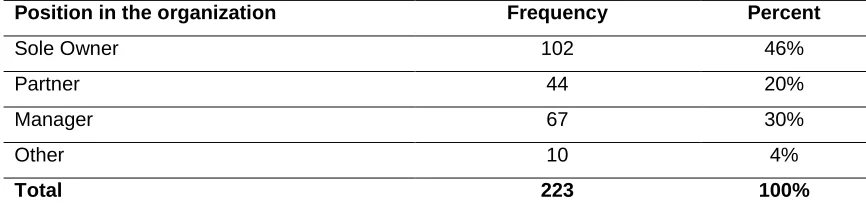
The ownership arrangement of the firms that were targeted for data collection was analysed.
The results as per Table 2 showed that 102(46%) of the respondents were sole owners of the
company, 44(20%) were partners and 67(30%) were managers. Only 10 (4%) were other
employees in the firm such as accountants. The 46% of operators of the SME projects were the
majority and being the owners of these firms, the probability of recording high profitability levels
through increased sales levels and sales growth rate is high, for they maximize revenue
generation activities available hence they fully utilize the available firm resources. They are also
characterized by being quick in decision making for they have no other persons they need to
consult. Hence taps quickly profitable opportunities that come their way. This would positively
contribute to increased performance of the SME projects.
The research finding portrayed that 44(20%) partners running the SME projects
indicated that the firms could be moderately performing well financially for partners may partly
serve the interest of the other members. They may not wholly commit themselves in the
operations of the firm hence loss of business opportunities. Whereas, the 30% of the
respondents who were made up of managers could register low performance for there is a high
chance of those managers to serve their own interest such as investing the firm resources in
venture which benefit them and not the owners and have shirking behaviour as postulated by the agency theory (Jensen and Mecling, 1976).The category of „others‟ was the lowest in
representation and may not materially influence the performance of those SME projects.
Sector of Operation of SME Projects
The SME projects under study cut across various industries. This aspect was important to the
researcher for firms in diverse sectors are faced by different business and social environment
which can either favour or make the firm to go under. Most of the firms in the same industry
have many aspects in common hence the researcher can identify cases of anomalies in
performance for the expected outcomes are known. The industry categories where the small
Licensed under Creative Common Page 388 Table 3: Sector of operation
Sector Industry of operation Frequency Percent
Service industry 112 50%
Merchandised products (Deals with already manufactured goods) 44 20%
Construction Industry 37 17%
Manufacturing Industry 30 14%
Total 223 100%
On cross examining the firms, half of them, 112 (50%) were from the service industry, 14% from
the manufacturing industry, 17% from construction industry while 20% dealt with already
manufactured products. The 50% category of SME projects operating in the service industry
portrayed financial sustainability of such firms for this is the largest industry in Kenya. Such
SME projects are characterized by increased productivity and high sales levels. The 20%
category representing firms dealing with already manufactured products implied a lower market
share of such firms.
Therefore there was a low chance of significantly contributing to performance. The other
two groups of construction and manufacturing industry (representing 31% of all SME projects in
Machakos County) portrayed low outputs in the economy that was associated with the kind of
SME projects. Such SMEs are threatened and may soon be non-operational hence adversely
influencing the overall performance of the SME projects.
Distribution of Employees per SME Project Categories
The number of workers engaged by an organization within a period of one year is an indicator of
the extent to which the firm has grown as compared to other firms in the same industry. The
larger the number of employees the firm has recruited in a certain period of time, the more the
firm has grown in size, holding other factors constant. The study focus was on the number of
employees the firms engaged on average within a period of one year. The employment statistics
are as shown in Table 4.
Table 4: Distribution of Employees per SME Project Categories
Number of employees No. %
10-50 employees 148 66.4
51-250 employees 75 33.6
Total 100
Licensed under Creative Common Page 389 As shown in Table 4, 66.4 % of the SMEs employed between 10 and 50 employees and 33.6 %
employed more than 50 employees but not exceeding 250 in total. Based on the number of
employees, the data revealed that majority of the SMEs in the sample were small enterprises
with prospects of growing beyond the classification of SME projects to big organization. This
generally implied that those small firms had the potential of performing well in the future.
Number of Years the SME Projects has been in Operation
The study sought to establish the number of years an SME project was in operation. This was
important because the longer the small and medium enterprise has been in operation, the
higher the probability of that firm being financially stable hence perpetuity is assured. Therefore,
the researcher could assess the sustainability of those organizations. The study findings
therefore were represented as presented in Table 5.
Table 5: Number of Years the SME Projects has been in Operation
Years of operation Frequency Percent
5 years 23 10%
6-10 years 76 34%
11-15 years 57 26%
16-20 years 24 11%
21-25 years 7 3%
26 and above years 36 16%
Total 223 100%
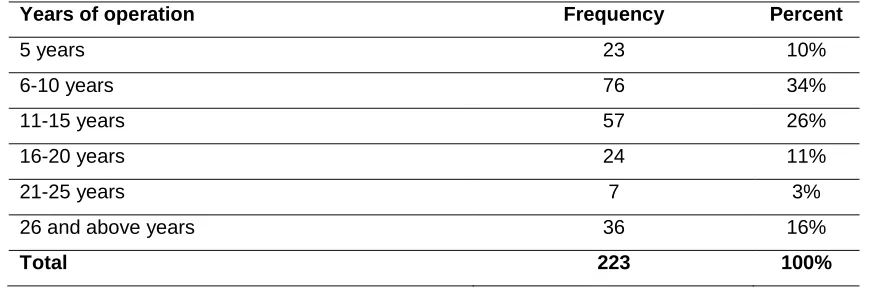
As per Table 5, 23 (10%) of SME projects were in operation for 5 years only, while 76 out of the
total 223 SME projects (34%) had been in operation for 6-10 years. Another 26%, totalling to 57
SME projects were in operation for a period between 11-15 years. 11% (24 SME projects)
ranged between 16-20 years in operation, and then between 21-25 years was 3%, translating to
7 firms. The last category in terms of lifespan was the category of SMEs in operation for 26
years and above, which was represented by 16% of the total SME projects investigated.
In summary, the firms with a range of lifespan of between 6 to 25 years of operation was
74% (164 SME projects) which was the majority for all the industries covered which would imply
that most firms were financially stable and chances of imminent failure was low. In addition, the
probability of having a sound management team with reliable decision making systems was high
Licensed under Creative Common Page 390 Similarly, the remaining category with more than 25 year of operation implied that those firms
were at their peak. This implied that, such firms were stable financially.
Control Environment and Performance of SME Projects
Control environment is a mainstream function for internal control system to be appreciated by all
participants. It controls consciousness of its people. Failure to give the function of control
environment preeminence in day to day running of the project is likened with demotivating of the
workers which translates to low productivity. This study sought to establish the extent to which
the function of control environment influenced performance of SME projects in Machakos
County.
This was achieved through use of a Likert scale of 5 scores whereby the respondents
were to give their diverse views. The scale used ranged from Strongly Agree (SA) =5, Agree (A)
=4, Neutral (N) =3, Disagree (D) =2 and Strongly Disagree (SD) =1. The outcome was
presented as per Table 6.
Table 6: Control Environment and Performance of SME Projects
Control Environment Statements No. SA A N D SD Mn
Std.
Dev
Integrity and ethical values
There exists proper systems to ensure best trade practices, ethical conduct and plans of solving cases of conflict of interest which are adequately
communicated 219
Frq
. 78 111 25 5 0 4.20 0.73
% 35.6 50.7 11.4 2.3 0.00
Proper tone is expressed at the upper levels by management who explicitly
offer moral guidance 217
Frq
. 73 75 12 36 21 4.22 0.67 % 33.6 34.6 5.5 16.6 9.7
Top management ensures fairness and truthfulness in dealings with workers, creditors, nationals, debt holders, owners
and external auditors? 218 Frq
. 71 116 29 2 0 4.17 0.68
% 32.6 53.2 13.3 0.9 0.00
Commitment to Job Competence
There is clear job description for workers which highlights main duties, responsibilities and set limitations with
effective communication 218 Frq
. 12 36 30 104 36 2.47 1.12
Licensed under Creative Common Page 391 Well-articulated knowledge and abilities
are set by management for job performance which also aid in employee
recruitment process 220
Frq
. 70 115 35 0 0 4.16 0.67
% 31.8 52.3 15.9 0.00 0.00 To attract the right cadre of workers,
management rewards the current
employees commensurately 217 Frq
. 41 62 78 27 9 3.46 1.06 % 18.9 28.6 35.9 12.4 4.2
The organization has employee performance appraisal system to
eliminate incompetence 215 Frq
. 81 88 41 2 3 4.13 0.85 % 37.7 40.9 19.1 0.9 1.4
Management philosophy and
operating style
The organization has no cases of dominance by few people on managerial
and operational decision matters 219 Frq
. 11 32 30 103 43 2.38 1.11
% 5.0 14.6 13.7 47.0 19.6
Before any investment decision is made, management carries a cost benefit
analysis 216
Frq
. 84 97 34 1 0 4.22 0.72 % 38.9 44.9 15.7 0.5 0.00
To achieve the set objectives of the firm, management uses a SWOT analysis
technique 215
Frq
. 41 80 76 11 7 3.64 0.96 % 19.1 37.2 35.3 5.1 3.3
Organizational structure
Organizational structure of the firm is clear on chain of command from top to
bottom 215
Frq
. 89 98 25 3 0 4.27 0.72
% 41.4 45.6 11.6 1.4 0.00 The devolved operational activities are
adequately supervised and monitored 218
Frq 81 106 27 4 0 4.21 0.73 % 37.2 48.6 12.4 1.8 0.00
The established structure of the organization fits well the existing complex
and firm size level 216
Frq
. 95 86 30 3 2
% 44.0 39.8 13.9 1.4 0.9 4.52 0.36
Assignment of authority and
responsibility
Accountability and transparency on authority delegation and obligation allocation based on expected results applies to all persons
216 Frq
. 104 86 20 2 4 4.31 0.83
Licensed under Creative Common Page 392 Proper communication on definition and
limitation set on authority are clearly
written 214
Frq
. 64 125 18 3 4 4.13 0.77 % 29.9 58.4 8.4 1.4 1.9
Authority to append signature is clearly assigned and management revisits and adjusts the same due to workers‟
turnover issue 215
Frq
. 69 114 24 4 4 4.12 0.82 % 32.1 53.0 11.2 1.9 1.9
There is clear allocation of job responsibility and communication channels are well established amongst
all workers which enable flow of report 214 Frq
. 73 112 23 3 3 4.16 0.78
% 34.1 52.3 10.7 1.4 1.4
Human resource policy and practices
The job specifications of the organization guide the human capital section to identify the right employees for there is a keen recruitment procedure which is in
place 216
Frq
. 85 96 29 6 0 4.20 0.78
% 39.4 44.4 13.4 2.8 0.00
There exists training programs with definite goals to assist those who are
learning on the job 216
Frq
. 21 89 75 19 12 3.41 0.97 % 9.7 41.2 34.7 8.8 5.6
Supervision of the personnel is done in an adequate manner and resources to
solve problems has been established 214 Frq
. 85 102 23 4 0 4.25 0.72 % 39.7 47.7 10.7 1.9 0.00
A system is in place to ensure spontaneous direct chastening of wrong character of an individual of any status
without fear or favor 217
Frq
. 86 106 22 3 0 4.27 0.70
% 39.6 48.8 10.1 1.4 0.00
An organized evaluation process exists. 206 Frq
. 71 112 18 5 0
% 34.5 54.4 8.7 2.4 0.00 4.21 0.70 Definition and communication on
outcome of performance evaluation and rewarding verdicts is appropriate and again, the rewarding plan is formally done with involvement of various levels
of management 216
Frq
. 85 103 20 3 5 4.20 0.84
% 39.4 47.7 9.3 1.4 2.3
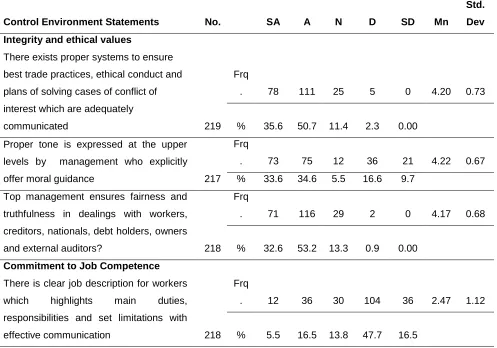
Licensed under Creative Common Page 393 From Table 6, it was revealed that SME projects in Machakos County had adopted proper
systems to ensure best trade practices, ethical conduct and plans of solving cases of conflict of
interest which were adequately communicated. This was evident by the highest rate of
189(86.3%) response of those who agreed. Whereas, those who disagreed were 5(2.3%) and
others 25(11.4%) were neutral. The corresponding mean was 4.20 and was higher than the
composite score while the SD was 0.73. This meant that integrity and ethical values especially
on existence of proper systems to ensure best business practices had positively influenced
performance.
In addition, 148(68.2%) of respondents acknowledged that management demonstrated the appropriate “tone at the top” including explicit moral guidance which were the majority in
favor of as compared to 57(26.3%) who disagreed with that statement and other 12(5.5%) who
did not give any suggestion concerning that matter. The mean to this statement was 4.22 which
was higher than 3.97 composite mean score whereas the SD was 0.67. It indicated therefore
that the action of the management to maintain proper tone at the apex impacted on the
performance of the SME projects in a positive manner.
Further, the aspect of top management ensuring fairness and truthfulness in dealings
with workers, creditors, nationals, debt holders, owners and external auditors gained favorable
opinion of 187(85.8%) respondents although a dismal number of 2(0.9%) did not agree
whereas, the undecided were 29(13.3%). This statement attracted a mean of 4.17which was
also greater than the composite mean score as per Table 6 and SD of 0.68 showing that the
assurance by the management on matters of fair and truthful business deals with external
interested parties was of great gain to performance. Any firm that has prospective future must
be transparent and accountable in their deals which enhance financial sustainability. Therefore,
matters of integrity and ethical values in any organization is a selling point of its products for
lack of this virtue translates to other parties to be scared and hence cannot fully commit
themselves to any matter from such an organization regardless of how attractive or beneficial it
may apparently appear. As per the results in Table 6, it was confirmed that maintenance of
integrity and good practice values was an assurance of royalty of customers, SME project to
government good relationships and harmonious association with creditors and other related
parties. This translates to increased market share, continuity in SME project operations and high
prospects in performance.
The study also focused on four facets of commitment to job competence out of which
three were highly supported by respondents while one was disregarded as follows: one,
well-articulated knowledge and abilities are set by management for job performance which also aid
Licensed under Creative Common Page 394 neutral while none of the respondents disagreed. The mean was 4.16, which was greater than
composite one [3.97], and the SD was 0.67. This finding implied that well-articulated knowledge
and abilities set by management played a positive role in performance of SME projects in
Machakos County as planned.
Second, the aspect of attracting the right cadre of workers, management rewarding the
current employees commensurately and the organization having employee performance
appraisal system to eliminate incompetence received approval by majority respondents of
103(47.5%) while other 36(16.6%) disagreed and the rest of 78(35.9%) were doubtful although
the mean was 3.46 which was smaller than the composite one, while the standard deviation
gotten was 1.06. This meant that, the consummate rewarding of employees by the management
did not positively influence performance of SME projects in Machakos County. This could be
due to less effective approach being used to attract the right class of workers. The management
needs to identify a better recruitment system that can be effectively utilized by the human
resource personnel to engage the right workers. This can be achieved by asserting the right job description parameters against which workers‟ performance and personal attributes can be
benchmarked with during the recruitment process.
Third, the concern of this study was the outcome of the employee performance appraisal
system used to eliminate incompetence in the organization. The respondents demonstrated a
big support of this aspect with 169(78.6%) being in agreement while 5(2.3%) which is a small
number disagreed and the rest of the 41(19.1%) were neutral. The associated mean was 4.13
greater than the composite mean value given and a corresponding SD of 0.85. This was an
indication that appraising of employees was a positive strategy to ensure enhancement of
performance of SME projects. Therefore, the top management should continue to promote all the value adding activities to performance appraisal so as to increase workers‟ productivity.
Fourth, commitment to job competence in respect to existence of clear job description
for workers which highlights main duties, responsibilities and set limitations with effective
communication attracted a minority support of 48(22%) while other 140(64.2%) did not agree
and the rest of 30(13.8%) did not support or oppose the suggestion given. The mean arising
from this statement was small at 2.47 (and SD was 1.12) value compared to the composite
value of 3.97. The resulting implication was that job clarification did not substantially positively
influence performance of SME projects in Machakos County. This could be due to less effective
methodology of division of labor through duty allocations. In overall it is well depicted that the
SME projects had a high level commitment in ensuring that employees are motivated through
provision of clear guidelines on how each should operate and also the compensation benefits to
Licensed under Creative Common Page 395 assurance to employees, resulting to minimal employee turnovers, strikes and in addition the organizations were assured of increased workers‟ productivity levels which prompt improvement
in performance.
Management philosophy and operating style got similar response as in the case of
commitment to job competence as follows; the cost benefit analysis undertaken by the firm
before any investment decision is made had highest response scores of 181(83.8%) of the
respondents who agreed, only 1(0.5%) of respondents disagreed while the other 34(15.7%)
remained undecided. The mean was 4.22 with a SD of 0.72. This indicated that cost-benefit
analysis undertaken before any investment is done had an economic and financial value
addition to the SME project performance for the mean was above the composite one. This is
because such a strategy ensured that only profitable investment ventures were financed. In
addition, the aspect of achieving the set objectives of the firm through management using
SWOT analysis technique attracted a majority support of 121(56.3%) while 18(8.4%) disagreed
and the rest of 76(35.3%) were neutral. The mean was 3.64, less than composite score which
was 3.97 and SD was 0.96. The implication was that the SWOT analysis undertaken by the
management did not optimally increase profitability of SME projects in Machakos County
although majority of the respondents were in support.
Further, the aspect of the organization avoiding dominance by few people on managerial
and operational decision matters attracted 43(19.6%) of respondents who agreed while
146(66.6%) disagreed and 30(13.7%) were unsure. The implication to this outcome was that the
organization did not factor in participation of all the concerned parties in decision making (was
discriminative) and as a result, this action led to low performance. This was evident by the
response mean which was 2.38 and low as compared to the composite mean score of 3.97 and
SD=1.11. The top management needs to initiate a decision support system that accommodates
decisional ideas from all cadres of managers to enhance productivity.
The organizational structure of the SME projects, namely; organizational structure of the
firm being clear on chain of command from top to bottom had a support of 187(87%) of those
who agreed and those who disagreed were 3(1.4%) and the undecided respondents were
25(11.6%). The mean score was 4.27 hence higher than composite value, and SD was 0.72. It
meant that clarity of the organizational structure of the firms had an incremental change on
performance. Additionally, the facet of devolved operational activities being adequately
supervised and monitored was supported by 187(85.8%) of respondents who agreed while
other 4(1.8%) disagreed and the rest of 27(12.4%) were neutral. Mean was 4.21 and also higher
Licensed under Creative Common Page 396 devolved operational activities aided in promoting positive changes in performance of SME
projects in Machakos County.
The established structure of the organization which was assumed to fit well the existing
complex and firm size level had gotten 181(83.8%) who agreed while other 5(2.3%) of the
remaining respondents disagreed and 30(13.9%) were undecided. The mean score gotten was
4.52 (SD=0.36) which was more than average composite score. This study outcome suggested
that the well-designed organizational structure of the SME projects in Machakos County
influenced the levels of performance in a positive way. In overall, the dominating positive
response is a sign of favorable change in SME project performance for the organizational
structure adopted dictated efficiency and effectiveness in operations, span of control and
smooth flow of instructions hence full resource utilization.
Assignment of authority and responsibility was also assessed as far as accountability
and transparency on authority delegation and obligation allocation which were based on
expected results and applies to all persons. The research findings showed that 190(87.9%)
agreed while 6(2.8%) disagreed and the rest of 20(9.3%) of the respondents did not take any
side of the opinion. The corresponding mean to this statement was 4.31 which was more than
the composite mean score [3.97] while the SD was 0.83. The implication derived from this
finding was that accountability and transparency when delegating duties contributed to
performance positively. For the case of limits of authority being clearly defined in writing and
appropriately communicated garnered a majority positive response of 189(88.3%) from
respondents and 7(3.3%) disagreed with that suggestion while 18(8.4%) were undecided. The
mean realized was 4.13 which was above 3.97, the composite mean as per Table 6 and a SD of
0.77. Such an average value as compared to the composite one depicted that the proper
communication and definition of authority helped the management to run the SME project with
incremental results on performance.
The delegation of signature authority limits in an appropriate manner and management
ensuring that reviews and updates of signature engraved on records is done due to cases of
employee turnover got 183(85.1%) support from respondents while 8(3.8%) were in
disagreement and the rest of 24(11.2%) were undecided. The line mean was 4.12, greater than
composite score [3.97], with a SD of 0.82. This implied that there was improvement in
performance due to management endeavors to ensure authenticity of signatures in past
records. Also establishment of job responsibilities, including specific duties, clear reporting
relationships and communication of the same to all employees had 185(86.4%) backup from
respondents. Another 6(2.8%) disagreed and the remaining 23(10.7%) were undecided. The
Licensed under Creative Common Page 397 improvement in reporting through well streamlined communication channels enhanced the
performance of the SME projects.
In a nutshell, the findings on assignment of authority and responsibility portrayed that
management actively participated in ensuring that accountability and transparency of the tasks
undertaken by the different levels of management and specific workers was accomplished. As a
result, productivity of SME projects increased which was evidenced by positive change in
profitability levels. Holding employees responsible to specific tasks is a way of ensuring that
there are no idle laborers who are paid for no work done.
Human resource policy and practice got positive majority response for all the estimation
proxies used whereby a careful hiring process which has been put in place and involvement of
identification of potential employees based on job requirements by the human resources
department got 181(83.8%). Those who disagreed with this opinion were 6(2.8%) and
29(13.4%) respondents were undecided. The mean was 4.20 and was higher than the derived
composite score and SD was 0.78 which implied that the human resource policy and practice
positively changed the performance of the SME projects.
Further, the aspect of having well defined objectives on-the-job and other effective
training programs was supported by 110(50.9%) of respondents who agreed while 31(14.4 %%)
disagreed and 75(34.7%) of the respondents were undecided. The mean realized was smaller
as compared to the composite mean score for it was 3.41 and SD of 0.97. This descriptive
outcome revealed that training programs had less impact on performance. The management
has to carry out a need assessment exercise so as to specifically identify the need gap to be filled so as to focus on the right knowledge impartation program. This could improve of workers‟
productivity.
Opinion on the adequacy of personnel supervision and availability of regular resource for
resolving problems was positively suggested by 187(87.4%) respondents who were in
agreement while 4(1.9%) disagreed and 23(10.7%) did not take either sides with a mean of 4.25
and SD= 0.72. The results gotten implied that performance level of SME projects in Machakos
County was enhanced by the adequate supervisory activities of the organization for the mean
established was higher than the composite mean value of 3.97. This also implied that failure to
closely and effectively oversee the firm resources may result to financial losses. Further, the
case of existence of a system to ensure spontaneous direct punishing of wrong character of an
individual of any status without fear or favor got a support of 192(88.4%) from the respondents
while 3(1.4%) disagreed and the rest of 22(10.1%) were neutral. The 4.27 mean value realized
was higher than the composite score one and the SD was 0.70. This implied that the
Licensed under Creative Common Page 398 malpractices and ill-advised activities amongst workers which assured the stakeholders of the
firm improved returns.
The concept of existence of an organized evaluation process had support of 183(88.9%)
supporters who agreed and other 5(2.4%) disagreed while the rest of 18(8.7%) were undecided.
This response statement was represented by 4.21 line mean which was superior to the
composite mean score of 3.97 and SD of 0.70 which implied that the evaluation process played
a positive role in improving performance of SME projects in Machakos County. Evaluation
process is a corrective approach which ensures that the outcome of a business activity is in
compliance with the set goals and objectives. In the case of SME projects in Machakos County,
the evaluation action seemed to have aided in rectifying areas of performance deviations.
The perspective of definition and communication on outcome of performance evaluation
and rewarding verdicts being appropriate and again, the rewarding plan being formally done
with involvement of various levels of management had a majority score of 188(87.1%) from
respondents who agreed while those who were against this suggestion were 8(3.7%) and
undecided category of respondents were 20(9.3%). The 4.20 mean generated and SD of 0.84
was better than the composite mean score. The suggestion accorded to this finding was that
proper communication of performance outcome and appropriate rewarding system had
enhanced the profitability of SME projects in Machakos County. In general, the human resource
policy and practice got more than the expected support implying that human capital
development was well done. Equipping of workers with the right training capacitates them to
perform better which in the case of SME projects in Machakos County was portrayed in the
positive change of financial performance.
Hypothesis Testing
H0: Control Environment does not significantly influence performance of small and
medium enterprise projects in Machakos County.
The prediction equation as shown in chapter three was;
PER = β0 + β1IEV + β2COC +β3MPO + β4OS + β5AAR + β6HPP+ ε
Where; FPER is financial performance
IEV is integrity and ethics values of the organization
COC is commitment to job competence
MPO is management philosophy and operating style
OS is organizational structure of the firm
AAR is assignment of authority and responsibility in pursuit of objective
Licensed under Creative Common Page 399 To test the null hypothesis, multiple regression analysis was utilized (Table 7).
Table 7: Control Environment and Financial Performance of SME Projects
Model Summary
Model R R Square Adjusted R Square Std. Error of the Estimate
1 .272a .074 .042 .63927
a. Predictors: (Constant), HPP2, IEV, OS, MPO, COC, AAR
ANOVA
Model Sum of Squares Df Mean Square F Sig.
1
Regression 5.692 6 .949 2.321 .035b
Residual 71.517 175 .409
Total 77.209 181
a. Dependent Variable: Financial Performance b. Predictors: (Constant), HPP, IEV, OS, MPO, COC, AAR
Coefficients
Model Unstandardized Coefficients Standardized Coefficients T Sig.
B Std. Error Beta
1
(Constant) 3.335 .330 10.110 .000
IEV .069 .042 .119 1.624 .106
COC .036 .044 .061 .828 .409
MPO .147 .047 .231 3.160 .002
OS .035 .035 .073 .994 .322
AAR -.029 .034 -.066 -.876 .383
HPP -.008 .032 -.018 -.238 .812
a. Dependent Variable: Financial Performance
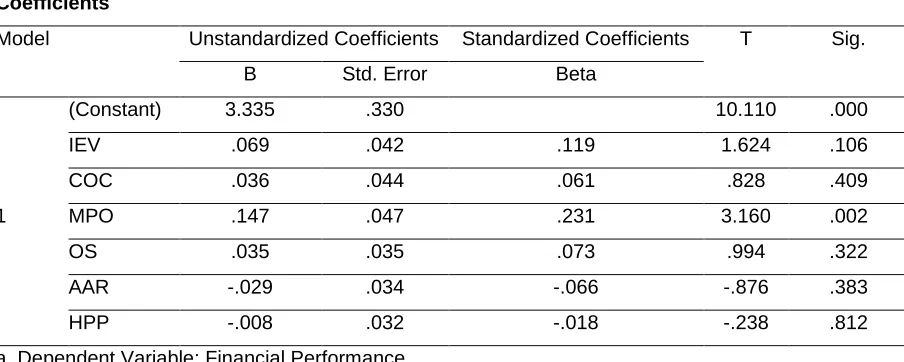
According to Table 7, it shows that the F statistic for the model was 2.321(p=.035). The computed (p˂.05) which implied that the model was statistically significant at 95% confidence
level and therefore suitable in estimating the financial performance of SME projects in
Machakos County. The best of fit test, that is R2, showed that integrity and ethics values of the
organization, commitment to job competence, management philosophy and operating style,
organizational structure of the firm, assignment of authority and responsibility in pursuit of
objective and human resource policy and practice taken together explained 7.4% of the total
variations of financial performance of SME projects. The rest of the changes occurring on
financial performance (92.6%) were explained by other factors ignored by the model.
The β coefficient test of best of fit on the significance of every individual predictor
Licensed under Creative Common Page 400 only management philosophy had caused a statistically significant positive change of .147
(p=0.002) on financial performance on adjusting it by one unit. On the other hand, Integrity and
ethics values of the organization unit change resulted to a weak direct change of .069(p=.106)
on financial performance which was statistically insignificant. In addition, a unit change in
commitment to job competence resulted to a weak statistically insignificant positive change of
.036(p=0.4095). Also a unit change in organizational structure of the firm led to statistically
insignificant change of .035 (p=.322) which was weak and positive. A unit adjustment in
assignment of authority and responsibility in pursuit of objective resulted to a negative change in
financial performance of .029(p=.383) which was weak and statistically insignificant. Further, a
unit alteration of human resource policy and practice showed that this act resulted to a weak
statistically insignificant negative change of .008(p=0.812). The empirical model established
was as: FPER= 3.335+ .069IEV+.036COC+ .147MPO+ .035OS-.029AAR-.008HPP
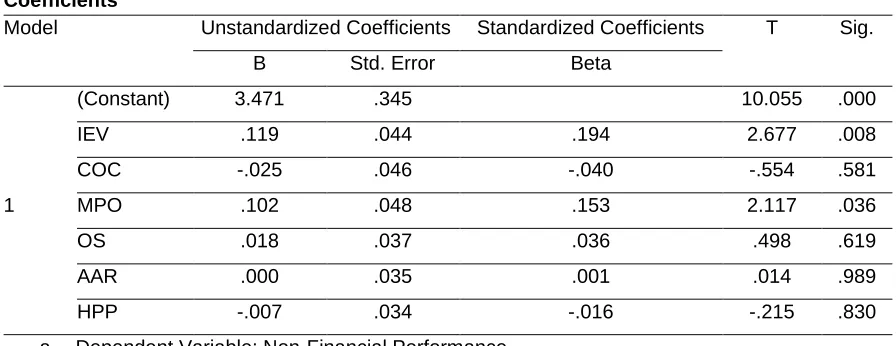
Lastly, the aspect of non-financial performance was considered and the regression
analysis outcome was as per Table 8.
Table 8: Control Environment and Non-Financial Performance of SME Projects
Model Summary
Model R R Square Adjusted R Square Std. Error of the Estimate
1 .251a .063 .032 .67738
a. Predictors: (Constant), HPP2, OS, IEV, MPO, COC, AAR
ANOVA
Model Sum of Squares Df Mean Square F Sig.
1
Regression 5.566 6 .928 2.022 .065b
Residual 83.051 181 .459
Total 88.617 187
a. Dependent Variable: Financial Performance b. Predictors: (Constant), HPP, IEV, OS, MPO, COC, AAR
Coefficients
Model Unstandardized Coefficients Standardized Coefficients T Sig.
B Std. Error Beta
1
(Constant) 3.471 .345 10.055 .000
IEV .119 .044 .194 2.677 .008
COC -.025 .046 -.040 -.554 .581
MPO .102 .048 .153 2.117 .036
OS .018 .037 .036 .498 .619
AAR .000 .035 .001 .014 .989
HPP -.007 .034 -.016 -.215 .830
Licensed under Creative Common Page 401
STUDY FINDINGS
The study finding on the influence of control environment depicted that only two out of the six
aspects of this ICS component had significant influence on performance. That is, a unit
transformation of management philosophy and operating style caused a statistically significant
positive change of .147(p=0.002) on financial performance. Similarly, a unit change in
management philosophy and operating style led to .102 (p=0.036) changes in non-financial
performance levels which were statistically significant and positive. This was in tandem with the
highly positive responses gotten from respondents such as aspect of management determining
the level of knowledge and skills needed to perform a particular job whereby the information is
used in the hiring process which scored 84.6% level of acceptance. In addition, a unit change
integrity and ethics values of the organization resulted to a direct change of .119(p=.008) on
non-financial performance of the SME projects in Machakos County. The management needs to
uphold those aspects by ensuring that available resources are efficiently allocated to them to
ensure that this status quo is either maintained or improved.
Other facets used to measure control environment demonstrated insignificant influence
to performance. This outcome was contrary to descriptive findings for most of those aspects got
a more than average (50%) positive response. The management need to endeavor in improving
areas of weakness to have an overall effective influence of control environment for it is the
function of internal control system that sets the tone of the organization by influencing the
control consciousness of its people (Whittington and Pany, 2001).
Research findings as per Table 8revealed that the F statistic for the model was
2.022(p=.065). The computed p value was greater than the critical value (.05) and this implied
that the model was not suitable in estimating the non-financial performance of SME projects in
Machakos County for it was statistically insignificant at 95% confidence level. The assessment
of best of fit as far as (R2) was concerned, showed that the six factors (integrity and ethics
values of the organization, commitment to job competence, management philosophy and
operating style, organizational structure of the firm, assignment of authority and responsibility in
pursuit of objective and human resource policy and practice) taken together explained 6.3% of
the total variations of non-financial performance of SME projects in Machakos County. The rest
of the changes occurring on performance (93.7%) are explained by other factors outside this
model.
Further, best of fit test on the significance of the slope for every individual predictor
variable was undertaken. A unit change in management philosophy and operating style led to .102(p˂.05) changes in non-financial performance levels which were statistically significant and
Licensed under Creative Common Page 402 pursuit of objective, did not demonstrate any change in non-financial performance (.000 and p˃.05) hence had statistically insignificant relationship with non-financial performance. Unit
change integrity and ethics values of the organization resulted to a direct change of
.119(p=.008) hence that variable statistically significantly influenced non-financial performance.
In addition, a unit change in commitment to job competence resulted to a weak statistically insignificant inverse change of .025(p˃.05) of non-financial performance. Also a unit
change in organizational structure of the firm led to statistically insignificant change of
.018(p=.619) of non-financial performance which was weak and positive and further, a unit
alteration of human resource policy and practice showed that this act resulted to a weak statistically insignificant negative change of 0.007(p˃.05) on non-financial performance. The
model arising from this analysis was as follows;
NPER= 3.471+.119IEV-.025COC+ .102MPO+ .018OS + 0.00AAR -.007HPP
Where;
NPER is non-financial performance and the other variables are as described in the predictive
model
The F statistic values for the case of financial performance was 2.321(p=.035)
respectively hence the model at 95% of confidence level was suitable to measure financial
performance. Whereas, for non-financial measure, the F statistic value was 2.022(p=.065)
hence control environment was not statistically significant to be used to assess non-financial
performance aspect of the SME projects in Machakos County. The study concluded that since
control environment significantly estimated financial performance aspects, that was good
enough to fail to accept the null hypothesis which states that; H0: Control environment does not
significantly influence performance of small and medium enterprise projects in Machakos
County. The conclusion made by this study meant that control environment statistically
significantly influence performance of SME projects in Machakos County.
CONCLUSION
Control environment statistically significantly influence performance of SME projects in
Machakos County. That is employees have positively embraced the laid down integrity and
ethical values and commitment to job competence which in turn has contributed to
enhancement of productivity levels of SME projects. Also the philosophies and the operating
styles used by the top management are effective which is evident in efficient delegation of
duties to the workers. It is also concluded that the human resource team is focused in identifying
Licensed under Creative Common Page 403
RECOMMENDATIONS
Top management of small and medium enterprise projects should strengthen the five internal
control system components inclusive of control environment for it is more advantageous as
compared to a case where some of them are given more emphasis. The five components based
ICS improves performance for it has more significant contribution than each element in isolation
and also it enhances reliability level by external auditors which translate to less audit costs
incurred.
External auditors have traditionally been forming audit opinion for shareholders or the
owners of the SME project and the reports are usually financial based. However, the
introduction of both financial and non-financial performance aspects as per this study, calls
upon the auditors to prepare reports for all stakeholders and on the same note, management is
advised to shift to good corporate governance which advocates for accountability and
transparency responsibility to all stakeholders. In other words, a shift paradigm from agency
theory to stakeholder theory is advocated by this study.
LIMITATIONS
This study sought to establish the extent to which control environment influenced performance
of medium sized enterprise projects in Machakos County, Kenya. This main objective was not
achieved without constraints. However, the researcher endeavored to put in control confines to
avoid significant effects which could materially distort the research findings established by this
study.
The limitation arising was on study conceptualization on the influence of control
environment on performance of SME projects in Machakos County. The study focused on
control environment and performance of SME projects. Although the research findings were
statistically significant, the outcome was limited to the cause-effect model selected and how
study variables were operationalized. The research findings were anchored on the methodology
used to collect and analyze data. Due to time constraints, the study used a sample of 265 from
a population of 5311 and relied on multiple, stepwise and hierarchical regression models for data analysis which from the researcher‟s judgment were more suitable for making statistical
inferences.
REFERENCES
Aldridge, R., & Colbert, J. (1994). Management's Report on Internal Control, and the Accountant's Response. Managerial Auditing Journal,, 9(7), 21-28.
Licensed under Creative Common Page 404 Babbie, E. (2003). Survey Research Methods. Belmont, California: Wadsworth Publishing Company.
Basle Committee on Banking Supervision, (1998).The Basel Committee‟s Framework for Internal Control Systems. Bertalanffy, L. V. (1968). General system theory. Foundations, Development, Application. New York: George Braziller.
Blackman, A. J. (2003). Entrepreneurs: Interrelationships between their characteristics, values, expectations, management practices and SME performance, Unpublished Doctoral Dissertation, Griffith University, Australia. Chen, H.C.K. (1996). Direction, magnitude, and implications of nonresponse bias in mail Surveys. Journal of the Market Research Society, 3(38), 267-277.
Covin, J. G. (1991). Entrepreneurial versus conservative firms: A comparison of strategies and performance, Journal of Management Studies 28(5), 439–462.
Economic Survey of Kenya, (2009).Report.
Elkington, J. (1997). Cannibals with forks: the triple bottom line of 21st Century business. Oxford: Capstone.
Frazer, L. (2012). The effect of internal control on the operating activities of small restaurants.Journal of Business & Economics Research, 10(6), 361-374.
Freeman, R.E. (1984). Strategic Management: A stakeholder Approach. Boston, MA: Pitman.
Gesare, M. R., Nyagol, M. &Odongo A. J. (2016). Influence of Internal Control Systems on Fraud Risk Management among Commercial Banks in Kisii Town, Kenya.Journal of Business and Management, 4(18), 28-34.
Government of Kenya (2007) Report.
ILO, (1972). Employment, incomes and equity: a strategy of increasing productive employment in Kenya. Geneva: International Labor Organization.
Jensen, M. C. &Meckling, W.H.(1976). Theory of the firm: Managerial behavior, agency costs and ownership structure. Journal of Financial Economics, 3(4), 305-360.
Kaplan, R. S. & Norton, D. P. (2001). Transforming balance score card from performance measurement to strategic management: Part 1. Accounting Horizons, 87-104.
Kinyua, J. K., Gakure, R, Gekara, M. &Orwa, G. (2015). Effect of Internal Control Environment on the Financial Performance of Companies Quoted in the Nairobi Securities Exchange. International Journal of Innovative Finance and Economics Research 3(4):29-48,
Lin, M.J. J. & Chen, C.J. (2008). Integration and knowledge sharing: Transforming to long-term competitive advantage. International Journal of Organizational Analysis, 16(4), 83-108.
Mallin, C.A. &Michelon, G. (2011). Board reputation attributes and corporate social performance: An empirical investigation of the US best corporate citizens. Accounting and Business Research, 41, 119-144.
Neely, A. (1999). The performance measurement revolution: why now and what next? International Journal of Operations & Production Management, University of Cambridge, UK: MCB University Press, 19(2), 205-228.
Oseifuah, E. K. &. Gyekye, A .B. (2013).Internal control in small and microenterprises in the Vhembe District, Limpopo Province, South Africa. European Scientific Journal, 1(9), 241-251.
Richard, P. J., Devinney, T. M. & Yip, G. S. (2009). Measuring organizational performance: Towards methodological best practice. Journal of Management, 12(35), 718-804
Stoner, T. (2003).Alternative financing models for energy efficiency performance contracting. Econergy International Corporation. Wai, L.Y. (2008). Importance of internal Auditing: Small and Medium Enterprises' (SMEs) perception. Putra Malaysian University website.
Whittington, R. &Pany, K. (2001). Principles of Auditing and other Assurance Services.
Wolff, J. A. &Pett, T. L. (2006). Small-firm performance: Modeling the role of the product and process improvements. Journal of Small Business Management, 44(2), 268 – 284.