
Atomic properties of elements 114 and 118 and their adsorption on inert
surfaces
A. Borschevsky1, V. Pershina2, E. Eliav3, and U. Kaldor3 1
Centre for Theoretical Chemistry and Physics, New Zealand Institute for Advanced Study, Massey University, Private Bag 102904, 0745 North Shore MSC, Auckland, New Zealand
2
GSI Helmholtzzentrum für Schwerionenforschung, Darmstadt, Planckstr. 1, D-64291 Germany 3
School of Chemistry, Tel Aviv University, 69978, Tel Aviv, Israel
Abstract.We present fully relativistic coupled cluster calculations of ionization potentials, electron affinities, and polarizabilities of superheavy elements 114 and 118, along with their lighter homologues, lead and radon. The combination of the 4-component Dirac Hamiltonian with the state of the art coupled cluster approach allows us to achieve very good agreement with experimental values for the lighter elements; similar precision can be expected for our predictions for the superheavy atoms. The trends in the atomic properties are discussed, demonstrating the strong relativistic effects. Using the calculated atomic properties, adsorption enthalpies of the superheavy atoms on inert surfaces are estimated and shown to be rather low for both elements.
1 Introduction
Theoretical investigations of atomic properties of the superheavy elements allow us to gain a fundamental insight into the influence of relativity on electronic structure. As relativistic effects become more pronounced with increase in the atomic number, superheavy elements will experience the most dramatic influence of both scalar relativistic and spin orbit effects on their atomic and chemical properties.
Knowledge of atomic properties of the superheavy elements can also assist in experimental studies. One of the possible chemical experiments on these extremely short lived species is gas-phase chromatography, where the elements are deposited, according to their volatilities, on alpha-detectors located along a chromatography column with a temperature gradient [1,2]. The deposition temperatures are then measured and related to the adsorption enthalpies, 4Hads. Using this method, the adsorption properties of the superheavy elements on various surfaces (usually on gold) can be compared to those of their lighter homologues in the groups. Recently, the adsorption enthalpies of Cn (Z=112) and element 114 on gold were estimated using this technique [3,4]. Theoretical predictions of the adsorption enthalpies are important for such experiments, in order to assess the feasibility of separation of the homologues on a given surface. Knowledge of 4Hads on inert materials, such as Teflon and polyethylene is also valuable, as these materials are used as transport capillaries from the target chamber to the experimental setup.
Here we collect the previously published calculated ionization potentials (IPs) [5, 6], electron affinities (EAs) [7, 8], and polarizabilities (.) [9, 6] of element 114 and
element 118. Using these properties and a simple physisorption model, we also calculate the adsorption enthalpies of these atoms and of their lighter homologues on inert surfaces. These two elements, due to their different valence atomic orbitals (7p1/2 for element 114 and 7p3/2 for element 118) are good study cases for illustrating the influence of relativistic effects on atomic and chemical properties.
2 Methods and computational details
The quality of any calculation is determined by three parameters: treatment of relativity, treatment of correlation, and the choice of the basis set. Any calculation performed on heavy and superheavy elements must treat relativity on the highest possible level. As we go down in the periodic table, the relativistic effects become the dominant parameter determining the atomic properties. Therefore, in order to get meaningful results, relativity should be included from the start, via a 4-component Dirac-Coulomb Hamiltonian [10], and not treated as a perturbation.
On the other hand, correlation is no less important for obtaining reliable results. Currently, the most powerful method for treatment of correlation is the coupled cluster approach. We employ two variants of this method: single reference coupled cluster with single, double, and perturbative triple excitations (SR CCSD(T)), which is EPJ Web of Conferences
DOI: 10.1051/
C
Owned by the authors, published by EDP Sciences, 2012 ,
epjconf 20123/
05002 (2012)
35
505002
This is an Open Access article distributed under the terms of the Creative Commons Attribution License 2 0 , which . permits unrestricted use, distributi and reproduction in any medium, provided the original work is properly cited.
(5) well suited for closed shell systems, and a multireference
Fock space CC method (FSCC) [11], for open shell systems.
The basis sets employed in the calculations are specially developed for relativistic methods [12,13], and we extend them by adding diffuse and high angular momentum functions until convergence with respect to the calculated properties is reached.
Alongside the calculations for the superheavy elements, we perform similar calculations for their lighter homologues, lead and radon, for which experimental atomic properties are known. We can thus compare our results to experiment and assess the accuracy of our calculations and the reliability of our predictions for the superheavy elements.
Full details of the calculations can be found in References [5-9]. Here we give a general outlook upon the computational methods that we employ.
2.1 Ionization potentials and electron affinities
The ionization potential and electron affinity calculations were performed within the framework of the projected Dirac-Coulomb-Breit Hamiltonian [10],
HDCB =
L>D(i)
+~)lIr;j
+Bij). (1)i<j
Here,hDis the one electron Dirac Hamiltonian,
hD(0=cUi· Pi+c
2
Pi+Vnuc(i), (2)
w.here U and ~ are the four dimensional Dirac matrices.
The two electron terms include the nonrelativistic electron repulsion and the Breit term,
Bij = -
2~
..[Ui .Uj+
(ui .rij )(U1"rij ) /r;;
J,
(3)IJ
and are correct to second order in the fine structure constant u. For the EA of element 118, the result was also corrected for higher order quantum electrodynamic (QED) effects [8].
Electron correlation is included by the Fock space coupled cluster method, augmented by the intermediate Hamiltonian approach, described in detail elsewhere [14]. This approach allows us to employ extremely large model spaces while avoiding convergence difficulties, and to achieve benchmark, typically meV quality for the calculated IPs and EAs.
2.2 Polarizabilities
Static dipole polarizabilities were obtained using the finite field approach [15, 16], with atomic energies calculated for free atoms and in the presence of uniform electric field acting in the z direction, Fz. The atomic energy in the presence of an electric field is given by
E(Fz )=E(O)+Fz
8~c;z)
I +~Fz2
8E:(Fz )I + ... (4)z Fz=0 8 Fz F =0
z
The first term in the above equation is the ground state energy of an atom in the absence of the electric field, the
second term contains the dipole moment, which vanishes for atoms, and the static dipole polarizability appears in the third term,
a
=
-2a
2E(Fz )a
2pz
Relativistic SRCCSD(T) atomic energy calculations were performed forFz= 0.000, 0.0005, and 0.001 a.u. and the polarizabilities were obtained by numerical differentiation.
2.3 Adsorption enthalpies
Itwas shown [17] that the dispersion interaction energy of an atom with an inert solid surface can be rather accurately estimated using the following equation, derived from a model of an atom-slab interaction,
3
(c
-1J
aat
E(x)= -t1Hads :::: - - - - (6)
16 c+2 ( 1 1
J
3l
IPslab +IPat x
Here, IPslaband IPa10mare the ionization potentials of the surface material and the adsorbed atom, respectively, Ual is the polarizability of the adsorbed element, £ is the dielectric constant of the surface material, and x is the adatom-surface distance. It was also shown [18] that x can be well approximated by Van der Waals radius (RvdW)
of the adsorbed atom. We obtain the RvdW of the
superheavy elements from a linear correlation between the radii of the maximal charge distribution of the valence orbital and the experimental RvdW of the lighter
homologues in the groups. Table 1 contains the experimental IPs and the dielectric constants of the inert materials considered here.
Table1.Properties of the inert surfaces.
Property Quartz Teflon Ice
IP (eV) 11.87 10.12 12.6
£ 3.81 2.04 3.5
3 Results and discussion
The trends in the atomic properties discussed here, and thus also the trends in the adsorption enthalpies will be set by the trends in the valence atomic orbitals.
Heavy Ion Accelerator Symposium2012
-0.2
-0.25 Ge Pb
Table 2. Ionization potentials (eV), electron affinities (eV), and polarizabilities (a.u.) of elements 114 and 118 and their lighter
homologues, Pb andRn.
Fig.1.DF binding energies (a.u.) of thenp1l2electrons of group 14 elements.
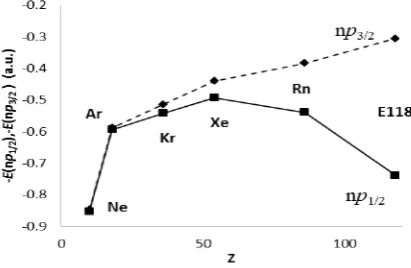
Figure 2 shows the binding energies of the npll2and the outernp3/2atomic orbitals of group18 elements. Here the most striking feature is the spin-orbit splitting between the sublevels, which increases with increase in Z. While thenpll2orbitals behave in a manner similar to that of the group 14 elements, a different trend is observed for the np3/2 electrons, which become less bound with increase in the atomic number.
In contrast to group 14, the ionization potentials of the rare gases do, indeed, decrease more or less monotonously (Fig. 4), as do the energies of their valence
np3/2 orbitals. These orbitals are destabilized through an indirect relativistic influence; however, the effect is rather small, and in line with the general trend in the group of decrease in the IP with the increase in the atomic number. Element118 will have the lowest IP in the group.
Ref. [5J, Ref. [20J, Ref. [7J, Ref. [21J Ref. [9J, Ref. [22J;gRef. [6J;hRef. [8J
IP EA a
Pb (calc) 7.349" 0.363c 46.96e
Pb (exp.) 7.417" 0.364° 47.1(7)1
114 (calc.) 8.539" NoEA" 30.5ge
Rn (calc.) 10.799g NoEA 35.04g
Rn (exp.) 10.749" NoEA
-118 (calc.) 8.914g 0.056" 46.33g
"
• b C . a e120
E114
100
80 60
Z
Sn
40
Si
20
c
o
-0.45 -0.4 ::i ~ -0.3
1
0 .35100 50
Kr
o
6.5 8.5 12.5
10.5 16.5
>
.!'-14.5 !!::
11.5
11
10.5
10
9.5
>
.!'- 9 !!::
8.5
8 Sn Pb E114
7.5 Ge
7 6.5
0 50 100
Z
18.5 22.5
z
Fig. 4. IPs (eV) of group 18 elements (experimental values for Ne to Rn, calculated value for element 118). Fig. 3. IPs (eV) of group 14 elements (experimental values for
C to Pb, calculated value for element 114).
20.5
Our calculations predict no electron affinity for element114, while lead, its lighter homologue, has an EA of about0.4 eV. The probable reason for this is twofold.
The 7P3/2LUMO orbital, where the extra electron would
attach, is destabilized by relativity. On the other hand, the relativistically contracted occupied 7P1l2 orbital should create a rather strong shielding of the nucleus, also lowering the binding energy of an additional electron. np3/2 _+
--EllS
100 z
50
o
-0.9 -0.8 -0.3 :::i ~-0.4
-0.2
;;t-0.5 c. c
~-0.6
~
c -0.7 ;;;r3.1 Ionization potentials and electron affinities
The calculated ionization potentials and electron affinities of element 114 and element 118 can be found in Table 2. There we also present the calculated and the experimental IPs and EAs for their lighter homologues, Pb and Rn. Our results for the lighter atoms are in excellent agreement with experimental values; similar accuracy can be expected for our predictions for the superheavy elements.
Figure 3 presents the ionization potentials of group 14 elements.Itis easy to see that the IP follow the trends set by the binding energies of the valencenp1l2orbitals. The ionization potential decreases from carbon to tin, and then increases again, so that the IP of element114 is even higher than that of silicon. This increase is a purely relativistic effect; without relativity the IP of element114 would be the lowest in the group.
Fig. 2. DF binding energies (a.u.) of thenp1l2(squares, solid line) and thenp3/2 (rhomboids, dashed line) electrons of group
18 elements.
Noble gases are chemically inert, and do not have electron affinity. Element 118, however, is rather special: calculations have shown that it should have an electron affinity of 0.056 eV, which can be attributed to the relativistic stabilization of the next 8s shell.
In group 18, the polarizabilities increase monotonously, and element 118 will have the highest polarizability in the group. Here, we do not find a trend reversal like we do in group 14, as the valence np3/2 shell does not experience relativistic contraction.
3.2 Polarizabilities 3.2 Adsorption Enthalpies
E114
Ice
Pb
Sn
Ge 11.5
26.5
6.5
'6
E 21.5
g
. ; 16.5 "?
,
Pb 114 Rn 118
RvdW 4.062 3.94 4.295 4.55
-!:J.Hads(quartz) 27.34 20.97 21.8 21.8
-!:J.Hads(ice) 26.29 20.20 21.1 21.0
-!:J.Hads(Teflon) 13.65 10.41 10.7 10.8
o 20 40 60 80 100 120
Z
Fig. 7. Adsorption enthalpies-!:i.Hadsof group 14 elements on quarts, ice, and Teflon[9]
Table 3. RVdW (a.u.) and adsorption enthalpies-!:i.Hads (kllmol)
of elements 114 and 118 and their lighter homologues on inert surfaces[69]
The adsorption enthalpies of the elements under study on quartz, ice, and Teflon, obtained in Ref. [9] and Ref. [6], are presented in Table 3. There we also show the Van der Waals radii of the atoms, derived through a liner correlation in the same publications.
31.5
The adsorption entha1pies of group 14 elements on all the surfaces studied here follow the trends set by the po1arizabi1ities (Figure 7), with a maximum at tin, and element 114 being similar to silicon. The low I1Hads of element 114 on Teflon should guarantee its transport through Teflon capillaries from the target chamber to the experimental set up. On quartz, its I1Hads is about 6
kJ/mol lower than that of lead, making possible their
separation on this surface.
E114
100
Pb
50 Ge
o
56.5 5L5 46.5 4L5
~36.5
::i -.!!.3L5
OJ26.5 2L5 16.5 lL5 6.5
z
Fig. 5. Polarizabilities (a.u.) of group 14 elements. Values forC to Sn are from Ref.[23],for Pb and 114-calculated in Ref.[9]. The calculated polarizabilities of all the atoms under study are shown in Table 2. Polarizability of Rn is yet to be measured, and the experimental polarizability of Pb has a rather large uncertainty of about 15%. Thus, together with the superheavy elements, we also make benchmark predictions of the polarizability of their lighter homologues.
Figures 5 and 6 show the polarizabilities of group 14 and group 18 elements, respectively. The values for Pb, Rn, element 114 and element 118 are from the SR CCSD(T) calculations, for the lighter homologues we use experimental values, where available, or best theoretical values from Ref. [23].
The electric dipole polarizability is a measure of the distortion of the overall atomic or molecular charge distribution by an external electric field. It can thus be intuitively connected to the atomic volume. For group 14, the polarizability increases from carbon to tin, with the increase of the atomic size. However, from tin to lead, the valence np1l2 orbital experiences relativistic contraction, which reduces the polarizability. This contraction is even stronger for element 114, and it should have an even lower polarizability than Si.
z
Fig. 6. Polarizabilities (a.u.) of group 18 elements. Values for Ne to Xe are from Ref. [23],for Rn and 118-calculated in[6].
50 45 40 35
~30 ::i
-.!!. 25 Xe
OJ 20 Kr
15 Ar
10 5
Ne
0
0 50
EllS
Rn
100
Adsorption enthalpies of group 18 elements on inert surfaces are shown in Figure 8. There is a steady increase in I1Hads on all the surfaces with an increase in atomic number, up to lead and element 118. The adsorption entha1pies of these two atoms are extremely close in values, which would preclude their separation using gas chromatography technique on all the surfaces studied here. This is caused by the compensation of the increase in po1arizabi1ity by an increase in RvdW from lead to the heavier homologue. As is the case with element 114, the
low !:i.Hads of element 118 on Teflon will allow its
Heavy Ion Accelerator Symposium 2012
20
25
Quartz elements, edited by M. Schadel (Kluwer, Dordrecht,2003),pp.1l7-158
3. R. Eichler, N.V. Aksenov, A.V. Belozerov, G.A.
Bozhikov, V.1. Chepigin, et al., Nat. Lett. 447, 72 (2007).
4. R. Eichler, N.V. Aksenov, Yu.V. Albin, AV.
Belozerov, G.A. Bozhikov, et al., Radiochim. Acta 98, 133 (2010)
5. A. Landau, E. Eliav, Y. Ishikawa, and U. Kaldor, J.
Chern. Phys. 114,2977 (2001)
6. V. Pershina, A. Borschevsky, E. Eliav, and U.
Kaldor,J.Chern. Phys. 129, 144106 (2008)
7. A. Borschevsky, V. Pershina, E. Eliav, and U.
Kaldor, Chern. Phys. Lett. 480,49 (2009)
8. E. Eliav, U. Kaldor, Y. Ishikawa, and P. Pykko,
Phys. Rev. Lett. 77, 5350 (1996); I. Goidenko, L.
Labzowski, E. Eliav, U. Kaldor, and P. Pykko, Phys. Rev. A 67, 020102(R) (2003)
9. V. Pershina, A. Borschevsky, E. Eliav, and U.
Kaldor,J.Chern. Phys. 128,024707 (2008) 10. J.Sucher, Phys. Rev. A 22,348 (1980)
11. E. Eliav, U. Kaldor, and Y. Ishikawa, Rhys. Rev. A 49, 1724 (1994).
12. K.Faegri, Theor. Chim. Acta 105, 252 (2001)
13. G. L. Malli, A B. F. Da Silva, and Y. Ishikawa,
Physical Review A47(1), 143 (1993)
14. A. Landau, E. Eliav, and U. Kaldor, Chern. Phys. Lett. 313, 399 (1999); A. Landau, E. Eliav, Y. Ishikawa, and U. Kaldor, J. Chern. Phys 115, 2389 (2001); A. Landau, E. Eliav, Y. Ishikawa, and U. Kaldor, J. Chern. Phys 121, 6634 (2004); E. Eliav, M. J. Vilkas, Y. Ishikawa, and U. Kaldor, J. Chern. Phys 122, 224113 (2005)
15. U. Kaldor,J.Phys. B 6,71 (1973)
16. H. J. Monkhorst, Int. J. Quantum Chern. 11, 421 (1977)
17. V. Pershina, T. Bastug, B. Fricke, and S. Vagra, J. Chern. Phys. 115,792 (2001)
18. E. Zaremba and W. Kohn, Phys. Rev. B 13, 2270 (1976)
19. J. P. Desclaux, At. Data Nucl. Data Tables 12,311 (1973)
20. C. E. Moore, Atomic Energy Levels (U.S. Goverment Printing Office, Washington, DC, 1958)
21. H. Hotop and W.e. Lineberger,J. Phys. Chern. Ref. Data 14, 731 (1985)
22. C. Thierfelder, B. Assadollahzadeh, P.
Schwerdtfeger, S. Schafer, and R. Schafer, Phys. Rev. A 78,052506 (2008)
23. P. Schwerdtfeger, "Atomic Static Dipole
Polarizabilities", in Computational Aspects of Electric Polarizability Calculations: Atoms, Molecules and Clusters, ed. G. Maroulis, lOS Press,
Amsterdam, (2006), pp.1-32, Updated static dipole polarizabilities are available as a pdf file from the
CTCP website at Massey University:
http://ctcp.massey .ac.nz/dipole-polarizabilities Ice
EllS
Teflon
Rn Xe
Kr Ne Ar
o
5
'6
E 15
g
;10
"?4 Conclusions
References
1. A Tilrler and K. E. Gregorich, "Experimental
Techniques", in Chemistry of the Superheavy
elements, edited by M. Schadel (Kluwer, Dordrecht,
2003), pp. 31-94
2. H. W. Gaggeler and A. Tilrler, "Experimental
Techniques", in Chemistry of the Superheavy
Acknowledgements. AB. thanks the GSI
Helmholtzzentrum Darmstadt, HI Mainz, and the
Marsden Fund, administered by the Royal Society of New Zealand, for financial support.
Calculated ionization potentials, electron affinities,
and polarizabilities of elements 114 and 118 are
presented, along with those of their lighter homologues, Pb and Rn. The combination of the 4-component Dirac Hamiltonian with the state of the art coupled cluster approach allows us to achieve benchmark accuracy for the calculated atomic properties. The results for the lighter atoms are in excellent agreement with the experimental values, where available.
Trends in the atomic properties in the groups are examined. In group 14 there is a trend reversal at tin, due to the relativistic stabilization of the valence npll2 orbital. Thus, the IP and the polarizability of element 114 are similar to those of Si, and this element will have negative electron affinity. No such trend reversal is observed in group 18. Element 118 will have the lowest IP and the highest a in the group. Itis also predicted to be the only noble gas with an electron affinity.
U sing the calculated atomic properties, the adsorption enthalpies of elements 114 and 118 on inert surfaces are estimated. In group 14, the adsorption enthalpies follow the trend set by the polarizabilities, with a characteristic maximum at tin, and element 114 being again similar to Si. The I1Hads of element 118 were found to be very
similar to radon, which should preclude their separation using gas phase chromatography on any of the surfaces studied here. Both superheavy elements should be easily transportable from the target chamber to the experimental set up due to their low adsorption enthalpies on Teflon.
o 20 40 60 80 100 120
Z
Fig. 8. Adsorption enthalpies-I1Hadsof group 18 elements on
![Fig. 7. Adsorption enthalpies -!:i.Hads of group 14 elements onquarts, ice, and Teflon [9]](https://thumb-us.123doks.com/thumbv2/123dok_us/8073042.1346633/4.595.76.273.623.753/fig-adsorption-enthalpies-hads-group-elements-onquarts-teflon.webp)
