IJSRR, 7(3) July – Sep., 2018 Page 1181
Case Study
Available online www.ijsrr.org
ISSN: 2279–0543
International Journal of Scientific Research and Reviews
Impact of GST on Small Traders
(A Study with reference to Tenkasi Taluk)
Rajeswari N.
Associate Professor of Commerce, Sri Parasakthi College for Women Courtallam-627802 Tirunelveli (Dt) Tamilnadu- India
E-mail:[email protected] Mobile:- 9597850680
ABSTRACT
The Goods and Service Tax (GST) was launched in India on July 1, 2017. It was indeed a
historic occasion and a paradigm shift as India moved towards “One Nation, One Tax, One Market.”
The global experience has shown that implementation of GST results in numerous benefits for all
stakeholders. In the Indian GST regime, the consumers will benefit from lower prices due to removal
of cascading in taxes and efficiency gains. The central and the State Governments will witness tax
buoyancy and the tax collection costs will reduce significantly. Exports will become more
competitive as goods and services will be exported without any taxes embedded in them. “Make in
India” programme will get a major fillip due to increased ease of doing business and protection from
cheap imports as all imports will be subject to integrated GST, in addition to the basic customs duty.
All the benefits will add significantly to the GDP growth of India in the medium and long run.
Small business will witness a complete transformation of the taxation system once the goods
and service tax (GST) comes into effect. The impact of GST on small traders is often cited as a
concern. Against this background, the researcher has choosen this topic “Impact of GST on small
traders in Tenkasi taluk” for her research study.
KEY WORDS:- Stakeholders, Tax buoyancy, Embedded, Customs duty, Transformation.
*Corresponding author
Dr.N.Rajeswari
Associate Professor of Commerce
Sri Parasakthi College for Women Courtallam-627802
Tirunelveli (Dt) Tamilnadu- India
IJSRR, 7(3) July – Sep., 2018 Page 1182
INTRODUCTION
The Goods and service tax (GST) was launched in India on July 1, 2017 in a midnight
function at parliament by Prime Minister in the august presence of the President of India. It was
indeed a historic occasion and a paradigm shift as India moved towards “One Nation, One Tax, One
Market.”
The global experience has shown that implementation of GST results in numerous benefits
for all stakeholders. In the Indian GST regime, the consumers will benefit from lower prices due to
removal of cascading in taxes and efficiency gains. The Central and the State Governments will
witness tax buoyancy and the tax collection costs will reduce significantly. All the benefits will add
significantly to the GDP growth of India in the medium and long run1
Small business will witness a complete transformation of the taxation system once the goods
and service tax (GST) comes into effect. The impact of GST on small traders is often cited as a
concern. Small traders can relief on GST for the tax exemption on annual turnover upto Rs.20 lakhs2
.GST registration is not required for traders. The proposed system shall be more transparent, more
paperless, but requires more compliance as well. Against this background, the researcher has
choosen this topic “Impact of GST on Small Traders in Tenkasi Taluk” for her research study.
STATEMENT OF THE PROBLEM
India’s biggest tax reform is now a reality. A comprehensive dual Goods and Services Tax
(GST) has replaced the complex multiple indirect tax structure from 1 July 2017. GST stands for
Goods and Service Tax. It is a kind of tax imposed on sale, manufacturing and usage of goods and
services. GST is applied on services and goods at a national level with a purpose of achieving overall
economic growth. India’s consumption story is going to become even stronger given the goods and
services tax slabs in the range of 5-28 percent announced by the Government3 .The introduction of
GST by the government was to align the Indian taxation system with global standards and make ease
of doing business with India easier than before. And at the domestic level, the purpose behind GST
was to replace the plethora of taxes such as sales tax, excise duty and others with a single uniform
tax across the country and make the movement of goods and services in India smoother. The new
GST rule will adversely influence the small and medium enterprises’ working capital4 .Under the
previous tax regime, the exemption limit for small traders was Rs.5 lakhs, whereas in the new tax
regime the exemption limit is enhanced to Rs.20 Lakhs. Even then, the small traders are also facing
IJSRR, 7(3) July – Sep., 2018 Page 1183
REVIEW OF LITERATURE
Nishitha Gupta (2014) in her study stated that implementation of GST in the Indian
framework will lead to commerce benefits which were untouched by the VAT system and would
essentially lead to economic development5 .Vasanthagopal.D (2011) in his paper titled “GST in
India- A big leap in the indirect taxation system” explained the impact of GST on various sectors6
Tagvi, et.al (2013) in their study “Challenges and opportunities of GST in India” gave brief
introduction to GST and they also explained the objectives, features, opportunities, challenges and
benefits of GST7 .Kumar.N (2014) in his paper titled “GST in India: A way forward” presented the
background, sailent features and the impact of GST in the present tax scenario in India8.Jangra.A
and Narwal.K (2014) in their study titled “Application of CGE models in GST: A Literature Review”
assessed different literatures on GST to find out CGE application in GST by examining 21 research
papers9 .
OBJECTIVES
1. To examine demographic profile of the small traders in Tenkasi Taluk.
2. To analyse the impact of GST on small traders in Tenkasi.
3. To study the general opinion about GST from the respondents.
4. To offer findings and suggestions.
METHODOLOGY
The study was conducted in Tenkasi taluk of Tirunelveli District, Tamil Nadu,India during
the period of 2017-18. The data required for this study was collected both from primary and
secondary sources. The primary data was collected from 50 small traders who were choosen based
on convenience sampling through well structured interview schedule. In this study, the researcher
has choosen small traders whose annual turnover is less than Rs. 20 lakhs per year. The researcher
has used statistical tools like percentage analysis and one-way ANOVA for analysis.
RESULTS AND DISCUSSION
The first part of the analysis explained the demographic profile of the respondents which is
IJSRR, 7(3) July – Sep., 2018 Page 1184
Part I- Demographic Profile of the respondents
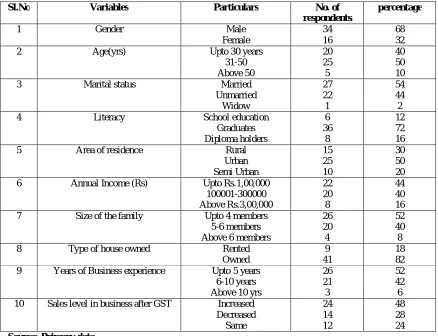
Table 1: Part I - Demographic profile of the respondents
Sl.No Variables Particulars No. of
respondents
percentage
1 Gender Male
Female
34 16
68 32
2 Age(yrs) Upto 30 years
31-50 Above 50 20 25 5 40 50 10
3 Marital status Married
Unmarried Widow 27 22 1 54 44 2
4 Literacy School education
Graduates Diploma holders 6 36 8 12 72 16
5 Area of residence Rural
Urban Semi Urban 15 25 10 30 50 20
6 Annual Income (Rs) Upto Rs.1,00,000
100001-300000 Above Rs.3,00,000 22 20 8 44 40 16
7 Size of the family Upto 4 members
5-6 members Above 6 members
26 20 4 52 40 8
8 Type of house owned Rented
Owned
9 41
18 82
9 Years of Business experience Upto 5 years
6-10 years Above 10 yrs
26 21 3 52 42 6
10 Sales level in business after GST Increased
Decreased Same 24 14 12 48 28 24
Source: Primary data
Above table reveals that out of 50 respondents, majority of them are belonging to the age
between 31-50 years and they are also married. Further, it explains that 72% respondents are
graduates. Majority of the respondents are living in urban area whose annual income is less that
Rs.3,00,000 having business experience of 10 years. 48% of the respondents expressed that their
sales level is increased after GST.
Part II - Impact of GST on small traders
The opinion on positive and negative impact of GST on small traders have been collected and
analysed by using one way ANOVA based on personal variable of Area wise ie Rural, urban and
semi urban. The following are the positive impact of GST expressed by the respondents.
1. Removal of multiple taxation.
2. Faster delivery of goods.
3. Reduction of tax burden on new business.
IJSRR, 7(3) July – Sep., 2018 Page 1185
Positive Impact
Table 2 Removal of Multiple Taxation – Area wise
Area wise No.of Respondents Mean S.D
Rural
Urban
Semi Urban
15
25
10
3
4.96
1.8
7
17.54
2.333
Source: Primary Data
Analysis of Variance
Source of Variation Sum of square DF Mean Square F value P value
Between groups 127.2267 2 63.6133
7.10146 0.01532
Within groups 644.96 47 8.9578
Total 772.1867 49
The opinion on removal of multiple taxation -area wise is presented in Table 2 which
indicates that it has highest mean score of (4.96) in urban areas as compared to a mean score of (3) in
rural areas.
An analysis of the statistical significance that the difference in the mean value is significant
as the calculated value of P (0.0015) is less than the given value at 5% significant level. Hence the
study reveals that the opinion on removal of multiple taxation expressed by small traders differs
based on area wise.
Faster delivery of goods – area wise
Faster delivery of goods is another positive impact of GST. The small traders can easily deliver
all the type of goods to the customers. The opinion on “faster delivery of goods” expressed by small
traders has been analyzed into area wise .
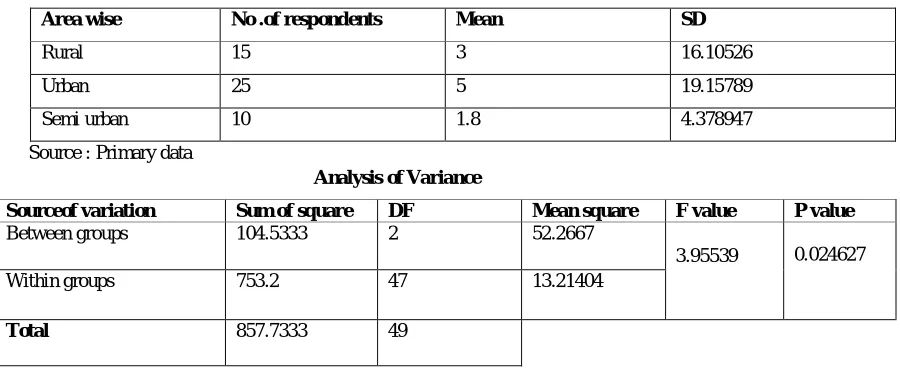
Table 3: Faster delivery of goods – Area wise
Area wise No .of respondents Mean SD
Rural 15 3 16.10526
Urban 25 5 19.15789
Semi urban 10 1.8 4.378947
Source : Primary data
Analysis of Variance
Sourceof variation Sum of square DF Mean square F value P value
Between groups 104.5333 2 52.2667
3.95539 0.024627
Within groups 753.2 47 13.21404
IJSRR, 7(3) July – Sep., 2018 Page 1186
The opinion on faster delivery of goods–area wise is presented in Table 3 which indicates that it
has highest mean score of (5) in urban areas as compared to a mean score of (3) in rural areas.
An analysis of the statistical significance of the difference indicates ,that the difference in the
mean value is significant as the calculated value of P(0.025) is less than the given value at 5%
significance level. Hence the study reveals that the opinion on faster delivery of goods expressed by
small traders differs based on area wise.
Reduction of tax burden on new business – area wise
The researcher has analyzed reduction of “tax burden on new business” which is one of the
positive impact of GST. The GST Act has reduced the tax burden on small traders. The reduction of
tax burden on new small business run by the respondents has been analyzed into area wise .
Table 4: Reduction of tax burden on new business – Area wise
Area wise No .of respondents Mean SD
Rural 15 3 7.77778
Urban 25 5 24.8889
Semi urban 10 1.8 3.95556
Source : Primary data
Analysis of Variance
Source of variation Sum of square DF Mean square F value P value
Between groups 52.2667 2 26.13333
2.140777 0.137094
Within groups 329.6 47 12.20741
Total 381.867 49
The opinion on reduction of tax burden on new business –area wise is presented in Table 4
which indicates that it has highest mean score of (5) in urban areas as compared to a mean score of
(3) in rural areas.
An analysis of the statistical significance of the difference indicates ,that the difference in the
mean value is not significant as the calculated value of P(0.137) is more than the given value at 5%
significance level. Hence the study reveals that the opinion on reduction of tax burden on new
IJSRR, 7(3) July – Sep., 2018 Page 1187
Ease of doing business – Area wise
Ease of doing business is a positive important factor in introducing GST in India. Every person
can easily start new business. The small traders can extend their business under GST Act. The
opinion on “ease of doing business” expressed by small traders has been analyzed into area wise .
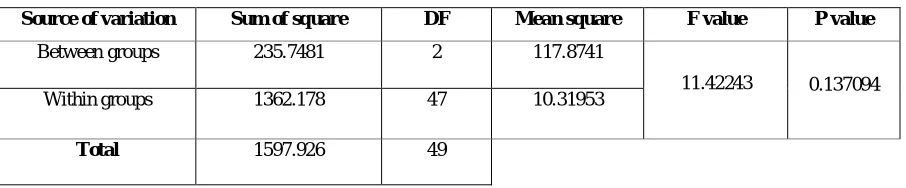
Table 5 : Ease of doing business – Area wise
Area wise No .of respondents Mean SD
Rural 15 2.9778 12.204
Urban 25 5 16.5
Semi urban 10 1.8 2.254
Source : Primary data
Analysis of Variance
Source of variation Sum of square DF Mean square F value P value
Between groups 235.7481 2 117.8741
11.42243 0.137094
Within groups 1362.178 47 10.31953
Total 1597.926 49
The opinion on ease of doing business –area wise is presented in Table 5 which indicates that it
has highest mean score of (5) in urban areas as compared to a mean score of (2.97) in rural areas.
An analysis of the statistical significance of the difference indicates ,that the difference in the
mean value is not significant as the calculated value of P(0.14) is more than the given value at 5%
significance level. Hence the study reveals that the opinion on ease of doing business expressed by
small traders do not differs based on area wise.
Negative Impact of GST
The negative impact of GST in the present study is measured with the help of the variables. The
respondents are asked to rate these variable and it is tested by using ONE WAY ANOVA. The mean
score of each variable is negative impact of GST among three group of respondents have been
computed along with its ‘F’ statistics.
Further, researcher has taken only two personal variables namely, area of residence and annual
income for computing one way ANOVA. The above two variables have greater impact on perceiving
opinion about GST from the respondents. The following are the negative impact expressed by the
respondents about GST.
IJSRR, 7(3) July – Sep., 2018 Page 1188
2. Cumbersome procedure
3. Trade problems
Issue of invoice –area wise
Issue of invoice is the important negative impact of GST. Invoice is a document which
provides evidence as to existence of transaction of sale or purchase of goods or the agreement of
supply. Issuing invoice for lower amount of purchase is difficult. The opinion on “issue of invoice”
expressed by small traders has been analyzed into area wise .
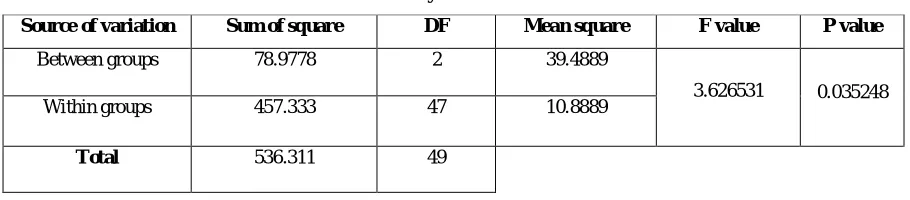
Table 6: Issue of invoice – Area wise
Area wise No .of respondents Mean SD
Rural 15 2.9333 6.4952
Urban 25 5 22.714
Semi urban 10 1.8 3.4571
Source : Primary data
Analysis of Variance
Source of variation Sum of square DF Mean square F value P value
Between groups 78.9778 2 39.4889
3.626531 0.035248
Within groups 457.333 47 10.8889
Total 536.311 49
The opinion on issue of invoice–area wise is presented in Table 6 which indicates that it has
highest mean score of (5) in urban areas as compared to a mean score of (2.9333) in rural areas.
An analysis of the statistical significance of the difference indicates ,that the difference in the
mean value is significant as the calculated value of P(0.035) is less than the given value at 5%
significance level. Hence the study reveals that the opinion on issue of invoice expressed by the
small traders differs based on area wise.
Cumbersome procedure – area wise
Cumbersome procedure is yet another negative impact of GST. This procedure includes the lack
of computer knowledge among the small traders. Many small traders are illiterates on using the
computer. The opinion on “cumbersome procedure” expressed by small traders has been analyzed
into area wise .
IJSRR, 7(3) July – Sep., 2018 Page 1189
Table 7:Cumbersome procedure – Area wise
Area wise No .of respondents Mean SD
Rural 15 3 4
Urban 25 5 19.111
Semi urban 10 1.8 2.8444
Source : Primary data
Analysis of Variance
Source of variation Sum of square DF Mean square F value P value
Between groups 52.2667 2 26.1333
3.020548 0.06549
Within groups 233.6 47 8.6518
Total 285.8667 49
The opinion on cumbersome procedure–area wise is presented in Table 7 which indicates that it
has highest mean score of (5) in urban areas as compared to a mean score of (3) in rural areas.
An analysis of the statistical significance of the difference indicates ,that the difference in the
mean value is not significant as the calculated value of P(0.065) is more than the given value at 5%
significance level. Hence the study reveals that the opinion on cumbersome procedure expressed by
small traders do not differs based on area wise.
Trade problems – area wise
Trade problem is an important factor in determining the society. The GST filing is more
complicated to small traders. The trading system is to be modified to implement of GST. The opinion
on “trade problems” expressed by small traders has been analyzed into area wise and income wise.
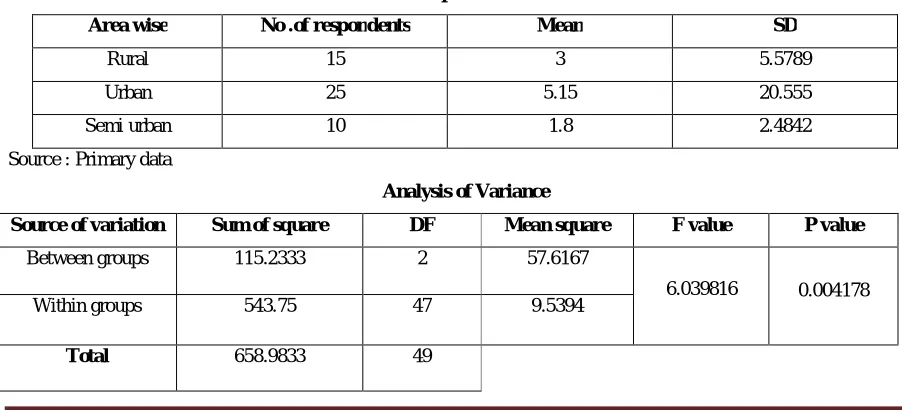
Table 8: Trade problems – Area wise
Area wise No .of respondents Mean SD
Rural 15 3 5.5789
Urban 25 5.15 20.555
Semi urban 10 1.8 2.4842
Source : Primary data
Analysis of Variance
Source of variation Sum of square DF Mean square F value P value
Between groups 115.2333 2 57.6167
6.039816 0.004178
Within groups 543.75 47 9.5394
IJSRR, 7(3) July – Sep., 2018 Page 1190
The opinion on trade problems–area wise is presented in Table 8 which indicates that it has
highest mean score of (5.15) in urban areas as compared to a mean score of (3) in rural areas.
An analysis of the statistical significance of the difference indicates ,that the difference in
the mean value is significant as the calculated value of P(0.004) is less than the given value at 5%
significance level. Hence the study reveals that the opinion on trade problems expressed by small
traders differs based on area wise.
Part III – General opinion about GST
Table 9: Opinion about GST and its impact on price of goods Opinion about GST No. of respondents Percentage
Yes
No
29
21
58
42
Total 50 100
Above table shows that 29(58%) respondents expressed that the price of goods and services
have been increased and the remaining 21 (42%) opined that after GST, it is not increased.
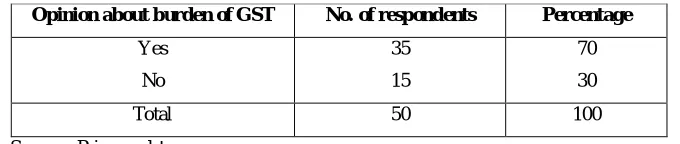
Table 10: Opinion about burden of GST on consumers
Opinion about burden of GST No. of respondents Percentage
Yes
No
35
15
70
30
Total 50 100
Source : Primary data
It is found from table 10, 35(70%) respondents opined that customers are burdened with GST
and remaining 15(30%) respondents opined that customers are not burdened with GST.
Table 11: Overall opinion about GST
Overall opinion about GST No. of respondents Percentage
Good
Moderate
Not good
25
19
6
50
38
12
Total 50 100
Source : Primary data
From the above table 11, it is found that 25 (50%) respondents are having “Good” opinion
about GST, 19 (38%) respondents are having “Moderate” opinion and the remaining 6 (12%)
IJSRR, 7(3) July – Sep., 2018 Page 1191
CONCLUSION
While analysing personal variables, majority of the respondents are in the age group between
31-40 years, who are married and also graduates, living in owned house. While expressing opinion
on positive impact of GST, there is a significant difference among respondents based on area wise is
noticed in respect of removal of multiple taxation. In negative impact of GST, there is a significant
different noticed in respect of issue of invoice and trade problem. Finally, 25 respondents expressed
good opinion about GST and only 6 respondents are not satisfied with GST.
REFERENCES
1. Vashishtha Chaudhary, “GST- A Practical Approach”,Taxmann Publications,Delhi,2017
2. Monica Singhania Vinod, “Income tax including GST”, Taxmann Publications,Delhi,2018
3. Background Material for GST, National Academy of Customs, Excise and Narcotics
4. CA Arpit Haldia,”GST Made Easy”, Taxmann Publications,Delhi,2017
5. Nishitra Gupta, “Goods and Services Tax: Its implementation on Indian Economy, CASIRJ,
2014; 5(3)
6. Vasanthagopal.D, “GST in India: A Big Leap in the Indirect Taxation system”, International
Journal of Trade, Economics and Finance, August 2015; 2(2)
7. Taqvi, et.al, “Challenges and Opportunities of GST in India”, Indian Journal of Applied
August 2015; 3(5)
8. Kumar.N, “GST in India: A Way Forward” Global Journal of Multidisciplinary Studies,
August 2015; 3(6)
9. Jangra. A and Narwal. K,“Application of CGE Models in GST: A Literature Review”,