Psychology Research and Behavior Management
Dovepress
R E V I E W
open access to scientific and medical research
Open Access Full Text Article
Paren
t–Child Interaction Therapy: current
perspectives
Corey C Lieneman Laurel A Brabson April Highlander Nancy M Wallace Cheryl B McNeil
Department of Psychology, West Virginia University, Morgantown, WV, USA
Abstract: Parent–Child Interaction Therapy (PCIT) is an empirically supported intervention
originally developed to treat disruptive behavior problems in children between the ages of 2 and 7 years. Since its creation over 40 years ago, PCIT has been studied internationally with various populations and has been found to be an effective intervention for numerous behavioral and emotional issues. This article summarizes progress in the PCIT literature over the past decade (2006–2017) and outlines future directions for this important work. Recent PCIT research related to treatment effectiveness, treatment components, adaptations for specific populations (age groups, cultural groups, military families, individuals diagnosed with specific disorders, trauma survivors, and the hearing-impaired), format changes (group and home-based), teacher–child interaction training (TCIT), intensive PCIT (I-PCIT), treatment as prevention (for externalizing problems, child maltreatment, and developmental delays), and implementation are discussed.
Keywords: PCIT, adaptations, implementation, effectiveness
Introduction
Parent–Child Interaction Therapy (PCIT) is an evidence-based approach originally intended to treat disruptive behavior problems in children aged 2 to 7 years.1 PCIT
involves two phases, child-directed interaction (CDI) and parent-directed interaction (PDI), in which therapists instruct and coach caregivers in play therapy and oper-ant conditioning skills. The goals of the CDI phase are to encourage warm, secure caregiver–child relationships. The foundational skills in this phase include praise, verbal reflection, imitation, behavioral description, and enjoyment and are often collectively referred to as the PRIDE skills.2 The goal of the subsequent PDI phase is to increase
child compliance and decrease disruptive behaviors.2 To “master” CDI, a caregiver
must use a number of positive interaction skills, while PDI mastery involves correctly following through with directly stated commands.2 Once mastery in CDI is achieved,
caregivers may advance to the PDI phase.2 A comprehensive review of the specific
skills taught in PCIT is beyond the scope of this paper; however, the reader may refer to McNeil and Hembree-Kigin2 for a detailed overview. Through both phases of PCIT,
clinicians typically observe sessions through a one-way mirror, communicating with caregivers by a bug-in-the-ear system. PCIT is unique because it treats caregivers and children as dyads and involves live coaching of parenting behaviors.3
In the more than 40 years since its creation by Dr. Sheila Eyberg at the Oregon Health Sciences University, PCIT has been studied worldwide in connection with a variety of populations and has been found to be an efficacious and effective intervention
Correspondence: Corey C Lieneman Department of Psychology, West Virginia University, Life Sciences Building 1222, 53 Campus Drive, PO Box 6040, Morgantown, WV 26505-6040, USA Tel +1 402 992 3508
Email [email protected]
Journal name: Psychology Research and Behavior Management Article Designation: REVIEW
Year: 2017 Volume: 10
Running head verso: Lieneman et al
Running head recto: PCIT: current perspectives DOI: http://dx.doi.org/10.2147/PRBM.S91200
Psychology Research and Behavior Management downloaded from https://www.dovepress.com/ by 118.70.13.36 on 26-Aug-2020
For personal use only.
This article was published in the following Dove Press journal: Psychology Research and Behavior Management
20 July 2017
Dovepress
Lieneman et al
for a myriad of emotional and behavioral difficulties. The purposes of this article are to summarize the advances documented in the PCIT literature over the past 10 years and to highlight future directions for this important work. This article covers recent PCIT research pertaining to the follow-ing topics: treatment effectiveness, treatment components, adaptations for different populations (age groups, cultural groups, military families, individuals diagnosed with specific disorders, trauma survivors, and the hearing-impaired), for-mat changes (group and home-based), teacher–child interac-tion training (TCIT), intensive PCIT (I-PCIT), treatment as prevention (for externalizing problems, child maltreatment, and developmental delays), and implementation.
In the past decade, several influential changes have occurred in the world of PCIT. The formation of PCIT Inter-national, Inc., an organization committed to the fidelity of PCIT in research and practice, was announced at the ninth annual PCIT International Conference in 2009 (CB McNeil, West Virginia University, oral communication, November, 2016). PCIT International, Inc. provides training and certifi-cation in the model. New training certificertifi-cation requirements, which can be viewed online,4 were established in 2009. In
line with the goal of maintaining fidelity to the PCIT model, the PCIT Protocol Manual5 was published in 2011 and is
available in six languages. The Dyadic Parent–Child Inter-action Coding System (DPICS): Comprehensive Manual for Research and Training, an integral tool used in PCIT to code different types of parent–child interactions, was released in its fourth edition in 2013 followed by the fourth edition of its Clinical Manual in 2014.6,7 DPICS updates reflect the
accumulation of data from widespread research and clinical applications. In addition, Parent-Child Interaction Therapy,2
the only book devoted entirely to PCIT, was released in its second edition in 2010. This new edition includes updated reviews of PCIT research, information about advances in cultural applications of PCIT, and current PCIT training regulations. The text also contains chapters describing adapta-tions of PCIT for infants, toddlers, older children, and siblings and describes ways in which PCIT may be applied to special populations (e.g., families with histories of abuse, separated parents, children with attention-deficit/hyperactivity disorder, severely aggressive children, and those with developmental disabilities).
Methods
A literature search was conducted through EBSCOhost
using the following keywords: PCIT, parent–child interac-tion therapy, parent child interacinterac-tion therapy, TCIT, and
teacher–child interaction therapy. The search span was limited to publication dates from 2006 to 2017. Dissertation abstracts were excluded. Subsequently, literature was sought through ILLiad, contact with PCIT experts, and reference lists of articles and chapters. Included resources had PCIT or TCIT as a major focus and were published in 2006 or later. Identified publications within these criteria were excluded if they were not in English, could not be obtained in their entireties, or were comprised mainly of basic descriptions of PCIT, which had already been covered by other included sources. Two reviewers independently categorized publica-tions by major topic area based on common themes in the literature and met to confirm categorization.
Meta-analyses and reviews
Since 2006, dozens of meta-analyses and reviews of the PCIT literature have been published in scientific journals, books, and newsletters, in print and online.1,8,9 One
meta-analysis of 12 PCIT studies demonstrated large effect sizes (d=1.65) for pre- to posttreatment reductions in externalizing problems for children with disruptive behavior disorders.10
Two separate research groups examined PCIT among other evidence-based treatments.11,12 One group described the
evidence base for PCIT along with 24 other evidence-based and possibly efficacious disruptive behavior treatments.11 The
second group specifically compared PCIT with an evidence-based treatment, Triple P – Positive Parenting Program, in a meta-analysis of 24 studies.12 Although both PCIT and
Triple P resulted in child disruptive behavior and parenting problem decreases, PCIT demonstrated significantly larger effect sizes for reducing negative parent behaviors, negative child behaviors, and caregiver reports of child behavior prob-lems than did most or all forms of Triple P.12 Evidence of the
efficacy of PCIT has been made available internationally as PCIT is now conducted and researched in 11 countries over 4 continents.4,13
Treatment effectiveness
As the efficacy of PCIT has been well established,11,14 research
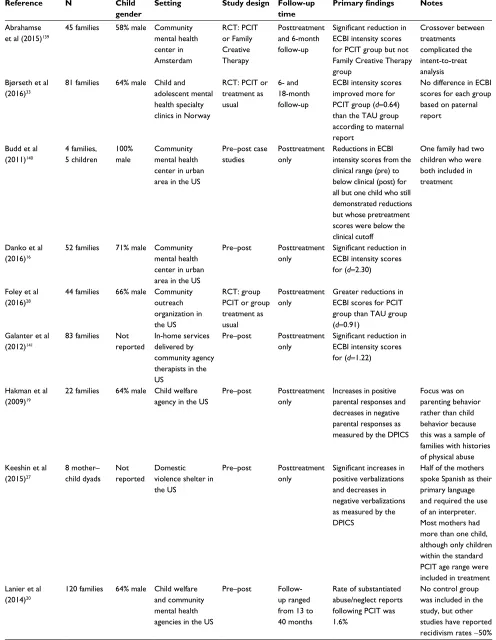
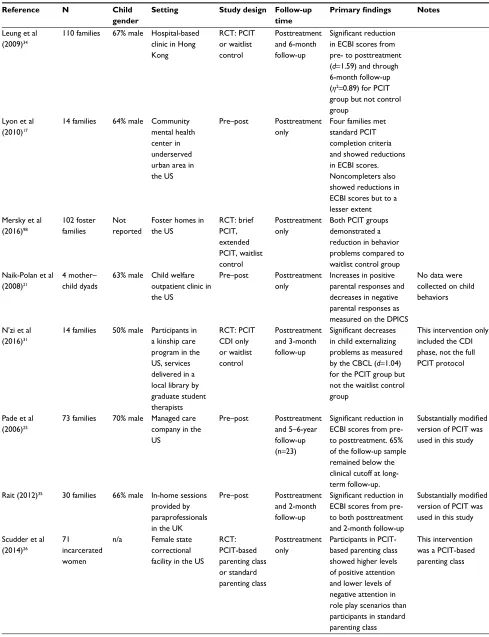
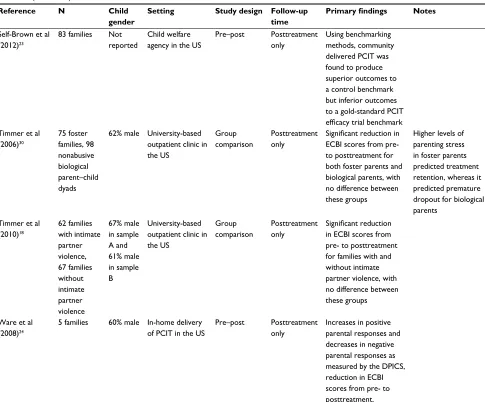
over the past decade has focused on testing the effectiveness of PCIT within various community treatment settings. This substantive body of literature is summarized in Table 1. Several studies have demonstrated improvements in child behavior as well as increases in positive parenting skills and decreases in negative parenting skills for families receiving standard PCIT for disruptive child behaviors in community treatment settings in the US.15–18 Similar positive outcomes
have been noted with PCIT delivered in child welfare
Psychology Research and Behavior Management downloaded from https://www.dovepress.com/ by 118.70.13.36 on 26-Aug-2020
Dovepress PCIT: current perspectives
Table 1 Summary of PCIT effectiveness studies
Reference N Child
gender
Setting Study design Follow-up
time
Primary findings Notes
Abrahamse et al (2015)139
45 families 58% male Community mental health center in Amsterdam RCT: PCIT or Family Creative Therapy Posttreatment and 6-month follow-up
Significant reduction in
ECBI intensity scores for PCIT group but not Family Creative Therapy group Crossover between treatments complicated the intent-to-treat analysis Bjørseth et al
(2016)33
81 families 64% male Child and adolescent mental health specialty clinics in Norway
RCT: PCIT or treatment as usual
6- and 18-month follow-up
ECBI intensity scores improved more for PCIT group (d=0.64) than the TAU group according to maternal report
No difference in ECBI scores for each group based on paternal report
Budd et al (2011)140 4 families, 5 children 100% male Community mental health center in urban area in the US
Pre–post case studies
Posttreatment only
Reductions in ECBI intensity scores from the clinical range (pre) to below clinical (post) for all but one child who still demonstrated reductions but whose pretreatment scores were below the clinical cutoff
One family had two children who were both included in treatment
Danko et al (2016)16
52 families 71% male Community mental health center in urban area in the US
Pre–post Posttreatment only
Significant reduction in
ECBI intensity scores for (d=2.30)
Foley et al (2016)28
44 families 66% male Community outreach organization in the US
RCT: group PCIT or group treatment as usual
Posttreatment only
Greater reductions in ECBI scores for PCIT group than TAU group (d=0.91)
Galanter et al (2012)141
83 families Not reported
In-home services delivered by community agency therapists in the US
Pre–post Posttreatment only
Significant reduction in
ECBI intensity scores for (d=1.22)
Hakman et al (2009)19
22 families 64% male Child welfare agency in the US
Pre–post Posttreatment only
Increases in positive parental responses and decreases in negative parental responses as measured by the DPICS
Focus was on parenting behavior rather than child behavior because this was a sample of families with histories of physical abuse Keeshin et al
(2015)27 8 mother– child dyads Not reported Domestic violence shelter in the US
Pre–post Posttreatment only
Significant increases in
positive verbalizations and decreases in negative verbalizations as measured by the DPICS
Half of the mothers spoke Spanish as their primary language and required the use of an interpreter. Most mothers had more than one child, although only children within the standard PCIT age range were included in treatment Lanier et al
(2014)20
120 families 64% male Child welfare and community mental health agencies in the US
Pre–post Follow-up ranged from 13 to 40 months
Rate of substantiated abuse/neglect reports following PCIT was 1.6%
No control group was included in the study, but other studies have reported recidivism rates ~50%
(Continued)
Psychology Research and Behavior Management downloaded from https://www.dovepress.com/ by 118.70.13.36 on 26-Aug-2020
Dovepress
Lieneman et al
Reference N Child
gender
Setting Study design Follow-up
time
Primary findings Notes
Leung et al (2009)34
110 families 67% male Hospital-based clinic in Hong Kong RCT: PCIT or waitlist control Posttreatment and 6-month follow-up Significant reduction
in ECBI scores from pre- to posttreatment (d=1.59) and through 6-month follow-up (h2=0.89) for PCIT
group but not control group
Lyon et al (2010)17
14 families 64% male Community mental health center in underserved urban area in the US
Pre–post Posttreatment only
Four families met standard PCIT completion criteria and showed reductions in ECBI scores. Noncompleters also showed reductions in ECBI scores but to a lesser extent Mersky et al
(2016)98
102 foster families
Not reported
Foster homes in the US RCT: brief PCIT, extended PCIT, waitlist control Posttreatment only
Both PCIT groups demonstrated a reduction in behavior problems compared to waitlist control group Naik-Polan et al
(2008)21
4 mother– child dyads
63% male Child welfare outpatient clinic in the US
Pre–post Posttreatment only
Increases in positive parental responses and decreases in negative parental responses as measured on the DPICS
No data were collected on child behaviors
N’zi et al (2016)31
14 families 50% male Participants in a kinship care program in the US, services delivered in a local library by graduate student therapists RCT: PCIT CDI only or waitlist control Posttreatment and 3-month follow-up Significant decreases
in child externalizing problems as measured by the CBCL (d=1.04) for the PCIT group but not the waitlist control group
This intervention only included the CDI phase, not the full PCIT protocol
Pade et al (2006)25
73 families 70% male Managed care company in the US
Pre–post Posttreatment and 5–6-year follow-up (n=23)
Significant reduction in
ECBI scores from pre- to posttreatment. 65% of the follow-up sample remained below the clinical cutoff at long-term follow-up.
Substantially modified
version of PCIT was used in this study
Rait (2012)35 30 families 66% male In-home sessions
provided by paraprofessionals in the UK
Pre–post Posttreatment and 2-month follow-up
Significant reduction in
ECBI scores from pre- to both posttreatment and 2-month follow-up
Substantially modified
version of PCIT was used in this study
Scudder et al (2014)26
71 incarcerated women
n/a Female state correctional facility in the US
RCT: PCIT-based parenting class or standard parenting class Posttreatment only
Participants in PCIT-based parenting class showed higher levels of positive attention and lower levels of negative attention in role play scenarios than participants in standard parenting class
This intervention was a PCIT-based parenting class
Table 1 (Continued)
(Continued)
Psychology Research and Behavior Management downloaded from https://www.dovepress.com/ by 118.70.13.36 on 26-Aug-2020
Dovepress PCIT: current perspectives
Reference N Child
gender
Setting Study design Follow-up
time
Primary findings Notes
Self-Brown et al (2012)23
83 families Not reported
Child welfare agency in the US
Pre–post Posttreatment only
Using benchmarking methods, community delivered PCIT was found to produce superior outcomes to a control benchmark but inferior outcomes to a gold-standard PCIT
efficacy trial benchmark
Timmer et al (2006)30
75 foster families, 98 nonabusive biological parent–child dyads
62% male University-based outpatient clinic in the US
Group comparison
Posttreatment only
Significant reduction in
ECBI scores from pre- to posttreatment for both foster parents and biological parents, with no difference between these groups
Higher levels of parenting stress in foster parents predicted treatment retention, whereas it predicted premature dropout for biological parents
Timmer et al (2010)18
62 families with intimate partner violence, 67 families without intimate partner violence
67% male in sample A and 61% male in sample B
University-based outpatient clinic in the US
Group comparison
Posttreatment only
Significant reduction
in ECBI scores from pre- to posttreatment for families with and without intimate partner violence, with no difference between these groups
Ware et al (2008)24
5 families 60% male In-home delivery of PCIT in the US
Pre–post Posttreatment only
Increases in positive parental responses and decreases in negative parental responses as measured by the DPICS, reduction in ECBI scores from pre- to posttreatment.
Abbreviations: CBCL, Child Behavior Checklist; CDI, Child-Directed Interaction; DPICS, Dyadic Parent–Child Interaction Coding System; ECBI, Eyberg Child Behavior Inventory; n/a, not applicable; PCIT, Parent–Child Interaction Therapy; RCT, randomized controlled trial; TAU, treatment as usual.
Table 1 (Continued)
settings19–22 and with in-home delivery.23,24 More novel
treat-ment settings for PCIT have included a time-limited modified version delivered in a managed care company,25 a PCIT-based
parenting program for incarcerated women,26 PCIT delivered
in a domestic violence shelter,27 and group-based PCIT
delivered by a community outreach agency.28 Each of these
studies noted similar decreases in child behavior problems and increases in positive parenting skills. It is interesting to note that several studies have also shown PCIT to be effec-tive with nonparental caregivers such as foster parents29,30
and participants in a kinship care program.31
More recently, researchers have examined the extent to which PCIT can be effective in other countries and cultures. Despite major cultural differences, PCIT has been shown to have more favorable outcomes in terms of parenting practices
and child behavior improvements relative to treatment as usual in the Netherlands,32 Norway,33 and Hong Kong.34 One
study also showed improvements from pre- to posttreatment in a community sample in the UK.35 Of note, improvements
in child behavior but not child compliance were observed in the Norwegian sample.33 This finding highlights the
importance of understanding cultural context, given that noncompliance can been seen as an expression of free will and independence in Norwegian culture and is not necessarily viewed as problematic.33
This rich body of literature demonstrates how many populations stand to benefit from PCIT. Since the evidence base has been established regarding the efficacy of PCIT, it is promising that researchers are moving toward understanding the limits of PCIT in terms of both population and setting.36
Psychology Research and Behavior Management downloaded from https://www.dovepress.com/ by 118.70.13.36 on 26-Aug-2020
Dovepress
Lieneman et al
It is important to note that researchers studying PCIT in countries outside of the US tend to employ rigorous research designs (e.g., randomized controlled trials [RCTs] with typi-cal treatment comparison groups), whereas researchers within the US tend to be more attentive to diverse and underserved populations while employing pre–post designs. Within the US, more researchers should consider conducting RCTs in community settings and using comparison groups rather than relying heavily on pre–post designs.
Treatment components
Although consensus in the literature supports the efficacy of PCIT and burgeoning research supports its effectiveness in community settings, researchers continue to seek detailed information about specific components of treatment. Homework is one such area of focus. Parental homework completion has been studied as a marker of engagement37
and predictor of parent and child outcomes.38 One
inves-tigation in a demographically diverse community mental health clinic found that treatment completers reported sig-nificantly more CDI homework completion than did those who dropped out of treatment prematurely. This study also showed that homework completion was positively correlated with treatment satisfaction.37 Homework completion has
also been linked to decreases in parenting stress, improve-ments in parenting skills, decreases in child behavior prob-lems,38 and reductions in the number of sessions needed to
reach CDI mastery.39
Another crucial component of PCIT, therapist–client communication, has been examined from a variety of angles. Mothers whose therapists communicated using constructive criticism were shown to use more positive and less negative parenting skills at posttreatment as compared with those mothers whose therapists used only positive or neutral communication styles.41 However, the high socioeconomic
status of this study sample may limit generalizability of its findings. Motivational interviewing communication strate-gies have been successfully incorporated in PCIT41 with
links to reductions in treatment ambivalence, increases in treatment retention,40 and reductions in future reports of
involvement with the child welfare system.42 Findings
spe-cifically regarding therapists’ coaching revealed that in vivo coaching resulted in more positive parenting skills than did delayed feedback43 and that remote coaching through an
earpiece was preferred to in-room coaching.44 A specialized
coaching measure, the Therapist-Parent Interaction Coding System, was developed in 2014.45 Using the Therapist–Parent
Interaction Coding System, researchers were able to code the
range of coaching strategies used, relate therapists’ feedback with parent skill level, and provide evidence that responsive rather than directive coaching predicted parenting behavior change between sessions.45
Although PCIT follows a manualized protocol, standard and supplementary components have been studied to assess their utility in the treatment process. Researchers have directly examined the use of positive parenting skills within PCIT, confirming their necessity.46 Combining the three
skills required for mastery in CDI influenced on-task child behavior more than a single skill, questions, or nonverbal attention alone, and behavioral descriptions alone increased on-task child behavior more than questions.46 Because PCIT
involves the use of the DPICS, the necessity of its standard 5-minute warm-up segments has also been investigated. No differences in coding between observations in warm-ups and in typically coded segments were found;47 however, other
research demonstrated that parents engaged in more leading behaviors in warm-up than in typically coded segments of CDI but showed only subtle variations in skill differences between PDI warm-up and typically coded segments.48
In support of the CDI phase of treatment itself, research-ers found that CDI predicted improvements in disruptive behavior, parenting stress, and parenting practices.49 These
components were influenced mostly by daily hassles and maternal depression before treatment and by social support after treatment.49 Finally, to address a supplementary
com-ponent of PCIT, another study compared the use of treatment maintenance follow-up calls with the original PCIT therapists to no assessment-only follow-ups after standard PCIT treat-ment.50 Contrary to hypotheses, results indicated that
long-term outcomes (i.e., 1- and 2-years posttreatment) were no different between participants who received follow-up treat-ment calls and participants receiving assesstreat-ment only calls.50
Authors proposed that the lasting effects from standard PCIT for both groups and the inadvertent reinforcement provided to the assessment-only group may have contributed to this surprising result.52
Population-specific adaptations
In recent years, treatment adaptations to better meet the needs of families from specific cultural groups, children outside of the typical PCIT age range, clients with comorbid disorders, trauma victims, individuals with disabilities, and those from unique family systems have emerged.51 While some of these
adaptations do not uphold strict fidelity to PCIT, the extensive reach of PCIT International helps retain the defining features while expanding treatment to more individuals.4
Psychology Research and Behavior Management downloaded from https://www.dovepress.com/ by 118.70.13.36 on 26-Aug-2020
Dovepress PCIT: current perspectives
Younger and older children
Developmentally appropriate treatment procedures and assessment measures have been created to extend the model of PCIT to younger children. The Infant Behavior Program maintains the defining features of the CDI component while placing emphasis on caregivers’ use of nonverbal praise and repeating of children’s vocalizations.52 These
modifica-tions, along with the exclusion of PDI, make the treatment appropriate for infants who are only beginning to develop effective communication and emotion regulation (ER) skills. Furthermore, infants who participated in the Infant Behavior Program produced significantly more unique and total vocal utterances than those in a control condition, supporting the frequent use of reflections as a mechanism for language development. PCIT for young toddlers includes shortened sessions, an emphasis on CDI skills, and information regard-ing PDI skills without formal PDI sessions.53 The positive
outcomes associated with PCIT (i.e., significant decreases in disruptive behaviors) are retained in PCIT for young tod-dlers.53 While many adaptations of PCIT omit the component
of PDI for toddler populations, some researchers suggest a modification of PDI.2 In instances of child noncompliance,
performing hand-over-hand guidance in place of time-out is recommended.2 Parents are also advised to become familiar
with child behavior patterns to identify early signs of frustra-tion and prevent misbehavior.2
Because PRIDE skills such as reflections and behavioral descriptions target specific goals for younger children (e.g., language development and improving attention span), they may not be as appropriate for older children. When using PCIT with older children, it is recommended that parents paraphrase reflections and use more sophisticated vocabu-lary.2 Adaptations of time-out procedures include extended
periods of ignoring (“big ignore”), incentive charts, and restriction of privileges.2 Each modification addresses the
practical issue of physically placing larger children in time-out. A published case study incorporating these adaptations with an 8-year-old child provides an excellent reference for practitioners.54
Families from specific cultural groups
Standard PCIT is effective across many cultures including Dutch, Norwegian, Chinese, and Puerto Rican popula-tions;55,56 however, adaptations may enhance the effects ofPCIT when cultural values, family systems, or parenting prac-tices are not adequately addressed within the standard PCIT model. Culturally sensitive versions of PCIT include using translated materials (e.g., homework sheets and assessments),
addressing cultural values within treatment, and modifying the treatment model.51
The foundational session duration, parent verbalizations, and skill usage of standard PCIT may not be compatible with certain cultural norms. In an adaptation of PCIT for American Indians and Alaska Natives, coding times were extended to accommodate the slower cadence of speech in these populations.57 Rules regarding the use of labeled
and unlabeled praises have also been examined for these groups. American Indian and Native Alaskan cultures often praise children by comparing them to their elders and cit-ing family member approval.57 Although these forms of
praise are avoided in standard PCIT, families may be more comfortable using their skills if they coincide with their cultural values.57 In collectivist cultures, frequent praise
may be viewed as an unusual approach to parenting.34 In
a sample of Chinese families, praise was found to be the most difficult DPICS criterion for caregivers to master.34
Some researchers suggest that clinicians should empathize with caregivers’ concerns regarding praise, emphasize the importance of using praise, and encourage more indirect praises to combat this barrier in treatment.34
Certain cultural values or ideologies may enhance or impede the positive outcomes associated with PCIT. Fami-lies from cultures that value familism and include multiple family members in childrearing may benefit from including extended family members in PCIT.56 For example, clinicians
may choose to include individuals other than parents who have significant roles in childcare when working with Appa-lachian or Latino families.56 The Guiando a Ninos Activos
(Guiding Active Children) program is an adaptation of PCIT designed to address cultural aspects of Mexican American families.58 In this model, clinicians discuss cultural values
and beliefs with families before beginning treatment to assess the potential impact these may have on treatment.59
The Māori population of New Zealand prioritizes the use of nonverbal communication,56 a practice that directly conflicts
with the encouragement of frequent parent verbalizations used in standard PCIT. This is an important cultural aspect for clinicians to consider when coaching Māori families to reach mastery criteria.
Cultural sensitivity in PCIT includes understanding cultural beliefs and values as well as environmental and situational characteristics that may be associated with some families. For many families, geographical isolation, poverty, and access to resources may serve as barriers to treatment. These families may benefit from the use of in-home treat-ment, internet training, or mobile therapy units.56
Psychology Research and Behavior Management downloaded from https://www.dovepress.com/ by 118.70.13.36 on 26-Aug-2020
Dovepress
Lieneman et al
Military families
Over 2 million children in the US have experienced parental deployment to Iraq and Afghanistan.60 Of these children,
53% are younger than 7 years, the maximum age treated with standard PCIT.60 PCIT is effective in strengthening
caregiver–child relationships, which may be relevant for families readjusting after deployment.61 While research in
this specific area is still being developed, several recommen-dations have been made for treating military families with PCIT. Treatment may need to be modified to accommodate caregivers with injuries or disabilities who are unable to perform activities such as playing on the floor or escorting a child to time-out.61 Parental mental health may impact
treatment progression and is of specific concern for veteran populations.60,61 Parental screening measures should be used
to assess the appropriateness of PCIT for each family.63 While
individuals with psychological disorders experience positive outcomes with PCIT, they may need adaptations including more direct coaching and more frequent at-home practice sessions.61 For example, individuals who are diagnosed with
posttraumatic stress disorder often experience decreases in emotional responding, which may impede their abilities to produce the levels of enthusiasm required in PCIT.61
Thera-pists may need to address this by coaching parents in the behavioral aspects of enthusiasm while demonstrating this skill for them thoroughly.61
Children and caregivers with additional
diagnoses
PCIT has been adapted to address various internalizing and externalizing symptoms associated with specific disorders. PCIT-Emotional Development was created for children with depression and has been extended to treat children with bipo-lar disorder.62–64 This model emphasizes caregivers’ abilities
to understand their children’s emotions while teaching them to regulate and address their feelings. Researchers compared treatment outcomes between PCIT-Emotional Development and a control condition, Developmental Education and Par-enting Intervention. Developmental Education and ParPar-enting Intervention included a didactic format but replaced the tra-ditional components of PCIT with education sessions where parents were given information regarding child development and wellness with an emphasis on social and emotional development.62,65 Compared with Developmental Education
and Parenting Intervention, PCIT-Emotional Development is associated with greater reductions in depression scores for both children and parents.62 It is important to note that
while PCIT-Emotional Development has been used with children diagnosed with bipolar disorder, there is limited research in this area.
To address symptoms of hyperactivity and impulsivity in children with attention-deficit/hyperactivity disorder, researchers have further adapted PCIT-Emotional Devel-opment to include PCIT with Emotion Coaching.64 PCIT
with Emotion Coaching emphasizes parental skills such as labeling emotions and praising effective ER to help children decrease impulsive behaviors associated with emotional dysregulation.64
PCIT’s foundations in attachment and learning theories make it appropriate for families of children with anxiety disorders; however, adaptations have been developed to specifically address children’s brave behaviors. Bravery-Directed Interaction, a third component of PCIT, is used to help families combat children’s symptoms of separation anxiety disorder with teaching and coaching sessions similar to PCIT’s standard components.62,66 During Bravery-Directed
Interaction, therapists coach parents in ways to use their skills to encourage children’s brave behaviors directly related to Separation Anxiety Disorder. PCIT with Bravery-Directed Interaction has been shown to be effective in reducing symptoms of Separation Anxiety Disorder below diagnostic criteria.62,66 Coaching Approach Behavior and Leading by
Modeling (CALM) addresses symptoms of child anxiety by incorporating exposure therapy into sessions.62,67 Parents are
trained in the traditional PCIT model in addition to the CALM model, which includes teaching caregivers strategies for guiding their children through anxiety provoking situations.67
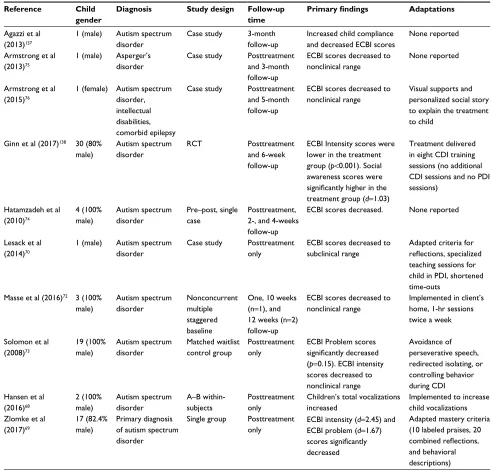
Recently, researchers have begun to investigate the efficacy of PCIT in treating children diagnosed with autism spectrum disorder.68,69 A summary of these studies can be
found in Table 2. While there are currently no standard adaptations for autism spectrum disorder, case studies demonstrate several changes that make PCIT compatible with various levels of social and intellectual functioning.70
Caregivers of children with autism spectrum disorder may need to alter their use of PRIDE skills to accommodate their child’s developmental ability. One case study adapted criteria for using reflections by allowing parents to reflect any speech-related sounds that showed intent for appropri-ate communication.70 Verbal prompts, models, and physical
guides are adaptations of the PDI component and increase the likelihood of compliance for children with autism spec-trum disorder.70 These changes help prevent noncompliance
as a result of receptive language difficulties.70 A number of
single case designs have demonstrated positive outcomes
Psychology Research and Behavior Management downloaded from https://www.dovepress.com/ by 118.70.13.36 on 26-Aug-2020
Dovepress PCIT: current perspectives
for PCIT delivered in community clinic settings for families of children on the autism spectrum.15,71–75 Similar positive
outcomes were found in a study that used home-based PCIT using a single-subject design for three children with high-functioning autism spectrum disorder.76
Caregiver-related treatment adaptations may be applicable when caregivers are experiencing mental health symptoms that impede their abilities to use effective, positive parenting skills.61,77,78 One study found that caregivers with
attention-deficit/hyperactivity disorder were able to significantly decrease their use of commands when they took effective
doses of medications.77 These results suggest that treating
parental disorders may aid in caregivers’ abilities to participate in PCIT. Caregivers with intellectual disabilities may benefit from minor adaptations in the model including simplified coaching instructions and single skill practice sessions.78
Increasing treatment frequency may help caregivers with intel-lectual disabilities learn and maintain skills more effectively.78
Families with histories of maltreatment
The risk for abusive parenting practices is highly correlated (r=0.31) with child disruptive behaviors.79 Standard PCITTable 2 Summary of PCIT with ASD studies
Reference Child
gender
Diagnosis Study design Follow-up
time
Primary findings Adaptations
Agazzi et al (2013)137
1 (male) Autism spectrum disorder
Case study 3-month follow-up
Increased child compliance and decreased ECBI scores
None reported
Armstrong et al (2013)75
1 (male) Asperger’s disorder
Case study Posttreatment and 3-month follow-up
ECBI scores decreased to nonclinical range
None reported
Armstrong et al (2015)76
1 (female) Autism spectrum disorder, intellectual disabilities, comorbid epilepsy
Case study Posttreatment and 5-month follow-up
ECBI scores decreased to nonclinical range
Visual supports and personalized social story to explain the treatment to child
Ginn et al (2017)138 30 (80%
male) Autism spectrum disorder RCT Posttreatment and 6-week follow-up
ECBI Intensity scores were lower in the treatment group (p<0.001). Social awareness scores were
significantly higher in the
treatment group (d=1.03)
Treatment delivered in eight CDI training sessions (no additional CDI sessions and no PDI sessions)
Hatamzadeh et al (2010)74 4 (100% male) Autism spectrum disorder Pre–post, single case Posttreatment, 2-, and 4-weeks follow-up
ECBI scores decreased. None reported
Lesack et al (2014)70
1 (male) Autism spectrum disorder
Case study Posttreatment only
ECBI scores decreased to subclinical range
Adapted criteria for
reflections, specialized
teaching sessions for child in PDI, shortened time-outs
Masse et al (2016)72 3 (100%
male) Autism spectrum disorder Nonconcurrent multiple staggered baseline
One, 10 weeks (n=1), and 12 weeks (n=2) follow-up
ECBI scores decreased to nonclinical range
Implemented in client’s home, 1-hr sessions twice a week
Solomon et al (2008)73 19 (100% male) Autism spectrum disorder Matched waitlist control group Posttreatment only
ECBI Problem scores
significantly decreased
(p=0.15). ECBI intensity scores decreased to nonclinical range
Avoidance of perseverative speech, redirected isolating, or controlling behavior during CDI Hansen et al
(2016)68 2 (100% male) Autism spectrum disorder A–B within-subjects Posttreatment only
Children’s total vocalizations increased
Implemented to increase child vocalizations Zlomke et al
(2017)69
17 (82.4% male)
Primary diagnosis of autism spectrum disorder
Single group Posttreatment only
ECBI intensity (d=2.45) and ECBI problem (d=1.67)
scores significantly
decreased
Adapted mastery criteria (10 labeled praises, 20
combined reflections,
and behavioral descriptions)
Abbreviations: CDI, Child-Directed Interaction; ECBI, Eyberg Child Behavior Inventory; PDI, Parent-Directed Interaction; RCT, randomized controlled trial.
Psychology Research and Behavior Management downloaded from https://www.dovepress.com/ by 118.70.13.36 on 26-Aug-2020
Dovepress
Lieneman et al
helps prevent child physical abuse by targeting the treatment of disruptive behaviors while teaching parents effective dis-cipline practices.42 Traditionally, PCIT treatment for abusive
families shifts the focus of services from child behavior change to caregiver behavior change.30,42 One study found
that in a population of abusive parents, negative parental reac-tions were common despite the lack of child misbehavior.23
However, PCIT produced rapid changes in parenting practices for this sample, similar to those experienced by nonabusive parents.23 Currently, research supports the use of
motiva-tional interviewing principles in addition to standard PCIT for treating abusive families.42 This treatment combination
decreases recidivism in the child welfare sector compared with treatment as usual.42
The hearing-impaired
PCIT is a highly verbal intervention and requires constant communication between therapists and caregivers.43 While
treatment may be effective for deaf and hard of hearing families,80 it requires several modifications. A case study
involving a hearing-impaired caregiver and child provides examples of treatment modifications that produced significant decreases in the child’s disruptive behaviors. Adaptations to PCIT included teaching an interpreter the principles of PCIT, using Signing Exact English, and visually counting before implementing the time-out procedure.80 This treatment
model produced increases in positive parenting practices and parent–child communication and decreases in child behavior problems across environments (e.g., home and school).80
While there is a dearth of knowledge in this area, additional adaptations are suggested for future research including using fluent interpreters who are certified in PCIT.80
Format-based adaptations
Several format-based adaptations have expanded the PCIT lit-erature including group-,26,81–83 home-,24,84–86 and school-based
approaches,87–90 as well as short-term, intensive models.91
Group PCIT
Although PCIT is typically delivered in outpatient clinic-based settings with individual families, research has dem-onstrated positive outcomes when the model is applied in a group-based format. Notably, when researchers compared the use of individual PCIT to group PCIT, significant improve-ments were noted in child conduct problems, parenting stress, and children’s adaptive functioning in both formats.83
Such groups have included families of predominantly low socioeconomic backgrounds in a community-based setting,82
women in a correctional facility,26,29 and families with a
history of child abuse or at risk of child maltreatment.28 in
addition to such lack of outcome differences between formats, a group treatment context may be more cost effective and foster a supportive community between participants.
Home-based PCIT
Given the high attrition rates often cited as a primary weakness of the outpatient, clinic-based PCIT model,92,93
researchers have begun to explore home-based deliv-ery methods to reach a broader scope of children and families.24,84–86 Advantages such as twice weekly sessions,
generalization of skills to the home, and elimination of transportation barriers likely outweigh disadvantages like home-based distractions and have contributed to the early success of this model. Results have indicated decreased child disruptive behavior problems on the Eyberg Child Behavior Inventory (ECBI) at posttreatment.24 High
rates (100%) of child compliance were also achieved at posttreatment, which continued to persist at follow-up. Modifications to standard PCIT protocol have included an in-room coaching model and treatment conducted by dual therapists. Further studies have applied an in-home model to 12–15-month-old infants84 with externalizing behavior
problems. Results indicated high rates of clinically signifi-cant infant behavior change as well as caregiver intervention satisfaction. Most recently, the largest scale implementation of in-home PCIT occurred across the state of Delaware, demonstrating the wide-spread impact of this model with impressive results.85
Teacher–Child Interaction Training
(TCIT)
TCIT was developed early on as an adaptation of PCIT for the classroom environment. Teachers involved in TCIT are trained in the foundational PCIT principles and skills, often in a group format. Skills are initially practiced with individual children before moving on to application with small groups, and finally, the classroom setting.88,90,94 During the CDI
phase, teachers are taught to implement PRIDE skills while attempting to reduce, rather than eliminate, commands and questions, given the necessity of such verbalizations in the classroom environment. During the discipline phase of treat-ment, entitled Teacher-Directed Interaction, teachers learn to use effective commands and a variety of methods with which to follow through including Sit and Watch, a time-out-like procedure used in response to a variety of disruptive behav-iors (e.g., defiance, verbal classroom disruption, throwing
Psychology Research and Behavior Management downloaded from https://www.dovepress.com/ by 118.70.13.36 on 26-Aug-2020
Dovepress PCIT: current perspectives
toys, and fighting).90,95 Unlike in PCIT, TCIT coaches remain
in-room with teachers, and feedback is provided using both verbal and written methods.90 Results of multiple
examina-tions of TCIT implementation demonstrate significantly increased rates of positive teacher statements (e.g., praise) and decreased critical statements.90,95,96 Results also indicate
high rates of teacher satisfaction across both phases of the model87,90 as well as decreased likelihood of attention toward
children’s negative attention seeking and misbehavior, and decreased stress regarding students’ negative behaviors.88
Finally, increases in children’s protective factor scores, a scale of the Devereux Early Childhood Assessment97 used to assess
children’s social–emotional strengths following TCIT, have also been found.89 Limitations of the model include a lack
of generalizability and the time-consuming, costly nature of teacher training and implementation.
Intensive PCIT (I-PCIT)
A typical course of clinic-based PCIT is about 3 months in length.2 Given the time-intensive nature of the intervention,
researchers have studied the feasibility of a brief, intensive version.91 Modeled from PCIT, I-PCIT was initially applied
to children with clinically significant levels of externalizing behavior problems. Following initial assessment, mother– child dyads attended 90-minute sessions each day for 5 days across a 2-week period. A PDI teach session occurred on the first day of the second week of treatment. The total treatment course lasted 10 sessions. Results indicated that following treatment, mothers implemented higher levels of nondirec-tive posinondirec-tive parenting skills (e.g., labeled praise and behav-ior descriptions) and lower levels of negative statements. Mothers also reported greater use of appropriate discipline strategies (e.g., clear consequences, remaining calm during discipline implementation). Mothers also noted decreased levels of parenting stress. Subsequently, children’s compli-ance improved from 50% at baseline to 86% just following treatment. Such compliance levels maintained at 80% at 4 months postintervention. Finally, the authors noted larger effect sizes at the posttreatment and 3–4-month follow-up assessments compared to effect sizes found in typical PCIT. Despite limitations such as a small, nonrandomized, relatively homogenous sample, these impressive results indicate the feasibility of a brief, intensive course of PCIT to assist in combatting the commonly cited weakness of high attrition rates92 in typical clinic-based PCIT. Subsequent research has
demonstrated the positive effects of short-term, 2-day PCIT training workshops on a group of foster parents. Compared to a waitlist control group, both groups that received the
intensive training course demonstrated significant decreases in behavior problem scores.98
PCIT as a preventative intervention
Recent efforts have been devoted to examining the use of PCIT as a preventative intervention. While traditionally treatments address problems at clinical or non-normative levels, preventative interventions focus on ameliorating subclinical concerns or treating at-risk individuals. This line of research has focused on several areas, including the prevention of problematic externalizing behaviors,85,100–102
child maltreatment,20,42,102,103 and developmental/language
delays.104–108
Prevention of externalizing behaviors
Given that externalizing behavior problems are the most common referral reason for child mental health services109and are associated with poor long-term outcomes,110,111
much can be gained from improving preventative services for externalizing behavior problems. Aside from improving the trajectories of millions of children, prevention programs could result in substantial savings in public expenditures on treatment each year.112 Additionally, parents in some
com-munities recognize the need for prevention programs and hold favorable attitudes toward PCIT principles and skills.101
As such, researchers have examined PCIT as a preventative intervention using several different approaches.
In one such study, two abbreviated versions of PCIT implemented in primary care settings resulted in high rates of parental satisfaction and reductions in child externalizing behaviors.113 The two versions included PCIT-Anticipatory
Guidance, in which parents were mailed written materials about PCIT skills and how to implement them, and Primary Care PCIT, a brief group version of PCIT consisting of two CDI sessions and two PDI sessions. There were no significant differences in outcomes between the two versions, indicating that both self-directed learning and face-to-face interventions have the potential to bring subclinical behavior problems into more normative and acceptable limits.113 Similarly,
positive outcomes were noted using a home-based version of PCIT for infants (12 and 15 months) at risk for behavior problems.84 Although limited by a small sample size (N=6),
results indicated significant improvements in infant behavior as well as high rates of parent satisfaction.84
Researchers have also found promising outcomes when taking more universal approaches to prevention, in contrast to identifying at-risk families or children. For instance, a parenting course based on PCIT principles resulted in
Psychology Research and Behavior Management downloaded from https://www.dovepress.com/ by 118.70.13.36 on 26-Aug-2020
Dovepress
Lieneman et al
improved parenting knowledge in a sample of nonparents (aged 19–23 years).100 Additionally, a PCIT-based
train-ing of preschool and kindergarten teachers demonstrated increases in positive skills and decreases in negative skills.99 Although these studies did not directly assess child
outcomes, these universal applications have the potential to preempt externalizing behaviors in far greater numbers than standard PCIT.
Prevention of child maltreatment
Some researchers have focused on the possibility of using PCIT to prevent child maltreatment, given its success as a treatment for this population.14 Two such studies have
dem-onstrated improved parent–child interactions, greater use of positive parenting behaviors, and a reduced likelihood of maltreatment recidivism following PCIT treatment for fami-lies with a history of child maltreatment.42,103 Similar results
have been found in children with a history of maltreatment and their adoptive families, rather than offending families.102
Since the children were being adopted into nonoffending homes, they were considered high risk for future maltreat-ment given their histories, not because of their adoptive home environments. Significant improvements in child behavior, increases in positive caregiver communication, and decreases in negative communication, as well as reduced caregiver stress, were noted.102 One additional study found similar
posi-tive results in at-risk families with and without maltreatment histories, although history of maltreatment was the strongest predictor of recidivism.20
Prevention of language and developmental
delays
A substantial body of literature exists demonstrating a strong association between externalizing behavior problems and lan-guage deficits in children.108 It has been hypothesized that the
skills taught to parents in PCIT should lead to improvements in both behavior problems and language deficits.108
Specifi-cally, PCIT teaches parents to use positive communication skills throughout the day, providing a language-rich envi-ronment.108 Additionally, the specific skills used by parents
(i.e., reflections, descriptions, and labeled praises) place emphasis and attention on the child. Not only do these skills model appropriate verbalizations, but they also help the child feel important and subsequently improve self-esteem. This increase in self-esteem may result in increased frequency of appropriate verbalizations.108
Several studies have found support for this hypothesis and have shown that PCIT can result in increased frequency
and type of verbalizations in both infants and children at risk for language or developmental delays.104,105 One multi-single
case study has also provided promising evidence that PCIT can reduce the frequency of stuttering.109 Consistent with the
hypothesis that parenting skills are the driving factor behind these improvements,108 preliminary evidence has shown
that CDI skills (i.e., reflections, descriptions, and labeled praises) mediate the relationship between PCIT treatment and improvements in both language and behavior.106
Implementation
As PCIT has been shown to be both therapeutically effec-tive11 and cost effective,114 focus has shifted more recently
to large-scale implementation initiatives. Simply disseminat-ing knowledge about an efficacious and effective interven-tion through peer-reviewed studies has been insufficient in promoting uptake into daily clinical practice.115 Successful
implementation requires the consideration of a variety of factors, and researchers have recently been more interested in such factors.
Several large-scale PCIT implementation efforts have taken place recently, and researchers have published informa-tion about their implementainforma-tion process in order to facilitate collaboration.22,85,116–118 Common recommendations across
these initiatives included careful consideration of the com-munity needs, matching of the treatment to be implemented with the identified needs, ongoing training and consultation, continuous evaluation, and upfront planning for long-term funding and sustainability.22,85,116,118 Common challenges to
implementation included high rates of provider attrition, insuf-ficient families, and difficulties maintaining clients.22,85,116,117
To date, most empirical studies on PCIT implementation have focused primarily on provider training. One earlier study identified a crucial difference between the training of graduate-level student therapists in university settings and the training of community providers.119 Specifically, in
the university training model, student therapists typically receive live, in-person coaching while they coach families (much like the PCIT model), whereas community trainers receive phone consultations. In a pilot study of community providers who received remote real-time training (much like Skype coaching), providers indicated that they were more comfortable with traditional phone consultation but found remote real-time training to be more helpful and ultimately preferred it to the traditional phone consultation.119 A more
recent study found that live video coaching resulted in small but meaningful improvements in client outcomes compared with traditional phone consultation.120
Psychology Research and Behavior Management downloaded from https://www.dovepress.com/ by 118.70.13.36 on 26-Aug-2020
Dovepress PCIT: current perspectives
Other research has examined trainee and organizational factors that influence the effectiveness of trainings in PCIT. For instance, positive provider attitudes toward evidence-based treatments are associated with greater engagement in training, greater use of consultation, and greater satisfaction with the training.121 Additionally, clinicians who were of a
psychodynamic orientation or mandated by agency admin-istrators to attend trainings were found to be less invested in training and slower to master skills.122 In a more recent
study, trainees rated the PCIT training content as valuable and were largely satisfied with training but cited the high cost and issues with agency reimbursement as potential barriers.123
Despite knowledge of some factors that might influence training engagement and outcomes, there is still a dearth of knowledge regarding the most effective training method. In an early study, researchers found that review of a treatment manual produced improvements, but not mastery, in clinician knowledge and skill.124 Both didactic (e.g., discussing PCIT
skills, reviewing client videotapes as a group) and experien-tial (e.g., role-plays, individually coding client videotapes) training resulted in added benefits above and beyond the manual review.124 More recently, researchers have interviewed
23 doctoral-level PCIT experts to understand their perspec-tives on critical components to PCIT training.125 There was
consensus among experts regarding the importance of pre-training preparation and trainee selection. A multiday work-shop with role-plays and video reviews was most commonly described as the ideal training format. In contrast, there was greater variability in responses regarding the process of the workshops, the use of case reviews, the method of teaching the time-out procedure, and the use of consultation/follow-up.125 Current research is building on these earlier studies in
an RCT comparing three different training approaches within a state-wide implementation trial of PCIT.118
Future directions
Harnessing technology
Advances in technology have impacted PCIT over the past decade, including the use of web-based videosharing for new trainee supervision,126 published didactic training video
segments,127 and remote live video coaching of new
thera-pists.119,120 Several RCTs comparing internet-based PCIT with
standard PCIT and waitlist conditions are currently being conducted.128Another ongoing PCIT study employs the use
of audio and video recording evidence of homework comple-tion, affording therapists the ability to provide additional feedback for families on their at-home practice. Preliminary
qualitative feedback suggests that fewer sessions are needed to reach CDI skill mastery for these participants than for those self-reporting homework completion as usual. It is likely that future integration of technological aids such as internet telemedicine will improve the efficiency and reach of PCIT, but more in-depth, future research is needed.119,128
Improving implementation
Research has shown that training is critical to the success-ful implementation of PCIT. Unfortunately, little is known about which training method produces greatest gains in cli-nician knowledge and skill, cost-effectiveness, or long-term sustainability. Results of the ongoing RCT will help answer these questions.118 In addition, there is a relative paucity of
research investigating the sustainability of PCIT programs after the initial implementation effort. Given the importance of increasing access to PCIT services, it is crucial that future research addresses these lingering implementation questions.
Reducing attrition
For PCIT to benefit more children and families, the rate of attrition inherent in parent-training programs must be addressed. Several studies of attrition in PCIT have identi-fied the following potential risk factors: younger child age, maternal internalizing problems,32 maladaptive personality
characteristics, single-parent status, removal of child from home, less caregiver education,13 lower socioeconomic
sta-tus,93,129 more maternal negative talk, less maternal praise,129
lower baseline global assessment of functioning score,93
younger caregiver age,93,130 waitlist assignment,
inappropri-ate minappropri-aternal behavior, and higher caregiver distress.129,130
Barriers to treatment such as transportation and childcare difficulties are also frequently cited.32 Aimed at
address-ing attrition, one study used motivational interviewaddress-ing in conjunction with PCIT and noted improved retention rates with low to moderately motivated caregivers compared with control groups.40 It is important to note that this sample was
composed only of families involved with the child welfare system. Looking to the future, these and other findings, such as decreased treatment length using I-PCIT87 or parent
train-ing workshops98 will be influential in developing strategies
aimed at reducing attrition. It is important that applications such as home-based PCIT be informed by attrition research so that PCIT is accessible to families who need it most.
Examining ER connections
Study of the connection between PCIT and ER is only begin-ning. Because ER is an important transdiagnostic process,131
Psychology Research and Behavior Management downloaded from https://www.dovepress.com/ by 118.70.13.36 on 26-Aug-2020
Dovepress
Lieneman et al
it is crucial to understand the way PCIT may benefit child and caregiver ER. Research at Florida International Univer-sity has explored this link by measuring respiratory sinus arrhythmia, a marker of cardiac vagal tone shown to indicate capacity for ER in children. Two studies demonstrated greater decreases in disruptive behavior through PCIT treatment for children with lower baseline respiratory sinus arrhythmia (i.e., lower capacity for ER).132,133 Positive PCIT parenting
skills were also associated with improved child respiratory sinus arrhythmia posttreatment.134 Several adaptations (e.g.,
The CALM Program,135 PCIT-Emotional Development,136
and PCIT with emotion coaching64) described within this
chapter target ER development in children. Future research examining ER and PCIT with and without emotion-related adaptations could inform this area, expanding the possible applications of PCIT.
Limitations
This literature review is limited in its level of detail. With so many studies of PCIT spanning the past decade, it is impos-sible to describe many important aspects of this research within a single article. In addition, several shortcomings common across much of behavioral health outcome research emerged in the contemporary study of PCIT. Many stud-ies were conducted on small samples, primarily involved mothers, had little demographic diversity, and included few long-term follow-ups.
Conclusion
As its efficacy has been well established, a large propor-tion of PCIT research over the past decade has focused on examining and improving the effectiveness of PCIT in community settings and targeting a wider range of families dealing with complex personal and contextual challenges. It is hoped that future endeavors will continue toward these ends while also expanding and closely studying large-scale implementation efforts, decreasing attrition, enhancing ER skills, and incorporating technology. The current literature review exemplifies how PCIT as a field has matured and changed within the past 10 years. Yet PCIT’s overarching goal of “improving the quality of the parent–child relation-ship and changing parent–child interaction patterns” remains constant4 as researchers and clinicians take advantage of the
scientific process to inform the continued refinement of this highly effective treatment approach.
Disclosure
The authors report no conflicts of interest in this work.
References
1. Funderburk BW, Eyberg SM. Parent-Child Interaction Therapy. In: Norcross JC, VandenBos GR, Freedheim DK, editors. History of Psychotherapy: Continuity and Change. 2nd ed. Washington, DC: American Psychological Association; 2011: 415–420.
2. McNeil CB, Hembree-Kigin TL. Parent-Child Interaction Therapy. 2nd ed. New York, NY: Springer Science & Business Media; 2010. 3. McNeil CB, Norman M, Wallace N. Parent-Child Interaction Therapy.
Acparian. 2013;7:9–11.
4. PCIT International Inc [webpage on the Internet]. Get certified by PCIT International. Available from: http://www.pcit.org/pcit-certification. html. Accessed December 5, 2016.
5. Eyberg SM, Funderburk BW. Parent-Child Interaction Therapy Pro-tocol. Gainesville, FL: PCIT International; 2011.
6. Eyberg SM, Nelson MM, Ginn NC, Bhuiyan N, Boggs SR. Dyadic Parent-Child Interaction Coding System (DPICS): Comprehensive Manual for Research and Training. 4th ed. Gainesville, FL: PCIT International; 2013.
7. Eyberg SM, Chase RM, Fernandez MA, Nelson MM. Dyadic Parent-Child Interaction Coding System (DPICS) Clinical Manual. 4th ed. Gainesville, FL: PCIT International; 2014.
8. Costello AH, Chengappa K, Stokes JO, Tempel AB, McNeil CB. Parent-Child Interaction Therapy for oppositional behavior in children: Integration of child-directed play therapy and behavior management training for parents. In: Drewes AA, Bratton SC, Schaefer CE, editors.
Integrative Play Therapy. Hoboken, NJ: John Wiley & Sons, Inc.; 2011:39–59.
9. Eyberg SM, Bussing R. Parent-Child Interaction Therapy for pre-school children with conduct problems. In: Murrihy RC, Kidman AD, Ollendick TH, editors. Clinical Handbook of Assessing and Treating Conduct Problems in Youth. New York, NY: Springer Science & Busi-ness Media; 2010:139–162.
10. Ward MA, Theule J, Cheung K. Parent-Child Interaction Therapy for child disruptive behaviour disorders: a meta-analysis. Child Youth Care Forum. 2016;45:675–690.
11. Eyberg S, Nelson M, Boggs S. Evidence-based psychosocial treat-ments for children and adolescents with disruptive behavior. J Clin Child Adolesc Psychol. 2008;37(1):215.
12. Thomas R, Zimmer-Gembeck MJ. Behavioral outcomes of Parent-Child Interaction Therapy and Triple P – Positive Parenting Program: a review and meta-analysis. J Abnorm Child Psychol. 2007;35(3):475–495.
13. Chen YC, Fortson BL. Predictors of treatment attrition and treatment length in Parent-Child Interaction Therapy in Taiwanese families.
Child Youth Serv Rev. 2015;59:28–37.
14. Chadwick Center for Children and Families. Closing the Quality Chasm in Child Abuse Treatment: Identifying and Disseminating Best Practices. San Diego, CA: Chadwick Center for Children and Families; 2004.
15. Budd KS, Hella B, Bae H, Meyerson DA, Watkin SC. Delivering Parent-Child Interaction Therapy in an urban community clinic. Cogn Behav Pract. 2011;18(4):502–514.
16. Danko CM, Garbacz LL, Budd KS. Outcomes of Parent-Child Interac-tion Therapy in an urban community clinic: a comparison of treatment completers and dropouts. Child Youth Serv Rev. 2016;60:42–51. 17. Lyon A, Budd K. A community mental health implementation of Parent-
Child Interaction Therapy. J Child Fam Stud. 2010;19(5):654–668. 18. Timmer SG, Ware LM, Urquiza AJ, Zebell NM. The effectiveness of
Parent-Child Interaction Therapy for victims of interparental violence.
Violence Vict. 2010;25(4):486–503.
19. Hakman M, Chaffin M, Funderburk B, Silovsky JF. Change trajec-tories for parent-child interaction sequences during Parent-Child Interaction Therapy for child physical abuse. Child Abus Negl. 2009;33(7):461–470.
20. Lanier P, Kohl PL, Benz J, Swinger D, Drake B. Preventing mal-treatment with a community-based implementation of Parent-Child Interaction Therapy. J Child Fam Stud. 2014;23(2):449–460.
Psychology Research and Behavior Management downloaded from https://www.dovepress.com/ by 118.70.13.36 on 26-Aug-2020