2608
Design Of Mathematics Learning Module Based
On Problem Based Learning To Improve Critical
Thinking Ability Students
Siti Nursolekah, SuparmanAbstract:—The ability to think critically is a form of reason where an individual can increase the potential of his thoughts through a process of problem analysis and evaluation. Modules are used because they set the learning time more by the needs and development of student learning so that they can help students in their critical thinking ability. The purpose of this study was to develop teaching materials in the form of modules based on the problem based learning approach to improve students’ critical thinking ability. This type of research is a method of research and development with the ADDIE development model, namely using a model of analyzing, design, develop, implement, evaluate. The subjects of this study were the class VII junior high school students. The instruments used were validation sheets, critical thinking ability tests, and interview guide guidelines. A validation sheet is addressed to material experts and media experts. Tests to find out student’s critical thinking ability with the use of modules so that it is known whether there is an increase in students’ critical thinking ability. Interview guidelines are given to teachers and students to find out the characteristic of students and the curriculum that applies in the school. The data analysis technique in this study uses data reduction, presentation, and conclusion. The module design is produced based on the PBL approach that is by the characteristics, curriculum, and assignments of students. This research can be developed into the development stage. implementation, and evaluation.
Index Terms:— Critical Thinking Ability, Modules, Problem Based Learning
————————————————————
1 I
NTRODUCTION The ability to think critically is a form of reason where an individual can increase the potential of his thoughts through a process of problem analysis and evaluation [1]. The ability to think critically is formed through disposition and ability [2]. Mathematics is one of the subjects that can improve critical thinking ability [3]. Critical thinking ability is very important in mathematics learning because to improve the quality of mathematics learning to be better and meaningful, it takes a systematic way to develop this ability through learning mathematics at school [4]. Similarly, in solving problems or the context of everyday life, critical thinking ability will encourage students to think independently [5]. According to Facione in Firdaus (2015), the most basic concepts of critical thinking are the ability of interpretation, analysis, evaluation, conclusion, explanations and seld-regulation [3]. Furthermore, Zhou et al. (2012) conducted a study that focused on efforts made to improve the critical thinking ability of middle school students in China. The analysis of the pre-test and post-test values in this study showed that students' critical thinking ability were considered low [6]. Furthermore, Fuad (2017) and Judge (2016) also found similar problems that occurred in Indonesia [7] [8]. Student's critical thinking ability can be caused by the low application of teacher-centered teaching where students act as passive participants and they are not given direct activities [9]. In this research, efforts to improve students' critical thinking ability were made by applying PBL. Problem Based Learning (PBL) is learning that is often used to increase interaction in achieving higher thinking, with one strategy using problems that are very relevant to the field of study, and student-centered [10]. Then, the problem based learning learning model was successfully implemented in junior high school studies.The results of a study conducted by Mergendoller in middle school students found that students who used the PBL method naturally gained more knowledge than students who still used the old learning method. As a result, PBL approach succeeded in designing students for their future learning. Therefore, Problem Based Learning approaches are effective in preparing students for their future learning [11]. One solution to a learning, especially junior high school mathematics learning must be accompanied by the use of teaching material. Teaching materials with the right learning approach will support learning objectives [12]. Teaching materials in the form of modules can be considered to be one of the right reasons [13]. Modules are teaching materials arranged systematically and easily mastered by students according to their level of understanding and age so that they can learn independently with minimal help from the teacher [12]. However, based on observations and the results of interviews with teachers at SMP Negeri 3 Pandak Bantul, it is known that students still have difficulty in applying the formula that has been learned to solve a problem. Students find it difficult to understand the material presented by the teacher because of the lack of understanding of the concepts in the material. Teaching materials used by teachers still do not make students active in the teaching and learning process, teaching materials used by schools are not in accordance with the characteristics of students and teaching materials used do not refer to a particular approach. Based on the description above that has been explained, researchers are interested in conducting research related to the development of learning modules and combined with learning models. This research is entitled "Design of Mathematics Learning Module Based on Problem Based Learning to Improve Critical Thinking Ability Students of Class VII Junior High School”.
2
R
ESEARCHM
ETHODSThe type of research used in this study is the research and development method (Research and Development) which uses the Analyze, Design, Develop, Implementation, and Evaluate (ADDIE) model [14], [15], [16], [17], [18], [19], 20], ____________________________________
Siti Nursolekah is currently pursuing masters degree program in mathematics education in Ahmad Dahlan University, Indonesia, PH+6282223159190. E-mail: [email protected] Suparman is lecture of masters degree program in mathematics
education in Ahmad Dahlan University, Indonesia,
2609 [21], [22]. The ADDIE model is an instructional designed one
[23]. The ADDIE model directs research on process optimization to measure measurable output [14]. Visually the ADDIE stages can be seen in Figure 1.
Fig. 1: Development Process [24]
However, in this study only limited in two stages, namely the analysis and design stages. The stage of analysis (analysis) carried out in this study is divided into 3 namely curriculum analysis, material analysis and analysis of student characteristics. The results of the analysis and analysis are used as a basis for developing products in the form of mathematics learning modules for the student of class VII Junior High School. The design phase (design) carried out in this study starts with the preparation of the product framework and designing the prototype of the product. The third stage development (development), the fourth stage is implementation (implementation) which is the application of the product that has been made, and the fifth stage is evaluation (evaluation) that is carried out to assess the overall product that has been made and implemented. The subjects of this study were class VII students at SMP Negeri 3 Pandak Bantul. The instruments of data collection in the form of validation sheets, tests of students' critical thinking ability, observation guidelines, and interview guidelines. To find whether there is an increase in students’ critical thinking ability conducted test before and after the use of students modules. The interview guidelines are conducted on teachers and students to find out the curriculum and characteristics of students in the school. Data analysis technique in this study is data reduction [25]. Data obtained from observations and interviews conducted by researchers were then concluded so that the results of the analysis obtained a clear explanation of the things that need to be made in module development, which must be done, namely data reduction, presentation, and conclusions.
3 R
ESULT ANDD
ISCUSSIONThis research was conducted by designing problem based learning on learning module mathematics for class VII SMP Negeri 3 Pandak. The following are the results of the development of the design through the analysis phase and design phase of the ADDIE.
3.1 Analysis Phase
3.1.1 Curriculum Analysis
Based on observations, the curriculum used in the modules used by students is in accordance with Core Competencies, Basic Competencies, and indicators in the 2013 curriculum. Every material described is in accordance with the indicators of achievement. In the use of the 2013 curriculum, the learning process is centered on students and teachers as facilities so that the modules developed are can support students as a center in learning activities.
3.1.2 Material Analysis
Based on observations students do not understand the material set and tend to be difficult to solve problems relating to the material sets. Just as students are still difficulties in applying the formula that has been studied to solve a problem. Students are difficult to understand the material presented by the teacher because of a lack of understanding on the concept of the material. This resulted in students not being able to know and understand the given problem, students are not able to make a precise model of problem-solving. Therefore, students are not able to use the right strategy to solve the problems on the set material.
3.1.3 Analysis of Student Characteristics
Students difficulties in solving mathematical problems. students take longer than the time allocation provided in the work on the problems, students can not understand the material very well for him confusing. Based on interviews with Ms. Rinawati as a mathematics teacher in grade VII learning methods based PBL to Improve Thinking Skills Critical Junior high school students of Class VII shows that students cannot absorb math well, students need a module that can help students understand the concept of the material sets. The teacher also explained that the obstacles in the learning process of mathematics are a child's mastery of concepts and understanding is low.
3.2 Design Phase
At the design stage, the module will be designed in the form of a mathematics learning module Base on Problem Based Learning (PBL) to Improve Critical Thinking Abilit Students of Class VII Junior High Scholl. Based on the description above, PBL based mathematics learning modules have been made as follows:
3.2.1 Opening Section
3.2.1.1 Cover
2610 the subject matter contained in this module. The following is
the module cover design in Figure 2.
Fig. 2. Display Module Cover
3.2.1.2 Preface
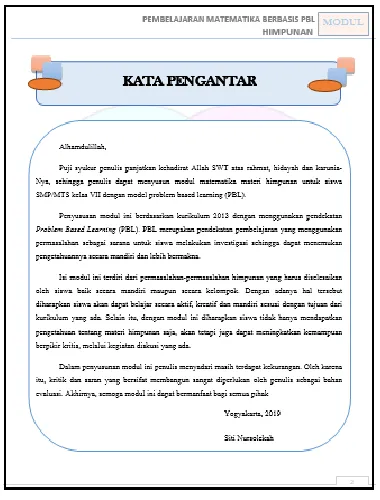
This introduction in the PBL based mathematics learning module expresses gratitude to those who have helped in the formation of this module and apologies and suggestions for this PBL based mathematics learning module. The following is a preface design that has been made:
Fig. 3. Display of Preface
3.2.1.3 Module Description
The description of the mathematics learning module based on problem based learning contains information modules in the form writers, mentors, validators, paper types, many pages and module sizes. Following is the design description of the module that has been made:
Fig. 4. Module Descriptions
3.2.1.4 List of Competency Goals
The list of competency goals in the mathematics learning module based on Problem Based Learning discovery contains what knowledge, attitudes, or skills can be mastered after completing learning. The following is a design list of competency objectives that have been made:
2611 3.2.1.5 Concept Maps
The concept map in this PBL based mathematics learning module contains topics to be studied in the module and shows the interrelationships between topics in the module. Concept maps also help teachers to improve the effectiveness of the learning process in the classroom. The following concept map design has been made:
Fig. 6. Concept Map Display
3.2.1.5 Table of Contents
The table of contents in the Problem Based Learning based mathematics learning module contains the topics discussed. The topic appears based on the sequences in the module. Students can also see the overall topics discussed in the module as well as printed page numbers to make it easier for readers to find topics. Following is the design of the table of contents that have been made:
Fig. 7. Display of Table of Contents
3.2.2 Core Part
3.2.2.1 Introduction
The introduction in the PBL based mathematics learning module contains the advantages of modules compared to other modules. The advantages of this module can be seen from how to package material combined with the PBL based learning to approach. The introduction also contains a general description of the contents of the module material, convincing learners that the material in the module is useful for them and provides guidance on how to learn the material to be taught. In this section, there are also core competencies and basic competencies used. Following are the preliminary designs that have been made:
2612 3.2.2.2 Material
The material in this PBL based mathematics learning module contains detailed explanations of the subjects that are delivered sequentially and systematically, so students are easy to master the learning material. In this module, there are also a number of Learning Activities that contain material descriptions, assignments, and summaries of each sub-chapter discussed. Next is the design of Learning Activities that have been made:
Fig. 9. Display of Learning Activities
Modules are arranged in accordance with the stage of learning discovery, namely to formulate problems, analyze problems, build guesses, make conclusions and apply conclusions. according to [26] interpreting learning which gives freedom to students to investigate mathematical problems through the following steps: (1) formulating problems, (2) formulating hypotheses, (3) testing hypotheses, (4) drawing conclusions [27]. Problem Based Learning learning steps are as follows: (1) stimulus (asking questions or encouraging students to observe pictures and reading books about material), (2) problem statements (giving students the opportunity to identify problems), (3) gathering data (giving students the opportunity to gather information), (4) processing data (processing data that has been obtained by students), (5) Verification (do a careful examination to verify the validity of the hypothesis), (6) generalization (conclusions on problems that have been given). According to [28] the method of discovery is in three stages, namely: clarification, drawing conclusions, validating. The following is the design of the material that has been made:
Fig. 10. Display Material
3.2.2.3 Assignment
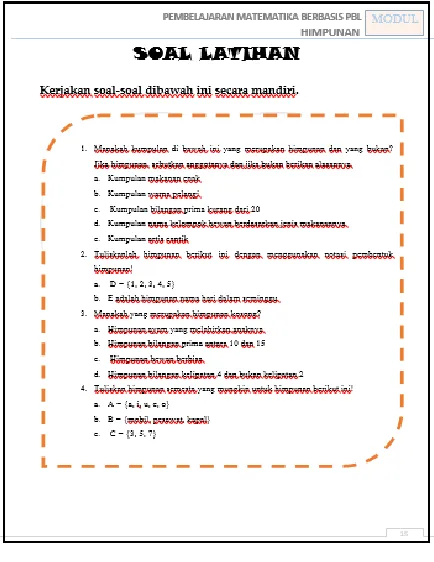
Assignment in PBL based mathematics learning module contains problem exercises that must be completed by students. Assignments in modules need to emphasize the competencies that students need to have. The following design assignments have been made:
2613 3.2.3 Closing Section
3.2.3.1 Summary
This summary in the mathematics learning module PBL based examines the main points in the module discussed. The following summary design has been made:
Fig. 12. Summary View
3.2.3.2 Glossary
The glossary in this Problem Based Learning based mathematics learning module contains concept definitions discussed in the module. The definition is summarized so as to it easier for students to recall the concepts that have been learned. The following is a glossary design that has been made:
Fig. 13. Glossary 3.2.3.3 References
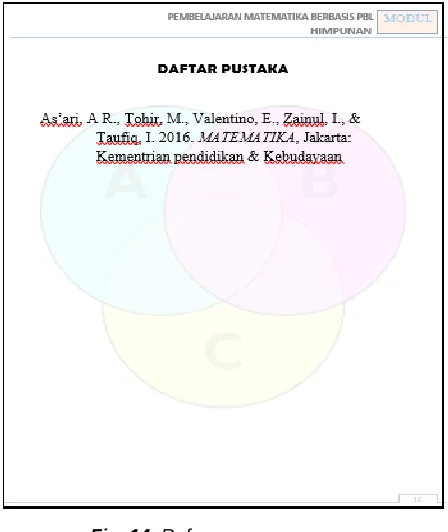
This references in the PBL based mathematics learning module contains sources of information about the contents of the module. The following references design has been made:
Fig. 14. References
3.2.4 Evaluation and Validation Phase
2614 materials and material in the module. Module design
validation uses assessment instruments and instruments in the form of questions and questionnaires that have been reviewed by media experts, namely Puguh Wahyu Prasetyo, S.Si., M.Sc. as a lecturer in the master of mathematics education at Ahmad Dahlan University. While the material expert, namely Rinawati, S.Pd. as a Mathematics teacher at SMP Negeri 3 Pandak. The material expert corrects the material to be used in the Module. Following are some of the feedback and suggestions from material experts which can be summarized in Table 1.
TABLE 1
COMMENTS AND ADVICE FROM SUBJECT MATTER EXPERTS
Suggestions and Comments Follow
Taking the problems in the formulation
Replacing some of the problems Try searching for a more precise problem
In the module design was revised material part that has been suggested
Comments and suggestions from experts material was then revised. Furthermore, the feasibility study items rated by the subject matter experts. The following are the results of calculations on the feasibility questionnaire learning module design validation by subject matter experts are shown in Table 2.
TABLE 2
CALCULATION QUESTIONNAIRE RESULTS FEASIBILITY VALIDATION MODULE DESIGN MATERIAL
Evaluator Position Score Criteria To
Quantitative Data
Rinawati, S.Pd.
Junior High School Mathematics Teacher 3 Pandak
17 Very good
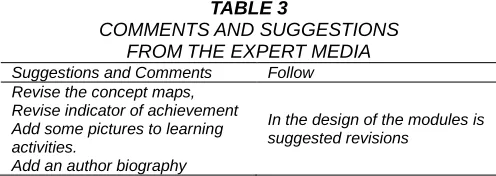
Based on Table 2, it can be seen that the average score is 17. The material expert assessment These results indicate that instructional media design developed in terms of the material in the excellent category. Media experts, namely Puguh Wahyu Prasetyo, S.Si., M.Sc. The following are some of the inputs provided by the media experts associated with the learning material can be seen in Table 3.
TABLE 3
COMMENTS AND SUGGESTIONS FROM THE EXPERT MEDIA
Suggestions and Comments Follow
Revise the concept maps, Revise indicator of achievement Add some pictures to learning activities.
Add an author biography
In the design of the modules is suggested revisions
Comments and suggestions from media experts then revised. Furthermore, the feasibility of the design of modules assessed by expert media. The following are the results of a questionnaire about validation calculation module design shown in Table 4.
TABLE 4
RESULT OF QUESTIONNAIRE DESIGN VALIDATION CALCULATION MODULE
Evaluator Position Score Criteria To
Quantitative Data Puguh Wahyu Prasetyo, S.Si., M.Sc Lecturer in Mathematics Education UAD
20 Very good
Based on Table 6, it can be seen that the average value of ratings matter experts is 20. So it can be concluded that the design of instructional media developed in terms of media included in the excellent category.
4
C
ONCLUSIONThis study resulted in the design of problem-based learning mathematics modules based on the analysis and design stages. At the analysis stage, the researcher grouped into three namely curriculum analysis, material analysis and analysis of student characteristics. In curriculum analysis, it was found that the curriculum used was the 2013 curriculum in accordance with the government. In the material analysis, it was found that students had difficulties in the subject set. While the analysis of student characteristics is obtained that students cannot understand the material of the set well because it is confusing for him. At the design stage, the researcher designed three parts in outline, namely the opening part consisting of cover, introduction, module description, list of competency goals, concept maps, table of contents, initial tests. The core consists of the introduction, material, assignment. The closing section which consists of the final test, summary, glossary, and references that will be tested by the media. The module developed has the advantage to improve students' critical thinking skills in learning mathematics on the subject matter of the set because each indicator of critical thinking ability is included in the questions in the module and integrates the problem-based learning approach. After this research was carried out, the next study was the development of PBL-based learning modules.
A
CKNOWLEDGMENTThe researchers would like to express their gratitude to both my parents, brother, and lecturers in the thesis proposal writing course.
R
EFERENCES[1] G. Aksu and N. Koruklu, N, “Determination the Effects of Vocational High School Students’ Logical and Critical Thinking Skill on Mathematics Success,” Eurasian Journal of Educational Research, 59, 181-2016, 2015.
[2] E. Aizikovits-Udi and D. Cheng, “Developing critical thinking skills from dispositions to abilities: Mathematics education from early childhood to high scholl.” Creative Education, 6(04), 455., 2015.
2615 Learning (Edulearn), 9(3), 226-236, 2015.
[4] P. Cobb, T. Wood, E. Yackel, and B. McNeal, “Characteristic of Classroom mathematics Tradition: An interactional analysis,” American Educational Research Journal, 29, 573-604, 1992.
[5] NCTM. Principles and Standards For School Mathematics. Reston, VA: NCTM, 2000.
[6] Q. Zhou, C. Yan, S. Zhao, L. Liu, and L. Xing, “A preliminary investigation into critical thinking of in-service and pre-in-service middle school chemistry teachers in Shaanxi province of China,” Asia-Pacific Forum Science Learning and Teaching, 13(2), 1-13, 2012.
[7] N.M. Fuad, S. Zubaidah, S. Mahanal, and E. Suarsini, “Improving junior high school’ critical thinking skills based on test three different models of learning,” International Journal of Instruction, 10(1), 101-116, 2017.
[8] Hakim, Liliasari, A. Kadarohman, and Y.M. Syah, “Improvement of students critical thinking skills with the natural product mini project laboratory learning,” Indonesian Journal of Chemistry, 16(3), 322-328, 2016.
[9] Irwanto, E. Rohaeti, and A.K. Prodjosantoso, “A Survey Analysis of Pre-Service Chemistry Teachers’ Critical Thinking Skills,” MIER Journal of Educational Studies, Trends and Practices, 8(1), 2018.
[10]L. Torp and S. Sage, Problems as Possibilities: Problem Based Learning for K-12 Education: Associations for upervision and Curriculum Development, 1703, 1998.
[11]R.A. Tarmizi and S. Bayat, “Collaborative problem based learning in mathematics: A Cognitive load perspective,” Procedia-Social and Behavioral Sciences, 32, 344-350, 2012.
[12]Fajarini, B.E. Soetjipto, and F. Hanurawan, “Developing a social studies module by using problem based learning (PBL) with Scaffolding for the seventh grade students in a junior high scholl in Malang,” Indonesia Education, 6(1), 62-69, 2016.
[13]D. Zulyadaini, "A Development of Students’ “Worksheets Based on Contextual Teaching and Learning,” IOSR Journal of Mathematics, 13(01). 30-38, 2017.
[14]L.W. Harahap and E. Surya, “Development of Learning Media in Mathematics for Students with Special Needs,” International Journal of Sciences: Basic and Applied Research, Vol. 33, No. 3 pp 1-12, 2017.
[15]N.R. Wahyuaji and Suparman, “Development of STEM Integrated E-Learning Design to Improve Student’s
Creative Thinking Capabilities,” International Journal of Scientific & Technology Research, vol. 8, issue 10, pp. 1164-1168, 2019.
[16]B.P. Syafina and Suparman, “Designing Student Worksheets to Improve Critical Thinking Ability Based on Problem Based Learning,” International Journal of Scientific & Technology Research, vol. 8, issue 10, pp. 1194-1199, 2019.
[17]Isnaepi and Suparman, “Design og Moodle-Based Mathematics Learning to Improve Spatial Ability for Class XII High School Students,” International Journal of Scientific & Technology Research, vol. 8, issue 10, pp. 1174-1177, 2019.
[18]L.F. Nuari and Suparman, “Designing Worksheets for the Mentally Retarded Student in Multiplication Operations,” International Journal of Scientific & Technology Research, vol. 8, issue 10, pp. 3579-3584, 2019.
[19]M. Faulina and Suparman, “Design Guided Discovery Student Worksheets to Construct the Understanding of the Blind,” International Journal of Scientific & Technology Research, vol. 8, issue 10, pp. 3685-3689, 2019.
[20]N.L. Fitri and Suparman, “Designing Worksheet Using the Context of Sugarcane,” International Journal of Scientific & Technology Research, vol. 8, issue 10, pp. 3669-3672, 2019.
[21]Suhendri and Suparman, “Development Mathematics Modules Based on Guided Discovery Learning to Improve Creativity Skills of Blind Students,” International Journal of Scientific & Technology Research, vol. 8, issue 10, pp. 1169-1173, 2019.
[22]S. Solihati and Suparman, “Design of Mathematics Module Development Based on PMRI to Improve Critical Thinking Ability Students of Class VIII Junior High School in Indonesia,” International Journal of Scientific & Technology Research, vol. 8, issue 10, pp. 3673-3679, 2019.
[23]G.M. Puskurich, “What is this instructional design stuff anyway” in Rapid Instructional Design Learning USA, 2015.
[24]G. Welty, “The Design Phase of the ADDIE Model”, Journal of GXP Compliance, Vol. 11 No. 4, 40-48, 2017.
[25]M.B. Miles, A.M. Huberman, and J. Saldana, “Qualitative Data Analisis, A Methods Sourcebook” Edition 3 USA Sage Publications. Trans-lated by Tjetjep Rohendi Jakarta Universitas Indonesia, 2014.
2616 Vol. 8. No. 1, 103-114, 2017.
[27]W.S. Adelia and E. Surya, “Resolution to Increase Capacity by Using Guided Discovery Learning Math Student’s.” International Journal Sciences: Basic and Applied Research, Vol. 34, No. 1, 144-154, 2017.