INTRODUCTION
Heavy metals in wastewater have emerged as focus of environmental remediation efforts of industr ialization and urbanization with new technological advancements1. The existing water resources are contaminated by discharging wastewater containing organics color, heavy metals, etc.2. The ground water contaminating particularly by heavy metals from industrial effects and their persistence in food chain has been of major concern as it is poisoning as serious threat to aquatic culture including fisheries4. Hence the removal of toxic heavy metals contaminants from wastewater is one of the most important environmental and economic issues today3. The ever-increasing demand for water of high quality has caused considerable attention to be focused towards recovery and reuse of wastewater5.
The toxicity of Cu+2 and Ni+2 metal ions18, even at trace level has been recognized with respect
Removal of Cu (II) and Ni (II) from aqueous solution
using Tectona grandis bark substrate
B.D. GHARDE
Department of Chemistry, Science College, Pauni, Bhandara (India). (Received: December 22, 2009; Accepted: February 05, 2010)
ABSTRACT
Tectona grandis bark substrate is found to have good sorption capacity for recovery of Cu+2 an
Ni+2. Tectona grandis bark substrate prepared from 0.25N H
2SO4 and 39%HCHO and has been used
for the adsorption Cu+2 and Ni+2 studies indicated that sorption of Cu+2 and Ni+2 increases in pH and
contact time of 90 minutes is found to be optimum. The effect of metal ions shows that Tectona grandis bark substrate can remove Cu+2 and Ni+2 at lower concentration. The bark substrate also indicated that
adsorption increases with increase in substrate concentration. The presence of Na+, Ca+2 and Mg+2
interfered with adsorption of Cu+2 and Ni+2. It is also reported that the substrate from the solution
removes more than 60% of the metal ions instaneously by using packed column of the bark substrate.
Key words: Cu+2 and Ni+2 metal ions, Tectona grandis bark substrate, Adsorption capacity U.V. Spectrophotometer, Shaking machine, packed column of tree bark substrate.
to public health for many years regarding their effluent concentration Cu+2 and Ni+2 have been evaluated as toxic to aquatic life above certain threshold toxicity levels19. Exposure to heavy metals toxicity can result from every facet of natural activity such as Agriculture, Mining transport, Energy and Industry17. Agriculture products and byproducts (such as peanut skin, rice straw, wheat gluten, wheat flour, onion skin, mango cotyledon residue, garlic skin, etc.) have been reported to remove the heavy metal cat ion from wastewater to below the discharge limits efficiently and economically12.
MATERIAL AND METHODS
Preparation of Adsorbent (Tectona grandis bark substrate)
bath at 50oC for 6h and occasionally stirred. The powder was cashed with distilled water for several times to remove H2SO4 and used for removal of metal ions.
For removal of metals form wastewater the general treatment method used. ‘Adsorption’ is the best technique, which is broadly applied to remove metals.
Adsorption is a surface phenomenon that may be defined in term of a unit operation that utilizes surface forces. It is one of the most effective physical processes for the removal of toxic metals from wastewater. It is based on the concept of partition of a chemical species between a bulk phase and an interface or accumulation of a substance near the interface. The technique is classified as localized, non-localized, negative, positive, static and dynamic adsorption based on the strength of binding forces.
The surface of solid has free vacancies or residual forces. Thus, it has a tendency to attract and to retain molecules of other species with which such surface comes in contact. This phenomenon is termed as Adsorption15, which is technical term to denote the taking up of gas, vapor or liquid by a surface or interface. The substance that adsorb on another substance is called adsorbent. While substances that are adsorbed on the first substance is called as adsorbate. It is more commonly referred to as physical and chemical adsor ption. Ion exchange process is physical adsorption and electrostatic is chemical adsorption16.
In order to understanding the adsorption behavior and adsorption potential, sorption studies were conducted different concentration of Cu+2 and Ni+2 have been prepare from stock solution and doses of Tectona grandis bark substrate was added. These samples were placed in a shaker at constant speed of 85 rpm. the system is equilibrated by shaking the contents of the flasks at room temperature so that adequate time of contact between adsorbent and metal ions is maintained. Investigation showed that the equilibrium uptake of Cu+2 and Ni+2 was attained in 1hr. with practically no charge detected up to a period of 24hrs. After the agitation for an equilibrium period, the super ant
solution is filtered though Whatman filter paper and the uptake of Cu+2 and Ni+2 is deter mined spectrophotometrically using filtrate. The parameter affecting adsorption process viz pH, agitation time, adsorbate and adsorbent concentration, temperature, co-metal and packed column of Tectona grandis bark substrate were studied.
All reagent sued in the experiment were of analytical grade. All glassware used were leached with 10% Nitric acid, washed with distilled water and dried in an oven. The initial stock solution of Cu+2 and Ni+2 were prepared by dissolving requisite amount of Copper sulphate and Nickel sulphate in distilled water. A standard solution of Cu+2 and Ni+2 were prepared by taking different aliquot from stock solution and subsequent dilution with distilled water.
RESULTS AND DISCUSSION Batch Technique
Effect of pH
The effect of pH on adsorption of Cu+2 and Ni+2 is by increasing pH of the solution from 2 to 9 (initial concentration was 28.41 ppm and 41.71 ppm). The results are shown in fig. 1. Sorption is highly dependent on pH and it increases with increase in pH. Maximum removal of Cu+2 and Ni+2 is recorded at pH5. On further increase in pH adsor ption decreases. Adsor ption sites shows blockage, due to the formation of metal hydroxide.
Effect of agitation time
It is observed that the effect of agitation time is studied by taking 28.41 ppm of Cu+2 and 41.78 ppm of Ni+2 at pH5 (adsorbent dose 1 gm). 36.95% of Cu+2 and 25.63% of Ni+2 ions were removed from solution within 5 minute, showing that metal ions uptake on substrate is very fast. At about an hour the removal of Cu+2 and Ni+2 ions from the solution recorded the value 73.24% and 72.03% and adsorption remains constant even after agitation time of 2hrs. Results are tabulated in fig.2. Effect of initial metal ions concentration
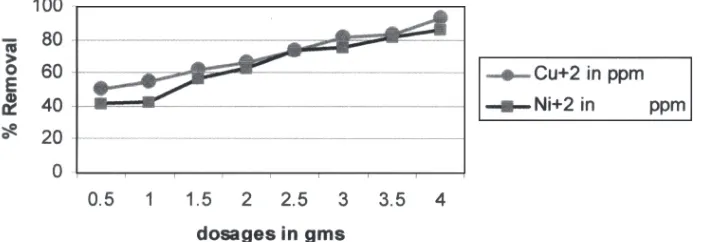
Fig. 1: Effect of pH on the adsorption of Cu+2 and Ni+2
Fig. 2: Effect of contact time on the adsorption of Cu+2 and Ni+2
Fig. 3: Effect of initial metal ions conc. on the adsorption of Cu+2 and Ni+2
Fig. 5: Effect of temp. on the adsorption of Cu+2 and Ni+2
Fig. 6: Adsorption of Cu2+ and Ni2+ from copper sulphabet and nickeal sulphapet using paced column
ions naturally decreases with increase in concentration of metal ions.
Effect of dosages
The effect of adsorbent doses level on sorption of Cu+2 and Ni+2 is shown in fig. 4. Study was carried out by taking 28.41 ppm and 41.78 ppm solution. Adsorbent doses varied from 0.5 gm. To 4.0 gm. It is observed that the adsorption of Cu+2 and Ni+2 increases with increase in doses of adsorbent.
Effect of temperature
It is found that the percentage removal of the metal ions from solution to the bark substrate decreases with increases in temperature. Maximum metals removal take place at room temperature conveniently. Results are shown in fig. 5.
Effect of light metal ions
Light metal ions such as Na+, Ca+2 and Mg+2 have considerable effect on the sorption of Cu+2 and Ni+2. It is observed that the sorption of metal ions gradually decreases in the presence of increasing concentration of light metal ions. Column Technique
CONCLUSION
The adsorption behaviors are like a typical cat ion exchanger with selectively characteristics. Hence it has different affinity for different metal ions. The metal ions in the solution exchange with the H+ resulting in to decrease in pH of the metal ions solutions. The fact also has been observed in present study, where the final pH of metal ions solution is less than initial pH and the useful range of operations is limited by the H+ concentration to weakly acidic through basic condition (say pH 2 to 9). In that the metal ions bound by the bark substrate
can be completely leached into solution by regenerating it with N/10 mineral acid. The effect of contact time, initial metal ion concentration, dosages of substrate, light metal ions and temperature on the adsorption efficiency of substrate follow the typical trend as shown by any adsorbent.
ACKNOWLEDGEMENTS
The author with thanks to our Principal Shri N. J. Meshram, Science College, Pauni (M.S.) to avail laboratory facilities to conduct this work.
1. Bhattacharya A. K., Das S. K. and Mandal S. N. “Removal of Zinc from waste water” Res., J. of Chem. and Environ., 8(4): 77-479 (2004).
2. Ramdevi T. A. and Srinivas K. “Agriculture solid waste” for the removal of in organics adsorption of Mercury (II) from aqueous solution by Tamarind Nut carbon, Res. J. of Chem. and Environ., 9(1): 54-59 (2005). 3. Rao M., Par vate A. V. “Competitive
Adsorption of Cr+6 and Ni+2 from aqueous solution using low cost adsorbent” Env. Poll. Con. J., 4(4): 50-57 (2001).
4. Sohali Ayub et. al., “Efficiency Evaluation of Neem bark in treatment of industrial waste water”, Evn. Poll. Con. J., 4(4): 34-38 (2001). 5. Gopi Krishna P., Mary Gladis J., Rambabu U., Prasadrao T., Naidu G. R. K., “ Preconcentrative Separation of Chromium (VI) species from Chromium (IIII) by co precipitation of its ethyl xanthate complex onto Napthalene Talenta, 63: 41-46 (2004). 6. Laxmi N. and Srinivasan K., “Removal of Ni (II) from water by agricultural waste cotton seed (Ciba Pentadra), Oriental Journal of Chemistry, 20(3): 487-492 (2004).
7. Vishwakarma P. P. Yadav K. P. and Sing V. N., “Ni(II) Removal from aqueous solution by adsorption on fly ash pentanika, 12: 357-366 (1989).
8. Shrinivassan K. Balsubramanian N. and Ramkrishna J. V., “Studies on chromium
removal by Rice husk carbon”. Indian J. Environ. Health, 30: 376-387 (1988). 9. Gharde B.D., Gholse S. B. and Patil P. V.
“Removal of Cu(II) and Ni(II) from solution using Aegal marmelose fruit shell substrate.” Asian Journal of Chemistry, 17(1): 191-194 (2005).
10. Tikomolora K. P. and Urakova I. N. C. “Adsorption on quartz of Co(II) and Ni(II) and Cu(II) in the from of hydroxide Nanoparticle or metal ionic species from solution with pH close to that onset of hydroxide formation.” Russian Journal of General Chemistry, 72(7): 989-996 (2002).
11. Chipin Huang and Huang C. P., “Aspergilus oryzae and Rhizopus oryzae for Cu(II) removal, Wat. Res. Oxford, 30(9): 1985-1990 (1996).
12. Nahaglu T., Malkoc E., Gurses A. and Canplot N., “Removal of Cu(II) from aqueous solution by Ulothrix zonata. Bio-resource Technology Turk, 85(3): 331-333 (2002). 13. Fujiyoshi Issei, “Adsorption of Cr+6, Ni+2 and
Co+2 on porous glass by ion exchange”. Kagoshima University, Kagoshima, Japan, 29(3): 439-41 (2003).
14. Salih B., Denizili A. Kuvakli C. Say E. Piskil Talanta, 46: 1205 (1998).
15. Hoshi S. Konuma K. Sugawar M. Uto Akatsuka K. Talanta, 47: 659 (1998). 16. Andrle C. M. Jakubowski N. Brockaert J. A.
17. Ona Gyliene, Sigita Visniakova “Heavy metal removal from solution using natural and synthetic sorbents”. Environmental Research, Engineering and Management, 1(13): 28-34 (2008).
18. Malgorzata Ulewicz, Wladyslaw Wackowiak, “Removal of Zn(II), Cd(II) and Pb(II) using
polymer inclusion membrance transport with proton ionisable Dm-16-C-5 Crown Ethers. 19. S. J. Patil, A. G. Bhole and G. S. Natarajan,