Review On SVM Based Method For Identification
And Recognition Of Faces By Using Feature
Distances
Piyush Choudhary, Poorva Agrawal, Gagandeep Kaur
Abstract: Support vector machine is a machine learning algorithm that has been developing since the mid-1990s. There are two significant things in face recognition using SVM. One is the component feature extraction from images, the other is the classifier we choose. The relative distance between the features of face is used to uniquely identify a person. These measures are used to train the SVM and the closest match with the input data is results in a successful identification. Minimum distance classifier is used for identification process.
Index Terms: Face recognition, machine learning, SVM, feature extraction.
—————————— ——————————
1
INTRODUCTION
Face recognition technology has been broadly used these days, for example, access control and authentication. Over the past few years interest and research work in the field has significantly increased [1]. Over the years various human authentication processes have been studied using natural attributes such as, fingerprints, retinal scan and voice recognition. The face recognition consists of three parts, 1) face detection 2) feature extraction 3) identification [1],[2]. In this paper a system is designed that can detect a face from a image . The key features of the face are located and then the distance between these features are calculated is given to the SVM as the training data, SVM is made to learn through this data set. Minimum distance classifier is used to look for a matchHumans have the ability to recognize a human many faces even without seeing the face for along time and developing such a system which is similar to human ability is still an area of research. Numerous algorithms have been proposed to detect a face from image or video in an effective manner. For this purpose researchers have focused on various detecting and recognition of traits and features of individuals also called principal components such as mouth, nose, eyes. Ongoing researches in face recognition try to build such systems which are more effective and efficient as human‘s ability to detect a face. Also many researchers have concluded that the efficiency and effectiveness can be increased when 3D faces are used. The rest of paper is arranged as follows: Section II gives the detailed related work in the field. Section III gives detail about various datasets. Section IV discusses various application of face recognition system. Section V discuss various challenges faced by face recognition system and The Final Section VI gives conclusion and future directions.
2
RELATED
WORK
Face detection algorithms and techniques have been extensively studied in the past many years. Examples include feature based methods, using geometric information such as skin color, geometric shapes, motion information, and machine-learning based approaches like neural networks, Gaussian mixtures, support vector machines and statistical modeling. These techniques require prior information about face‘s features. Segmentation of visual features is done to deal with Low level features. Machine learning techniques are used to deal with complex scenarios such as faces of multiple size and shapes and poses are to be detected. They require relatively less knowledge of the features and detect the faces with this relatively minimal information. Pre-classified face samples are used to train the system. However these systems are very computationally expensive and research is on going to improve the real time performance of these systems
2.1 Using ANN
In recent years, different architectures and models have been developed and used for face detection and recognition. ANN is developed to duplicate the working of neurons work in the human brain, this is the main reason for its use in face recognition.
2.1.1 Convolutional Neural Network (CNN)
Masakazu Matsugu (2003) [3] described a algorithm for robust facial expression detection using a convolutional neural network. Facial expression recognition problems such as translation, rotation and scale invariance were discussed in this study.
Fig. 1. Face detection using CNN [8]
—————————————————
• Piyush Choudhary is currently pursuing masters degree program in computer science engineering in Symbiosis International Deemed University, India
• Poorva Agrawal is currently Assistant Professor in Symbiosis International Deemed University, India
4263
2.1.2 Fast neural network(FNN)
In [4] Hazem El-Bakry proposed fast neural network approach. This approach reduces the computational time to locate the faces. Every image is segmented or divided into smaller sub images and then each sub image is tested separately using fast ANN. Results of experiments of this study showed high speed is achieved.
2.1.3 Evolutionary optimization of neural networks
A Stefan, et al in [5] used ANN to determine whether a pre-processed image is a human face or not. Hybrid algorithm combining evolutionary computation and gradient- based learning is used, this performs considerable faster with precision. The proposed hybrid algorithm deals with the problem of decreasing the number of hidden neurons of face detection network without loss of accuracy.
2.2 Support Vector Machine
SVM is the method that deals with classification. As SVM is a machine learning algorithm in which the classifier is trained that can effectively deal with the face recognition problem, from the training data the SVM takes out the related discriminatory information [1]. For face recognition SVM can be applied individually or can be used with other algorithms or techniques as well. Like a hybrid method can be used to extract features suing independent component analysis (ICA) and then recognition can be done using SVM. This approach gives good but slow in feature selection and classification. Other methods for extracting features are PCA, 2DPCA, LDA.
Fig. 2. Face recognition using SVM [1]
2.3PRINCIPAL COMPONENT ANALYSIS (PCA)
Turk and Pentland [6] were the first to do face recognition using PCA. The recognition method known as eigenface method defines a feature which reduces the dimensionality of the original data space. PCA is standard method used for recognition of statistical design and for feature extraction. This removes redundant information and preserve the important information of the pattern. The task recognition system is to show that image on which testing is performed is of a human face. A Face comprises of a set of features and these features are called eigenfaces or principal components. These features are extracted from the original image of face with the help of principal component analysis or PCA [7]. But poor discriminating power within class and large computation are some problems in the PCA method. This can be overcome by Linear Discriminant Analysis (LDA).
FIGURE 3: PCA APPROACH FOR FACE RECOGNITION [7]
2.4 LINEAR DISCRIMINANT ANALYSIS(LDA)
Linear Discriminant Analysis or LDA is a supervised algorithm. It takes the class label into consideration. It is a way by which the class dimensionality is reduced while at the same time preserving as much of the class discrimination information as possible [8]. In classification problems there are often too many attributes or factors on the basis of which the classification is done, these are also called variable features. The higher the number of variable features harder it is to work on the training data set. Most of the features which are correlated are redundant. Here the dimensionality reduction algorithm come into play, it is the process of reducing variables or factors taken into consideration. This process is divided into two parts
Feature selection
Feature selection is the method of filtering out the irrelevant or redundant variables in the dataset. Feature selection method keeps subset of original features while feature extraction is the method that creates new ones. Some of the supervised learning algorithms already have built in feature selection such as random forests and regularized learning. This involves three ways:
1. Filter
2. Wrapper
3. Embedded
Feature extraction
Feature extraction is the method of reducing the high dimensional space into lower dimension space which means reducing the number of dimensions. This set of features still contains most of the useful information. Some algorithms already have built in feature extraction. Deep learning is one of the examples, where it extracts useful information from raw data through every hidden neural layer. Feature extraction can be supervised or unsupervised.
3 FACE DATABASES
database is developed on the basis of two rules which make it easy for both algorithm development and evaluation. First being that a common data base is required for development and testing and secondly diversity of the problem defined by images in dataset should increase.
3.1FERET DATABASE
Formed in 11 sessions from data base consists of 14,126 images in 1564 sets of 1199 subjects and also with 365 duplicate sets of images [9]. Duplicate set contains the second images of people who already has their face images in the database which are taken at different time or dates. This database is developed on the basis of two rules which make it easy for both algorithm development and evaluation. First being that a common data base is required for development and testing and secondly diversity of the problem defined by images in dataset should increase.
3.2 AT&T Face database
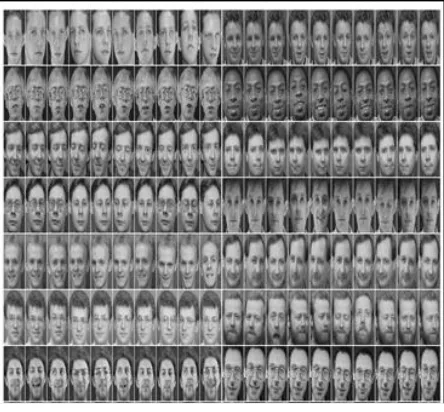
AT&T face database has total 400 images. These images are of 40 individuals with 10 different facial images [9]. These images were collected from 1992 to 1994. These images were taken at different times with different conditions with a dark background. This database is good for initial testing and is quite easy.
Figure 4: Images in AT&T database
3.3 Yale Face database
The database is available publically for non-commercial use. This face database consists images in GIF format of 15 individuals [8] . There are165 images in grayscale, 11 images per subject, one per different facial expression: with glasses, without glasses, normal, sad, happy, surprised, wink and sleepy. All the images are unedited. Size of this database is 6.4MB. It is a more upgraded version of AT&T database as it presents harder problem. There is a extended version of Yale face database, this database consists of images of 38 individuals and a total of 2414 images. No change in expressions are to be found but more focus is on extracting feature apt to illumination and they are available in cropped version.
3.4 AR dataset
This database was created by Aleix Martinez and Robert Benavente in the computer vision center (CVC) at the U.A.B. This dataset consists of over 4000 images of 126 people‘s faces where 70 are men and 56 are women. This database is publically available and can be obtained from Ohio state university website. Images with different conditions such as bright and low light and different facial expressions such as happy, sad, normal, wink and different occlusions (Sun glasses and scarf) were taken. The pictures were taken at strictly controlled conditions. The images of all the individual were taken 2 times at different times with 14 days gap. This database is free for academic use. Male images are stored as : M-xx-yy.raw and female images are stored as F-xx-yy.raw. xx is a unique person identifier. From ―00‖ to ―76‖ for makes and ―00‖ to‖56‖ for females and yy specifies the feature of each image. Such as smile, anger, scream, neutral. Images can be converted in any format from RAW
4
APPLICATIONS
OF
FACE
RECOGNITION
Few applications where face recognition technique is used are discussed under.
4.1SECURITY
Security and privacy are the most prime necessities in all places. For example general identity verification of a person, mobile or computer unlocking, searching for criminals, voter registration, banking, e-commerce, nation IDs, passports [10].
4.2 Surveillance
Surveillance means ‗watching over‘. CCTV (Closed circuit television) cameras are generally used for this purpose. It is used to keep an eye on the individual‘s or target‘s behavior and activities to ensure safety and security in the surrounding. Government agencies use this to gather intelligence, crime control, monitoring traffic. However some section of society also considers this as a violation of privacy and is criticized by many. Researchers are trying to get more accurate results through various new algorithms.
4.3 Access Control
Access Control is the method by which only authorized group of people are allowed to have access of a personal account by logging in through their credentials. By using facial recognition system images of face are taken under natural conditions. This automatic system of detecting and recognizing a face is also used to authorize a used to access a mobile phone, making monetary payments.
5
CHALLENGES IN FACE RECOGNITION
Recognizing any face, be it from a video or image a very difficult task. There are too many algorithms and approaches to do this but none of the approaches can do this with 100 percent accuracy because of the challenges it faces. There are two categories of factors. These are Intrinsic factors and Extrinsic factors. [11]Intrinsic factors are the one which comprises of the physical conditions of the face, e .g. age, facial expressions, etc. that influence the process, while factors that change the appearance of the face, e .g. difference in pose, lightening condition are Extrinsic factors.
5.1 Aging
4265
Durability and authenticity is very essential quality for any biological and physical measurement and to treat it as a biometric. Face of a human is a combination of hair, facial and bone tissues. When the muscles contract, the facial features are deformed. Aging, however causes significant changes in an individual's facial appearance, e.g. facial structure (wrinkles, etc.) and face shape over time [12]. The facial recognition systems should be fairly capable of meeting this requirement [13]. Most studies are conducted with the primary goal of addressing this issue [14]. Since aging is a very slow process [15], collection of data becomes difficult for training of the system to cope with the aging issue for recognition system. Research conducted with respect to age has gained a great deal of attention.
5.2 Facial Expression
Facial expression is a nonverbal interaction approach as it uses gestures to convey messages. Expression variability, however, induces vagueness for facial recognition systems. Several facial recognition systems are developed which operate well for images under very controlled environment. Different facial expressions are associated with different moods, people's attitudes, and change in the facial geometry, hence it becomes very hard for the face recognition system to detect if there is a slight contrast in the image. Researchers worked with facial expression to recognize the face [16][17] . Various methods can be used to address this issue, such as model-based approaches, muscle-based approaches, motion-based approaches. It is a myth that although a person's face shape changes due to different facial expressions, certain features may still be less likely to be affected because of the same. The head is a mixture of muscles, bones and skin tissues. Static signals such as hair, sex or color, etc., and slow signals such as bulges and wrinkles, although they do not transmit emotion, they influence the rapid facial expression signal. Facial expression serves as a signal which is immediately affected by shrinking of facial muscles such as eyebrows, cheeks, etc. Upon defining these features, the issues of non-rigid face recognition can be reduced to one that is rigid. Nevertheless, it is not possible to find a perfect shape with complete invariant shape value.
5.3 Pose Variation
Another challenge in creating an effective face recognition system is the pose variation. Each time when a person‘s picture is taken, he/she pose differently. There's no similar standard pose. Therefore making it hard to differentiate the faces from images with different poses and to recognize them. Difference in poses degrade the facing requirement's efficiency. Many systems operate under inflexible conditions of imaging. The methods which are used to handle the pose variation are of two types, i.e. face recognition across pose and multi-view face recognition, depending on what type of dataset of images is used. Multi-view face recognition can be treated as an extra addition to face recognition for front of the face in which image of each pose is taken into account. Yet on the other hand, across a face-recognition pose, we face such a pose that the system has not seen before. A good approach to face recognition should have high sensitivity of pose and the ability to recognize various poses. Many issues remain open in this regard, such as the lack of perceptive subspace presenting variant images. This topic is being discussed by several researchers. No program with 100%
accuracy, however, is yet available. There are several different ways and solutions to address the issues of face recognition and pose changes that are classified into three groups, which are, general algorithms, 2D methods for face recognition across poses, face recognition across poses.
5.4 Partial Occlusion
The objects in a picture that are natural or unnatural are called occlusion. The approaches to partial occlusion detection were classified into various categories, including part-based methods, feature-based methods, and fractal-based methods. Partial occlusion has affected efficiency of image processing in many ways, such as ear recognition due to jewelry for ears. Occlusion also affects the efficiency of a device when people either wear sunglasses, scarves, veils or place mobile device on ears or other objects in front of their faces to confuse it. Many times various other factors, such as shadows, often serve as occlusion due to its extreme illumination. Various techniques are used to address the issue of partly occluding faces splitting the faces into separate parts. By removing few features that create trouble in efficiency of recognizing system the image, this problem can be rectified. Mostly local approaches are based on interface analysis, finding best features and then merging them. Another approach which can be used for an almost holistic approach in which characteristics, attributes and characters are removed and the remainder of the face can be used valuable information. The researchers are developing various techniques to cope with this problem [18][19].
5.5 Effect of Illumination
Variation in lighting greatly affects the face recognition process, thereby transforming most researchers into a field of study. Recognizing multiple individuals from still or video is difficult. Extracting information for our use from images taken under a restricted environment where the background does not change is quite easy, face must be identified from different backgrounds in an uncontrolled environment. This requires shadow variance, over and under exposure. Researchers worked hard to address this problem. There are three methods for dealing with it, namely the strategy of calculating the slope, gray rate and face area of reflection. The technique of gray level transformation performs a detailed mapping with a non-linear or non-linear function. Gradient extraction approaches are used to remove gray-level edges of an object. Because light is a variable that greatly affects facial recognition from a image or a video, these techniques were developed to ignore or at least minimize the effect of this issue.
6
CONCLUSION AND FUTURE SCOPE
This review paper includes a survey of literature studies related to face detection and recognition using SVM and other architectures. Survey shows that Different architecture, approach, programming language, processor and memory requirements, different datasets for training / testing images and measuring performance of face recognition system were used in each study. Each study has its own strengths and limitations. In future work a face detection scheme can be suggested based on using Linear Discriminant analysis and SVM for better and faster performance in face detection system.
[1] Ghosh Dastidar, Jayati & Basak, Priyanka & Hota, Siuli & Athar, Ambreen. (2018). SVM Based Method for Identification and Recognition of Faces by Using Feature Distances. 10.1007/978-981-10-7566-7_4.
[2] Tie, Y., Guan, L.: Automatic landmark point detection and tracking for human facial expressions. J. Image Video Proc. 2013, 8 (2013). https://doi.org/10.1186/1687-5281-2013-8 [3] Masakazu Matsugu (2003) ―Subject independent facial
expression recognition with robust face detection using a convolutional neural network‖, Neural Networks, Vol.16, pp555–559.
[4] Hazem M. El-Bakry (2002), Face Detection Using Neural Networks and Image Decomposition Lecture Notes in Computer Science Vol. 22, pp:205-215.
[5] Stefan W., Christian I. & Uwe H (2004) ―Evolutionary Optimization of Neural Networks for Face Detection‖, Proceedings of the 12th European Symposium on Artificial Neural Networks, Evere, Belgium: d-side publications [6] M.Turk and A. Pentland, "Eigenfaces for Recognition",
Journal of Cognitive Neuroscience, March 1991.
[7] Kaur, R., & Himanshi, E. (2015). Face recognition using Principal Component Analysis. 2015 IEEE International
Advance Computing Conference (IACC).
doi:10.1109/iadcc.2015.7154774
[8] Mankar, Vijay & Bhele, Sujata. (2012). A Review Paper on Face Recognition Techniques. International Journal of
Advanced Research in Computer Engineering &
Technology. 1. 339-346.
[9] Muhammad Sharif et al.: ―Face Recognition: A Survey‖,
Journal of Engineering Science and Technology Review 10 (2) (2017) 166- 177
[10] Lal, Madan & Kumar, Kamlesh & Arain, Rafaqat &
Maitlo, Abdullah & Ruk, Sadaquat & Shaikh, Hidayatullah. (2018). Study of Face Recognition Techniques: A Survey. International Journal of Advanced Computer Science and Applications. 9. 10.14569/IJACSA.2018.090606.
[11] Gong, Shaogang, Stephen J. McKenna, and
Alexandra Psarrou. Dynamic vision: from images to face recognition. Imperial College Press, 2000
[12] Park, Unsang, Yiying Tong, and Anil K. Jain.
"Age-invariant face recognition." Pattern Analysis and Machine Intelligence, IEEE Transactions on 32.5 (2010): 947-954.
[13] Gong, Dihong, et al. "Hidden factor analysis for age
invariant face recognition." Computer Vision (ICCV), 2013 IEEE International Conference on. IEEE, 2013.
[14] Juefei-Xu, Felix, et al. "Investigating age invariant
face recognition based on periocular biometrics."
Biometrics (IJCB), 2011 International Joint Conference on. IEEE, 2011
[15] Lanitis, Andreas, Christopher J. Taylor, and Timothy F.
Cootes. "Toward automatic simulation of aging effects on face images." Pattern Analysis and Machine Intelligence, IEEE Transactions on 24.4 (2002): 442-455
[16] Li, Xiaoxing, Greg Mori, and Hao Zhang.
"Expression-invariant face recognition with expression classification." Computer and Robot Vision, 2006. The 3rd Canadian Conference on. IEEE, 2006
[17] Boughrara, Hayet, et al. "Face recognition under
varying facial expression based on Perceived Facial
Images and local feature matching." Information
Technology and e-Services (ICITeS), 2012 International Conference on. IEEE, 2012
[18] Jia, Hongjun, and Aleix M. Martinez. "Face recognition
with occlusions in the training and testing sets." Automatic Face & Gesture Recognition, 2008. FG'08. 8th IEEE International Conference on. IEEE, 2008.
[19] Zhou, Zihan & Wagner, Andrew & Mobahi, Hossein &
Wright, John & Yu, Lei. (2009). Face Recognition With Contiguous Occlusion Using Markov Random Fields. Proceedings of the IEEE International Conference on
Computer Vision. 1050 - 1057.
![Fig. 1. Face detection using CNN [8]](https://thumb-us.123doks.com/thumbv2/123dok_us/8623696.1413404/1.612.349.551.603.718/fig-face-detection-using-cnn.webp)
![FIGURE 3: PCA APPROACH FOR FACE RECOGNITION [7]](https://thumb-us.123doks.com/thumbv2/123dok_us/8623696.1413404/2.612.61.291.388.527/figure-pca-approach-face-recognition.webp)