INTRODUCTION
Indole derivatives are the basic framework of biologically active compounds. The indole ring system is found to be present in a number of drug
molecules and biologically active compounds1-3.
Indole derivative exhibits several biocidal activities such as chemotherapeutic importance. Indole derivatives possess various types of
pharmacological properties4–6 such as antifungal ,
antibacterial, antitumour and antitubercular activities. It is established from the literatures survey
www.orientjchem.org Est. 1984
An International Open Free Access, Peer Reviewed Research Journal CODEN: OJCHEG
2012, Vol. 28, No. (4): Pg. 1803-1808
Synthesis, Spectral and Biocidal Screening of
Schiff Base Complexes of Co(II), Ni(II) and Cu(II)
Containing Nitrogen and Sulphur Donor atoms
B. K. RAI*, RANJANA¹, PREM PRAKASH² and PREM LATA³
*Department of Chemistry, L. N. T. College, Muzaffarpur, B.R.A. Bihar University, Muzaffarpur, India.
1Rsearch Scholar, B. R. A. Bihar University, Muzaffarpur, India.
2Assistant Manager, Quality and Product Division, A.C.C. Cement, Thane, Mumbai, India.
3Department of Chemistry, Central Hindu School, Gorakhpur, India.
*Corresponding author E-mail: [email protected]
(Received: August 15, 2012; Accepted: October 07, 2012)
ABSTRACT
The present paper is a report on the synthesis of some Co(II), Ni(II) and Cu(II) complexes by the condensation of 2 ethyl indole 3-carboxaldehyde with thiosemicarbazide hydrochloride using ethanol as reaction medium. The bonding pattern and structural studies of ligand and complexes have been carried out on the basis of elemental analyses, molar mass, IR spectra, electronic spectra, molar conductance and magnetic susceptibility measurements. The nonelectrolytic nature of the complexes has been proposed on the basis of their molar mass determination and conductance measurements. The ligand and their complexes have been screened in vitro for their antimicrobial activity. Some of the reported complexes were found to be quite active.
Key words : EICT, Schiff base, Co(II), Ni(II) and Cu(II), Complexes, Antimicrobial screening.
that biologically active compound when coordinated with suitable metal ion, its biological activity is
enhanced7 many folds.
Schiff base complexes play a vital role in application in biocidal, clinical, analytical and pharmaceutical areas. Schiff bases are now attracting a new kind of chemotherapeutic activities
by several workers8-9. Keeping the above
considerations in mind and in continuation of our
earlier work10-16 in this field, we herein report the
of Schiff base, 2 ethyl indole 3-carboxaldehyde thiosemicarbazone (EICT) and its complexes with Co(II), Ni(II) and Cu(II).
EXPERIMENTAL
All the chemicals used were of AnalR grade and used without further purification. Metals salts were purchased from E-Merck and used as received.
Synthesis of ligand [EICT]
The hot ethanolic solution (20 ml) of 2 ethyl indole 3-carboxaldehyde (0.01 M) and thiosemicarbazide hydrochloride (0.01 M) dissolved in 10% ethanolic solution of sodium acetate were refluxed for 4 h. The resulting mixture was poured on crushed ice. The product obtained was filtered, washed with water, dried and recrystallized from
ethanol. Yield-70%; m.p. 167±1oC.
Preparation of the Complexes Preparation of halide complexes
The complexes were prepared by respective metal halides (0.001 M) in ethanol with ligand 2 ethyl indole 3-carboxaldehyde thiosemicarbazone (EICT) (0.002 M) in molar ratio 1:2. The resulting reaction mixture was refluxed on a water bath for 2-3 h. The precipitated complexes were filtered, washed with aqueous ethanol and dried in electric oven. Yield 65-70%.
Preparation of nitrate complexes
The following general method was adopted for the preparation of nitrate complexes. Ethanolic solution of respective metal nitrate (0.001 M) is treated with ligand 2 ethyl indole 3-carboxaldehyde thiosemicarbazone (0.002 M) dissolved in ethanol. The resulting reaction mixture was heated on a water bath for 2-3 h. The precipitated complexes were filtered, washed several times with ethanol and then dried in electrc oven. Yield 70-75%.
Melting point was taken in open capillary tubes and is therefore uncorrected. Analytical data (C,H,N) were collected on Perkin Elmer-2400 CHNS/O elemental analyzer. Magnetic susceptibility of the samples were made on a Gouy balance using
Hg[Co(NCS)4] as a calibrant. IR spectra of the ligand
and complexes were recorded on Perkin-Elmer-577
spectrophotometer in the range 4000-200 cm 1 using
KBr disc. Molar conductance were recorded on Systronics conductivitymeter model 303 using DMF as a solvent. The electronic spectra were recorded on Cary 2390 spectrophotometer.
RESULTS AND DISCUSSION
The IR spectrum shows a sharp and strong
band at 3400 cm-1 assignable17,19 to ν
N–H vibration.
In spectra of all the complexes, this band without change in position and intensity, clearly indicates noninvolvement of nitrogen atom of either amino of imino group in coordination with metal ion. A broad
and sharp band was obtained at 1470 cm-1 in the
ligand assignable17,19,20 to ν
C=N vibration. This band
has been reduced by 20-30 cm-1 in the complexes
suggesting coordination of azomethine N with metal ion. The next IR band of the ligand shows a broad
and strong band at 780 cm-1 assignable17,20,21 to ν
C=S vibration. After complexation this band shows red shift with slightly reduced intensity. The shift of the band and change in intensity indicate coordination of thione sulphur with metal ion.
The conclusive evidence of bonding of ligand to metal ion through oxygen atom of nitrate group, nitrogen atom of azomethine group and sulphur atom of thiosemicarbazone moiety is indicated by the appearance of far ir bands due to νM–O
22,23 at 540-510 cm-1, ν M–N
22,23 at 475-455 cm-1
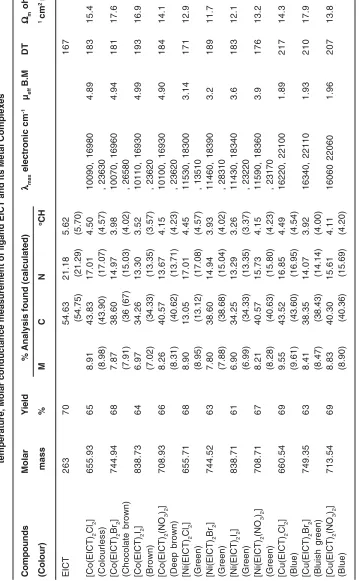
and νM–S22,23 at 425-395 cm-1 respectively. The evidence of metal halogen linkage is supported by the low molar conductance value of the complexes
in the range 12.1-17.9 ohm-1 cm2 mol-1 and
appearance of a band in the far ir region at 325-265
cm-1 assigned22-23 to ν
M–X (X=Cl
-,Br-,I-)
The next IR bands at 1635 and 1500 cm-1
with a separation of 135 cm 1 suggest
monocoordinated behaviour of nitrate group24-26.
Electronic spectra and magnetic susceptibility of the complexes
The Co(II) complexes display three bands in the region, 10070-10160, 16930-17110 and
23540-23630 cm-1, assigned to the transitions, 4T
2g
(F) ←4T
1g (F),
4A
2g (F) ←
4T
1g (F) and
4T
1g (P) ←
4T 1g
T a ble 1: Anal ytical, Molar mass, Electr onic spectra, Ma gnetic susceptibility , Decomposition
temperature, Molar conductance measurement of ligand EICT and its Metal Complexes
Compounds
Molar
Yield
%
Analysis found (calculated)
λλλλλmax electronic cm -1 µeff B.M D T ΩΩΩΩΩm ohm -(Colour) mass % M C N oCH 1 cm 2 mol
-1 EICT 2 6 3 7 0 54.63 21.18 5.62 1 6 7 (54.75) (21.29) (5.70) [Co(EICT) 2 Cl 2 ] 655.93 6 5 8.91 43.83 17.01 4.50 10090, 16980 4.89 1 8 3 15.4 (Colourless) (8.98) (43.90) (17.07) (4.57) , 23630 [Co(EICT) 2 Br 2 ] 744.94 6 8 7.87 38.60 14.97 3.98 10070, 16960 4.94 1 8 1 17.6 (Chocolate brown) (7.91) (36 (67) (15.03) (4.02) , 26580 [Co(EICT) 2 I2 ] 838.73 6 4 6.97 34.26 13.30 3.52 10110, 16930 4.99 1 9 3 16.9 (Brown) (7.02) (34.33) (13.35) (3.57) , 23620 [Co(EICT) 2 (NO 3 )2 ] 708.93 6 6 8.26 40.57 13.67 4.15 10100, 16930 4.90 1 8 4 14.1 (Deep brown) (8.31) (40.62) (13.71) (4.23) , 23620 [Ni(EICT) 2 Cl 2 ] 655.71 6 8 8.90 13.05 17.01 4.45 11530, 18300 3.14 1 7 1 12.9 (Green) (8.95) (13.12) (17.08) (4.57) , 13510 [Ni(EICT) 2 Br 2 ] 744.52 6 3 7.80 38.60 14.94 3.93 11460, 18390 3.2 1 8 9 11.7 (Green) (7.88) (38.68) (15.04) (4.02) , 28310 [Ni(EICT) 2 I2 ] 838.71 6 1 6.90 34.25 13.29 3.26 11430, 18340 3.6 1 8 3 12.1 (Green) (6.99) (34.33) (13.35) (3.37) , 23220 [Ni(EICT) 2 (NO 3 )2 ] 708.71 6 7 8.21 40.57 15.73 4.15 11590, 18360 3.9 1 7 6 13.2 (Green) (8.28) (40.63) (15.80) (4.23) , 23170 [Cu(EICT) 2 Cl 2 ] 660.54 6 9 9.55 43.52 16.85 4.49 16220, 22100 1.89 2 1 7 14.3 (Blue) (9.61) (43.60) (16.95) (4.54) [Cu(EICT) 2 Br 2 ] 749.35 6 3 8.41 38.35 14.07 3.92 16340, 22110 1.93 2 1 0 17.9 (Bluish green) (8.47) (38.43) (14.14) (4.00) [Cu(EICT) 2 (NO 3 )2 ] 713.54 6 9 8.83 40.30 15.61 4.11 16060 22060 1.96 2 0 7 13.8 (Blue) (8.90) (40.36) (15.69) (4.20)
DT = Decomposition
T
emper
a
Table 2: IR spectral bands of ligand eict and its metal complexes of co(ii), ni(ii) and cu(ii) Compounds νννννN–H νννννC = N νννννC = S νννννM–O νννννM–N νννννM – S νννννM – X
EICT 3400 s,b 1470 s,b 780 s,b
[Co(EICT)2Cl2] 3400 s,b 1450 m,b 745 m,b 470 m 310 m
[Co(EICT)2Br2] 3400 s,b 1445 m,b 750 m,b 470 m 425 m 315 m
[Co(EICT)2I2] 3400 s,b 1440 m,b 755 m,b 470 m 435 m 315 m
[Co(EICT)2(NO3)2] 3400 s,b 1445 m,b 755 m,b 535 m 470 m 420 m
[Ni(EICT)2Cl2] 3400 s,b 1445 m,b 755 m,b 475 m 425 m 280 m
[Ni(EICT)2Br2] 3400 s,b 1440 m,b 750 m,b 475 m 415 m 275 m
[Ni(EICT)2I2] 3400 s,b 1445 m,b 750 m 470 m 405 m 265 m
[Ni(EICT)2(NO3)2] 3400 s,b 1445 m,b 750 m,b 520 m 470 m 410 m
[Cu(EICT)2Cl2] 3400 s,b 1445 m,b 750 m,b 460 m 400 m 280 m
[Cu(EICT)2Br2] 3400 s,b 1450 m,b 750 m,b 465 m 395 m 315 m
[Cu(EICT)2(NO3)2] 3400 s,b 1450 m,b 750 m,b 510 m 455 m 395 m
m = medium, s = strong, b = broad
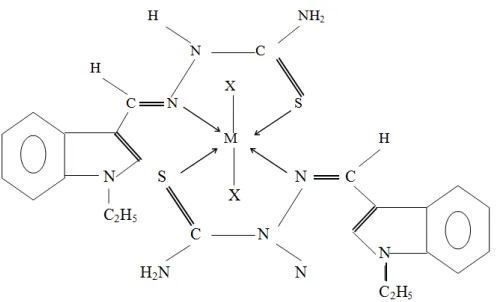
Fig.1: [M(EICT)2X2]; M = Co(II) and Ni(II); X = Cl-, Br-, I- and NO 3
-; M = Cu(II); X = Cl-, Br- and NO 3
-geometry. The octahedral geometry of Co(II)
complex is supported29-31 by high m
eff value in the
range 4.87-4.99 B.M. The Ni(II) complexes exhibit
three bands in the region 11430-11540 cm-1,
18300-18390 cm-1 and 23170-23400 cm-1 assigned to
transitions 3T
2g (F) ←
3A
2g (F),
3T
1g (F) ←
3A
2g (F) and
3T
1g (P) ←
3A
2g (F) respectively, which indicate
octahedral28,32 geometry for all the Ni(II) complexes,
which is further supported29,30,33 by the m
eff value in
the range 3.2-3.14 B.M. for all the Ni(II) complexes. The Cu(II) complexes display two ligand field bands
in the region 16010-16220 cm-1 and 22100-22260
cm-1 assigned to the transitions 2T
2g ← 2E
g and charge transfer band respectively. The electronic spectra of all the Cu(II) complexes suggest
octahedral28,34 geometry around central metal ion.
The magnetic moment value of Cu(II) complexes
lie in the range 1.87-1.96 B.M.29,30,35
Molar conductivity
Molar conductance data of the complexes were measured in the solvent DMF and the
complexes were found to be nonelectrolytic36 in
nature. The molar conductance value of the
complexes is in the range 12.1-17.9 ohm-1 cm2
mol-1.
Antifungal activity
antifungal activity against Aspergillus flavus and
Aspergillus niger by disc plate method37. On
comparison with reference to fungicide, the complexes were found to move more effectively
than free ligand due to chelation theory38.
CONCLUSION
On the basis of above mentioned studies the complexes tentatively proposed an octahedral geometry as shown in Fig.1.
ACKNOWLEDGMENTS
B.K. Rai thanks University Grant Commission, for awarding Minor Research Project [Grant No.PSB-001/08-09 dated 12 Dec-2008]. The authors are grateful to professor D.C. Baluni, Professor and Head Deptt. of Zoology , R.D.S. College, Muzaffarpur for his help in determination of antifungal effect of ligand and complexes.
REFERENCES
1. Rai A., Sengupta S. K. and Pandey O. P.,
Indian J. Chem., 39A: 1198 (2000).
2. Kar D. M., Sahu S. K., Pradhan D., Dash G. K.
and Misra P. K., J. Teaching Res. Chem., 10: 20 (2003).
3. Verma M., Nath S., Singh K. N. and James P.
S., Acta Pharmaceutica, 54: 49 (2004).
4. Trivedi G. S. and Desai N. C., Indian J. Chem.,
31B: 366 (1992).
5. Dunniyamurthy T, Kalra S. J. S. and Iqbal J.,
Tetrahedron Lett., 36: 8497 (1995).
6. Hitoshi T., Tamao N., Hideyaki A., Manabu
and Takayuki M., Polyhedron, 16: 3787
(1997).
7. Parashar R. K. and Sharma R. C., J. Inor.
Biochem., 28, 225 (1987).
8. Chui Y. K., Chjo K. H., Park S. M. and
Daddaponani N., J. Electrochem. Soc., 142: 4107 (1995).
9. Katia B., Simon L., Anne R., Gerard C.,
Francoise D. and Bernard M., Inorg. Chem., 35: 387 (1996).
10. a) Rai B. K., Asian J. Chem., 22: 2761 (2010).
b) Rai B. K. and Kumar Chandan, Asian J. Chem., 22: 5613 (2010)
c) Rai B. K. and Singh Sateydeo, Asian J. Chem., 22: 5619 (2010)
d) Rai B. K. and Sharma K. K., Asian J. Chem., 22: 5625 (2010)
11. a) Rai B. K., Kumar Hitesh, Sharma Minaxi
and Rastogi V. K., J. Indian Chem, Soc, 87: 1241 (2010).
b) Kishore K. R. and Rai B. K., Asian J. Chem., 22: 8055 (2010).
c) Rai B. K. and Kumar Bimal, Asian J. Chem. 22: 8073 (2010).
d) Rai B. K. and Singh S., Orient J. Chem, 26: 989 (2010).
e) Rai B. K. and Kumar Chandan, Orient J. Chem, 26: 1019 (2010).
c) Rai B. K.and Kumar, Orient J. Chem., 26: 1097 (2010).
12. Rai B. K. and Kumari Rachana, Asian J.
Chem., 23: 4625 (2011).
13. Rai B. K., Sinha Puja, Vidyarthi S. N. and
Singh Vineeta, Asian J. Chem., 23: 4629 (2011).
14. Rai B. K. and Kumar Bimal, Asian J. Chem.,
23: 4635 (2011).
15. Rai B. K., Singh Vineeta, Vidyarthi S. N. and
Sinha Puja, Asian J. Chem., 23: 4638 (2011).
16. Rai B. K. and Anand Puja, Orient J. Chem.,
28: 525 (2012).
17. Kemp William, Organic Spectroscopy,
Polgrave, Macmillan Press Ltd, New York, Silverstein R. M. and Webster F. X., Spectrometric Identification of Organic
Compounds 6th edn, John Wiley and Sons,
109, 2008, (2008).
18. Patil M. S. and Shah J. R., J. Indian Chem;
Soc, 58, 944 (1981).
19. Maurya R. C., Patel P. and Rajput S., Synth.
React. Inorg. Metal-Org. Chem., 33, 817
(2003).
20. Rao C. N., Chemical Application of IR
Spectroscopy, Academic Press, New York, 260 (1963).
Indranil Chakraborti, Synth. React. Inorg. Met. Org. Chem., 25: 679 (1995).
22. Ferraro J. R., “Low Frequency Vibration of
Inorganic and Co-ordination Compound”, Plenum Press, New York.
23. Goldstein M. and Unswarth D., Inorg. Chim,
Acta, 4: 342 (1970).
24. Nakamoto K., Infrared Spectra of Inorganic
and Coordination Compounds, John Wiley and Sons, New York (1976).
25. Addison C. C., Logan N., Wallwork S. C. and
Barner D. C., Quart, Rev (1971).
26. Nyquist R. A., Putzig C. L., Leugers M. A.,
Infrared and Raman Spectral Atlas of Inorganic Compounds and Organic Salts, Academic Press, New York (1995).
27. Mane P. S., Shirodhar S. G., Arbad B. R. and
Chondekar T. K., Indian J. Chem, 40 A, 648 (2000).
28. Lever ABP, Inorganic Electronics
Spectroscopy, Elsevier Amsterdam, 395 (1968); Jorgenson C. K., Acta Chem.; Scand, 19, 887 (1966). Allen J. R, Brown D. H., Nutal R. H. and Sharp D.W. A., J. Inorg Nucl. Chem, 26, 1895 (1964).
29. Figgis B. N., Introduction to Ligand Field,
Wiley Eastern Ltd., New Delhi, 279 (1976).
30. Carlin R. L. and Van Dryneveledt A. J.,
Magnetic Properties of Transition Metal Compounds, Springer Verlag, New York (1997).
31. Ballhauson C. J. and Gray H. B., Inorg. Chem.,
1: 111 (1962).
32. Tahir A. K., Shivajnl H. S. and Shoukat K.,
Indian J. Chem Sect, A. 39: 450 (2000).
33. Jetty V. K., Singh J., Shukla M., Rehman and
Rastogi S. N., J. Indian Chem. Soc., 67: 987 (1990).
34. Mishra A. P., Khare M. and Gautam S. K.,
Synth. React. Inorg. Met. Org. chem; 32: 1485 (2002).
35. Singh N. K. and Agarwal N. K., Indian J. Chem.
Sect. A., 37: 276 (1998).
36. Wolmsley J. A. and Tyree S. V., Inorg. Chem.,
2, 312 (1963); Sathyanarayan D. N. and Patel C. C., Indian J. Chem., 5: 360 (1967).
37. Mukherjee P. K., Saha K., Giri S. N., Pal M.
and Saha B. P.; Indian J. Microbiology, 35
(1995).
38. Nishant N., Ahmad S. and Ahmad R. T., J.