Research article
Available online
www.ijsrr.org
ISSN: 2279–0543
International Journal of Scientific Research and Reviews
Chronic aerobic exercise - a boon to pulmonary functions
Bharali Rwitusmita*, Chutia Horshajyoti and Baishya Reeta
Department of Physiology, Assam medical college,Dibrugarh-786002
ABSTRACT
Regular aerobic exercise enhances physical capabilities and physiological responses of the human body and the lungs are of no exception. On the other hand, impaired respiratory function is associated with various morbidity and mortality. Spirometry serves as a tool to assess the lung functions. So, the present study is aimed at comparing lung function tests of young footballers of Assam medical college and comparing them with sedentary group. A total of 100 subjects comprising footballers and sedentary were assessed for pulmonary function test. The parameters used as determinants of lung function were FVC, FEV1, PEFR and FEV1/FVC ratio, which were recorded as per standard procedure using Medspiror. The results showed a statistically significant increase in the values of FVC, FEV1, FEV1/ FVC and PEFR in footballers compared to sedentary group. This study suggests that regular aerobic exercise plays a pivotal role in improving the lung functions.
KEYWORDS- Aerobic exercise, Footballers, Pulmonary function tests, Sedentary group
Corresponding author
:-
Rwitusmita Bharali,
INTRODUCTION
:
-Regular exercise leads to numerous and varied physiological changes which improves the
quality of life. The American College of Sports Medicine (ACSM) defines aerobic exercise as "any
activity that uses large muscle groups, can be maintained continuously, and is rhythmic in nature." It
is a type of exercise that overloads the heart and lungs, and causes them to work harder than at rest.1
Footballer’s training session includes rigorous aerobic exercise like walking, jogging, running and
skipping. Regular exercise improves cardio-respiratory function and skeletal muscle function.
Pulmonary functions are generally determined by the strength of respiratory muscles, compliance of
the thoracic cavity, airway resistance and elastic recoil of the lungs.2 Exploration of the relation
between aerobic exercise and lung functions, will aid in understanding the mechanisms of how
aerobics improves the overall physical and psychological well-being. Hence the present study was
undertaken to study the pulmonary functions of young male footballers and to compare them with
age matched sedentary group.
MATERIALS AND METHOD:
-
This study was conducted in the Department of Physiology, Assam medical college,
Dibrugarh. A total of 50 footballers and 50 sedentary subjects, all students of the Assam medical
college, participated in the study. They were aged 17-24 years. Their ages, smoking habits, physical
status and health conditions were recorded by using a questionnaire. The ethical committee clearance
and an informed consent of the subjects were taken. Footballers training session included aerobic
exercise training of 1hr in the morning and 2hrs in the evening daily. Only those footballers were
included who had undergone the training for more than 6months.Subjects with clinical abnormalities
of the vertebral column and the thorax, diabetes mellitus, pulmonary tuberculosis, bronchial asthma,
chronic bronchitis, bronchiectesis, emphysema and malignancy, and those who smokes, chews
tobacco and those who had undergone abdominal or chest surgery and those with BMI≥25were
excluded from the study. Subject’s height and weight were measured and then BMI was derived by
Quetelet's index. Measurements were taken between 8 AM and 12 PM to avoid diurnal variations in
lung functions. Procedure was explained to each subject before the test. The lung function tests were
carried on all the subjects as per the standards mentioned by M.R Miller et al3,4 by using a
Med-spiror (Recorders and Medicare System, Chandigarh). Lung function parameters like Forced
Expiratory Volume in 1 second (FEV1), Forced Vital Capacity (FVC), FEV1 / FVC Ratio and Peak
Data analysis:-
The data was analyzed by using Microsoft Excel and Statistical Package of Social Sciences
(SPSS version 20.0). The mean and standard deviation (SD) were calculated and reported for the
quantitative variables. The statistical difference in the mean values was tested by using one way
ANOVA (analysis of variance) with post-hoc turkey tests. A p-value of < 0.05 was considered as
statistically significant.
RESULTS:-
The study population consisted of total 100 individuals included in two different categories
namely sedentary group(50) and footballers(50). The mean±SD values of age and anthropometric
measurements of both groups are shown in table 1. The findings suggest that the two groups didnot
differ significantly with respect to age and anthropometric parametres.
TABLE 1:-Showing the mean±SD of age and anthropometric measurements in study population
PARAMETERS FOOTBALLERS SEDENTARY
GROUP
p-VALUE SIGNIFICANCE
AGE(Years) 21±2.4 20±3.3 0.0863 NS
HEIGHT(cm) 1.62±2.56 1.60±3.04 0.9717 NS
WEIGHT(Kg) 54±4.70 55±2.90 0.2034 NS
p value > 0.05 was non-significant (NS);p value < 0.05 was significant(S)
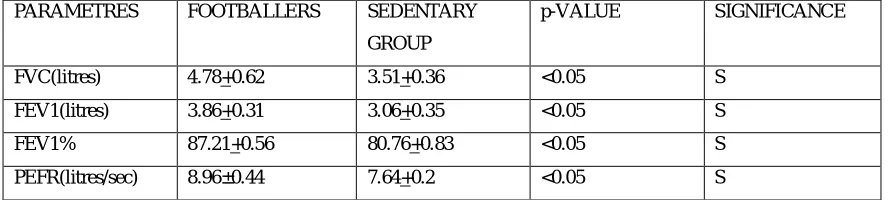
The mean±SD of the various lung function parameters in the study population is shown in
table 2. Mean FVC of footballers was higher compared to sedentary subjects and the difference was
statistically significant. The result is shown in figure 1.There was also a statistically significant
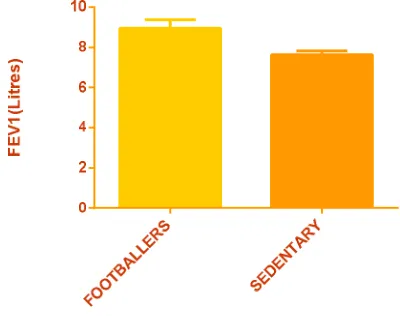
increase in values of FEV1 in footballers as shown in figure 2. Similarly the mean values of FEV1%
and PEFR showed a significant increase in footballers as compared to sedentary group as depicted in
figure 3 and 4 respectively.
TABLE 2:-Showing mean±SD of the various lung function parameters in the study population
PARAMETRES FOOTBALLERS SEDENTARY
GROUP
p-VALUE SIGNIFICANCE
FVC(litres) 4.78+0.62 3.51+0.36 <0.05 S
FEV1(litres) 3.86+0.31 3.06+0.35 <0.05 S
FEV1% 87.21+0.56 80.76+0.83 <0.05 S
PEFR(litres/sec) 8.96±0.44 7.64+0.2 <0.05 S
FIGURE 1:- Showing mean±SD of FVC in the study population
FIGURE 2 :- Showing mean±SD of FEV1 in the study population
FOO TBA
LLE RS
SED ENTA
RY
F
E
V
1
(L
it
re
s
)
FIGURE 4:- Showing mean±SD of PEFR in the study population
DISCUSSION:-
Results obtained from the present study showed that mean±SD value of FVC in footballers
(4.78+0.62litres) was significantly higher than sedentary group(3.51+0.36 litres).similiar results were
observed by Onadeko et al5, Bjorstrom et al6 and Shivesh Prakash et al7. Hagberg8 reported that
values for static lung volumes (TV and FVC) of accomplished marathoners and other endurance
trained athletes was not different from those of untrained controls. However, Douglass G and et al.
also reported higher mean FVC scores in athletes as compared to non-athletes.
The mean±SD value of FEV1 in footballers and sedentary group was 3.86+0.31litres and
3.06+0.35 litres respectively. The statistically significant increase of FEV1 in footballers which was
recorded is in agreement with the findings of Y.J. Cheng et al9, Riza Farid et al10 and ShobhaRani
Vedala et al11; but Olufeyi A. Adegoke et al12 and Ayesha AK et al13did not observe any significant
change in FEV1.
Measurements of FEV1% in the present study showed a significant difference in the two
groups of study population. Similiar findings were noted by ShobhaRani Vedala et al11 but,
Adegoke OA et al12 and Hagberg8 observed no significant differences in between athletes and non
athletes.
The conflicting findings may be due to genetic and ethnic factors.
In the present study the PEFR of footballers (8.96±0.44litres/sec) was significantly higher
than the sedentary group (7.64+0.2 litres/sec). The increase in PEFR was also reported by Shobha
Rani Vedala et al11 and Chaitra B et al14.
Lung dimensions, compliance and respiratory muscle power determines the vital capacity,
The period of exercise to bring improvement in PFT varied from 1 month to 8 months reported by
various researchers in India.Regular exercise increases the strength and function of muscles, making
them more efficient. The increase muscle strength helps the lung to inflate and deflate maximally.
This maximum inflation and deflation is an important physiological stimulus for the release of
surfactant as stated by Hildebrean et al15. The findings of the present study can also be explained on
the basis of better functions of respiratory muscle strength, improved thoracic mobility and the
balance between lung and chest elasticity which the footballers may have gained from regular
exercise.
CONCLUSION:-
In conclusion, the current study has shown that, the pulmonary function parameters were
higher in footballer than in the sedentary group indicating that regular exercise produces numerous
favourable changes that collectively result in the body being able to work in a far more efficient
manner.
Perhaps one of the greatest challenges we face in developed societies is how to facilitate and
encourage healthier lifestyles that include regular physical activity. Left unchecked, this problem will
contribute to ever-increasing health care costs and higher disease rates. Regular exercise is not the
magic bullet in terms of disease prevention, but when combined with a healthy diet, it may be the
best intervention currently available to anyone who is willing to get up off the couch.
REFERENCES:-
1. American College of Sports Medicine. Guidelines for exercise testing and
prescription. 3rd ed. Philadelphia: Lea and Febiger, 1988:168-169
2. Cotes JE. Lung Function Assessment and Application in Medicine; 3rd ed. Oxford: Blackwell ScientificPublications;1975:281-7.
3. Miller MR, Hankinson J, Brusasco V, Burgos F, Casaburi R, Coates A et al. Standardization of spirometry series “ATS/ERS Task Force”: Standardization of Lung
Function Testing. European Respiratory Journal. 2005; 26 (2): 321.
4. Miller MR, Hankinson J, Brusasco V, Burgos F, Casaburi R, Coates A, et al. Standardization of spirometry Series “ATS/ERS Task Force”: Standardization of Lung
Function Testing; European Respiratory Journal. 2005;26 (2): 326
6. Bjourstrom R. L, Schocne RB.Control of ventilation in elite synchronized swimmers. J Appl Physiol. 1987;63(3):1019-24
7. Prakash S, Meshram S, Ramlekkar U. Athletes, Yogis and individuals with sedentary life styles, Do their lung functions differ? Indian J. Physiol Pharmacol. 2007; 51 (1): 76-80.
8. Hagberg J M. Pulmonary function in young and older athletes and untrained men. J. Appl. Physiol. 1988; 65:101-4
9. Y.J. Cheng et al. Effects of Physical Activity on Exercise Tests and Respiratory Function. Br. J. Sports Med. 2003;37:521-528
10. Riza Farid et al. Effect of Aerobic Exercise Training on Pulmonary Function and Tolerance of Activity in Asthmatic Patients. Iran J Allergy Asthma Immunol.2005; 4(3):
133-38
11. ShobhaRani Vedala, Niranjan Paul, Abhay B Mane.Difference in pulmonary function test among the Atheletic and sedentary population.National Journal of Physiology, Pharmacy
& Pharmacology.2013; 3(2) :118 – 123
12. Adegoke OA, Arogundade O. The effect of chronic exercise on lung function and basal metabolicrate in some Nigerian athletes. African Journal of Biomedical. Research 2002; 5:
9- 11
13. Khanam AA, Sachideva U, Gulesia R, Deepak KK. Study of Pulmonary and Autonomic functions of Asthma Patients after Yoga Training. Indian J. Phsiol Pharmacol 1996; 40 (4):
318-324.
14. Chaitra b, Pandurang Narahare, Nagaraja Puranik and Vijay Maître. Effect of aerobic exercise training on pulmonary functiontests: a pragmatic randomized controlled trial.
International Journal of Pharma and Bio Sciences.2011; 2(4):455-460