Licensed under Creative Common Page 1
http://ijecm.co.uk/
ISSN 2348 0386
PUBLIC PROCUREMENT AUDIT PROCESS IN PRACTICE
A CASE STUDY OF THE PUBLIC PROCUREMENT AUTHORITY OFFICE IN KUMASI AND
THE PROCUREMENT UNIT OF THE KUMASI POLYTECHNIC
Etse, Daniel
Kumasi Polytechnic, Kumasi, Ghana
Asenso-Boakye, Maxwell
Kumasi Polytechnic, Kumasi, Ghana
Abstract
This study aimed at making information available on how public procurement audit is carried out
in practice in Ghana’s public sector establishments. The coverage of this study is limited to the
Northern Zonal Office of the Public Procurement Authority and the procurement unit of Kumasi
Polytechnic. A survey was conducted on these two Ghanaian public sector institutions and
responses were obtained with regards to the methods and procedures used in auditing public
procurement activities. Five main stages of audits were outlined by the respondents, these
stages are: audit notification; pre-audit meeting; auditing activities; exit conference; and
presentation of audit report. Main auditing activities include: interviewing relevant stakeholders;
documentary audits; questionnaires; and various discussions with all those whose information
are relevant to the audit exercise. Findings also indicate that: public procurement entities are
audited at least once every year; the Ghana Audit Service are the main auditors of public
entities; and the procurement audit process is relatively easy and simple from the point of view
of the auditees.
Keywords: Public Procurement; Audit Process in Practice; Public Procurement Audit
INTRODUCTION
Ignorance of the method and process of performing a given function has the danger of
sub-optimal achievement; inefficiency; and in some cases a complete destruction of a system. In the
case of public procurement audit, the use of poor auditing process has the risk of keeping weak
Licensed under Creative Common Page 2
report them. Other risks to public procurement due to poor audit practices include: waste of
public resources; lack of fair and transparent procurement process; lack of accountability; and
failure to comply with procurement rules and procedures. All these have the ultimate effect of
adversely affecting the national development efforts.
The thrust of this study is to find out what has been recorded in the literatures with
regards to the process of public procurement audit and also to ascertain how public
procurement audits are done in practice in some public institutions in Ghana. This study has
potential benefits for academic purposes (i.e. those who want to know how public procurement
audits are performed in public institutions in Ghana), the audit service; this will help the audit
service to know whether audits are being performed as expected. Experts in procurement audit
can also use this study to proffer expert opinion on the appropriate ways of performing public
procurement audits. The salient points of this study are: literature review; method of data
collection and analysis; research findings and discussions of findings; recommendations and
conclusion.
LITERATURE REVIEW
Public Procurement Audit
The auditing function has the primary objective of providing reasonable assurance that a set of
specified and established criteria have been complied with; and it involves the collection and
evaluation of sufficient evidence to determine whether an assertion corresponds with
established criteria (Abdolmohammadi and Thibodeau, 2007). The two main forms of audits
often referred to are: internal and external audits. The main difference between these two
borders on the extent of details; whilst internal audit generally is concerned about the whole
operations of an institution with respect to certain five key internal control objectives and not just
the financial aspects, external audits mainly focuses on financial control systems that have
direct, significant effect on the financial performance of the institution (Encyclopedia of Small
Business, 2007).
Drawing from the definitions Abdolmohammadi and Thibodeau (2007), public
procurement audit can be explained as the process of gathering and evaluating sufficient
evidence on government procurement activities to ascertain whether specified laid down
procedures have been complied with or not. Public procurement audits are seen as very
important to the realisation of value addition to government procurement in terms of ensuring
accountability, transparency, prevention of improper procurement practices, and improving upon
Licensed under Creative Common Page 3 Reasons for Public Procurement Audit
The basic reason for conducting audits including public procurement audits is to ascertain
whether performance measures up to pre-determined standards within defined parameters so
that changes can be implemented to improve standards (Hart, Northmore and Gerhardt, 2009).
Some specific reasons for public procurement audits are; to prevent fraud, to provide assurance
with regards to effective and efficient operations, to ensure reliable financial reporting, to comply
with laws and regulations, to address corruption, and to prevent future mistakes (Wayne State
University, 2014; Petrovits, Shakespeare and Shih, 2009; Krivinsh and Vilks, 2013). Moreover,
public procurement is audited to verify whether there was an actual need for a given
procurement; whether the procurement procedure achieved value for money, and whether
public procurement regulations were adhered to (Pelzer, n.d.).
Public Procurement Audit Procedures
The main objective for auditing public procurement is to ensure that procurement activities are
done in an effective, efficient, and economical manner within the provisions of relevant acts,
regulations and guidelines (Office of the Auditor General- Nepal, 2005). A public procurement
performance audit document of city of Chesapeake- Virginia indicates that the procurement
audit process entails a number of activities including the following: a comprehensive review and
evaluation of relevant public procurement policies, procedures, and operations, contract
documents and reports as well as all relevant documents; interviewing those involved in the
procurement activities; holding discussions with consultants contracted; information obtained is
analysed and a report is generated (Audit Services Department; Chesapeake-Virginia, 2010).
In the document „Government Auditing Standards‟, the Office of the Auditor General of Nepal
outlines the following procurement audit procedures as guidelines for public procurement audit:
Checking of accounting records; these records are examined to ascertain how true and
fair a financial statement is and the extent to which government approved accounting
practices have been complied with. To this end accounts should be verified to check if
proper accounting records have been maintained and if all figures have been properly
recorded. In addition, invoices issued by suppliers or contractors should be verified to
ascertain if they are in agreement with the government approved format;
Examination of files and documents; this is to establish if appropriate files have been
maintained by the procurement entities, and whether these files are well documented
and properly organised. Such examinations provide understanding with regards to
procurement proceedings, views expressed at different levels of authorities, and duration
Licensed under Creative Common Page 4
auditors to identify risk areas of a procurement process so as to be able to plan
appropriately and draw well informed conclusions;
Field observation and inspection; this entails visiting the entities‟ office or project site to
acquaint oneself with actual situations at the field level. Field observation is expected to
include activities such as interviews with officials, suppliers, contractors, and other
stakeholders. It also requires carrying out physical verification, checking of site registers
and other records, taking photograph, and conducting other appropriate checks as
demanded by the prevailing situation;
Checking if relevant legal provisions have been complied with; the audit exercise is also
used to ascertain the extent to which public procurement practices conform to the
relevant legal and regulatory provisions. To this end the audit process entails checking if
each action carried out is in accordance with established system, procedures and norms
adopted by the procurement entity within the provision of the related laws and
regulations (Office of the Auditor General- Nepal, 2005).
Public Procurement in Ghana
Ghana, like many other developing countries have over the years come to realise the critical
role of sound procurement policies in poverty reduction, attainment of health and educational
objectives, and prudent management and utilisation of national resources (Evenett and
Hoekman, 2006). Over the years Ghana has made attempts at improving her public
procurement process by doing a number of things including: the enactment of a public
procurement act in 2003 to provide a sound legal and institutional framework for a standardised
procurement system; the creation of a public procurement authority to provide effective and
efficient administrative function for public procurement; actively participating in international and
regional procurement networks; infusing professionalization and capacity development by
providing educational and training opportunities in the area of public procurement; and creating
space for a vibrant civil society to serve as a watchdog against corruption and to engender
accountability and social responsibility (World Bank, 2013; Public Procurement Authority, 2013).
However, the advantages of an effective and efficient procurement system continue to elude
Ghana due to problems such as weak monitoring and evaluation of the use of financial
resources; weak compliance with financial regulations; deficiencies in accounting and auditing,
especially internal auditing; and poor record keeping (Ministry of Finance, 2013).
It has been identified that though a number of developing countries have reformed their
public procurement system, many of the systems remain weak and serve to squander scarce
Licensed under Creative Common Page 5
cannot be over stated, and one of the surest ways of doing that is by ensuring effective
monitoring and auditing (Wittig, 2003).
Public Procurement Audit in Ghana
The section 1.8 of Ghana‟s public procurement manual provides that each procurement entity
must ensure regular internal monitoring of procurement activities which is to be performed by
the Public Procurement Board, and this is aimed at assessing the professional efficiency and
effectiveness of procurement as well as to ensure the overall effectiveness of the procurement.
This provision is rooted in section 91 of the public procurement act which states that the
Auditor-General shall conduct annual audits of procurement activities of procurement entities; the same
shall carry out specific audits into the procurement activities of procurement entities and
compliance by contractors, suppliers and consultants; and the statutory audit of procurement
activities may be relied on by the procurement board for system improvement purposes (Public
Procurement Act, 2003; Public Procurement Manual, 2006).
The Ghana Audit Service is the state institution mandated to audit the activities of all
public institutions with the aim of promoting good governance in the areas of transparency,
accountability and probity in the management of financial and other public resources (Ghana
Audit Service, 2014). The Auditor- General who is the head of Ghana Audit Service, is enjoined
by section 13 of Ghana‟s Constitution to audit the public accounts of Ghana and all public
offices on annual basis and report the audit findings to Parliament (Ghana Audit Service, 2014;
Ghana Audit Service, 2012).
The primary objectives of procurement audits are to: determine whether proper
procedures have been followed by a procurement entity in its procurement administration;
ascertain whether activities of the entity are in accordance with relevant laws and regulations;
determine whether proper records have been maintained with respect to the entity‟s operations;
assess the adequacy of rules and procedures applied in procurement operations with regard to
the protection of public assets and property and ; ensure that procurement activities of the entity
are undertaken within the budgetary limits set by Parliament. The Audit Service is also expected
to ascertain whether internal control procedures established by public entities are adequate and
strong enough to protect public resources and ensure efficiency and effectiveness of operations
(Ghana Audit Service, 2010; Ghana Audit Service, 2012).
In conducting a procurement audit, the Audit Service carries out a number of exercises
among which are: understanding the procurement administration process of a procurement
entity; application of audit tools to facilitate the identification of various risks to which a
Licensed under Creative Common Page 6
administration and; reviewing all relevant documents of the procurement entity (Ghana Audit
Service, 2012). To proactively ensure efficiency, accountability, and transparency in the
management of public sector resources, Government in 2004 brought into force the Internal
Audit Agency Act. And the promulgation of this Act mandated public institutions to establish
internal audit units which are expected to report to the Auditor-General on the efficient and
judicious utilisation of public resources (Internal Audit Agency, 2008; Ghana Audit Service, n.d.).
A number of entities in Ghana, especially civil society advocates have expressed grave
concerns about the effectiveness of public procurement audits and public audits in general. For
instance the Institute of Economic Affairs, an independent public policy institute in Ghana,
lamented that though the Auditor-General documents and reports on misappropriation of public
funds, identical cases of such misappropriations have become perennial often within the same
government departments and agencies (Ofori-Mensah and Rutherford, 2011). This is an
indication that the audit activities and subsequent audit reports are not doing much to correct
and prevent the weaknesses in the public sector institutions.
RESEARCH METHODOLOGY
One of the methods used to obtain in-depth understanding of a concept is the case study
method; this is because many of the variables studied by social scientists are notoriously
difficult to measure using the conventional statistical approach (George and Bennett, 2004).
Furthermore, in investigating a phenomenon which is yet to be sufficiently understood, case
study is deemed very appropriate for such exploratory work (Seuring, 2008; Yin, 2003). These
scholarly considerations influenced the choice of case studies in this particular research. The
thrust of this research is to establish the processes employed in conducting public procurement
audit; this is an initial step towards a study of the propriety, effectiveness and efficiency of the
public procurement audit method used in Ghana.
Two important public institutions: the public procurement office- Kumasi and the Kumasi
Polytechnic procurement unit. The Kumasi office of the Public Procurement Authority is
responsible for the entire Northern Sector of Ghana as the administrative head office of the
Public Procurement Authority, this makes the Kumasi office a very important public procurement
office in Ghana. Kumasi Polytechnic is a very important tertiary academic institution in Ghana,
and one of the institutions which pioneered the study of purchasing and supply as an academic
discipline. Considering the status of these public sector institutions in the scheme of affairs of
Ghana, it is reasonable to anticipate that credible and worthwhile information would be obtained
from them, hence the choice of these as the cases of this study.
Key officials who are involved in procurement responded to questionnaires. Officers who
Licensed under Creative Common Page 7
Authority, the director of procurement of Kumasi Polytechnic, accountants of the two institutions
as well as procurement officers, staff of internal audit units, and all officers of the two institutions
who answer directly or indirectly to the Auditor-General when there is a procurement audit
activity. A total of fifty (50) questionnaires were administered out of which forty one (41) were
answered by officials of these two institutions. Questionnaires answered included questions on
frequency of audits, auditors who conduct the audit, reasons why the audits are conducted,
procedures and stages of public procurement audits, and the complexity of the audit process.
FINDINGS
The following were some of the findings made after analysing the responses of the 41
respondents. The software; SPSS was used in processing the data gathered, more emphasis
was however on the processes involved in the audits and conditions under which audits are
conducted than the number of respondents who indicated a particular response. This is
because it was observed that respondents of the two institutions provided basically the same
information, the difference however was in the level of details provided by each respondent.
Inferring from responses provided, some of the respondents were more familiar and conversant
with the audit processes than others, and such respondents provided more detailed responses.
In the following paragraphs the key findings of the study are stated and discussed:
Audit Frequency
All the respondents indicated that procurement activities of their institutions are audited. It came
to light that routine procurement audit of these institutions take place once every year. However,
internal audits and special audits are conducted as and when necessary. This annual audit
exercise and special audits agree with the provisions of section 91 of the public procurement act
and the constitutional mandate of the Auditor-General (Public Procurement Act, 2003; Ghana
Audit Service, 2014). Refer to tables 1 and 2 for the research results on audit frequency.
Table 1: Whether Public Procurement Activities of the Agency are Audited or No.
Frequency Percent Valid Percent
Cumulative Percent
Licensed under Creative Common Page 8
Table 2: Audit Frequency
Frequency Percent Valid Percent
Cumulative Percent
once a year 21 51.2 51.2 51.2
once by audit service and once by internal audit
10 24.4 24.4 75.6
when audit need arises 5 12.2 12.2 87.8
once every year and when need arises
5 12.2 12.2 100.0
Total 41 100.0 100.0
Public Procurement Auditors
All respondents indicated that their institutions have an internal audit unit. Ghana Audit Service
is mentioned as the main external auditors. Some of the respondents indicated that under
special circumstances private audit firms are engaged to conduct audits. The presence of
internal audit units in the institutions of this study implies that these institutions have complied
with the Internal Audit Agency Act of 2004 (Internal Audit Agency, 2008).
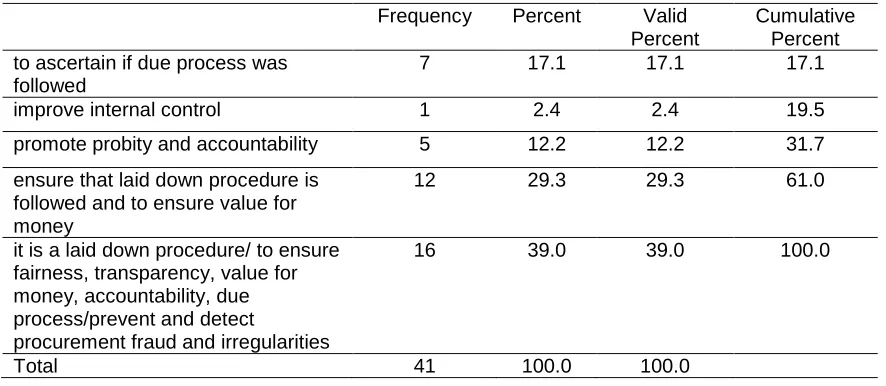
Reasons for Public Procurement Audits
Respondents provided a number of reasons why procurement audits are conducted among
these are: to ascertain whether due process was followed in procurement; to improve internal
control of procurement entities; to ascertain whether relevant procurement regulations have
been complied with; to promote accountability; to detect and prevent procurement irregularities;
to ensure fairness and transparency; and to ensure best value for money. Responses provided
are similar to reasons obtained from the literature review (Hart, Northmore and Gerhardt, 2009;
Petrovits, Shakespeare and Shih, 2009; Krivinsh and Vilks, 2013; Ghana Audit Service, 2014).
Refer to table 3.
Table 3: Reasons for Public Procurement Audits
Frequency Percent Valid Percent
Cumulative Percent to ascertain if due process was
followed
7 17.1 17.1 17.1
improve internal control 1 2.4 2.4 19.5
promote probity and accountability 5 12.2 12.2 31.7 ensure that laid down procedure is
followed and to ensure value for money
12 29.3 29.3 61.0
it is a laid down procedure/ to ensure fairness, transparency, value for money, accountability, due process/prevent and detect
procurement fraud and irregularities
16 39.0 39.0 100.0
Licensed under Creative Common Page 9 Public Procurement Audit Stages and Procedures
All the respondents indicated at least five main stages for the auditing activities namely: auditors
notifying procurement entity of an impending audit; meeting of management and relevant
stakeholders of the procurement entity with the audit team to clarify audit objectives; actual
performance of audit; exit conference; and subsequent presentation of audit report by auditors.
Main activities involved in the audit exercise as indicated by respondents include: interviews;
study of relevant procurement documents; discussions with officers in charge of procurement
and other related activities; and in some instances completion of questionnaires. Among the
documents reviewed are the following: standard tender documents; invitation letters; tender
evaluation reports; contract documents; stores records; budget/procurement plan; invoices and
payment certificates; and payment vouchers.
The audit procedures outlined by respondents have some similarities with the
procedures mentioned by the Audit Services Department; Chesapeake-Virginia (2010) and
Office of the Auditor General- Nepal (2005). However, audit activities such as review and
evaluation of public procurement policies and procedures, discussions with consultants of
procurement contracts; and field observations and inspections identified in the literature review
were not captured by responses provided by the respondents. This could mean that these audit
activities not mentioned by the respondents are not performed by auditors. If it is so then there
is the need for auditors to consider for instance the need to conduct field observations and
inspections; interviewing contract consultants and all whose involvement in a procurement
activity can furnish auditors with relevant information; and also conducting a comprehensive
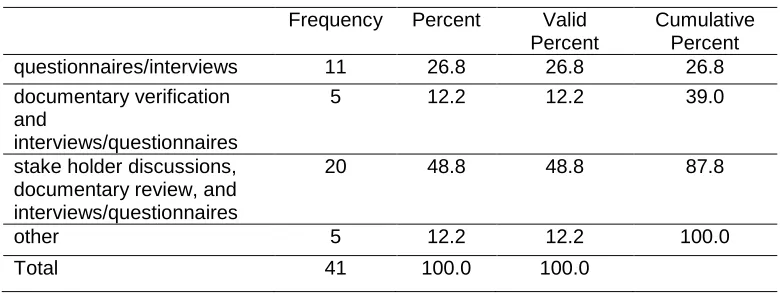
review and evaluation of procurement policies and procedures of the entities. Table 4 shows the
methods of conducting audit exercise.
Table 4: Auditing Methods
Frequency Percent Valid Percent
Cumulative Percent questionnaires/interviews 11 26.8 26.8 26.8 documentary verification
and
interviews/questionnaires
5 12.2 12.2 39.0
stake holder discussions, documentary review, and interviews/questionnaires
20 48.8 48.8 87.8
other 5 12.2 12.2 100.0
Total 41 100.0 100.0
Licensed under Creative Common Page 10 Complexity of the Audit Process
All other things being equal, public procurement entities will be able to conduct procurement
activities more effectively if they are conversant with procurement procedures they are expected
to follow. Laid down procurement policies and procedures are often the basis used by auditors
to verify and control the procurement activities of entities. Indicating that the procurement audit
process is simple and easy to understand implies that the respondents understand how
procurement should be done appropriately. This further suggests that violation of procurement
regulations and processes by respondents could be due to other reasons than ignorance. From
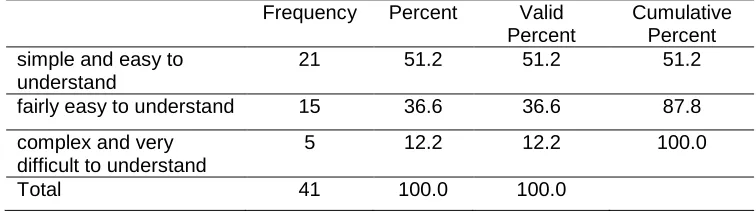
the responses provided (Refer to table 5) majority of the respondents are of the view that the
procurement audit process is simple and easy to understand.
Table 5: Complexity of Public Procurement Audit Process
Frequency Percent Valid Percent
Cumulative Percent simple and easy to
understand
21 51.2 51.2 51.2
fairly easy to understand 15 36.6 36.6 87.8 complex and very
difficult to understand
5 12.2 12.2 100.0
Total 41 100.0 100.0
RECOMMENDATIONS AND CONCLUSION
The main limitation of this study is the smallness of the sample size. Only two out of the many
public sector institutions in Ghana were covered by this study, and only one administrative
region out of the ten in Ghana. Due to this limitation, this study cannot be used to generalise for
all the public sector institutions in Ghana.
Future study should consider a large scale study with the aim of finding out the
procurement audit practice in other public sector establishments. Furthermore, future research
should test the relevance of the current audit practice in terms of its objectives of discovering
procurement irregularities and the prevention thereof as well as strengthening the internal
structures of public institutions to ensure effective and efficient procurement practices.
The processes involved in procurement audits as identified in this study appear to be rather
reactive instead of being pre-emptive and preventive. The responses provided did not indicate
measures such as vetting of contracts by auditors for propriety before the contracts are
awarded; periodic assessment of risks associated with procurement contract and alerting
relevant agencies to prevent losses; and empowering the internal audit units to adopt creative
Licensed under Creative Common Page 11
violations of regulations. The best way of auditing procurement is by preventing procurement
irregularities rather than reporting them.
The Ghana Audit Service should on regular basis review its audit techniques to ascertain
whether their intended purposes are being achieved effectively and efficiently. They should
always devise means of being ahead of procurement fraudsters, bid riggers; those who engage
in conflict of interest, and other corrupt procurement practices. This will enhance efficiency,
economy, effectiveness in procurement, integrity and accountability, as well as ensure that
taxpayers money is spent the best interest of the public.
REFERENCES
Abdolmohammadi, M.J. and Thibodeau, C.J. (2007) “Auditing”, in Kaliski, B.S.(ed.) Encyclopedia of Business and Finance.2nd edn. Detroit: Macmillan Reference, vol.1, pp. 42-45. Gale Virtual Reference
Library Web [Online]. Available at:
http://go.galegroup.com.vlib.interchange.at/ps/i.do?id=GALE%7CCX1552100029&v=2.1&u=wash89460&i t=r&p=GVRL&sw=w&asid=b1c30acdf2d1fd897382e642a4f6acfb (Accessed: 7 January 2014).
Encyclopedia of Small Business. (2007) “Audits, internal”. 3rd edn. Detroit: Gale, vol.1, pp.65-70. Gale
Virtual Reference Library Web [Online]. Available at:
http://go.galegroup.com.vlib.interchange.at/ps/i.do?id=GALE%7CCX2687200042&v=2.1&u=wash89460&i t=r&p=GVRL&sw=w&asid=b08d01c5fd31b3d17042c1c371e60f98 (Accessed: 7 January 2014).
Evenett, S.J. and Hoekman, B.M. (2005) International cooperation and the reform of public procurement policies. Paris: Institut d‟Etudes Politiques, Groupe d‟Economie Mondiale. The World Bank Policy Research Working Paper Series 3720.
George, L. A. and Bennett, A. (2004) Case studies and theory development in the social sciences. Cambridge: MIT Press.
Ghana Audit Service (2010) Report of the Auditor-General on the public accounts of Ghana, pre-university educational institutions for the financial year ended 31December 2010. Accra: Ghana Audit Service. Available at: http://www.ghaudit.org/reports/pre_university.pdf (Accessed: 17 January 2014). Ghana Audit Service (2012) Procurement audit report of the Auditor General on the Driver, Vehicle and Licensing Authority (DVLA) headquarters covering the period January 2008 to December 2009. Accra: Ghana Audit Service. Available at: http://www.ghaudit.org/reports/DVLA_SINGLES_COVER.pdf (Accessed: 17 January 2014).
Ghana Audit Service (2014) Welcome to Ghana Audit Service. Available at: http://www.ghaudit.org/gas/?message=welcome (Accessed: 17 January 2014).
Ghana Audit Service (n.d.) Profile on sectors within the audit service. Available at:
http://www.ghaudit.org/publications/microsoft+word+-+profile+on+sectors+within+the+audit+serviceedited.pdf (Accessed: 19 January 2014).
Ghana. Ministry of Finance (2013) Background to Ghana‟s public financial management system. Available at: http://www.ghana.gov.gh/index.php/2012-02-08-08-18-09/ministries/252-ministry-of-finance-and-economic-planning (Accessed: 17 January 2014).
Hart, A., Nothmore, S. and Gerhardt, C. (2009) Auditing, benchmarking and evaluating public engagement. Bristol: National Co-ordinating Centre for Public Engagement. Available at: https://www.publicengagement.ac.uk/our-research/literature-reviews-and-research (Accessed: 7 January 2014).
Licensed under Creative Common Page 12 Krivinsh, A. and Vilks, A. (2013) “Prevention of corruption in public procurement: importance of general legal principles”, Jurisprudence, 20(1), pp. 235-247.
Mapesa, M. and Kibua, N. (2006) An assessment of the management and utilisation of the constituency development fund in Kenya. Nairobi: Jomo Kenyatta Foundation.
Nepal. Office of the Auditor General (2005) Government auditing standards: procurement audit. Available at: http://www.oagnep.gov.np/downloadfile/Procurement%20Guide-Eng_1301381856.pdf (Accessed: 14 January 2014).
OECD (2005) “Strengthening procurement capacities in developing countries”. Paris: OECD Publishing. Ofori-Mensah, M. and Rutherford, L. (2011) “Effective parliamentary oversight: mission impossible?”, Governance Newsletter, 17(3), pp.1-9.
Pelzer, W. (n.d.) Public procurement process to improve transparency and accountability. Available at: http://sadcopac.wikispaces.com/file/view/Windhoek%20Presentation%203.pdf/331002610/Windhoek%20 Presentation%203.pdf (Accessed: 11 January 2014).
Petrovits, C., Shakespeare, C. and Shih, A. (2009) The causes and consequences of internal control
problems in non-profit organisations. Available at:
http://pbfea2005.rutgers.edu/20thFEA/AccountingPapers/Session4/Petrovits,%20Shakespeare,%20and% 20Shih.pdf (Accessed: 11 January 2014).
Public Procurement Authority (2013) “Act 663- antidote to corruption in public procurement”, E-Bulletin, 4(4), pp. 1-12, [Online]. Available at: http://ppaghana.org/documents/Bulletins/PPAE-BulletinJulAug2013Final.pdf (Accessed: 17 January 2014).
Seuring, S. (2008) “The rigor of case study research in supply chain management”, Supply Chain Management: An International Journal, 13(2), pp. 128-137.
The World Bank (2013) Ghana‟s comprehensive approach to public procurement reform. Available at: http://www.worldbank.org/en/news/feature/2013/02/04/Ghana-8217-s-Comprehensive-Approach-to-Public-Procurement-Reform (Accessed: 17 January 2014).
Virginia. Audit Services Department (2010) Public procurement performance audit: July 1 2005 through
December 31 2009. Available at:
http://www.cityofchesapeake.net/Assets/documents/departments/audit/department-audits/Audit-Public-Procurement-Department.pdf (Accessed: 14 January 2014).
Wayne State University (2014) Fraud red flags. Available at: http://internalaudit.wayne.edu/fraud.php (Accessed: 11 January 2014).
Wittig, W. A. (2003) Public procurement and the development agenda. Geneva: International Trade Centre.