R E S E A R C H A R T I C L E
Open Access
The
eClinical Care Pathway Framework
:
a novel structure for creation of online
complex clinical care pathways and its
application in the management of sexually
transmitted infections
Jo Gibbs
1,2*, Lorna J. Sutcliffe
1, Voula Gkatzidou
3, Kate Hone
3, Richard E. Ashcroft
4, Emma M. Harding-Esch
5,
Catherine M. Lowndes
5, S. Tariq Sadiq
6, Pam Sonnenberg
2and Claudia S. Estcourt
1Abstract
Background:
Despite considerable international eHealth impetus, there is no guidance on the development of
online clinical care pathways. Advances in diagnostics now enable self-testing with home diagnosis, to which
comprehensive online clinical care could be linked, facilitating completely self-directed, remote care. We describe a
new framework for developing complex online clinical care pathways and its application to clinical management of
people with genital chlamydia infection, the commonest sexually transmitted infection (STI) in England.
Methods:
Using the existing evidence-base, guidelines and examples from contemporary clinical practice, we developed
the
e
Clinical Care Pathway Framework, a nine-step iterative process. Step 1: define the aims of the online pathway; Step 2:
define the functional units; Step 3: draft the clinical consultation; Step 4: expert review; Step 5: cognitive testing; Step 6:
user-centred interface testing; Step 7: specification development; Step 8: software testing, usability testing and further
comprehension testing; Step 9: piloting. We then applied the Framework to create a chlamydia online clinical care
pathway (Online Chlamydia Pathway).
Results:
Use of the Framework elucidated content and structure of the care pathway and identified the need for
significant changes in sequences of care (Traditional: history, diagnosis, information versus Online: diagnosis, information,
history) and prescribing safety assessment. The Framework met the needs of complex STI management and enabled
development of a multi-faceted, fully-automated consultation.
Conclusion:
The Framework provides a comprehensive structure on which complex online care pathways such
as those needed for STI management, which involve clinical services, public health surveillance functions and
third party (sexual partner) management, can be developed to meet national clinical and public health
standards. The Online Chlamydia Pathway
’
s standardised method of collecting data on demographics and
sexual behaviour, with potential for interoperability with surveillance systems, could be a powerful tool for
public health and clinical management.
Keywords:
Online clinical care pathway, Framework, eHealth, Sexual health, Sexually transmitted infections,
Chlamydia trachomatis
* Correspondence:[email protected]
1
Blizard Institute, Barts and The London School of Medicine & Dentistry, Queen Mary University of London, London, UK
2Research Department of Infection and Population Health, University College
London, Mortimer Market Centre, off Capper Street, London, UK Full list of author information is available at the end of the article
Background
In common with many other countries, UK has a
promin-ent
e
Health agenda which prioritises self-led and remote
care [1
–
3]. Most eHealth to date has focused on
monitor-ing and management of long-term health conditions, such
as asthma, diabetes and hypertension, offered as an
ad-junct to traditional care [4
–
6]. Typically patients first
re-ceive
their
medical
diagnosis
from
a
healthcare
professional in a face-to-face consultation, with
opportun-ities to discuss their condition and its management, before
digital technologies such as apps for adherence, health
promotion and symptom diaries [4
–
20] are offered.
Analogous to home pregnancy testing, new infectious
disease diagnostic technology means that people will be
able to self-test for various infections at home and will be
able to self-diagnose with a new medical condition remote
from medical services. This could have considerable
bene-fits, particularly for people with stigmatizing infections such
as sexually transmitted infections (STIs) and HIV, as people
report barriers to accessing services and highly value
acces-sibility and convenience of medical care [21
–
25]. In
England, the major burden of STIs occurs in young people
[26]. This group has high smartphone and internet usage,
with 88 % of 16
–
24 year olds owning a smartphone, and
being rapid adopters of new technology [27].
The development of home STI diagnostics creates
po-tential for developing a completely remote online clinical
care pathway, from diagnosis through to management.
However, UK national standards for STI management
contain multiple facets of care [28] which are far more
complex than simply prescribing antibiotics. These
in-clude sexual partner management, health promotion,
sign-posting to other related services and collection of
data for routine public health surveillance purposes, whilst
maintaining data security and patient confidentiality [29].
All these elements would need to be incorporated within
an online care pathway for National Health Service use.
Currently there is no guidance in England on the
devel-opment and content of online clinical care pathways (
‘
struc-tured multidisciplinary plans of anticipated care
’
[30]), and,
in particular, no guidance specific to sexual health.
Here we describe a new framework for development of
complex online clinical care pathways (see Methods)
and demonstrate its utility for development of a system
for management of genital
Chlamydia trachomatis
infec-tion (see Results), the commonest STI in England [26],
using an online automated clinical consultation followed
by remote prescribing and sexual partner management.
Methods
Development of the framework
Using the existing evidence base, guidelines and
exam-ples from contemporary clinical practice, we developed
the
e
Clinical Care Pathway Framework. For the Online
Chlamydia Pathway, intended to take users, who have
tested using a variety of routes, from accessing test
re-sult, and therefore diagnosis, through automated medical
assessment and on to treatment, we undertook a
com-prehensive literature review of published and grey
litera-ture. We were unable to identify any validated tools or
methods to guide the development of a remote online
automated clinical care pathway. However, there was
formation available that could be used to indirectly
in-form
the
development
of
such
a
pathway.
We
synthesised our findings to develop the Framework
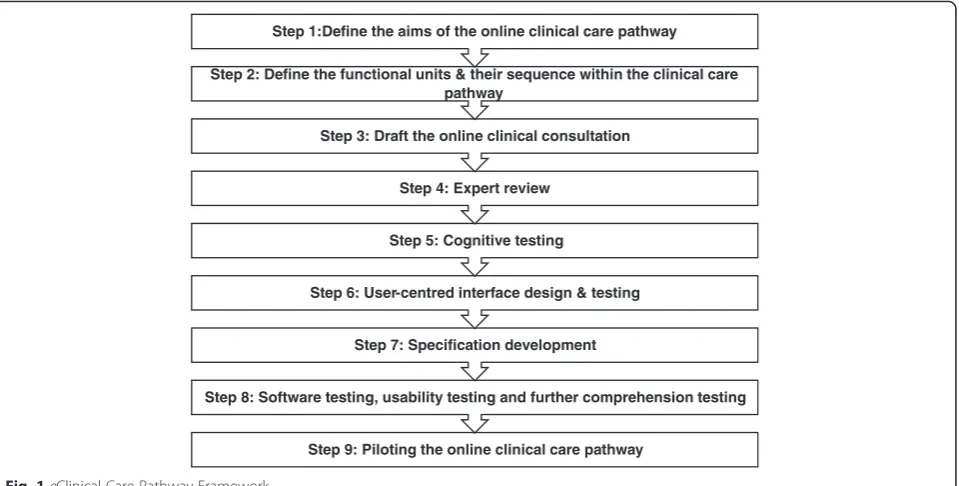
cre-ating a nine-step iterative process (Fig. 1).
This included evidence on Step 1 (aims) [31, 32], Step 2
(pathway sequence) [33], Step 3 (online consultation) [34],
Step 4 (expert review) [34
–
36], Step 5 (cognitive testing)
[37
–
41], Step 6 (interface testing) [39, 42, 43], Step 8
(soft-ware and usability testing) [32, 33, 35, 39, 44, 45] and Step
9 (pilot) [31, 35, 41].
Step 1 is to define the aims of the online clinical care
pathway. Step 2 requires definition of the functional
units by breaking down the clinical care pathway into
sections (for example history, examination and
investiga-tions (screening or diagnostic tests) based around the
traditional aspects of clinical care it contains. It is
im-portant to consider whether the sequence needs to be
different to traditional care. For example, in a traditional
clinical care pathway sequence where a patient comes
into clinic, the initial functional unit is the presenting
complaint and history of presenting complaint. In an
on-line clinical care pathway this may not be appropriate,
particularly if the pathway is linked to, for example,
re-mote self-testing and diagnosis.
Step 3 involves drafting the automated online clinical
consultation which is likely to be a key component of
most clinical care pathways. This is the
“
automated
med-ical assessment
”
which includes history-taking,
decision-making and easily extractable and transmissible
surveil-lance data. Composed of clinical and behavioural
ques-tions, it is designed to determine whether it is safe and
appropriate to proceed with remote management of the
condition. Relevant published literature, proformas and
protocols in contemporary use, standards and existing
services provide a robust evidence-base for the online
consultation.
Step 6 involves user-centred interface design and
test-ing. For user-centred interface design the question set is
translated into a format that works on the chosen screen
resolutions with the appropriate response options. It is
important to use relevant user interface design
guide-lines as a basis for this [42]. The purpose of testing is to
focus on the users
’
views of the interface, how the
infor-mation is presented and the order of the interactive
steps in the user interface.
Step 7 requires conversion of the online clinical
con-sultation into a database specification in order for
soft-ware engineers to design the system according to one
’
s
needs. This process is described in more detail in the
re-sults section below and includes translation of the
data-base specification in to wireframes to specify the user
interface to achieve the optimal design output. Once the
software engineers have produced an application (app),
further expert usability review, software testing, usability
testing and comprehension testing can be conducted by
a clinical researcher and Human Computer Interface
ex-pert (Step 8). Finally, Step 9 involves piloting of the
on-line clinical care pathway with the target population,
with further refinement occurring on the basis of
find-ings and evaluation of this.
Application of the framework to chlamydia
Once the Framework was developed, we then applied it
to our exemplar condition, genital chlamydia to produce
the Online Chlamydia Pathway. Chlamydia is an ideal
candidate infection as it is common, and there is a
standard first line antibiotic therapy, Azithromycin 1 g
orally [47]. Azithromycin has good tolerability, a low
side-effect profile, and allergy and drug interactions are
infrequent among the target population [48
–
53].
This phase involved:
1. Sourcing of national and international clinical
standards for sexual history taking, chlamydia
management, health promotion, sexual health
service provision, consent, good medical practice,
and prescribing
2. Collation of protocols (
‘
a comprehensive set of rigid
criteria outlining the management steps for a single
clinical condition or aspects of organisation
’
[
30
])
and proformas in use in contemporary sexual health
settings
3. Literature search for evidence on provision of STI
results and the individual components of the online
clinical consultation
4. Collation of sexual health questionnaires and
computer assisted structured interviews
Results and discussion
Step 1: Aim
The aim of the Online Chlamydia Pathway was to
en-able people with genital chlamydia to receive their
test result online, obtain information about the
infec-tion, complete a clinical consultainfec-tion, and for those
for whom it was appropriate to do so, progress to
re-ceive a remote prescription of antibiotic treatment in
a safe, efficient manner. It also needed to ensure that
patients for whom it was not appropriate to be
man-aged in this way were identified and transferred to
traditional services in a timely and efficient manner.
Step 9: Piloting the online clinical care pathway
Step 8: Software testing, usability testing and further comprehension testing Step 7: Specification development
Step 6: User-centred interface design & testing Step 5: Cognitive testing
Step 4: Expert review
Step 3: Draft the online clinical consultation
Step 2: Define the functional units & their sequence within the clinical care pathway
Step 1:Define the aims of the online clinical care pathway
Further aims of the Online Chlamydia Pathway
in-cluded partner notification, provision of
epidemio-logical treatment where acceptable and appropriate
for sexual partners, a two-week health adviser
follow-up phone-call for all patients who accessed the online
clinical consultation, and collection of data for
na-tional surveillance system purposes.
Step 2: pathway sequence
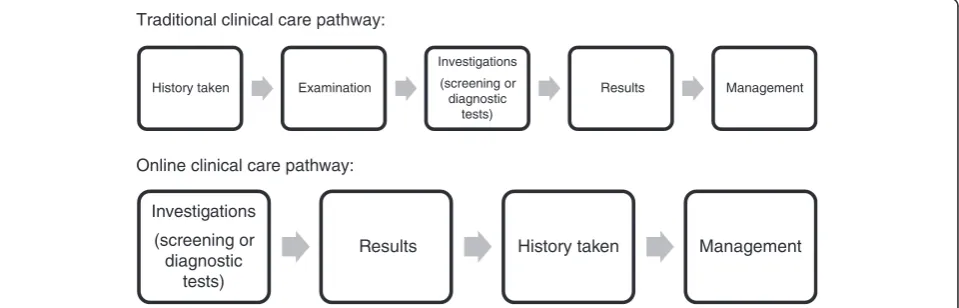
Use of the Framework clarified the basic sequence of
func-tional units of care (Fig. 2), which is fundamentally
differ-ent to traditional care pathways which start with the
medical history, followed by examination, investigations,
results and management. Our pathway had to
accommo-date patients entering from different types of chlamydia
screening providers, each with different processes for, and
content of, medical information gathering and capture at
the time of testing, whilst keeping collection of patient
identifiable data to a minimum. This meant that there was
no patient history available at the point of diagnosis and
therefore this had to be taken once the patient was already
aware of the results of the investigations.
It is also possible that people may have developed new
symptoms in the time between testing and diagnosis, or
that they may be more candid in the face of a positive test
result, and it was therefore important to establish a history
specific to whether it was safe and appropriate to prescribe
Azithromycin without face-to-face clinical review. This was
a radical departure from traditional pathways and had
major implications in terms of the information that needed
to be provided and the content, phrasing, logic and order
of the questions asked in the clinical consultation.
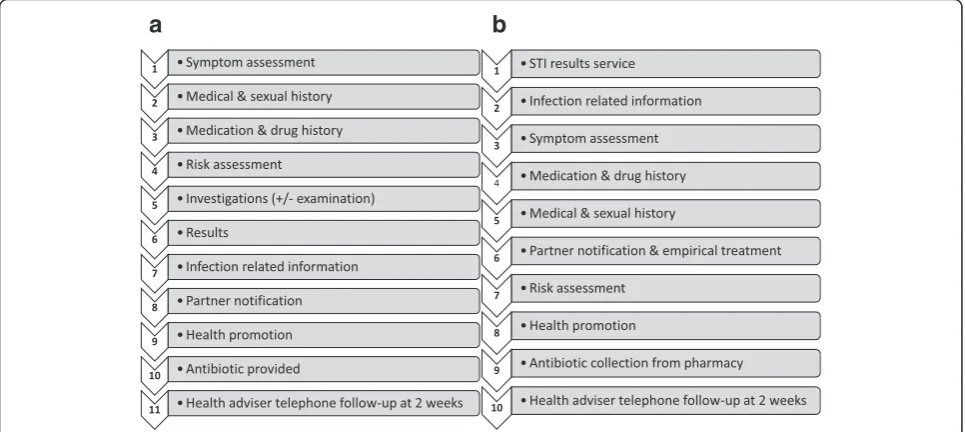
Based on the online pathway sequence, the individual
functional units of the pathway were established (Fig. 3a
and b). As well as the points made above, the rationale
behind the order chosen included reducing the length of
the interaction for those whom it was not safe to treat.
In this way such patients could transfer to alternative
(face-to-face) care as quickly as possible, rather than
only finding this out at the end of the consultation.
Step 3: online consultation
The automated online clinical consultation consisted of
functional units one to nine, as shown in Fig. 3b. For each
of these units, the objective of the unit and evidence bases
for the unit were analysed, with a decision then being
made as to the optimal way of developing and
implement-ing that unit. The first functional unit was a results service
which required examination of the evidence base [54
–
67]
and current practice to conclude the best way for patients
to access their results. Information was collected within
the online clinical consultation on basic personal and
demographic details (required for both clinical needs and
surveillance purposes), taking relevant medical/drug
his-tory, symptom assessment, sexual hishis-tory, risk assessment,
and partner notification with epidemiological treatment
[38, 43, 48, 51
–
53, 68
–
108].
Those patients for whom it was assessed to be safe and
appropriate were able to choose a local pharmacy from
where they could collect their treatment. A clinical
help-line was available to support patients
’
medical and
psycho-social needs throughout this pathway. All patients who
consented [109] were followed up with a phone call from
a research health adviser at two weeks. A separate portal
was developed to support the research health adviser; this
included details and status of all eligible patients, details of
information entered onto the system by the results
admin-istrator and patient, a screen for documenting
conversa-tions via the clinical helpline, treatment outcomes and a
structured two week phone follow-up.
Step 4: expert review
The expert review panel consisted of consultant
genito-urinary medicine and public health physicians,
aca-demics in sexual health, public health, human computer
interaction, bioethics and a research health adviser.
Traditional clinical care pathway:
Online clinical care pathway:
History taken Examination
Investigations
(screening or diagnostic
tests)
Results Management
Investigations
(screening or diagnostic
tests)
Results
History taken
Management
Feedback from the panel led to amendments to the
con-tent and phrasing of the text and questions within the
online clinical consultation.
Step 5: cognitive testing
Beatty and Wallis define cognitive testing as
‘
the
admin-istration of draft survey questions while collecting
add-itional verbal information about the survey response,
which is used to evaluate the quality of the response or
to help determine whether the question is generating the
information that its author intends
’
[110]. Cognitive
test-ing was conducted with members of the public. One of
the main findings from this was that people either did
not know what azithromycin (a macrolide and first-line
treatment for chlamydia [93]) was or confused it with
erythromycin. This meant that they were unable to
ac-curately interpret and answer the question relating to
al-lergies. It was therefore necessary to develop a series of
questions which allowed patients with no allergies to
pass on to the next section whilst ensuring that any
pa-tients who were allergic to macrolides came off the
on-line pathway and into clinic.
Step 6: user-centred interface design and testing
Initial focus groups were conducted by a Human
Com-puter Interaction researcher in university and secondary
schools in order to establish user requirements [42]. User
interface design principles and guidelines were then used
to design the interface to ensure optimal display of
ques-tions and response sets, along with facilitating the user
journey and flow of interaction. Lab-based user interface
testing was conducted with wire-framed prototypes.
Step 7: specification development
A specification was developed in Microsoft Excel which
included text, logic, data item numbering, field names
and the export data sheet. This was sent to the software
engineers, along with the user interface design
wire-frames (which specified the look and feel of the interface
and clarified the user journey) for development of a
demonstration version of the pathway.
Step 8: software and usability testing
Further software, usability and cognitive testing was then
conducted with the demonstration version of the pathway
before the system went live. This included the Human
Computer Interaction researcher conducting an expert
us-ability review and lab-based testing with members of the
public, and repeated testing of the system to ensure that it
was accurate, fully functional and coded correctly.
Step 9: pilot
The Online Chlamydia Pathway has been successfully
piloted in an exploratory study involving patients
re-cruited from Sexual Health Clinics and the National
Chlamydia Screening Programme in England [111].
Conclusions
Despite the increasing uptake of eHealth within the NHS,
at present there is no guidance available on the
develop-ment of online clinical care pathways. There are
funda-mental differences between the approach taken with
online compared to traditional clinical care pathways.
These include the sequence of the pathway, which
ques-tions are asked and how the text is phrased, ensuring that
it is safe and appropriate for the patient to be managed
a
b
online and providing an alternative rapid pathway into
care for those patients for whom it is not appropriate.
We developed a new framework for complex online
clinical care pathways and adapted it for use for
manage-ment of genital
Chlamydia trachomatis
infection. The
Framework is a useful structure for developing an online
clinical care pathway. We have used it here to develop a
complex online clinical care pathway for chlamydia
which provides the services, data collection, surveillance
function and standards a patient would have if attending
a traditional service, within an easy and acceptable
for-mat. This Online Chlamydia Pathway is compliant with
relevant standards and guidance. This is a new method
of developing an automated online clinical consultation
which is logical, comprehensive and aims to provide
users with the ability to choose the management
path-way which best suits them, and is most appropriate for
them, whilst maintaining a high standard of care. The
methodology used could be applied and adapted to a
wide range of conditions outside Sexual Health.
We have focused here on a common treatable bacterial
STI (
Chlamydia trachomatis
). However, the pathway
could be adapted to incorporate testing and managing
other STIs, and other services. Indeed, study patients
re-ceived negative results via the Online Chlamydia
Path-way results service for other STI tests they had in clinic.
As well as potentially reducing the time to treatment for
index patients, and increasing the proportion of patients
treated appropriately within the community, this
stan-dardised method of collecting data on demographics and
sexual behaviour, with easily extractable data and the
po-tential for interoperability with surveillance systems,
could be a powerful tool for public health and clinical
care. In order to complete this type of process effectively
requires effective multi-disciplinary collaboration.
Abbreviations
NHS, The United Kingdom’s National Health Service; STI, Sexually Transmitted Infection
Acknowledgements
We are very grateful to Catherine Aicken, Sue Eaton and Ala Szczepura for their helpful comments when developing and applying this Framework.
Funding
UKCRC Translational Infection Research (TIR) Initiative supported by the Medical Research Council,eSTI2 Consortium (Grant Number G0901608). The funding body had no role in the design or application of the Framework, in the writing of the manuscript and in the decision to submit the manuscript for publication.
Availability of data and materials
Not applicable, because raw data were not used in this research.
Authors’contributions
The paper was conceived by JG, CSE and PS. JG wrote the first draft, with further contributions from KH, EMHE, CML, STS, PS and CSE. JG conducted the initial literature review and JG, CSE, VG and LJS developed the Framework. JG, LJS, VG and CSE applied the framework to the Online Chlamydia Pathway. EMHE and CML provided input on the surveillance component of the pathway. LJS, VG, KH,
REA, EMHE, CML, STS, PS and CSE participated in Step 4 (Expert Review Panel). VG and KH conducted Step 6 (user-centred interface design and testing). JG, LJS, VG and KH conducted Step 8 (software and usability testing). KH, CML, STS (Principal Investigator), PS and CSE, were applicants on theeSTI2 Consortium grant, wrote the initial protocol and obtained funding. PS led the Clinical, Public Health and Economics work stream. CSE led the exploratory study of the Online Chlamydia Pathway with contributions from JG, LJS, VG, KH, REA, EMHE, CML, STS, and PS. All authors read and approved the final manuscript.
Competing interests
The authors declare that they have no competing interests.
Consent for publication
Not applicable.
Ethics approval and consent to participate
Ethical approval and consent to participate was not required for this research. This complies with national guidelines [112]. Ethical approval was gained for the Online Chlamydia Pathway exploratory studies (Brighton & Sussex (NHS) Research Ethics Committee, REC reference 13/LO/1111; IRAS project ID: 112513).
Author details
1Blizard Institute, Barts and The London School of Medicine & Dentistry,
Queen Mary University of London, London, UK.2Research Department of Infection and Population Health, University College London, Mortimer Market Centre, off Capper Street, London, UK.3School of Information Systems & Computing, Brunel University London, Uxbridge, UK.4School of Law, Queen
Mary University of London, Mile End Road, London, UK.5HIV/STI Department, Public Health England, London, UK.6Institute of Infection and Immunity, St
George’s, University of London, London, UK.
Received: 11 January 2016 Accepted: 13 July 2016
References
1. England NHS. Putting Patients First: The NHS England business plan for 2013/4–2015/6. 2013. http://www.england.nhs.uk/wp-content/uploads/ 2013/04/ppf-1314-1516.pdf.
2. England NHS. NHS Commissioning Board launches library of NHS-reviewed phone apps to keep people healthy. 12-3-2013. 24-6-2013. http://www. england.nhs.uk/2013/03/12/nhs-apps/.
3. England NHS. Safer hospitals, safer wards: achieving an integrated digital care record. 2013. p. 1–7.
4. Blake H. Mobile phone technology in chronic disease management. Nurs Stand. 2008;23:43–6.
5. Blake H. Innovation in practice: mobile phone technology in patient care. Br J Community Nurs. 2008;13:160. 162–160, 165.
6. de Jongh T, Gurol-Urganci I, Vodopivec-Jamsek V, Car J, Atun R. Mobile phone messaging for facilitating self-management of long-term illnesses. Cochrane Database Syst Rev. 2012;12:CD007459.
7. Baptist AP, Thompson M, Grossman KS, Mohammed L, Sy A, Sanders GM. Social media, text messaging, and email-preferences of asthma patients between 12 and 40 years old. J Asthma. 2011;48:824–30.
8. Krishna S, Boren SA, Balas EA. Healthcare via cell phones: a systematic review. Telemed J E Health. 2009;15:231–40.
9. Pinnock H, Slack R, Pagliari C, Price D, Sheikh A. Understanding the potential role of mobile phone-based monitoring on asthma self-management: qualitative study. Clin Exp Allergy. 2007;37:794–802.
10. Klasnja P, Pratt W. Healthcare in the pocket: mapping the space of mobile-phone health interventions. J Biomed Inform. 2012;45:184–98.
11. van der Meer V, van den Hout WB, Bakker MJ, Rabe KF, Sterk PJ, Assendelft WJ, et al. Cost-effectiveness of Internet-based self-management compared with usual care in asthma. PLoS One. 2011;6:e27108.
12. Ryan D, Price D, Musgrave SD, Malhotra S, Lee AJ, Ayansina D, et al. Clinical and cost effectiveness of mobile phone supported self monitoring of asthma: multicentre randomised controlled trial. BMJ. 2012;344:e1756. http://www.bmj. com/content/344/bmj.e1756.
14. Smith M, Dang D, Lee J. E-prescribing: clinical implications for patients with diabetes. J Diabetes Sci Technol. 2009;3:1215–8.
15. Mark DA, Fitzmaurice GJ, Haughey KA, O’Donnell ME, Harty JC. Assessment of the quality of care and financial impact of a virtual renal clinic compared with the traditional outpatient service model. Int J Clin Pract. 2011;65:1100–7. 16. Jeffery R, Iserman E, Haynes RB. Can computerized clinical decision support
systems improve diabetes management? A systematic review and meta-analysis. Diabet Med. 2012.
17. Ebrahiminia V, Riou C, Seroussi B, Bouaud J, Dubois S, Falcoff H, et al. Design of a decision support system for chronic diseases coupling generic therapeutic algorithms with guideline-based specific rules. Stud Health Technol Inform. 2006;124:483–8.
18. Austin BS, Gunlock TL, Krishna S, Kramer TC. Computer-aided diabetes education: a synthesis of randomized controlled trials. AMIA Annu Symp Proc 2006, 51–55.
19. Boyce N. The lancet technology: June, 2012. Maps, apps–and evidence? Lancet. 2012;379:2231.
20. Muessig KE, Pike EC, Legrand S, Hightow-Weidman LB. Mobile phone applications for the care and prevention of HIV and other sexually transmitted diseases: a review. J Med Internet Res. 2013;15:e1. 21. Kinghorn GR. Patient access to GUM clinics. Sex Transm Infect. 2001;77:1–2. 22. Foley E, Patel R, Green N, Rowen D. Access to genitourinary medicine clinics
in the United Kingdom. Sex Transm Infect. 2001;77:12–4.
23. Thomas M, Dixon K, Ali AH, Patel R, Robinson AJ, Yuen HM, et al. Young persons’access to genitourinary medicine clinics in the UK: a cross-sectional survey. Sex Transm Infect. 2012;88:348–51.
24. Saunders JM, Mercer CH, Sutcliffe LJ, Hart GJ, Cassell J, Estcourt CS. Where do young men want to access STI screening? A stratified random probability sample survey of young men in Great Britain. Sex Transm Infect. 2012;88:427–32. 25. Mercer CH, Aicken CR, Estcourt CS, Keane F, Brook G, Rait G, et al. Building the
bypass–implications of improved access to sexual healthcare: evidence from surveys of patients attending contrasting genitourinary medicine clinics across England in 2004/2005 and 2009. Sex Transm Infect. 2012;88:9–15.
26. Public Health England. Health Protection Weekly Report: Sexually transmitted infections and chlamydia screening in England, 2014. 2015. 3-11-2015. https:// www.gov.uk/government/uploads/system/uploads/attachment_data/file/ 437433/hpr2215_STI_NCSP_v6.pdf.
27. Ofcom. The Communication Market 2014. 2014. http://stakeholders.ofcom. org.uk/binaries/research/cmr/cmr14/2014_UK_CMR.pdf.
28. BASHH & MEDFASH. Standards for the managment of sexually transmitted infections (STIs). 2014. http://www.medfash.org.uk/uploads/files/ p18dtqli8116261rv19i61rh9n2k4.pdf.
29. Harding-Esch E, Nardone A, Gibbs J, Sutcliffe LJ, Sonnenberg P, Estcourt C, et al. Can remote STI/HIV testing and eClinical care be compatible with robust public health surveillance. 2015.
30. OPEN CLINICAL knowledge management for medical care. Clinical Pathways: multidisciplinary plans of best clinical practice. 8-7-2013. 16-8-2013. http://www.openclinical.org/clinicalpathways.html.
31. Medical RC. Developing and evaluating complex interventions: new guidance. 2010. 1-5-2015. www.mrc.ac.uk/complexinterventionsguidance. 32. Murray E, Treweek S, Pope C, MacFarlane AF, Ballini LF, Dowrick CF, et al.
Normalisation process theory: a framework for developing, evaluating and implementing complex interventions. BMC Med. 2010;8:63.
33. May C. A rational model for assessing and evaluating complex interventions in health care. BMC Health Serv Res. 2006;6:86.
34. Health and Social Care Information Centre. NHS Pathways. 2015. 6-4-2015. http://systems.hscic.gov.uk/pathways.
35. French RS, Cowan FM, Wellings K, Dowie J. The development of a multi-criteria decision analysis aid to help with contraceptive choices: My Contraception Tool. J Fam Plann Reprod Health Care. 2014;40:96–101. 36. Tideman R, Pitts M, Fairley CK. Use of the Delphi sorting technique to
establish a core sexual history. Int J STD AIDS. 2006;17:170–2. 37. Erens B, Phelps A, Clifton S, Mercer CH, Tanton C, Hussey D, et al. Methodology
of the third British National Survey of Sexual Attitudes and Lifestyles (Natsal-3). Sex Transm Infect. 2013.
38. Aicken CR, Gray M, Clifton S, Tanton C, Field N, Sonnenberg P, et al. Improving questions on sexual partnerships: lessons learned from cognitive interviews for Britain’s third National Survey of Sexual Attitudes and Lifestyles (“Natsal-3”). Arch Sex Behav. 2013;42:173–85.
39. Gustafson DH, Wyatt JC. Evaluation of ehealth systems and services. BMJ. 2004;328:1150.
40. Rothrock NE, Kaiser KA, Cella D. Developing a valid patient-reported outcome measure. Clinical Pharmacology & Therapeutics. 2011;90:737–42.
41. Weston RL, Hopwood B, Harding J, Sizmur S, Ross JD. Development of a validated patient satisfaction survey for sexual health clinic attendees. Int J STD AIDS. 2010;21:584–90.
42. Gkatzidou V, Hone K, Sutcliffe L, Gibbs J, Sadiq ST, Szczepura A, et al. User interface design for mobile-based sexual health interventions for young people: design recommendations from a qualitative study on an online Chlamydia clinical care pathway. BMC Med Inform Decis Mak. 2015;15:72.
43. McCarthy O, Carswell K, Murray E, Free C, Stevenson F, Bailey JV. What young people want from a sexual health website: design and development of Sexunzipped. J Med Internet Res. 2012;14:e127.
44. Brown III W, Yen PY, Rojas M, Schnall R. Assessment of the Health IT Usability Evaluation Model (Health-ITUEM) for evaluating mobile health (mHealth) technology. J Biomed Inform. 2013;46:1080–7.
45. Cummings E, Turner P. Patients at the centre: methodological considerations for evaluating evidence from health interventions involving patients use of web-based information systems. Open Med Inform J. 2010;4:188–94. 46. Campanelli P. Testing Survey Questions: New Directions in Cognitive Interviewing. Bulletin de Methodologie Sociologique. 1997;55:5-17. 47. British Association of Sexual Health & HIV. 2015 UK national guideline for
the management of infection withChlamydia trachomatis.2015. 16-11-2015. http://www.bashh.org/documents/2015_UK_guideline_for_the_ management_of__Chlamydia_trachomatis_final_12....pdf.
48. eMC. Azithromycin 500mg tablets SPC. 17-9-2013. 13-11-2013. http://www. medicines.org.uk/EMC/medicine/21720/SPC/Azithromycin+500mg+Tablets/. 49. Golden MR, Whittington WL, Handsfield HH, Hughes JP, Stamm WE,
Hogben M, et al. Effect of expedited treatment of sex partners on recurrent or persistent gonorrhea or chlamydial infection. N Engl J Med. 2005;352:676–85.
50. Schillinger JA, Kissinger P, Calvet H, Whittington WL, Ransom RL, Sternberg MR, et al. Patient-delivered partner treatment with azithromycin to prevent repeated Chlamydia trachomatis infection among women: a randomized, controlled trial. Sex Transm Dis. 2003;30:49–56.
51. Nahata M. Drug interactions with azithromycin and the macrolides: an overview. J Antimicrob Chemother. 1996;37(Suppl C):133–42. 52. Svanstrom H, Pasternak B, Hviid A. Use of azithromycin and death from
cardiovascular causes. N Engl J Med. 2013;368:1704–12.
53. British National Formularly. BNF November 2013. 13-11-2013. http://www. medicinescomplete.com/mc/bnf/current/PHP3503-azithromycin-non-proprietary.htm#PHP3503-azithromycin-non-proprietary.
54. Ling SB, Richardson DB, Mettenbrink CJ, Westergaard BC, Sapp-Jones TD, Crane LA, et al. Evaluating a Web-based test results system at an urban STI clinic. Sex Transm Dis. 2010.
55. Brown L, Copas A, Stephenson J, Gilleran G, Ross JD. Preferred options for receiving sexual health screening results: a population and patient survey. Int J STD AIDS. 2008;19:184–7.
56. Llewellyn CD, Sakal C, Lagarde M, Pollard A, Miners AH. Testing for sexually transmitted infections among students: a discrete choice experiment of service preferences. BMJ Open. 2013;3:e003240.
57. Martin L, Knight V, Read PJ, McNulty A. Clients’preferred methods of obtaining sexually transmissable infection or HIV results from Sydney sexual health centre. Sex Health. 2013;10:91–2.
58. Labacher L, Mitchell C. Talk or text to tell? How young adults in Canada and South Africa prefer to receive STI results, counseling, and treatment updates in a wireless world. J Health Commun. 2013;18:1465–76.
59. Evans-Jones J, Steedman N, Newman M, Jones R, Milburn A, O’Mahony C. Use of Telephonetics RESULTS computer-facilitated telephone system with automatic results upload. Int J STD AIDS. 2011;22:525–6.
60. Steedman NM, Thompson C. Telephonetics RESULTS computer-facilitated telephone system: a novel method for patient results retrieval. Int J STD AIDS. 2007;18:422–3.
61. National Chlamydia Screening Program. Text messaging for test results communication within the National Chlamydia Screening Programme. 2013. 12-5-2015. Ref Type: Online Source. https://www.gov.uk/government/uploads/ system/uploads/attachment_data/file/508763/Chlamydia_Test_Result_ Notification_Text_Messaging_NCSP_Recommendations_Jan_2013.pdf. 62. Kohn R, Williams D, Klausner JD. Getting STD Test Results Over the Internet: San
63. health i. Amsterdam to launch STD clinic online. 22-10-2007. 13-12-1921. Ref Type: Online Source. http://ehi.co.uk/news/EHI/3114/amsterdam-to-launch-std-clinic-online.
64. Duncan B, Hart GF, Scoular AF, Bigrigg A. Qualitative analysis of psychosocial impact of diagnosis of Chlamydia trachomatis: implications for screening. BMJ. 2001;322:195-9.
65. Lim MSC, Hocking JS, Hellard ME, Aitken CK. SMS STI: a review of the uses of mobile phone text messaging in sexual health. Int J STD AIDS. 2008;19:287-90. 66. Lim EJ, Haar JF, Morgan J. Can text messaging results reduce time to
treatment of Chlamydia trachomatis? Sex Trans Infect. 2008;84:563–64. 67. Fuller SS, Sutcliffe LJ, Estcourt CS, Gkatzidou V, Hone K, Sonnenberg P, et al.
What are young people’s perceptions of using electronic self-tests for STIs linked to mobile technology for diagnosis and care (eSTI2)? Sex
TransmInfect. 2013;89 Suppl 1:A69. Ref Type: Abstract.
68. Lim MS, Bowring AL, Gold J, Aitken CK, Hellard ME. Trends in sexual behavior, testing, and knowledge in young people; 2006–2011. Sex Transm Dis. 2012;39: 831–4.
69. Owens Jr RC, Nolin TD. Antimicrobial-associated QT interval prolongation: pointes of interest. Clin Infect Dis. 2006;43:1603–11.
70. Shamos SJ, Mettenbrink CJ, Subiadur JA, Mitchell BL, Rietmeijer CA. Evaluation of a testing-only“express”visit option to enhance efficiency in a busy STI clinic. Sex Transm Dis. 2008;35:336–40.
71. Singh RH, Erbelding EJ, Zenilman JM, Ghanem KG. The role of speculum and bimanual examinations when evaluating attendees at a sexually transmitted diseases clinic. Sex Transm Infect. 2007;83:206–10.
72. BASHH Clinical Effectiveness Group. 2013 UK national guideline for consultations requiring sexual history taking. 2013.
73. Department of Health, NHS. Information Governance Toolkit. 2013. 74. Department of Health, NHS. NHS Information Governance: Information
Risk Management Guidance: Short Message Service (SMS) & Texting. 2010. 12-2-2013. http://systems.hscic.gov.uk/infogov/links/sms2010.pdf. 75. Gammell K. Mobile phone insurance: don’t lose money if you lose your
smartphone. 2012.28-5-2014. http://www.telegraph.co.uk/finance/ personalfinance/insurance/9573224/Dont-lose-money-if-you-lose-your-smartphone.html.
76. Consumer Reports. Smart phone thefts rose to 3.1 million last year, Consumer Reports finds. 28-5-2014. http://www.consumerreports.org/cro/ news/2014/04/smart-phone-thefts-rose-to-3-1-million-last-year/index.htm. 77. Bracebridge S, Bachmann MO, Ramkhelawon K, Woolnough A. Evaluation of
a systematic postal screening and treatment service for genital Chlamydia trachomatis, with remote clinic access via the internet: a cross-sectional study, East of England. Sex Transm Infect. 2012;88:375–81.
78. Public HE. Commissioning, reporting and using chlamydia activity data. 2013. 19-1-2015. http://www.chlamydiascreening.nhs.uk/ps/info-management.asp. 79. Mosholder AD, Mathew J, Alexander JJ, Smith H, Nambiar S. Cardiovascular
risks with azithromycin and other antibacterial drugs. N Engl J Med. 2013; 368:1665–8.
80. Ray WA, Murray KT, Hall K, Arbogast PG, Stein CM. Azithromycin and the risk of cardiovascular death. N Engl J Med. 2012;366:1881–90.
81. eMC. Erythromycin 250mg Capsules SPC. 28-10-2014. 20-1-2015. http:// www.medicines.org.uk/emc/medicine/26315/SPC/Erythromycin+250mg +Capsules/#UNDESIRABLE_EFFECTS.
82. The National Survey of Sexual Attitudes and Lifestyles. Natsal-3. 2014. 17-1-2015. http://www.natsal.ac.uk/natsal-3.
83. Estcourt C, Sutcliffe L, Cassell J, Mercer CH, Copas A, James L, et al. Can we improve partner notification rates through expedited partner therapy in the UK? Findings from an exploratory trial of Accelerated Partner Therapy (APT). Sex Transm Infect. 2012;88:21–6.
84. Public Health England. Sexually transmitted infections and chlamydia screening in England, 2013. 2014. https://www.gov.uk/government/uploads/ system/uploads/attachment_data/file/345181/Volume_8_number_24_ hpr2414_AA_stis.pdf.
85. Tideman RL, Chen MY, Pitts MK, Ginige S, Slaney M, Fairley CK. A randomised controlled trial comparing computer-assisted with face-to-face sexual history taking in a clinical setting. Sex Transm Infect. 2007;83:52–6. 86. Rogers SM, Willis G, Al-Tayyib A, Villarroel MA, Turner CF, Ganapathi L, et al.
Audio computer assisted interviewing to measure HIV risk behaviours in a clinic population. Sex Transm Infect. 2005;81:501–7.
87. Richens J, Copas A, Sadiq ST, Kingori P, McCarthy O, Jones V, et al. A randomised controlled trial of computer-assisted interviewing in sexual health clinics. Sex Transm Infect. 2010;86:310–4.
88. Kurth AE, Martin DP, Golden MR, Weiss NS, Heagerty PJ, Spielberg F, et al. A comparison between audio computer-assisted self-interviews and clinician interviews for obtaining the sexual history. Sex Transm Dis. 2004;31:719–26. 89. Fairley CK, Sze JK, Vodstrcil LA, Chen MY. Computer-assisted self
interviewing in sexual health clinics. Sex Transm Dis. 2010;37:665–8. 90. Fernando I, Thompson C. Testing time: testing patient acceptance and
ability to self-screen for a No-Talk Testing service. Int J STD AIDS. 2013. 91. Kissinger P, Rice J, Farley T, Trim S, Jewitt K, Margavio V, et al. Application of computer-assisted interviews to sexual behavior research. Am J Epidemiol. 1999;149:950–4.
92. Ghanem KG, Hutton HE, Zenilman JM, Zimba R, Erbelding EJ. Audio computer assisted self interview and face to face interview modes in assessing response bias among STD clinic patients. Sex Transm Infect. 2005;81:421–5.
93. Horner P, Boag F, the Clinical Effectiveness Group. 2006 UK National Guideline for the Management of Genital Tract Infection withChlamydia trachomatis. 2006. 94. Macleod J, Salisbury C, Low N, McCarthy A, Sterne JA, Holloway A, et al.
Coverage and uptake of systematic postal screening for genital Chlamydia trachomatis and prevalence of infection in the United Kingdom general population: cross sectional study. BMJ. 2005;330:940.
95. Ferreira A, Young T, Mathews C, Zunza M, Low N. Strategies for partner notification for sexually transmitted infections, including HIV. Cochrane Database Syst Rev. 2013;10:CD002843.
96. Low N, Welch J, Radcliffe K. Developing national outcome standards for the management of gonorrhoea and genital chlamydia in genitourinary medicine clinics. Sex Transm Infect. 2004;80:223–9.
97. Sutcliffe L, Brook MG, Chapman JL, Cassell JM, Estcourt CS. Is accelerated partner therapy a feasible and acceptable strategy for rapid partner notification in the UK?: a qualitative study of genitourinary medicine clinic attenders. Int J STD AIDS. 2009;20:603–6.
98. Trelle S, Shang A, Nartey L, Cassell JA, Low N. Improved effectiveness of partner notification for patients with sexually transmitted infections: systematic review. BMJ. 2007;334:354.
99. General Medical Council. Good practice in prescribing and managing medicines and devices. 2013. http://www.gmc-uk.org/guidance/ethical_guidance/14316.asp. 100. Althaus CL, Turner KM, Mercer CH, Auguste P, Roberts TE, Bell G, et al.
Effectiveness and cost-effectiveness of traditional and new partner notification technologies for curable sexually transmitted infections: observational study, systematic reviews and mathematical modelling. Health Technol Assess. 2014; 18:1–viii.
101. Nicholas A, Bailey JV, Stevenson F, Murray E. The Sexunzipped trial: young people’s views of participating in an online randomized controlled trial. J Med Internet Res. 2013;15:e276.
102. Allison S, Bauermeister JA, Bull S, Lightfoot M, Mustanski B, Shegog R, et al. The intersection of youth, technology, and new media with sexual health: moving the research agenda forward. J Adolesc Health. 2012;51:207–12. 103. Bailey JV, Murray E, Rait G, Mercer CH, Morris RW, Peacock R, et al.
Interactive computer-based interventions for sexual health promotion. Cochrane Database Syst Rev. 2010;9:CD006483.
104. Jones K, Eathington P, Baldwin K, Sipsma H. The impact of health education transmitted via social media or text messaging on adolescent and young adult risky sexual behavior: a systematic review of the literature. Sex Transm Dis. 2014;41:413–9.
105. Bull SS, Levine DK, Black SR, Schmiege SJ, Santelli J. Social media-delivered sexual health intervention: a cluster randomized controlled trial. Am J Prev Med. 2012;43:467–74.
106. McClean H, Chair BASHH National Audit Group, Radcliffe K, Sullivan A, Ahmed-Jushuf I. BASHH Statement on Partner Notification for Sexually Transmissible Infections. 3-7-2012. 28-8-2013. www.bashh.org/documents/4445.pdf. 107. Society of Sexual Health Advisers. The Manual for Sexual Health Advisers.
2004. http://www.ssha.info/wp-content/uploads/ha_manual_2004_ complete.pdf.
108. National Chlamydia Screening Programme. Patient Group Direction for the administration of azithromycin for Chlamydia trachomatis. 2012. 20-4-2015. http:// www.medicinesresources.nhs.uk/en/Communities/NHS/PGDs/PGD-Development- Implementation/National-templates/Azithromycin-National-Chlamydia-Screening-Programme-Template/.
109. General Medical Council. Consent guidance. http://www.gmc-uk.org/ guidance/ethical_guidance/consent_guidance_contents.asp. 110. Beatty PC, Willis GB. Research synthesis: the practice of cognitive
111. Estcourt CS, Gibbs J, Sutcliffe LJ, Gkatzidou V, Tickle L, Hone K, et al. Is an automated online clinical care pathway for people with genital chlamydia (chlamydia-OCCP) within an eSexual health clinic feasible and acceptable? Proof of concept study. Sex Transm Infect. 2015;91:A55.
112. NHS Research Health Authority. Does my project require review by a Research Ethics Committee? 2013. http://www.hra.nhs.uk/documents/2013/09/does-my-project-require-rec-review.pdf.
• We accept pre-submission inquiries
• Our selector tool helps you to find the most relevant journal
• We provide round the clock customer support
• Convenient online submission
• Thorough peer review
• Inclusion in PubMed and all major indexing services
• Maximum visibility for your research
Submit your manuscript at www.biomedcentral.com/submit