R E S E A R C H A R T I C L E
Open Access
Is soft tissue repair a right choice to avoid
early dislocation after THA in posterior
approach?
Yiqin Zhou
1†, Shiqi Cao
1†, Lintao Li
1,2†, Manoj Narava
3, Qiwei Fu
1*and Qirong Qian
1*Abstract
Background:Dislocation is the second most common complication after total hip arthroplasty (THA). The effectiveness of soft tissue repair to reduce dislocation rate is still debated and thus a meta-analysis was conducted.
Methods:A systematic search in PubMed, Embase, and Cochrane databases was conducted for this meta-analysis. Inclusion criteria: clinical comparative trials on the use of soft tissue repair including rotators and capsule repair in primary THA. The main data outcome were the incidences of early hip dislocation after primary THA. HSS score, incidence of other complications was also included in the outcomes.
Results:A total of 4816 cases were included for the analysis from ten studies (3 RCTs/7 Retrospective trials). Overall, the soft tissue repair group showed a significant lower early dislocation rate and higher HSS score compared to the no repair group; but no significant difference was observed between the two groups in regards to the early dislocation rate in RCT studies only. The capsule repair group showed a significant lower early dislocation rate than no capsule repair group while no significant difference was observed between the rotators repair group and no rotators repair group. In all included studies, 4 greater trochanter fractures, 2 sciatic nerve palsies and 1 infection were reported in soft tissue repair group while no cases were observed in the no repair group. Conclusions:The efficacy of soft tissue repair is positive but still not conclusive to reduce the early dislocation rate after primary THA while soft tissue repair may bring more other complications. Capsule repair seems more effective than rotators repair only.
Keywords:Primary total hip arthroplasty, Soft tissue repair, Early dislocation
Background
Dislocation is one of the most common complications after total hip arthroplasty (THA), an incidence second to septic loosening [1]. Most dislocations occurred 6 months after surgery and were referred to as early dislocations. Woo et al. from Mayo Clinic Center re-ported the dislocation rate in a 10500 research cases was 3.2% [2]. Demos reported dislocation rate after pri-mary THA was 3.2–6.5% while the incidence increased to 7.4–11.4% after revision [3]. The dislocation could cause a major physical and mental burden to patients,
so it is important for surgeons to figure out better ways to decrease the incidence of dislocation.
In recent years, a few studies reported that surgeons tend to suture more soft tissue including the capsule and rotators (piriformis, superior gemellus, obturator internus, inferior gemellus) to decrease the dislocation rate when the posterior approach was taken in the pri-mary THA [4–13]. However, the results were not con-sistent with each other and the effectiveness of soft tissue repair is still debated. Therefore, we did a meta-analysis to examine the efficacy of soft tissue repair in primary THA.
* Correspondence:[email protected];[email protected] †Equal contributors
1Joint Surgery and Sports Medicine Department, Shanghai Changzheng
Hospital, Second Military Medical University, 415 Fengyang Road, Shanghai 200003, China
Full list of author information is available at the end of the article
© The Author(s). 2017Open AccessThis article is distributed under the terms of the Creative Commons Attribution 4.0
Methods
This article was reported in accordance with the Pre-ferred Reporting Items for Systematic Reviews and Meta-Analyses (PRISMA) guidelines.
Identification and study selection
We conducted a literature search using PubMed (Med-line), Embase and Cochrane Central Register of Con-trolled Trials to identify all articles published between 1966 and 2016 that evaluated the early dislocation rate of the posterior approach of primary THA with and without soft tissue repair (including joint capsule and external rotators). The key terms used were “Arthro-plasty/Replacement”, “Hip”, “soft tissue repair/capsule repair/rotators repair”, and “dislocation”. A literature search was conducted for each author of the studies to find other relevant studies. Each study and previous re-view were examined manually to find further studies on similar topics. As we did not include unpublished re-search, publication bias could not be avoided.
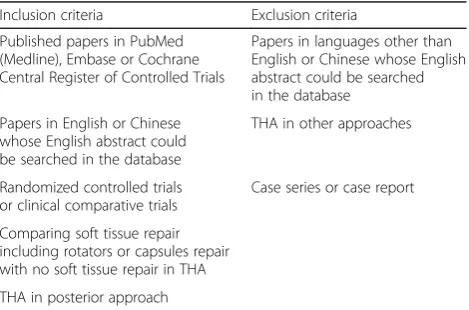
In consideration of the selection bias, criteria for in-clusion were as follows: English published papers and Chinese published papers whose English abstract could be searched in the database described above (Table 1). There was no history of hip infection or hip surgery as-sociated with any of these cases. Although randomized controlled trials may be preferable in meta-analysis, number of such suitable RCT studies were limited, so reports were also considered suitable if they were com-parative trials between THA with and without repair posterior soft tissues; all THA were of posterior ap-proach of primary THA.
Outcome assessment
Majority of the results were the incidences of early hip dislocation after primary THA. HSS score, operation time, incidence of other complications, and incidence of revision were also included in the outcomes. Titles and
abstracts were judged first; then the full text was ob-tained and examined if the outcome was potentially eligible.
Data extraction
After all suitable studies were chosen, data extraction was independently done by three authors subse-quently. We gathered several kinds of component from these suitable studies including type of study, surgery methods, early dislocation rate, operation time, HSS score, age, follow-up, abduction angel, ante-version angle and complications.
Data analysis and quality assessments
All analysis was performed using Review manager 5.3 and Stata 12.0. Relative risk (RR) was used for dichotom-ous outcomes, and the mean differences (MD) was used for continuous outcomes. The results were shown as for-est plots. We used 95% confidence intervals (CI) for each study. I2was used to estimate total variation across studies. A Chi text (X2) significance level of less than 0.10 was interpreted as evidence of heterogeneity. While a random effect model was chosen when there was stat-istical evidence of heterogeneity, a fixed effect model was applied when there was no statistical evidence of heterogeneity. Additionally, meta regression was per-formed to assess the effect of confounding factors in the occurrence of dislocation. The regression was considered statistically significant if the P <0.05 level at the 95% CI did not intersect the midline.
The quality of the eligible studies was estimated accord-ing to the items recommended in Cochrane Collaboration (Revman 5.3; http://handbook.cochrane.org/), including se-lection bias, performance bias, attrition bias, detection bias, reporting bias, and other sources of bias. Two au-thors (ZY and CS) independently made the assessment of the quality of all the studies. Any disagreements were resolved by discussion, and finally judged by QQ.
Results
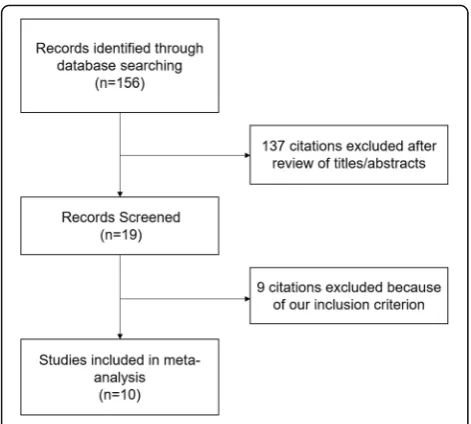
A total of 156 potential studies were identified using the databases (71 from PubMed, 75 from EmBase, 10 from CNKI, and none from the Cochrane databases). Of these, 81 were excluded on the basis of the titles alone, 56 reports were excluded after review of the abstracts. 9 studies were excluded after detailed review of the full text. Ten studies were included in this meta-analysis (Fig. 1).
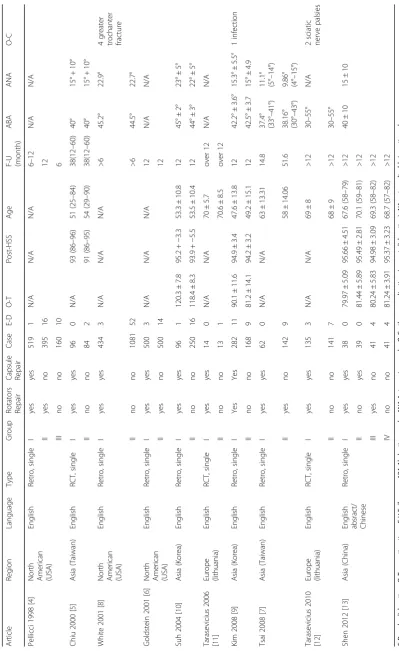
Table 2 summarizes the characteristics of the ten stud-ies, which were published between 1998 and 2012. There were three studies of RCTs. The other seven were all retrospective comparative trial. A total of 4816 cases were finally included for the analysis. We examined the effect of soft tissue repair on the early dislocation rate, Table 1Inclusion and exclusion criteria
Inclusion criteria Exclusion criteria
Published papers in PubMed (Medline), Embase or Cochrane Central Register of Controlled Trials
Papers in languages other than English or Chinese whose English abstract could be searched in the database
Papers in English or Chinese whose English abstract could be searched in the database
THA in other approaches
Randomized controlled trials or clinical comparative trials
Case series or case report
Comparing soft tissue repair including rotators or capsules repair with no soft tissue repair in THA
HSS score and operation time. We also examined the subgroup results to determine the effect of capsule re-pair only or rotators rere-pair only had on the early disloca-tion rate, and the effect of soft tissue repair on the early dislocation rate in RCTs only.
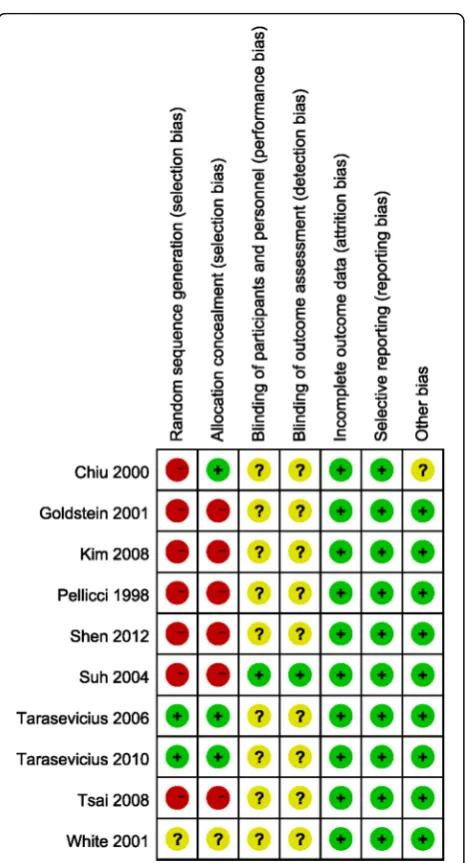
Characteristics and quality of all included studies are presented in Figs. 2 and 3. The methods of random allo-cation were described clearly in only 3 trials, including 1 quasi-randomized controlled trial. Only 1 study was de-scribed as being inconclusive to patients and doctors. No data was incomplete and selective report didn’t exist in all included studies. Inter-rater reliability for the risk of bias assessment was calculated, yielding a κ-statistic of 0.69 (p< 0.01) and Kendall W of 0.977 (p= 0.04), indi-cating good agreement between raters.
Result 1: Comparison of early dislocation rate between soft tissue repair group and no repair group
Eight studies were relevant to the analysis of the com-parison of early dislocation rate between soft tissue re-pair group, the group in which both capsule and rotators were repaired, and no repair group (Fig. 4). Relative risk (RR) was used because it’s dichotomous outcome. Fixed effect model was chosen because there was no statistical evidence of heterogeneity (P= 0.29). Overall, the soft tis-sue repair group showed a significant lower early dis-location rate than no repair group. (RR = 0.25; 95% CI: 0.16–0.38;P= 0.0005; I2= 16%)
Meta regression was performed to assess the effect of confounding factors, including ABA and ANA, in the occurrence of dislocation, No significant differ-ence could be attributed to ABA (p= 0.25) or ANA (p= 0.16).
Result 2: Comparison of early dislocation rate between soft tissue repair group and no repair group
(RCT studies only)
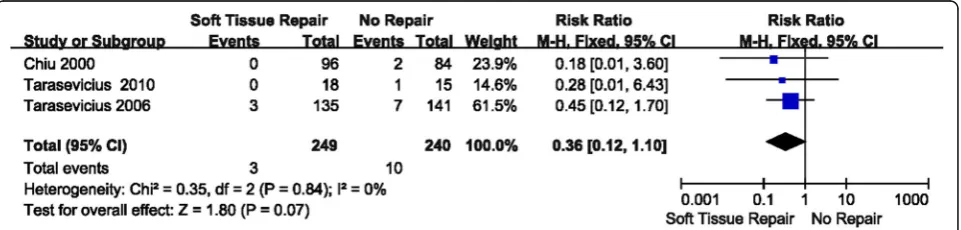
Three studies were relevant to the analysis of compar-ing early dislocation rate between soft tissue repair group and no repair group in only RCT studies (Fig. 5). Relative risk (RR) was used because it was dichotom-ous outcome. Fixed effect model was chosen because there was no statistical evidence of heterogeneity (P= 0.84 > 0.1). Overall, no significance was observed be-tween the soft tissue repair group and no repair group in early dislocation rate in RCT studies only. (RR = 0.36; 95% CI: 0.12–1.10;P= 0.07; I2= 0%)
Result 3: Comparison of early dislocation rate between capsule repair group and no capsule repair group Four studies were relevant to the analysis of comparison of early dislocation rate between capsule repair group and no capsule repair group (Fig. 6). Relative risk (RR) was used because of its dichotomous outcome. Fixed ef-fect model was chosen because there was no statistical evidence of heterogeneity (P= 0.65 > 0.1). Overall, the capsule repair group showed a significant lower early dislocation rate than no capsule repair group. (RR = 0.12; 95% CI: 0.05–0.30;P< 0.00001; I2= 0%).
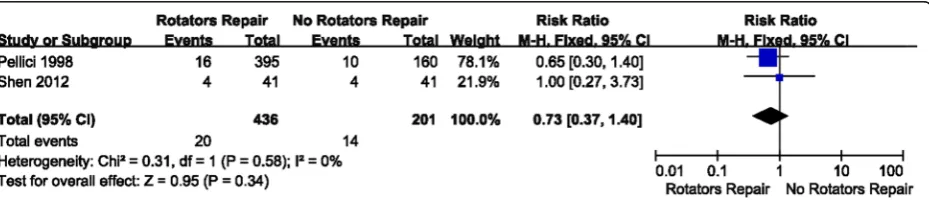
Result 4: Comparison of early dislocation rate between rotators repair group and no rotators repair group Two studies were relevant to the analysis of comparison of early dislocation rate between rotators repair group and no rotators repair group (Fig. 7). Relative risk (RR) was used because it’s dichotomous outcome. Fixed effect model was chosen because there was no statistical evi-dence of heterogeneity (P= 0.58 > 0.1). Overall, no sig-nificance was observed between the rotators repair group and no rotators repair group in regards to the early dislocation rate. (RR = 0.73; 95% CI: 0.37–1.40; P< 0.34; I2= 0%).
Result 5: Comparison of HSS score between soft tissue repair group and no repair group
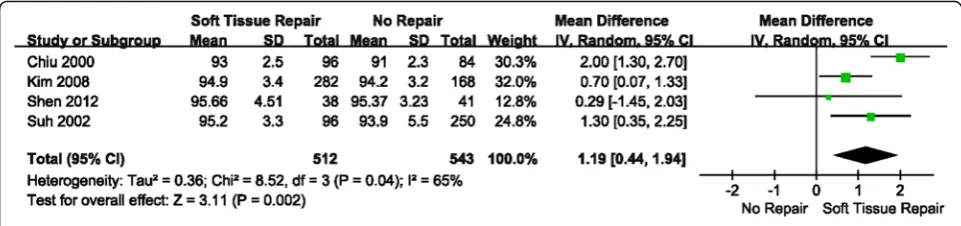
Four studies were relevant to the analysis of com-parison of HSS score between soft tissue repair group and no repair group (Fig. 8). Mean Differ-ence (MD) was used because it is continuous out-come. Radom effect model was chosen because there was no statistical evidence of heterogeneity (P= 0.04 < 0.1). Overall, a significant higher HSS score was observed in soft tissue repair group than no repair group. (MD = 1.19; 95% CI: 0.44–1.94; P= 0.002; I2= 65%)
Table 2 Characteristics of included studies Article Re gion Langu age Type Grou p Rotator s Repai r Cap sule Repai r Case E-D O -T Post-HSS Age F-U (month) ABA ANA O-C Pellic ci 1998 [ 4 ] Nort h Ame rican (USA) Eng lish Retro, sing le I yes yes 519 1 N/ A N/A N/A 6 – 12 N/A N/A II yes no 395 16 12 III no no 160 10 6 Chiu 2000 [ 5 ] Asi a (Tai wan) Eng lish RCT, sing le I yes yes 96 0 N/ A 93 (86 – 96) 51 (25 – 84) 38(12 – 60) 40° 15° + 10° II no no 84 2 91 (86 – 95) 54 (29 – 90) 38(12 – 60) 40° 15° + 10° Whi te 20 01 [ 8 ] Nort h Ame rican (USA) Eng lish Retro, sing le I yes yes 434 3 N/ A N/A N/A >6 45.2° 22.9° 4 gre ater troch anter fra cture II no no 1081 52 >6 44.5° 22.7° Goldste in 2001 [ 6 ] Nort h Ame rican (USA) Eng lish Retro, sing le I yes yes 500 3 N/ A N/A N/A 12 N/A N/A II yes no 500 14 12 Suh 2004 [ 10 ] Asi a (Kore a) Eng lish Retro, sing le I yes yes 96 1 120. 3 ± 7.8 95.2 + − 3.3 53.3 ± 10.8 12 45° ± 2° 23° ± 5° II no no 250 16 118. 4 ± 8.3 93.9 + − 5.5 53.5 ± 10.4 12 44° ± 3° 22° ± 5° Tarase vicius 2006 [ 11 ] Eu rope (lit huania) Eng lish RCT, sing le I yes yes 14 0 N/ A N/A 70 ± 5.7 over 12 N/A N/A II no no 13 1 70.6 ± 8.5 over 12 Kim 2008 [ 9 ] Asi a (Kore a) Eng lish Retro, sing le I Yes Yes 282 11 90.1 ± 11 .6 94.9 ± 3.4 47.6 ± 13.8 12 42.2° ± 3.6° 15.3° ± 5.5° 1 inf ection II no no 168 9 81.2 ± 14 .1 94.2 ± 3.2 49.2 ± 15.1 12 42.5° ± 3.7 15° ± 4.9 Tsai 2008 [ 7 ] Asi a (Tai wan) Eng lish Retro, sing le I yes yes 62 0 N/ A N/A 63 ± 13.31 14.8 37.4° (33° – 41°)
11.1° (5°–
14°) II yes no 142 9 58 ± 14.06 51.6 38.16° (30° – 43°)
9.86° (4°–
Results 6: Comparison of other complications (except early dislocaton) between soft tissue repair group and no repair group
In all included studies, 4 greater trochanter fracture, 2 sciatic nerve palsies and 1 infection were reported in soft tissue repair group while no cases were observed in the no repair group.
Discussion
With the progress of surgical technique in recent years, THA has been an important and common treatment for aseptic necrosis of head of femur, rheumatoid hip arth-ritis, hip osteoartharth-ritis, fracture of neck of femur, devel-opmental dysplasia of the hip and some hip tumor. Meanwhile, increasing number of THA cases have been problematic all over the world, and more cases with sorts of complications have been reported. Early disloca-tion is one of the most serious complicadisloca-tion after THA, an occurrence second to septic prosthesis loosing [14]. Reducing the incidence of hip dislocation is a significant issue to an orthopedist.
Generally, hip dislocation after THA is influenced by multiple factors, which could be mainly divided into three aspects [1]: (1) Patient related factors, (2) Postop-erative management and (3) Surgery related factors. Pa-tient related factors include age, gender, original disease and surgery history of hip. It’s reported that dislocation in aged patients over 80 was 2–3 times than usual [15, 16]. It’s also reported the incidence of dislocation rate in female patients was about twice than the rate compared to male patients [17]. Dislocation rate also increased when patients had a history of hip surgery or nervous system related diseases such as Parkinson’s disease [18]. Postoperative management was also important for pa-tients after THA. Papa-tients should be informed to avoid doing high-risk postures.
Surgery related factors included surgery approach, experience, prosthesis position, offset, and prosthesis design. Different surgery approaches could result in
Fig. 2Summary graph of author judgments for each risk of bias criteria
Fig. 3Risk of bias assessment based on author judgment for
different dislocation rates [19]. However only posterior approach was analyzed in this study. The experience of surgeon was directly related to the dislocation rate. The reason that dislocation rate of decreased from 0.8 to 0.4% in ten years was because the surgeons become more experienced with the number of THA cases they conducted [7]. The position of prosthesis is the most important factor for the stability of the joint after sur-gery. The optimal abduction angle is 40° ± 10° and anteversion angle is 15° ± 10°. Lewinnek reported the dislocation increased fourfold when the parameters were out of that range [20]. In our study, all included literatures didn’t report a significant difference in ABA and ANA among groups, which suggested good control of confounding factors. In addition, a meta regression was performed to analyze the heterogeneity in disloca-tion among included studies that could be attributed to ABA and ANA, and no statistical significance was found. Offset is also a key factor of hip stability be-cause it is the force arm of hip abductor which is a key muscle that keeps the hip stable. Prosthesis design also matters in the incidence of hip dislocation, especially the diameter of femur head. It was reported that the
dislocation rate decrease significantly when the diam-eter of femur head was over 28 mm [21]. The head-to-neck ratio of prosthesis is important too, it’s reported that components with higher ratios impinge less [1].
Soft tissue repair is also a surgical related factors that affected the hip dislocation rate after THA. However, its real efficacy is still controversial. This meta-analysis in-cluded 10 clinical trials including 4816 hips treated with posterior approach in primary THA to assess its efficacy. Parimarily, according to all included data, the results demonstrated a significant lower early dislocation rate and higher HSS score in soft tissue repair group com-pared to no repair group. It is consistent with previous meta-analysis, which means soft tissue repair may be an effective method to decrease hip dislocation. However, as 7 of 10 included studies were retrospective studies, we did a subgroup analysis from 3 RCTs. It was interest-ing that there was no statistical significance observed in dislocation rate at this time. That means the effect of soft tissue repair to avoid hip dislocation is still not conclusive although it worked in many published retro-spective studies. On the other hand, Kim et al. [9] and Suh et al. [10] reported soft tissue repair would increase
Fig. 4Forest plot of early dislocation rate between soft tissue repair group and no repair group
operation time, which is not surprising as the results in additional steps to suture soft tissue including capsule and rotators. It is necessary to mention that longer op-eration time may result in higher risk of complications from anesthesia [22]. We also noticed that there were 4 greater trochanter fractures, 2 sciatic nerve palsies and 1 infection reported in soft tissue repair group while no cases were observed in the no repair group in all in-cluded studies. Asymptomatic avulsion fracture of the greater trochanter could be induced by decreasing mechanical strength during reattachment of capsule flap and increasing tension of soft tissue when patients exceed the available ROM postoperatively, and a modi-fication of tension reducing and strength enhancing technique was raised by the original author to avoid this peculiar complication. Besides, sciatic nerve dam-age could be directly related to the tendon reconstruc-tion, which is another issue should be taken into consideration. Under the circumstances, safety should be a crucial issue for soft tissue repair, but related com-plications could be avoided via cautious operation and improved operation technique, and shouldn’t be the obstacle for this technique.
Besides, two more subgroup analysis were made to analyze the effect of capsule repair only or rotators re-pair only. We found that the effect of capsule rere-pair to prevent early dislocation was significant while rotators repair was not, which means capsule repair played a greater role in forming a mechanical barrier and
decreasing dislocation rate than rotators repair. Also from our experience, method of rotators repair was more complicated than capsule repair which could spend more time and have higher risk to damage sciatic nerve, but it still needs to be confirmed in the future research. Capsule repair seems a safe trial and effective method to avoid hip dislocation in some extent, but it is important to figure out the function of capsule espe-cially the mechanical property when deciding whether repair capsule, because capsule function may get worse because of aging. So it is an interesting issue to deter-mine the relationship between aging and capsule func-tion in the future.
This is an updated meta-analysis for this issue, but it is the first one to compare the effect of soft tissue re-pair, capsule repair and rotators repair separately, and the first time safety issue has been mentioned in soft tissue repair method. One limitation of this study is that in the included studies there were not enough RCTs, which may affect the quality of our meta-analysis. Although we have included all related studies thus far and tried to collect more data to make this meta-analysis and assess its effect, more research is needed to confirm the results and conclusions. Another limitation is the lack of detailed information reported about acetabulum prosthesis management and size of femur head in included studies, and many different kinds of prosthesis were used in each study which may increase the heterogeneity.
Fig. 6Forest plot of early dislocation rate between capsule repair group and no capsule repair group
Conclusions
Overall, according to results above, we conclude that al-though soft tissue repair could build mechanical barrier to prevent dislocating after THA, and it seemed to work in several studies and also resulted in better HSS score. However, a stricter meta-analysis showed the efficacy of soft tissue repair is still not clear on decreasing disloca-tion rate which more RCTs are needed to confirm. It is also not negligible that more complications such as greater trochanter fractures, sciatic nerve palsies and in-fections were found in soft tissue repair, meanwhile more steps could extend the surgery. So it is recom-mended to think twice to decide whether to perform soft tissue repair until more high quality studies are pub-lished to draw conclusive results. Additionally, it’s inter-esting that capsule repair only showed a better result than rotators repair only. Given the method to repair capsule is simpler, capsule repair only may be a safe and effective method to use in THA, but the issue of aging should be considered because it may affect the function of capsule.
Abbreviations
ABA:Abduction angle; ANA: Anteversion angle; CI: Confidence intervals;
HSS: Hospital of special surgery; MD: Mean differences; RCT: Randomized control trial; RR: Relative risk; THA: Total hip arthroplasty
Acknowledgements
Not applicable.
Funding
Not applicable.
Availability of data and materials
All data generated or analysed during this study are included in this published article.
Authors’contributions
LL collected data, ZY made the analysis and drafted this manuscript, CS made analysis, revised the manuscript and supplemented statistical support and interpretation, MN revised the manuscript and corrected the grammar problem, FQ collected data, organized revision and involved in discussion, QQ conceived and designed the study and interpreted the data. All authors read and approved the final manuscript.
Competing interests
The authors declare that they have no competing interests.
Consent for publication
Not applicable.
Ethics approval and consent to participate
It is not necessary in this meta-analysis.
Author details
1
Joint Surgery and Sports Medicine Department, Shanghai Changzheng Hospital, Second Military Medical University, 415 Fengyang Road, Shanghai 200003, China.2Department of Orthopedics, Jinling Hospital, Nanjing University School of Medicine, Nanjing, China.3University of Pittsburgh,
Pittsburgh, USA.
Received: 27 October 2016 Accepted: 8 February 2017
References
1. Soong M, Rubash HE, Macaulay W. Dislocation after total hip arthroplasty.
J Am Acad Orthop Surg. 2004;12(5):314–21.
2. Woo RY, Morrey BF. Dislocations after total hip arthroplasty. J Bone Joint
Surg Am. 1982;64(9):1295–306.
3. Demos HA, Rorabeck CH, Bourne RB, MacDonald SJ, McCalden RW.
Instability in primary total hip arthroplasty with the direct lateral approach.
Clin Orthop Relat Res. 2001;393:168–80.
4. Pellicci PM, Bostrom M, Poss R. Posterior approach to total hip replacement
using enhanced posterior soft tissue repair. Clin Orthop Relat Res. 1998;355:
224–8.
5. Chiu FY, Chen CM, Chung TY, Lo WH, Chen TH. The effect of posterior
capsulorrhaphy in primary total hip arthroplasty: a prospective randomized
study. J Arthroplast. 2000;15(2):194–9.
6. Goldstein WM, Gleason TF, Kopplin M, Branson JJ. Prevalence of dislocation
after total hip arthroplasty through a posterolateral approach with partial
capsulotomy and capsulorrhaphy. J Bone Joint Surg Am. 2001;83A:2–7.
7. Tsai SJ, Wang CT, Jiang CC. The effect of posterior capsule repair upon
post-operative hip dislocation following primary total hip arthroplasty. BMC Musculoskel Dis. 2008;9:29.
8. White RE, Forness TJ, Allman JK, Junick DW. Effect of posterior capsular
repair on early dislocation in primary total hip replacement. Clin Orthop
Relat Res. 2001;393:163–7.
9. Kim YS, Kwon SY, Sun DH, Han SK, Maloney WJ. Modified posterior
approach total to hip arthroplasty to enhance joint stability. Clin Orthop
Relat Res. 2008;466(2):294–9.
10. Suh KT, Park BG, Choi YJ. A posterior approach to primary total hip
arthroplasty with soft tissue repair. Clin Orthop Relat Res. 2004;418:162–7.
11. Tarasevicius S, Kesteris U, Kalesinskas RJ, Wingstrand H. Dynamics of hip
joint effusion after posterior soft tissue repair in total hip arthroplasty. Int
Orthop. 2006;30(4):233–6.
12. Tarasevicius S, Robertsson O, Wingstrand H. Posterior soft tissue repair in
total hip arthroplasty: a randomized controlled trial. Orthopedics. 2010; 33(12):871.
13. Shen P, Xu N, Jiang F, Zhu L, Weng F, Wang Y. Impact of joint capsule
repair and external rotators suture on prognosis in primary total hip arthroplasty by posterolateral approach. Zhongguo Xiu Fu Chong Jian Wai
Ke Za Zhi. 2012;26(11):1300–5.
14. Kwon MS, Kuskowski M, Mulhall KJ, Macaulay W, Brown TE, Saleh KJ. Does surgical approach affect total hip arthroplasty dislocation rates? Clin Orthop
Relat Res. 2006;447:34–8.
15. Pieringer H, Labek G, Auersperg V, Bohler N. Cementless total hip
arthroplasty in patients older than 80 years of age. J Bone Joint Surg Br.
2003;85(5):641–5.
16. Ekelund A, Rydell N, Nilsson OS. Total hip arthroplasty in patients 80 years
of age and older. Clin Orthop Relat Res. 1992;281:101–6.
17. Bitz JJ. Risk factors associated with hip dislocation following total hip
arthroplasty Master’s and Doctoral Projects 2010, Paper 278.
18. Weber M, Cabanela ME, Sim FH, Frassica FJ, Harmsen WS. Total hip
replacement in patients with Parkinson’s disease. Int Orthop. 2002;26(2):66–8.
19. Palan J, Beard DJ, Murray DW, Andrew JG, Nolan J. Which approach for total
hip arthroplasty: anterolateral or posterior? Clin Orthop Relat Res. 2009;
467(2):473–7.
20. Lewinnek GE, Lewis JL, Tarr R, Compere CL, Zimmerman JR. Dislocations
after total hip-replacement arthroplasties. J Bone Joint Surg Am. 1978;60(2):
217–20.
21. Amlie E, Hovik O, Reikeras O. Dislocation after total hip arthroplasty with 28
and 32-mm femoral head. J Orthop Traumatol. 2010;11(2):111–5.
22. Kopp SL, Berbari EF, Osmon DR, Schroeder DR, Hebl JR, Horlocker TT,
Hanssen AD. The impact of anesthetic management on surgical site infections in patients undergoing total knee or total hip arthroplasty.
Anesth Analg. 2015;121(5):1215–21.
• We accept pre-submission inquiries
• Our selector tool helps you to find the most relevant journal • We provide round the clock customer support
• Convenient online submission • Thorough peer review
• Inclusion in PubMed and all major indexing services • Maximum visibility for your research
Submit your manuscript at www.biomedcentral.com/submit