P R O C E E D I N G S
Open Access
On the efficacy of per-relation basis performance
evaluation for PPI extraction and a high-precision
rule-based approach
Junkyu Lee, Seongsoon Kim, Sunwon Lee, Kyubum Lee, Jaewoo Kang
*From
ACM Sixth International Workshop on Data and Text Mining in Biomedical Informatics (DTMBio 2012)
Maui, HI, USA. 29 October 2012
Abstract
Background:Most previous Protein Protein Interaction (PPI) studies evaluated their algorithms’ performance based on“per-instance” precision and recall, in which the instances of an interaction relation were evaluated
independently. However, we argue that this standard evaluation method should be revisited. In a large corpus, the same relation can be described in various different forms and, in practice, correctly identifying not all but a small subset of them would often suffice to detect the given interaction.
Methods:In this regard, we propose a more pragmatic“per-relation” basis performance evaluation method instead of the conventional per-instance basis method. In the per-relation basis method, only a subset of a relation’s instances needs to be correctly identified to make the relation positive. In this work, we also introduce a new high-precision rule-based PPI extraction algorithm. While virtually all current PPI extraction studies focus on improving F-score, aiming to balance the performance on both precision and recall, in many realistic scenarios involving large corpora, one can benefit more from a high-precision algorithm than a high-recall counterpart.
Results:We show that our algorithm not only achieves better per-relation performance than previous solutions but also serves as a good complement to the existing PPI extraction tools. Our algorithm improves the
performance of the existing tools through simple pipelining.
Conclusion:The significance of this research can be found in that this research brought new perspective to the performance evaluation of PPI extraction studies, which we believe is more important in practice than existing evaluation criteria. Given the new evaluation perspective, we also showed the importance of a high-precision extraction tool and validated the efficacy of our rule-based system as the high-precision tool candidate.
Background
The volume of new biomedical literatures available for processing rapidly increases. Currently more than 2000 new articles are added daily to the Medline database. As it became obvious that purely manual curation cannot cope with the fast growing data, attention has been increasingly directed to the automatic information extraction techniques from the BioNLP and Bio-text mining communities. The protein-protein interaction (PPI) extraction problem is the most extensively studied
information extraction problem in the biomedical domain.
PPI extraction research is largely categorized into two groups based on the types of classification models they use. One group of approaches use rules and patterns to describe the matching protein pairs [1-4]. The others rely on machine learning methods to predict the interaction pairs [5-8]. New methods are consistently introduced, improving extraction performance. However, we argue that there is an inherent and grossly ignored problem in the performance evaluation methods employed in the research.
* Correspondence: [email protected]
Department of Computer Science, Korea University, Seoul, Korea
First, virtually all PPI extraction research focuses on improving F-score, which gives equal emphasis on both precision and recall. Depending on the application sce-nario, we may have to value one more than the other. For example, suppose we are to construct a knowledge base for biomedical events by combining manually curated sources together with automatically extracted information through literature mining. In such a case, one might prefer a high-precision PPI extraction tool to its high-recall counterpart because potential false positive relations intro-duced by the high-recall tool will significantly degrade the accuracy and reliability of inferred knowledge from the combined database. In spite of this, almost all existing PPI research focus on improving F-score, giving equal weights on both precision and recall.
Second, current PPI research evaluates their perfor-mance on a“per-instance”basis. For example, in AIMed corpus [9], the IL-6 and gp130 pair appears total of 29 times, 8 instances annotated as positive (i.e.,“interaction”) and the remaining 21 annotated as negative. According to the conventional per-instance basis evaluation, 100% accu-racy is achieved only when a PPI tool correctly labels all the 8 positive instances as positive and the remainders as all negative. However, in principle, the 8 positive instances describe the same relation, IL6/gp130 interaction. They merely describe it in different linguistic styles, some straightforward and some others complex and/or indirect. Hence, correctly identifying any one of them would be helpful.
The“non-interaction”cases aggravate the situation. In AIMed, the PTF/TBP pair is annotated 26 times, all as negative. Just a single mistake will make the PTF/TBP pair an“interaction,”i.e., a false positive, or at least put it in limbo where human intervention is required in order to draw a definitive conclusion. The false positive pro-blem aggravates as the size of corpus increases. Note that the AIMed corpus consists of 225 abstracts containing only 1955 sentences. The real-world corpus (e.g., PubMed) which we have to deal with in practice, is sub-stantially larger than the benchmark corpora. This strongly suggests that, although it has been grossly ignored so far by the researchers developing PPI tools, an ultra-high precision PPI extraction tool can be extremely useful to domain scientists who actually use it in many application scenarios.
Given these observations, we introduce a new perfor-mance evaluation method based on“per-relation”basis instead of the conventional per-instance basis, which is more pragmatic in practice. We also introduce a new pat-tern-based PPI extraction method that achieves extremely high precision while retaining good recall in the new per-relation basis evaluation. We have reported the preliminary performance results of our rule-based algorithm in [10]. In
this work, we generalize our algorithm into a two-tier fra-mework. With this framework, our rule-based algorithm can be combined with other PPI solutions through simple pipelining. For example, we can use an existing high-per-formance extraction algorithm in the first phase and then pipeline the results to our high-precision rule-based algo-rithm for the second screening.
We expect that our method is more practical in real-world applications than conventional methods that are designed to balance the per-instance basis precision and recall. We validate our method using the AIMed corpus, a widely used benchmark corpus for PPI extraction tasks.
Related work
PPI extraction research is largely categorized into two approaches: pattern-based and machine learning-based approaches. We briefly survey the two methods below.
Pattern-based PPI extraction
Pattern-based methods define lexical and/or syntactic pat-terns to find matching text regions that are likely to con-tain PPIs. Many of early PPI systems fall into this category [11-13]. Blaschke et al used a pre-defined set of 14 verbs indicating interactions and composed a series of rules based on the verb and protein arrangement [11]. Ono et al defined simple POS rules for matching interactions [13]. They also employed regular expression patterns to filter negative sentences in order to reduce false positives. Huang et al proposed a method for automatically generat-ing patterns for PPI extraction [12]. They used a dynamic programming algorithm to compute discriminative pat-terns by aligning sentences and key verbs that describe interactions. Finally, a matching algorithm is proposed to evaluate the patterns.
More recently, approaches utilizing computational lin-guistic technologies have been introduced [1,2,4]. These methods use parsing techniques to make the patterns more precise and systematic. The methods are further divided into two categories: shallow parsing-based [1,3] and deep parsing-based [2,4]. Parsing is a very computa-tionally demanding NLP task. The shallow parsing-based methods tradeoff accuracy for computational efficiency. In [1], Ahmed et al split complex sentences into simple clausal structures made up of syntactic roles, tagged bio-logical entities using ontologies, and finally extracted interactions by analyzing the matching contents of syn-tactic roles and their linguistic combinations. Meanwhile, Fundel et al proposed an extraction system, RelEx, employing more sophisticated rules utilizing“full”parse tree structures [2]. Rinaldi et al also employed a probabil-istic dependency parser to extract patterns describing biological interactions [4].
coarsely defined rules, they produce large numbers of false positives, making them inapplicable to use cases where“per-relation”precision is important.
Machine learning-based PPI extraction
Recently, many machine learning-based approaches have employed linguistic engineering techniques including shallow and full parsing. Among them, kernel-based methods have been investigated most extensively [5-8]. They typically parse a sentence containing a protein pair and extract some lexical and syntactic features from the parsing result. Depending on the approaches, the extracted features either are vectorized to be used with conventional kernel functions such as RBF and polyno-mial kernels [6,14,15], or are used as is as input to a cus-tom-designed kernel [5,8,16].
Many of the recently introduced custom kernels are convolution kernels [17]. Convolution kernels take as input two discrete structures such as strings, trees, and graphs, and compute their similarity by recursively aggre-gating the similarity of their“parts.”In our context, some relevant parts of the parse tree or lexical subsequences can be used as the input to the convolution kernels. Kernel methods in this category include subsequence kernels [18,19], tree kernels [20,21], and shortest path kernels [9]. Please see [22] for a more comprehensive survey and benchmark study for the kernel-based methods.
Data: A protein pair to be tested, sentence/clause,
dependency tree
Result: Positive, if interaction exists; Negative, otherwise
foreachrule Rifrom R1to R8 do test if the input pair matchesRi; ifmatchedthen
return Positive;
end end
Return Negative;
Algorithm 1:Rule-based PPI classifier
Although the machine learning-based approaches gener-ally achieve better performance than the pattern-based approaches, they still face the same problem. Because of the inherent probabilistic nature of the machine learning methods, it is very difficult to design an ultra-high preci-sion machine-learning based classifier. For this reason, the machine learning-based approaches also are not appropri-ate for our problem context. In this work, we address these problems by introducing a rich set of high precision lexical/syntactic rules.
Methods
Our rule-based system works in two steps: text prepro-cessing/parsing and PPI rule evaluation for extraction. We explain the details for the two steps below.
Text preprocessing and parsing
Recent study shows that the accuracy of a parser has a non-negligible impact on the accuracy of PPI extraction tasks [23]. As no parser can be perfect, we preprocess the text in order to reduce the potential risk of parser errors. In this work, we follow the preprocessing procedure used in [6]. First, we replace the protein names withPROTEIN0, 1, 2, etc., in order to replace a complex multi-word protein name with a single term. This practice is commonplace in many PPI extraction studies because comprehensive pro-tein name dictionaries are available and the focus of the study is to find the relations, and not the entity recognition [8,22]. Second, we remove parentheses and the enclosed words if no protein exists within the parenthetical remark. Third, sentences consisting of multiple clauses are split into separate clauses, and finally, only the sentences/clauses containing at least two proteins are analyzed with the Stan-ford parser to produce the dependency tree [24].
Rule-based PPI extraction
We model the PPI extraction task as a binary classifica-tion problem. For each protein pair within a sentence, all rules are applied in sequence until a matching rule is found. The outline of our rule-based PPI classification is given in Algorithm 1. Given a candidate protein pair, a sentence containing the pair, and its dependency tree, the algorithm returns positive if a matching rule is found, and negative otherwise.
We use a total of eight rules in our framework. The first three are the refined versions of the rules introduced originally in the RelEx system [2]. The rest are the newly introduced rules in this work. We explain the rules using examples below.
Rule 1:Pi- REL - Pj
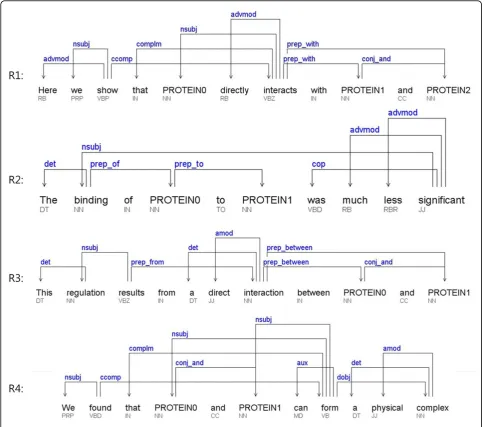
An example sentence and its dependency relations are illustrated in Figure 1-R1. In this example instance, two PPIs exist:P0- P1 andP0- P2. This rule is intended to capture a pattern where the first protein is the nominal subject (nsubj), verb corresponds to a relation word, and the second protein is either a direct object (dobj) or a prepositional modifier (prep*) of the verb. In the exam-ple,P0 is the subject of“interacts,”a relation word, and P1 is the prepositional modifier of“interacts,”and hence
P0- P1 matches the rule.P0- P2 is also extracted by the same rule.
Note that we also handle negation by checking if a nega-tion (neg) dependency exists on either the relation word or the subject. For example, in a sentence,“P0 does not bind toP1,” no PPI is extracted because there exists a neg
If the parsing result is always correct, the rule should extract correct PPIs all the time. However, it is far from reality. Long-distance relations in complex sentences are typically prone to parsing errors. The long-distance rela-tions are also susceptible for mistakes by human
annotators due to the high complexity of sentences. As we are specifically aiming for an extreme high-precision PPI extraction method, we ignore such long-distance relations. We achieve this by considering only the pairs within a
seven-word window on the original sentence. We also put Figure 1Dependency relations for the example sentences.
Table 1 Relation keywords
Activation activate, increase, induce, initiate, stimulate, promote, catalyze, up-regulate, coactivate, potentiate, precipitate, reactivate
Deactivation block, decrease, down-regulate, inactivate, inhibit, reduce, repress, suppress, interfere, antagonize, degrade, obstruct
Creating bond
associate, link, dimerize, heterodimerize, crystalize, methylate, phosphorylate, assemble, polymerize, bound, bond, oligomerize, glycosylate, bind, complex, form, conjugate, acetylate, couple
Breaking bond
cleave, demethylate, dephosphorylate, sever, unbind, depolymerize, dissociate, deacetylate, deglycosilate, disassemble
a constraint on the maximum number of dependency-bearing words allowable in between the two proteins. We empirically determined the max to bethree. In the exam-ple,P0- P2 is a valid candidate because the two proteins fall within a seven-word window and there are only three dependency-bearing words in between them (i.e.,“with” and“and”do not count).
Rule 2:REL - of - Pi- PREP - Pj
This rule is intended to match a phrase like“binding of
P0 toP1”as shown in the example in Figure 1-R2. We first find a relation word“binding”and follow theprep_of
dependency to retrieve the first proteinP0. We then fol-low aprep*dependency to capture the second proteinP1. Other examples that match this rule include“activation of
P0 byP1”and“interaction ofP0 withP1.”The negation handling in this case is done in two different places. First, as in the example, “no interaction of P0 with P1 was found,”the negation (neg) dependency must be checked on the relation word ("interaction”). Second, the negation also can occur at verb level as in the following example:
“activation ofP0 byP1 was not identified.”
Rule 3:REL -{between, of}- Pi- and - Pj
We first find a relation keyword and follow the
pre-p_betweenorprep_ofdependencies from the keyword to retrieve two proteins. In the example in Figure 1-R3, there are two relation keywords ("regulation”and“interaction”) in the sentence but only the second ("interaction”) matches the rule. The negation handling is performed in a similar way as Rule 2.
Rule 4:Pi- and - Pj- REL
This rule covers the cases where a protein conjunction (P0 andP1) is involved innsubjdependency and the con-junction is linked to a relation keyword. However, not all relation keywords are acceptable in this rule. The rule rejects the PPI if the relation keyword is involved in eitherdobjorprep*dependency. The“form”in the exam-ple in Figure 1-R4 is the only exception; it is allowed only if it has“complex”as itsdobj. The negation is handled in the same way as Rule 1.
Rule 5:Pi-{-, /}- Pj-{interaction, complex, hetero-dimer, product, assembly}
This rule defines a lexical pattern that matches phrases such as“P0-P1 complex”and“P0/P1 heterodimer.”
The negation is handled in the same way as Rule 2 and 3.
Rule 6: Pi - VERB - {receptor, ligand, substrate, binding protein}-{for, of}- Pj
This rule is constructed using both syntactic and lexical relations. A sentence like“P0 is a receptor forP1”implies thatP0 will bind toP1. We identify four such keywords as above that imply the binding property between the two proteins. The negation is handled in the same way as Rule 1.
Rule 7:Pi-{receptor, ligand, substrate, binding pro-tein}-(Pj)
In the example, “erythropoietin receptor (EPOR),” we know that EPOR is a protein that acts as a receptor for erythropoietin. We capture such relation using this sim-ple lexical rule. The same relation holds for ligand and substrate. No negation handling is necessary in this rule.
Rule 8: Pi - {binding domain, binding site} - {in, within, on, of}- Pj
This is a sister rule to Rule 7, defining a similar relation using“binding domain”and“binding site.”Like the rule above, it is a handy lexical pattern that matches high
pre-cision binding relations. For example,“CD30L binding
domain on the human CD30 molecule”suggests a PPI
between CD30L and CD30. No negation handling is required in this rule.
Results
Datasets
In order to test the performance of our approach, we use
AIMed [9] corpus, which is considered as thede facto
standard for the PPI extraction benchmark. There also exist several other benchmark corpora but we decided to use only AIMed for several reasons. Pyysalo et al [25] conducted a comparative analysis of five popular PPI cor-pora including AIMed [9], BioInfer [26], HPRD50 [2], IEPA [27], and LLL [28]. They reported that there are sizable discrepancies among the corpora, which are intro-duced mainly by the differences in annotation policy.
Unlike others, AIMed strictly focuses on causal rela-tions that lead to physical changes or changes in dynamics in the target molecule. The other corpora include non-causal interactions such aspart-ofandis-a
relations. For example, BioInfer annotates static rela-tions like protein family memberships, as interacrela-tions. Some corpora are more inclusive while some others are more restrictive in interaction determination. Because of these differences, the number of annotated interactions and the level of certainty differ widely across the cor-pora. We chose AIMed because we focus only on the causal relations and aim to extract only highly certain relations; AIMed turns out the best-fit benchmark for our purpose.
Baselines
of the two methods are reported as comparable to other current state-of-the-art methods.
Evaluation method
As mentioned earlier, we argue that we need a new way to measure the PPI extraction performance. In this work, we introduce a“per-relation”basis performance evalua-tion method. The key idea behind this new evaluaevalua-tion method has been discussed already in the introduction section. Now we formulate the per-relation evaluation metrics. LetTPdenote the number of true positive rela-tions,FP, the false positives, andFN, the false negatives.
While the conventional“per-instance”TP andFPare
computed by counting the number of correctly predicted relation instances, our“per-relation”TPandFPare com-puted by counting the number of distinct protein pairs that are predicted correctly.
The question here is by what criteria we decide the interaction and non-interaction for a pair. A viable solu-tion is a sophisticated weighted vote based on the predic-tion labels assigned to each instance of the relapredic-tion [29]. However, in this work, we use a simple strategy where one positive instance makes the corresponding relation positive. We leave the investigation for a more sophisti-cated voting scheme for future work because it is out of scope of the current work. Finally, we turn to define the per-relation precision, recall, and F-score as follows.
Precision= TP
TP+FP (1)
Recall= TP
TP+FN
(2)
F−score= 2×Recall×Precision
Recall+Precision (3)
Performance of our rule-based algorithm as a stand-alone extraction system
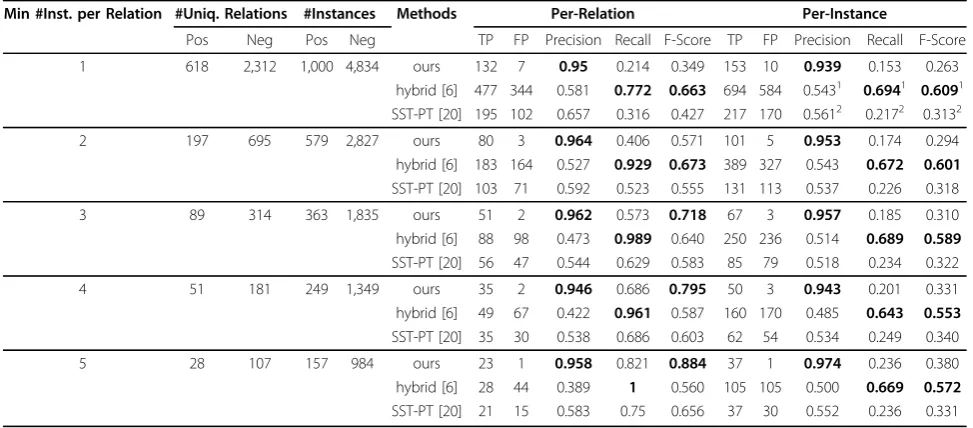
Table 2 shows the experiment results. Our approach achieved the highest precision in both per-relation and per-instance evaluations. We conducted the test by vary-ing the minimum number of instances per relation (here-after, MIpR). For example, the first group (MIpR = 1) represents experiment where we test relations with at leastoneinstance (i.e., all relations; equal to full AIMed corpus). Similarly, the second group (MIpR= 2) repre-sents the experiments involving only the relations with at leasttwoinstances. In order to test the effects of the number of positive instances on the classification accu-racy for a positive relation, we further constrained the number of positive instances per positive relation to be at
least two in the second group (likewise, three in the third group, etc.). We need this additional constraint because even for a positive PPI relation, there are many negatively annotated instances for it. In AIMed, there are total of 618 positive and 2312 negative relations (not instances). A positive relation contains on average 1.6 positive and 1.5 negative instances.
As shown in Table 2, our rule-based approach exhibits the highest precision in all groups in both per-relation and per-instance evaluations. The per-relation precision is around 95-96% and the per-instance precision is around 94-97%. As expected (and intended so), the per-instance recall is not impressive achieving only 15-24%. On the other hand, the per-relation recall gradually improves up to 82% in group 5. We note that the baseline approaches tradeoff the per-relation precision for the per-relation recall as they move on from group 1 to group 5. Contrast-ingly, our approach does not degrade the precision while achieving substantial improvement on recall as it move on to group 5. Figure 2 illustrates the performance changes over the varying minimum instance requirements. These results suggest that our high-precision approach is more appropriate than the baseline approaches, especially for a use case involving large corpora.
Improving the performance of baselines with our method
We wanted to test if our high-precision method can be augmented to an existing PPI extraction tool, in order to improve the performance of the original method. In Table 3, the first and the third rows represent the (per-instance) performances of the original baselines. The sec-ond row represents the result obtained from pipelining the hybrid baseline and our rule-based method. The pipelining is done as follows. We run the hybrid method to comple-tion and save the instances that are predicted positive. We then run our method over those instances rejected by the hybrid method and finally compute the overall TP and FP by aggregating the numbers obtained from the first and the second runs. As we can see, the performance of the hybrid baseline, though marginal, was improved.
The performance improvement was much more signif-icant with SST-PT. The precision, recall, and F-score were improved by 15%, 48%, and 37%, respectively. The result suggests that our high-precision method can be also useful even in the conventional“per-instance”basis evaluation scenarios as we can achieve easy improve-ments of the performance of existing tools through the simple pipelining of our method.
Performance of our rule-based method as a two-tier extraction system
extraction framework to a two-tier system. Our rule-based method can be placed either in the first tier or in the second tier while plugging in an existing PPI tool in the remaining tier. This two-tier system has many possi-ble materializations; for example, in the first tier, we run our high-precision rule-based extraction method and pipeline all the negatively labeled instances to an SVM classifier in the second tier for an additional screening.
We evaluated several popular machine learning mod-els for our two-tier system including Support Vector Machine (SVM), Naive Bayesian (NB), Decision Tree (DT), and k-Nearest Neighbor (kNN), in addition to the two baseline PPI extraction tools. For the machine learning models, as features we used two sets of bigrams taken from a forward dependency chain which is a dependency path from the root of a dependency tree to
the first protein and from a backward chain which is a dependency path from the root to the second protein. For improving the accuracy and efficiency of the machine learning models, we performed feature selec-tion where we picked the top-100 bigrams from each of the two bigram sets (i.e., sets of bigrams taken from the forward and the backward chains) based on the differ-ences between their occurrdiffer-ences in the forward chains and the backward chains; for example, the top-100 for-ward bigrams are selected after sorting the bigrams based on the number of the occurrences in the forward chains subtracted by the number of the occurrences of the corresponding bigrams in the backward chains.
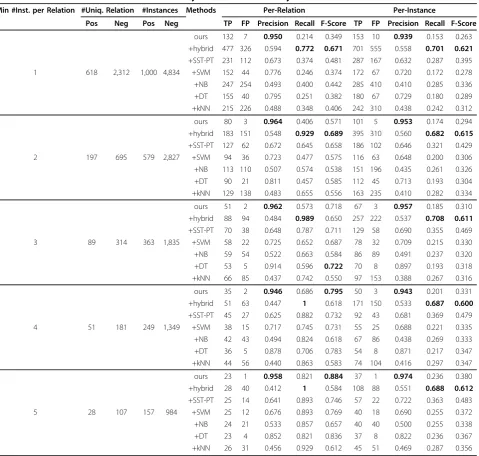
Table 4 shows the results of the experiments where our rule-based system is put in the first tier. For example, with theMIpRbeing set to one, the“ours+hybrid”model
Figure 2Per-relation and per-instance evaluation results with varying“min #instance per relation”. Table 2 Per-relation and per-instance performance evaluation results
Min #Inst. per Relation #Uniq. Relations #Instances Methods Per-Relation Per-Instance
Pos Neg Pos Neg TP FP Precision Recall F-Score TP FP Precision Recall F-Score
1 618 2,312 1,000 4,834 ours 132 7 0.95 0.214 0.349 153 10 0.939 0.153 0.263 hybrid [6] 477 344 0.581 0.772 0.663 694 584 0.5431 0.6941 0.6091 SST-PT [20] 195 102 0.657 0.316 0.427 217 170 0.5612 0.2172 0.3132
2 197 695 579 2,827 ours 80 3 0.964 0.406 0.571 101 5 0.953 0.174 0.294 hybrid [6] 183 164 0.527 0.929 0.673 389 327 0.543 0.672 0.601
SST-PT [20] 103 71 0.592 0.523 0.555 131 113 0.537 0.226 0.318
3 89 314 363 1,835 ours 51 2 0.962 0.573 0.718 67 3 0.957 0.185 0.310 hybrid [6] 88 98 0.473 0.989 0.640 250 236 0.514 0.689 0.589
SST-PT [20] 56 47 0.544 0.629 0.583 85 79 0.518 0.234 0.322
4 51 181 249 1,349 ours 35 2 0.946 0.686 0.795 50 3 0.943 0.201 0.331 hybrid [6] 49 67 0.422 0.961 0.587 160 170 0.485 0.643 0.553
SST-PT [20] 35 30 0.538 0.686 0.603 62 54 0.534 0.249 0.340
5 28 107 157 984 ours 23 1 0.958 0.821 0.884 37 1 0.974 0.236 0.380
hybrid [6] 28 44 0.389 1 0.560 105 105 0.500 0.669 0.572
achieved the per-relation precision, recall, and F-score of 0.594, 0.772, and 0.671, respectively. It represents a slight improvement from the stand-alone hybrid model shown in Table 2 (2.2%, 0%, 1.2% from 0.581, 0.772, 0.663,
respectively). Similarly, per-instance performance also was improved by 2.8%, 1.0%, 2.0% from 0.543, 0.694, 0.609 to 0.558, 0.701, 0.621, respectively. Similar improvements were observed in all five MIpR settings from 1 to 5 while the gain gradually increased as the
MIpR increased. For example, withMIpR= 5, the
per-relation performance was improved by 5.9%, 0%, 4.3% from 0.389, 1, 0.560 to 0.412, 1, 0.584, respectively. The per-instance performance was also improved by 10.2%, 2.8%, 7.0% from 0.5, 0.669, 0.572 to 0.551, 0.688, 0.612, respectively.
The improvement of the stand-alone SST-PT model was even more drastic. WithMIpR= 5, SST-PT’s per-relation performance was improved by 9.9%, 19.1%, 13.7% from
Table 3 Performance improvement of baselines through pipelining our approach
TP FP Prec. Rec. F
Hybrid 694 584 0.543 0.694 0.609
+ours
(%increase) 713 (2.7%)
585 (0.2%)
0.549 (1.2%)
0.713 (2.7%)
0.621 (1.8%)
SST-PT 217 170 0.561 0.217 0.313
+ours
(%increase) 322 (48.4%)
178 (4.7%)
0.644 (14.8%)
0.322 (48.4%)
0.429 (37.1%)
Table 4 Performance of the two-tier extraction system: our rule-based system in the first tier
Min #Inst. per Relation #Uniq. Relation #Instances Methods Per-Relation Per-Instance
Pos Neg Pos Neg TP FP Precision Recall F-Score TP FP Precision Recall F-Score
ours 132 7 0.950 0.214 0.349 153 10 0.939 0.153 0.263
+hybrid 477 326 0.594 0.772 0.671 701 555 0.558 0.701 0.621
+SST-PT 231 112 0.673 0.374 0.481 287 167 0.632 0.287 0.395 1 618 2,312 1,000 4,834 +SVM 152 44 0.776 0.246 0.374 172 67 0.720 0.172 0.278 +NB 247 254 0.493 0.400 0.442 285 410 0.410 0.285 0.336 +DT 155 40 0.795 0.251 0.382 180 67 0.729 0.180 0.289 +kNN 215 226 0.488 0.348 0.406 242 310 0.438 0.242 0.312
ours 80 3 0.964 0.406 0.571 101 5 0.953 0.174 0.294
+hybrid 183 151 0.548 0.929 0.689 395 310 0.560 0.682 0.615
+SST-PT 127 62 0.672 0.645 0.658 186 102 0.646 0.321 0.429 2 197 695 579 2,827 +SVM 94 36 0.723 0.477 0.575 116 63 0.648 0.200 0.306 +NB 113 110 0.507 0.574 0.538 151 196 0.435 0.261 0.326 +DT 90 21 0.811 0.457 0.585 112 45 0.713 0.193 0.304 +kNN 129 138 0.483 0.655 0.556 163 235 0.410 0.282 0.334
ours 51 2 0.962 0.573 0.718 67 3 0.957 0.185 0.310
+hybrid 88 94 0.484 0.989 0.650 257 222 0.537 0.708 0.611
+SST-PT 70 38 0.648 0.787 0.711 129 58 0.690 0.355 0.469 3 89 314 363 1,835 +SVM 58 22 0.725 0.652 0.687 78 32 0.709 0.215 0.330 +NB 59 54 0.522 0.663 0.584 86 89 0.491 0.237 0.320 +DT 53 5 0.914 0.596 0.722 70 8 0.897 0.193 0.318 +kNN 66 85 0.437 0.742 0.550 97 153 0.388 0.267 0.316
ours 35 2 0.946 0.686 0.795 50 3 0.943 0.201 0.331
+hybrid 51 63 0.447 1 0.618 171 150 0.533 0.687 0.600
+SST-PT 45 27 0.625 0.882 0.732 92 43 0.681 0.369 0.479 4 51 181 249 1,349 +SVM 38 15 0.717 0.745 0.731 55 25 0.688 0.221 0.335 +NB 42 43 0.494 0.824 0.618 67 86 0.438 0.269 0.333 +DT 36 5 0.878 0.706 0.783 54 8 0.871 0.217 0.347 +kNN 44 56 0.440 0.863 0.583 74 104 0.416 0.297 0.347
ours 23 1 0.958 0.821 0.884 37 1 0.974 0.236 0.380
+hybrid 28 40 0.412 1 0.584 108 88 0.551 0.688 0.612
0.583, 0.75, 0.656 to 0.641, 0.893, 0.746, respectively, while its per-instance performance was improved by striking percentages of 30.8%, 53.8%, 45.9% from 0.552, 0.236, 0.331 to 0.722, 0.363, 0.483, respectively.
On the other hand, the two-tier approach turned out to be not as effective for improving the performance against our stand-alone rule-based system as it was for improv-ing the baselines. For example, withMIpR= 5, the per-relation performance of our method after pipelining to the hybrid model was improved by -133%, 21.8%, -51.4% from 0.958, 0.821, 0.884 to 0.412, 1, 0.584, for precision, recall, F-score, respectively. Similarly, the per-instance performance was improved by -76.8%, 192%, 61.1% from 0.974, 0.236, 0.38 to 0.551, 0.688, 0.612, respectively. The two-tier approach generally improved the per-relation and per-instance recall of our rule-based model while substantially degrading its precision. Similar observations were made across the models.
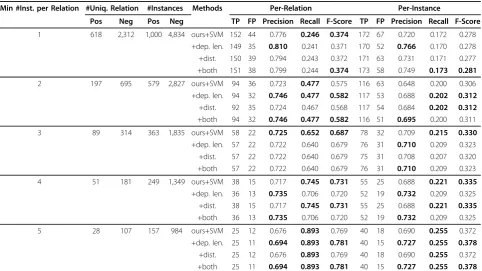
In this test, we only used one type of feature, the dependency bigram, for the machine learning models. In order to see if we can improve the performance further by adding more features to the models, we conducted an additional test as shown in Table 5. We only show the
result of the“ours+SVM”model in this test. The remain-ing models showed the similar performance characteristic as that of the“ours+SVM”model. The first row in each
MIpRgroup represents the result of“ours+SVM”with
the top-100 forward and backward dependency bigrams. The second row represents the result produced with an additional feature of dependency length which is the length of a dependency path from the root of a depen-dency tree to a protein. We used both forward and back-ward dependency lengths. The third row shows the result with an offset distance between two proteins in a sen-tence added in addition to the original dependency bigrams. The fourth row shows the result from using all three types of features including the dependency bigrams, the dependency lengths, and the offset distance. As we can see in the table, however, the improvement that we achieved by adding more features was not significant. Only a slight improvement on precision was achieved by using the dependency lengths together with the depen-dency bigrams.
Finally, we conducted the same experiment as Table 4 after swapping the tiers. In this test, the two baseline models and the four machine learning models are used
Table 5 Performance of the“ours+SVM”model with incremental feature sets
Min #Inst. per Relation #Uniq. Relation #Instances Methods Per-Relation Per-Instance
Pos Neg Pos Neg TP FP Precision Recall F-Score TP FP Precision Recall F-Score
1 618 2,312 1,000 4,834 ours+SVM 152 44 0.776 0.246 0.374 172 67 0.720 0.172 0.278 +dep. len. 149 35 0.810 0.241 0.371 170 52 0.766 0.170 0.278 +dist. 150 39 0.794 0.243 0.372 171 63 0.731 0.171 0.277 +both 151 38 0.799 0.244 0.374 173 58 0.749 0.173 0.281
2 197 695 579 2,827 ours+SVM 94 36 0.723 0.477 0.575 116 63 0.648 0.200 0.306 +dep. len. 94 32 0.746 0.477 0.582 117 53 0.688 0.202 0.312
+dist. 92 35 0.724 0.467 0.568 117 54 0.684 0.202 0.312
+both 94 32 0.746 0.477 0.582 116 51 0.695 0.200 0.311
3 89 314 363 1,835 ours+SVM 58 22 0.725 0.652 0.687 78 32 0.709 0.215 0.330
+dep. len. 57 22 0.722 0.640 0.679 76 31 0.710 0.209 0.323 +dist. 57 22 0.722 0.640 0.679 75 31 0.708 0.207 0.320 +both 57 22 0.722 0.640 0.679 76 31 0.710 0.209 0.323
4 51 181 249 1,349 ours+SVM 38 15 0.717 0.745 0.731 55 25 0.688 0.221 0.335
+dep. len. 36 13 0.735 0.706 0.720 52 19 0.732 0.209 0.325 +dist. 38 15 0.717 0.745 0.731 55 25 0.688 0.221 0.335
+both 36 13 0.735 0.706 0.720 52 19 0.732 0.209 0.325
5 28 107 157 984 ours+SVM 25 12 0.676 0.893 0.769 40 18 0.690 0.255 0.372 +dep. len. 25 11 0.694 0.893 0.781 40 15 0.727 0.255 0.378
+dist. 25 12 0.676 0.893 0.769 40 18 0.690 0.255 0.372 +both 25 11 0.694 0.893 0.781 40 15 0.727 0.255 0.378
1
Note that the result shown here is different from the ones reported in [6]. It may be due to the differences in SVM optimization parameters used for the experiments. We obtained the codes from the authors’web page at http://staff.science.uva.nl/bui/PPIs.zip and ran as is with the parameters: RBF kernel gamma -0.0145; C = 9; Weka Cost-SensitiveClassifier optimization.
2
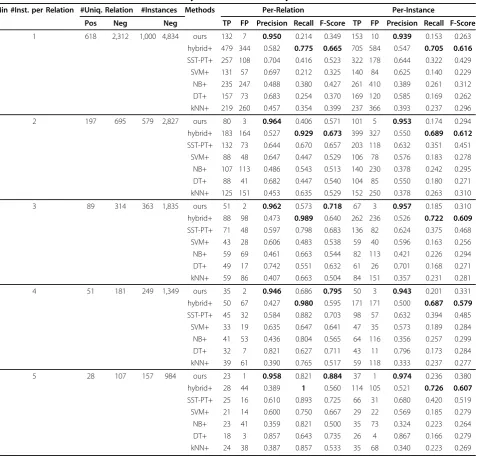
as the first tier system and our rule-based model is used as the second tier system. The result is shown in Table 6. The performance of the baselines was improved in both per-relation and per-instance evaluations as we pipelined the negatively-labeled instances to our rule-based system.
For example, withMIpR = 5, the per-relation
perfor-mance of the SST-PT method was improved by 4.6%, 19.1%, 10.5% from 0.583, 0.75, 0.656 to 0.61, 0.893, 0.725, respectively. The per-instance performance was also improved by 23.2%, 78.0%, 56.8% from 0.552, 0.236, 0.331 to 0.68, 0.42, 0.519, respectively. However, the two-tier approach was not as effective for improving our
rule-based system as it was for the baselines. Similar to the previous experiment in Table 4, the two-tier system degrades the precision while improving the recall.
Discussion
As we can see from the results, our high-precision rule-based system is quite effective in many aspects especially for use cases involving large corpora. The results show that our rule-based system not only performs well as a stand-alone system but also serves well as a complement to other existing PPI extraction models. The latter prop-erty is important as our rule-based system can improve
Table 6 Performance of the two-tier extraction system: our rule-based system in the second tier
Min #Inst. per Relation #Uniq. Relation #Instances Methods Per-Relation Per-Instance
Pos Neg Neg TP FP Precision Recall F-Score TP FP Precision Recall F-Score
1 618 2,312 1,000 4,834 ours 132 7 0.950 0.214 0.349 153 10 0.939 0.153 0.263 hybrid+ 479 344 0.582 0.775 0.665 705 584 0.547 0.705 0.616
SST-PT+ 257 108 0.704 0.416 0.523 322 178 0.644 0.322 0.429 SVM+ 131 57 0.697 0.212 0.325 140 84 0.625 0.140 0.229 NB+ 235 247 0.488 0.380 0.427 261 410 0.389 0.261 0.312 DT+ 157 73 0.683 0.254 0.370 169 120 0.585 0.169 0.262 kNN+ 219 260 0.457 0.354 0.399 237 366 0.393 0.237 0.296
2 197 695 579 2,827 ours 80 3 0.964 0.406 0.571 101 5 0.953 0.174 0.294 hybrid+ 183 164 0.527 0.929 0.673 399 327 0.550 0.689 0.612
SST-PT+ 132 73 0.644 0.670 0.657 203 118 0.632 0.351 0.451 SVM+ 88 48 0.647 0.447 0.529 106 78 0.576 0.183 0.278 NB+ 107 113 0.486 0.543 0.513 140 230 0.378 0.242 0.295 DT+ 88 41 0.682 0.447 0.540 104 85 0.550 0.180 0.271 kNN+ 125 151 0.453 0.635 0.529 152 250 0.378 0.263 0.310
3 89 314 363 1,835 ours 51 2 0.962 0.573 0.718 67 3 0.957 0.185 0.310 hybrid+ 88 98 0.473 0.989 0.640 262 236 0.526 0.722 0.609
SST-PT+ 71 48 0.597 0.798 0.683 136 82 0.624 0.375 0.468 SVM+ 43 28 0.606 0.483 0.538 59 40 0.596 0.163 0.256 NB+ 59 69 0.461 0.663 0.544 82 113 0.421 0.226 0.294 DT+ 49 17 0.742 0.551 0.632 61 26 0.701 0.168 0.271 kNN+ 59 86 0.407 0.663 0.504 84 151 0.357 0.231 0.281
4 51 181 249 1,349 ours 35 2 0.946 0.686 0.795 50 3 0.943 0.201 0.331 hybrid+ 50 67 0.427 0.980 0.595 171 171 0.500 0.687 0.579
SST-PT+ 45 32 0.584 0.882 0.703 98 57 0.632 0.394 0.485 SVM+ 33 19 0.635 0.647 0.641 47 35 0.573 0.189 0.284 NB+ 41 53 0.436 0.804 0.565 64 116 0.356 0.257 0.299 DT+ 32 7 0.821 0.627 0.711 43 11 0.796 0.173 0.284 kNN+ 39 61 0.390 0.765 0.517 59 118 0.333 0.237 0.277
5 28 107 157 984 ours 23 1 0.958 0.821 0.884 37 1 0.974 0.236 0.380
hybrid+ 28 44 0.389 1 0.560 114 105 0.521 0.726 0.607
the performance of existing solutions simply by pipelining the existing solutions to ours without having to modify the internals of the other existing tools.
We also demonstrated that the generalized two-tier platform for PPI extraction is a viable alternative. The two-tier system can be useful for improving the perfor-mance of legacy PPI tools and also can be useful for use cases where recall is equally important. The remaining challenge is how we can retain the high precision of our rule-based system while improving its recall in the two-tier system. This seems to be an inherently difficult pro-blem. The extraction model in the other tier should be extremely conservative in determining positive instances in order to retain the high precision. The six models we tested in this experiments all failed to achieve this goal. We leave this as our future work.
Conclusion
In this work, we argued that the current“per-instance” basis performance evaluation method is not pragmatic in many realistic PPI extraction scenarios. To address this problem, we introduced a new“per-relation”basis evalua-tion method. In the new method, precision and recall are computed based on the number of distinct relations (not instances) that are classified correctly. We also proposed a high-precision rule-based PPI extraction method and showed our method achieves substantially higher precision than two state-of-the-art PPI extraction baselines in both per-relation and per-instance evaluation. Finally, we gener-alized our rule-based model to a two-tier PPI extraction system, in which our rule-based model is augmented with other existing extraction models through pipelining. With this two-tier system, we demonstrated that our rule-based model is also a valuable complement to other existing PPI tools. In our future work, we plan to investigate more sophisticated weighted voting scheme in order to make our PPI extraction system more robust to potential parsing and annotation errors. We also plan to investigate highly conservative high-precision machine learning models in order to retain the high precision of our rule-based system while improving the recall when used in our two-tier system.
Authors’contributions
JK carried out the design of the system and drafted the manuscript. JL and SK participated in the implementation of the system and its validation. SL and KL carried out the use of the system for validation and helped to draft the manuscript. All authors read and approved the final manuscript.
Competing interests
The authors declare that there are no competing interests.
Acknowledgements
This research was supported by the National Research Foundation of Korea (NRF) grant (2012R1A2A2A01014729) and the Next-Generation Information
Computing Development Program through the NRF (2012M3C4A7033341) funded by the Ministry of Education, Science and Technology.
This work is based on an earlier work:“High precision rule based PPI extraction and per-pair basis performance evaluation”, inProceedings of the ACM Sixth International Workshop on Data and Text Mining in Biomedical Informatics, 2012 © ACM, 2012. http://doi.acm.org/10.1145/2390068.2390082
Declarations
The publication costs for this article were funded by the Next-Generation Information Computing Development Program through the National Research Foundation of Korea (NRF) funded by the Ministry of Education, Science and Technology (2012M3C4A7033341).
This article has been published as part ofBMC Medical Informatics and Decision MakingVolume 13 Supplement 1, 2013: Proceedings of the ACM Sixth International Workshop on Data and Text Mining in Biomedical Informatics (DTMBio 2012). The full contents of the supplement are available online at http://www.biomedcentral.com/bmcmedinformdecismak/ supplements/13/S1.
Published: 5 April 2013
References
1. Ahmed S, Chidambaram D, Davulcu H, Baral C:Intex: A syntactic role driven protein-protein interaction extractor for bio-medical text.
Proceedings of the ACL-ISMB Workshop on Linking Biological Literature, Ontologies and Databases: Mining Biological SemanticsAssociation for Computational Linguistics; 2005, 54-61.
2. Fundel K, Küffner R, Zimmer R:RelEx-Relation extraction using dependency parse trees.Bioinformatics2007,23(3):365-371. 3. Leroy G, Chen H, Martinez J:A shallow parser based on closed-class
words to capture relations in biomedical text.Journal of biomedical Informatics2003,36(3):145-158.
4. Rinaldi F, Schneider G, Kaljurand K, Hess M, Andronis C, Konstandi O, Persidis A:Mining of relations between proteins over biomedical scientific literature using a deep-linguistic approach.Artificial intelligence in medicine2007,39(2):127-136.
5. Airola A, Pyysalo S, Björne J, Pahikkala T, Ginter F, Salakoski T:All-paths graph kernel for protein-protein interaction extraction with evaluation of cross-corpus learning.BMC bioinformatics2008,9(Suppl 11):S2.
6. Bui Q, Katrenko S, Sloot P:A hybrid approach to extract protein-protein interactions.Bioinformatics2011,27(2):259-265.
7. Miwa M, Sætre R, Miyao Y, Tsujii J:Protein-protein interaction extraction by leveraging multiple kernels and parsers.International Journal of Medical Informatics2009,78(12):e39-e46.
8. Zhang Y, Lin H, Yang Z, Wang J, Li Y:Hash Subgraph Pairwise Kernel for Protein-Protein Interaction Extraction.IEEE/ACM Transactions on Computational Biology and Bioinformatics (TCBB)2012,9(4):1190-1202. 9. Bunescu R, Mooney R:A shortest path dependency kernel for relation
extraction.Proceedings of the conference on Human Language Technology and Empirical Methods in Natural Language ProcessingAssociation for Computational Linguistics; 2005, 724-731.
10. Lee J, Kim S, Lee S, Lee K, Kang J:High precision rule based PPI extraction and per-pair basis performance evaluation.Proceedings of the ACM Sixth International Workshop on Data and Text Mining in Biomedical Informatics
New York: ACM; 2012, 69-76.
11. Blaschke C, Andrade M, Ouzounis C, Valencia A:Automatic extraction of biological information from scientific text: protein-protein interactions.
Proc Int Conf Intell Syst Mol Biol, Volume 71999, 60-67.
12. Huang M, Zhu X, Hao Y, Payan D, Qu K, Li M:Discovering patterns to extract protein-protein interactions from full texts.Bioinformatics2004, 20(18):3604-3612.
13. Ono T, Hishigaki H, Tanigami A, Takagi T:Automated extraction of information on protein-protein interactions from the biological literature.Bioinformatics2001,17(2):155-161.
14. Liu B, Qian L, Wang H, Zhou G:Dependency-driven feature-based learning for extracting protein-protein interactions from biomedical text.
Proceedings of the 23rd International Conference on Computational Linguistics: PostersAssociation for Computational Linguistics; 2010, 757-765.
2009 Conference on Empirical Methods in Natural Language Processing: Volume 1-Volume 1Association for Computational Linguistics; 2009, 121-130. 16. Sætre R, Sagae K, Tsujii J:Syntactic features for protein-protein interaction
extraction.Proceedings of the International Symposium on Languages in Biology and Medicine (LBM short oral presentations)Citeseer; 2007. 17. Collins M, Duffy N:Convolution kernels for natural language.Proceedings
of NIPS, Volume 142001, 625-632.
18. Bunescu R, Mooney R:Subsequence kernels for relation extraction.
Advances in neural information processing systems2006,18:171. 19. Kim S, Yoon J, Yang J, Park S:Walk-weighted subsequence kernels for
protein-protein interaction extraction.BMC bioinformatics2010,11:107. 20. Choi S, Myaeng S:Simplicity is better: revisiting single kernel PPI
extraction.Proceedings of the 23rd International Conference on Computational LinguisticsAssociation for Computational Linguistics; 2010, 206-214.
21. Zelenko D, Aone C, Richardella A:Kernel methods for relation extraction.
The Journal of Machine Learning Research2003,3:1083-1106. 22. Tikk D, Thomas P, Palaga P, Hakenberg J, Leser U:A comprehensive
benchmark of kernel methods to extract protein-protein interactions from literature.PLoS Computational Biology2010,6(7):e1000837. 23. Miyao Y, Sagae K, Sætre R, Matsuzaki T, Tsujii J:Evaluating contributions of
natural language parsers to protein-protein interaction extraction.
Bioinformatics2009,25(3):394-400.
24. Klein D, Manning C:Fast exact inference with a factored model for natural language parsing.Advances in neural information processing systems2002,15(2002):3-10.
25. Pyysalo S, Airola A, Heimonen J, Björne J, Ginter F, Salakoski T:Comparative analysis of five protein-protein interaction corpora.BMC bioinformatics
2008,9(Suppl 3):S6.
26. Pyysalo S, Ginter F, Heimonen J, Bjorne J, Boberg J, Jarvinen J, Salakoski T: BioInfer: a corpus for information extraction in the biomedical domain.
BMC Bioinformatics2007,8:50.
27. Ding J, Berleant D, Nettleton D, Wurtele E:Mining MEDLINE: abstracts, sentences, or phrases.Pacific Symposium on Biocomputing, Volume 72002, 326-337.
28. Nédellec C:Learning language in logic-genic interaction extraction challenge.Proceedings of the 4th Learning Language in Logic Workshop (LLL05)Citeseer; 2005, 31-37.
29. Cusick M, Yu H, Smolyar A, Venkatesan K, Carvunis A, Simonis N, Rual J, Borick H, Braun P, Dreze M,et al:Literature-curated protein interaction datasets.Nature methods2009,6:39-46.
doi:10.1186/1472-6947-13-S1-S7
Cite this article as:Leeet al.:On the efficacy of per-relation basis performance evaluation for PPI extraction and a high-precision rule-based approach.BMC Medical Informatics and Decision Making2013
13(Suppl 1):S7.
Submit your next manuscript to BioMed Central and take full advantage of:
• Convenient online submission
• Thorough peer review
• No space constraints or color figure charges
• Immediate publication on acceptance
• Inclusion in PubMed, CAS, Scopus and Google Scholar
• Research which is freely available for redistribution