Research Article
NPRA: Novel Policy Framework for Resource Allocation
in 5G Software Defined Networks
1
Sahrish Khan Tayyaba, Adnan Akhunzada,
2Noor ul Amin, Munam Ali Shah,
2Faheem Khan,
3Ihsan
Ali
Dept. of Computer Science COMSATS Institute of Information Technology, Islamabad 2Department of Computer Science Bacha Khan University
Charsadda, kpk, Pakistan 3Department of Computer Systems and Technology, Faculty of Computer Science and Information Technology, University of
Malaya, 50603, Kuala Lumpur. MALAYSIA
[email protected], [email protected], [email protected], [email protected], [email protected],
Abstract
In cellular networks, physical resources are always limited, especially when shared among different contributors such as mobile network operator (MNO) or mobile virtual network operators (MVNO) etc. Software Defined Network (SDN) and Network Function Virtualization (NFV) is a Current research area. SDN-based cellular networks provide high Quality of Services (QoS) to the end-user and NFV provides isolation. The sharing of resources is often provided by leveraging virtualization. SDN can generate new forwarding rules and policies for dynamic routing decision based on the traffic classification. However, virtualization in cellular networks is still in infancy and many issues and challenges remain un-addressed. The queue-length problem for providing QoS is cellular network requires attention. The queue management requires separate management protocols for fair allocation of resources. In this research paper, we propose a novel framework for resource allocation and bandwidth management in the 5G cellular network. We are using two level of virtualization, i.e., implementing dynamic resource optimization at network slice manager and executing optimized policies at the wireless virtual manager.
Keywords: Resource Allocation; SDN, 5G, Cellular Network.
Received on 08 December 2017, accepted on 24 February 2018, published on 22 March 2018
Copyright © 2018Sahrish Khan Tayyabaet al., licensed to EAI. This is an open access article distributed under the terms of the Creative Commons Attribution licence (http://creativecommons.org/licenses/by/3.0/), which permits unlimited use, distribution and reproduction in any medium so long as the original work is properly cited.
doi: 10.4108/eai.22-3-2018.154387
1. Introduction
In a cellular network, changing wireless conditions and limited shared spectrum require fair resource allocation and fair scheduling at the base station. Resources in a cellular network are provided by Base Station (BS) which maintain incoming flow queue and schedule them at the time of deployment. This static allocation leads to inefficient resource utilization. For efficient resource allocation, virtual resources are allocated in slices to serve service request. The virtualization of resources at the BS required frequent management due to frequent changing dynamics of cellular networks. In wireless virtualization, physical resources such as wireless spectrum are shared
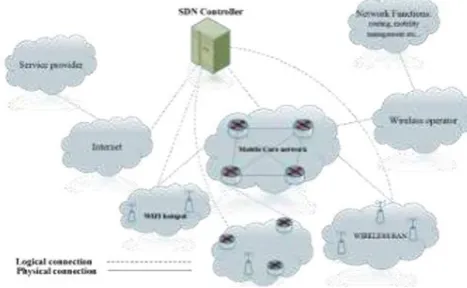
centralized orchestration and efficient resource allocation by providing fine grain traffic steering. In recent research, many SDN based architectures are proposed by the researcher that provide architectural requirements of a cellular network such SoftRAN [2], CellSDN [3], SoftCell [4], UbiFlow [5], Cross-layer SDN/SDR [6] [7] and SoftAir [8] etc. A general architecture for SDN based cellular networks is shown in Fig. 1.
Fig. 1. SDN based cellular network architecture showing different networks coordinate with SDN controller and communicate with each
other.
However, in the existing research, SDN wireless virtualization solutions are still facing many challenges due to link variability, incomplete isolation of wireless slice, the distance between source and destination etc. [9]. In wireless virtualization, flow based isolation is still lacking. Wireless virtualization also suffers from queue length problem. These factors degrade the overall network performance. We propose an end-to-end dynamic resource allocation and bandwidth management in SDN based cellular network using two level of virtualization, i.e., network level virtualization, and wireless virtual manager. The queue length problem in a cellular network is addressed using different methods such as optimization, resource scheduling or different policies. Our contribution is to make use of these three approaches in
achieving optimized bandwidth management and resource allocation in SDN based cellular network. we are formulating a Novel Policy for Resource Allocation (NPRA). The aim of providing two level of virtualization is maximizing the performance and reducing the end-to-end delay from User Equipment (UE) to the core network. The major focus is the management and allocation of resources in term of limited available spectrum in wireless communication and bandwidth in the core network. The remainder of the paper is structured as follows. Section II discusses related work, in section III problem and requirements are defined for the resource allocation and bandwidth management in SDN based 5G cellular network. Section IV describes the proposed methodology for addressing resource allocation based on two level of virtualization i.e. Network virtualization and wireless virtualization. The research paper is concluded in section V.
2. Related work
unique optimal between allocated bandwidth and price that a user is willing to pay. The queueing model used at the controller and eNB are different, i.e., M/M/1 queue is used at the P-GW and controller, and M/D/1 queue is used at eNB. This results in large delay due to different arrival rate. 5G virtualization, guaranteeing bandwidth allocation is proposed by R. Kuko in [13]. This proposal comprises of a Network Virtualization Substrate (NVS) for the cellular network to provide efficient realization of resource allocation, isolation, and customization. This architecture consists of two types of schedulers (i) slice scheduler and (ii) flow scheduler. It provides flow-based scheduling at the BS per slice based accommodating bandwidth and resource reservation. The objective of bandwidth allocation in SDN is to maximize the performance gain and to achieve maximum control application rate based on the fair allocation of link bandwidth and flow table assignment in each switch. Bandwidth/resource allocation in SDN using virtualization is done through FlowVisor [14] which statically allocate bandwidth and flow table for multiple control applications with separated slices. Resource management in the 5G cellular network is proposed in [15], where data offloading in the case of congestion on the heterogeneous network is handled by offloading data to Wi-Fi network instead of the cellular network and alleviates the spectrum shortage concern in the heterogeneous network. The primary bandwidth is allocated by. the cellular network, and secondary bandwidth is assigned by the Wi-Fi network. Ian. F. Akhildiz et al. [8] proposed an architecture for 5G cellular network based on SDN and suggested to have queue-length managing wireless hypervisor that is responsible for allocating resources to the baseband unit or BS which is monitored by SDN FlowVisor. However, despite the strong theoretical framework of SDN based 5G cellular network architecture, practical implication and results are not evident as a proof of concept.
3 Requirement and Problem Definition
In a cellular network, the wireless hypervisor does not consider queue length based solutions while SDN follows flow-based traffic engineering which results in a huge disparity between flow management and queue based resource allocation of incoming flow request. The changes are required in the transmission from cellular BS to the SDN controller. Front-haul connectivity requires high bandwidth due to the transfer of I-Q signals from UE to the BS from communicating diagnostic measurements, the front-haul and backhaul bandwidths both are important to take into consideration while updating and allocating bandwidth for multiple cellular networks communicating different network operating services. The queue-length based policies are considered as throughput optimal. However, in wireless hypervisors, the queue-length based solution is not taken
into account [8]. There is a lack of central optimization for the backhaul and front-haul resource allocation in the cellular network [16] [17] which requires centralized backhauls and front-haul bandwidth allocation and flow-level virtualization for a cellular network. There is a lack of central optimization [33] of the resources at the core network and cellular network. Wireless virtualization used in SDN-based cellular networks does not provide dynamic resource allocation and bandwidth management which ultimately induce a mismatch of queue-based and flow-based resource allocation. This mismatch of queue-flow-based and flow-based resource allocation techniques result in the increased size of the client request queues ultimately dropping the packets (client requests). This drop of packets consequently degrades the network performance and provides poor QoS to the end-user. The queue-length problem is illustrated in Fig. 2.
4. Proposed Methodology
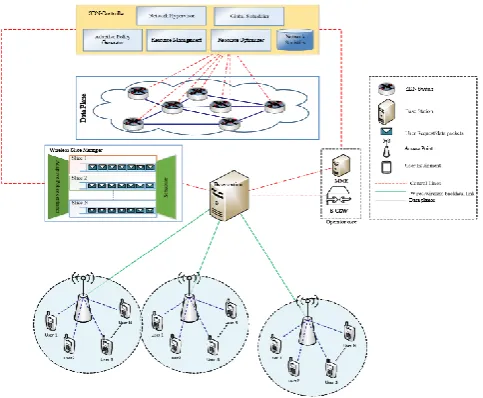
In this research work, we define an SDN-based cellular network bandwidth allocation policy using virtualization manager. An adaptive real-time resource allocation policy is implemented on the control plane based on the traffic classification (jobs). The policy framework is implemented on the SDN based cellular architecture. The architecture consists of two level of virtualization, i.e., network wide virtualization at the controller for network management and wireless slice manager at the BS. The SDN controller provides a central orchestration of the network and devices policies for
The efficient resource scheduler will fairly schedule different slices resources. Scheduling of resources will be done using the global scheduler implemented in the controller. The global scheduler will run in the network hypervisor and may implement different scheduling algorithms such as First In First Out (FIFO), Shortest Job First (SJF), Round Robin (RR), etc. A local scheduler will schedule resources at the BS in the wireless slice manager. Local scheduler at BS will help UEs to share resources at the BS. Globally dynamic policy mediation is provided using search optimization techniques for dynamic resource allocation. We define a Novel Policy Framework for Resource Allocation and bandwidth management called NPRA in SDN based 5G cellular network including methods and techniques for bandwidth allocation in virtual network slices associated with an application. This policy can dynamically adjust its behavior in response to changes and QoS requirements. We define an optimal policy for network bandwidth allocation and queue management at the cellular BS. The optimized policy will consider queue-length
resource allocation in the wireless slice manager to bridge the gap between resource demand at the BS and bandwidth allocation at the controller. The network hypervisor, i.e., FlowVisor centrally manages the SDN cellular network and is responsible for handling virtual slice manager at the base station, i.e., wireless hypervisor instance, and allocate bandwidth as per requirement to achieve fairness. Virtual Slice manager at each BS will serve as local controller. This local controller will reduce the communication overhead from the centralized controller. The resource allocation policy is enforced by traffic classification and capacity of QoS queues in at the BS. The proposed architecture for SDN based cellular network is shown in Fig. 3.
4.1 Salient features of NPRA
NPRA is SDN based cellular network management and bandwidth allocation policy using virtualization manager at the centralized controller and at the base station for core and wireless virtualization. It Provides queue-length resource allocation in the wireless hypervisor and flows management at the controller level hypervisor. NPRA can dynamically adjust its behavior in response to changes and QoS requirements due to the presence of virtual Slice manager at each BS and a local controller.
Fig. 4. Flow management of proposed solution (NPRA) for bandwidth allocation using virtual slice manager at BS and
network hypervisor.
The incoming flow is matched in the flow table of the data plane. In SDN based cellular network, the base station checks the associated policy for the specific flow in its database. If the flow exists, the allocated bandwidth is assigned according to the adjusted rate of available resources for the slice flow. However, if the flow is new or flow entry expires, then a packet in message is send to the controller [19, 20, 21]. Controller defined rules according to our policy framework for fair allocation. Before assigning resources, traffic classification based on QoS parameters are scheduled in the BS virtual queues for managing multiple slices. After that available resources are fairly allocated. Virtual slice manager dynamically adjusts its behaviour.
4.2 Implementation and Expected
Outcome
configuration of SDN network and provides flexibility. Mininet also provides some complex topologies that can further be extending for more complex topologies and networking experiments. We have implemented initial topology in Mininet for testing SDN outcome for separate control and data plane. However, its support for wireless communication, especially for large scale 5G networks is not enough. We are using OPNET which is a stable tool for wired and wireless simulation. Bandwidth allocation model usually used mathematical modeling or convex optimization, max-min fair allocation, etc. which may be considered in OPNET. For our work, we are using Flood Light controller to emulate our proposed solution [28, 29, 30, 31, 32]. The results then will be compiled to check the throughput delay, and fairness of the proposed solution. The focus of our research is increase performance in term of high throughput and reduced latency as anticipated for 5G network as well as fairness in resource allocation and bandwidth management.
5 Conclusion
In this paper, we propose an end-to-end dynamic resource allocation and bandwidth management in SDN based cellular network using two level of virtualization, i.e., network level virtualization, and wireless virtual manager. The queue length problem in a cellular network is addressed using different methods such as optimization, resource scheduling or different policies. There is a trade-off between performance gain and computation delay at the controller. The main challenge is forming dynamic slices for the available resources at the BS which is running virtual slice manager.
References
1. Dahlman E, Mildh G, Parkvall S, Peisa J, Sachs J, Selén Y, et al. 5G wireless access: requirements and realization. IEEE Commun Mag. 2014 Dec;52 (12):42–7.
2. Gudipati A, Perry D, Li LE, Katti S. SoftRAN: Software Defined Radio Access Network. In: Proceedings of the Second ACM SIGCOMM Workshop on Hot Topics in Software Defined Networking [Internet]. New York, NY, USA: ACM; 2013. p. 25–30. (HotSDN ’13). Available from: http://doi.acm.org/10.1145/2491185.2491207
3. Jin X, Li L, Vanbever L, Rexford J. Cellsdn: Software-defined cellular core networks. Open Netw Summit SDN Event. 2013;
4. Jin X, Li LE, Vanbever L, Rexford J. Softcell: Scalable and flexible cellular core network architecture. In: Proceedings of the ninth ACM conference on Emerging networking experiments and technologies. ACM; 2013. p. 163–174.
5. Wu D, Arkhipov DI, Asmare E, Qin Z, McCann JA. UbiFlow: Mobility management in urban-scale software defined IoT. In: 2015 IEEE Conference on Computer Communications (INFOCOM). 2015. p. 208–16.
6. González S, de la Oliva A, Costa-Pérez X, Di Giglio A, Cavaliere F, Deiß T, et al. 5G-Crosshaul: An SDN/NFV control and data plane architecture for the 5G integrated Fronthaul/Backhaul. Trans Emerg Telecommun Technol. 2016 Sep 1;27 (9):1196–205.
7. Cho HH, Lai CF, Shih TK, Chao HC. Integration of SDR and SDN for 5G. IEEE Access. 2014; 2: 1196–204.
8. Akyildiz IF, Wang P, Lin S-C. SoftAir: A software defined networking architecture for 5G wireless systems. Comput Netw. 2015; 85: 1–18.
9. Richart M, Baliosian J, Serrat J, Gorricho JL. Resource Slicing in Virtual Wireless Networks: A Survey. IEEE Trans Netw Serv Manag. 2016 Sep;13(3):462–76.
10. Narmanlioglu O, Zeydan E. Software-defined networking based network virtualization for mobile operators. Comput Electr Eng. 2017 Jan; 57: 134–46.
11. Costa-Pérez X, Swetina J, Guo T, Mahindra R, Rangarajan S. Radio access network virtualization for future mobile carrier networks. IEEE Commun Mag. 2013;51(7):27–35. 12. Kang S, Yoon W. SDN-based resource allocation for
heterogeneous LTE and WLAN multi-radio networks. J Supercomput. 2016 Apr 1;72(4):1342–62.
13. Kokku R, Mahindra R, Zhang H, Rangarajan S. NVS: A Substrate for Virtualizing Wireless Resources in Cellular Networks. IEEEACM Trans Netw. 2012 Oct;20(5):1333– 46.
14. Sherwood R, Gibb G, Yap K-K, Appenzeller G, Casado M, McKeown N, et al. Flowvisor: A network virtualization layer. OpenFlow Switch Consort Tech Rep. 2009;1–13. 15. Duan X, Akhtar AM, Wang X. Software-defined
networking-based resource management: data offloading with load balancing in 5G HetNet. EURASIP J Wireless Communication Network. 2015 Dec 1;2015(1):181. 16. Bagci KT, Sahin KE, Tekalp AM. Queue-allocation
optimization for adaptive video streaming over software defined networks with multiple service-levels. In: 2016 IEEE International Conference on Image Processing (ICIP). 2016. p. 1519–23.
17. Cheng W, Zhang X, Zhang H. Heterogeneous statistical QoS provisioning over 5G wireless full-duplex networks. In: 2015 IEEE Conference on Computer Communications (INFOCOM). 2015. p. 55–63.
18. Mininet: An Instant Virtual Network on your Laptop (or other PC) - Mininet [Internet]. Available from:
http://mininet.org/.
19. Akhunzada, Adnan, et al. "Secure and dependable software defined networks." Journal of Network and Computer Applications pp. 199-221 (2016).
20. Sookhak, Mehdi, et al. "Remote data auditing in cloud computing environments: a survey, taxonomy, and open issues." ACM Computing Surveys (CSUR) 47.4 (2015). 21. Alam, Khubaib Amjad, et al. "Impact analysis and change
propagation in service-oriented enterprises: A systematic review." Information Systems pp. 43-73. (2015).
directions." Journal of Network and Computer Applications 48 (2015): 44-57.
23. Sookhak, Mehdi, et al. "Remote data auditing in cloud computing environments: a survey, taxonomy, and open issues." ACM Computing Surveys (CSUR) 47.4 (2015): 65. 24. Sookhak, Mehdi, et al. "Geographic wormhole detection
in wireless sensor networks." PloS one 10.1 (2015): e0115324.
25. Sookhak, Mehdi, et al. "Towards dynamic remote data auditing in computational clouds." The Scientific World Journal 2014 (2014).
26. Abdelaziz, Ahmed, et al. "Distributed controller clustering in software defined networks." PloS one 12.4 (2017): e0174715.
27. Akhunzada, Adnan, et al. "A formal framework for web service broker to compose QoS measures." SAI Intelligent Systems Conference (IntelliSys), 2015. IEEE, 2015. 28. Akhunzada, Adnan, et al. "Towards experiencing the pair
programming as a practice of the Rational Unified Process (RUP)." SAI Intelligent Systems Conference (IntelliSys), 2015. IEEE, 2015.
29. Liaqat, Misbah, et al. "Distance-Based and Low Energy Adaptive Clustering Protocol for Wireless Sensor Networks." PloS one 11.9 (2016): e0161340.
30. N. Usman; Q. Javaid; A. Akhunzada; K. K. R. Choo; S. Usman; A. Sher; M. Ilahi; M. Alam, "A Novel Internet of Things-centric Framework to Mine Malicious Frequent Patterns," in IEEE Access, vol.PP, no.99, pp.1-1, doi: 10.1109/ACCESS.2017.2690456
31. Akhunzada, Adnan, et al. "Securing software defined networks: taxonomy, requirements, and open issues." IEEE Communications Magazine 53.4 (2015): 36-44. 32. Akhunzada, Adnan, and Muhammad Khurram Khan.
"Toward Secure Software Defined Vehicular Networks: Taxonomy, Requirements, and Open Issues." IEEE Communications Magazine 55.7 (2017): 110-118.
33. Faheem Khan, Sohail Abbas, and Samiullah Khan. “An