DEFINING SOCIAL INFLUENCE OF WIVES WITH HIGH
COMPENSATION AND POSITION
Elpidio H. Nodado, EdD
Faculty, College of Arts and Sciences, Jose Rizal Memorial State University
----
-Abstract
The study aimed to define the concept of social influences of wives with high compensation and position in relation to husband having a minimal remuneration, and occupying the lower position. Specifically, it sought to determine the predisposing experience of husband and wives that undergone a various changes, and built an analytical concern that have been brought about by modernization and have been relatively affect the relationship that tried to cope and determine the modern practices, and catches awareness for direct socially and culturally response to the societal practices. Moreover, the nature of each family structure and the interactions therein has been observed to influence personality of spouses and wives that emanates from formidable social odds. Hence, the high income and position transcend wives to the highest level and signify the changing of family practices were the occurrence of condition are in turmoil and relationships are at stake. The descriptive method was used in this study, and there were 90 respondents involved were properly chosen and purposively applied in the selection, and all responses were consolidated categorized and analyzed properly. The results of the study revealed that most of the behavior displayed by the wives and husband were explicitly manifest negative impact to the entire family and society with an alarming result brings about problems which is forced to tackle are closely linked to effects. Based on the findings of the study, the researcher hereby concludes that the social influences of wives are pushes to cope with the existing demand that may change the condition resulted into disorganized family relationship and problems. The measure and recommendation are hereby demonstrated and properly verified and discussed appropriately were made.
Introduction
Modern times characterize the diversified role of women played and portrayed to be independent and capable of holding different functions and position that entered into a conventional and scientific conditions that would rich the echelon of career, which primarily dominated by man that would require strength and mental agility.
The edge of women is new, and no longer are considered women as soft and others paint women as sensitive and emotional who constantly struggle to gain influence and set a standard that would make them tough and reliable to sustain daily existence and most of all gain social status and influence others particularly men.
Social influence gives great impact that constitutes inferiority to men. This shows a disposition with authority catapulted with a great responsibility, which motivates individuals towards respect and influence. The negative influence causes men to develop a feeling of insecurity and a certain type of a high complex situation that may results into an unparalleled disposition of behavioral pattern.
The situation develops a stigma and effects, and in a various occasion men manifested behavior which acted and reacted to the system as individuals. It unveiled reactions which later become unpleasant and purported with situation that increase the likelihood of divorce and can be regarded as the end point of marital instability and to some point constantly stimulated attitude of despair and loneliness.
This Precursor triggers life challenges the usual attitudes and individual behavior and relate to others in the society. The effects explicitly manifested and emphasized which part is related to other that show case changes that greatly affect individuals.
According to Fieldes (2015) women of today are permanent parts of the waged workforce and the union movement, but still women’s works remain generally undervalued. Sexist attitudes and practices are rampant in the work place, and the majority of domestic labor, especially childcare, is still done by working class women. Nonetheless the shift away from stereotypes of the past is clear enough that even in a notorious social conservative. The vast majority of modern women are going to be in the workforce for most of their lives, even their children bearing years.
Despite considerable changes, things remain constant on the role of the women in the rising of generation of workers. And maintaining the ability to work of the existing generation of both sexes, the present condition of employers that women often time encounter attitudinal biases that prevent them from reaching their full potential .With the rise of women liberation movement feminist analyses which contested this statement, at least in relation to the family and women oppression, become influential, given that women oppressions continued unabated in these country.
The study defined the wives social influences towards men having a very minimal compensation and occupy lower position that undergoes various changes occurring the process of its development, as a social institution affected the social structure, and that to determine the overtly and covertly feeling of individual that persists and greatly affects the relationship of family as whole, that continually persisting and destroy the solidity and the desirable attitude of espouses as a member of society.
Theoretical Consideration
The study is anchored on the social theory of Eagly (2004) which focuses on interaction between husband and wife as developed by social system. The social role theory proposed that human behavior is guided by expectations held both by the individual and by other people. The expectations correspond to different roles individual perform or enact in their lives. Social theory implies individual capacity of women in particular position, such as leadership roles.
The Feminist Theory of Hanks (2013) stretched that feminism is usually equated with the push for the Equal Rights; but feminism is much more than the liberal feminist struggle for equal rights. Feminism is not simply one philosophy or movement, but many female ideologies, from goddess cultures, to medieval feminist texts, to nineteenth-century reformers, to twentieth-century post-modernism. Feminist theory now encompasses diverse historical and modern approaches for creating female opportunity, authority, discourse, and influence.
“Equality vs. difference” groupings and the variety of feminist theories provide useful contexts for understanding feminism. Several feminist theories have surfaced in America since the Revolutionary period including: liberal, cultural, socialist, psychoanalytic, existentialist, radical, and post-modern feminism.
.
Denying women formal authority while encouraging their indirect authority sends a clear message of inferiority and invalidation. It also causes women to seek power indirectly, behind the scenes, such as manipulation. At any level, two styles of decision-making may occur: hierarchy allows leaders to make decisions for those organizationally below them; while consensus or group decision may invite participation of those affected by decision.
Autonomy or personal authority is encouraged by Mormon theology and doctrine yet is generally ignored. On the personal level, women and men alike may experience frustration with authority and decision-making in the church; but women additionally struggle with a complete lack of representation in the all-male priesthood leadership. Church vote or “common consent” could utilize personal authority in decision-making. Women’s revelation and authority are suppressed in the church; yet they still emerge in the culture and feminist theology. Personal authority grows more important in women’s lives when the church fails to meet their spiritual needs.
Social influence, however, is the process by which individual’s makes real changes to their feeling and behaviors as a result of interaction with others who perceived to be similar, desirable, or expert people adjust their beliefs with respect to others whom they feel similar in accordance with psychological principles such as balance. Individual are also influenced by the majority: when a large portion of an individual referent social group holds a particular attitude, it is likely that the individual will adopt it as well. In Addition, individual may change an opinion under the influence of another who is perceived to be an expert in the matter at hand.
This is corroborated with the study of Kelman (2009)which identified the three broad varieties of social influence: (1) compliance in which people appear to agree with others, but actually keep their dissenting opinion privately , to illustrate the compliance is the act of responding favorably to an implicit explicit request offered by others. Technically, compliance is a change in behavior but not necessarily attitude one can only comply due to mere obedience, or by otherwise opting to withhold ones private thoughts due to social pressures. The satisfaction derived from compliance is due to social effect of the accepting influence. (I.e. people comply for an expected reward or punishment– aversion). (2) Identification in which people are influenced by someone who is liked and respected such as a famous celebrity. Identification is the changing of attitude or behaviors due to the influence of someone liked.
Advertisement that relies upon celebrities to market their products are taking advantage of this phenomenon. The desired relationship that the identifier relates with the behavior or attitude change is the reward. (3) Internalization in which people accept a belief or behavior and agree both publicly and privately. Internalization is the process of acceptance of a set of norms established by people or groups which are influential to the individual. The individual accepts the influence because the content of the influence accepted is intrinsically rewarding. It is congruent with the individual’s value system, and the reward of internalization is the content of the new behavior.
Methodology
This study employed the descriptive evaluative method of research using purposive sampling technique and adopted checklist which consisted of two sets of self-made questionnaire intended for the wives in a declarative form of statement and for the husband in an interrogative form. The respondents of the study are the working wives with position and the working husband but occupying lower position of Dipolog and Dapitan. The first parts of the instruments is the profile of the respondents and the second is a set of question which focus on the social influence of wives which require a qualitative approach to ascertain the response of the main core of the study. The collection of data is made through distribution of questionnaire to the number of spouses as required in the study and the respondents. Permission from the concern respondents had been sought, and the researcher then proceeded to the distribution of questionnaire and an ample of time was given to the respondents to accomplish the said instrument, and gathered data were tallied, debated and prepared for statistical treatment, using frequency distribution and percentage.
4.0 Result and Discussion
Profile of the Wives and Husbands
than husbands. Majority of the husbands and wives have similar age range and labor years (Table 1).
Table 1Frequency and Percent of Wives and Husbands’ Age, Education and Years of Service
Majority of the husbands and wives as respondents were presently employed in the public sector (Table 2). More than 32 or 40 % of wives hold the top level of their divisions while only 6 or 7.50% of husbands hold the same positions.
Table 2Frequency and Percent of Wives and Husbands’ Type of Institution Employed and Level of Management
Agency Wife Husband
Frequency % Frequency %
Institution Type
Public 62 77.50 53 66.25
Private 18 22.50 27 33.75
Level of Management
Wife Husband
Frequency % Frequency %
Age
51 and above 18 22.50 21 26.25
46 - 50 19 23.75 17 21.25
41–45 22 27.50 18 22.50
36–40 8 10.00 11 13.75
31–35 6 7.50 6 7.50
26–30 5 6.25 5 6.25
21–25 2 2.50 0 0.00
21 and below 0 0.00 2 2.50
Highest Educational Attainment
EdD /PhD 11 13.75 0 0.00
EdD/ PhD units 12 15.00 0 0.00
MS /MA 19 23.75 12 15.00
MS/MA units 4 5.00 7 8.75
Bachelor's Degree 29 36.25 36 45.00
College Level 3 3.75 10 12.50
High School 2 2.50 15 18.75
Length of Service
31–35 5 6.25 3 3.75
26–30 20 25.00 21 26.25
21–25 17 21.25 12 15.00
16–20 22 27.50 19 23.75
Top 32 40.00 6 7.50
Middle 30 37.50 18 22.50
First Line 18 22.50 56 70.00
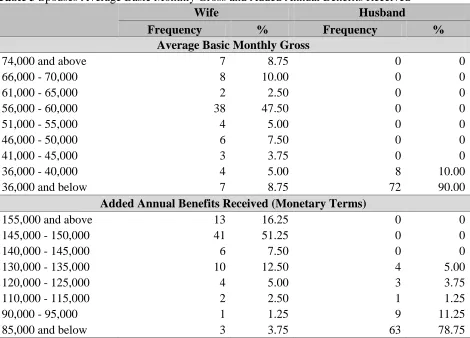
Almost half of the wives surveyed received at least P56, 000 monthly gross incomes that are more than what husband-respondents received (at most P31, 000 per month among 90%). Added benefits among 67.50% of the respondent-wives were at least P 145,000 in a year. Monetary terms of the added benefits received by husbands (78.75%) amounted only to at most P 80,000 in a year as shown in table 3.
Table 3 Spouses Average Basic Monthly Gross and Added Annual Benefits Received
Wife Husband
Frequency % Frequency %
Average Basic Monthly Gross
74,000 and above 7 8.75 0 0
66,000 - 70,000 8 10.00 0 0
61,000 - 65,000 2 2.50 0 0
56,000 - 60,000 38 47.50 0 0
51,000 - 55,000 4 5.00 0 0
46,000 - 50,000 6 7.50 0 0
41,000 - 45,000 3 3.75 0 0
36,000 - 40,000 4 5.00 8 10.00
36,000 and below 7 8.75 72 90.00
Added Annual Benefits Received (Monetary Terms)
155,000 and above 13 16.25 0 0
145,000 - 150,000 41 51.25 0 0
140,000 - 145,000 6 7.50 0 0
130,000 - 135,000 10 12.50 4 5.00
120,000 - 125,000 4 5.00 3 3.75
110,000 - 115,000 2 2.50 1 1.25
90,000 - 95,000 1 1.25 9 11.25
85,000 and below 3 3.75 63 78.75
Social Influence of Wives Intellectual Show Off
behaviour that usually created and succumbing the feelings of humiliation that leads into confrontation and frustration.
This is corroborated with the study of Adler (2010) that pointed out that if an individual faced task to overcome or master the task. This is known as striving for superiority. For a well-adapted individual, this striving is not for personal superiority over others, but an overcoming of the task, or finding useful answers to questions in life. When faced with the task, the individual will experience a feeling of inferiority or a sense that the current situation is not as good as it could be.
Know It All
Still table 4 presents the second factor 'know it all', majority of the wives respondents described item no. 8 with 70 or 87.50% which revealed that most of the wives are very critical , the same way the husband response disclosed 70 or 87.50% considered most of the times wives are very critical of others response regardless level of position; 69 or86.25 % revealed the items are in ranges with the results with the descriptions always want to talk and refuse to be told, it is almost identical and much apparent . Meanwhile, the other descriptors show a significant result as perceived by the respondents is being express appropriately indicates a response connotes negative impact. This means that respondents are aware about the manifestations that create negative effect and it may result into disharmony. This implies that knowledge is alarming and dangerous and dominates every situation and that downward the experience for complexities.
This is also corroborated with Kruger (2015) that a person who acts like a know-it-all might be a megalomaniac, or a narcissist, or someone overcompensating for depression, but it could just be that they have a very common disorder: of human arrogance. Studies have found that quite a lot of people have distorted views of themselves.
Overly Aggressive
Based on the table presentation of overly aggressive factor, 33 out of 80 wives admitted that they are usually ambitious and regarded achiever. Meanwhile ,72 out of 80 husband respondents described that wives openly and answered the item enormously that wives are easily demonstrate verbally which got the highest number of responses. Likewise, 71 or88.75% identified as to the response on the other hand usually highly emotional and quick tempered as they approach and influence others .This means that wives are overly aggressive are influence by the manner of a working condition that responding to the task requires ability as the head of the agency the implications were admittedly and explicitly manifested by the wives respondents. This implies that showing unpleasant behaviour is admittedly changed with regards to their positions hold. However, the effect are suddenly create tension to spouses which are not usual thing sounds tuning the negative practices. This is corroborated with the study of Maccoby (1980) that the spouse need not be conscious of these principles to act aggressively, but must have some rudimentary understanding of each to act in a fully aggressive manner. At a broader cognitive level, the spouses must be able to understand the nature ofthe other, including the other’s goals and plans.
Rabble Rouser
descriptors of the latter and sometimes encourage others to get involved in negative action, this may constitute alarming, this means that will initiate into a wrong action and may cause trouble while the remaining data attributed to a big effect. This implies the conditioning of ones minds constantly it may constitute a stigma that leads into chaos, disorganization and at the same time will create destruction to other people and direct complexity of life.
Table 4 Social Influences of Spouse (Intellectual Show Off, Know It All, Overly Aggressive, Rabble Rouser)
Emotional Function
Item
Wife Husband
Yes No Yes No
Freq % Freq % Freq % Freq %
Intellectual Show Off
1. fully display a competitive behaviour and
carry over imposition and confrontation 27 33.75 53 66.25 52 65.00 28 35 2. want everyone to know how smart I am 13 16.25 67 83.75 60 75.00 20 25 3. struggle overtly to be accepted and to have
a good relationship. 33 41.25 47 58.75 52 65.00 28 35 4. dominate and disallow other input. 8 10.00 72 90.00 68 85.00 12 15 5. usually seek attention and admiration in
performance and act as superior. 11 13.75 69 86.25 60 75.00 20 25
Know It All
6. always want to talk and refuse to be told
anything. 68 85.00 12 15.00 61 76.25 19 23.75 7. manifest superior attitude towards others
and argumentative. 64 80.00 16 20.00 61 76.25 19 23.75 8. am sarcastic and even get nasty and seldom
losses self-control. 70 87.50 10 12.50 70 87.50 10 12.5 9. Most of the time they were very critical to
others response regardless they are the
same level. 61 76.25 19 23.75 59 73.75 21 26.25 10. always refuse to be told and a poor listener. 69 86.25 11 13.75 66 82.50 14 17.5
Overly Aggressive
11. approach others by attacking and usually
highly emotional and quick tempered. 7 8.75 73 91.25 71 88.75 9 11.25 12. easily demonstrate verbal or physical
abuse and openly defiant. 6 7.50 74 92.50 72 90.00 8 10 13. usually ambitious and regarded achiever. 33 41.25 47 58.75 45 56.25 35 43.75 14. try to get others to go along with act of
aggression. 15 18.75 65 81.25 60 75.00 20 25 15. have Anti-class confronted behavior and
usually claims never get a fair deal. 8 10.00 72 90.00 71 88.75 9 11.25
Rabble Rouser
16. usually regard as leader of a cause. 53 66.25 27 33.75 48 60.00 32 40 17. want to stir up trouble and avoid
responsibility. 76 95.00 4 5.00 75 93.75 5 6.25 18. Trying to encourage others to get involved
in negative actions. 74 92.50 6 7.50 68 85.00 12 15 19. When big trouble arises they act like an
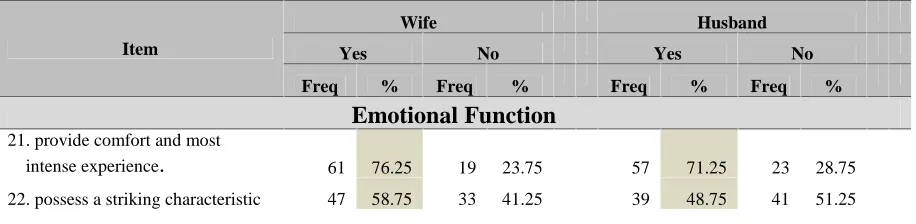
Table 4.A The findings reveals on the emotional function, most of the time wives are emotional, the data defects the frequency and the percentage are considered high, both respondents affirm the condition of being emotional. It is love and the worthiness which forms the most distinctive feature of the human personality, the complex of human relationships is found. The numbers of item in the table were very much apparent to both respondents primarily the weakness of wives, it stifles the inner feelings. This implies wives are too sensitive and weak and closely connected with the concept of human rationality and distinctive emotions.
This is corroborated by Weiner (2015) thatemotion plays a key role in causal ascriptions. Evidence is presented indicating that in achievement-related contexts, there are a few dominant causal perceptions, and it is suggested that the perceived causes of success and failure share the 3 common properties of locus, stability, and controllability, with intentionality and globally as other possible causal structures.
Social Function
Disclosed in the same table is the data pertaining to the social function of the respondents. The table reveals that both respondents believed that the dimensions of every human are considered important and has contributing factor of every success. The figure shows an overwhelming response, and social order provides the atmosphere the environment that inspires the complete development and actualization of all. This means that the social function of wives in the workplace garnered resounding results as shown in the table above and the remaining data were considered as strikingly subdued as the characteristic required of the respondents. This implies that, emphasizing the importance of the social function that may govern a human relation that relates the function human dynamic experience.
Bully Factor
Table 4.A reflects the response of the respondents with regards to bully factor. As seen on the table both respondents are attributed with all items that are enormous in relation to the response. Revelation of result signifies that wives practice the characteristic stipulated and it resulted into deterioration of respect of husband. On the other hand the husband response constitute to the result which revealed the same response on how wives manifest with regards to the bully factor result. This implies that a constant practice of unpleasant actions and words utter degrades or reduces man is respect to the level of rationality, thus it may employ negative impact to oneself or as person.
This is also corroborated with Copers (2013) that states that Bullying or mobbing is used for systematically harassing a person for a long time. In the context of stress theory, bullying is a severe form of social stressors at work, whereas in terms of conflict theory, bullying signifies an unsolved social conflict having reached a high level of escalation and an increased imbalance of power.
Loud Mouth Factors
implies the feeling of complications which creates distraction and deterioration of marriages and increases the distance and alienation.
The result were attested by Gottman is evaluation of marriage and declines in marital satisfaction and stability, whereas constructive behaviors et al. (2012) behavioural theories of marriage that destructive behaviors result in negative lead to improvements in evaluations of marriage and increases in marital satisfaction and stability. Conflict behaviors and divorce that may lead to deterioration of marriages over the long term.
Insecurity Factor
At the same time table 4.A disclosed the insecurity factor of the wives respondents. The results revealed that the data reflects the highest frequency 76 or 95 % represents the affirmation of the wives with regards to the item presented which was described, it develop negative attitude and show no respect ,likewise the responses of the husband were considered as uprooting sentiments that create negative predisposition. This means the feeling of inferiority and difficulty of relationship is at stake. This implies the condition of outward practices which generate mistrust and misunderstanding framework ones thought feeling in the context of relationship.
According to Bowlby (1980) insecure attachment may also contribute to cognitive vulnerability to depression, specifically, dysfunctional attitudes. Attachment dynamics are theorized to shape an individual’s schemas and expectations regarding others, as well as affect the cognitive appraisals of interpersonal events.
Psychological Stress
Disclosed in table 4.A is the Psychological stress of the respondents. As seen on the table the frequency that garnered the highest numerical of 55 or 68.75% , seriously one takes adjustment and may lead into breakdown , while the husband respondents express their sentiments with a little deference of frequency of 53 o66.25% .In this case ,they affirm the condition on which the wives explicitly show their attitude . This means that it is an indicative or constitutive of the malady, root cause of not complying of constant fulfilment of their duties prescribed by nature. This implies that most of the wife-respondents are susceptible to psychological stress due to work condition and function. In most cases wives are negated with a different type of stress that generate negative predisposition.
This study was also corroborated by Copers (2015) which discloses that coping often portray women as less able than the samples of men with whom they are compared. A reformulated theory, based on different women's experiences, explicitly examines the role of social forces and access to power as variables in the coping process rather than solely focusing on the individual.
Table 4.A Social Influences of Spouse (Emotional Function, Social Function, Bully Factors, Loud Mouth, Insecurity, and Psychological Stress)
Item
Wife Husband
Yes No Yes No
Freq % Freq % Freq % Freq %
Emotional Function
21. provide comfort and most
of being affectionate. 23. always length and extend of
service willingly with dedications. 68 85.00 12 15.00 63 78.75 17 21.25 24. develop a relative stable
interpersonal relationship. 58 72.50 22 27.50 57 71.25 23 28.75 25. have love that provides the
justification for going together. 66 82.50 14 17.50 60 75 20 25.00
Social Function
26. serve an important mechanism
for controlling behavior. 66 82.50 14 17.50 61 76.25 19 23.75 27. continuously exert pressure to
make behave according to
accepted norms. 66 82.50 14 17.50 63 78.75 17 21.25 28. undergo various changes set by
norms in the society. 65 81.25 15 18.75 65 81.25 15 18.75 29. consider the broad concepts of
social change and its impact. 70 87.50 10 12.50 67 83.75 13 16.25 30. the interaction that goes within
is invariably desirable. 60 75.00 20 25.00 57 71.25 23 28.75
Bully Factors
31. Always push others around,
verbally and physically. 67 83.75 13 16.25 62 77.5 18 22.50 32. have a bad temper and often a
bad mouth and brags loudly. 74 92.50 6 7.50 70 87.5 10 12.50 33. usually degrade others and
humiliate others in public. 76 95.00 4 5.00 70 87.5 10 12.50 34. have extremely negative and
very poor self-concept. 76 95.00 4 5.00 74 92.5 6 7.50 35. always give sarcastic
complements and threaten others
continually. 72 90.00 8 10.00 66 82.5 14 17.50
Loud Mouth
36. never talk softly, nagger. 71 88.75 9 11.25 69 86.25 11 13.75 37. try to be loud in order to be
tough. 68 85.00 12 15.00 68 85 12 15.00 38. consider being loud an
opportunity to enhance
personality. 58 72.50 22 27.50 60 75 20 25.00 39. behave loudly; burst into the
room slams doors. 69 86.25 11 13.75 64 80 16 20.00 40. openly seek recognition by a
loud mouth especially in publics. 75 93.75 5 6.25 69 86.25 11 13.75
Insecurity
41. Occasionally avoid violent
emotions. 55 68.75 25 31.25 49 61.25 31 38.75 42. develop negative attitude and
show no respect. 76 95.00 4 5.00 69 86.25 11 13.75 43. self-righteous and Open
Avenue of less interests. 62 77.50 18 22.50 60 75 20 25.00 44.don’t accept suggestion from
others. 73 91.25 7 8.75 70 87.5 10 12.50 45. show less interest of talking
with other people. 69 86.25 11 13.75 68 85 12 15.00
Psychological Stress
46. am frustrated when ones striving are thwarted by
obstacle. 44 55.00 36 45.00 46 57.5 34 42.50 47. believe stress openly a stem
from pressure to achieve goals
48. pressure and demand a desire
to gain positive result. 23 28.75 57 71.25 26 32.5 54 67.50 49. seriously take ones adjusted
resources and become lead to
breakdown. 55 68.75 25 31.25 53 66.25 27 33.75 50. will accomplished something
which other will benefit from. 6 7.50 74 92.50 13 16.25 67 83.75
Self-Esteem
Table 4.B discloses the data on self-esteem. Items were found to be attributed to special and immediate attention; 43 or 53.75 % identify needs to feel involved a definite time. In this context, recognition and attention must be properly given which are important to individual in order to stimulate the interest towards every day target. The data revealed its frequency along them table of the husband, it affirms the characteristic of the wives regardless of differences of style and adaptation of work .This means the feeling is firmly believed to be self-centred and unhealthy and May radiates to encompass a situation. This implies the one-sided relation that goes conflict and a possible cause of marital problem where individuals perceived a threatening exercise individual appeared to repudiate power situation.
According to the study of Cohen (2009) persons showed with self-esteem are more likely to show conformity. Furthermore concluded those people with low self-esteem are persuaded more easily than people with high self-esteem.
Self-Confidence
Described in table 4.B is the case of self-confidence of wives. The table representation above shows that the indicator which states 'I am not attentive in deferent and apparently lazy' got 72 wives and 68 husbands who answered yes. This shows that item number 60 has the highest number of yes responses from both wives and husbands. This means that the challenges of espouses is to learn to synchronize responses to work out mutually fulfilling relationship. This implies that wives initiate a wilful action that creates an unhealthy living in sustaining the daily life experience to gain confidence in dealing with people between performance and goal result that is effective response to past action and expectation of one’s future action to attain goal.
This study was also corroborated by Ericson (2014) that self-confidence is not a motivational perspective by itself. It is a judgment about capabilities for accomplishment of some goals, and, therefore, must be considered within a broader conceptualization of motivation that provides the goal context.
Low Morale
The same table disclosed the last factor of low morale with indicators which considered high response of both respondents. It indicates, that wife respondent are pampered at home and in the work place, maybe the adjustment to each other’s falls upon each attention to work or family readily associate with problem. This implies that wives are too much focused and have no time for recreation. The marital conflicts rise and may be resorted to conflict and may irritate in a situation where contradictions ignite and oftentimes result to angry when their desires are blocked or frustrated.
fragile that we need help, especially when we feel the person we should talk to would not be sympathetic.
Table 4.B Social Influences of Spouse (Self-esteem, Self-confidence, and Low Morale)
Item
Wife Husband
Yes No Yes No
Freq % Freq % Freq % Freq %
Self-esteem
51. need to feel involve definite
anytime. 43 53.75 37 46.25 50 62.50 30 37.50 52. provide the warm emotional
security and determine the
large extend. 26 32.50 54 67.5 31 38.75 49 61.25 53. believe healthy relation will
radiate to encompass situation. 9 11.25 71 88.75 67 83.75 13 16.25 54. believe affection giving a solid
foundation and make for life. 18 22.50 62 77.5 20 25.00 60 75.00 55. dare try to succeed every
endeavor for good. 10 12.50 70 87.5 16 20.00 64 80.00
Self Confidence
56. transform self-consciousness to
self-confidence. 18 22.50 62 77.5 23 28.75 57 71.25 57. strive towards positive result
and relax. 4 5.00 76 95 10 12.50 70 87.50 58. quick to complements positively
and criticized constructively. 11 13.75 69 86.25 15 18.75 65 81.25 59. respond to the needs and extend
hand to others. 6 7.50 74 92.5 9 11.25 71 88.75
60. not attentive in deferent and
apparently lazy. 8 10.00 72 90.00 68 85.00 12
15.00
Low Morale
61. usually need prodding to complete
work. 19 23.75 61 76.25 61 76.25 19 23.75 62. unhappy and achieve below
ability. 16 20 64 80.00 66 82.50 14 17.50 63. manifest a situation behavior
with no apparent reason. 15 18.75 65 81.25 62 77.50 18 22.50 64. intensely dislike responsibility. 7 8.75 73 91.25 68 85.00 12 15.00
Table 4.C Chi-Square Test of Association between Spouse Gender and Social Influence at 0.05 Level of Significance
Variables Pearson
Chi-square value
P-value Decision
Gender and Know It All 11.240 0.508 Do not reject Ho
Gender and Overly Aggressive 86.435 0.00 Reject Ho
Gender and Rabble Rouser 86.526 0.00 Reject Ho
Gender and Emotional Function 38.884 0.00 Reject Ho
Gender and Social Function 8.638 0.734 Do not reject Ho
Gender and Bully Factors 17.156 0.144 Do not reject Ho
Gender and Loud Mouth 21.154 0.048 Reject Ho
Gender and Insecurity 50.355 0.00 Reject Ho
Gender and Psychological Stress 141.554 0.00 Reject Ho
Gender and Self-esteem 142.568 0.00 Reject Ho
Gender and Self Confidence 155.984 0.00 Reject Ho
Gender and Low Morale 11.022 0.527 Do not reject Ho
Table 4.C shows the Chi-Square Test of Association between Spouse Gender and Social Influence at 0.05 Level of Significance. There exist significant association between spouse’sgender and social influence particularly in terms of intellectual show off, overly aggressive, rabble rouser, emotional function, loud mouth, insecurity, psychological stress, self-esteem, self-confidence [p-values 0.00 and 0.048 are less than alpha level of 0.05], while there was no sufficient evidence that there exist significant association between spouse gender and know it all, social function, bully factors, low morale. The inferential statistics further imply that social influences significantly vary among wife and husband.
Conclusion
Based on findings of the study the general tendency across wives influence tends to show authority and a downgraded identity towards spouses. The findings evidently shows that wives dominance contain an element of perceptual biases particularly in a situation where potential response evidently create unwholesomeness and negative disturbances. The data cast doubt and dissolution on the precise nature of the husband. In some degree the perceived toleration of behaviour further sights the pre-existing conditions which was vulnerable and create peculiarities of both spouses.
The non-conformity of husband response is regarded to extend unparalleled effect that almost certain a cause of problem among couples.
Disorganization of relationship exists, when competition of couples is very much apparent. This prevalence and constant pressure ignites and extreme bizarre of mood adaptation of behaviour, is an infallible sign of intrinsic deterioration of feelings and predilection of liking, which leads to conflict adjustment of couples catapulted with jealousy and frustration.
The wives promotion and success are definitely a threat, thus, competition and rivalry were distinctively apparent.
Challenge of the new society for equality of gender occupation is very stiff; the influences are dictates by cultural variation and practice particularly the role and function of men and women. The consideration of this conflict may pave away through proper orientation of both couples of the present era of practices and compromise for the good interest and not to confine in old ways.
Recommendation
Based on the results of this study, the researcher hereby recommends that:
that is very minimal and this make important contribution to the family and help make a great deal in raising the levels of living.
2. Wives, who already acquired social position in the community, should exhibit a quality human behaviour to their husbands and extend participation in the community for these and the activities form social classes of individual that determines the opportunities and the expectation towards others in the society.
3. There should be an effective factor in socialization that develops a cordial personality and acquire the bases for distinguishing the right and wrong orientation that provides direction as well as responsibility to make a healthy relationship of both espouses.
4. Relationships are never free from social control pressures and are extended upon to conform to certain standards; spouses should initiate the presence of pattern signifying the bases and guidance to a good relationship and follow squarely as value orientation so that social pressures are more tolerable and manageable.
5. The relationship may drastically change, if unpleasant actions and words are constantly influenced by doubt on a daily bases, thus, espouse should instil a corrective measure directed towards the person with authority, and resulted into a spontaneous affection and respect, devotion is a sense of obligation and obedient to eliminate difficulty when it comes to relationship.
6. Mutual respect and affection among espouses and individual personality should be respected. This development is gradually putting aside the autocratic concept of espouses, that circumvent the threat of feelings that result into a various disagreement.
7. Psychological and personal problems may result from inadequate preparation that can cause family discomfort, in the process of eliminating the psychological stress. Spouses should acquire the give and take attitudes, characteristics of being mature individuals and disregard the hurl charges and the counter charges.
References
Adler, J. (2010). Sex Differences in Social Behavior: Are the Social Role and Evolutionary Explanations Compatible? American Psychologist, 51, 909-917.
Bowlby (1980). Loss: Sadness & Depression. Attachment and Loss (Vol. 3); International Psycho-analytical Library No.. 109).
Cohen, Geoffrey L. (2009). The Psychology of Change: Self-Affirmation and Social Psychological Intervention
Copers (2015). Coping with Stress: Effective People and Processes. Oxford University Press. Retrieved from http://www.oxfordclinicalpsych.com/view/10.1093/med:psych/ 9780195130447.001.0001/med-9780195130447-chapter-14.
Eagly (2004). Sex of Researchers and Sex-Typed Communications as Determinants of Sex Differences in Influenceability: A meta-analysis of social influence studies. Psychological Bulletin, 90, 1-20.
Ericson (2014). Self-Confidence and Performance. Retrieved from https://www.nap.edu/read/ 2303/chapter/13.
Fieldes (2015). Gender Wage Inequality: The De-gendering of the Occupational. Retrieved from https://academic.oup.com/esr/article/32/1/162/2404369/Gender-Wage-Inequality-The-De-gendering-of-the
Foucault, Michel. Power/Knowledge,ed. Colin Gordon (New York: Pantheon Books, 1980), 98.
Gilad, Adam (2016). 5 Ways to Step into Your Courage Zone. Retrieved from http://www. huffingtonpost.com/adam-gilad/5-ways-to-step-into-your-_b_9825212.html
Gottman (2012). Sprint Retrospective Meeting – Scrum Training Series. Retrieved from http://scrumtrainingseries.com/.../SprintRetrospectiveMeeting_script.pdf
Hanks, Maxined (2013). Women and Authority: Re-emerging Mormon Feminism. Retrieved from http://signaturebookslibrary.or/840/.
Kanfer, R. (2010). Emotions in the Workplace: Understanding the Structure and Role Emotions in Organizational Behaviour. San Francisco, CA: Pfeiffer.
Kelman (2005). Compliance, Identification, and Internalization: Three Processes of Attitude Change. Retrieved from http://scholar.harvard.edu/hckelman/files/Compliance _identification_and_internalization.pdf
Kelman (2009). Social Representation and Social Influence. 53 (2), pg 223-237.
Kruger (2015). Unskilled and Unaware of It: How Difficulties in Recognizing One’s Own Incompetence Lead to Inflated Self-Assessments. Journal of Personality and Social Psychology. 77 (6): 1121-34
Maccoby, E.E. (1980). Social development. New York: Harcourt Brace. Retrieved from http://www.pitt.edu/ppcl/Publications/chapters/aggressive_behavior_disorders.htm
Torabi, Farnoosh (2014). When She Makes More: 10 Rules for Breadwinning Women. http://farnoosh.tv/new-ways-to-pursue-your-equal/