I
nfection or impaired wound heal-ing in the immediate postopera-tive period leads to poor surgical outcomes and increased health care costs. Hyperglycemia has been shown to be a significant factor associated with postoperative infection (1–3). Chronic complications of diabetes such as neuropathy and nephropathy have been attributed to poor long-term control of blood glucose (4). Prolonged exposure to high glucose levels causes glycosylation of proteins, which impairs the activity of neutro-phils and fibroblasts, leading to poor wound healing and infection (5).A1C is formed by irreversible glycation of the amino acids in the hemoglobin molecule and reflects glycemic control over the previous 8–12 weeks. It is used as one of the diagnostic criteria for diabetes, and the American Diabetes Association recommends an A1C level <7% as an acceptable glycemic target for most people (6). During the past decade, there have been suggestions that bet-ter long-bet-term glycemic control may play a significant part in abating
postoperative complications (7–10). However, the evidence is not conclu-sive (11).
The purpose of this prospective, observational pilot study was to determine whether elevated A1C is associated with a higher incidence of surgical wound problems, surgical site infection, or infection elsewhere within the first postoperative week. The secondary objective was to com-pare glycemic control and blood glucose variability during the imme-diate postoperative period.
Research Design and Methods
All adult patients with diabetes who were scheduled for elective surgery were eligible to be enrolled into this institutional review board–approved, prospective, observational study. The subjects were identified from the dai-ly operating-room schedule. Patients having cardiac surgery or a surgical procedure expected to take <1 hour were excluded, as were those with preexisting infection and those taking antibiotics, steroids, chemotherapy, or immunosuppressive medications.
Postoperative Complications: A Prospective
Observational Study
Pinxia Chen,1 Katherine K. Hallock,1 Christie L. Mulvey,1 Arthur S. Berg,2 and Verghese T. Cherian1
1Department of Anesthesiology and
Perioperative Medicine and 2Department of
Public Health Sciences, Penn State Health Milton S. Hershey Medical Center, Hershey, PA
Corresponding author: Verghese T. Cherian, [email protected]
https://doi.org/10.2337/cd17-0081
©2017 by the American Diabetes Association. Readers may use this article as long as the work is properly cited, the use is educational and not for profit, and the work is not altered. See http:// creativecommons.org/licenses/by-nc-nd/3.0 for details.
FEA
TURE ARTICLE
The plan for this pilot study was to enroll all eligible, consecutive patients throughout a 6-month period until at least 25 subjects (a convenience sample) were enrolled in each of two groups: Group A, having an A1C <7% and Group B, having an A1C ≥7%. A1C was assessed for all of the patients within 2 weeks of their surgery.
The data collected for each patient included demographic details (age, sex, weight, height, and comor-bidities); diabetes details (type of diabetes, antidiabetic medications, and A1C); type and duration of surgery; all blood glucose values mea-sured during the perioperative period; and the average of all blood glucose values measured during the first post-operative 24-hour period. Additional data collected focused on complica-tions during the first postoperative 7 days, including surgical site infec-tion or infecinfec-tion elsewhere (pyrexia or inflammation of the surgical site that resulted in administration of prophylactic antibiotic was recorded as postoperative infection); surgical wound problems (any inflammation, excessive oozing, delayed healing, or dehiscence of the surgical incision was recorded as a surgical wound problem); and other morbidity or mortality.
Statistical Methods
All continuous variables were an-alyzed by Mann–Whitney U test, and discrete variables were analyzed by Fisher’s exact test. Descriptive statistics are reported as mean ±
SD. Statistical analysis was conduct-ed using R Project for Statistical Computing (The R Foundation, Vienna, Austria). P values <0.05 were considered significant.
Results
During the study period, all consecu-tive patients with diabetes who were scheduled for elective, noncardiac sur-gery were selected. After excluding 13 subjects based on the exclusion crite-ria (6 for surgical duration <1 hour, 2 for systemic steroid use, 4 for tak-ing antibiotics, and 1 for preexisttak-ing
infection), 25 subjects were enrolled into each study group (Group A for those with an A1C <7% and Group B for those with an A1C ≥7%). Patient Demographics
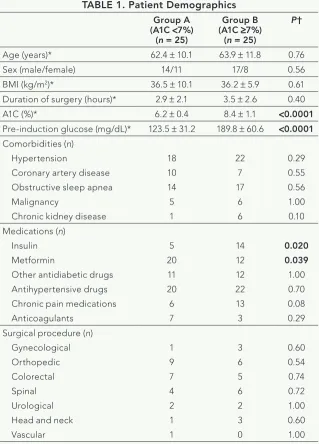
The two groups were comparable with respect to age, BMI, sex, as-sociated comorbidities, and dura-tion and type of surgical procedures (Table 1). Group B had significantly higher pre-induction glucose lev-els (P <0.0001), higher A1C levels (P <0.0001), and more patients on insulin (P = 0.02), whereas more
pa-tients in Group A were on metformin (P = 0.039).
Glucose Levels and
Postoperative Complications One patient from Group A and 10 from Group B had pre-induction glucose values >200 mg/dL, and 4 of these patients, all from Group B, de-veloped postoperative infections. For each patient, all glucose values mea-sured during the first 24 hours after surgery were averaged, and glucose variability was calculated. Average glucose during the first 24 hours was higher in Group B (P = 0.0016), as
TABLE 1. Patient Demographics Group A
(A1C <7%) (n = 25)
Group B (A1C ≥7%)
(n = 25)
P†
Age (years)* 62.4 ± 10.1 63.9 ± 11.8 0.76
Sex (male/female) 14/11 17/8 0.56
BMI (kg/m2)* 36.5 ± 10.1 36.2 ± 5.9 0.61 Duration of surgery (hours)* 2.9 ± 2.1 3.5 ± 2.6 0.40 A1C (%)* 6.2 ± 0.4 8.4 ± 1.1 <0.0001 Pre-induction glucose (mg/dL)* 123.5 ± 31.2 189.8 ± 60.6 <0.0001 Comorbidities (n)
Hypertension
Coronary artery disease Obstructive sleep apnea Malignancy
Chronic kidney disease
18 10 14 5 1
22 7 17
6 6
0.29 0.55 0.56 1.00 0.10 Medications (n)
Insulin Metformin
Other antidiabetic drugs Antihypertensive drugs Chronic pain medications Anticoagulants
5 20 11 20 6 7
14 12 12 22 13 3
0.020 0.039 1.00 0.70 0.08 0.29 Surgical procedure (n)
Gynecological Orthopedic Colorectal Spinal Urological Head and neck Vascular
1 9 7 4 2 1 1
3 6 5 6 2 3 0
0.60 0.54 0.74 0.72 1.00 0.60 1.00
was glucose variability (P = 0.02) (Table 2). During the first postoper-ative day, of the 18 patients (5 from Group A and 13 from Group B) who had glucose values >200 mg/dL (Table 2), 4 from Group B developed infections.
During the first postoperative week, nine patients developed surgi-cal site infections or surgisurgi-cal wound problems, one developed a urinary tract infection, and one had hospital- acquired pneumonia. Of these 11 patients, 10 were in Group B, and 1 was in Group A (Table 2). This translates to a relative risk of 10.0 for a person with an A1C ≥7% to develop postoperative complications. The one patient from Group A who developed surgical wound hematoma had an A1C of 6.9%. There were no significant differences in the distri-bution of surgical procedures or the type of diabetes between those who did and did not develop postoperative wound problems. Apart from these 11 patients, 4 developed other compli-cations (Table 2), all of which were self-limiting.
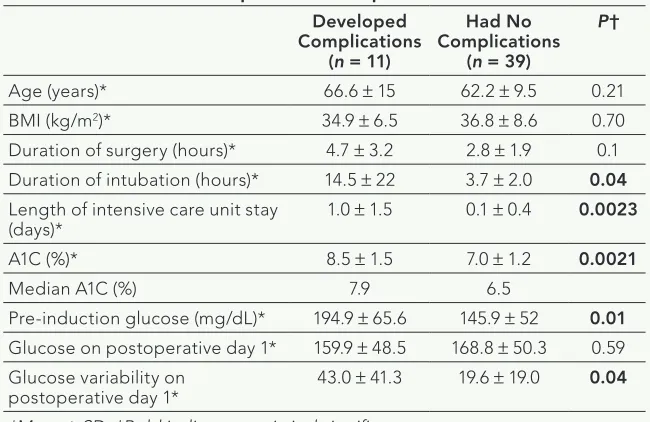
A subgroup analysis of those who developed postoperative com-plications showed that they had significantly higher A1C levels (P = 0.0021) and pre-induction glucose levels (P = 0.01), as well as a longer duration of intubation and lengthier intensive care unit stay
(Table 3). Although glucose levels on the first postoperative day were com-parable between groups, variability in glucose levels was significantly greater among those who developed compli-cations (P = 0.04). Because reliable information about patients’ duration of diabetes was not available, use of insulin was taken as a surrogate marker for severity of diabetes. Of the 14 patients in Group B who were on insulin, only 6 developed compli-cations, whereas 4 of the 11 patients who were not on insulin developed complications. This was not a signif-icant difference (P = 0.74).
Discussion
In this observational study, patients with diabetes who had an A1C ≥7% had a higher incidence of postoper-ative infection and surgical wound problems than those with an A1C
<7%. These patients also showed higher blood glucose levels with wider variability in the postoperative period. Hyperglycemia leads to glyca-tion of intracellular and extracellular proteins, which subsequently form advanced glycation end-products (AGEs), and this process has an important role in the pathophysiology of the chronic complications of
diabe-TABLE 2. Postoperative Glucose and Infection Details Group A (A1C <7%)
(n = 25)
Group B (A1C ≥7%)
(n = 25)
P†
Glucose on postoperative day 1 (mg/dL)* 152.7 ± 32.4 183.0 ± 40.4 0.0016 Glucose variability on postoperative day 1 (mg/dL)* 22.8 ± 12.3 43.0 ± 32.2 0.02 Mean glucose >200 mg/dL on postoperative day 1 (n) 5 13 <0.05 Infection (at surgical site or elsewhere) or surgical wound problems
(drainage, hematoma, dehiscence) (n) 1 10 0.0046
Other complications (n) Acute renal failure Postoperative ileus
Systemic lupus erythematosus flare-up Supraventricular tachycardia
0 1 1 0
1 0 0 1
— — — —
*Mean ± SD. †Bold indicates statistical significance.
TABLE 3. Comparison of Patients Stratified by Development of Postoperative Complications
Developed Complications
(n = 11)
Had No Complications
(n = 39)
P†
Age (years)* 66.6 ± 15 62.2 ± 9.5 0.21
BMI (kg/m2)* 34.9 ± 6.5 36.8 ± 8.6 0.70 Duration of surgery (hours)* 4.7 ± 3.2 2.8 ± 1.9 0.1 Duration of intubation (hours)* 14.5 ± 22 3.7 ± 2.0 0.04 Length of intensive care unit stay
(days)* 1.0 ± 1.5 0.1 ± 0.4 0.0023
A1C (%)* 8.5 ± 1.5 7.0 ± 1.2 0.0021
Median A1C (%) 7.9 6.5
Pre-induction glucose (mg/dL)* 194.9 ± 65.6 145.9 ± 52 0.01 Glucose on postoperative day 1* 159.9 ± 48.5 168.8 ± 50.3 0.59 Glucose variability on
postoperative day 1* 43.0 ± 41.3 19.6 ± 19.0 0.04
FEA
TURE ARTICLE
tes such as nephropathy, neuropathy, and retinopathy. AGEs cause release of proinflammatory molecules such as tumor necrosis factor-α that can limit wound closure (12). In diabetic mice, AGEs have also been shown to affect the functioning of fibroblasts, lead-ing to reduced collagen deposition, reduced proliferation of endothelial cells, and impaired angiogenesis (13). Although it is widely accepted that hyperglycemia in the perioperative period is associated with surgical site infections and other complications after surgery (1,2,10), tight glycemic control in the postoperative period may act as a double-edged sword, increasing the risk of hypoglycemia and its associated higher mortality (14). Thiessen et al. (15) have sug-gested that, in patients undergoing cardiopulmonary bypass, accept-ing glucose values up to 180 mg/dL would be prudent to avoid hypogly-cemia in the pursuit of achieving normoglycemia.
In this study, postoperative glu-cose levels and their variability were both significantly higher among those with an A1C ≥7% (Table 2), despite efforts to keep blood glucose levels to <180 mg/dL, per institutional guidelines. In the subgroup analysis comparing patients who developed postoperative complications to those who did not, A1C levels and glyce-mic variability were significantly higher among those who developed complications, whereas mean glucose on the first postoperative day did not differ significantly (Table 3). This could suggest that factors other than hyperglycemia may be contributing to postoperative complications.
Knapik et al. (9), in a retrospec-tive study, looked at the prevalence of elevated A1C and its association with postoperative complications such as stroke, renal failure, wound infection, and perioperative myocardial infarc-tion in 2,665 patients undergoing coronary artery surgery. Of the 782 who had diabetes (29%), 283 (38%) had an A1C >7%. The only associ-ation they found with elevated A1C
was a higher incidence of periopera-tive myocardial infarction (9). Halkos et al. (8) showed that A1C >8.6% was associated with a fourfold increase in mortality in patients undergoing cor-onary artery bypass surgery. Acott et al. (11) in a retrospective review of nearly 39,000 patients undergoing major surgery, observed that of the 2,960 patients with diabetes, 780 (26%) developed one or more com-plications. They showed that patients with diabetes were at increased risk for complications and death after surgery compared to those who did not have diabetes, but the risk did not correlate with A1C levels.
As the prevalence of diabetes increases in the population, it seems likely that there will be a correspond-ing increase in the number of people with diabetes who need scheduled surgery (16). The important socio-economic question, then, is whether A1C levels should be measured preoperatively in all patients with dia-betes. A1C is a measure of glycemic control, and the cause of poor glyce-mic control could be multifactorial, encompassing both noncompliance to treatment and poor response to treat-ment. An elevated A1C result, unlike a single preoperative glucose value, could predict difficulty in achieving postoperative glycemic control and the development of complications. Although the evidence showing an association between elevated A1C and postoperative complications is inconsistent (15,17,18), the authors of a recent editorial (19) argue that a preoperative A1C screening for all patients with diabetes is justified by the fact that a relatively inexpen-sive test can identify candidates for increased surveillance to prevent a potentially serious complication.
This prospective study, in which a small sample of patients with diabetes were observed for adverse outcomes in the immediate postoperative period, has resulted in more questions than answers. Among these questions are:
1. Is postoperative morbidity the
result of hyperglycemia or of
poor long-term glycemic control or both? The fact that the mean glucose value on the first postoper-ative day was comparable between those who developed compli-cations and those who did not (Table 3) suggests that hyperglyce-mia may not be the only relevant factor for wound complications. In a patient with poor long-term glycemic control, the development of postoperative complications could either be a consequence of glycosylation of tissue proteins and impaired neutrophil activity or a direct consequence of ele-vated A1C. Either way, however, an elevated A1C could be an easily measured marker.
2. Should elective surgery in a
patient with an elevated A1C be rescheduled? If so, what would be an acceptable A1C level for sur-gery? In this study, the median A1C among patients who devel-oped complications was 7.9%, compared to 6.5% among those who did not have complications. In summary, patients with A1C
≥7% have a greater incidence of sur-gical wound complications and also wider postoperative glycemic variabil-ity. Although a standard protocol was used for glycemic control in all of the patients in this study, glycemic con-trol was more difficult to maintain in those with higher A1C values. Given the current trend of implementing a perioperative “surgical home” and reducing postoperative hospital days and readmissions (20), it seems pru-dent to optimize glycemic control before scheduling patients for elec-tive surgery. A1C could be a valuable indicator in such efforts.
Duality of Interest
No potential conflicts of interest relevant to this article were reported.
Author Contributions
review board submission, patient identi-fication, and obtaining patient consent. A.S.B. helped with statistical analysis of the data. V.T.C. conceived of and planned the study, performed institutional review board submission, researched data, and wrote the manuscript. V.T.C. is the guarantor of this work and, as such, had full access to all the data in the study and takes responsibility for the integrity of the data and the accuracy of the data analysis.
References
1. Golden SH, Peart-Vigilance C, Kao WH, Brancati FL. Perioperative glycemic control and the risk of infectious complications in a cohort of adults with diabetes. Diabetes Care 1999;22:1408–1414
2. Pomposelli JJ, Baxter JK, Babineau TJ, et al. Early postoperative glucose control predicts nosocomial infection rate in dia-betic patients. JPEN J Parenter Enteral Nutr 1998;22:77–81
3. Pozzilli P, Leslie RD. Infections and diabetes: mechanisms and prospects for prevention. Diabet Med 1994;11:935–941 4. Stratton IM, Adler AI, Neil HA, et al. Association of glycaemia with macrovas-cular and microvasmacrovas-cular complications of type 2 diabetes (UKPDS 35): prospective observational study. BMJ 2000;321:405–412 5. Alba-Loureiro TC, Munhoz CD, Martins JO, et al. Neutrophil function and metabo-lism in individuals with diabetes mellitus. Braz J Med Biol Res 2007;40:1037–1044
6. American Diabetes Association. Standards of medical care in diabe-tes—2013. Diabetes Care 2013;36(Suppl. 1):S11–S66
7. Dronge AS, Perkal MF, Kancir S, Concato J, Aslan M, Rosenthal RA. Long-term glycemic control and postoper-ative infectious complications. Arch Surg 2006;141:375–380
8. Halkos ME, Puskas JD, Lattouf OM, et al. Elevated preoperative hemoglobin A1c level is predictive of adverse events after coronary artery bypass surgery. J Thorac Cardiovasc Surg 2008;136:631–640 9. Knapik P, Ciesla D, Filipiak K, Knapik M, Zembala M. Prevalence and clinical significance of elevated preoperative gly-cosylated hemoglobin in diabetic patients scheduled for coronary artery surgery. Eur J Cardiothorac Surg 2011;39:484–489 10. Zerr KJ, Furnary AP, Grunkemeier GL, Bookin S, Kanhere V, Starr A. Glucose control lowers the risk of wound infection in diabetics after open heart operations. Ann Thorac Surg 1997;63:356–361
11. Acott AA, Theus SA, Kim LT. Long-term glucose control and risk of perioperative complications. Am J Surg 2009;198:596–599
12. Ahmed N. Advanced glycation end-products: role in pathology of diabetic complications. Diabetes Res Clin Pract 2005;67:3–21
13. Hennessey PJ, Ford EG, Black CT, Andrassy RJ. Wound collagenase activity
correlates directly with collagen glyco-sylation in diabetic rats. J Pediatr Surg 1990;25:75–78
14. NICE-SUGAR Study Investigators. Intensive versus conventional glucose con-trol in critically ill patients. N Engl J Med 2009;360:1283–1297
15. Thiessen S, Vanhorebeek I, Van den Berghe G. Glycemic control and outcome related to cardiopulmonary bypass. Best Pract Res Clin Anaesthesiol 2015;29:177–187 16. Jacober SJ, Sowers JR. An update on perioperative management of diabetes. Arch Intern Med 1999;159:2405–2411
17. Goodenough CJ, Liang MK, Nguyen MT, et al. Preoperative glycosylated hemoglobin and postoperative glucose together predict major complications after abdominal surgery. J Am Coll Surg 2015;221:854–861
18. Bock M, Johansson T, Fritsch G, et al. The impact of preoperative testing for blood glucose concentration and haemoglobin A1c on mortality, changes in management and complications in noncardiac elec-tive surgery: a systematic review. Eur J Anaesthesiol 2015;32:152–159
19. Mutter TC, Bryson GL. Choosing wisely and preoperative hemoglobin A1c testing: what should it mean? Can J Anesth 2016;63:1307–1313