Rashmi Deka*, Jiten Ch. Dutta
Electronics and communication Engineering, School of Enginering, Tezpur University, Tezpur, Assam, India.
*Corresponding author’s E-mail:[email protected]
Received: 20-10-2016; Revised: 22-12-2016; Accepted: 30-12-2016. ABSTRACT
Conductance based model of biological neuron can accurately reproduce the waveform of the membrane voltage as well as the spike timing in response to injected currents. Some of the remarkable models are Hodgkin Huxley (H-H) conductance based neuron model, Fitghugh model and IZ model. These models have different elements and parameters, the values of which determine the trajectory of the membrane voltage. It is, therefore, important to find the optimized parameter values for proper reproduction of the action potential of neuron. Here we have used three algorithms namely, Genetic Algorithm (GA), Particle swarm optimization (PSO) and Firefly Algorithm (FA) to estimate the parameters of three neuron models and compared them with a reference signal. It is found that FA is more accurate and efficient in terms of estimation parameters of neuron model.
Keywords: Hodgkin-Huxley model, Fitghugh model, Izekevich model, Firefly Algorithm.
INTRODUCTION
here are various conductance based mathematical models developed so far1-18. These models can reproduce the various neuron signals associated with it. To produce the required signals, it is necessary to have a good estimate of the parameters associated with it. Although there are numerous methods for estimating the parameters, here genetic algorithm, particle swarm optimization and firefly method are taken into consideration.
These methods were chosen due to the fact that they are based on evolutionary algorithms; nature inspired and is advanced optimization methods so far. These methods are easy to use and efficient. The neuron models considered in this paper are the infamous H-H model, IZ and Fitghugh models. These neuron models parameters are compared by the optimization methods with the actual values obtained by the models and their accuracy is observed. Estimation of parameters is an important field in neurology since it will help to find out the abnormality in a signal and the reason behind it.
For estimating the parameters, an algorithm is required and a fitness function which will reproduce the signal. Here, particle swarm optimization (PSO) method, genetic algorithm (GA) and firefly algorithm (FA) is used for estimating the parameters. PSO is an advanced optimization algorithm where it follows the principle of searching food by bird flocks2- 7. It constantly searches for better solution obtained by neighboring particle. The solution then converges towards the best solution obtained so far. Firefly optimization method is a recent developed optimization method. It is a meta heuristic method inspired from nature. It uses the principle of fireflies who attracts the other fireflies by its brightness. Genetic algorithm is an evolutionary algorithm. It uses the
principle of Darwin’s survival of the fittest from the random population generated. The fittest ones are selected for mating, crossover and mutation 8-14. This process goes on until the best solution is found. These three methods were applied to the mathematical models of neuron to extract the essential parameters. The three methods were compared on account of their reliability, accuracy, speed and efficiency. The different models which are used for estimating the parameters are described in the sections below.
Hodgkin-Huxley model
The extracellular fluid and the inside of the cell is separated by a semi permeable membrane which acts as a capacitor. This ionic charge is disturbed when an external stimulus is exerted on it and adds further charge. The ionic concentration is different in either sides of the membrane and it is called Nernst potential and is represented by ENa, EK, and El for sodium, potassium and
leakage ions respectively. The total current flow is divided into capacitive current, sodium ions, potassium ions and leakage ions as shown in equation (1) and (2).
ion I dt dV membrane C
I (1)
) ( ) ( 3 .) ( 4
l V V l g Na V V h m Na g K V V n K g dt dV membrane C
I (2)
Each individual current is represented by its conductance and difference between the membrane potential (V) and equilibrium potential of each ions (VNa, VK, Vl).m, n, h are
the probability of opening of the channels of sodium and potassium respectively. They are generally referred as gating variables; m and h are the probability of activation and inactivation of the sodium channels. n is the probability of activation of potassium ions. αm, βm, βh are
Optimization of Neuron Models Using Advanced Algorithms
T
the rate constants which are responsible for flow of ions from outside to inside and vice versa for βm,αh, βn of
sodium ions and potassium ions respectively1-4. These equations were found by Hodgkin-Huxley by curve fitting methods. The above variables will be estimated by using genetic algorithm, particle swarm optimization method, firefly optimization method.
Fitghugh model
Fitghugh model is a reduced form of H-H model. It is a mathematical model describing the neuron. It takes the principle of excitation and propagation of action potential. The mathematical description of the model takes the form shown in equation (3) and (4). It is observed from H-H equation that n and h are slow and summed up to a very small value. Fitghugh have reduced the neuron model therefore in two dimensional models. z represents the external current stimulation in a neuron, x is the membrane potential. y is the recovery variable necessary to attain resting potential5.
)
3
(
3
x
z
y
x
c
dt
dx
(3)c
a
by
x
dt
dy
/
)
(
(4)Izekevich model
Izhikevich have mathematically given the following equations 18:
v’=0.04v2+5v+140-u+I (5)
)
(
'
a
bv
u
u
(6)If v= 30 mV then v
c, u
u+da, b, c ,d are the constant parameter and are dimensionless. v is the membrane voltage and u is the recovery variable and it is constantly changed to get the required signal. a is the timing variable recovery, b determines the sensitivity of the recovery variable and the oscillations of the spikes to v, c is the recovery variable for v due to potassium ions after the spike and d represents reset of variable u due to conductance of sodium and potassium. The two simple equation can produce different type of spikes by varying the variables unlike H-H model which takes into account many differential equations to produce the action potential. By changing the values of a, b, c, d one can generate different types of spikes such as regular spikes, fast spikes, slow threshold spikes etc.
MATERIALS AND METHODS
Estimation of parameters in the above models requires a good optimization method. Genetic Algorithm (GA), Firefly algorithm (FA) optimization method and particle swarm optimization method (PSO) are used here. For any estimation method, fitness function is required. Fitness function is obtained by the equations given in the section
above. A reference signal is also needed to compare the signals and for exact and accurate estimation of the parameters. Reference signals are taken from the signals given by Hodgkin-Huxley, IZ, and Fitghugh 15-19. The optimization methods were coded in MATLAB 2010a software for estimation purpose.
The parameters described in the equations in the section above are estimated. The algorithms were applied in MATLAB to estimate the parameters related to the neuron signals 12-19.
GA is a meta heuristic method which searches for an optimum solution and follows the principle of evolution. A fitness function and its variables is defined which is optimized for better results in GA.GA uses the principle of Darwin’s theory of natural selection. It generates a population using the variables and this population (parent) is used to generate the next generation (off springs). This process continues until a convergent to solution is found. While a new population is generated, two parents are chosen for better results. The parent is chosen according to the best result yield which is called selection process. In the next step, crossover is applied to form new off springs where the off springs contain the elements of both the parents equally. Mutation occurs which leads to sudden change and new population is replaced by the existing ones. This process is continued until the solution converges to best solution.
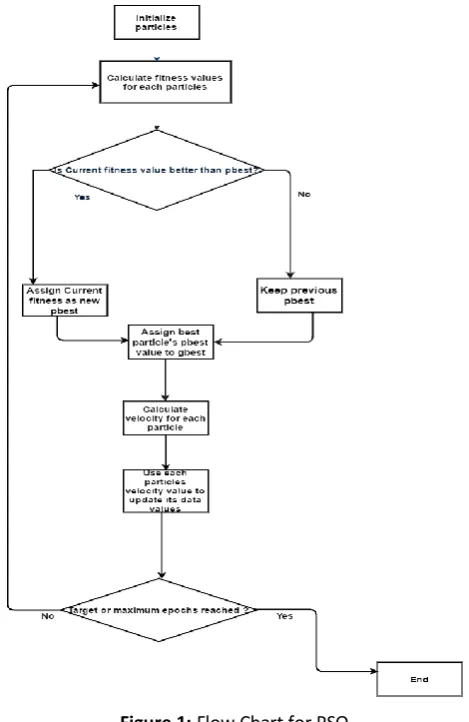
PSO is a meta heuristic algorithm (Fig.1) which follows the principle of flocking of birds established by Dr. Eberhart and Dr. Kennedy in 1995. Unlike GA, PSO does not follow the principle of evolution, crossover, mutation etc. In PSO, the solutions fly over to the optimum solution just like the flocking of birds.
Similar to birds who flock towards the bird who is closest to the food, the variables are kept closer to the solution desirable. Each particle in PSO searches for the best solution obtained so far called the pbest. The other particle then flocks towards the pbest solution. Another particle optimizer keeps track of the best solution obtained in the neighboring area called the lbest solution. gbest is the global best which tracks the best solution obtained taking into account all the population. This process is repeated until optimum solution is reached.
Third optimization method which is taken into account is the firefly algorithm. It is a nature inspired algorithm and found to be better than other algorithms like GA and PSO. Firefly algorithm follows the principle of fireflies following the brighter fireflies. Fireflies are attracted to other fireflies by their brightness level. The less bright ones are attracted to the brighter one and if it cannot find the brighter one than itself, the firefly moves randomly. The brightness I at a particular location x can be defined as I(x)is directly proportional to f(x). β is the attractiveness factor and it is affected by distance rij where i and j are
two different fireflies. The light intensity is defined by inverse square law given in equation (7):
2
/
)
(
r
I
r
I
S (7)Where I (s) is the intensity at the source.
In a fixed light absorption coefficient γ, I (light intensity) depends with distance r. I0 is the original light intensity in
equation (8).
r
e
I
I
0 (8)Both the above equation is combined to avoid r =0 and takes the form shown in equation (9):
2
0 r
e
I
I
(9)The distance between the fireflies i and j is the Cartesian distance:
2
1
,
, )
(
d
k
k j k i j
i
ij x x x x
r (10)
Where xik is the kth component of xi.
The movement of firefly i is attracted to another firefly j is explained as:
) 2 1 (
) (
2
rand x
x e x
x j i
r o i i
ij
(11)
Second term is the attraction factor and the third term is the randomization factor (α). rand is a random number
generated between 0 to 1. The above logic is used to implement the firefly algorithm.
RESULTS AND DISCUSSION
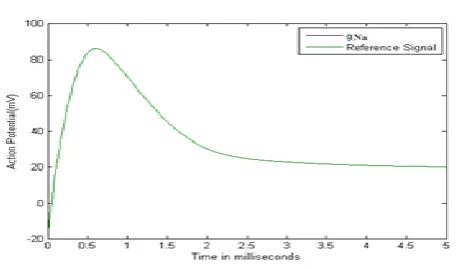
Figure 2 shows the action potential using GA in Hodgkin-Huxley model estimating the value of gNa. Similarly, in
Fig.3 and Fig.4 shows the action potential using PSO and FA with the reference signal estimating the value of gNa. It
is observed that value estimated by FA is more close to the value given by H-H model. In this way, gk is estimated
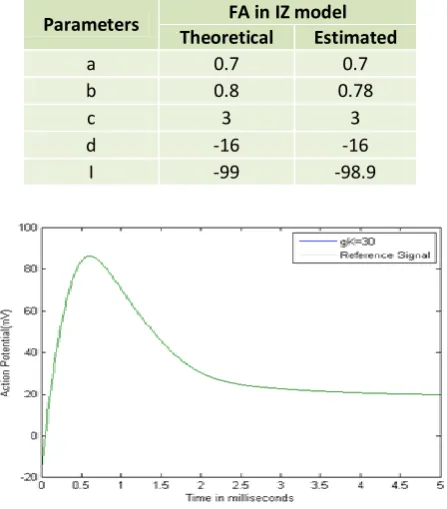
using these three optimization methods and shown in Fig.5, Fig. 6 Fig.7. It is seen that FA is more efficient than the other two methods. Using FA, the value is almost equal to the values given by H-H shown in Fig.7. Table 1(a) and Table 1(b) shows the theoretical and estimated values of the values of H-H model, IZ and Fitghugh using the three optimization methods.
Figure 2: Action Potential estimating the value of gNa using
GA in H-H model
Figure 3: Estimation of sodium conductance using PSO method
Table 1(a): Theoretical and estimated values of the values of H-H model.
Parameters GA PSO FA
Theoretical Estimated Theoretical Estimated Theoretical Estimated
gsodium 120 200 120 180 120 120
gpotassium 36 20 36 22 36 36
gleakage 0.3 0.2 0.3 0.2 0.3 0.3
Esodium -115 -110 -115 -111 -115 -115
Epotassium 12 10 12 11 12 12
Eleakage -10.613 -10 -10.613 -10 -10.613 -10.6
I 0.1 0.3 0.1 0.1 0.1 0.09
αm 0.1 0.08 0.1 0.1 0.1 0.1
βm 4 3.8 4 4 4 4
αn 0.01 0.01 0.01 0.02 0.01 0.01
βn 0.125 0.2 0.125 0.2 0.125 0.125
αh 0.07 0.068 0.07 0.06 0.07 0.07
βh 1 0.7 1 0.8 1 0.99
Table 1(b): Estimation of IZ and Fitghugh model using FA
Parameters FA in Fitghugh model Theoretical Estimated
a 0.7 0.7
b 0.8 0.78
c 3 2.9
z 0.3 0.3
Parameters FA in IZ model Theoretical Estimated
a 0.7 0.7
b 0.8 0.78
c 3 3
d -16 -16
I -99 -98.9
Figure 5: Estimation of potassium conductance using GA.
Figure 6: Estimation of potassium conductance using PSO method
Figure 7: Estimation of gK using FA showing the
convergence with the reference signal.
CONCLUSION
other models and their parameters can also be estimated by this method.
REFERENCES
1. Hodgkin AL, HuxleyAF. A quantitative description of membrane current and its application to conduction and excitation in nerve, The Journal of physiology, 117(4), 1952, 500-544.
2. Hodgkin AL and Huxley AF. The dual effect of membrane potential on sodium conductance in the giant axon of Loligo, The Journal of physiology, 116(4), 1952, 497-506.
3. Hodgkin AL and Huxley AF. The components of membrane conductance in the giant axon of Loligo, The Journal of physiology, 116(4), 1952, 473.
4. Hodgkin AL, Huxley AF. Ionic movements and electrical activity in giant nerve fibers, Proceedings of the Royal Society of London, Series B, Biological Sciences,148, 1957,1-38.
5. Fitzhugh R. Threshold and plateaus in the Hodgkin-Huxley nerve equations, J. Gen. Physiology, 43, 1960, 867.
6. Zhao J, Kim YB. Circuit implementation of FitzHugh– Nagumo neuron model using field programmable analog arrays, Circuits and Systems (MWSCAS’2007), 50th Midwest Symposium, 2007, 772-775.
7. Roy G.A simple electronic analog of the squid axon membrane: The neurofet. Biomedical Engineering, IEEE Transactions on Biomedical Engineering, 1972, 60-63. 8. Buhry L, Grassia F, Giremus A, Grivel E, Renaud S and Saïghi,
S. Automated parameter estimation of the Hodgkin-Huxley model using the differential evolution algorithm: Application to neuro mimetic analog integrated circuits. Neural computation, 23(10), 2011, 2599-2625.
9. Vavoulis DV, Straub, VA, Aston, JA, Feng J.A self-organizing state-space-model approach for parameter estimation in Hodgkin-Huxley-type models of single neurons, PLoS Comput Biol., 8(3), 2012p.e1002401.
10.Sangrey TD, Friesen WO, Levy WB. Analysis of the optimal channel density of the squid giant axon using a
reparameterized Hodgkin–Huxley model, Journal of neurophysiology, 91(6), 2004, 2541-2550.
11.Gerken WC, Purvis LK, Butera RJ. Neuro computing. Genetic algorithm for optimization and specification of a neuron model, 69(10) 2006, 1039-1042.
12.Csercsik D, Szederkényi G, Hangos KM , Farkas I. Parameter estimation of Hodgkin-Huxley model of GnRH neurons, Proc. of the 9th Int. Phd. workshop: Young Generation Viewpoint, 2008.
13.Buhry L, Pace M, Saïghi, S Saighi. Global parameter estimation of an Hodgkin–Huxley formalism using membrane voltage recordings: Application to neuro-mimetic analog integrated circuits, Neuro computing, 81, 2012, 75-85.
14.Buhry L, Saïghi S, Giremus A, Grivel E. and Renaud S. Parameter estimation of the Hodgkin-Huxley model using meta heuristics: application to neuro mimetic analog integrated circuits, Biomedical Circuits and Systems Conference, 2008, 173-176.
15.Buhry L, Giremus A , Grivel E, Saighi S ,Renaud S. New variants of the differential evolution algorithm: application for neuroscientists, IEEE Signal Processing Conference, 17th European, 2009, 2352-2356.
16.Willms AR, Baro DJ, Harris-Warrick RM, Guckenheimer J. An improved parameter estimation method for Hodgkin-Huxley models, Journal of Computational Neuroscience, 6(2), 1999), 145-168.
17.Crotty P, Sangrey T. Optimization of battery strengths in the Hodgkin-Huxley model, BMC Neuro science, 12(Suppl 1), 2011, 282.
18.Izhikevich EM. Simple model of spiking neurons, IEEE Transactions on neural networks, 14(6), 2003, 1569-1572. 19.Cedersund G, Samuelsson O, BallG, Tegnér J,
Gomez-Cabrero D. Optimization in biology parameter estimation and the associated optimization problem, Uncertainty in Biology, Springer.