R E S E A R C H A R T I C L E
Open Access
Development and validation of a diagnostic
model for early differentiation of sepsis and
noninfectious SIRS in critically ill children
-a d-at-a-driven -appro-ach using m-achine-
machine-learning algorithms
Florian Lamping
1,2,3, Thomas Jack
2, Nicole Rübsamen
1, Michael Sasse
2, Philipp Beerbaum
2, Rafael T. Mikolajczyk
1,3,
Martin Boehne
2†and André Karch
1,3*†Abstract
Background:Since early antimicrobial therapy is mandatory in septic patients, immediate diagnosis and distinction from non-infectious SIRS is essential but hampered by the similarity of symptoms between both entities. We aimed to develop a diagnostic model for differentiation of sepsis and non-infectious SIRS in critically ill children based on routinely available parameters (baseline characteristics, clinical/laboratory parameters, technical/medical support). Methods:This is a secondary analysis of a randomized controlled trial conducted at a German tertiary-care
pediatric intensive care unit (PICU). Two hundred thirty-eight cases of non-infectious SIRS and 58 cases of sepsis (as defined by IPSCC criteria) were included. We applied a Random Forest approach to identify the best set of
predictors out of 44 variables measured at the day of onset of the disease. The developed diagnostic model was validated in a temporal split-sample approach.
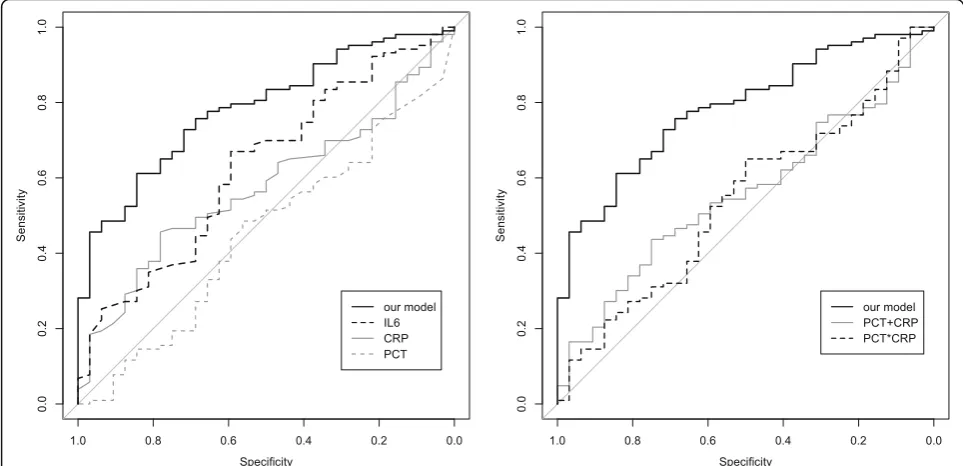
Results:A model including four clinical (length of PICU stay until onset of non-infectious SIRS/sepsis, central line, core temperature, number of non-infectious SIRS/sepsis episodes prior to diagnosis) and four laboratory parameters (interleukin-6, platelet count, procalcitonin, CRP) was identified in the training dataset. Validation in the test dataset revealed an AUC of 0.78 (95% CI: 0.70–0.87). Our model was superior to previously proposed biomarkers such as CRP, interleukin-6, procalcitonin or a combination of CRP and procalcitonin (maximum AUC = 0.63; 95% CI: 0.52–0. 74). When aiming at a complete identification of sepsis cases (100%; 95% CI: 87–100%), 28% (95% CI: 20–38%) of non-infectious SIRS cases were assorted correctly.
Conclusions:Our approach allows early recognition of sepsis with an accuracy superior to previously described biomarkers, and could potentially reduce antibiotic use by 30% in non-infectious SIRS cases. External validation studies are necessary to confirm the generalizability of our approach across populations and treatment practices. Trial registration:ClinicalTrials.govnumber: NCT00209768; registration date: September 21, 2005.
Keywords:Diagnosis, Sepsis, SIRS, Pediatric, Random Forest, Intensive care unit
* Correspondence:[email protected]
†Equal contributors
1Department of Epidemiology, Research Group Epidemiological and Statistical Methods (ESME), Helmholtz Centre for Infection Research, Inhoffenstr. 7, 38124 Braunschweig, Germany
3German Center for Infection Research (DZIF), Hannover-Braunschweig site, 30625 Hannover, Germany
Full list of author information is available at the end of the article
Background
Sepsis and the systemic inflammatory response syndrome (SIRS) are two conditions with similar pathophysiological patterns and symptoms, but different causes of disease [1–3]. While the systemic immune response in sepsis is caused by pathogens, non-infectious SIRS is due to non-infectious triggers. In children, sepsis is de-fined as the presence of SIRS during evidence of an infection [1, 3]. Evidence for an infection is typically provided by pathogen identification in the blood (mainly by blood culture analyses), or by presence of clinical symptoms associated with a high probability of systemic infection [1–4]. However, blood culture sampling often yields false-negative results, and clinical signs of infection are often unspecific. It is therefore a huge challenge to diagnose sepsis correctly in early disease states, which would be necessary to initiate prompt antimicrobial treat-ment and to reduce case fatality rates [5]. Therefore, many patients with fulfilled SIRS criteria but weak evidence of infection are unnecessarily treated with antimicrobial agents. This may be associated with adverse drug effects, favor the emergence of multi-resistant bacteria and in-crease healthcare costs [6].
In the past decades, several biomarkers have been pro-posed as diagnostic tests for the differentiation of sepsis and non-infectious SIRS [7, 8], like e.g. procalcitonin (PCT) and interleukin-6 (IL-6) [9–11]. However, none of them was considered suitable to diagnose sepsis with sufficient accuracy in clinical practice [12]. In some cases, initial study results were overoptimistic due to flawed study designs and lack of external validation [10, 11]; in others, the proposed markers were too expensive or too difficult to obtain for being implemented in the therapeutic standards of intensive care medicine [13]. In an adult population, a recent study showed that the dis-criminatory ability of several weak sepsis biomarkers could be improved when combining them into one diag-nostic model [14]. However, even this combination could not sufficiently improve the accuracy for sep-sis/non-infectious SIRS discrimination [14, 15]. Due to age-related changes in symptoms and laboratory markers, diagnosis of sepsis and distinction from non-infectious SIRS are even more complex in children.
Our aim was to develop and validate a diagnostic model for the discrimination of pediatric sepsis and non-infectious SIRS during the clinical course based on routinely available parameters, which can easily be implemented into clinical practice. Therefore, we de-cided to perform a fully data-driven approach using all information gathered on a pediatric intensive care unit (PICU) during a randomized clinical trial (RCT) with a homogeneous and validated definition for sep-sis and non-infectious SIRS.
Methods Source of data
Data used for this analysis arise from a prospective single-center RCT investigating the effect of in-line filtration in an interdisciplinary PICU of a German tertiary care hos-pital (ClinicalTrials.govnumber: NCT00209768) [16]. Pa-tient recruitment took place between February 2005 and September 2008.
Outcome
Outcome of interest was the presence of non-infectious SIRS or sepsis according to the criteria defined by the inter-national pediatric sepsis consensus conference (IPSCC) in 2005 [1, 3]. Sepsis was diagnosed according to IPSCC cri-teria as“SIRS in the presence of or as a result of suspected or proven infection”. To further improve the correctness and validity of the infectious origin we additionally applied the consensus conference criteria for infection in the inten-sive care unit [17]. All sepsis diagnoses were later reviewed according to the updated Centers for Disease Control and Prevention (CDC) criteria from 2008 [18] as indicated. A catheter-related sepsis with common skin commensals as coagulase negative staphylococci was defined according to the consensus conference criteria for infection in the inten-sive care unit [3]. Further information about all sepsis epi-sodes including the sites of primary infection as well as microbiological test results can be found in the additional files (Additional file1: Table S1).
Diagnoses of SIRS/sepsis were made prospectively in real-time by an experienced attending physician with the consultation of infectious disease specialists. The diagno-ses were later reviewed independently by two blinded experienced pediatric intensive care physicians. The con-firmatory review was a post-hoc analysis with the availabil-ity of all clinical data such as vital signs, infectiological, laboratory and radiological data. This final analysis was performed after discharge of the patient from PICU and after checks for data integrity and validity. In case of dis-agreement, a consensus was achieved after open discussion with a third senior pediatric intensive care physician and the episode was allocated without ambiguity to either non-infectious SIRS or sepsis. The reviewers initiated the original study, but were not involved in the data analysis concept of the present analysis.
Study participants
Eight hundred seven patients formed the final dataset of the original RCT. Only patients who developed non-infectious SIRS or sepsis during their ICU stay were con-sidered for the analysis. The total number of diagnosed non-infectious SIRS and sepsis episodes was 274 and 58, respectively. These episodes occurred in 230 patients (Fig.1); 213 had at least one non-infectious SIRS episode, 47 at least one sepsis episode; 20 suffered from both non-infectious SIRS and sepsis. In order to avoid bias towards disease types occurring early during PICU visit (e.g. post-surgery SIRS), we included not only the first, but all non-infectious SIRS and sepsis episodes of a patient into our analysis. However, we considered only episodes for inclu-sion, which were diagnosed at least 10 days after termin-ation of the previous episode to avoid any effect of the prior episode on parameter measures. Thus, the primary dataset of our study included 238 non-infectious SIRS and 58 sepsis episodes (Fig.1).
Predictors
Forty-six variables were considered as potential predic-tors in the development stage of the model (Additional file 1: Table S2). All predictor values were extracted from the trial database and were based on parameters obtained from the hospital information system or from patient records. For time-dependent predictors only values at the day of diagnosis were considered (before
start of treatment). If more than one value per day was measured for a predictor, the most abnormal value was recorded. All parameter values were checked for plausi-bility first by the responsible clinicians and statisticians of the original RCT, and again by the statisticians of this secondary analysis. Continuous predictor variables were kept continuous. If age- and sex-specific reference values were available, we standardized the respective parame-ters for age and sex (Additional file1: Table S2) by divid-ing the measured value by the mean reference value of the respective age group.
Missing data
Missing data were handled in a three-step approach based on a missing at random assumption. First, if a value for a given predictor was missing but there were values on the day before and on the day after the event, the arithmetic mean of these two values was used for imputing the missing value. In a second step, all predic-tors containing more than 30% missing values, and all episodes which were associated with missing values in more than 30% of the predictors considered were ex-cluded since missForest (the imputation method used subsequently) provides unbiased imputation results for up to 30% missing values [19, 20]. After application of exclusion criteria related to missing values, two variables (central venous oxygen saturation and glutamate
Patients enrolled in RCT NCT00209768 n=807
No evidence for SIRS or sepsis n=577
Patients with SIRS/sepsis n=230
SIRS episodes n=274 Sepsis episodes
n=58
Within 10 days of other SIRS/Sepsis episode
n=36
Unique SIRS episodes n=238 Within 10 days of other
SIRS/Sepsis episode n=0
Unique sepsis episodes n=58
Final number of sepsis episodes n=56
Final number of SIRS episodes n=233
More than 30% of predictor data missing
n=2
More than 30% of predictor data missing
n=5
dehydrogenase) as well as five non-infectious SIRS and two sepsis episodes were excluded, resulting in a final dataset of 233 non-infectious SIRS and 56 sepsis epi-sodes (Fig.1) and 44 variables.
All other missing values were imputed using the R package missForest (version 1.4, [19, 20]). MissForest is a nonparametric missing value imputation methodology able to handle mixed-type data [19]. It was shown to outperform other widely used imputation techniques, such as multivariate imputation by chained equations (MICE) and k nearest neighbour imputation (KNNim-pute), especially when complex interactions and nonlin-ear relations are suspected as it was the case with our dataset [19, 20]. Imputation was done leaving out the outcome variable as well as the variables counting the previous events (see Additional file1: Table S2). Imput-ation with missForest was performed independently for training and test datasets. The variable“base excess”was excluded after imputation since it represented a linear combination of variables already present in the dataset.
Statistical analyses
Methodological concept
Machine learning is a branch of artificial intelligence used for data analysis which automates analytic model building. Random forests are a method typically used for classification problems which uses machine learning algorithms. Due to the high-dimensional data and the unclear predictor structure, we chose a random forest (RF) approach [21–23] based on conditional inference trees [24] for analysis. While classic statistical modelling techniques building on regression methodology cannot be used in cases where the number of potential predic-tors exceeds the number of observations, Random For-ests have been shown to perform well in these situations [23]. Our analysis approach was data driven since we did not make any a-priori judgements about what kind of variables to use as potential predictors or about what kind of distributions the respective variables might fol-low. Predictor selection was performed using a backward selection process based on out-of-bag areas under the curve (OOB-AUC [25]). This approach is known to give the same weight to both occurring classes irrespective of the class size [25, 26]. We used the recently developed AUC-based permutation Variable Importance Measure (VIM) [26] which has been shown to be the best selec-tion method in the case of imbalanced datasets as present in our analysis [26]. The model with the largest OOB-AUC was selected as the model of choice. No pen-alization for the number of selected variables was ap-plied since AUCs were already calculated based on internal validation minimizing the risk of overfitting. A more detailed description of the methodological concept can be found in Additional file1: Methods S1.
Statistical software
All analyses were performed using the R package party, version 1.0–22 [26]. By setting the parameters mincriter-ion, minbucket and minsplit in the cforest function to zero, conditional inference trees were grown to maximal possible depth [26]; bootstrap sampling was used as the resampling scheme; the number of trees per forest was set to 1000. The mtry parameter was set to the square root of the number of predictor variables. All parameters were hold fixed throughout the entire analysis. R codes used for this analysis are presented in Additional file 1: Code S1.
Model validation
The dataset was split into two parts (training and valid-ation dataset) in a non-random manner. Patients en-rolled 2005–2006 were used for the training dataset, while those enrolled in 2007–2008 served as the valid-ation dataset. Non-random time splits represent one of the best validation methods when no truly external val-idation dataset is available and provide considerably more valid results than random splits of datasets; they are therefore considered an intermediate between in-ternal and exin-ternal validation [27]. Areas under the curve (AUCs) with DeLong confidence intervals were used as a measure of diagnostic accuracy. Sensitivity and specificity of sepsis diagnosis (with respective Wilson confidence intervals) were calculated for two cut-off values defined by a) the Youden index [28] and b) the lowest cut-off probability associated with 100% correct classification rate for sepsis.
Comparison to previously proposed individual markers We evaluated the diagnostic accuracy of previously pro-posed markers for differentiation of non-infectious SIRS and sepsis (C-reactive protein [CRP], PCT, IL-6) and their combination in our validation dataset and com-pared it to the accuracy of the diagnostic model devel-oped in the RF approach.
Sensitivity analyses
is once used as test data to assess model performance. Therewith 3 performances measures are obtained which are usually averaged to get the average CV-AUC. We followed this principle and applied our entire data analysis approach (including missing data imputation with Mis-sForest and variable selection) each time to two folds of the data and used the third fold as an independent test data to assess model performance. Third, we ran a sensi-tivity analysis limiting the study population to one episode per patient (randomly drawn). Fourth, we developed a prediction model using the entire dataset for both training and testing to show how the predictive performance would be overestimated if internal validation was lacking. This can be understood as a bad practice example to show how previous studies might have overestimated the true predictive performance of their models.
Results
Study participants
Sepsis episodes were more likely to occur in patients with higher PIM-II score (p= 0.034), longer duration of PICU stay until onset of disease (p< 0.001), previous history of SIRS and/or sepsis (p< 0.001), and were asso-ciated with higher levels of PTT (p= 0.013), d-dimers (p = 0.001), fibrinogen (p= 0.018), IL-6 (p= 0.001), PCT (p = 0.020), CRP (p= 0.009), body temperature (p< 0.001) and lower levels of platelets (p= 0.023). In the blood gas analysis, sepsis episodes showed higher bicarbonate (p= 0.048), whereas SpO2 (p= 0.015) values were lower in sepsis than in non-infectious SIRS episodes (Table1).
Model development
After the dataset was time-split, 130 non-infectious SIRS and 24 sepsis episodes were assigned to the training dataset, while validation was performed on 103 non-infectious SIRS and 32 sepsis cases. Variable selection by a backward selection process in the training dataset showed increasing OOB-AUCs until eight variables were left in the model and decreased afterwards (Fig. 2, Additional file 1: Table S3).
A model including four clinical parameters (length of PICU stay until onset of non-infectious SIRS/sepsis, presence of a central line, core temperature, cumulative number of sepsis and non-infectious SIRS episodes prior to diagnosis) as well as four laboratory parameters (IL-6, platelet count, PCT, CRP) was identified as the best model showing an out-of-bag area under the curve (OOB-AUC) of 0.82 (Fig.2, Table2). Analysis of variable importance measures suggested that length of current PICU stay until onset of non-infectious SIRS/sepsis and IL-6 were the most important predictors in our RF ap-proach (Table2).
Model performance
The developed prediction model was then applied to the validation dataset reaching a moderate diagnostic accur-acy with an AUC of 0.78 (95% CI: 0.70–0.87). When requesting that all sepsis cases were classified as such (correct classification rate of 100% (95% CI: 87–100%)), 28% (95% CI: 20–38%) of non-infectious SIRS episodes were classified correctly. If aiming at the best overall performance as defined by the Youden index, 61% (95% CI: 51–70%) of non-infectious SIRS cases and 84% (95% CI: 66–94%) of sepsis cases could be identified as such.
Comparison of RF approach to other proposed diagnostic tests
Previously proposed markers for the differentiation of non-infectious SIRS and sepsis such as CRP (AUC = 0.57; 95% CI: 0.47–0.68), IL-6 (AUC = 0.63; 95% CI: 0.52–0.74) and PCT (AUC = 0.55; 95% CI: 0.34–0.56) performed worse than the model developed in the RF approach when applied to the validation dataset. Com-bining CRP and PCT (as proposed by Han et al. in a non-validated study [14]) provided similar accuracy values as the application of single biomarkers (AUC = 0.56; 95% CI: 0.45–0.66 without allowing for interaction; AUC = 0.54; 95% CI: 0.43–0.65 with allowing for inter-action, Fig.3).
Sensitivity analyses
Three-fold cross-validation showed an average AUC of 0.75, confirming the results of the time-split validation approach. Variation of the RF mtry parameter did not affect accuracy measures (AUCs ranging from 0.72 to 0.84, see Additional file 1: Figure S1). Restriction of the study population to one episode per patient, again, did not have a relevant effect on study results. By using the entire dataset for model development and assessment of performance at the same time, an apparent AUC of 0.98 could be calculated, which overestimates the true pre-dictive performance considerably (see Additional file 1: Figure S2).
Discussion
Table 1Patient characteristics stratified by non-infectious SIRS/sepsis (n= 289)
Predictor variable Sepsis (n= 56) frequency/
median (1st quartile-3rd quartile)
Non-infectious SIRS (n= 233) frequency/median (1st quartile-3rd quartile)
p-value (chi squared/ Wilcoxon ranksum test)
Baseline characteristics
Age (months) 28 (4–105) 46 (9–120) 0.129
Female sex (n) 21 109 0.233
Weight (kg) 11.85 (4.50–27.12) 15.95 (7.67–32.68) 0.126
Height (cm) 97 (63–124) 99 (68–138) 0.048
Indicators of disease severity
PRISM score at PICU admission 14 (8–19) 11 (7–17) 0.155
PIM II score at PICU admission 5 (2–10) 2 (1–7) 0.034
Clinical parameters
SBP (mmHg) 80.5 (70–94.75) 82 (70–94) 0.763
HR (bpm) 162 (138–180.8) 151 (133–175) 0.947
CVP (mmHg) 11 (8–15.5) 13 (10–16) 0.178
Lactate (mmol/L) 1.8 (1.4–2.77) 2 (1.2–3.8) 0.513
Respiratory frequency (per minute) 25 (15–40) 22 (15–35) 0.973
SpO2(%) 95 (89.25–97) 96 (94–98) 0.015
Urinary excretion (L per day) 3.34 (1.62–4.49) 2.83 (1.88–4.43) 0.582
Core temperature (°C) 39.15 (38.6–39.32) 38.7 (38.2–39) < 0.001
Blood gases/ laboratory parameters
pH 7.41 (7.33–7.46) 7.39 (7.32–7.45) 0.388
pCO2(mmHg) 42 (38–50.25) 41 (36–47) 0.433
HCO3−(mmol/L) 25 (23–27.25) 24 (22–27) 0.048
Leucocyte count (× 109/L) 11.9 (5.05–18.5) 13.55 (6.6–18.2) 0.593
Hb (g/dL) 10.9 (9.5–12.8) 10.8 (9.5–12.6) 0.331
Platelet count (× 109/L) 112 (44–288.5) 169.5 (110.8–239.8) 0.023
INR 1.42 (1.21–1.67) 1.33 (1.2–1.62) 0.28
PTT (sec) 39.5 (34–50) 35 (31–44.75) 0.013
Fibrinogen (μmol/L) 3.24 (2.31–4.08) 2.6 (1.75–3.8) 0.018
d-dimer (ng/mL) 5008 (2328–11,240) 2733 (1224–5726) 0.001
CRP (mg/L) 48 (30–85.5) 33.5 (12.25–72) 0.009
IL-6 (ng/L) 118 (40–412) 52 (22–122.5) 0.001
PCT (μg/L) 2.55 (0.48–8.45) 1 (0.3–4.17) 0.020
AST (U/L) 75 (34.5–146.5) 73.5 (40–182.5) 0.388
ALT (U/L) 43.5 (16.25–93.5) 32 (18–71.5) 0.295
Phosphate (mmol/L) 1.54 (1.24–1.86) 1.64 (1.27–2.02) 0.238
Creatinine (μmol/L) 33.5 (26.25–61.5) 44.5 (31–65) 0.079
Urea (mmol/L) 7.55 (3.92–11.25) 6.2 (4–10.5) 0.285
Technical ICU support
Mechanical ventilation (n) 55 (98%) 221 (95%) 0.474
Central venous catheter (n) 43 (77%) 201 (86%) 0.099
Number of peripheral IV cannulas 2 (1–2) 2 (1–2) 0.972
In-line filter application (allocation to interventional group in NCT00209768;ClinicalTrials.govnumber)
laboratory parameters like platelet count and indicators of disease severity like presence of a central venous line or core temperature. Length of current PICU stay until onset of non-infectious SIRS/sepsis was identified as the most relevant predictor. This can be explained by the fact that most non-infectious SIRS episodes occur early after surgery or trauma and thus early after admission to PICU. In con-trast, the risk of sepsis increases with length of stay on PICU.
Previously proposed markers for the differentiation of non-infectious SIRS and sepsis in adults like CRP, IL-6, and PCT performed only slightly better than chance and considerably worse than the model developed in the RF approach, when applied to our data. Even a combination of CRP and PCT (using the same model building ap-proaches as proposed before in a study focusing at a
differentiation in the 48 h after disease onset [14]) did not improve their diagnostic accuracy. This emphasizes clearly that not only panels or combinations of bio-markers, but also the additional implementation of clin-ical parameters as predictors is important when aiming at an improvement of the diagnostic accuracy for the differentiation of sepsis and non-infectious SIRS. Since our study was the first one to take into account all routinely available clinical and laboratory data, it pro-vides an innovative diagnostic approach for sepsis identification which can easily be applied into clinical practice.
One major advantage of our approach is that all relevant information can be entered directly in the model and no further clinical judgement (e.g. on if the SIRS episode happens early or late after admission) Table 1Patient characteristics stratified by non-infectious SIRS/sepsis (n= 289)(Continued)
Predictor variable Sepsis (n= 56) frequency/
median (1st quartile-3rd quartile)
Non-infectious SIRS (n= 233) frequency/median (1st quartile-3rd quartile)
p-value (chi squared/ Wilcoxon ranksum test)
Medical/ surgical treatment
Antibiotics (n) 49 (88%) 195 (84%) 0.545
Steroids (n) 17 (30%) 45 (19%) 0.101
Catecholamines (n) 24 (43%) 132 (57%) 0.074
FiO2 0.3 (0.25–0.5) 0.35 (0.24–0.5) 0.806
Surgery before PICU admission (n) 40 (71%) 171 (73%) 0.741
Sepsis/ SIRS related factors
Length of PICU stay until onset of SIRS/ sepsis (days)
15 (6–41) 2 (1–9) < 0.001
Cumulative sepsis or SIRS episodes (n) < 0.001
0 31 199
1 14 24
2 7 6
3 2 4
4 2 0
Total SIRS episodes (n) 0.003
0 40 203
1 11 23
2 4 6
3 1 1
Total sepsis episodes (n) < 0.001
0 43 223
1 9 10
2 2 0
3 1 0
4 1 0
ALTalanine transaminase,ASTaspartate transaminase,CRPC-reactive protein,CVPcentral venous pressure,FiO2fraction of inspired oxygen,Hbhemoglobin,HCO3−
bicarbonate,HRheart rate,ICUintensive care unit,IL-6interleukin 6,INRinternational normalized ratio,pCO2partial pressure of carbon dioxide,
PCTprocalcitonin,PTTpartial thromboplastin time,SBPsystolic blood pressure,SIRSsystemic inflammatory response syndrome,SpO2oxygen saturation from
needs to be performed. Once an episode of SIRS is iden-tified (e.g. by using a computer-based clinical decision support system implemented in an intensive care unit or by a clinician) and the question arises whether the epi-sode is due to an infection or not, the physician would enter the current values for the eight parameters of our model to an web-based interface (in which the Random Forest construct can be stored), and would promptly receive a decision about if the episode is of infectious origin or not and if antibiotic treatment is necessary. Moreover, probabilities would be given on how likely it is that the episode can be classified as non-infectious SIRS or sepsis. To diminish the risk of mistreatment in septic cases, an episode would only be classified as non-infectious if the model predicts this with 100%
probability. Since all of this could happen in routine practice in real-time, even days before microbiological results are expected, treatment initiation could be already triggered by the model results.
Strengths
Our study has several major strengths. First, the dataset used for our study was very well characterized having been run through various plausibility and quality checks, not the least for the outcome definitions of non-infectious SIRS and sepsis; moreover, it was sufficiently large for the applied analysis strategy allowing time-split validation and accounting for age differences in pre-dictor measures by using age-specific reference values. Moreover, the methodological concept applied to this Fig. 2Graphical illustration of the backward variable selection process based on the out-of-bag area under the curve (OOB-AUC).Left panel:Area under the curve (AUC) based permutation variable importance measure (VIM) ordered by importance of included variable; the VIM is a proxy for the importance of the variable for correct outcome prediction, but has not the same meaning as classic influence measures based on distributional statistics (like effect sizes (e.g. Odds Ratios) orpvalues).Right panel:Areas under the curve by number of included predictor variables (as determined by out-of-bag area under the curve (OOB-AUC) procedure). Corresponding variables can be found in Additional file1: Table S3
Table 2Variables selected for the diagnostic model in the training dataset and their importance
Variable Variable importance measurea
Length of PICU stay until onset of non-infectious SIRS/sepsis 0.031
Interleukin-6 0.017
Platelet count 0.010
Procalcitonin 0.008
Cumulative sepsis or non-infectious SIRS episodes (n) 0.007
Core temperature 0.005
C-reactive protein 0.005
Central venous catheter 0.004
a
analysis took advantage of modern machine learning algorithms, developed particularly for situations with many weak predictors as present in our dataset. In con-trast to previous studies in the field we rigorously ap-plied the TRIPOD guideline which has become a requirement for high-quality studies in the field of prediction modelling [27]. By combining our purely data-driven approach with rigorously performed valid-ation techniques, we were able to provide a realistic view on the maximum diagnostic accuracy for differ-entiation of pediatric non-infectious SIRS and sepsis associated with routinely available information. Sev-eral previous studies barely mentioned validation processes, so that overfitting and thus overestimation of model performance is very likely [11, 14]. If we did not incorporate validation techniques in our analysis, we got an AUC of 0.98 resulting in an almost perfect discrimination between SIRS and sepsis. In contrast to the model presented in our study, such a model would perform much worse on a new unrelated data-set and would thus not be generalizable. Some of the variables included in our predictive model have not been described previously as strong univariable pre-dictors of the discrimination of non-infectious SIRS and sepsis. The strength of our methodological approach is that it combines their predictive abilities in a
non-linear way allowing for hierarchical interactions of the predictors, so that the weaknesses of single predictors in specific situations can be counteracted by other variables in the model.
Limitations
reassuring that the sample size was still large enough for deriving stable estimates.
Though carefully validated, it is not clear if the model can easily be applied to PICUs with standards different from the tertiary-care hospital in which this study was performed. Non-infectious SIRS and sepsis should be di-agnosed using the same consensus criteria [1,3]; predic-tors being part of the final diagnostic model should be measured in a similar way. Moreover, the generalizability of the model could be impacted by the fact, that we included patients with and without in-line filter treat-ment [16], even though the original RCT showed that application of in-line filters decreased the risk for non-infectious SIRS. However, the inclusion of all patients led to a more realistic estimate of the diagnostic accur-acy of our model when applied to PICUs with differing treatment standards and varying SIRS and sepsis rates, hence possibly facilitating generalizability. Sensitivity analyses restricted to the control group of the RCT showed results compatible to the main analyses.
Nevertheless, external validation of the proposed model in a dataset not related to the present one is ne-cessary to confirm the generalizability of our results.
The data used for this analysis have been collected between 2005 and 2008 so that current treatment practices might not necessarily be reflected. However, since we used pre-treatment parameter values (at least concerning SIRS/sepsis) the risk of a systematic bias by calendar time can be considered as small. In order to avoid a selection bias towards cases occur-ring early duoccur-ring PICU stay, we used more than one episode per patient for the main analysis. With this approach we might have underestimated the total variability of our dataset and thus might have overes-timated the diagnostic accuracy of the model. How-ever, in a sensitivity analysis with only one randomly selected episode per patient we got virtually un-changed results showing that no bias was introduced by our approach.
One general limitation of the RF approach is that it does not allow direct inference on the role of specific predictors like e.g. classic multivariable model building approaches like logistic regression models; it is thus often described as a“black box” since it cannot be used e.g. to develop scores which can be applied with pen and paper but must be run in its original form as a software application to get predictions for new patients. However, variable importance measures can give some information about which variables are most important for discrimin-ation and need to be assessed in order to be able to clas-sify a patient according to the RF based model. While most of the variables included in the final model are routinely available in most ICUs on a daily base, IL-6 and PCT might not which is a potential limitation of
our model. In the past years, a new sepsis definition for adult patients was developed [4] which is no longer based on SIRS criteria and might have an impact on fu-ture pediatric sepsis definitions [30].
Conclusions
We have developed and validated for the first time a diag-nostic model for the differentiation of non-infectious SIRS and sepsis in critically ill children. It used an innovative methodological approach and identified a combination of eight clinical and laboratory parameters as relevant predic-tors. The diagnostic accuracy of our model in a validation sample was superior to previously proposed tests for the differentiation of non-infectious SIRS and sepsis when ap-plied to the same dataset. The model allows early recogni-tion of all sepsis cases (correct classificarecogni-tion rate of 100%) and could potentially reduce antibiotic use by 30% in non-infectious SIRS cases. All patients in our study were treated with antibiotics at some point during their episode, which underlines the clinical relevance of the proposed reduction in antibiotic treatment for patients with non-infectious SIRS. External validation of our model in an un-related dataset is necessary to confirm the generalizability of the proposed approach across populations and treat-ment standards.
Additional file
Additional file 1: Table S1: Overview of all sepsis cases with site of infection and relevant corresponding infectiological data.Table S2: Systematic Overview of the Predictors used in the Analysis.Table S3: Overview of all models in the backward selection procedure.Methods S1: Detailed description and explanation of data analysis approach.Code S1: R code for the main analysis.Figure S1: AUCs of the time-split ap-proach with different mtry parameter.Figure S2: ROC analysis without validation procedure (“Apparent Performance”). (DOCX 81 kb)
Abbreviations
AUC:Area under the curve; CRP: C-reactive protein; IL-6: Interleukin-6; OOB: Out-of-bag; PCT: Procalcitonin; PICU: Pediatric intensive care unit; RCT: Randomized controlled trial; RF: Random Forrest; SIRS: Systemic inflammatory response syndrome
Acknowledgements
Not applicable.
Funding
This secondary data analysis was funded by the Hannover-Braunschweig site of the German Center for Infection Research (DZIF). Funding for the original RCT was provided by a research grant from Hannover Medical School and partially by an unrestricted grant from Pall Corporation, Dreieich, Germany and B. Braun Corporation, Melsungen, Germany.
Availability of data and materials
The R Code used for this analysis is available as an additional file. The dataset analyzed during the current study is available from the corresponding author on reasonable request.
Authors’contributions
manuscript. All authors contributed to revising the manuscript and agreed with its final version.
Ethics approval and consent to participate
Ethics approval was obtained from the ethics committee of Hannover Medical School (3702/2005). All legal guardians provided written informed consent on admission to PICU.
Consent for publication
Not applicable.
Competing interests
FL, NR, PB, RTM and AK report no conflicts of interest. MS, TJ and MB report having been paid travel and lecture fees from Pall Corporation and B. Braun Corporation.
Publisher’s Note
Springer Nature remains neutral with regard to jurisdictional claims in published maps and institutional affiliations.
Author details
1Department of Epidemiology, Research Group Epidemiological and Statistical Methods (ESME), Helmholtz Centre for Infection Research, Inhoffenstr. 7, 38124 Braunschweig, Germany.2Department for Pediatric Cardiology and Intensive Care Medicine, Hannover Medical School, 30625 Hannover, Germany.3German Center for Infection Research (DZIF), Hannover-Braunschweig site, 30625 Hannover, Germany.
Received: 17 April 2017 Accepted: 26 February 2018
References
1. Goldstein B, Giroir B, Randolph A. International consensus conference on pediatric S: international pediatric sepsis consensus conference: definitions for sepsis and organ dysfunction in pediatrics. Pediatr Crit Care Med. 2005;6:2–8. 2. Bone RC, Balk RA, Cerra FB, Dellinger RP, Fein AM, Knaus WA et al.
American-College of Chest Physicians Society of Critical Care Medicine Consensus Conference - Definitions for Sepsis and Organ Failure and Guidelines for the Use of Innovative Therapies in Sepsis. Crit Care Med. 1992;20:864–74.
3. Gebara BM. Values for systolic blood pressure. Pediatr Crit Care Med. 2005;6:500. author reply 500-501
4. Singer M, Deutschman CS, Seymour CW, Shankar-Hari M, Annane D, Bauer M, Bellomo R, Bernard GR, Chiche JD, Coopersmith CM, et al. The third international consensus definitions for sepsis and septic shock (Sepsis-3). JAMA. 2016;315:801–10.
5. Kumar A, Roberts D, Wood KE, Light B, Parrillo JE, Sharma S, Suppes R, Feinstein D, Zanotti S, Taiberg L, et al. Duration of hypotension before initiation of effective antimicrobial therapy is the critical determinant of survival in human septic shock. Crit Care Med. 2006;34:1589–96. 6. Ratzinger F, Schuardt M, Eichbichler K, Tsirkinidou I, Bauer M, Haslacher H,
Mitteregger D, Binder M, Burgmann H. Utility of sepsis biomarkers and the infection probability score to discriminate sepsis and systemic inflammatory response syndrome in standard care patients. PLoS One. 2013;8:e82946. 7. Hall TC, Bilku DK, Al-Leswas D, Horst C, Dennison AR. Biomarkers for the differentiation of sepsis and SIRS: the need for the standardisation of diagnostic studies. Ir J Med Sci. 2011;180:793–8.
8. Pierrakos C, Vincent JL. Sepsis biomarkers: a review. Crit Care. 2010;14:R15. 9. Brunkhorst FM, Wegscheider K, Forycki ZF, Brunkhorst R. Procalcitonin for
early diagnosis and differentiation of SIRS, sepsis, severe sepsis, and septic shock. Intensive Care Med. 2000;26(Suppl 2):S148–52.
10. Selberg O, Hecker H, Martin M, Klos A, Bautsch W, Kohl J. Discrimination of sepsis and systemic inflammatory response syndrome by determination of circulating plasma concentrations of procalcitonin, protein complement 3a, and interleukin-6. Crit Care Med. 2000;28:2793–8.
11. Neunhoeffer F, Plinke S, Renk H, Hofbeck M, Fuchs J, Kumpf M, Zundel S, Seitz G. Serum concentrations of Interleukin-6, procalcitonin, and C-reactive protein: discrimination of septical complications and systemic inflammatory response syndrome after pediatric surgery. Eur J Pediatr Surg. 2016;26:180–5.
12. Vincent JL. The clinical challenge of sepsis identification and monitoring. PLoS Med. 2016;13:e1002022.
13. Neugebauer U, Trenkmann S, Bocklitz T, Schmerler D, Kiehntopf M, Popp J. Fast differentiation of SIRS and sepsis from blood plasma of ICU patients using Raman spectroscopy. J Biophotonics. 2014;7:232–40.
14. Han JH, Nachamkin I, Coffin SE, Gerber JS, Fuchs B, Garrigan C, Han X, Bilker WB, Wise J, Tolomeo P, et al. Use of a combination biomarker algorithm to identify medical intensive care unit patients with suspected sepsis at very low likelihood of bacterial infection. Antimicrob Agents Chemother. 2015;59:6494–500.
15. Kofoed K, Andersen O, Kronborg G, Tvede M, Petersen J, Eugen-Olsen J, Larsen K. Use of plasma C-reactive protein, procalcitonin, neutrophils, macrophage migration inhibitory factor, soluble urokinase-type plasminogen activator receptor, and soluble triggering receptor expressed on myeloid cells-1 in combination to diagnose infections: a prospective study. Crit Care. 2007;11:R38.
16. Jack T, Boehne M, Brent BE, Hoy L, Koditz H, Wessel A, Sasse M. In-line filtration reduces severe complications and length of stay on pediatric intensive care unit: a prospective, randomized, controlled trial. Intensive Care Med. 2012;38:1008–16.
17. Calandra T, Cohen J, International Sepsis Forum Definition of Infection in the ICUCC. The international sepsis forum consensus conference on definitions of infection in the intensive care unit. Critical care medicine. 2005;33:1538–48.
18. Horan TC, Andrus M, Dudeck MA. CDC/NHSN surveillance definition of health care-associated infection and criteria for specific types of infections in the acute care setting. Am J Infect Control. 2008;36: 309–32.
19. Stekhoven DJ, Buhlmann P. MissForest–non-parametric missing value imputation for mixed-type data. Bioinformatics. 2012;28:112–8. 20. Waljee AK, Mukherjee A, Singal AG, Zhang Y, Warren J, Balis U, Marrero J,
Zhu J, Higgins PD. Comparison of imputation methods for missing laboratory data in medicine. BMJ Open. 2013;3:e002847.
21. Boulesteix AL, Janitza S, Kruppa J, König IR. Overview of random forest methodology and practical guidance with emphasis on computational biology and bioinformatics. Wiley Interdiscip Rev Data Min Knowl Discov. 2012;2:493–507.
22. Breiman L. Random Forests. Mach Learn. 2001;45:5–32.
23. Diaz-Uriarte R, Alvarez de Andres S. Gene selection and classification of microarray data using random forest. BMC Bioinformatics. 2006;7:3. 24. Hothorn T, Hornik K, Zeileis A. Unbiased recursive partitioning: a conditional
inference framework. J Comput Graph Stat. 2006;15:651–74. 25. Calle ML, Urrea V, Boulesteix AL, Malats N. AUC-RF: a new strategy for
genomic profiling with random forest. Hum Hered. 2011;72:121–32. 26. Janitza S, Strobl C, Boulesteix AL. An AUC-based permutation variable
importance measure for random forests. BMC Bioinformatics. 2013;14:119. 27. Moons KG, Altman DG, Reitsma JB, Ioannidis JP, Macaskill P, Steyerberg EW,
Vickers AJ, Ransohoff DF, Collins GS. Transparent reporting of a multivariable prediction model for individual prognosis or diagnosis (TRIPOD):
explanation and elaboration. Ann Intern Med. 2015;162:W1–73. 28. Youden WJ. Index for rating diagnostic tests. Cancer. 1950;3:32–5. 29. James G, Witten D, Hastie T, Tibshirani R: An introduction to statistical
learning: with applications in R. New York: Springer Publishing Company, Incorporated; 2014.