https://doi.org/10.5194/amt-12-4591-2019 © Author(s) 2019. This work is distributed under the Creative Commons Attribution 4.0 License.
Development and validation of a supervised machine learning radar
Doppler spectra peak-finding algorithm
Heike Kalesse1,2, Teresa Vogl1,2, Cosmin Paduraru3, and Edward Luke4 1Leibniz Institute for Tropospheric Research, Leipzig, Germany
2Institute for Meteorology, Universität Leipzig, Leipzig, Germany
3Department of Mining and Materials Engineering, McGill University, Montréal, Canada
4Environmental and Climate Sciences Department, Brookhaven National Laboratory, Upton, New York
Correspondence:Heike Kalesse ([email protected]) Received: 8 February 2019 – Discussion started: 28 March 2019
Revised: 4 July 2019 – Accepted: 10 July 2019 – Published: 30 August 2019
Abstract. In many types of clouds, multiple hydrometeor populations can be present at the same time and height. Studying the evolution of these different hydrometeors in a time–height perspective can give valuable information on cloud particle composition and microphysical growth pro-cesses. However, as a prerequisite, the number of differ-ent hydrometeor types in a certain cloud volume needs to be quantified. This can be accomplished using cloud radar Doppler velocity spectra from profiling cloud radars if the different hydrometeor types have sufficiently different ter-minal fall velocities to produce individual Doppler spectrum peaks. Here we present a newly developed supervised ma-chine learning radar Doppler spectra peak-finding algorithm (named PEAKO). In this approach, three adjustable param-eters (spectrum smoothing span, prominence threshold, and minimum peak width at half-height) are varied to obtain the set of parameters which yields the best agreement of user-classified and machine-marked peaks. The algorithm was de-veloped for Ka-band ARM zenith-pointing radar (KAZR) observations obtained in thick snowfall systems during the Atmospheric Radiation Measurement Program (ARM) mo-bile facility AMF2 deployment at Hyytiälä, Finland, dur-ing the Biogenic Aerosols – Effects on Clouds and Climate (BAECC) field campaign. The performance of PEAKO is evaluated by comparing its results to existing Doppler peak-finding algorithms. The new algorithm consistently identifies Doppler spectra peaks and outperforms other algorithms by reducing noise and increasing temporal and height consis-tency in detected features. In the future, the PEAKO algo-rithm will be adapted to other cloud radars and other types
of clouds consisting of multiple hydrometeors in the same cloud volume.
1 Introduction
Determining cloud composition in terms of hydrometeor populations is a nontrivial task in thick, cold precipitating clouds below 0◦C. In these clouds, supercooled liquid water droplets and solid ice crystals of a variety of shapes and sizes can coexist at temperatures between−40 and 0◦C. Mixed-phase clouds and thick, cold precipitating cloud systems play an important role in the Earth’s climate, due to their strong influence on the radiative budget (Tan et al., 2016). Global climate models (GCMs) still have problems in representing mixed-phase clouds, and especially the supercooled liquid fraction (SLF), accurately (Komurcu et al., 2014).
This motivates the need for highly time- and range-resolved observations of the occurrence of different hydrom-eteor populations and of cloud phase in the vertical column. The first step towards characterizing hydrometeor types is determining the number of different populations within a cer-tain cloud volume. Profiling cloud Doppler radars are well suited for this task for two reasons.
dif-ferent ice particle populations (and sometimes liquid cloud droplets) and ice particles, which are present simultaneously within a radar sampling volume, are characterized by differ-ent terminal fall velocities due to their differdiffer-ent particle size distributions and densities (Shupe et al., 2004; Verlinde et al., 2013; Kalesse et al., 2016; Radenz et al., 2019).
Each of these different particle size distributions thus gen-erates a peak in the radar Doppler velocity spectrum (Kollias et al., 2016). However, sub-volume turbulence broadens the cloud Doppler spectra peaks and thus smears/smoothes the microphysical signature. Using narrow-beam width anten-nas and optimizing observational strategies with short dwell time and high vertical resolution reduces turbulence-induced spectrum broadening (Kollias et al., 2016). However, the ob-served Doppler spectrum is always a convolution of micro-physical and dynamical effects.
In order to infer microphysical properties from the radar Doppler spectrum, the peaks have to be separated. Because spectra can be noisy and peaks can be merged, this is a non-trivial task, which has already been approached in multiple ways in the past for different cloud types: Shupe et al. (2004) were able to separate observed Doppler velocity spectra into a liquid and an ice spectral mode for a 30 min long altostra-tus case study. They empirically defined criteria, which were applied by an algorithm to distinguish multiple peaks in the radar Doppler spectra.
The Microscale Active Remote Sensing of Clouds (Mi-croARSCL) data product (Kollias et al., 2007; Luke et al., 2008) is generated by a post-processing routine applied to Doppler spectra recorded by the U.S. Department of Energy (DOE) Atmospheric Radiation Measurement (ARM) pro-gram millimeter wavelength cloud radars. It uses the mor-phology of the Doppler spectrum to determine shape pa-rameters like skewness and kurtosis for both the primary peak (highest reflectivity) and, if applicable, an additional noise-separated secondary peak (of lower reflectivity). The peak power densities and modal velocities of up to two lo-cal maxima (sub-peaks) located within the primary peak are also included. The MicroARSCL product has, for example, been used by Riihimaki et al. (2016) and Oue et al. (2018). The former used it to infer hydrometeor phase in a trop-ical deep convective system, the latter to study hydrome-teor populations in deep precipitating systems in the Arc-tic. Oue et al. (2018) found multimodal Doppler spectra in a dendritic/planar growth layer as well as in mixed-phase lay-ers. They also highlighted the added value of joint analysis of Doppler spectra and polarimetric variables from scanning cloud radar observations for snow microphysical studies.
Other studies have utilized Doppler spectra analyses to identify cloud microphysical composition and cloud pro-cesses operating in Arctic clouds. For instance, four Arc-tic cloud hydrometeor populations (background ice, cloud, drizzle, and new ice) were successfully classified using continuity of spectral modes in time and height combined with high-spectral-resolution lidar (HSRL) and in situ
ob-servations (Verlinde et al., 2013). Analyses of the Biogenic Aerosols – Effects on Clouds and Climate (BAECC) field campaign have also distinguished up to three noise-floor-separated peaks in the recorded Doppler spectra for frontal snow falling through a supercooled water layer (SWL) that produced rimed snowflakes (Kalesse et al., 2016). These re-spective peaks were then used to track microphysical pro-cesses along slanted fall streaks, although this documented case was special due to the separation of peaks by the noise floor (merged peaks are usually observed, motivating the need to develop robust cloud radar Doppler spectrum peak separation techniques). Finally, KAZR observations of liquid-only and mixed-phase clouds at Oliktok Point, Alaska, have been used to identify multiple Doppler peaks using the depth of the local minimum between the main peak and sub-peak as the main separation criteria (Williams et al., 2018).
All these efforts, using somewhat differing approaches, show that there is a need to correctly separate multiple merged peaks in Doppler spectra to aid microphysical un-derstanding of mixed-phase cloud processes as well as to improve hydrometeor classification techniques. In the past, algorithms mimicking the feature detection skill of human experts in analyzing Doppler spectra have been shown to achieve robust results (Cornman et al., 1998), while recent studies highlight the role of machine learning as a tool for hy-drometeor classification based on remote-sensing data (e.g., Besic et al., 2016; Praz et al., 2017). This study describes a new algorithm that adopts machine learning tools to classify Doppler spectra peaks in complex mixed-phase cloud scenar-ios.
2 Data set description
The Biogenic Aerosols – Effects on Clouds and Climate (BAECC; Petäjä et al., 2016) campaign took place at the Station for Measuring Ecosystem-Atmosphere Relations II (SMEAR II) in Hyytiälä, Finland (61◦510N, 24◦170E, 150 m above sea level). The ARM program deployed their second ARM mobile facility (AMF2) to Hyytiälä from February to September 2014. Within this time frame, a snowfall exper-iment (BAECC SNEX) took place as a collaborative effort between DOE ARM, the University of Helsinki, the Finnish Meteorological Institute (FMI), the National Aeronautics and Space Administration (NASA), and Colorado State Univer-sity. An intensive operation period (IOP) from 1 February to 30 April 2014 was aimed at measuring snowfall micro-physics using a comprehensive suite of remote-sensing in-struments, complemented by surface-based precipitation ob-servations.
li-dar (MPL). Supplementing these measurements, radiosondes were launched four times daily. This study will focus on the Doppler spectra recorded by the KAZR, and will utilize other observations (e.g., ground-based in situ, HSRL – if applica-ble) for comparison and validation purposes. The KAZR was operated with a temporal resolution of 2 s, a vertical range gate spacing of 30 m, and a Doppler velocity spectrum reso-lution (bin width) of 2.37 cm s−1.
3 Methodology
In the following section, the supervised Doppler spectra peak detection algorithm developed in this work is introduced. This description is followed by an introduction of the other Doppler spectra peak-finding algorithms which are com-pared to the new algorithm.
3.1 PEAKO algorithm description
In this study, a supervised Doppler spectra peak-finding algo-rithm (in the following text referred to as PEAKO) was de-veloped, which was trained via hand-marked Doppler peaks as input. The learning process was split into two phases, the training phase and the test phase. For that purpose, three data sets, each containing example input and the corresponding desired output, were created:
– a first training data set, used to obtain an initial model; – a second training data set, about half as large as the first
training data set, used to tune the model;
– a testing data set, which is approximately the same size as the second training data set, used for model evalua-tion.
With the help of a graphical MATLAB interface, in which the currently to-be-marked Doppler spectrum and its sur-rounding neighbors (in time and height) are displayed in logarithmic space (see Fig. 1), pronounced Doppler spec-trum peaks were hand-marked by an experienced user. Even though this approach is subjective, criteria such as peak width, dynamic range, i.e., the height above noise floor, skewness of the spectrum, and consistency of the feature (peak) in time–height were taken into account. The locations of these hand-marked peaks (in mean Doppler velocity (VD) units, m s−1), as well as their corresponding signal powers (dBZ), were then saved as data matrices.
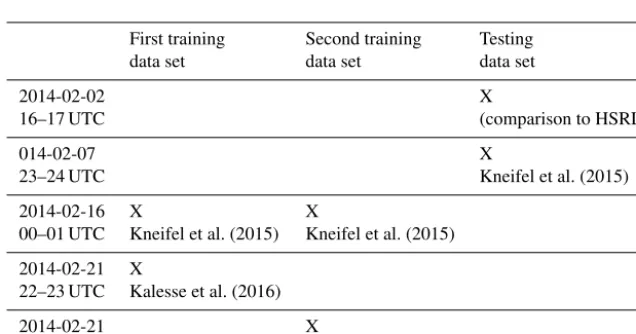
The training and test data sets were chosen as individ-ual nonoverlapping time–height areas rather than randomly splitting all hand-marked spectra into training and test cat-egories. For the training phase, data recorded on 21 Febru-ary 2014, 22–23 UTC were utilized, a time period which was studied in greater detail before (Kalesse et al., 2016; Ma-son et al., 2018). Data from 16 February 2014, 00–01 UTC, which were in part investigated in a case study presented in
Kneifel et al. (2015), were used in the training phase as well. The third case selected for the training data set, 21 Febru-ary 2014, 23–24 UTC, was in part analyzed by Kneifel et al. (2015) as well. The test set is comprised of two 1 h cases, which were recorded on 2 February 2014, 16–17 UTC, and on 7 February 2014, 23–24 UTC. In the case of 2 February 2014, 16–17 UTC, the study area was set within the lowest liquid layer where independent HSRL measurements were used to check the performance of the PEAKO algorithm for liquid-peak detection. Unfortunately, the HSRL was fully at-tenuated by near-surface liquid layers during the other case studies. The chosen period on 7 February 2014 overlaps with another case investigated by Kneifel et al. (2015). Table 1 gives a summary of which measurement periods were used for which of the data sets.
The PEAKO algorithm includes a set of three subse-quently described adjustable parameters (smoothing span, prominence threshold, minimum peak width at half-height), which are varied to obtain the set of parameters which yields the best agreement of hand-marked and machine-marked peaks. The search for the best parameter combination is done via a search through a finite set of values in the three-dimensional search space.
As a first step, the raw spectrum at the current time and height is replaced by an average spectrum obtained by aver-aging 27 spectra, 9 in time and 3 in height centered on the current one. For the given KAZR time–height resolution of 2 s (time) and 30 m (range), this translates to averaging of 18 s in the temporal dimension and 90 m in the spatial di-mension. With hydrometeor populations usually appearing in distinct layers, which are persistent over a certain period of time, more neighbors in time than height are used for averag-ing. Figure 9a in Buehl et al. (2016) shows minimum liquid layer depths on the order of 50 to 100 m equivalent to two to three range gates assuming 30 m vertical range gate spacing, which motivated our choice of 90 m. The averaged spectrum is then further smoothed using local polynomial regression. The smoothing method applied, locally estimated scatterplot smoothing (loess), performs weighted linear least-square fit-ting on consecutive subsets of adjacent data points with a second-degree polynomial model. The span for smoothing is the fraction of the total number of data points (here Doppler bins) of one Doppler velocity spectrum to be used for each local fit. Loess was chosen empirically after testing different methods because it showed the best ability to capture peaks while filtering out noise. The span is varied in a range be-tween 3.5 % and 13 %, regularly spaced with a distance of 0.5 %.
In the next step, local maxima are identified in the aver-aged and smoothed spectrum. Only peaks with powers above the raw spectrum’s maximum noise are considered. Finally, peaks with prominences below the prominence threshold and widths smaller than the minimum peak width are excluded.
Figure 1.Example of graphical user interface for peak-marking by hand. For the Doppler spectrum in the center panel, two peaks (red stars) were marked by the user (HK). The surrounding panels display the spatially and temporally neighboring spectra. Data are as follows: KAZR spectra observed at TMP on 16 February 2014, 0.03–0.05 UTC, between 1.0 and 1.2 km height. The red line marks the maximum noise floor determined according to Hildebrand and Sekhon (1974), and the black line the mean of the noise.
Table 1.Overview of the measurement periods used in each of the three data sets (first training data set, second training data set, testing data set) containing hand-marked peaks. Published studies of the selected periods, to which results can be compared, are noted as well.
First training Second training Testing data set data set data set
2014-02-02 X
16–17 UTC (comparison to HSRL)
014-02-07 X
23–24 UTC Kneifel et al. (2015)
2014-02-16 X X
00–01 UTC Kneifel et al. (2015) Kneifel et al. (2015)
2014-02-21 X
22–23 UTC Kalesse et al. (2016)
2014-02-21 X
23–24 UTC Kneifel et al. (2015)
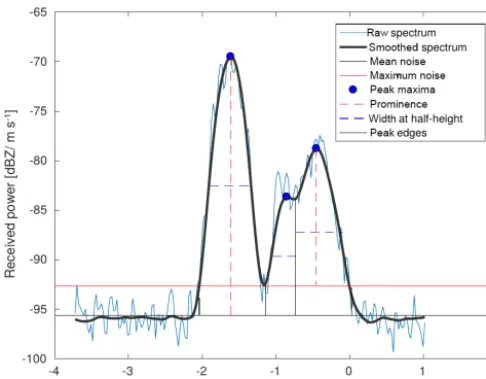
Doppler spectrum. The prominence of a peak is the power difference (dynamic range) of the peak’s maximum and the signal’s minimum between the considered peak and the near-est higher peak. Concerning the highnear-est peak of the Doppler spectrum, the prominence is the power difference between the peak maximum and the mean of the spectral noise deter-mined by Hildebrand and Sekhon (1974). This parameter is varied between 0 and 2 dBZ m−1s−1in the training phase of
Figure 2. Example spectrum (blue line) with multiple merged peaks, recorded on 21 February 2014, 22.7 UTC, at 2.44 km alti-tude. The smoothed spectrum (average of neighbor spectra in time and height domain, smoothed using a span of 8.5 %) is shown as well (bold black line). For each of the three peaks marked in this spectrum (blue dots), the prominences (red dashed lines) and widths at half-height (blue dashed lines) as well as the edges (vertical black lines) of the peaks are marked. The red horizontal line marks the maximum value of the power in the raw (blue) spectrum among those Doppler spectral bins identified as noise by Hildebrand and Sekhon (1974). The black horizontal line is drawn at the mean power of the Doppler bins containing only noise.
at around −1.1 m s−1). For the peak with the lowest power at VD≈ −0.8 m s−1, the prominence of 0.25 dBZ m s−1 is barely visible because it is defined as only the distance be-tween this peak’s maximum and the minimum to the closest higher peak, which is the peak with the lowest absoluteVD.
The third adjustable parameter is the minimum peak width at half-height. The range of values in which it is varied (4.2 to 8.4 Doppler velocity bins, spaced with a distance of 1.05) was determined from a low-turbulence cloud re-gion only consisting of liquid droplets (21 February 2014, 22.53–22.59 UTC 2.9–3.1 km). Doppler spectra peaks in low-turbulent liquid cloud droplet layers are very narrow and thus suited to determine the minimum width of a peak con-sidered physically meaningful. At the given KAZR resolu-tion, these peaks were found to be between 4.2 and 8.4 VD bins wide corresponding to about 10–20 cm s−1.
To determine the optimal parameter combination, a sim-ilarity measure is defined, based on the maximum overlap-ping area of detected peaks as illustrated in Fig. 3: for a cer-tain set of smoothing span, minimum peak width, and promi-nence threshold, the algorithm will detect certain peaks in a Doppler spectrum (shown as red dots surrounded by blue circles in Fig. 3). For these peaks, as well as for the peaks marked by a user in the same Doppler spectrum (red stars in Fig. 3), the edges (marked with vertical lines) are
deter-Figure 3.Schematic to visualize how the similarity measure to compare user-marked and algorithm-found peaks in Doppler spec-tra: areas of matching peaks are summed up (blue hatched area), and the areas of mismatched peaks (red hatched) are subtracted.
mined, which are defined as follows. The edge is either the first Doppler bin where the spectrum power is smaller than the maximum noise floor or, in the case of a merged peak, the minimum (saddle point) between the merged peaks. In the next step, the overlapping area for each pair of hand-marked and machine-found peaks is identified. In the case of multiple peaks in one spectrum, the sum of all overlapping areas is determined. Nonoverlapping regions caused by ei-ther a mismatch in the number of hand-marked and machine-found peaks or a different location (in x direction, i.e., in Doppler velocity) of the pair of peaks are penalized by sub-tracting the nonoverlapping area (red hatched area in Fig. 3) of the mismatched peaks from the similarity area measure. The optimum parameter combination is the triplet of span, prominence threshold, and minimum peak width for which the similarity has its maximum value.
3.2 Description of other radar Doppler spectra peak-finding algorithms
Three other radar Doppler velocity spectrum peak-finding al-gorithms were compared to PEAKO and will be briefly ex-plained in the following.
The algorithm described in Shupe et al. (2004) (from now on referred to as “Shupe_04”) uses peak-finding crite-ria optimized to one relatively short (30 min) mixed-phase cloud case study period. In short, the power of the primary (strongest) peak must be at least 4 standard deviations of the noise above the mean spectral noise level. In addition, one or more secondary peaks are identified as maxima being at least 2.5 standard deviations of the noise greater than the mean spectral noise level. Both primary and secondary peaks must have a width of at least 0.448 m s−1. Merged peaks are iden-tified as separate spectral modes if the saddle point between the two maxima is lower than 65 % of the lowest of the two peaks from the noise level.
three-bin-boxcar-filtered radar Doppler spectra into a primary peak (defined as the peak containing the bin with maximum spec-tral power density), dominating the total reflectivity and containing up to two sub-peaks, and a possible secondary peak. Fixed thresholds, i.e., minimum primary or secondary peak width (Pwmin), minimum sub-peak height (Phmin), min-imum sub-peak separation (Psmin), and minimum primary– secondary peak edge separation (Pnmin), are applied to ex-tract a suite of variables from the Doppler spectra. Pwminis set to five Doppler velocity bins (0.12 m s−1), Psminto three Doppler velocity bins (0.07 m s−1), Pnminto one Doppler ve-locity bin (0.0237 m s−1), and Phmin to 1 dBZ m−1s−1. For the comparative study, a third technique, a polynomial fit-ting algorithm as described in Kollias et al. (1999, 2003), was also applied to the radar Doppler spectra that are ana-lyzed in this study. This routine first extracts the parts of the spectrum above the maximum noise floor (the noise thresh-old determined by Hildebrand and Sekhon, 1974) and ex-tends the edges of the found peaks down to the mean noise floor. In a next step, each continuous sample of data above the noise floor is identified as a sub-spectrum. Sub-spectra that are classified as being too narrow (with velocity ranges of the peak smaller than 0.2 m s−1) are excluded. For each of the remaining sub-spectra, polynomial fitting of the 12th order is applied. The first and second derivatives are taken to identify minima and maxima. Peaks are defined as sequences of minimum–maximum–minimum. Peaks having a velocity range smaller than 0.2 m s−1 are ignored, as well as peaks with an amplitude smaller than 2 dB, with amplitude being defined as the difference in reflectivity between consecutive minimum and maximum.
4 Results and discussion
The following section will be structured as follows: in Sect. 4.1, the best parameter values obtained during the training phase of the PEAKO algorithm are summarized. The peaks detected by one of these best parameter com-binations are compared to peaks found by the Shupe_04, MicroARSCL, and Polyfit12 algorithms in a case study. It should be noted that PEAKO was trained with a subset of data from the same distribution as this firstly presented case study. This means that PEAKO has somewhat of an advan-tage over the other three algorithms when comparing to the training data set. Section 4.2 summarizes the testing phase and presents a comparative independent study case, in which PEAKO-found peaks are again compared to peaks detected by the three other algorithms and validated against HSRL retrievals of liquid water droplets. More case studies are pre-sented in the Appendices.
4.1 Training phase of the PEAKO algorithm
The training phase was split into two steps: Initially, peaks marked manually in 1340 Doppler spectra were used for training the PEAKO algorithm and obtaining an initial model via a coarse parameter search. This initial training resulted in six equally well-performing combinations of span, promi-nence threshold, and width, which all yield the same value of the similarity measure. A more finely resolved search for the three parameters was then performed, using 775 Doppler spectra with user-marked peaks. This second, re-fined training again resulted in several combinations of min-imum peak prominence, minmin-imum peak width, and smooth-ing span yieldsmooth-ing the same similarity. Table 2 gives an overview of the possible ranges found for the three PEAKO parameters after the initial training and the more finely re-solved parameter search. The span for loess became slightly larger (increased by 0.5 %–1 % in absolute terms) and con-verged to one single possible value (8.5 %). The mini-mum peak prominence decreased by one-third, i.e., from 0.15 to 0.1 dBZ m−1s−1. This prominence threshold is very low compared to values used by other peak-finding tech-niques. However, in other approaches, spectra are usually not smoothed and neighbor-averaged. Maxima prominent enough in time and height to be still visible after aver-aging and smoothing are most probably physical, justify-ing the low prominence threshold. The possible values for the minimum peak width did not change significantly tween the initial and the more refined model and ranges be-tween 0.09 and 0.15 m s−1 (i.e., VD range, from 4 to 6.25 VD bins for the given KAZR Doppler spectra resolution). Doppler spectrum peaks detected by PEAKO configured in one of these combinations (span=8.5 %; prominence thresh-old=0.1 dBZ m−1s−1; minimum peak width=4 m s−1) are compared to peaks found by other methods for a study case on 21 February 2014, 22.54 to 22.77 UTC, at 2 to 6 km height. This parameter set containing the smallest possible minimum peak width was chosen because it is most stringent and thus best suited for the detection of narrow supercooled liquid water peaks. The selected period was discussed in de-tail in Kalesse et al. (2016).
Table 2.Ranges of the parameters yielding the highest similarity measure after the initial and the finely tuned training using the first and second training data sets, respectively.
Optimal parameter range Optimal parameter range after initial training after fine-tuned training
Span for smoothing 7.5 %–8 % 8.5 %
Peak prominence threshold 0.15 dBZ m−1s−1 0.1 dBZ m−1s−1 Minimum peak width 4.2–6.3VDbins 4–6.25VDbins
(9.95–14.93 cm s−1) (9.48–14.81 cm s−1)
Figure 4. Case study period from 21 February 2014, 22.54 to 22.77 UTC, at 2 to 6 km height. Panels(a),(b), and(c)show the radar reflectivity factor Ze, the mean Doppler velocity (MDV), and the Doppler spectrum widthσof the main peak in the Doppler spec-trum.
value), andσ with decreasing altitude. As the frontal cloud moves in and snow begins to fall through the SLW layer, rim-ing takes place along slanted fall streaks. A more in-depth analysis of the synoptic situation and the observed micro-physical growth processes is given in Kalesse et al. (2016).
The number of detected peaks for this case study is shown in Fig. 5. All algorithms show a similar general picture with
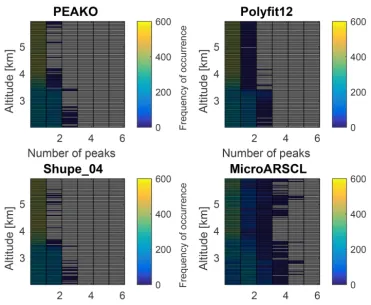
Figure 6.Contoured frequency by altitude diagram (CFAD) for the frequency of occurrence of number of detected peaks from different algorithms for the case study period on 21 February 2014 from 22.54 to 22.77 UTC at 2 to 6 km altitude.
an increasing number of spectral peaks as the snow front moves in and snow starts falling through the SLW layer of the mid-level mixed-phase cloud. A closer examination however reveals some differences between the methods: the PEAKO and Shupe_04 algorithms have very similar results except for some areas in the snowfall region where PEAKO detects three peaks and Shupe_04 detects two peaks. MicroARSCL generally shows higher variability than the other algorithms; the small areas of higher peak number often coincide with increased spectrum width in Fig. 4. Polynomial fitting shows three peaks in the area where snow falls through the top of the SLW layer and is otherwise very similar to PEAKO and Shupe_04. The areas where the different algorithms show discrepancies are now examined in more detail.
For that purpose, contoured frequency by altitude dia-grams (CFAD, Fig. 6) is created to compare the results of the algorithms in a different way. The CFAD shows the num-ber of detected peaks (abscissa) at different heights (ordinate) as a colored frequency of occurrence for the total case study sample. For all four compared algorithms, it is most com-mon that only one peak is detected. This is especially true for higher altitudes within the snow front (4 km and above). It is visible that the PEAKO algorithm and the results obtained using the Shupe_04 approach agree to a large extent. In the polynomial fitting approach, two or three peaks are detected
Figure 7.Four exemplary Doppler spectra picked from the case study on 21 February 2014, 22.54 to 22.77 UTC, at 2 to 6 km altitude. The averaged and smoothed spectrum which is used as input to PEAKO is drawn in bold over the original spectrum. The peaks detected by the four algorithms are marked. The number of peaks found by each algorithm is noted in parentheses in each figure legend. Please note the differentyscales.
algorithms are able to detect the very narrow noise-floor-separated peak produced by the supercooled liquid droplets withVDnear 0 m s−1. Figure 7d shows a spectrum recorded at the same time but below the SLW layer at 2.41 km height, where freshly generated ice (VD= −0.5 m s−1), unrimed snow (VD= −1 m s−1), and rimed snow (VD= −1.7 m s−1) are present. These hydrometeor populations do not have suf-ficient differences in terminal fall velocities and thus produce a spectrum with merged peaks. For this example, Shupe_04 and Polyfit12 detect the two main maxima (freshly generated ice and rimed snow), whereas MicroARSCL and PEAKO find three peaks. However, closer examination of the exam-ple spectrum shows that the two algorithms each detect an additional peak in different locations: MicroARSCL finds a sub-peak in the faster falling hydrometeor population (the Gaussian peak of the rimed snow) while PEAKO detects a sub-peak in the slower-falling mode, which exhibits a strong skewness. This sub-peak is most likely caused by snow from the upper layers, which remained unrimed as discussed in Kalesse et al. (2016).
Figure 8. HSRL measurements from the case study period from 2 February 2014 from 16 to 17 UTC at 0 to 3 km height. Panel (a) shows the attenuated backscatter cross section and panel (b)the circular depolarization ratio. The black dashed line marks the boundary of the supercooled liquid layer, indicated by high backscatter and low depolarization ratio.
of peaks in both cases (Figs. A2 and B2). The fall streak fea-ture which exhibits particle size sorting was better detected by PEAKO and MicroARSCL than by the other two algo-rithms. The increase in number of peaks at 0.67 to 0.75 UTC can be explained by the presence of large needle aggregates of sometimes more compact and sometimes very open struc-ture as explained in Kneifel et al. (2015), which lead to the interesting multimodal Doppler spectrum with up to four peaks as shown in Fig. B4d. Ground-based in situ observa-tions show that during 0.75–0.85 UTC aggregates and rimed particles with enhanced terminal velocities were present and that the number of large aggregates was further found to de-crease while number of increasingly rimed aggregates fur-ther increased until 1 UTC. Radio-sounding observations on 15 February 2014 at 23.2 UTC show a thin layer at 0.8– 0.9 km altitude, which is subsaturated with respect to ice and liquid and which might explain the decrease to one found Doppler peak at this altitude. For 21 February 2014, 23.01 to 23.25 UTC, Kneifel et al. (2015) report the transition from a low concentration of strongly rimed particles (lump graupel) to aggregate snowfall with large snowfall rates and increas-ing size and number of the aggregates. The fast transition of the snowfall from rimed particles to aggregates results in the bimodal Doppler spectra (with two found peaks) at 23
Figure 9.Like Fig. 4 but for 2 February 2014, 16:00 to 17:00 UTC, at 0 to 2.7 km height.
to 23.05 UTC and monomodal spectra afterwards. For this case study, PEAKO and Shupe_04 and Polyfit12 agree well with the situation described in Kneifel et al. (2015) while Mi-croARSCL overestimates the number of peaks, especially in the turbulent boundary layer and near 4 km altitude.
4.2 Testing phase of the algorithm
Figure 10.Like Fig. 5 but for 2 February 2014, 16:00 to 17:00 UTC, at 0 to 2.7 km height. Boxes mark the points in time–height where peaks detected in single spectra are analyzed in greater detail. The dashed lines mark the bottom and top of the SLW layer detected by the HSRL (Fig. 8).
1 km height and is slightly lifted as the front is moving in. Its base and top are traced with dashed lines in Fig. 8. Af-ter 16.8 UTC, the microwave-radiomeAf-ter-derived liquid wa-ter path (LWP) decreases from around 300 g m2to approxi-mately 60 g m2and the lidar does not detect the cloud base anymore due to the scarcity in small liquid droplets to which the lidar is sensitive and due to the strong snowfall. The strong decrease in LWP again points to riming. Analysis of the ground-based in situ particle imaging package (PIP) data shows a variety of different precipitating particles during that 1 h time period (Annakaisa von Lerber, personal communi-cation, 2018): around 16 UTC, oblate particles, possibly nee-dles, and some small needle aggregates are present. When Ze decreases around 16.3–16.55 UTC (Fig. 9), no large par-ticles are present at all, just very small ones, maybe single
pristine crystals (the resolution of PIP is not good enough to distinguish). At 16.55–16.8 UTC when Ze increases strongly and LWP decreases significantly, the PIP observes a clear change to round, dense, fast-falling particles, indicative of small graupel. Finally, from 16.8 UTC onward, particle sizes at the ground increase and there are more (quite dense) ag-gregates, resulting in Ze of up to 10 dBZ.
Figure 9 shows the first three radar moments (Ze, MDV, andσ) of the main peak for the selected case study. The su-percooled liquid layer at the top of the mid-level cloud ex-tends from about 2.1 to 2.4 km and is characterized by MDV of near 0 m s−1. Snow fall rate is at first low and increases at about 16.6 UTC (surface meteorological observations, not shown). Pronounced fall streaks can be seen coinciding with large values of spectrum width, indicating the presence of several hydrometeor populations, producing Doppler spectra with broad merged peaks.
Figure 10 reveals that the number of peaks detected by the four algorithms differs significantly for this case study. Shupe_04 and Polyfit12 again agree to large extents, al-though Shupe_04 does mostly only detect one peak at 2– 2.5 km height before 16.3 UTC and after 16.5 UTC where all other algorithms mostly detect two peaks. MicroARSCL generally detects a larger number of peaks in the Doppler spectra; PEAKO is in this case more similar to MicroARSCL than to the other two algorithms and often detects three to four and sometimes even five peaks along certain fall streaks. However, due to the smoothing performed within PEAKO, the detected features are less noisy and more consistent in time and height than for MicroARSCL.
Figure 11 shows CFAD diagrams for each of the four algo-rithms for the case study on 2 February 2014, 16 to 17 UTC. These graphs confirm that Polyfit12 and Shupe_04 estimate the number of peaks more conservatively than PEAKO and MicroARSCL. It is obvious that MicroARSCL often detects three or four peaks in the lowermost radar height bins, which can probably be attributed to turbulence. The HSRL-detected SLW layer (varying between 0.7 and 1.5 km height) is most obvious in the Shupe_04 and PEAKO CFAD plot; the num-ber of spectra which are assigned two or three peaks is no-ticeably higher in this altitude range.
Figure 11.Like Fig. 6 but for the case study period on 2 February 2014, 16:00 to 17:00 UTC, at 0 to 2.7 km altitude.
the SLW peak, are detected by PEAKO and MicroARSCL, while Shupe_04 and Polyfit12 both only detect one maxi-mum.
The spectrum shown in Fig. 12b is near the top of the SLW layer detected by the HSRL. The narrow liquid peak with fall velocity near 0 m s−1is only detected by PEAKO and Shupe_04. Both algorithms find two more snow peaks with larger fall velocity. These two peaks are also detected by Polyfit12. MicroARSCL detects three peaks as well; how-ever it is not able to detect the liquid peak. Figure 12c shows a spectrum which was chosen in an area where PEAKO finds five peaks. Again, one of them is a SLW peak within the SLW layer detected by the HSRL (Fig. 10). This peak is also de-tected by MicroARSCL and Shupe_04 but not Polyfit12. The four other peaks found by PEAKO are merged snow peaks with different fall velocities which hint to various degrees of riming that the other algorithms have difficulties detecting. In Fig. 12d, the number of peaks detected by the four algorithms differs significantly: the peak with the highest reflectivity at around −1.5 m s−1 fall velocity is found by all algorithms. PEAKO detects two sub-peaks, which are each identified by at least one other algorithm as well. However, none of the other methods finds both other ice sub-peaks.
In Appendices A–C, three more case studies from the training and test phase are presented. Results of comparison of PEAKO to the other peak-finding algorithms are similar
to the cases presented here. Appendix D contains a sensitiv-ity study on the effect of different smoothing schemes and spatiotemporal averaging scales.
5 Conclusions and outlook
5.1 Summary of findings and outlook
Figure 12.Four exemplary Doppler spectra picked from the case study on 2 February 2014, 16:00 to 17:00 UTC, at 0 to 2.5 km altitude. The averaged and smoothed spectrum which is used as input to PEAKO is drawn in bold over the original spectrum. The peaks detected by the four algorithms are marked. The number of peaks found by each algorithm is noted in parentheses in each figure legend. Mean and maximum noise floors are presented by black and red horizontal lines, respectively. Please note that the scale of theyaxis is different in each plot.
and height. Consistency in time and to a lesser extent height is a good indicator of the performance of a peak-finding algorithm because hydrometeor populations and cloud mi-crophysical processes generally occur in layers (unless in highly turbulent regions). The number of found cloud radar Doppler velocity spectrum peaks within mixed-phase winter-time snow clouds in Finland was validated with independent ground-based in situ observations described in Kneifel et al. (2015) and, if available, HSRL observations.
The described approach only identifies underlying hy-drometeor populations if the particle types differ sufficiently in their terminal fall velocities to produce individual Doppler spectrum peaks.
In upcoming projects, it is planned to test if the best three-parameter pairs of PEAKO found are applicable to other radar systems (like METEK MIRA 35 GHz radars or RPG 94 GHz FMCW radars) or to which extent further refinement is needed for different radar sampling parameters. Addition-ally, the effect of stronger cloud dynamics will be evaluated.
Determining thenumberof different hydrometeor popula-tions in the same radar volume based on morphological fea-tures of the radar Doppler spectrum as presented in this com-parative study is the first step towards cloud particle classi-fications. Having this easily adjustable cloud radar Doppler spectrum peak detection algorithm available will facilitate carrying out microphysical process studies, involving appli-cations such as peak tracking.
Appendix A: Case study from 16 February 2014, 0.67–0.92 UTC (training data set 2)
The results of the PEAKO comparison to the other three peak-finding approaches for the training data set of 16 Febru-ary 2014, 0.67 to 0.92 UTC, are shown in Appendix A. This time period is also analyzed by Kneifel et al. (2015) in depth, so it was possible to compare the microphysical signatures reported in this study to the Doppler peaks de-tected by the four algorithms. For 16 February 2014, 0.67 to 0.92 UTC, Kneifel et al. (2015) reported high values of microwave-radiometer-derived liquid water path of 100 to 500 g m−2 and clear signatures of large aggregates in the dual-wavelength ratios of Ka-band and W-band reflectivities below 2 km as well as in the reflectivity fall streak feature at 0.85 UTC that were also seen in the X–Ka dual-wavelength ratios around 0.85 UTC. The general structures of the lay-ers of Doppler peak number detected by PEAKO, Shupe_04, and Polyfit12 again agree to a large extent, whereas Mi-croARSCL detects a higher number of peaks in both cases (Figs. A2 and B2). The fall streak feature which exhibits particle size sorting was better detected by PEAKO and Mi-croARSCL than by the other two algorithms. The increase in number of peaks at 0.67 to 0.75 UTC can be explained by the presence of large needle aggregates of sometimes more compact and sometimes very open structure as ex-plained in Kneifel et al. (2015), which lead to the inter-esting multimodal Doppler spectrum with up to four peaks as shown in Fig. B4d. Ground-based in situ observations show that during 0.75–0.85 UTC aggregates and rimed par-ticles with enhanced terminal velocities were present and that the number of large aggregates was further found to de-crease while the number of increasingly rimed aggregates further increased until 1 UTC. Radio-sounding observations on 15 February 2014 at 23.2 UTC show a thin layer at 0.8– 0.9 km altitude which is subsaturated with respect to ice and liquid and which might explain the decrease to one found Doppler peak at this altitude.
Appendix B: Case study from 21 February 2014, 23.01–23.10 UTC (training data set 3)
The training data set of 21 February 2014, 23.01 to 23.25 UTC, which is also a case study of Kneifel et al. (2015), is described in Appendix B. For 23.01 to 23.25 UTC, Kneifel et al. (2015) report the transition from a low con-centration of strongly rimed particles (lump graupel) to ag-gregate snowfall with large snowfall rates and increasing size and number of the aggregates. The fast transition of the snowfall from rimed particles to aggregates results in the bimodal Doppler spectra (with two found peaks) at 23 to 23.05 UTC and monomodal spectra afterwards. For this case study, PEAKO and Shupe_04 and Polyfit12 agree well with the situation described in Kneifel et al. (2015), while MicroARSCL overestimates the number of peaks, especially in the turbulent boundary layer and near 4 km altitude.
Figure B1.Like Fig. 4 but for 21 February 2014, 23.01–23.25 UTC, at 0.2–4 km height.
Appendix C: Case study from 7 February 2014, 23.75–24 UTC (test data set 2)
The second test data set of 7 February 2014, 23.75 to 24 UTC, is characterized by dendritic ice particles (Kneifel et al., 2015) and a slanted fall streak feature extending from near 4 to 1 km from 23.75 to 23.9 UTC (Fig. C1) with bi-modal Doppler spectra (Figs. C2 and C4). Ground-based in situ observations report mostly small, open-structured aggre-gates (which are later replaced by more compact spheroidal habits) as well as a small number of spherical probably rimed particles.
Figure C1.Like Fig. 4 but for 7 February 2014, 23.75–24 UTC, at 0.2–4 km height.
Appendix D: Sensitivity study on the effect of different smoothing schemes and spatiotemporal averaging scales To assess the influence of different smoothing schemes and spatiotemporal averaging space on the algorithm’s perfor-mance, a sensitivity study was performed. Two smoothing methods available in MATLAB are themoving averageand the locally weighted scatterplot smoothing (lowess) schemes. Lowess is very similar to loess with the difference that lowess utilizes a first-degree polynomial, which is fit to the data sub-set defined by span. We trained PEAKO in different configu-rations using the first training data set (Table 1). The PEAKO configurations tested were the following:
– averaging over five spectra on a temporal scale and five spectra on a spatial scale, which results in an averaging timescale of 10 s and an averaging height of 150 m (the average spectrum is smoothed using the loess method). – omitting time–height averaging altogether prior to
smoothing the spectra using loess.
– keeping the spatiotemporal averaging fixed at the de-fault of 16 s and 90 m but using moving average smooth-ing instead of the loess method.
– keeping the spatiotemporal averaging scale fixed at the default and using lowess instead of loess.
The optimized parameters obtained after training PEAKO in each of the above-listed configurations were applied to the case study presented in Fig. 5. Figure D1 shows the results.
The panels in Fig. D1 all display a similar pattern with respect to peak number. This is not surprising because the training process of PEAKO is the same for each of the meth-ods, i.e., the three adjustable parameters are adjusted to ob-tain the best agreement with the human-created training data. A change in the spatiotemporal averaging scale towards more neighbors in height and fewer neighbors in time does not al-ter the result significantly. However, performing time–height averaging prior to smoothing at all is important as can be seen in the third panel in Fig. D1: if no spatiotemporal av-eraging is carried out before smoothing, the features de-tected by PEAKO become less coherent and more noisy. Figure D1d and e explore the effect of different smoothing schemes on the algorithm performance. Both moving aver-age and lowess methods are able to reproduce the features detected by PEAKO in the default configuration only with some minor deviations.
Figure D1. Number of Doppler spectrum peaks detected by PEAKO in five different configurations for the selected case study on 21 February 2014 from 22.54 to 22.77 UTC, at 2 to 6 km altitude.
Author contributions. HK, TV, and CP designed the PEAKO algo-rithm together. CP developed most of the MATLAB model code. HK and TV performed the data analysis and visualization and pre-pared the paper. EL contributed MicroARSCL data for the selected case studies.
Competing interests. The authors declare that they have no conflict of interest.
Acknowledgements. The authors thank the entire BAECC SNEX science team, the AMF2 team, and the SMEAR II staff for data ac-quisition and analysis. Thanks also to Annakaisa von Lerber of the Finnish Meteorological Institute for discussions on ground-based in situ data as well as Pavlos Kollias for discussions on peak-finding in cloud radar Doppler velocity spectra. Thanks to the Leibniz Institute for Tropospheric Research through which the student research posi-tion of Teresa Vogl has received funding from the European Union’s Horizon 2020 research and innovation program under grant agree-ment no. 654109.
Financial support. This research has been supported by the DFG (grant no: GZ:KA 4162/1-1).
Review statement. This paper was edited by Mark Kulie and re-viewed by two anonymous referees.
References
Besic, N., Figueras i Ventura, J., Grazioli, J., Gabella, M., Ger-mann, U., and Berne, A.: Hydrometeor classification through statistical clustering of polarimetric radar measurements: a semi-supervised approach, Atmos. Meas. Tech., 9, 4425–4445, https://doi.org/10.5194/amt-9-4425-2016, 2016.
Bühl, J., Seifert, P., Myagkov, A., and Ansmann, A.: Measuring ice- and liquid-water properties in mixed-phase cloud layers at the Leipzig Cloudnet station, Atmos. Chem. Phys., 16, 10609– 10620, https://doi.org/10.5194/acp-16-10609-2016, 2016. Cornman, L. B., Goodrich, R. K., Morse, C. S., and
Eck-lund, W. L.: A Fuzzy Logic Method for Improved Mo-ment Estimation from Doppler Spectra, J. Atmos. Ocean. Tech., 15, 1287–1305, https://doi.org/10.1175/1520-0426(1998)015<1287:AFLMFI>2.0.CO;2, 1998.
Ermold, B., Eloranta, E., Michelsen, H., Garcia, J., Goldsmith, J., and Bambha, R.: High Spectral Resolution Lidar (HSRL), data set, https://doi.org/10.5439/1025200, 2014.
Hildebrand, P. H. and Sekhon, R. S.: Objective Deter-mination of the Noise Level in Doppler Spectra, J. Appl. Meteor., 13, 808–811, https://doi.org/10.1175/1520-0450(1974)013<0808:odotnl>2.0.co;2, 1974.
Kalesse, H., Szyrmer, W., Kneifel, S., Kollias, P., and Luke, E.: Fin-gerprints of a riming event on cloud radar Doppler spectra: ob-servations and modeling, Atmos. Chem. Phys., 16, 2997–3012, https://doi.org/10.5194/acp-16-2997-2016, 2016.
Kneifel, S., von Lerber, A., Tiira, J., Moisseev, D., Kollias, P., and Leinonen, J.: Observed relations between snowfall microphysics and triple-frequency radar measurements, J. Geophys. Res.-Atmos., 120, 6034–6055, https://doi.org/10.1002/2015jd023156, 2015.
Kollias, P., Lhermitte, R., and Albrecht, B. A.: Vertical air mo-tion and raindrop size distribumo-tions in convective systems us-ing a 94 GHz radar, Geophys. Res. Lett., 26, 3109–3112, https://doi.org/10.1029/1999GL010838, 1999.
Kollias, P., Albrecht, B. A., and Marks Jr., F. D.: Cloud radar observations of vertical drafts and microphysics in convective rain, J. Geophys. Res.-Atmos., 108, 4053, https://doi.org/10.1029/2001jd002033, 2003.
Kollias, P., Miller, M. A., Luke, E. P., Johnson, K. L., Cloth-iaux, E. E., Moran, K. P., Widener, K. B., and Albrecht, B. A.: The Atmospheric Radiation Measurement Program Cloud Pro-filing Radars: Second-Generation Sampling Strategies, Process-ing, and Cloud Data Products, J. Atmos. Ocean. Tech., 24, 1199– 1214, https://doi.org/10.1175/jtech2033.1, 2007.
Kollias, P., Bharadwaj, N., Widener, K., Jo, I., and John-son, K.: Scanning ARM Cloud Radars. Part I: Operational Sampling Strategies, J. Atmos. Ocean. Tech., 31, 569–582, https://doi.org/10.1175/jtech-d-13-00044.1, 2014.
Kollias, P., Clothiaux, E. E., Ackerman, T. P., Albrecht, B. A., Widener, K. B., Moran, K. P., Luke, E. P., Johnson, K. L., Bharadwaj, N., Mead, J. B., Miller, M. A., Verlinde, J., Marc-hand, R. T., and Mace, G. G.: Development and Applica-tions of ARM Millimeter-Wavelength Cloud Radars, Meteor. Mon., 57, 17.1–17.19, https://doi.org/10.1175/amsmonographs-d-15-0037.1, 2016.
Komurcu, M., Storelvmo, T., Tan, I., Lohmann, U., Yun, Y., Penner, J. E., Wang, Y., Liu, X., and Takemura, T.: In-tercomparison of the cloud water phase among global cli-mate models, J. Geophys. Res.-Atmos., 119, 3372–3400, https://doi.org/10.1002/2013jd021119, 2014.
Luke, E. P., Kollias, P., Johnson, K. L., and Clothiaux, E. E.: A Technique for the Automatic Detection of Insect Clutter in Cloud Radar Returns, J. Atmos. Ocean. Tech., 25, 1498–1513, https://doi.org/10.1175/2007JTECHA953.1, 2008.
Luke, E. P., Kollias, P., and Shupe, M. D.: Detection of supercooled liquid in mixed-phase clouds using radar Doppler spectra, J. Geophys. Res.-Atmos., 115, D19201, https://doi.org/10.1029/2009JD012884, 2010.
Mason, S. L., Chiu, C. J., Hogan, R. J., Moisseev, D., and Kneifel, S.: Retrievals of Riming and Snow Density From Vertically Pointing Doppler Radars, J. Geophys. Res.-Atmos., 123, 13807– 13834, https://doi.org/10.1029/2018jd028603, 2018.
Matthews, A., Isom, B., Nelson, D., Lindenmaier, I., Hardin, J., Johnson, K., and Bharadwaj, N.: Ka ARM Zenith Radar (KAZRGE), data set, https://doi.org/10.5439/1025214, 2014a. Matthews, A., Isom, B., Nelson, D., Lindenmaier, I.,
Hardin, J., Johnson, K., and Bharadwaj, N.: Ka ARM Zenith Radar (KAZRSPECCMASKGECOPOL), data set, https://doi.org/10.5439/1025218, 2014b.
Petäjä, T., O’Connor, E. J., Moisseev, D., Sinclair, V. A., Man-ninen, A. J., Väänänen, R., von Lerber, A., Thornton, J. A., Nicoll, K., Petersen, W., Chandrasekar, V., Smith, J. N., Win-kler, P. M., Krüger, O., Hakola, H., Timonen, H., Brus, D., Lau-rila, T., Asmi, E., Riekkola, M.-L., Mona, L., Massoli, P., Engel-mann, R., Komppula, M., Wang, J., Kuang, C., Bäck, J., Virta-nen, A., Levula, J., Ritsche, M., and Hickmon, N.: BAECC: A Field Campaign to Elucidate the Impact of Biogenic Aerosols on Clouds and Climate, B. Am. Meteorol. Soc., 97, 1909–1928, https://doi.org/10.1175/bams-d-14-00199.1, 2016.
Praz, C., Roulet, Y.-A., and Berne, A.: Solid hydrometeor classifica-tion and riming degree estimaclassifica-tion from pictures collected with a Multi-Angle Snowflake Camera, Atmos. Meas. Tech., 10, 1335– 1357, https://doi.org/10.5194/amt-10-1335-2017, 2017. Radenz, M., Bühl, J., Seifert, P., Griesche, H., and
Engel-mann, R.: peakTree: A framework for structure-preserving radar Doppler spectra analysis, Atmos. Meas. Tech. Discuss., https://doi.org/10.5194/amt-2019-76, in review, 2019.
Riihimaki, L. D., Comstock, J. M., Anderson, K. K., Holmes, A., and Luke, E.: A path towards uncertainty assignment in an op-erational cloud-phase algorithm from ARM vertically pointing active sensors, Adv. Stat. Climatol. Meteorol. Oceanogr., 2, 49– 62, https://doi.org/10.5194/ascmo-2-49-2016, 2016.
Shupe, M. D., Kollias, P., Matrosov, S. Y., and Schnei-der, T. L.: Deriving Mixed-Phase Cloud Proper-ties from Doppler Radar Spectra, J. Atmos. Ocean. Tech., 21, 660–670, https://doi.org/10.1175/1520-0426(2004)021<0660:dmcpfd>2.0.co;2, 2004.
Tan, I., Storelvmo, T., and Zelinka, M. D.: Observational constraints on mixed-phase clouds imply higher climate sensitivity, Science, 352, 224–227, https://doi.org/10.1126/science.aad5300, 2016. Verlinde, J., Rambukkange, M. P., Clothiaux, E. E., McFarquhar,
G. M., and Elorant, a. E. W.: Arctic multilayered, mixed-phase cloud processes revealed in millimeter-wave cloud radar Doppler spectra, J. Geophys. Res.-Atmos., 118, 13199–13213, https://doi.org/10.1002/2013JD020183, 2013.