IJIRT 146992
INTERNATIONAL JO URNAL OF INNOVATIVE RESEARCH IN TECHNOLOGY715
Study on Effect of Shore Hardness on Yarn Quality
N. Thukkaiappn
1, Dharanithukks
2Lecturer (Senior Grade), Department of Textile Technology, Nachimuthu Polytechnic College, Pollachi
Abstract- The present trend in textile industry turns towards quality awareness. Many factors such as machinery condition, spinning parameters and raw material contribute to quality. Accessories like cots and their shore hardness are of vital importance to spinning performance and for quality yarns. S o we have taken a study in spinning on the topic "S tudy on Effect of shore hardness on yarn quality".
S hore hardness is defined as a degree of hardness (or) toughness of the synthetic rubber. In this we have conducted trials using different cots of different shore hardness both in simplex and at ring frame stage to know their effect on yarn quality. Also we interchanged the positions of cots [front and back position] and tried to evaluate their effect on quality parameters like neps and imperfections. Finally, the results are also compared to find out the durable and optimum performing cots that improves yarn quality as well as the machine performance.
Index Terms- Cotton; S pinning; Yarn.
I. INTRODUCTION
Quality is the way of lift today. In every walk of life quality has assumed special importance. These have been experiments and trials conducted to improve the quality parameters and reduce the imperfection level. In this regard, we conducted trials to see the impact of shore hardness of top rollers on yarn quality. The degree of hardness of top roller varies from 70 degree to 90 degree. If cots are too soft, lapping may occur. Too hard means possibilities for roller slip and cracking are high. So we have to select a cot of optimum shore hardness both at simplex and ring frame stages to have better working and to produce fault free yarns.
Few years ago, softer cots were used in ring frame, which has very short life. Earlier the average life of softer cots was two years. In recent years, the life of softer cots was fallen to twelve months. In a textile mill particularly at ring name 5% of the stores cost was spent for cots. So selection of suitable synthetic cots and analysis of the effect of their shore hardness
in the quality of yarn in terms of U% and imperfections are done justifying the cots selection with reference to cost.
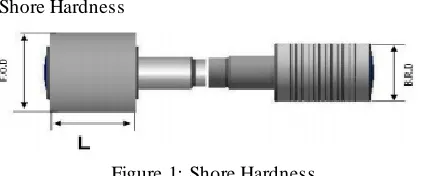
Shore Hardness
Figure 1: Shore Hardness
Hardness may be defined as the resistance to indention under conditions that do not puncture the rubber. It is called elastic modulus of rubber compound. These tests are based on the measurement of the penetration of the rigid ball into the rubber test piece under specific conditions. The measured penetration is converted into hardness degrees. A Durometer is used for measuring soft solid rubber compounds. Other scales are also used like Shore D which is used to measure the hardness of very hard rubber compounds including ebonite. The main drawback is in reproducibility of results by different operators. So, a practical tolerance of 5° is acceptable. As per the ASTM(D 2240 – Defines apparatus to be used and its sections such as diameter, length of the indenter, force of spring and D 1415 –Defines specimen size ), DIN, BRITISH and ISO Standards following test conditions have been laid for measuring.
II. MOUNTING
2.1Mounting allowance
IJIRT 146992
INTERNATIONAL JO URNAL OF INNOVATIVE RESEARCH IN TECHNOLOGY716
2.2 Excess DimensionsThe extra length of cots provided will shrink to the required length after mounting. Outside diameter of the cots is 1 to 1.5 mm greater after mounting so as to get the correct finished diameter after grinding.
2.3 Cot Mounting
Most textile mills have a well-equipped cot mounting and grinding shop. The person In charge of mounting and grinding should be familiar with the problems which result from incorrect 'flaunting and grinding ofcots.
i) Preparing the Shell
The shell must be thoroughly cleaned and made free from oil, grease and dirt, previous adhesive or any traces of old rubber, must be removed. The non - detachable assemblies fitted with ball bearings should not be put in a solvent as the grease will be washed off. Do not put any pressure on the ball bearing while cleaning. Use a clean cloth damped with a solvent [Example : M.E.K (or) Acetone] to clean the shells. Adhesive deposits in the grooves should be removed thoroughly.
ii) Mounting Of Cots
With higher top - arm pressure and increase in spindle speed several mills face cots slippage problem by use of single component adhesive. Therefore, two components harder and resin for mounting of cots to avoid cot slippage. The cot mounting can be conveniently done on a vertical mounting machine using a tapper cone.
iii) Fitting Long Cots
For cots, longer than 100mm, it is advisable to use pneumatic mounting equipment. Immediately after mounting while the adhesive is still wet, the cots should be calendared under pressure to remove the trapped air. If the calendaring is not properly the pockets of adhesive and air remain, then cot can collapse and become concave (or) wavy.
2.4 Grinding
Grinding makes foreground and taper - free surface on the cots, which is absolutely essential for superior yarn quality.
Grinding helps to avoid formation of grooves or channels on the surface of top roller cots. The grinding frequency may vary according to the hardness of cots used The grinding frequency of cots of different hardness are mentioned below
Hardness Frequency
• 65° - 45- 6o days • 70° - 45- 6o days • 83 0 - 3 months • 85° - 3 months
• 90' - 3 months and depending on condition of cots. 2.5. Surface Treatments of Cots
2.5.1. Heating of Cots
After buffing, the cots is taken to a chamber with infra - red heating tube be kept near the grinding machine. Freshly buffed cots may be heated at a temperature of about 100 deg.cen for 75 to 20 minutes to remove the moisture. This will increase the cot hardness by 1 deg.to 2 deg and thus improve the performance of cots.
2.5.2. Acid Treatment
It is one of the oldest methods which can help to reduce lapping. Semi-automatic acid treatment machines are preferred to laborious manual method which can be hazardous. The cots surface is treated with concentrated sulphuric acid for a few seconds, rinsed with water, neutralized with alkaline solution and again with water and dried.
The cots after acid treatment should be checked for acidity of the surface by Ph paper. The cot surface should be completely neutral after treatment.
2.6 U- V Rays Treatment
Cabinet type automatic and manual machines are available for this process.. Irradiation of ultraviolet rays for 5 to 10 minutes on cot surface gives slight oxidation and makes it smoother. With this treatment, roller lapping can be reduced for Synthetic and blended fibers.
III. WORK DONE
A brief experiment was conducted to see the effect of shore hardness of cot in 100% of cotton yarn. The count taken for the experiment was 30s carded yarns. The fiber used for spinning the above mentioned yarn is NHH44 and 5% to 6% soft waste was added along with the raw cotton. There are two process involved in our work
1. In the first process, the cots in both simplex and Ring frame machines were changed
2. In the second process, the cots have been
changed only in Ring frame.
IJIRT 146992
INTERNATIONAL JO URNAL OF INNOVATIVE RESEARCH IN TECHNOLOGY717
Cotton used• NHH 44 95%
• Soft waste 5%
• Trash content 5%
Blow Room
Number of beating points - 5
Blow room hank flap - 0.0017
Carding
Licker in speed - 960 rpm. Cylinder speed - 360 rpm.
Flat speed - 3.75 inches/min.
Doffer sped - 16 rpm.
Sliver hank - 0.12
Percentage of neps in card sliver - 10 to 11%
Draw Frame
Delivery speed - 250 meters/minute
Delivery hank - 0.12
Number of doubling - 8
Simplex
Spindle speed - 1075rpm
TPI - 1.59
Front roller delivery - 180 inches/min Top arm Pressure, for each top
Rollers - 20 kgs/.Cm
Type of drafting system - 4/4(double apron) Bottom roller settings - 44,50,46 in mm Top roller settings - 44,50,38 in mm
Delivery hank - 1.1
Spacer used - 5 mm
Draft - 9.166
Brake draft - 1.21
Ring Frame
Spindle speed - 12000rpm
Front roller delivery - 480 inches/min
Type of top arm - P3
Top arm pressure for each
top roller - 16,12,14 kg/cm2 Drafting system type - 3/3(Double apron) Bottom roller setting - 42.5,60 in mm Top roller setting - 42.5,60 in mm
Spacer - 3.25 mm
Draft - 27.27
Traveller number - E.NO.13/0
Type of ring - Anti-wedge
.First process
Work done in simplex
We have selected 5 arms of 10 spindles which have the following properties.
The spindles having corresponding feeding cans
full of sliver.
The top arm having uniform pressure as
mentioned in process parameter.
The settings in the top arm are also checked with
reference to process parameters
Spindle without eccentricity.
The flyers should not vibrate.
The condition of false twister is good without any damage.
Work done in ring frame Selection of spindles
We have selected 5 arms of 10 spindles having the following properties.
The top arm having uniform pressure as
mentioned in the process parameter.
The setting in the top arm is also checked with reference to process parameter.
Spindles without eccentricity.
The rings without any damage.
The tapes without any damage or cut.
A spindle with new traveler (Eg. No: E M. 13/0)
Simplex Trial- I Count- 30s Ne Bobbin Color – Green
Front Roller Shore Hardness - 830 Back Roller Shore Hardness - 700
Test No U (%) CV
(%)
CV (1m) (%)
CV (3m)(%)
1 6.22 7.90 3.21 2.01
2 5.96 7.49 2.84 2.30
3 6.46 8.15 3.65 2.71
4 5.85 7.43 2.77 1.85
5 5.55 7.00 2.65 1.57
6 6.25 7.91 2.69 1.79
7 6.39 8.03 2.66 1.67
8 6.34 10.05 3.08 1.97
9 6.06 7.60 2.69 1.90
10 6.17 7.77 3.00 1.69
M ean Value
6.125 7.93 2.92 1.95
IJIRT 146992
INTERNATIONAL JO URNAL OF INNOVATIVE RESEARCH IN TECHNOLOGY718
Simplex Trial- IICount- 30 s Ne Bobbin Color – PINK
Front Roller Shore Hardness - 700 Back Roller Shore Hardness - 830
Test No
U(%) CV (%) CV
(1m)(%) CV (3m)(%)
1 6.36 7.96 3.01 2.00
2 6.02 7.60 3.48 2.76
3 5.92 7.47 2.52 1.21
4 5.98 7.49 2.51 1.22
5 5.82 7.40 2.47 1.42
6 5.76 7.28 2.80 1.54
7 5.64 7.09 2.75 1.74
8 6.07 7.64 2.48 1.42
9 6.19 7.78 2.40 1.67
10 6.46 8.13 2.74 1.51
M ean Value
6.02 7.58 2.72 1.65
CV (%)
4.30 4.11 12.12 27.71
IV.RESULTS
SPINNING APPERANCE Simplex Trial –I
Count- 30S Ne
Material Fed- Simplex Trial 1 Bobbin Front Roller Shore Hardness- 900 Back roller Shore hardness - 700
Figure 2: Simplex I Spinning Appearance of 1Bobbin Count- 30s Ne
Material Fed- Simplex Trial 2 Bobbin Front Roller Shore Hardness - 900 Back roller Shore hardness - 700
Figure 3: Simplex I-Spinning appearance of 2 Bobbin
Simplex Trial –II Count- 30s Ne
Material Fed- Simplex Trial 1 Bobbin Front Roller Shore Hardness - 700 Back roller Shore hardness - 900
Figure 4: Simplex II- Spinning Appearance 1 Bobbin Count- 30s Ne
Material Fed- Simplex Trial 2 Bobbin Front Roller Shore Hardness - 900 Back roller Shore hardness - 700
Fig 5:Simple xII-Spinning Appearance of 2 Bobbins Graphs
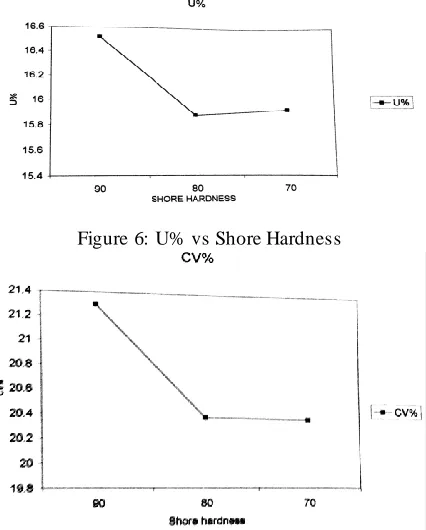
Figure 6: U% vs Shore Hardness
IJIRT 146992
INTERNATIONAL JO URNAL OF INNOVATIVE RESEARCH IN TECHNOLOGY719
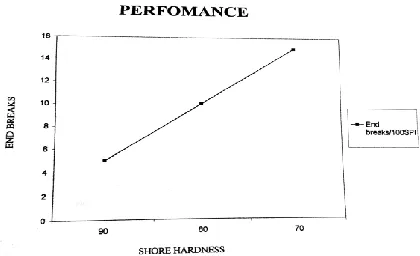
Figure 8: Performance of Spinning of Shore HardnessFigure 9: Comparison of Thin Places (-30%)
Figure 10: Comparison of Thin Places (+35%)
V.CONCLUSION
Softer cots of 700Shore hardness give substantial improvement in quality of yarn. The unevenness and imperfections/km are reduced. Also the strength of yarn is 1.5% to 2% increased. However, the performance of the ring frame with softer cots is not so good compared to its performance with harder cots.
The reason is that the softer cots have less forwarding action offibers. So, roller lapping occurs which results in more end breaks and higher waste.
Harder cots of 90 degree Shore hardness do not produce quality yarns as the softer cots. There is also loss in strength in case of harder cots. But an end break at ring frame is reduced.
By using cots of 80 degree shore hardness, the quality of yarn is better than harder cot and performance is also good, waste produced is less. So 8o0cots can be used for optimum result.
REFERENCES
[1] T.V.Ratnam,K.N.Seshan,K.P.Chellamani,
S.Karthikeyan:Quality Control in Spinning; The South India Textile Research Association –1994 [2] W.Klein :A Practical Guide to Opening and
Carding: The Textile Institute—1987.
[3] W.Klein :A Practical Guide to Ring Spinning: The Textile Institute.1987.
[4] W. Klein: The Technology of Short Staple Spinning: The Textile Institute, printed in England by Latimer Trend & co ltd , Plymouth
[5] W. Klein: A Practical Guide to Combing and Drawing: The Textile Institute, printed in England by Latimer Trend & co ltd , Plymouth.
[6] R.V. MahendraGowda : New Spinning
system:NCUTE,setup by Ministry of Textile, Govt. of India, IIT Delhi –2003.
[7] R.Chattopadhyay: Advances in Technology of
Yarn Prodution: NCUTE Publication –2002.
[8] R.S. Rengasamy: Mechanics of Spinning
Machines: NCUTE, setup by Ministry of Textile, Govt. of India, IIT Delhi –2002.
[9] R.W.MONCRIEFF: Man- made fibres:
IJIRT 146992
INTERNATIONAL JO URNAL OF INNOVATIVE RESEARCH IN TECHNOLOGY720
[10]A.Venkatasubramani, : Spun Yarn TechnologyVolume III.: Saravana Publication Madurai— 1994.
[11]A.Venkatasubramani,:SpunYarnTechnology
Volume II.:Saravana Publication ,Madurai-1988.
[12]SITRA,Coimbatore:Quality control in
Spinning—1994.
[13]R.Chattopadhyay: Advances in Technology of
Yarn Production:NCUTE Publication, setup by Ministry of Textile, Govt. of India, IIT Delhi – 2002.
[14]R.S. Rengasamy: Mechanics of Spinning
Machines:NCUTEPublication,setup by
Ministry of Textile, Govt. of India, IIT Delhi – 2002.
[15]R.Chattopadhyay:TechnologyofCarding:NCUTE