Vivek Aggarwal et al, IJSRR 2019, 8(2), 1908-1918
IJSRR, 8(2) April. – June., 2019 Page 1908
Research article Available online www.ijsrr.org
ISSN: 2279–0543
International Journal of Scientific Research and Reviews
To Study the Effect on the Hardness and Microstructural Behaviour of
3 Different Tool Materials En-31, En-8 and D-3after Heat Treatment
Vivek Aggarwal
*1, Tarish Mittal
2and Onkar Singh
31*
Assistant Professor, Department of Mechanical Engineering, IKGPTU, Main Campus, Kapurthala 2
H.O.D, MechanicalEngineering Department, LLRIET, Moga 3
M.Tech. Student, Mechanical Engineering Department, LLRIET, Moga
ABSTRACT
This Study is based upon the experimentalwork which means it is derived from practicaland
observations ratherthan theory. Theobjective is to study the effect on the hardness of three Sample
Grades of Tool Steel i.e. EN -31, EN-8, and D3 after heat treatment processes such as Annealing,
Normalizing, Hardening and Tempering. Literature review shows the lack of research in specific
field and helps to design the survey focusing on the heat treatment performance Index HTPI 2012.
Industrial survey has been carried out in form of questioner at Ludhiana to develop the experimental
setup and to select the various parameters such as techniques, time and cost. Material and heat
treatment processes have been selected on the basis of survey; various mechanical and chemical
analysis, such as Composition testing of tools, are performed before the heat treatment. After heat
treatment, hardness test has been carried out with treated and untreated work samples.
KEYWORDS
: Annealing, Normalizing, Hardening, Tempering.*Corresponding author:
Vivek Aggarwal
Assistant Professor,
Department of Mechanical Engineering,
Vivek Aggarwal et al, IJSRR 2019, 8(2), 1908-1918
IJSRR, 8(2) April. – June., 2019 Page 1909
I. INTRODUCTION
Heat Treatment is the controlled heating and cooling ofmetals to alter their physical and
mechanical properties without changing the product shape. Heat treatment is sometimes done in
advertently due to manufacturing processes that either heat or cool the metal such as welding or
forming. Heat Treatment is often associated with increasing the strength and other properties of
material, but it can also be used to alter certain manufacturability objectives such as improve
machining, formability, restore ductility after a cold working operation. Thus it is a very enabling
manufacturing process that can not only help other manufacturing process, but can also improve
product performance by increasing strength or other desirable characteristics.
Thus, the main aim of heat treatment operations is to control the properties of a metal or alloy
through the alternation of structure of metal or alloy. The purposes of the various heat treatment
operations are as given below:
To refine or relieve strains or stresses is induced by cold working (drawing, bending and
more) or non-uniform cooling of worm material for example. welding: Annealing
To increase power or hardness of the material for improved wear resistance: Hardening.
To upgrade machinability : Annealing
To soften the material: Annealing
To reduce hardness and increase ductility and toughness to with high impact.
To refine the cutting and bending properties of tools.
To change the physical properties of material for example electrical
properties, magnetic
Properties are corrosion resistance and heat resistance etc.
II.
RESEARCH BACKGROUND
2.1. Literature Review
Literature has been collected from numerous journals, books and papers; and has been
reviewed some facts. Steels are mostly suitable for heat treatment, since they respond well to heat
treatment. The commercial use of steels exceeds that of any other kind of material. Steels are heat
treated for one of the some reasons as explained in following:
1. Softening
2. Hardening
Vivek Aggarwal et al, IJSRR 2019, 8(2), 1908-1918
IJSRR, 8(2) April. – June., 2019 Page 1910
1.Softening: The properties, such as strength or hardness, remove residual stresses, improve
toughness, restore ductility, refine grain size, or change the electromagnetic properties have been
reduced by softening. Restoring ductility or removing residual stresses is aessentialprocess when a
large amount of cold working is to be executed, such as in a cold-rolling operation or wiredrawing,
Annealing, Normalizing and tempering Austempering, Martempering are the principal ways by
which steel is softened. It is also decrease to their strength and hardness.
2. Hardening: The strength and wear properties could be increased by hardening. One of the
fundamentals for hardening is sufficient carbon and alloy content. If there is sufficient Carbon
content, the steel will be directly hardened. Otherwise the surface of the part has to be Carbon
supplemented using some diffusion treatment hardening techniques.
3. Material Modification: Heat treatment is used to modify properties of materials instead of
hardening and softening. These processes modify the performance of the steels in a beneficial
manner to maximize service life, e.g., stress relieving, or strength properties, e.g., cryogenic
treatment, or some other desirable assets, e.g., spring aging. This makes the matrix richer in carbon
and alloying elements with the hardness finally achieved depending mainly on the amount of carbon
dissolved. The alloying elements mostly regulate the speed at which the steel must be quenched and
the depth of hardness achieved in it.
Quenching consists of cooling the heated work piece rapidly by immersing it in a liquid, surrounding
it with gas or air, or submerging it in a fluidized bed to keep the carbon in solid solution in the
harden.
Tempering consists of reheating the quenched steel one or more times to a lower temperature, 150 to
650 °C., and cooling it again to cultivate the desired levels of ductility and toughness.
Steel in the annealed condition is soft and ductile; and has low tensile strength.
At hardening temperature the steel is identical soft and has very low tensile strength.
Structure: Austenite + residual Carbides Later quenching the steel is hard and brittle.
Structure: Martensitic (highly stressed) + other transformation products + soft retained
Austenite + residual Carbides.
After Temper 1 the steel is hard but tougher Structure: Tempered (less stressed) Martensitic,
+ highly stressed un-tempered. Martensite or other transformation products + small quantity
of retained Austenite + residual carbides
After Temper 2 the toughness is further increased (best impact strength) Structure: tempered
Vivek Aggarwal et al, IJSRR 2019, 8(2), 1908-1918
IJSRR, 8(2) April. – June., 2019 Page 1911 Heat treatment is a combination of scheduled heating and cooling applied to a particular
metal or alloy in the solid state in such ways as to produce certainmicrostructure and preferred
mechanical properties such as hardness, toughness, yield strength, ultimate tensile strength, Young’s
modulus, percentage elongation and percentage reduction. Annealing, normalizing, hardening and
tempering are the most significant heat treatments often used to modify the microstructure and
mechanical properties of engineering materials particularly steels. Hardening is the most conjoint
heat treatment applied to tool steels. It consists of following three operations:
1. Heating
2. Quenching
3. Tempering.
III. MATERIALS AND METHODS
3.1 Empirical Approach
Empirical Approach means resulting from experiment and observation rather than theory.
Step 1 Literature Gap analysis & ConductingIndustrial Survey for the selection of Tool Steel Grades
for experiment & Index preparation of objective function
Step 2 Cutting and Grinding of Specimens
Step 3 Composition testing of Untreated Tool Steeli.e. EN-31, EN-8, and D3
Step 4 Heat Treatment Processes Such As Annealing,Normalizing, and Hardening & Tempering of
Tool Steels i.e. EN-31, EN-8, and D3.
Step 5 Hardness Testing of Untreated & Treated ToolSteel i.e. EN-31, EN-8, and D3
3.2 Experimental Procedure
Step 1
Literature Gap analysis & Conducting Industrial Survey for the selection of Tool Steel
Grades for experiment & Index preparation of objective function Literature Gap study has been
collected by referring various journals, books, papers etc. for the purpose of the Selection of tool
steels grades material on and work piece material on which lesser study will be carried out. Another
objective selection of Place where to Perform Experiment, Market availability of the recommended
tool steel & their Cost Analysis, Time Analysis to complete the experiment etc. The purpose of
Selecting Tool Steel is that they are Mostly Used in the Manufacturing Industry. Tool Steel Grades
like EN-31, EN-8 and D-3 is selected for project. These steel grades were suggested to be the best
during Surveying Numerous Industries for that objective we designed an industrial based questioner.
Vivek Aggarwal et al, IJSRR 2019, 8(2), 1908-1918
IJSRR, 8(2) April. – June., 2019 Page 1912 between selected Parameters after Heat Treatment. These Materials are purchased From Material
Shop of C.T.R Ludhiana. For defining the main objective of study to be carried out more effectively
and specific we designed Heat Treatment Performance Index HTPI 2012.
Step 2
Cutting and Grinding of Specimens Sample Mark: EN-31, EN-8, and D3 Instrument Used:
Power Hack saw & Grinding Machine Units of Sample Prepared: Six for each material for different
objectives there was a Requirement for 6 Samples of Each Material for the Treatment and Testing
Purpose. So we cut the Samples Using Power Hack-Saw .All the Samples are 20mm in Diameter and
2.5" to 3.5" in length. Chamfering was done using Bench Grinder.During Chamfering we also
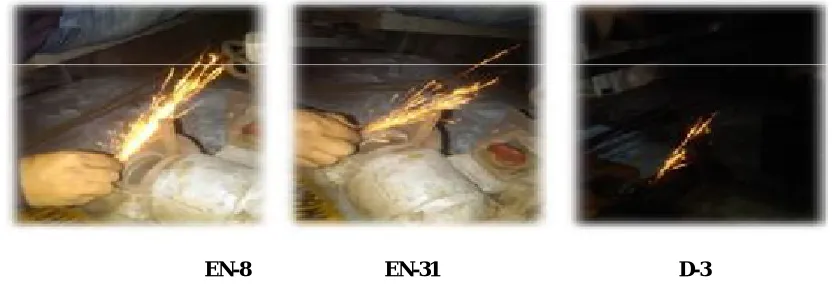
Performed Spark Testing of the material which is commonly used in the Industries to analyze
Different Material on the basis of the Intensity of Spark Produced and Flowers evolved during Spark
Testing. Figure Below shows the three Material undergoing Spark testing.
EN-8 EN-31 D-3
Fig 1. Pictorial View of Spark Testing for Various Materials
Step 3
Composition testing of Untreated Tool Steel i.e. EN-31, EN-8, and D3 Chemical
Composition is Important Testing for making sure that the Chemical Composition of the Purchased
Material Matches with that of the International Standards of Materials. This Testing is done By
Using the Glow Discharge Spectrometer. Surface finishing of Single Sample of Each material is
done on the Belt Grinding Machine of 100Grit Belt. After Grinding giving the material a good
Surface finish Sample EN-8 is inserted in the Machine. The Machine Holds the Material by Vacuum
Holder of the machine .Then the Door is closed for further Operation to be performed on the material
and command is given to the Specific Software on the Computer. This is done by using the glow
discharge method, experimental material is uniformly sputtered Spit up in an explosive manner from
the surface.
Vivek Aggarwal et al, IJSRR 2019, 8(2), 1908-1918
IJSRR, 8(2) April. – June., 2019 Page 1913
SampleMark: EN-31, EN-8, and D3
Instrument Used:Glow Discharge SpectrometerIt takes about 5-6 minutes for the chemical
composition testing of a single material. The readings of the test are shown on the Display of
Computer in Tabulated Form. It Shows the Percentage Composition of Each Element .After Testing
Chemical Composition of the material, the valuesCompared with that of Values as per International
Standards. The Testing of a Single Sample is done 2-4 times from Different point on the smooth
surface of the sample. The same Procedure for chemical testing is also done for EN-31 and D-3 also.
The figure below show the Specimen where the Chemical Composition Testing is done leaving
behind the impact of Argon Gas used at the time of testing. We can see three marks which states that
Testing is Performed 3 times on the Material. Step 4 Heat Treatment Processes Such As Annealing,
Normalizing, and Hardening & Tempering of Tool Steels i.e. EN-31, EN-8, and D3
Place of Experiment: Central Tool Room, Ludhiana
Heat treatment process: Annealing [A],Normalizing [N] and Hardening & Tempering [H&T].
Sample Mark: EN-31, EN-8, and D3
Instrument Used: Muffle Furnace [for EN-8] &Fulmina Furnace [for EN-31 & D-3]
Step 5 Hardness Testing of Untreated& Treated Tool Steel i.e. EN-8, EN-31, and D3
Place of Experiment: Central Tool Room, Ludhiana
Type of Sample: Round Piece, Material EN-8, EN-31, D3
Sample mark 1: Untreated Material EN-31, EN-8, and D3
Type ofSample: Round Piece, Material EN-31
Sample Mark 2: Annealing [A], Normalizing [N] andHardening & Tempering [H&T].
Type of Sample: Round Piece, Material EN-8
Sample Mark 2: Annealing [A], Normalizing [N] and Hardening & Tempering [H&T].
Type of Sample: Round Piece, Material D-3
Sample Mark 2: Annealing [A], Normalizing [N] and Hardening & Tempering [H&T].
Instrument Used: Rockwell hardness tester Steel Hardness Calculator Used for Conversion of
Values. Using that, we calculated HRB value & Brinell Hardness HB, Vickers HV.
IV. RESULTS AND DISCUSSION
Vivek Aggarwal et al, IJSRR 2019, 8(2), 1908-1918
IJSRR, 8(2) April. – June., 2019 Page 1914
Table 1. Composition of Tool Steel as per AISI Standard
Table 2 Composition of Tool Steel after Composition Testing using Glow Discharge Spectrometer
Table 3 Heat Treatment Conditions for Annealing Process for Tool Steel i.e. EN-31, EN-8, and D3
Materials Annealing Temp. Soaking Time
EN-8 800 2 hour
EN-31 800 2 hour
D-3 820 2 hour
Table 4 Heat Treatment Conditions for Normalizing Process for Tool Steel i.e. EN-31, EN-8, and D-3.
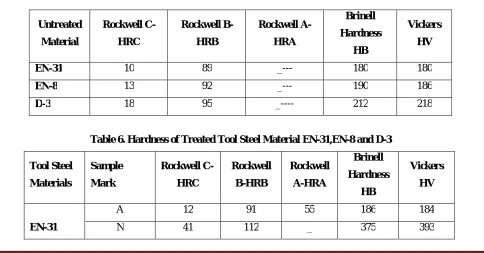
Table 5.Hardness of Untreated Tool SteelMaterial EN-31, EN-8, and D3.
Table 6. Hardness of Treated Tool Steel Material EN-31,EN-8 and D-3
Tool Steel Materials Sample Mark Rockwell C- HRC Rockwell B-HRB Rockwell A-HRA Brinell Hardness HB Vickers HV EN-31
A 12 91 55 186 184
N 41 112 _ 375 393
Mark C% Si% Mn% P% S% Cr%
En-31 1.00 0.20 0.50 0.024 0.20 1.40
En-8 0.40 0.25 0.80 0.015 0.015 ---
D-3 2.10 0.30 0.40 0.021 0.30 11.50
Mark C% Si% Mn% P% S% Cr%
En-31 1.30 0.30 0.50 0.024 0.025 1.40
En-8 0.45 0.32 0.8 0.05 0.05 ---
D-3 2.10 0.65 0.45 0.021 0.03 11.50
Material Annealing Time Temp Soaking Time Cooling Medium
EN-8 880 1/2 hour In air
EN-31 930 1/2 hour In air
D-3 900 1/2 hour In air
Untreated Material Rockwell C-HRC Rockwell B-HRB Rockwell A-HRA Brinell Hardness HB Vickers HV
EN-31 10 89 _--- 180 180
EN-8 13 92 _--- 190 186
Vivek Aggarwal et al, IJSRR 2019, 8(2), 1908-1918
IJSRR, 8(2) April. – June., 2019 Page 1915
H & T 55 0 _ 552 649
EN-8
A 9 88 54 178 178
N 25 101 _ 250 255
H&T 48 116 _ 456 490
D-3
A 23 100 _ 240 247
N 55 0 _ 552 649
H& T 56 0 _ 572 694
Annealing: After annealing value of hardness ofspecimen is 55 HRC as compared to untreated
specimen annealed work specimen becomes softer. Therefore specimen machine-ability properties
increase. We used HRA scale because after annealing EN-31 becomes soft and below 20 HRC value
HRC scale is not gives the accurate value and as well as value is not valid.
Normalizing: After normalizing hardness is 40 HRCgiven result on Rockwell testing machine. It
shows after the normalizing the specimen becomes harder then annealing specimen .this is due to
formation of Bainite & Martensite.
Hardening and Tempering: After H&T treatmentspecimen hardness is 55 HRC it shows H&T
treatment makes hardest then other two treatments.That means experimental material has more wear
and tear as compared two other two heat treatments.
Comparison: Afterward annealing specimen becomesmore softer then untreated specimen as
hardness value shown.After normalizing hardness is more as compared to untreated specimen. After
hardening and tempering specimen are hardest then other three specimens (Conclusion for EN-8)
Before treatment EN-8 hardness value is 10 HRC.Hardness of untreated material is less due to low
carbon percentage in EN-8. After done the three treatments
Annealing: After annealing value of hardness ofexperimental specimen is 55 HRA as compared to
untreated specimen annealed specimen becomes softer. So machine-ability properties of specimen
increase due to annealing we used HRA scale because after annealing EN-8 becomes soft and below
20 HRC. Value HRC scale is not gives the accurate value and also not valid.
Normalizing: After normalizing hardness is 25 HRCgiven on Rockwell testing machine.It shows
after the normalizing the specimen becomes harder thanannealing specimen .this is due to formation
of pearlite is more as compared to ferrite.
Hardening and Tempering: After H&T treatmentspecimen hardness is 48 HRC it shows H&T
treatment makes hardest then other two treatments. This means material has more tear and wear as
compared two other two heat treatments.
Comparison: After annealing specimen becomesmore softer then untreated experimental specimen
Vivek Aggarwal et al, IJSRR 2019, 8(2), 1908-1918
IJSRR, 8(2) April. – June., 2019 Page 1916 After hardening and tempering specimen arehardest then other three specimens due to formation of
fine tempered martensite. Conclusion for D-3
Before treatment D-3 hardness value is 13 HRC hardness of untreated material is less. After done
three treatments
Annealing: After annealing value of hardness ofexperimental specimen is 23 HRC.As compared to
untreated specimen annealed specimen becomes harder. This is due to formation of carbide particles.
Normalizing: After normalizing hardness is 55 HRCgiven on Rockwell testing machine. It shows
after the normalizing the specimen becomes harder then annealing specimen .This is due to
formation of greater no. of Un-dissolved carbide particles so specimen becomes brittle.
Hardening and Tempering: After H&T treatmentspecimen hardness is 56 HRC. It shows H&T
treatment and normalizing have same hardness value. But we cannot use normalizing due improper
microstructure. But in case of H&T hardness value is same but specimen consists of dissolved
carbide particles. This means material has more corrosion resistance and hardness as compared two
other heat treatments.
Comparison: After annealing specimen becomesmore harder then untreated specimen. After
annealing hardness is more as compared to untreated specimen. But specimen has not obtained good
microstructure. After hardening and tempering specimen are hardest then other three specimens also
having a good corrosion resistance.
CONCLUSIONS
Literature gap analysis & industrial survey conduction are found to be very useful approach
forselection of tool steel grade which will more beneficial for industrial point of view. From the
literature review, it is observed that less research work has been seen for Tool Steel materials i.e.
EN-31, EN-8, and D3 after Heat Treatment Processes Such As Annealing, Normalizing, and
Hardening & Tempering. Also less work has been reported for AISI D3 Die Steel. It is observed that
the effect of hardness of work piece material after treatment of Tool Steel i.e. EN-31, EN-8, and D3
have not been explored yet, so it‘s interesting to Study the Effect on the Hardness of three Sample
Grades of Tool Steel i.e. EN-31, EN-8, and D3 after Heat Treatment Processes Such As Annealing,
Normalizing, and Hardening & Tempering. All these aspects will be addressed in research work.
Indexing of HTPI 2012 is found to be effective to defined objective function.After annealing
specimen of EN-31 becomes more softer then untreated specimen as hardness value shown. After
normalizing hardness is more as compared to untreated specimen. After hardening and tempering
Vivek Aggarwal et al, IJSRR 2019, 8(2), 1908-1918
IJSRR, 8(2) April. – June., 2019 Page 1917 After annealing specimen of EN-8 becomes more softer then untreated experimental specimen as
hardness value shown. After normalizing hardness is more as compared to untreated specimen. After
hardening and tempering specimen are hardest then other three specimens due to formation of fine
tempered martensite. After annealing specimen of D-3 becomes more harder then untreated
specimen. After annealing hardness is more as compared to untreated specimen. But specimen has
not obtained good microstructure. After hardening and tempering specimen are hardest then other
three specimens also having a good corrosion resistance.Future Aspects of this study to carry out
further is wider. Choosing of different tool steel material and compare them the effects on their
mechanical properties. Recommended material for further work done to be carried out for similar
study D-2, mild steel, HC HCR cold working tool steel grades as so many. HSS found to be very tool
steel grade difficult for such study as per investigation form industrial survey. Using Different
analytical approaches is also making an effective outcome which is also recommended.
REFERENCES
1. Fadare D.A.,Fadara T.G. and Akanbi O.Y.” Effect of Heat Treatment on Mechanical
Properties and Microstructure of NST 37-2 Steel “, Journal of Minerals & Materials
Characterization & Engineering, 2011; 10(3): 299-308.
2. Harish S., Bensely A., Lal D. Mohan, Rajadurai A. and Gyöngyvér B. Lenkey”
Microstructural study Of cryogenically treated En 31 bearing steel” Journal of Material
Processing Technology, 2008; 209.
3. Leskovsek V, Sustarsic B and Jutrisa G” The influence of austenitizing and tempering
temperature on the hardness and fracture toughness of hot-worked H11 tool steel” Journal of
Material Processing Technology, 2006; 178-185.
4. Romesh C Sharmaet. Al.” principles of heat treatment of steels”New Age International
Publishers, 2008; 401-409
5. ASM International ” ASM Handbook: Heat Treatment” American Society for Metals Park,
Ohio. 1991; 4: 210-220
6. ASTM E23” Standard Test Method for Izod Bar Impact Testing of Metallic Materials”
American Society of Testing and Materials, 2008; 409-434
7. Jokhio, M.H., “Effect of Retained Austenite on Abrasive Wear Resistance of Carburised SAE
8822H Steel.”Mehran University of Engineering and Technology, Jamshoro 1991;319-325.
8. Charkrabarti, A.K. and Das,.”Kinectics of Second stage graphitization in Quenched Alloy
Vivek Aggarwal et al, IJSRR 2019, 8(2), 1908-1918
IJSRR, 8(2) April. – June., 2019 Page 1918
9. Charkrabarti, A.K. and Das P” Tempering Characteristic of Quenched Alloy Spheroid
Graphite Cast Iron” Journal of British Foundry man, 1988; 67: 330- 334.
10.Properties and Microstructure of NST 37-2 “Steel‖, Journal of Minerals & Materials
Characterization & Engineering” 10(3): 299-308.
11. Dieter G.E. Jr.,” Mechanical Metallurgy” 2nd edition, Metallurgy and
MetallurgicalEngineering Series, Tata McGraw-Hill 1976; 2: 34-84
12. Ebner R., Leitner H., Jeglitsch F. and Caliskanoglu D., “Methods of property oriented tool
steel design”5th International Conference on Tooling, Leoben, University of Leoben, Austria,