96 Abstract— Dynamic Spectrum Allocation (DSA) is one of the latest technologies serving to cater to rising demand of spectra. Since a decade, cognitive radios (CR) are looked upon as a solution to increase spectral efficiency. However, to make CR a reality, development of air interface is a big challenge. In this paper, we have proposed a CR architecture followed by its equivalent mathematical model. We consider a centralized network where the master/controller of this ad-hoc network coordinates for spectrum allocation with the surrounding CR in the network. This CR ad-hoc network is assumed to coexist with the network of licensed users where the controller of licensed users is updated with CR coordinating engine. The mathematical model is formed of two Markovian distributed queues. One of these queues is modeled as M/M/1 and the second as M/G/S/N. Mathematical analysis of our proposal is focused to evaluate bandwidth access latency of an unlicensed user.
Index Terms—access latency, arrival rate, blocking probability, cognitive radio, dynamic spectrum allocation, opportunistic spectrum access, traffic intensities
I. INTRODUCTION
In the present scenario, a service provider or user needs to obtain spectrum usage license from the respective government / regulatory body to be able to transmit and receive in the desired band. Thus, the spectrum is distributed on mutually exclusive / non shared basis. This way of spectrum distribution is called fixed spectrum assignment and the licensed users as primary user (PU). However, the fixed assignment of spectrum cannot fulfill the increasing demands of ever rising number of service providers, applications and the users. As per the observations of federal communication commission (FCC) of USA [1], many of the frequency bands are unoccupied most of the times. This underutilization of spectrum motivated the researchers to think in terms of utilizing the unused band of PU called spectrum holes, to be used by the unlicensed users, called secondary users (SU).
Manuscript received December 12, 2010.
This paper was adjudged as best in ICINC Conference, 24-26 November, 2010, Malaysia. and committee decided to publish it in IJET journal.
Prabhjot Kaur is with EECE Department, ITM University, Sector 23 A, Gurgaon, India 122017. (phone:999-977-7516; e-mail: [email protected], [email protected] ).
Arun Khosla is with the Electronics and communication Department, Dr. B. R. Ambedkar National Institute of Technology, Jalandhar, Punjab, India ( email: [email protected] )
Moin Uddian is Pro-Vice Chancellor of Delhi Technical University, Shadbad Daulatpur, Bawana Road, Delhi-42, India.. (e-mail: [email protected] ).
J. Mitola [2] at first introduced a device called CR that utilizes spectrum holes to communicate wherever and whenever needed, thus increasing spectrum utilization efficiency. CR is built upon software defined radio (SDR) platform to support reconfigurability to different physical layer attributes [3].
The efforts for standardizing the air interface for CR is on going and first draft for the standard IEEE 1900.4 is already available [4]. Another standard being developed is IEEE 802.22 based on underutilized frequencies in TV band [5]. Main focus among all such standards and other research efforts is to enable CR to sense the spectrum holes effectively, communicate as per requirement without causing interference to PU and to increase spectrum utilization efficiency. The information of spectrum holes detected by an SU in its surroundings at any particular time is shared with the master controller in case of a centralized network, or with other SU in case of a decentralized network. However, a centralized network eliminates hidden terminal problem, provides better coverage and an efficient spectrum handover scheme. Apart from these, ease in billing, maintenance of unused frequencies and saving of battery backup of SU are some additional advantages that motivated us to select a centralized network for cognitive radio network (CRN) operations. For the ongoing efforts of standardizing the CR operations in TV broadcast bands, the working group of upcoming standard IEEE 802.22 [5] is also in the process of standardizing centralized protocols. The time varying channel availability that is not present in the conventional wireless networks, imposes new challenges in designing such protocols. The lack of spectra for fixed assignment technique has motivated dynamic spectrum access technique to satisfy increasing number of applications, subscribers and service providers in the wireless market. Using DSA, spectrum is exclusively allotted to users in a particular region and particular time. How much is to be allocated depends on the spatial and temporal statistics of traffic for different services. The switching between frequencies allotment is targeted to be fast in order to improve the spectrum efficiency. Thus, the use of frequency allocated is for particular service or application only where the flexibility of usage is not given to the assignee. Thus, there is a need to device new strategies for medium access control (MAC) for unlicensed users.
Recently, many attempts have been made to develop MAC protocols for CRN. A dynamic spectrum access protocol (DSAP) is proposed that enables lease-based dynamic spectrum access through a central coordinating entity called DSAP server [6]. However, a complete protocol specification,
Markovian Queuing Model for Dynamic
Spectrum Allocation in Centralized Architecture
for Cognitive Radios
97 SU sensing and coordination with DSAP server is not included. Mohammad M. Rashid et all [7], considered an opportunistic channel allocation scheme in order to allocate available channels among SUs and proposed an admission controller to maintain the given QoS. A spectrum-aware MAC protocol for CRN (CMAC) was proposed by Y. Yuan et all [8]. CMAC enables opportunistic access and sharing of the available white spaces in the TV spectrum by adaptively allocating the spectrum among contending users. Another protocol is a distributed cognitive radio MAC (COMAC) developed by Haythem A. Bany Salameh et all [9] that enables unlicensed users to dynamically utilize the spectrum while limiting the interference on primary (PR) users.
Our model is unique in sense that to the best of our knowledge, this is the first model based on distributed Markovian queuing for CRN. In this paper we propose a centralized MAC model based on DSA for CRN and develop an analytical framework for evaluating the performance of SUs by studying the queuing statistics of its packets. An interesting feature of our model is its adaptability for both infrastructure based and infrastructure-less centralized networks. A record of spectra and its allocation to intended users is to be performed by the master or cluster head [10,11] and by the fixed controller or base station (BS) in infrastructure-less and infrastructure based networks respectively. The proposed MAC scheme is analyzed using distributed Markovian queuing network model where one of the two distributed queues is modeled as M/M/1 queue and the other as a semi Markovian M/G/S/N queue. Access latency for the SU is evaluated as QoS parameter of the proposal.
The rest of this paper is organized as follows. In section II, we brief the concept of CR and DSA. Section III presents the system architecture of our proposed system. An equivalent queuing model of the proposed scheme is formulated in section IV. Mathematical analysis of the proposed model is given in section V. Access latency is considered as evaluation metric of our scheme. The analytical results are discussed in section VI indicating blocking probability, access latency for SU for varying blocking probabilities and increasing SU traffic. The paper concludes with section VII with the future scope of this work.
II. BACKGROUND
A. Cognitive Radio
In this technology to increase spectral efficiency in wireless communication, either a network or a wireless node changes its transmission or reception parameters to communicate efficiently avoiding interference with licensed or unlicensed users. This requires active monitoring of several factors in the external and internal radio environment, such as radio frequency spectrum, user behavior and network state.
A CR can reliably sense wide bandwidth, detect spectrum holes and use these holes for communication as and when required only if it does not interfere with PU. CR in this context is also referred to as an SU. The air interface for CR is based on following four main procedures [5]:
Spectrum sensing: detection of spectrum holes with the help of spectrum sensing techniques as transmitter detection, interference based detection, and cooperative detection.
Spectrum management: acquiring the best available spectrum to meet user communication requirements. The function includes spectrum analysis and then selecting the band according to user requirements.
Spectrum mobility: mobility occurs when CR changes its frequency band upon detection of PU signal. CR needs to switch to another frequency, maintaining seamless communication requirements during the transition to better spectrum.
Spectrum sharing: once a CR knows its transmitting frequency, it informs its receiver about the band chosen. Besides, a fair spectrum scheduling method is to be provided. It can be regarded to be similar to generic MAC problems in existing systems.
CR was initially thought to be an extension of SDR but most of the work now is moving towards utilizing TV bands because of underutilized spectrum as discussed earlier.
B. Dynamic Spectrum Allocation
Dynamic Channel Allocation Scheme involves the conception of algorithms which allows a particular channel to be allocated to any user at any given time on the basis of various factors such as the availability of primary channel, likelihood of future blocking within the secondary cell, the frequency use of the candidate channel, the reuse distance of the channel, time stamp, type of service required. Unlike fixed channel allocation (FCA) scheme, which requires tedious manual planning of channel distribution as well as does not cater to the needs of varying traffic volumes, DCA scheme aims at better utilization of spectrum resources.
For FCA, If the total number of available channels in the system is divided into S sets, the minimum number of channel sets N required to serve the entire coverage area is related to the frequency reuse distance D as follows:
/3
where R is cell radius. Due to short term fluctuations in the traffic, FCA schemes are often not able to maintain high quality of service and capacity attainable with static traffic demands.
In DCA schemes, all channels are kept in a central pool and are assigned dynamically to new calls as they arrive in the system. After each call is completed, the channel is returned to the central pool. It is fairly straightforward to select the most appropriate channel for any call based simply on current allocation and current traffic, with the aim of minimizing the interference.
98 this proposal and is also referred to as opportunistic spectrum access (OSA). OSA has three basic components: opportunity
Figure 1. Cognitive Radio Network Architecture
identification, opportunity exploitation and regulatory policy as briefly described below.
C. Spectrum Opportunity Identification:
SU scans the complete operating frequency range and detects instantaneous unoccupied frequencies of all PU in the network. These unoccupied frequencies are spectrum opportunities for a SU. Spectrum opportunity is determined by the activeness of PU, location of SU transmitter and also the location of SU receiver. In general, opportunity identification is done at physical layer. A spectrum sensing strategy may be designed to detect spectrum opportunity and to maintain sensing statistics to be used in future.
D. Spectrum Opportunity Exploitation
Once the spectrum opportunity is detected, this technique exploits what and how to access. SU decides how much it can rely upon its detectors. Based on error probability of detector, it decides its transmission power, modulation scheme and spectrum sharing strategy.
E. Regulatory Policy
All SU share their detected opportunity among each other in decentralized network or with their BS in case of a centralized network. A policy governs the rules of such cooperation and plays an important role in coexistence of heterogeneous networks.
III. PROPOSED SYSTEM
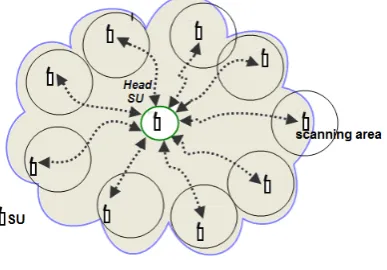
We propose to follow a centralized architecture with a central controller responsible to allocate bandwidth to intended users. However, the sensing is considered to be decentralized in order to overcome hidden terminal problem and to obtain complete database of unoccupied frequencies. Unoccupied frequency band is also termed as a spectrum hole. Under our proposal, each SU is considered to consist of two transceivers: one dedicated for control and second a software defined radio (SDR) based. The SDR based transceiver scans the availability of spectra in its vicinity and forwards the information of these spectrum holes to the master/controller in case the SUs form an infrastructure less network or to the BS in case of infrastructure based network. This master or controller of the network may appropriately be chosen from amongst the active SU at a particular time. For simplicity, we call this master/controller/BS as Head SU as shown in figure
1a. Head SU receives the information of the
Figure 2. Queuing Model for DSA in CR Network
spectrum holes in the scanning area of each SU as shown in fig 1b along with the frequencies being used by the PU in its own vicinity. Thus, the head SU has the complete record of occupied and unoccupied frequency bands at any given time in the network.
Based on the availability of the number of unoccupied channels with the head, the bandwidth is allocated to the SU. To protect the rights of PU over its licensed channels, the Head vacates or instructs the SU to vacate the intended band as and when required by the PU. An alternate frequency may be allocated to SU in case available with Head. A jugglery scheme of frequency allocations may be followed at Head for dynamic allocation as is done in case of most of the cellular base stations.
A. Formulation of the Queuing Model
The equivalent model of network of queues for the system proposed in previous section is as shown in figure 2.
These queues are special cases of stochastic processes, characterized by an arrival process of service requests, a waiting list of requests to be processed, queuing discipline i.e. the manner the requests are selected to be served and a service process. The queue stacking all entries of SUs is referred as a secondary users queue (SUQ) and all the requests entering this queue are served on first come first serve (FCFS) basis. At any time when bandwidth needs be allocated to the SU, the Head considers both the requests from SU and the PU who need its licensed channel. Thus while distributing number of frequencies to PU and SU, the arrival rates of both the users are summed to access the frequencies with the Head. The queue so formed is referred to as bandwidth allocation queue (BAQ).
B. Basic Assumptions
The analysis is based on some basic assumptions. The message arrival process for both SUQ and BAQ are
considered poisson and independent with mean rates as
λ
1and
λ
2 respectively. SUQ has infinite capacity andexponentially distributed message service times with mean
rate
μ
1. Thus, SUQ is modeled as an M/M/1 queue where M99 future and past states are independent.
Formally,
Pr (Xn+1= x|X1= x1, X2=x2……,Xn= xn)=Pr(Xn+1= x|Xn= xn)
Hence we use Markov process to analyze the queuing models. The queue model maps with our assumption of infinite system capacity of SUQ and may include infinite SU population requesting to the system for bandwidth.
The Head is considered to have an access to a limited S number of channels with queuing capacity of N. Since different types of requests arrive at BAQ, the service rate is considered to be general. Thus, BAQ is modeled as an M/G/S/N loss queuing system. Here, G is for general distribution as there may be a variety of requests from both PU and SU entering to this system. S denotes the available unoccupied channels available with Head and N denotes limited BAQ capacity.
For simplicity, we consider a special case where queue size is same as the available number of channels in the system, i.e. S=N. With this consideration, the BAQ becomes an M/M/S/S queue.
C. Parameters used in Analysis
Customer Arrival Rate defines the number of customers enters into the system per unit time. Basically the customer arrives into the system as per Poisson process, that is, exponentially distributed inter-arrival times.
Customer Service time is number of customers the system serves per unit time when it is constantly busy.
Access Latency is defined as total time encountered by an SU request of bandwidth to Head in getting the access grant. We may say it’s the difference in the time a request enters into SUQ from the time it leaves BAQ.
Blocking Probability is the probability that an SU request will be denied. This happens when there are no more vacant channels with the Head SU and the intended users request is discarded.
IV. MODEL ANALYSIS
SUQ is of M/M/1 type. Under the assumption that the traffic intensity of this queue, ρ =1 λ1/μ1 is less than unity (i.e. <1Erlamg), SUQ becomes stable and the output process is still Poisson with mean rate
λ
1, due to Bruke’s theorem [13]. As we consider, the master to be updated with CR engine capabilities to handle bandwidth requests of both licensed as well as unlicensed users, independent Poisson processes with mean ratesλ
1 andλ
2 are summed at theinput of BAQ. Thus, total mean arrival rate at BAQ is
λ
=
(λ
1+
λ
2) and value of traffic intensity for BAQ is given by2
ρ
= (λ
1+
λ
2 ) E[X], where E[X] is the mean service duration for BAQ.The blocking probability PB for the bandwidth request
made by CR that finds all the channels with Head as occupied is given by the well known Erlang-B formula as given below:
∑
=
=
≡ s
o i
i s S
B
i S P P
!
! 2
2
ρ ρ
(1)
Figure 3. Blocking probability (PB) against SU utilization in the system (
ρ
1). The variation in PB is depicted with different numbers of channels(S), available with the system.
Let N1 and N2 denote mean number of messages in queues
SUQ and BAQ, respectively. According to the M/M/1 classical theory, we have for queue SUQ:
1 1 1
1
ρ
ρ
− = N
(2) According to M/M/S/S classical theory, we have for queue BAQ:
) 1 ( 2
2 PB
N =
ρ
− (3)Let T1 and T2 denote the mean delay experienced by a message in crossing SUQ and BAQ, respectively. From the little theorem we have:
1 1 1 λ
N
T =
and
] [ ) 1 )(
( 1 2
2
2 E X
P N T
B ≡ − + =
λ
λ (4)
To determine the total mean access delay, T, consider two different cases depending on the input of the message in our system as follows:
Case a. SU messages arriving at SUQ from outside the system.
Probability that these messages arrive at SUQ from outside the system is given as λ1/(λ1+λ2) with a mean message
delay TD1 given as:
TD1=
T
1+
(
1
−
P
B)
T
2Case b. PU messages arriving at CAQ from outside the system.
100 Figure 4. Mean access delay (T) against traffic intensity of SU (ρ1) at
different blocking probabilities while mean arrival rate at BAQ (λ) is fixed at 0.5 and the mean arrival rate of PU (λ2) is 0.2.
2 2
2
P
0
(
1
P
)
T
(
1
P
)
T
T
D=
B×
+
−
B=
−
BThus, T can be obtained as below:
[
]
[
2]
2 1
2 2
1 2 1
1 T (1 P )T (1 P )T
T B − B
+ + −
+ +
=
λ
λ
λ
λ
λ
λ
2 1
2 1
1 T (1 P )T B − + + =
λ
λ
λ
(5) By means of expressions of T1 and T2 using (4) and N1 and N2 using (2) and (3), we obtain the overall access latency, T as follows:
2 1
2 1 1
2 1
2 1
)
1
(
1
λ
λ
ρ
ρ
ρ
λ
λ
+
−
+
−
=
+
+
=
B
P
N
N
T
(6) The equation defines the overall delay encountered by any SU to access a channel for transmission of its own voice/data. Thus, T represents the time interval between the request initiated by the SU and the request granted the required bandwidth.
V. RESULTS
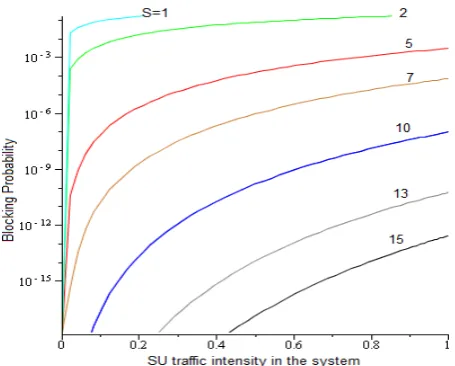
Blocking probability from equation (1) is plotted in figure 3. Variation in PB is shown with respect to change in number
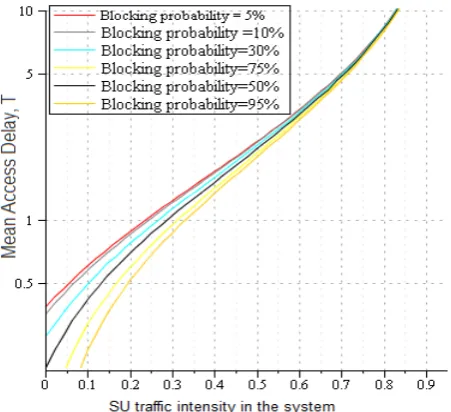
of available channels in the system as 2, 5, 7, 10, 13 and 15. Blocking probability increases with increase in SU traffic in the network as is known in standard. The analytical results corresponding to equation (6) for total access latency against traffic intensity of SU is plotted in Fig. 4 for variation in blocking probabilities as 5%, 10%, 30%, 50%, 75% and 95%, while the total mean arrival rate is fixed at 0.5 and the mean arrival rate of PU is 0.2. The plot shows that for any
Figure 5. Aaccess latency versus SU traffic intensity,
ρ
1, for different traffic intensities of BAQgiven blocking probability, T increases with increase in traffic intensity of SU while it decreases for an increase in the blocking probability. T seems to move sharply towards infinity for an increase in system utilization of SU beyond 0.5. Also, the access delay tends to merge to same values for increase in
ρ
1 beyond 0.8, irrespective of the value of blocking probability.As blocking probability PB << 1, neglecting it in equation
(6) and considering equal arrival rates for SU and PU as 0.5, we obtain another plot as shown in figure 5. The plot shows the variation in access delay with respect to the increase in traffic intensity of SU for different traffic intensities of BAQ as 0.2, 0.4, 0.6 and 0.8. The latency increases with the increase in the traffic intensities of SU. The delay also increases with increase in traffic intensity of BAQ.
VI. CONCLUSION AND FUTURE SCOPE
CR may be considered as a truly intelligent device capable of selecting its own band of operation and deciding for authorized or unauthorized access. With the introduction of CR concept to improve the spectrum utilization, DSA is the underlying promising approach for spectrum access. This work presented an analytical equivalence of DSA for CR coexisting with the licensed users. We proposed a centralized architecture coexisting with licensed users and formed its Markovian queuing model.
This work may further be extended for QoS evaluation in real time scenarios with a network of SU and PU comprising different traffic types. The work is being extended to design a more approximate model for CR DSA using priority queues. However, the real networks may tend to deviate from the results shown here due to the assumptions and approximations considered to simplify the analysis also due to the fact that real implementation of CR in its true sense will take few more years. Hence there may be many changes required as the researchers revile more technicalities of CR.
0 2 4 6 8 10
0.1 0.2 0.3 0.4 0.5 0.6 0.7 0.8 0.9
SU traffic intensity
A
c
c
e
s
s
La
te
nc
y
For traffic intensity of BAQ=0.2 For traffic intensity of BAQ=0.4 For traffic intensity of BAQ=0.6
101 REFERENCES
[1] Federal Communication Commission (FCC) ‘ Unlicensed operation in TV Broadcast Bands’, Notice for Proposed Rule Making, ET Docket No. 04-113, May 25, 2004.
[2] J. Mitola, ‘Cognitive radio: An integrated agent architecture for software defined radio’, PhD Dissertation, Royal Inst. Technol. (KTH), Stockholm, Sweden, 2000.
[3] Mitola, J., III; Maguire, G.Q., Jr. “Cognitive radio: making software radios more personal,” IEEE Personal Communications, Volume 6, Issue 4, Aug 1999 pp. 13 – 18.
[4] Hiroshi Harada , Stanislav Filin, “White Space Communication Enabled by IEEE Standard 1900.4”, Feburary, 2009.
[5] C. Cordeiro, K. Challapali, D. Birru, and S. Shankar, “IEEE 802.22: The first worldwide wireless standard based on cognitive radios,” New
Frontiers in Dynamic Spectrum Access Networks, 2005. DySPAN
2005.2005 First IEEE International Symposium, pp.328-337, Nov. 2005.
[6] Brik, V. Rozner, E. Banerjee, S. Bahl, P. , “DSAP: a protocol for coordinated spectrum access,” First IEEE International Symposium on New Frontiers in Dynamic Spectrum Access Networks, DySPAN 2005. pp: 611-614.
[7] Mohammad M. Rashid, Jahangir Hossain, Ekram Hossain, Vijay K. Bhargava. “Opportunistic Spectrum Access in Cognitive Radio Networks: A Queueing Analytic Model and Admission Controller Design,” GLOBECOM 2007. pp. 4647- 4652.
[8] Y. Yuan, P. Bahl, R. Chandra, P. Chou, J. Ferrell, T. Moscibroda, S. Narlanka, and Y. Wu, “Knows: Kognitive Networking over White Spaces,” Proc. First IEEE Int’l Symp. New Frontiers in Dynamic Spectrum Access Networks (DySPAN), pp. 416-427, Apr. 2007. [9] Haythem A. Bany Salameh, Marwan M. Krunz, Ossama Younis.
“MAC Protocol for Opportunistic Cognitive Radio Networks with Soft Guarantees” IEEE Transactions On Mobile Computing, Vol. 8, No. 10, October 2009. pp: 1339-1352.
[10] L. Zhang, B. H. Soong and W. Xiao, “ An integrated cluster based multi channel MAC protocol for mobile ad hoc networks,” IEEE
Transactions on Wireless Communications, vol. 6, no. 11, pp.
3964-3974, 2007.
[11] T. Chen, H. Zhang, G.M Maggio, and I. Chlamtac, “ CogMesh: a cluster-based cognitive radio network,” in Proceedings of IEEE international Symposium on New Frontiers in Dynamic Spectrum Access Networks(DYSPAN), April 2007, pp. 168-178.
[12] Qing Zhao Sadler, B.M., “A Survey of Dynamic Spectrum Access”,
IEEE Signal Processing Magazine Vol. 24, No. 3. May, 2007. pp.
79-89.
[13] J.F. H. Hayes. Modeling and Analysis of Computer Communication Networks. Plenum Press, New York, 1986
Prabhjot Kaur (M’09), born in 1979, in Rajpura, Punjab, India. She did her Bachelor of Technology in electronics and communication engineering from Punjab Technical University, India in 2001 and Masters of Engineering in electronics product design and technology from Punjab University, Chandigarh. Prabhjot is currently pursuing her research in Cognitive Radios towards completion of her PhD from Dr. B.R. Amberdkar National Institute of Technology, Jalandhar, India.
She has a total academic experience of 8 years and at present she is ASSISTANT PROFESSOR (Senior Grade) in electronics and communication department with Institute of Technology and Management, Gurgaon, Haryana, India. Earlier, she had worked as HEAD of Electronics and Communication department with Institute of Engineering and Technology, Bhaddal, Punjab and PG OFFICER IN CHARGE (University Regional Centre). She has guided nine post graduate engineering dissertations and several projects. She has twelve papers in the proceedings of various International and National Conferences and three of her papers are under review in reputed international journals. Her recent research interests include dynamic spectrum allocation, Adhoc Networks, software defined radios and Cognitive Radios.
Ms. Kaur is a life member of IETE and ISTE national societies. She has also been awarded with a Research Grant from AICTE, Govt. of India under research promotion scheme in April 2008.
Arun Khosla received his PhD degree from Indraprastha University, Delhi in the field of Information Technology. He is presently working as ASSOCIATE PROFESSOR and HEAD of Department of Electronics and Communication Engineering, National Institute of Technology, Jalandhar. India.
Dr. Khosla has been reviewer for various IEEE and other National and International conferences and also serves on the editorial board of International Journal of Swarm Intelligence Research. He is a life member of Indian Society of Technical Education.
Moin Uddin is a senior member, IEEE. Moin Uddin did his B.Sc Engineering in 1972 and M.Sc. Engineering in 1978 from Aligarh Muslim University, Uttar Pardesh, India. He completed his PhD in 1993 from Roorkee University, India.
He has more than 30 years of total experience in academics and research and is currently serving as PRO-VICE CHANCELLOR of Delhi Technical University, Delhi, India. Prior to that he was DIRECTOR of Dr. B R Ambedkar National Institute of Technology, Jalandhar, India, since 2005. Prior to this, he was PROFESSOR and HEAD, Electrical Department at Jamia Millia Islamia University, New Delhi. Twelve research scholars have completed their PhD under his guidance and seven more are pursuing the same. He has designed the computer engineering curriculums of many international and national universities and institutions and is among the expert panel of these universities.