Asian Journal of Applied Science and Technology (AJAST)
Volume 1, Issue 8, Pages 31-37, September 2017
Page | 31
SUSTAINABILITY MEASUREMENT OF SYSTEM’S ORGANIZATION
UNDER KNOWLEDGE BASED EWZ MODEL USING
GREY-MOORA APPROACH
Siddharth Dwivedi1, Neha Verma2
M-Tech Scholar, Production Engg (Specialization)1, Faculty2,
Department of Mechanical Engg, Shri Shankaracharya Institute of Professional Management and Technology Mujgahan, Raipur. Email: [email protected], [email protected] 2 Communicating author: [email protected]
Abstract- Environmental, Minimization of the Waste and Zero Defect is idea, which is counted
as three pillar of sustainability of system’s organization. Sustainability measurement is the holistic chain, which stress on strengthens
and the way of execution and regeneration of the production system of every firm globally. In last decade, every firm has begun to set up the production system with rapid production rate in responding to the high demand of products along with rich-quality of service level. In order to respond these subjects, the firms must properly activate their operational chain against three significant sustainability practices i.e.
environmental, minimization of the waste and zero defect. In the presented research work, the authors have proposed a DSS, consist of EWZ system sustainability model accompanied with grey-MOORA to evaluate the performance of system’s organization. This is core novelty of this work is that proposed DSS can make decision under partial information of team of professionals (Ps) against vague practices.
Keywords: EWZ system sustainability model, Grey set, Benchmarking, Lean Manufacturing, Sustainability, MOORA (Multi-Objective Optimization by Ratio Analysis).
I. EWZ SYSTEM SUSTAINABILITY The sustainability can be gained by preserving the
organization better for following practices i.e. minimizing waste, zero defective notion and environmental concerns. How can organization achieve the sustainability is broadly discussed in EWZ based sustainability model. EWZ (Environmental, Minimization of the Waste and Zero Defect) is idea and counted as three pillar of sustainability, which chiefly focus to minimize the
industrial waste with environmental (Green) manufacturing via adopting zero defect planning scheme (waste minimization) i.e. renewable energy process, recycling of waste and hazard materials, recycling of waste water, over processing, most excellent production, effective movement, elimination of manufacturing of defective products, meager rejection of goods and minimization of reworking.
II. OBJECTIVE EWZ system sustainability appraisement model
constructed by identifying and short listing momentous measures and measures’ interrelated practices.
Asian Journal of Applied Science and Technology (AJAST)
Volume 1, Issue 8, Pages 31-37, September 2017
Page | 32
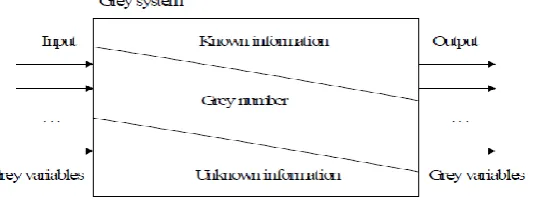
Fig. 1 The sustainability model. III. GREY SET THEORY In present context, the authors have fruitfully
implemented grey theory (discrete information system) deals with utterly known cum unknown information, where utterly known information is being enveloped passing through white number, while unknown information is enveloped passing through black number.
In grey theory, discrete information aligns the amputation of both information that cope the
range of the grey system itself. Grey theory has now been applied to various areas such as forecasting, system control, and decision-making and computer graphics.
Grey set and grey number in grey theory Deng, the concept of a grey system is shown in fig. 2
IV. NOVELTY OF RESEARCH WORK The authors has proposed a crisp AHP (Analytic
Hierarchy Process) weight evaluation technique with the novel idea of global weight evaluation coupled with Grey-MOORA (Multi-Objective
Optimization By Ratio Analysis) to tackle the partial information of Professionals against practices.
V. GREY BASED APPROACH
The Grey-Multi-objective optimization by ratio analysis:
For the normalization of responses of alternatives expressed in the form of interval numbers, suggested the use of the following formula:
m
j
ij ij
ij ij
x x
x x
1
2 2 *
) (
……….(1)
Asian Journal of Applied Science and Technology (AJAST)
Volume 1, Issue 8, Pages 31-37, September 2017
Page | 33
Formula (1) provides the appropriate form for normalizing responses of alternatives expressed by interval grey numbers. However, in cases of multi-practices optimizations which require simultaneously the use of crisp and interval grey numbers, the previously mentioned formula give unsatisfactory results. Determining overall ranking index based on Ratio system approach of the MOORA method for optimization based on the Ratio system part of the MOORA method we start from the formula:
j j
j y y
y* , * * * ij i i ij i i
j s x s x
y G G
………(2) * ij i ij s x
y G
, , * ij i ij s x
y G
Here,
y
*j as the overall ranking index of alternative i; yj and , j
y as total sums of maximizing and minimizing responses of alternative i to objectives j respectively; si as
significance coefficient of objective j;
x
*ij and or*
ij
x
, as the normalized responses of alternative i on different objectives j, which are expressed in the form on crisp or interval grey numbers and
G
assets of objectives to be maximized expressed in the form on crisp or interval grey numbers and
G
are sets of objectives to be minimized expressed in the form on crisp or interval grey numbers (Stanujkic et al., (2012); Samantra, et al.,(2013); Sahu et al., (2012); Vinodh et al., (2011); Liu et al., (2015); Naim and Gosling 2011); Matawale et al., (2012):
i. When objectives have the same significance(0):
, , ) 1 ( * * * * * ij i i ij i i ij i i ij i ij s x s x s x s x
y G G G G ……….……(3) ii. When the decision maker has no preferences (0.5)
, 2 1 , 21 * * * *
* ij i i ij i i ij i i ij i i
j sx sx sx sx
y G G G G ………(4) iii. When the decision maker has no preference and objectives have the same significance (1):
, ) 1 ( , * * * * * ij i i ij i i ij i i ij i i j x s x s x s x s y G G G G …………..…(5)During problem solution, i.e. ranking of alternatives, the attitude of the professionals can lie between pessimistic and optimistic, and the whitening coefficient
, allows expression of professionals degree of optimism or pessimism. In the cases of particularly expressed optimism, the whitening coefficient
, in accordance with aforesaid formula, takes higher values (1) and ranking order of alternatives is mainly based on the upper bounds of intervals with which overall response of each alternative is expressed,* ) 1
( j
j y
y . On the other hand, in the cases of
particularly expressed pessimistic, the whitening coefficient
takes lower values (0)and ranking order of alternatives is mainly based on lower bounds of the intervals, *) 0
( j
j y
y . On the other hand, in the cases of particularly expressed moderate, the whitening coefficient
takes half of lower and upper values (0.5)is taken and ranking order of alternatives is mainly based on lower bounds of the intervals, *) 5 . 0 ( j j y
y .
VI EMPIRICAL CASE RESEARCH
Step 1: Constructed a Grey-knowledge based EWZ sustainability appraisement hierarchical structural evaluation model for assessing the sustainability of system’s organization, shown in Table 1.
Step 2: Evaluation of suitable linguistic grey scale in terms of appropriateness ratings, shown in Table 2.
Asian Journal of Applied Science and Technology (AJAST)
Volume 1, Issue 8, Pages 31-37, September 2017
Page | 34
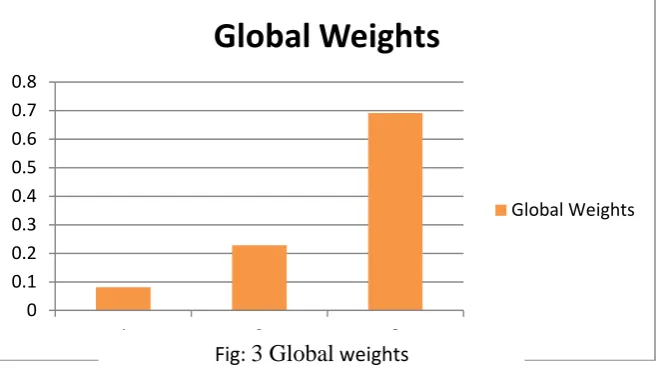
[0.019,0.023,0.039,0.051,0.072,0.105,0.153,0.223,0 .314] against metrics. From the 2nd level metrics, the global weight of 1st level is computed. The
computed global weights for first level are i.e. 0.081,0.228 and 0.691, shown in fig 3.
Step4: Transform the linguistic variables into grey set and then assigned by Ps in linguistic terms, shown in Table 3-5. Then converted into single responses against first level measures.
Step 5: Applied equation 1 to normalize rating data and multiplied by measure’s global weights.
Step6: Estimation of overall performance of material supplier firm by using equation 2,3,4,5 with respect to 0,0.5,1. Result shown in table 6.
Table: 5.1. Grey-knowledge based EWZ sustainability appraisement hierarchical structural evaluation model
Goal, (C) Measures, (Ci) Metrics, (Cij) Attitudes
Sustainability Measurement
Environmental, (C1)
Renewable Energy, (C1,1) (+)
Recycling of Waste Material, Hazard Material, (C1,2)
(+)
Recycling of Water, (C1,3) (+)
Waste Minimization, (C2)
Over Processing, (C2,1) (-)
Unwanted Production, (C2,2) (-)
Unnecessary Movement, (C2,3) (-)
Zero Defect, (C3)
Defective Product, (C3,1) (-)
Rejection, (C3,2) (-)
Rework, (C3,3) (-)
Table 2: The scale of attribute ratings G
Scale r
Very Poor (VP) [0, 1]
Poor (P) [1, 3]
Medium Poor (MP) [3, 4]
Fair (F) [4, 5]
Medium Good (MG) [5, 6]
Good (G) [6, 9]
Very Good (VG) [9, 10]
0 0.1 0.2 0.3 0.4 0.5 0.6 0.7 0.8
1 2 3
Global Weights
Global Weights
Asian Journal of Applied Science and Technology (AJAST)
Volume 1, Issue 8, Pages 31-37, September 2017
Page | 35
Table.3 Appropriateness grey rating against indices for A1
Metrics, (Cij) P1 P2 P3 P4 P5
Renewable Energy, (C1,1) VG G G G VG
Recycling of Waste Material, Hazard Material, (C1,2) VG VG VG VG MP
Recycling of Water, (C1,3) MG F F MP MP
Over Processing, (C2,1) G F F MP VG
Unwanted Production, (C2,2) VG F F MP F
Unnecessary Movement, (C2,3) MG F P MP F
Defective Product, (C3,1) MG MP VG VG F
Rejection, (C3,2) MG MP F MG G
Rework, (C3,3) F MP F MG G
Table.4 Appropriateness grey rating against indices forA2
Metrics, (Cij) P1 P2 P3 P4 P5
Renewable Energy, (C1,1) F G MG MG G
Recycling of Waste Material, Hazard Material, (C1,2) G MG MG G G
Recycling of Water, (C1,3) MG MP MG G G
Over Processing, (C2,1) MG MP F G G
Unwanted Production, (C2,2) MG F F G MG
Unnecessary Movement, (C2,3) VG F VG MG MG
Defective Product, (C3,1) F VG F MG MG
Rejection, (C3,2) MG MP F G F
Rework, (C3,3) MG MP VG G MG
Table.5 Appropriateness grey rating against indices for A3
Metrics, (Cij) P1 P2 P3 P4 P5
Renewable Energy, (C1,1) MG MP F G MG
Recycling of Waste Material, Hazard Material, (C1,2) VG MP F G MG
Recycling of Water, (C1,3) F VG F G MG
Over Processing, (C2,1) F F G VG MG
Unwanted Production, (C2,2) MG F P VG VG
Unnecessary Movement, (C2,3) F F VP MG G
Defective Product, (C3,1) F VG VP MG G
Rejection, (C3,2) G F G MG G
Rework, (C3,3) MG VG G MG VG
Table.6 Ranking results obtained using MOORA technique for 0, 0.5,1
0 0.5 1
Alternatives y*j Ranking y*j Ranking y*j Ranking
A1 -0.269 1.000 -0.303 1.000 -0.338 1.000
A2 -0.290 2.000 -0.326 2.000 -0.361 2.000
Asian Journal of Applied Science and Technology (AJAST)
Volume 1, Issue 8, Pages 31-37, September 2017
Page | 36
VII. RESULTS Proposed Grey-knowledge based EWZ
sustainability appraisement hierarchical structural evaluation model with AHP combined with Grey-MOORA (Multi-Objective Optimization Ratio Analysis) decision making evaluation techniques is called Decision Support System (DSS) is proposed. The sustainability of 1st candidate
system’s organization is found the best than rests. It must be elected. Ranking results obtained using Grey-Multi objective optimization by simple ratio analysis technique for 0, 0.5,1is shown in Fig.4.
Fig.4. preference orders by Grey-MOORA for 0, 0.5,1 VIII. CONCLUSION
In the presented work, the Grey-knowledge based EWZ sustainability appraisement hierarchical structural evaluation model (constituted by mixing the segregated Environmental, Minimization of the Waste and Zero Defect ‘three pillar’ and their corresponding interrelated practices. APH
combined with Grey-MOORA (Multi-Objective Optimization Ratio Analysis) decision making evaluation techniques is applied on model to tackle the incomplete information of decision makers against vague practices. The sustainability of 1st candidate system’s organization is found the best.
REFERENCES
Stanujkic, D., Magdalinovic, N., Jovanovic, R. and Stojanovic, S. (2012). An objective Multi-Measures approach to optimization using MOORA method and interval grey numbers’, Technological and Economic Development of Economy, 18, 2, 331-363. Samantra, C., Sahu, N. K., Datta, S. & Mahapatra, S. S. (2013). Decision-Making in Selecting Reverse Logistics Alternative using Interval-Valued Grey Sets Combined with VIKOR Approach. International Journal of
Services and Operations Management, 14, 2, 175-196.
Sahu N. K., Datta S, Mahapatra S. S. (2012). Establishing green supplier appraisement platform using grey concepts", Grey Systems: Theory and Application, Vol. 2, No 3, pp.395 – 418.
Asian Journal of Applied Science and Technology (AJAST)
Volume 1, Issue 8, Pages 31-37, September 2017
Page | 37
Journal of Advanced Manufacturing Technology, Vol. 57, No. 1-4, pp. 343-352. Liu, J., Liu, X., Liu, Y., & Liu, S. (2015c). A new decision process algorithm for MCDM problems with interval grey numbers via decision target adjustment, The Journal of Grey System, 27, 2, 104-120.
Naim, M.M. and Gosling, J (2011). On leanness, agility and le-agile supply chains,
International Journal of Production Economics, Vol. 131, No. 1, pp.