The Effects of a School-Based Program on
the Reported Self-Advocacy Knowledge of
Students With Learning Disabilities
Faye Mishna
1, Barbara Muskat
2, Fataneh Farnia
3, Judith Wiener
3University of Toronto1, Hospital for Sick Children2, OISE/University of Toronto3
A school-based study examined self-reported self-advocacy knowledge of middle school students with learning disabilities (LD). Children with LD are vulnerable to experiencing psychosocial and academic problems. Self-advocacy is a protective factor as students with LD enter middle and high school, comprising knowledge of one’s learning strengths and LD; awareness of one’s rights and responsibilities; awareness of accommodations needed; and ability to communicate one’s learning needs and required accommodations. The students reported increasing their ability to advocate for themselves. Results underscore the importance of adults such as teachers and parents discussing LD and associated issues with children and youth.
Une étude en milieu scolaire a examiné les perceptions qu’avaient des élèves à l’école intermédiaire ayant des troubles d’apprentissage par rapport à leur autonomie sociale. Ces élèves sont à risque de souffrir de problèmes psychosociaux et académiques. L’autonomie sociale constitue un facteur de protection quand les élèves ayant des troubles d’apprentissage commencent l’école intermédiaire ou secondaire. Elle implique la connaissance de ses forces académiques et de ses troubles d’apprentissage; la conscience de ses droits et ses responsabilités; la conscience des accommodations nécessaires; et la capacité de faire connaître ses besoins en matière d’apprentissage et d’accommodations. Les élèves ont indiqué qu’ils se sentaient mieux en mesure de se défendre. Les résultats soulignent l’importance pour les adultes comme les enseignants et les parents de discuter de troubles d’apprentissage et d’enjeux qui s’y rattachent avec les enfants et les jeunes.
Although many individuals with LD do not have adjustment problems (Morrison & Cosden, 1997), children and adolescents with LD are more prone than their peers without LD to have psychosocial problems (Cosden, 2001; McNamara, Willoughby, Chalmers, & YLC-CURA, 2005). Cognitive deficits inherent to LD can put students at risk for poor academic achievement (Pearl & Bay, 1999), which is associated with other difficulties such as psychosocial (Cosden, 2001) and academic problems (Pearl & Bay, 1999), psychiatric disorders, involvement in criminal activities, and compromised social and vocational adjustment (Morrison & Cosden, 1997; Offord, Boyle, & Racine, 1990). Interventions for this population typically target their academic skills and less often address their psychosocial difficulties and adjustment (Morrison & Cosden, 1997; Shechtman & Pastor, 2005).
disabilities (Wehmeyer, Field, Doren, Jones, & Mason, 2004). Self-advocacy, a component of self-determination, is especially important for students who have LD and comprises knowledge of one’s learning strengths and LD, rights and responsibilities, and the ability to communicate one’s learning needs and required accommodations (Merchant & Gajar, 1997).
In this article, we present a study that evaluated an intervention designed to improve the self-advocacy of middle school students with LD. This multifaceted school-based intervention was based on an ecological conceptual framework (Bronfenbrenner, 1986, 1994; Germain & Bloom, 1999; Wiener, 2003). It included a workshop entitled Walk a Mile in My Shoes (Mishna & Muskat, 2004b) designed to change attitudes toward students with LD, group therapy focused on self-advocacy, and consultation with participants’ teachers. We report on the effect of this intervention on the students’ self-advocacy skills.
Social and Emotional Adjustment of Students with LD
Peer relations are vital for healthy social development (Boivin, Hymel, & Bukowski, 1995; Gresham, Sugai, & Horner, 2001) and are strong predictors of adult adjustment. Students with LD are significantly more likely to be rejected (Greenham, 1999) and bullied (Thompson, Whitney, & Smith, 1994) than their peers without LD. They report more symptoms of depression and anxiety and greater loneliness (Hernandez-Halton, Hodges, Miller, & Simpson, 2000; Maag & Reid, 2006; Margalit, 1991; McDermott, Goldberg, Watkins, Stanley, & Glutting, 2006). Although these children and youth are similar to their peers without LD in terms of self-esteem, they tend to have a lower academic self-concept (Stone & May, 2002). Children with LD are more likely to have adjustment problems (Al-Yagon & Mikulincer, 2004), are overrepresented in the substance abuse and young offender populations (Keilitz, & Dunivant, 1987; Winters, 1997), and their school dropout rate is higher (Lichtenstein, 1993; Sinclair, Christenson, Evelo, & Hurley, 1998).
The negative attitudes of peers significantly contribute to the social problems of students with LD (Harper, 1999; Pearl & Bay, 1999). The dominant approach of society ascribes disability to an individual deficit as opposed to the external obstacles that hold back persons with disabilities (Barnes, Mercer, & Shakespeare, 1999). Evidence suggests, however, that children’s attitudes can be changed with a brief intervention. For example, contact with children who have disabilities and adult-guided discussion greatly increased primary schoolchildren’s understanding of individuals with disabilities (Favazza, & Odom, 1997).
Students with LD are typically less liked by teachers (Vaughn, Elbaum, & Boardman, 2001), which influences the perceptions of peers (Haager & Vaughn, 1995) and children’s own self-expectations (Perry & Weinstein, 1998). Interventions should, therefore, help peers and teachers to recognize vulnerable students as important members of the school (Patton et al., 2000; Pearl & Bay, 1999).
Ecological Framework
(Germain & Bloom, 1999; Perry & Weinstein, 1998). These factors and the milieu in which children function should be addressed in order to enhance protective factors and offset risk factors (Morrison & Cosden, 1997; Vaughn et al., 2001).
To promote students’ well-being, the focus of intervention should extend to such factors as school climate and social integration (Brown, D’Emidio-Cason, & Benard, 2001; Mishna & Muskat, 2004a). School climate encompasses the attitudes, values, and norms that sanction how a school operates (McEvoy & Welker, 2000). Change is most likely to occur if an intervention involves modification of teachers’ attitudes, administrative support to improve teaching, and openness to collaboration (Dellar, 1999; Fullan, 2000). Interventions in the education sector that promote sustainable change are typically achieved by input from teachers, parents, and students throughout research development and implementation (Gersten, Vaughn, Deshler, & Schiller, 1997; Vaughn et al., 2001).
Self-Determination and Self-Advocacy
The transition from primary to middle and high school can challenge many children and adversely affect their psychosocial and academic functioning (Kuperminc, Leadbeater, & Blatt, 2001). It can be especially hard for students with LD, who are at risk of losing motivation or of developing antisocial behaviors (Eisenman & Chamberlin, 2001; Field et al., 2003). The invisibility of learning disabilities can result in these students’ challenges being overlooked during the transition process (Merchant & Gajar, 1997). Students with LD may become accustomed to concentrating primarily or solely on their learning and social deficits. It is essential, however, that they also recognize their strengths and learn to advocate on their own behalf (Merchant & Gajar, 1997), to initiate appropriate strategies, and to assume control and responsibility over their actions (Durlack, Rose, & Bursuck, 1994). Encouraging these students to establish goals and make their own decisions can contribute to their success at these critical times (Trainor, 2002).
Self-determination has many definitions, including conveying one’s interests and needs (Merchant & Gajar, 1997), understanding one’s strengths and limitations (Field et al., 2003), making and taking responsibility for one’s choices without external encouragement (Wehmeyer, Agran, & Hughes, 2000), and displaying assertiveness (Durlack et al., 1994). Common among the various definitions is the capacity to recognize and take responsibility for one’s own goals while valuing oneself (Field, Hoffman, & Posch, 1997). Self-determination includes the following components: “know yourself, value yourself, plan, act, and experience outcomes and learn” (Field & Hoffman, 2002, p. 113).
Self-determination evolves over one’s life span in accordance with other developmental (i.e., social, emotional, behavioral) experiences. In addition, self-determination occurs in an ecological context and develops through a person’s interactions with the environment. Compelling evidence indicates that self-determination and self-advocacy are associated with success later in life and that support from adults fosters the self-determination of students with disabilities (Goldberg, Higgins, Raskind, & Herman, 2003; Malian & Nevin, 2002).
behalf. There is increasing emphasis on supporting individuals with LD to become self-advocates, which constitutes a component of self-determination (Merchant & Gajar, 1997) and is centered on the notion of empowerment (Pennell, 2001). Self-determination activities important to be offered to youth before they enter high school may include the development of social skills, self-awareness, goal-setting, conflict resolution, and team-building (Eisenman & Chamberlin, 2001). For example, implementing social-skills activities such as role-playing may enhance self-awareness and self-regulating behaviors and increase students’ independence and subsequently their self-determination (Eisenman & Chamberlin, 2001).
School-Based Interventions
School-based programs reach students who may not otherwise have access to services or who are at risk for dropping out (Dishion & Kavanagh, 2000; Meyer & Farrell, 1998). Group approaches are increasingly offered in schools (Akos, 2000; Dennison, 2008). A meta-analysis of 64 school-based programs between 1975 and 1997 that examined the self-concept of students with LD found group counseling more helpful than social-skills training for middle school students. Middle school students were more likely to benefit from group intervention than younger children (Elbaum & Vaughn, 2001). Group treatment offers a peer group for alienated children and youth, fosters social competence (Hoag & Burlingame, 1997) and offers a miniature real-life situation to help members change (Mishna, 1996a, 1996b; Mishna & Muskat, 2004a). Group interventions are effective regardless of age (Weisz, Weiss, Han, Granger, & Morton, 1995) and can increase self-esteem, social skills, verbal expressiveness, and academic achievement and can reduce anxiety and depression (Dennison, 2008; Holmes & Sprenkle, 1996). An added benefit for students with LD is the chance to discuss their LD with peers (Wiener & Harris, 1997).
Method
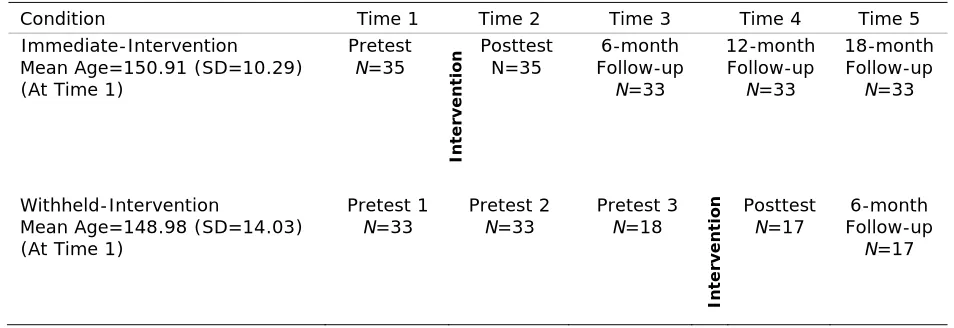
This school-based intervention study was informed by an ecological systems framework and comprised: (a) a school-based group treatment for students with LD; (b) manualized workshops on LD for teachers, parents, and students without LD; and (c) consultation for teachers of the students who participated in the group treatment. A partial crossover design (Reid & Smith, 1989) was used with outcomes assessed at pretest, posttest, 6-, 12-, and 18-month follow-ups (Table 1). Seven schools were involved in the study. Students in three schools received the intervention immediately after pretest, and those in four schools received the intervention a year later. Schools were randomly assigned to immediate- and withheld-intervention groups.
The hypothesis was that the self-advocacy skills of students receiving the intervention would increase from pretest to posttest in comparison with the control group for whom the intervention was delayed. We expected that these gains would be maintained over 18 months.
Participants
The initial sample in the school-based intervention comprised 68 students (50 boys, 18 girls), their parents, and their teachers. The students were in grades 6-8 across seven schools in an urban school board. Eighteen (26%) were native speakers of English, and for 45 (66%) students English was their second language (ESL). Data were not available for five (14%) of the students. The ESL students came from homes in which Tamil, Tagalog, Portuguese, Italian, Spanish, French, Hungarian, Polish, Arabic, or Armenian was spoken. Ninety-three percent (N =42) of the ESLs for whom data on the country of birth were available were born in Canada.
All participating students were diagnosed with LD by a psychologist, were school identified, and received special education services. Due to the inconsistent criteria used in the initial diagnoses, scores from the Wechsler Intelligence Scale for Children (WISC-III; Wechsler, 1991) and Wechsler Intelligence Scale for Children (WISC-IV; Wechsler, 2003) administered no more than five years before data collection and from standardized academic achievement tests (i.e., Wechsler Individual Achievement Test, Wechsler, 2001; Woodcock Johnson Tests of Achievement) administered no more than three years before data-collection were taken from the participants’ files. When these file data were not available, graduate students in school and a
Table 1
Research Design and Timeline
Condition Time 1 Time 2 Time 3 Time 4 Time 5 Immediate-Intervention
Mean Age=150.91 (SD=10.29) (At Time 1)
Pretest N=35 In ter v en ti o
n Posttest N=35 Follow-up 6-month N=33 12-month Follow-up N=33 18-month Follow-up N=33 Withheld-Intervention
Mean Age=148.98 (SD=14.03) (At Time 1)
Pretest 1
N=33 Pretest 2 N=33 Pretest 3 N=18
In ter v en ti o n Posttest
N=17 Follow-up 6-month
clinical child psychologist administered the WISC-IV and the Letter/Word Identification, Passage Comprehension, Calculation, Applied Problems, Spelling, and Writing Samples subtests of the Woodcock Johnson Tests of Achievement (WJ-III; Woodcock, McGrew, & Mather, 2001). Students were included in the sample if they obtained an IQ score greater than or equal to 85 and if at least one subtest standard score on the standardized academic achievement test was below 85.
Of the 68 participants, 35 (21 boys and 12 girls) in three schools received the intervention immediately in Year One (immediate-intervention group), and 33 students (28 boys and 5 girls) in four schools received the intervention in Year Two after the third assessment (withheld-intervention group). Two students in the immediate-(withheld-intervention and 16 students in the withheld-intervention groups withdrew at some point before completion of the study. Attrition reduced the sample by 23%. Consequently, 50 students, 33 in the immediate intervention (19 boys, 14 girls) and 17 in the withheld-intervention groups (all boys), had full data over five times of testing. To examine whether students who withdrew from the study were significantly different from their peers on the outcome measure, cognitive abilities, and academic skills, we compared their nonverbal ability and achievement scores with those of students who remained in the study. There were no significant differences between the two groups’ nonverbal ability (t(64)=–.51, p=.610), math reasoning (t(62)=.04, p=.97) or spelling, t(62)=1.64, p =.11, nor were there significant differences in SAI at Time 1 (t(66)=−.19, p=.85) or Time 2, t(64)=.05, p=.96. However, the groups varied significantly on word identification skills (t(66)=2.44, p=.02) and reading comprehension scores, t(66)=2.22, p=.03. Students who did not complete the study had higher scores on these tests than those who completed the study. Attrition was not related to the outcome measure. However, because the missingness was not at random, the data were not multiply imputed for those who dropped out from the study.
School Settings
All seven schools were affiliated with a large publicly funded urban Catholic school district, and all accommodated students from kindergarten through grade 8. The three immediate intervention schools had an average of 808 pupils, and the three intervention-withheld schools had an average of 549 students. Of the three immediate intervention schools, two were considered high-need with respect to family income, and one was considered low-need. The percentage of students in these schools who were not born in Canada ranged from 25% to 60%, and the percentage of students who spoke a language other than English at home ranged from 12 % to 30%. Of the four withheld-intervention schools, one was considered high-need, two were classified as medium-need, and one was deemed low-need. In the withheld-intervention schools, the percentage of students not born in Canada ranged from 9% to 37%, and the number of students who spoke a language other than English at home ranged from 10% to 27%.
Measures
test-retest reliability of the YSR Internalizing and Externalizing Scales were .67 and .78 respectively. Self-Advocacy. The Self Advocacy Interview for Students (SAI) is a 30-minute structured interview that evaluates four main knowledge components (Brunello-Prudencio, 2001). The knowledge of learning disability component evaluates students’ knowledge of LD through four questions. A sample question is Can you tell me what a learning disability is? The knowledge of learning style component includes 14 items and evaluates students’ understanding of their strengths and weaknesses in their ability to learn through probes such as Tell me when or how you learn best. The component that taps students’ Knowledge of resources, services, support and accommodation evaluates their knowledge of how to increase their potential for success using available resources and services and on how to adapt to their environment. This component of the SAI includes five questions such as Can you tell me two things that people in the school can do to help you learn better? The fourth component, Knowledge of the ability to succeed comprises nine items developed to understand whether students with LD are aware that they can succeed despite their learning problems. A sample question is Do you think people with learning disabilities, like yourself, can finish high school? Why or why not? The research assistant who conducted the SAI with students recorded the students’ responses verbatim. The internal consistency of the SAI measure was α=0.73 (internal consistency of the SAI subscales is as follows: Knowledge of LD α= 0.74; Knowledge of learning style α= 0.47; Knowledge of resources α=0.31; Knowledge of ability to succeed α=0.66).
The interrater reliability for 25% of the participants for all items that required interpretation was calculated using percent agreement (94%) and Cohen’s (1960) Kappa Coefficient (observed agreement minus probability of chance agreement divided by one minus probability of chance agreement). The analysis yielded an almost perfect agreement rate of K=.88 (Landis & Koch, 1977). Overall test-retest reliability of the measure was .87.
Intervention
Component 1. A weekly group treatment for students with LD in grades 6 and 7. Groups ran for 12 weeks and were 60 minutes in length. They comprised between four and eight members and were co-led by an experienced agency group leader and a school-based practitioner. The literature supports this length for school-based groups (Brown et al., 2001; Gerrity & DeLucia-Waack, 2007). The group approach, developed by the agency involved in the project (Mishna & Muskat, 2004a, 2004b), is unique in combining interpersonal group treatment (Yalom & Lescz, 2005), mutual aid (Shulman, 1999), self-psychology (Kohut, 1984), and self-advocacy (Brunello-Prudencio, 2001). In addition, attention was paid to bullying, as this population is vulnerable (Mishna, 2003). Support was provided for the group in an earlier study (Mishna, 1996a, 1996b).
learning disabilities; (c) members’ strengths and interests; (d) members’ specific learning difficulties; (e) supports that help members learn and complete school work; (f) standing up for oneself/dealing with bullies; (g) role-playing and practicing standing up for oneself; (h) asking for help with school work; (i) learning to calm down and relax; (j) relaxation and problem-solving; (k) practicing lessons learned; and (l) summary, wrap-up, celebration, and awards. The aims of the sessions were to deliver content, use activities to illustrate content, allow for discussion and practice of self-advocacy skills, and promote fun. Information presented in the sessions, members’ drawings and art, and work sheets used in sessions were placed in folders that were given to members at the end of the session. A list of relevant and accessible resources was included at the end of each session.
The 11 group leaders were all qualified social workers or school psychologists. Each group was co-led by an agency staff member and a school social worker or psychologist. All the school-based leaders participated in a one-day training session on the use of the manual and the group treatment approach. The training was provided by the second author and comprised didactic and discussion modes and analysis of videotapes of agency groups for children and youth with learning disabilities. Throughout the project, a number of meetings were held with the group leaders to obtain their comments and responses to the group process in general and more specifically, working with the manual.
Component 2. Delivery of a manualized workshop about learning disabilities, Walk a Mile in My Shoes, for all parents, teachers, and students in grades 6-8. This workshop was developed by the agency involved in the project. Feedback from over 6,000 participants throughout Ontario has been highly positive. The workshops for parents and teachers were three hours in length, whereas the workshops for students lasted one hour. The workshop began with an overview of the concept of learning disability. Then specific types of learning disability were defined (e.g., reading problems, expressive language problems, visual-spatial problems), and participants engaged in exercises that simulated the experience of each type of learning disability. An example of such an exercise entails reading sentences that are spelled phonetically rather than conventionally. After each exercise, participants were given the opportunity to discuss their reactions to experiencing the particular difficulty. Participants were offered strategies to use to support individuals who struggled with each specific difficulty.
Component 3. This component involved consultation with teachers of students in the group treatment (component 1). A team comprising the group co-leaders, one of whom was a social worker or psychology member of the school team, the school vice principal, and the child’s primary and special education teachers met once during the course of the intervention to address the student’s learning and psychosocial problems. This team at times made recommendations about the child’s treatment, which were communicated to the parents through a school representative.
The study received approval from the University of Toronto Research Ethics Board.
Group Adherence Questionnaire/Checklist
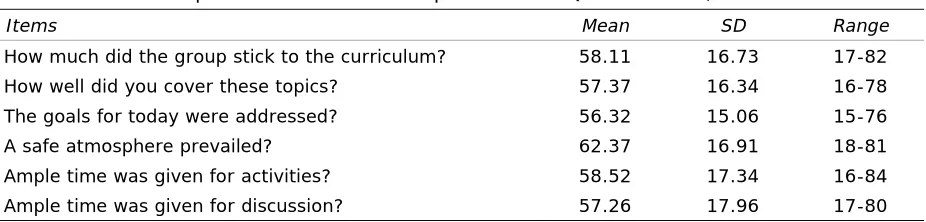
was ample time for discussion. The six items were rated using a seven-point Likert scale (ranging from 1 for not at all to 7 for very much). Leaders’ responses to each Likert item over the 12 group intervention sessions were summed to be treated as interval data measuring a latent variable (e.g., goals addressed, time for activities). The maximum summed score is 84 for each item; the summed responses were normally distributed. Means and standard deviations and the range of responses are shown in Table 2. In general, range statistics provide information on the direction of the average response, and standard deviations provide information on the average distance of the responses from the mean. As noted in Table 2, standard deviations are relatively large, that is, there is a large variability in the responses. Mean scores, however, are closer to the maximum than the minimum scores, meaning that on average, the leaders rated themselves as adhering to the manualized group approach.
Procedure
Table 1 shows the timeline and design of the study. The first pretest (Time 1, October 2005), which involved administration of the SAI, began after receiving parental consent and the children’s own assent to participate in the study. The group sessions began immediately after pretest at Time 1 for the immediate-intervention condition and after Time 3 (October 2006) for the withheld-intervention condition. As group sessions were held during nonacademic “advisory periods,” students did not miss class. The Walk a Mile in my Shoes workshop was offered after school for teachers and in the evening for parents several weeks after pretest at Time 1 for the immediate-intervention condition and Time 3 for the withheld-intervention condition. The team consultations took place midway through the intervention. The SAI, CBCL, and YSR were administered on five occasions: Pretest, Posttest, six-month, 12-month, and 18-month follow-up for the immediate-intervention condition and three pretests, posttest, and six-month follow-up for the withheld-intervention condition.
Both intervention groups (immediate-intervention and withheld-intervention) were assessed five times with a pretest-posttest follow-up design. Students’ self-advocacy skills and problem behaviors were assessed (posttest/Time 2) six months after the first assessment. Three follow-up assessments took place three times every six months after the posttest. Within- and between-group comparisons were made for Times 1 and 2 (pretest-posttest for immediate-intervention) and across five measurement points for immediate-intervention and withheld-intervention groups.
Table 2
Descriptive Statistics for Group Adherence Questionnaire/Checklist
Items Mean SD Range
Results
Distribution, skewness, and kurtosis of the data were examined to ensure that the assumptions for different analyses were met. Missing data cells were multiply imputed for IQ and
achievement scores. There were no significant age differences between the two groups. Means, standard deviations, and range of nonverbal ability and of academic achievement scores, provided by participating schools, are presented in Table 3. The t-test statistics for the
immediate- and withheld-intervention groups are also presented in this table. Means, standard
Table 3
Descriptive Statistics for Cognitive Abilities and Achievement Scores for Immediate- and Withheld-Intervention Groups
Immediate-Intervention (N=35)
Withheld- Intervention (N=33)
Measure M SD M SD t (66) p
Age 150.91 10.29 149.48 13.88 0.48 0.63 Nonverbal Ability1 93.15 10.77 92.15 12.62 0.35 0.73
Full Scale IQ 85.34 8.33 88.63 10.94 -1.40 0.16 Word Identification 86.11 10.01 87.85 12.56 -0.63 0.53 Reading Comprehension 81.75 10.94 84.45 12.98 -0.93 0.35 Spelling 88.39 12.05 88.87 13.93 -0.14 0.88 Math Reasoning 86.39 9.04 86.68 11.08 -0.11 0.91
1. The Nonverbal Ability score is a composite of the WISC-III Performance IQ (n= 46), and the Perceptual Reasoning Index of the WISC-IV given at the time of data collection for this study (n=20). The Verbal IQ on the WISC-III and Verbal Reasoning Index on the WISC-IV are not reported due to the high number of participants (n=45) who reported that a language other than English is spoken at home.
Table 4
Descriptive Statistics for Child Behaviour Checklist and Youth Rating Scale for Immediate- and Withheld-Intervention Groups
Immediate-Intervention (N=35)
Withheld-Intervention (N=33)
Measure M SD Range M SD Range t (66) p
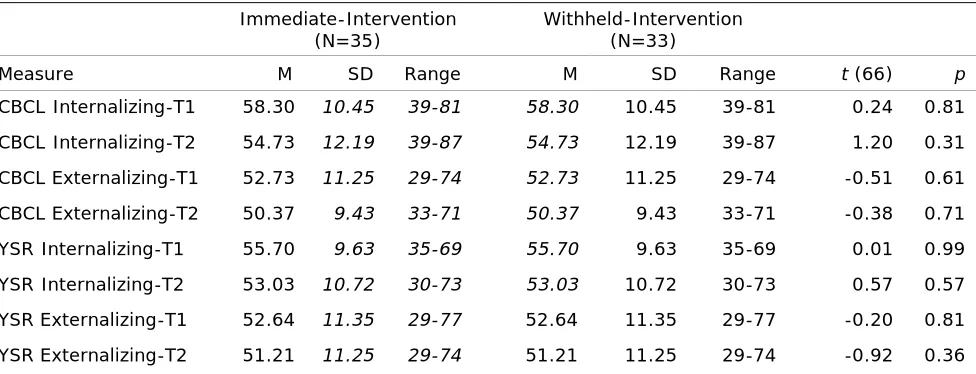
deviations, and range of Internalizing and Externalizing Scales of CBCL and YSR and the related t-test statistics for the immediate- and withheld- intervention groups are presented in Table 4. There were no significant group differences on these variables.
Comparisons for the Self-Advocacy Interview (SAI) were made using two sets of analyses. First, we used all available data (SAI: N=68) obtained during the first two times of testing to examine the effectiveness of early intervention. In this set of analyses, we also compared the Internalizing and Externalizing Scales of the CBCL and YSR. Second, to understand the long-term effectiveness of the intervention in increasing self-advocacy knowledge and its overall change over time, we examined SAI scores of immediate- and withheld-intervention groups across five times of testing. As noted above, in the latter analysis we used data from 50 students who had complete data.
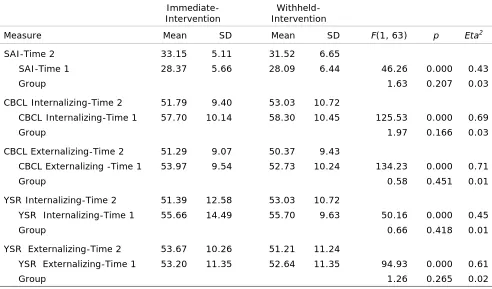
We used univariate analyses of covariance to examine the effect of intervention on students’ performance on the SAI and the internalizing and externalizing subscales of the CBCL and YSR at Time 2 after controlling for age and the baseline pretest scores as covariates. This was to control for initial group differences on these variables. Results of the univariate analysis of covariance are presented in Table 5. As noted in Table 5, there is a within-group change from Time 1 to Time 2. However, there was no intervention effect on the students’ scores on SAI, parents’ ratings of their children behaviors, or the youths’ ratings of their behaviors in the immediate- and withheld-intervention groups.
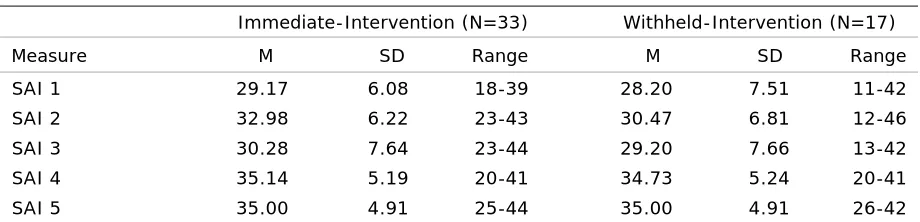
We used GLM repeated-measures procedures to examine the within-group mean differences and to compare groups longitudinally. Means, standard deviations, and range of SAI across five
Table 5 Univariate Analysis of Covariance for SAI, CBCL, and YSR
Immediate-Intervention
Withheld-Intervention
Measure Mean SD Mean SD F(1, 63) p Eta2
SAI-Time 2 33.15 5.11 31.52 6.65
SAI-Time 1 28.37 5.66 28.09 6.44 46.26 0.000 0.43
Group 1.63 0.207 0.03
CBCL Internalizing-Time 2 51.79 9.40 53.03 10.72
CBCL Internalizing-Time 1 57.70 10.14 58.30 10.45 125.53 0.000 0.69
Group 1.97 0.166 0.03
CBCL Externalizing-Time 2 51.29 9.07 50.37 9.43
CBCL Externalizing -Time 1 53.97 9.54 52.73 10.24 134.23 0.000 0.71
Group 0.58 0.451 0.01
YSR Internalizing-Time 2 51.39 12.58 53.03 10.72
YSR Internalizing-Time 1 55.66 14.49 55.70 9.63 50.16 0.000 0.45
Group 0.66 0.418 0.01
YSR Externalizing-Time 2 53.67 10.26 51.21 11.24
YSR Externalizing-Time 1 53.20 11.35 52.64 11.35 94.93 0.000 0.61
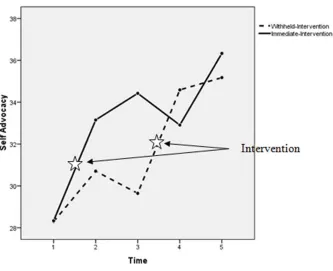
times of testing for the immediate- and withheld-intervention groups are reported in Table 6. The next step in the analyses was to examine change in the knowledge of SAI over five times of assessment. The results of GLM repeated measure indicated a significant main effect of time. That is, both groups made substantial gains in SAI over the five times of assessment F(3.40, 163.35)=23.170, p=.000, Eta2=0.33, with Huyn Feldt correction. The results also showed a highly significant interaction effect of time by intervention group, F(3.40, 163.35)=4.65, p=.005, Eta2=0.28, with Huyn Feldt correction. Tests of within-subject contrasts indicate that the withheld-intervention group has shown a significant increase in their knowledge of SAI from Time 3 to Time 4 (Figure 1) after they received the intervention, F(1, 48)=13.86, p=.001, Eta2=0.22. There were no significant differences between the overall means of the two groups,
F(1, 48)=1.07, p=.307, Eta2=0.02.
Discussion
This study evaluated a school-based intervention designed to improve the reported self-advocacy knowledge of middle school students with LD. An important feature of the study was the inclusion of the students’ school context in the overall intervention, thus recognizing the influence of the school milieu on students (Dishion & Kavanagh, 2000; Elbaum & Vaughn, 2001; Pavri & Hegwer-DiVita, 2006). The ecologically informed intervention comprised delivery of a manualized workshop on LD to participants’ teachers, parents, and classmates; provision of a manualized group that focused on self-advocacy to participants; and consultation with participants’ teachers. The findings of this study suggest that middle school students with LD can significantly increase their self-reported self-advocacy knowledge and ability. A limitation is that the findings are based on the students’ self-reports as measured by the Self Advocacy Interview for Students (Brunello-Prudencio, 2001). Further research should include parents’ and teachers’ reports on evidence and use of self-advocacy skills by students with LD. A second limitation is that we cannot determine which of the three components (workshop, group treatment, or consultation) or combination led to the significant change. A related limitation is that the multi-component intervention was costly and required significant involvement not only of the research team, but of school personnel including teachers, social workers, and psychologists. Further research is required to determine the effect of each component and of the whole intervention. Should results indicate that the multiple components are required, this will
Table 6
Descriptive Statistics for Immediate-Intervention and Withheld-Intervention Groups across Five
Immediate-Intervention (N=33) Withheld-Intervention (N=17)
Measure M SD Range M SD Range
have implications for dissemination due to the cost and labor involved (Evans et al., 2006). Notwithstanding the limitations, our findings strongly suggest that the intervention led the students to increase their ability for self-advocacy according to their self-report. This result is significant as it is supported by the literature, which highlights the importance of self-advocacy at key times of development, in particular during the transition from middle school to high school (Field et al., 2003). Moreover, the elements of self-advocacy such as having knowledge of one’s learning strengths and LD are considered to be among the factors considered protective for students with LD (Goldberg et al., 2003; Wiener, 2002).
There has been a shift in the nature of professionals’ roles in working with individuals who have disabilities from that of decision-maker to advisor to consultant. With more responsibility for making informed decisions being given to people with disabilities, professionals are now providing training and assistance for them to become more self-reliant (Pennell, 2001), which includes the ability to advocate for oneself. Supportive teachers affect students’ ability to discuss their disability and gain self-realization (Eisenman & Tascione, 2002). Although conversations with parents and teachers about their disabilities are vital for determination and self-advocacy, students with LD nevertheless report that their parents and teachers do not discuss their LD with them (Eisenman & Tascione, 2002). The intervention provided in this study included various components that involved discussion about topics related to learning disabilities directly or indirectly, for example, bullying. The associated increase in self-advocacy highlights the importance of adults initiating and fostering discussions with students that include various issues related to LD and to their strengths.
An important aspect of the intervention is that it was embedded in the students’ school ecological context, consistent with an approach to teaching that takes advantage of naturally
occurring incidents and considered “teachable moments” (Gresham et al., 2001; Mishna & Muskat, 2004a). School-based interventions take place in the setting, which fosters in vivo learning, offers students countless opportunities to practice, and helps increase the sensitivity of others in the school setting such as teachers and students.
Conclusion
The students reported increasing their ability to advocate for themselves and their needs. Further research is required (a) to obtain the perspectives of others such as parents and teachers on the students’ advocacy; and (b) to administer objective measures on the students’ self-advocacy to examine their behavior with respect to self-self-advocacy, for example, their ability to identify their learning needs and to ask for help.
Results highlight the importance of adults such as teachers and parents discussing LD with children and youth and understanding associated issues. As the project included the group in addition to workshops for staff, teachers, and students, it is not possible to determine the isolated effects of the group component.
Acknowledgments
This study was funded by a grant from the Social Sciences and Humanities Research Council of Canada (SSHRC). We acknowledge the support of the Toronto Catholic District School Board psychologists, social workers, teachers, and administrators, and the children and their parents, in particular Maria Kokai. We thank Integra group leaders and administration, research assistants, and especially the research project coordinator Arija Birze.
References
Achenbach, T., & Rescorla, L. (2001a). Child behavior checklist. Burlington, VT: University of Vermont
Press.
Achenbach, T., & Rescorla, L. (2001b). Youth self-report. Burlington, VT: University of Vermont Press.
Akos, P. (2000). Building empathic skills in elementary school children through group work. Journal
for Specialists in Group Work, 25, 214-223.
Al-Yagon, M., & Mikulincer, M. (2004). Patterns of close relationships and socioemotional and academic
adjustment among school-age children with learning disabilities. Learning Disabilities Research and
Practice, 19, 12-19.
Barga, N.K. (1996). Students with learning disabilities in education: Managing a disability. Journal of
Learning Disabilities, 29, 413-421.
Barnes, C., Mercer, G., & Shakespeare, T. (1999). Exploring disability: A sociological introduction.
Cambridge, UK: Polity Press.
Boivin, M., Hymel, S., & Bukowski, W.M. (1995). The roles of social withdrawal, peer rejection, and
victimization by peers in predicting loneliness and depressed mood in childhood. Development and
Psychopathology, 7, 765-785.
Bronfenbrenner, U. (1986). Ecology of the family as a context for human development: Research
Bronfenbrenner, U. (1994). Ecological models of human development. In T. Husén & T.N. Postlethwaite
(Eds.), International encyclopedia of education (2nd ed., vol. 3, pp. 1643-1647). Oxford, UK:
Pergamon Press.
Brown, J.H., D’Emidio-Cason, M., & Benard, B. (2001). Resilience education. Thousand Oaks, CA:
Corwin Press.
Brunello-Prudencio, L.A. (2001). Knowledge and communication skills training for high school students
with learning disabilities for the acquisition of self-advocacy skills. Dissertation Abstracts
International Section A: Humanities and Social Sciences, 62(4-A), October 2001, pp. 1321, ISSN 0419-4209.
Cohen, J. (1960). A coefficient of agreement for nominal scales, Educational and Psychological
Measurement, 20, 37-46.
Cosden, M. (2001). Risk and resilience for substance abuse among adolescents and adults with LD. Journal of Learning Disabilities, 34, 352-358.
Dellar, G. (1999). School climate, school improvement and site-based management. Learning
Environments Research, 1, 353-367.
Dennison, S. (2008). Measuring the treatment outcome of short-term school-based social skills groups. Social Work with Groups, 31(3/4), 307-328.
Dishion, T.J., & Kavanagh, K. (2000). A multilevel approach to family-centered prevention in schools:
Process and outcome. Addictive Behaviors, 25, 899-911.
Durlak, C., Rose, E., & Bursuck, W. (1994). Preparing high school students with learning disabilities for
the transition to postsecondary education: teaching the skills of self-determination. Journal of
Learning Disabilities, 27, 51-59.
Eisenman, L., & Chamberlin, M. (2001). Implementing self-determination activities: Lessons from
schools. Remedial and Special Education, 22, 138-147.
Eisenman, L.T., & Tascione, L. (2002). “How come nobody told me?” Fostering self-realization through a
high-school English curriculum. Learning Disabilities Research and Practice, 17, 35-46.
Elbaum, B., & Vaughn, S. (2001). School-based interventions to enhance the self-concept of students with
learning disabilities: A meta-analysis. The Elementary School Journal, 101, 303-329.
Evans, S.W., Timmins, B., Sibley, M., White, L.C., Serpell, Z.N., & Schultz, B. (2006). Developing
coordinated multimodel school-based treatment for young adolescents with ADHD. Education and
Treatment of Children, 29, 359-378.
Favazza, P.C., & Odom, S.L. (1997). Promoting positive attitudes of kindergarten-age children toward
people with disabilities. Exceptional Children, 63, 405-418.
Field, S., & Hoffman, A. (2002). Preparing youth to exercise self-determination: quality indicators of school environments that promote the acquisition of knowledge, skills, and beliefs related to
self-determination. Journal of Disability Policy Studies, 13, 113-118.
Field, S., Hoffman, A., & Posch, M. (1997). Self-determination during adolescence. Remedial and Special
Education, 18, 285-293.
Field, S., Sarver, M., & Shaw, S. (2003). Self-determination: A key to success in postsecondary education
for students with learning disabilities. Remedial and Special Education, 24, 339-349.
Fullan, M. (2000). The three stories of education. Phi Delta Kappan, 81, 581-584.
Germain, C.B., & Bloom, M. (1999). Human behavior in the social environment: An ecological view (2nd
ed.). New York: Columbia University Press.
Gerrity, D.A., & DeLucia-Waack, J.L. (2007). Effectiveness of groups in the schools. Journal for
Specialists in Group Work, 32, 97-106.
Gersten, R., Vaughn, S., Deshler, D., & Schiller (1997). What we know about using research findings:
Implications for improving special education practice. Journal of Learning Disabilities, 30, 466-476.
Goldberg, R.J., Higgins, E.L., Raskind, M.H. & Herman, K.L. (2003). Predictors of success in individuals
Research and Practice, 18, 222-236.
Greenham, S. (1999). Learning disabilities and psychosocial adjustment: A critical review. Child
Neuropsychology, 5, 171-196.
Gresham, F.M., Sugai, G., & Horner, R.H. (2001). Interpreting outcomes of social skills training for
students with high-incidence disabilities. Exceptional Children, 67, 331-344.
Haager, D., & Vaughn, S. (1995). Parent, teacher, peer, and self-reports of the social competence of
students with learning disabilities. Journal of Learning Disabilities, 28, 205-215, 231.
Harper, D.C. (1999). Social psychology of difference: Stigma, spread, and stereotypes in childhood
[Presidential address]. Rehabilitation Psychology, 44, 131-144.
Hernandez-Halton, I., Hodges, S., Miller L., & Simpson, D. (2000). A psychotherapy service for children
and adults with learning disabilities at the Tavistock Clinic, London, UK. British Journal of Learning
Disabilities, 28, 120-124.
Hoag, M.J., & Burlingame, G.M. (1997). Child and adolescent group psychotherapy: A narrative review of
effectiveness and the case for meta-analysis. Journal of Child and Adolescent Group Therapy, 7,
51-68.
Holmes, G., & Sprenkle, L. (1996). Group interventions in school. Journal of Child and Adolescent Group
Theory, 6, 203-223.
Keilitz, I., & Dunivant, N. (1987). The learning disabled offender. In C. Nelson, R. Rutherford, & B.
Wolford, (Eds.), Special education in the criminal justice system (pp. 120-137). Toronto, ON: Merrill.
Kohut, H. (1984). How does analysis cure? Chicago, London: University of Chicago Press.
Kuperminc, G.P., Leadbeater, B.J., & Blatt, S.J. (2001). School social climate and individual differences in
vulnerability to psychopathology among middle school students. Journal of School Psychology, 39,
141-159.
Landis, J.R., & Koch, G.G. (1977). The measurement of observer agreement for categorical data. Biometrics, 33, 159-174.
Lichtenstein, S. (1993). Transition from school to adulthood: Case studies of adults with learning
disabilities who dropped out of school. Exceptional Children, 59, 336-347.
Maag, J.W., & Reid, R. (2006). Depression among students with learning disabilities: Assessing the risk. Journal of Learning Disabilities, 39, 3-10.
Malian, I., & Nevin, A. (2002). A review of self-determination literature: Implications for practitioners. Remedial and Special Education, 23, 68-74.
Margalit, M. (1991). Understanding loneliness among students with learning disabilities. Behaviour
Change. Special Issue: Social Competence of Children and Adolescents, 8(4), 167-173.
Massey, O., Armstrong, K., Boroughs, M., Henson, K., & McCash, L. (2005). Mental health services in schools: A qualitative analysis of challenges to implementation, operations, and sustainability. Psychology in the Schools, 42, 361-372.
McDermott, P.A., Goldberg, M.M., Watkins, M.W., Stanley, J.L. & Glutting, J.J. (2006). A nationwide
epidemiologic modeling study of LD: Risk, protection, and unintended impact. Journal of Learning
Disabilities, 39, 230-251.
McEvoy, A., & Welker R. (2000). Antisocial behaviour, academic failure, and school climate: A critical
review. Journal of Emotional and Behavioral Disorders, 8, 130-140.
McNamara, J.K., Willoughby, T., Chalmers, H., & YLC-CURA (2005). Psychosocial status of adolescents
with learning disabilities with and without comorbid attention deficit disorder. Learning Disabilities
Research and Practice, 20, 234-244.
Merchant, D., & Gajar, A. (1997). A review of the literature on self-advocacy components in transition
programs for students with learning disabilities. Journal of Vocational Rehabilitation, 8, 223-231.
Meyer, A.L., & Farrell, A.D. (1998). Social skills training to promote resilience in urban sixth-grade students: One product of an action research strategy to prevent youth violence in high-risk
Mishna, F. (1996a). In their own words: Therapeutic factors for adolescents with learning disabilities. International Journal of Group Psychotherapy, 46, 265-273.
Mishna, F. (1996b). Finding their voice: Group therapy for adolescents with learning disabilities. Learning Disabilities, Research and Practice, 11, 249-258.
Mishna, F. (2003). Learning disabilities and bullying: Double jeopardy. Journal of Learning Disabilities,
36, 336-347.
Mishna, F. (2004). A qualitative study of bullying from multiple perspectives. Children and Schools, 26,
234-247.
Mishna, F., & Muskat, B. (2004a). “I’m not the only one!” Group therapy for children and adolescents
with learning disabilities. International Journal of Group Psychotherapy, 54, 455-476.
Mishna, F., & Muskat, B. (2004b). School-based group treatment for students with learning disabilities: A
collaborative approach. Children and Schools, 26, 135-150.
Morrison, G.M., & Cosden, M.A. (1997). Risk, resilience, and adjustment of individuals with learning
disabilities. Learning Disability Quarterly, 20, 43-60.
Muskat, B. (2004). Project inside and out: Enhancing self-understanding in students with learning
disabilities group work manual. Unpublished manuscript.
Muskat, B., Mishna, F., Farnia, F., & Wiener, J. (in press). “We may not like it but we guess we have to do
it”: Bringing agency-based staff on board with evidence-based group work. Social Work with Groups.
Offord, D.R., Boyle, M., & Racine, Y. (1990). Ontario child health study: Children at risk. Toronto: ON:
Ministry of Community and Social Services.
Patton, G.C., Glover, S., Bond, L., Butler, H., Godfrey, C., Di Pietro, G., et al. (2000). The Gatehouse
Project: A systematic approach to mental health promotion in secondary schools. Australian and
New Zealand Journal of Psychiatry, 34(4), 586-593.
Pavri, S., & Hegwer-DiVita, M. (2006). Meeting the social and emotional needs of students with
disabilities: The special educators’ perspective. Reading and Writing Quarterly, 22, 139-153.
Pearl, R., & Bay, M. (1999). Psychosocial correlates of learning disabilities. In V.L. Schwean & D.H.
Saklofske (Eds.), Handbook of psychosocial characteristics of exceptional children (pp. 443-470).
New York: Kluwer Academic/Plenum.
Pennell, R. (2001). Self-determination and self-advocacy: Shifting the power. Journal of Disability Policy
Studies, 11, 223-227.
Perry, K.E., & Weinstein, R.S. (1998). The social context of early schooling and children’s school
adjustment. Educational Psychologist, 33, 177-194.
Reid, W.J., & Smith, A.D. (1989). Research in social work (2nd ed.). New York: Columbia University
Press.
Sar, B., & Wulff, D. (2003). Family builders approach: enhancing the well-being of children through
family-school partnerships. Children and Schools, 25, 241-251.
Shechtman, Z., & Pastor, R. (2005). Cognitive-behavioral and humanistic group treatment for children
with learning disabilities: A comparison of outcomes and process. Journal of Counseling Psychology,
52, 322-336.
Shulman, L. (1999). Social work with groups. In The skills of helping individuals, families, groups, and
communities (pp. 301-318). Itasca, IL: F.E. Peacock.
Sinclair, M., Christenson, S., Evelo, D., & Hurley, C. (1998). Dropout prevention for youth with
disabilities: Efficacy of a sustained school engagement procedure. Exceptional Children, 65, 7-21.
Stone, C.A., & May, A.L. (2002). The accuracy of academic self-evaluations in adolescents with learning
disabilities. Journal of Learning Disabilities, 35, 370-383.
Thompson, D., Whitney, I., & Smith, I. (1994). Bullying of children with special needs in mainstream
schools. Support for Learning, 9(3), 103-106.
Vaughn, S., Elbaum, B., & Boardman, A.G. (2001). The social functioning of students with learning
disabilities: Implications for inclusion. Exceptionality, 9(1, 2), 47-65.
Wechsler, D. (1991). Wechsler Intelligence Scale for Children―Third edition manual. San Antonio, TX:
Psychological Corporation.
Wechsler. D. (2001). Wechsler Individual Achievement Test―Second Edition. San Antonio, TX: Harcourt
Assessment.
Wechsler, D. (2003). Wechsler Intelligence Scale for Children―Fourth Revision. San Antonio, TX:
Psychological Corporation.
Wehmeyer, M., Agran, M., & Hughes, C. (2000). A national survey of teachers’ promotion of
self-determination and student-directed learning. Journal of Special Education, 34(2), 58-68.
Wehmeyer, M.L., Field, S., Doren, B., Jones, B., & Mason, C. (2004). Self-determination and students’
involvement in standards-based reform. Exceptional Children, 70, 413-425.
Wiener, J. (2002). Friendship and social adjustment of children with learning disabilities. In B. Wong &
M. Donahue (Eds.), The social dimensions of learning disabilities: Essays in honor of Tanis Bryan
(pp. 93-114). Mahwah, NJ: Erlbaum.
Wiener, J. (2003). Resilience and multiple risks: A response to Bernice Wong. Learning Disabilities
Research and Practice, 18(2), 77-81.
Wiener, J., & Harris, P.J. (1997). Evaluation of an individualized, context-based social skills training
program for children with learning disabilities. Learning Disabilities Research and Practice, 12(1),
40-53.
Weisz, J.R., Weiss, B., Han, S.S., Granger, D.A., & Morton, T. (1995). Effects of psychotherapy with
children and adolescents revisited: A meta-analysis of treatment outcome studies. Psychological
Bulletin, 117, 450-468.
Winters, C.A. (1997). Learning disabilities, crime, delinquency, and special education placement. Adolescence, 32(126), 451-462.
Woodcock, R.W., McGrew, K.S., & Mather, N. (2001). Examiner’s manual. Woodcock-Johnson III Tests of
Achievement. Itasca, IL: Riverside.
Woolley, M.E., & Bowen, G.L. (2007). In the context of risk: Supportive adults and the school engagement
of middle school students. Family Relations, 56(1), 92-104.
Yalom, I.D., & Lescz, M. (2005). The theory and practice of group psychotherapy (5th ed.). New York:
Faye Mishna is a professor and Dean in the Factor Inwentash Faculty of Social Work in the University of Toronto and is cross-appointed to the Department of Psychiatry. She holds the Margaret and Wallace McCain Family Chair in Child and Family. Her program of research is focused on bullying; cyber abuse/cyber bullying and cyber counseling; and school-based interventions for students with learning disabilities. An integral component of her research entails collaboration with community agencies and organizations. Her scholarly publications have focused on bullying, social work education, and clinical practice.
Barbara Muskat is an academic and clinical specialist in the Department of Social Work in the Hospital for Sick Children in Toronto. She is also an adjunct assistant professor of social work in the Factor-Inwentash Faculty of Social Work in the University of Toronto, specializing in group work and clinical work with children and families coping with exceptionalities.
Fataneh Farnia is a research fellow in the Hincks-Dellcrest Centre/Institute, Department of Psychiatry, and OISE, University of Toronto. Her research on the overlap of language and socio-emotional problems and on the early identification of first and second language and literacy difficulties to prevent school failure has implications for practitioners, researchers, and policymakers.
Judith Wiener is a professor of school and clinical child psychology in the Department of Human Development and Applied Psychology at the Ontario Institute for Studies in Education/ University of Toronto. She has done extensive research on peer relations of children with learning disabilities and affective and social outcomes of special education and inclusion programs. This research culminated in a classroom-based social skills training program for these children. Her current research is on the
perceptions of children and adolescents with ADHD of their behavior and their social milieu. Her recent
publications, in the Journal of School Psychology, Journal of Abnormal Child Psychology, and