An UGC Autonomous Institution
(Approved by AICTE, permanently affiliated to JNTU, Hyderabad) (NAAC Accredited Institution with ‘A’ Grade)
Vol. 8 No. 3 July-September 2019 (Special Issue)
ISSN (Online) : 2322-0449
ISSN (
) : 2277-6753
Department of Master of Business Administration
Abstract
This paper is focuses on the impact of IT on Knowledge Management practices in the Engineering institutions belongs to Solapur District. The paper is based on the literature review, personal teaching experience, administrative experience of the faculties, and students studying in engineering institutions. The purpose of this paper is to highlight the importance of KM in higher education institutes, highlighting the impact of IT on faculty teaching and student learning systems to gain knowledge in engineering institutions. At the same time, it has covered some of the challenges and scope of the knowledge management in higher education. It also reviews the readiness of Institutions for KM application by illustrating different development initiatives taken by the Institute Management. However, the literature also identifies how IT based teaching is going to effect on Employment, Credit linkage, and settlement of trainees. The paper proposes adopting IT based teaching and learning materials to share technical knowledge with students in the institutes, recognizing the importance of IT in knowledge management in engineering institutes.
Keywords: IT, KM, KMS, Higher Education
Introduction
In today's world of information and technology, a large number of students are beginning to think in terms of managing knowledge, so that they are using their personal store of knowledge, including the training, experience and informal network of friends, colleagues.In addition to this, various computer enabled systems are being used in the field of education for the overall development of the students. KM is an incomparable process wherein the organization has made it easy to use and integrate all the knowledge, experience and training of different departments or professors, staff and students.Because, in fact, KM's advantage is that it actively addresses both the "technology culture" and the "information culture" in the organization and seeks to advance at the same time(Petrides, & Nodine, 2003).
Every year there are new changes in higher education in India, and it is to be said that the change in IT during these changing times has brought about a new revolution in the field of
* Research Scholar School of Management Sciences, SRTMU, Nanded (Sub Center Latur) ** Research Guide School of Management Sciences, SRTMU, Nanded (Sub Center Latur)
Impact of IT on Knowledge Management Practices at
Engineering Institutions in Solapur District
education.While radical changes in the field of education are taking place, many education institutions have applied the principles, practices, methods or tools of KM. At the same time, these organizations are adopting various computer systems used for KM management. This paper basically provides a high level reviews and efforts from engineering education institutes for the implementation of KM using IT.At the same time it highlights how it affects students' development and their careers. We have also given conclusions and suggestions and after that we have concluded the paper.
2. The Concept of Knowledge
Knowledge is an understanding that we have gained through experience or practice. Knowledge is the identity of an individual such as facts, information, descriptions or skills that we acquire by learning, understanding, searching or learning.These elements are defined as follows:
• Fact: The fact is statement made about an area of truth or fact about a particular topic. E.g., just as human being is born, death is inevitable.
• Procedural rule: In any case, the steps followed to the organization that definesthe norms and the systematic steps by the procedures or rules are called procedural rules. E.g., Use a helmet when riding a two-wheeler.
• A heuristic: Finding things out of your own experience and learning things from your own experience, rather than teaching the other person.
E.g. if a person drives no more than 5 miles above the speed limit, then that person is not likely to be stopped for speeding.
Knowledge is a concept in which it is familiar to someone or something. It may refer to the theory or practical understanding of a particular subject. In the philosophy, the study of knowledge is known as epistemology. Thus, there is no consensus on the definition of knowledge, even though there are numerous theories to explain it. While primarily acquiring knowledge, it involves cognitive processes such as society, communication, organization, and reasoning. That is why knowledge is considered a means of acknowledgment among human beings.
3. Knowledge Management and Information Technology
3.1 Knowledge Management
a balanced view of computer technology captures, distributes, and shares knowledge in the organization by linking human experts and documented knowledge in an integrated KM system.
KM is not about "Knowledge capture," per se. Knowledge cannot be captured in its entirely. Problems involving collaboration, cooperation, and organizational culture must be addressed before one can be sure of reliable knowledge capture. This technology focuses on automating high-volume static processes such as claim processing, updating mortgage loans in the banking sector and air traffic reservation systems during the period 1960s and 1970s. The emergence of e-commerce in the late 1980s and 1990s showed how information technology could implement a new way of doing business effectively. Ever-increasing processing power, high bandwidth data transmission, and networking made it possible to reinvasion how business get done.
3.2 Information technology
Information technology plays a vital role in our modern day lifestyle. He has covered everything in human life. With the evolution of computers, we are making radical changes in the business sector. From small entrepreneurs to multinationals, IT plays a huge role. IT plays an important role in various fields of communication, inventory management, data management, management information systems, knowledge management, transportation communication and customer relationship management.For small entrepreneurs today, the new information technology has made significant changes in their life by providing computer information for various subjects like business information collection, statistics, customer information and salary information of workers.Information technology is the combination of computers and telecommunication, and we will see the use of this technology in large numbers today.
4. Industrial and educational identity of Solapur
Solapur is a well known textile hub; also known was laborer city in old days in Maharashtra. It's having unique identification in the state because of ruled by various dynasties such as Andhrabhratyas, Chalukyas, Rashtrkutas, Yadavas and Bahamanis. In this district there are eleven talukas. Pandharpur and Akkalkot these two religious places are in this district. Barshi city is famous for Bhagwant temple and Mangalvedha is famous for Sant Damaji who is the important personalities. This city is different in the history of India because the city has enjoyed the freedom of the people from that time during the per-independence period from May 9 to May 11, 1930. Also, Solapur Municipal Council was the first Municipal Council of India which organized a national flag at the city council building in the pre-independence period.
In the colleges of engineering, the Internet and other information technologies are being used today to intensively and primarily knowledge management. However, problems arise when colleges use information such as knowledge representation, knowledge restructuring, knowledge clustering, knowledge retrieval, and the extent to which knowledge is used in the web environment. Due to changes in the external environment and new demands, engineering Institutions are being used a new technology using what we called "information technology tools in engineering."
5. Research Methodology
The research paper is an attempt of exploratory research, based on the secondary data sourced from the Board Of Examination and Evaluation, Punyashlok Ahilyadevi Holkar Solapur University regarding Engineering Institutes under the university. The data which are available as secondary are extensively used for the study. A requirements of the objectives stated in study the research design employed for the study is of descriptive type.
6. Objectives of the study
• To emphasize the need for KM in engineering institutions • To examine the impact of IT based interventions
• To identify the perceived benefits of IT implementation in KM
• To evaluate outcome of IT implementation in KM in Teaching, learning and evaluation process
7. Review of literature
In the recent decades, there has been a really big revolution in the field of higher education, with the incorporation of educational technologies that improve the quality of education and the quality of the educational environment. The concept of knowledge management in the field of education has been talked about and heard from the year 2000. Later, some researcher Nonaka, Takeuchi, Swabi, Polani, etc. they developed various tools, methods, models in this field. Rowley states (2000) that the academic field is the always recognized as the focal point which involves various knowledge processes, such as knowledge creation, dissemination and learning. Today, educational institutions globally are focusing on the delivery of courses. In which the emphasis is on using computers (Digital Library) instead of sitting in the classroom as a traditional teaching method to give the student the opportunity to learn at his/her own pace. There is also a trend to provide access to the courses via Internet or Intranet (Kemm, R.E., 2001).
8. Pedagogy - Outcome of IT implementation in knowledge management
IT can be used as a learning process for knowledge management in the following ways: • Informative tool: It provides large amount of data regarding area in various formats
such as audio, video, and documents.
• Video - This includes instructional video tools such as static images, pre-scripted moving images, and real-time moving images with audio conferencing.
• Printing - An instructional print format that includes curriculum-related textbooks, study guides, workbooks and cases. (Bhattacharya and Sharma, 2007; National Programme on Technology Enhanced Learning, 2007).
Digital hymns like the digital library have been created through IT. Where students, teachers can go into the system anytime, anywhere, and use research materials and course materials. Such facilities allow the networking of academics and researchers, and therefore make it possible to share study material. This helps prevent duplication of work.
There is several IT tools has been used at engineering Institutions as given below table:
Sr. No. Department IT enabled tools and software
1 E & TC MATALAB, Micro Control (practical), XYLINX, Turbo C 2 Electrical MATALAB, MYPOWER
3 Mechanical CATIA, AUTOCAD 2D & 3D, CREO, ANYSYS(for analysis) 4 CSE PROTS, XILILNE, PCB Design, Eacalipas, SQL, Python, Subline Test 5 Civil AUTOCAD 2D & 3D, Stadpro, Etabs for foundation, Revit Structure,
Revit Architecture, Revit Mep
• Evaluation - Outcome of IT implementation in knowledge management
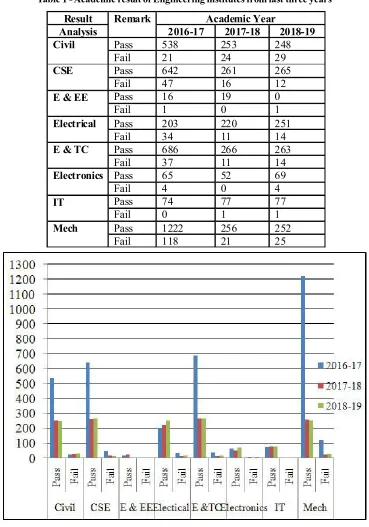
Table 1 - Academic result of Engineering institutes from last three years
Result Remark Academic Year
Analysis 2016-17 2017-18 2018-19
Civil Pass 538 253 248
Fail 21 24 29
CSE Pass 642 261 265
Fail 47 16 12
E & EE Pass 16 19 0
Fail 1 0 1
Electrical Pass 203 220 251
Fail 34 11 14
E & TC Pass 686 266 263
Fail 37 11 14
Electronics Pass 65 52 69
Fail 4 0 4
IT Pass 74 77 77
Fail 0 1 1
Mech Pass 1222 256 252
Column Chart - 1
Source of data: Examination & Control department, Punyshlok Ahilyadevi Holkar Solapur University, Solapur
In above graph it shows the overall result performance of all Engineering institutions with implementation of KM and it shows the impact of such practices on Institutes.
9. Implications of using IT in knowledge management in engineering
Institutions
1. Due to the use of information technology and communication in knowledge management, the teaching work of the teachers has been made pleasant and effective.
2. In the traditional teaching methodology, leaving behind the tradition of sitting in the classroom, IT and communication are being used to get information from anywhere in the college campus. Because of this, curiosity and interest are being created among students in colleges today.
3. Due to the creation of a central information storage system (Digital library) for the study of the college students, those are frequently using it today. Therefore, their tendency to study is day by day increasing.
4. IT enabled software has been implemented in every department for the dissemination of knowledge towards helping students in their practical work effectively. Due to this no. of research has been conducted as well as research paper has been written in different areas by the teachers and students.
5. For the development of the personality and overall development of the students, the computer system has been implemented in the college to deal with many topics like behavior science, communication, and intellectual science. As a result, you are feeling the urgency of getting a job at a company. Also academic results are increased positively by last three years.
6. Today, the student is positively looking at the change in information management and knowledge technology in engineering colleges. Also, if there is a radical change in the field of engineering in the coming days, it will not be possible for the students to say that their education will be convenient as the system is working.
10. Conclusion
and technology is a competent tool and vehicle that is essential to the implementation of students' interests. Through this research paper you can see that knowledge management is being implemented very well in the College of Engineering under Solapur University using information and technology. As a result, today you are discovering new research, research papers, new experiments in various departments, invention of cutting edge tools etc. in the institutes. In the same way, if the prevalence of IT in knowledge management increases in the future, there will definitely be an increase in researchers in the society and it will benefit to the society.
References
1. Knowledge Management in Theory and Practice - by Kimiz Dalkir, Jay Liebowitz (foreword), 2011 2. Knowledge Management - Paul Gamble & John Blackwell (2001)
3. Knowledge management Elias M. Awad, Hassan Ghaziri 2004, English, Book edition
4. Application of Knowledge management in management education: A Conceptual Framework - Journal of theoretical and applied information technology (2002)
5. A study on the effect of using A Knowledge Management System on Design Education- (Johannessen and Olsen, 2003).
6. The role of ICT in higher education for the 21st century: ICT as a change agent for education Ron Oliver -Edith Cowan University, Perth, Western Australia -2002
7. Analysis of Knowledge Management within Five Key Areas-Alireza Anvari, Gholam-Abbas Alipourian-October 2011
8. Exploring the use of knowledge management practices in an academic library in a changing information environment- Judith Mavodza1 and Patrick Ngulube2 (SA Jnl Libs & Info Sci 2011, 77(1))