PLANT PATHOLOGY AND NEMATOLOGY
Identification of Factors that Influence Screening for Bacterial Blight Resistance
T. A. Wheeler*, U. S. Sagaram, G. L. Schuster, and J. R. Gannaway
T.A. Wheeler and J.R. Gannaway, Texas Agricultural Experiment Station, 1102 E. FM 1294, Lubbock, TX 79403; U.S. Sagaram, Dept. of Plant Pathology and Microbiology, Texas A&M University, Box 2132, College Station, TX 79480; G.L. Shuster, West Texas A&M University, Division of Agriculture, Box 60998, Canyon, Texas 79016-0001. Corresponding author: [email protected]
ABSTRACT
Inoculation of plant pathogenic bacteria in field plots has been improved by the use of organosilicone surfactants. Factors, such as cul-tivars, number of applications, crop stage, plant density, concentration of bacteria, and irrigation application method (overhead spray versus drop hoses), that may affect field screening of cotton cultivars for resistance to bacterial blight caused by Xanthomonas axonopodis pv. malvaceaum
(Xam) were tested. Plants were inoculated with Xam (race 18) plus the organosilicone non-ionic wetting agent, Silowet L-77 (0.25% v/v). Disease incidence (DI) was similar for plants inoculated with Xam 1, 2, and 3 times. DI was not affected by Xam concentration when applied at 106 to 108
cfu/ml. DI was affected by the number of leaves at the time of inoculation for a susceptible cultivar (Paymaster 2326 RR) in 1 of 3 tests. The number of leaves at the time of inoculation had no effect on DI of the susceptible cultivar (PM 2326 RR), a partially resistant cultivar (PM 2200 RR), or an immune cultivar (FiberMax 960BR) in two tests. Plant density ranging from 3 to 16 plants/m row positively affected DI for PM 2326 RR and negatively affected DI for PM 2200 RR, although the effect of plant density was small. Overhead irrigation increased DI in PM 2200RR compared with drop hoses, but irrigation method did not affect DI for PM 2326RR. Based on these results, the suggested protocol for inoculating plants is as follows: 106 cfu/ml Xam plus Silowet L-77 (0.25%
v/v) applied in 470 L/ha of water over the top of cotton. Number of leaves (2 to 8), plant density (3 to 16 plants/m row), and irrigation method did not
substantially affect the ability to distinguish be-tween susceptible and partially resistant cultivars. Environmental factors had a smaller affect than cultivar (susceptible versus partially resistant) on the development of symptoms.
B
acterial blight caused by Xanthomonasaxonopodis pv. malvacearum (Xam) can
cause significant yield losses of cotton (Gossypium
hirsutum L.) (Hillocks, 1992). Xam causes
seedling blight, angular leaf spot, black arm, or boll blight (Smith, 1920) and infects plants through open stomata, wounds, and bolls (Bird and Smith, 1961).
Bacterial blight damaged cotton in all regions of the U. S. Cotton Belt during the 1940s and 1950s. In the United States, large-scale development of resistant cultivars for bacterial blight began in the late 1940s with the release of resistant cultivars starting in 1955 (Bird, 1986). Early cultivars were not effective in reducing disease because of the ap-pearance of new races of Xam (Bird, 1986). Based on disease reactions of 10 host differentials, there are 19 races of Xam (El-Zik et al., 2001). Currently in the United States, as well as other countries, race 18 is the most frequently encountered race (Allen and West, 1991; Hussian, 1984; Thaxton et al., 2001; and Verma and Singh, 1975). In Texas, more than 75% of the cultivars planted in the last 5 years were susceptible to race 18 of Xam (Thaxton et al., 2001). There are sources of stable immunity to all races of bacterial blight (Brinkerhoff et al., 1984), except a new race identified in the Upper Volta and Sudan (Bush, 1983).
bacteria (Johnson et al., 1996; Sheikh, et al., 2001; Zidack et al., 1992). The objective of this study was to determine how various application methods and plant and environmental parameters affect develop-ment of bacterial blight symptoms in field plots of cotton when bacterial inoculum was applied with an organosilicone non-ionic wetting agent.
METHODS AND MATERIALS
Field studies were conducted in 2001 and 2002 at the ‘City Farm’ field in Lubbock, TX. Two tests were planted in 2004; one at the City Farm and the other at the Texas A&M Research and Extension Center, Lubbock. Plots (15.3-m long by 2- rows wide with 1-m row spacing) were planted (17 kg ha-1 of
seed) using a 4-row cone planter on 22 May 2001, 14 May 2002, and 20 May 2004 (Texas A&M) and 26 May 2004 (City Farm). All tests were arranged in a randomized complete block design with four replications. Except in the irrigation study, the test area in 2001 and 2002 was irrigated (127 kl/ha) 2 to 3 d after inoculation for all treatment dates and areas with a linear system containing overhead sprinklers. Furrow irrigation was used for the two fields in 2004.
Bacterial inoculations were made at the 8- to 10-leaf stage, unless otherwise specified, at 106 colony
forming units (cfu)/ml (2001, 2004) or 107 cfu/ml
(2002) in 470 L/ha of tap water + organoslicone non-ionic wetting agent (Silwet L-77; Loveland Industries; Greeley, Co) at 0.25% v/v. There were two methods of application, depending on the test; a Co2 backpack sprayer at 124 Kpa and TeeJet
8002VS nozzles (Spraying Systems Co.; Wheaton, IL), or a tractor driven sprayer at 83 Kpa and TeeJet 8008 nozzles.
Three isolates of Xam (IS-3, IS-9, and IS-15) were obtained from Dr. Peggy Thaxton (Missis-sippi State Univ.; Stoneville, MS) and used in equal proportions in 2001. In 2002 and 2004, only IS-15 was used since the other two isolates did not express leaf symptoms in 2002. Bacterial cultures were maintained by transferring bacteria onto potato car-rot dextrose agar (PCDA) (Bird and Blank, 1951) every 10-14 d during the inoculation period, and from frozen stock cultures at the start of the inocu-lation period. The inoculum for field applications was grown in trypticase soybroth (30 g/L, Thomas Scientific; Swedesboro, NJ) for 36 h on a wrist action shaker (Model 75; Burrell Scientific Inc.; Pittsburgh,
PA) at room temperature. Room temperature ranged from 21 to 23 °C. The concentration of Xam was checked by dilution plating on PCDA.
Plots were rated when water soaked lesions were visible on the under and upper surface of the leaves, which occurred between 14 and 21 d after application. Disease incidence (DI) was based on the number of plants per plot with any leaf disease symptoms, divided by the total number of plants per plot. no effort was made to rate disease with regard to lesion size, number of lesions per leaf, or number of leaves with symptoms per plant.
Application number. The effect of one, two, and three bacterial applications was determined on ‘Paymaster (PM) 2326 RR’ (Delta and Pine Land Co.; Scott, MS). In 2001, applications were made on 17 July (all plots), 25 July (only plots receiving two or three applications), and 1 August (only plots receiving three applications). In 2002, the applica-tions were made on 10 July, 17 July, and 24 July. The Co2 backpack sprayer was used to make applications
both years.
Bacterial concentration. In 2001, Xam was applied at 105, 106, and 107 cfu/ml and in 2002 at
106, 107, and 108 cfu/ml. The Co
2 backpack sprayer
was used to make the applications on 17 July for both years. Two cultivars included in the test were PM 2326 RR and PM 2200 RR (Delta and Pine Land Co.). Years were analyzed separately, since the concentrations used were not the same in both years. Bacterial concentration was transformed to log10 (cfu/ml) in the analysis.
Plant development stage. Applications were made when the majority of plants were at the 2-, 4-, 6-, or 8-leaf stage in 2002 and 2004. The Co2
interactions were not significant for DI, then cultivar means and standard errors were obtained, and the combinations of FM 960 BR versus PM 2200 RR and PM 2200 RR versus PM 2326 RR were compared with a t-test (P ≤ 0.05).
Plant density. Plots were adjusted to 10, 16, and 20 plants/m row in 2001 and 3, 10, and 16 plants/m row in 2002. Both PM 2326 RR and PM 2200 RR (Delta and Pine Land Co.) were included in the test. Applications were made with the Co2 backpack
sprayer in 2001 and the tractor driven sprayer in 2002. In 2001, applications were made to all plots on 17 July, 25 July, and 1 August. In 2002, applica-tions were made to all plots on 10 July and 17 July. Since plant densities were different between years, the analysis was run separately by year.
Irrigation method. overhead sprinkler irrigation was compared with a low energy precision application (LEPA) method using drop hoses that placed the water directly on the soil without splashing on the plants (Bordovsky et al., 1992). Both irrigation treatments were applied simultaneously by the linear irrigation system at 127 kl/ha. The plot size was adjusted so that the overhead nozzles treated six rows, while the LEPA plots were two rows. The irrigation event was delayed for at least one day after inoculum applica-tion to allow the bacteria time to infect without being washed-off the leaves. The plots were inoculated with a tractor driven sprayer in both years. The bacteria were applied on 17 and 25 July in 2001 and 10 and 17 July in 2002. Both PM 2326 RR and PM 2200 RR (Delta and Pine Land Co.) were included in the test. If the interaction between cultivar and irrigation treat-ment was significant, t-tests (P < 0.05) were used to compare PM 2200 RR with LEPA versus PM 2200 RR with overhead and PM 2326 RR with LEPA versus PM 2326 RR with overhead.
Statistical analysis. Analysis of these ex-periments was with mixed linear models (PRoC MIXED) using SAS (version 9.1; SAS Institute; Cary, NC). A factor was considered significant at
P < 0.05. Fixed factors included year, number of applications, leaf stage, plant density, bacterial con-centration, cultivar, and irrigation. Random factors were block and site.
Relationship of environmental factors to disease incidence. The weather station at the Texas A&M Research and Extension Center, Lubbock, TX, was used to collect weather data (maximum tem-perature, minimum temtem-perature, maximum relative humidity, minimum relative humidity, wind speed,
solar radiation, and rainfall) on the dates that Xam was applied and for 2 wk after application. Relative humidity measurements were used only for the 24 hr after application. Temperature, wind, and solar radiation measurements were analyzed as an aver-age for the 2 wk following application. The sum of precipitation for 2 wk following application was used in the analysis. only tests that were treated once with Xam were included in the analysis [ap-plication test with one ap[ap-plication (2001 and 2002); bacterial concentration for 106 and 107 cfu/ml (2001
and 2002); application for different growth stages, using only the 8-leaf stage in 2002 and all growth stages in 2004]. The variable cultivar was included and given a value of 0 for PM 2200 RR and 1 for PM 2326 RR. FM 960 BR was not included in the overall analysis. Bacterial concentration at either log10(106) or log10(107) cfu/ml was also included as
a factor. Disease incidence for each observation was included as the dependent variable. Stepwise regres-sion (PRoC STEPWISE) was used to determine which environmental factors had a significant (P < 0.05) effect on disease incidence. The procedure was run on all variables listed and also on each cultivar separately (including FM 960 BR).
RESULTS AND DISCUSSION
Application number. The effect of year on DI was significant (P = 0.0001), but the number of applications and the interaction between year and number of applications were not (1 = 90% DI, 2 = 90% DI, and 3 = 92% DI). PM 2326 RR averaged 85% DI in 2001 and 97% in 2002. Based on these results, one application is recommended when field screening for bacterial blight resistance.
Bacterial concentration. In 2001, disease incidence was significant for cultivar (average DI = 28 and 58% for PM 2200 RR and PM 2326 RR, P = 0.05), bacterial concentration (P = 0.0002), and their interaction (P = 0.01). The slope of the equation esti-mated for PM 2200 RR was not significantly greater than 0, but there was an increase in DI with increas-ing bacterial concentration for PM 2326 RR (Fig. 1). The model predicting DI for PM 2326 RR was DI = -103.3 + 26.9(log10 cfu/ml). The difference in DI
between the susceptible and the partially resistant cultivar was not as obvious at 105 cfu/ml as at higher
concentrations (Fig. 1), so 105 cfu/ml was eliminated
and a higher rate (108 cfu/ml) was substituted in
on DI (average DI = 18 and 98% for PM 2200 RR and PM 2326 RR, P = 0.001). Innes and Last (1961) and Gunn and Innes (1961) observed a significant reduction in disease severity when concentrations were reduced below 106/ml of Xam. The proportion
of reduction in disease severity was higher for sus-ceptible cultivars than resistant cultivars as bacterial concentrations were reduced below 106/ml. A range
from 106 to 107 cfu/ml has been used successfully in
other bacterial blight breeding programs to identify resistance (Hopper et al., 1975; Thaxton and El-Zik, 1993). In these studies, at least 106 cfu/ml was
nec-essary to distinguish between cultivars. The use of an organosilicone non-ionic wetting agent did not permit a reduction of the bacterial concentrations used in other programs to identify resistance.
Reyes, 1983). Dizon and Reyes (1983) also found that 60-day-old cotton leaf lesions were more typi-cal of a resistant response than for cotton treated at a younger age. In the current study, the top leaves were the primary recipients of the bacteria, so while number of leaves at the time of spraying changed over time, leaf age at treatment was similar. Leaf lesions were not different in size and showed water soaked symptoms on the under side for all leaf stages treated. Last (1959) injected Xam directly into the main vein of leaves and determined that older leaves were more resistant than younger leaves; however, on plants of different ages, the younger leaves from a range of plant maturities (except for the very young-est leaf) were similar in the spread of disease. So leaf age was important for susceptibility in the study by Last (1959), but not plant age.
Plant density. DI was not affected by plant den-sities of 10 to 20 plants/m in 2001 on either cultivar, but cultivar had a significant (P = 0.0001) effect on DI (average DI was 95 and 22% for PM 2326 RR and PM 2200 RR, respectively). In 2002, cultivar (P
= 0.0001) and the interaction between plant density and cultivar were significant (P = 0.004) for DI. Plant density ranged from 3 to 16 plants/m row in 2002. Both cultivars were fitted with linear models that contained significantly different intercept and slope values (Fig. 2). The model for PM 2200 RR was DI = 34.5 – 1.3(plant density). The model for PM 2326 RR was DI = 90.9 + 0.4(plant density). If the choice is to maximize the differences between a susceptible and partially resistant cultivar, then the higher plant density (16 plants/m row) resulted in the greatest predicted differences between the two cultivars. There were differences in DI between susceptible and partially resistant cultivars at all densities tested.
10 40 70 100
5 6 7 8
Log10(cfu/ml)
Disease
incidence (%)
Figure 1. Effect of Xanthomonas axonopodis pv. malvaceraum
(Xam) concentration on disease incidence (DI) of plants with bacterial blight symptoms on leaves. A susceptible cultivar, Paymaster (PM) 2326 RR in 2001 ( ) was fitted with the equation: DI = -103.3 + 26.9(Log10 cfu/ml) . PM
2326 RR in 2002 ( ) and PM 2200 RR in 2001 ( ) and 2002 ( ) were not affected by Xam concentration.
Plant development stage. In 2002, number of leaves significantly (P = 0.001) affected DI (leaf stage 2 = 95%, 4 = 98%, 6 = 97%, and 8 = 99%), al-though there was little difference in disease incidence among the number of leaves. In 2004, only cultivar had a significant (P = 0.0001) effect on DI. Site, leaf stage, and all interactions were not significant. The comparisons tested indicated that FM 960 BR was significantly (P = 0.0001, DI = 1%) more resistant than PM 2200 RR (DI = 19%), and PM 2200 RR was more resistant than PM 2326 RR (P = 0.0001, DI = 71%). The results in 2002 contradicted the results in 2004; however, there was only a 4% difference in DI between leaf stages in 2002. The technique appears to be relatively insensitive to leaf stage.
When cotton leaves were sprayed with Xam in water or water plus carborundum, there was a delay of symptom development for 60-d-old cotton compared with 10- to 40-day-old cotton (Dizon and
Disease
incidence (%)
0 25 50 75 100
0 5 10 15 20
Plants per m row
Figure 2. Effect of plant density on disease incidence (DI) of plants inoculated with Xanthomonas axonopodis pv.
malva-ceraum. DI for Paymaster (PM) 326 RR ( ) increased as
Irrigation method. Data were not analyzed for 2001, because there were significant rainfall events between inoculation and rating. In 2002, cultivar (P
= 0.0001) and cultivar by irrigation method interac-tion (P = 0.008) were significant for DI. PM 2326
RR had similar levels of disease incidence between irrigation methods (DI =98% for overhead spray and 99% for LEPA), while PM 2200 RR had higher dis-ease incidence with overhead spray irrigation (20%) than with LEPA (15%). King and Brinkerhoff (1949) demonstrated that Xam could be spread by sprinkler irrigation in the absence of rain. Schnathorst et al. (1960) noticed a higher incidence of bacterial blight in California in areas where sprinkler irrigation was used compared to areas with furrow irrigation. The overhead sprinkler would promote splashing over the entire plant, while the LEPA method would be placing the water directly on the soil without splash-ing the plants. It was easy to differentiate between susceptible and partially resistant cultivars with either method of irrigation.
Relationship of environmental factors to dis -ease incidence. The best model to predict the role of environmental factors on DI included cultivar (partial
R2 = 0.78) as a positive factor, average relative
humid-ity on the day of application as a positive factor (partial
R2 = 0.01), maximum temperature averaged over 2 wk
as a negative factor (partial R2= 0.03), and solar
radia-tion as a positive factor averaged over 2 wk (partial R2
= 0.01). The environmental factors had a smaller role in predicting DI than genotype (susceptible versus a partially resistant cultivar). No model could be fitted for FM 960 BR, since no factors were significant at
P < 0.05. The best model for PM 2200 RR included only minimum average temperature for the 2 wk after inoculation (R2 = 0.25). Disease incidence increased
by 3.4% for each degree increase in average minimum temperature. For the susceptible cultivar PM 2326 RR, the best fitting model included bacterial concentration (12% increase in disease incidence when inoculum was increased from 106 to 107 cfu/ml, partial R2 =
0.24); maximum relative humidity (1% increase in disease incidence for each 1% increase in relative humidity, partial R2 = 0.05); and average temperature
(3.7% increase in disease incidence for each degree increase in temperature, averaged over the 2 wk fol-lowing application, partial R2 = 0.10).
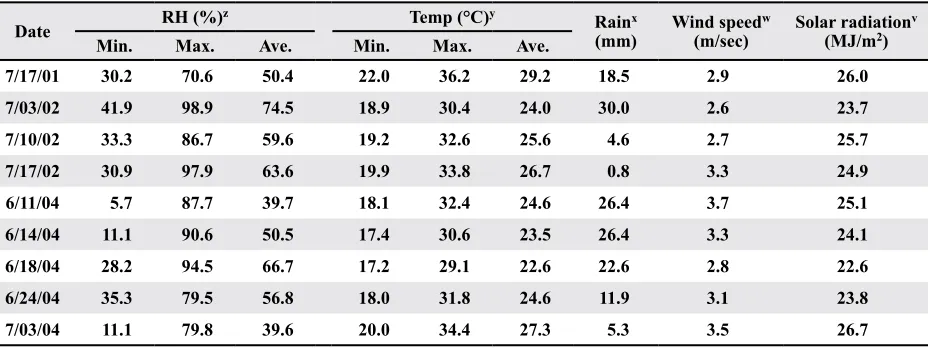
Stoughton (1932; 1933) found that high relative humidity (> 85%) for 48 hr after application was important for good infection. After that, relative humidity did not influence the expression of disease. In these tests, the maximum relative humidity on the day of application ranged from a low of 70.6% on 17 July 2001 to a high of 98.9% on 3 July 2002 (Table 1). This factor only explained 5% of the variation in DI for PM 2326RR. The protocol appears to be relatively insensitive to high relative humidity for the 48 hr following application.
Table 1. Environmental parameters during the day of application and for the 2 wk after application with Xanthomonas
axonopodis pv. malvacearum
Date Min. RH (%)Max. z Ave. Min. Temp (°C)Max. y Ave. (mm)Rainx Wind speed(m/sec) w Solar radiation(MJ/m2) v
7/17/01 30.2 70.6 50.4 22.0 36.2 29.2 18.5 2.9 26.0
7/03/02 41.9 98.9 74.5 18.9 30.4 24.0 30.0 2.6 23.7
7/10/02 33.3 86.7 59.6 19.2 32.6 25.6 4.6 2.7 25.7
7/17/02 30.9 97.9 63.6 19.9 33.8 26.7 0.8 3.3 24.9
6/11/04 5.7 87.7 39.7 18.1 32.4 24.6 26.4 3.7 25.1
6/14/04 11.1 90.6 50.5 17.4 30.6 23.5 26.4 3.3 24.1
6/18/04 28.2 94.5 66.7 17.2 29.1 22.6 22.6 2.8 22.6
6/24/04 35.3 79.5 56.8 18.0 31.8 24.6 11.9 3.1 23.8
7/03/04 11.1 79.8 39.6 20.0 34.4 27.3 5.3 3.5 26.7
z Minimum, maximum, and average relative humidity (RH) were taken for the 24 hrs of the day of application. y Minimum, maximum, and average temperature (°C) were obtained for the 2 wk after application, which presumably
represented the period of infection.
Stoughton (1931; 1933) found that the amount of infection resulting from spray inoculation depended on the prevailing mean temperature during the infec-tion period, and that the actual temperature at the time of inoculation was not important. Stoughton found that high average temperature (35 °C) for the infection period favored disease, and as temperature decreased, so did disease. Analysis also indicated that disease increased as either the minimum air temperature or average temperature increased for the 2 wk following inoculation. Temperature appeared to be a more important factor than relative humid-ity since it explained 25% of the variation in DI for PM 2200RR and 10% of the variation in DI for PM 2326RR. The use of an organosilicone non-ionic wetting agent did not eliminate the importance of warm temperatures on disease development.
Stoughton’s research was conducted on a suscep-tible cotton cultivar. Brinkerhoff and Presley (1967) found that temperature could affect the expression of resistance in partially resistant cultivars, but had little effect on immune or susceptible cultivars. The par-tially resistant cultivars were susceptible under cool night temperatures (19 °C) and warm day tempera-tures (36.5 °C), but were resistant under cool nights (19 °C) and moderate day temperatures (25.5 °C), moderate night and daytime temperatures (26.5 °C), and moderate night temperatures (26.5 °C) and warm day temperatures (36.5 ° C). For the partially resistant cultivar PM 2200 RR, disease incidence increased as minimum temperature increased. For this cultivar, the range for minimum temperature was a low of 17.2 °C (18 June 2004) and a high of 22.0 °C (17 July 2001) (Table 1). Disease incidence was higher as night time temperature increased, which is not in agreement with Brinkerhoff and Presley (1967), although the level of resistance in PM 2200 RR is also low (Sagaram et al., 2003) and may not be comparable to the resistant genes tested by Brinkerhoff and Presley (1967). The immune cultivar FM 960 BR was not affected by environmental parameters tested.
The key to successful screening is an aggressive isolate of Xam applied at or greater than 106cfu/ml
and using Silowet L-77. The number of applications, plant growth stage at the time of application, plant density, and irrigation method had little or no affect in screening for susceptible and partially resistant germplasm. Another benefit of using Silowet L77 was that symptoms developed regardless of the time of day that material was sprayed (Sagaram et al., 2003). In our breeding program, plants are sprayed between
0900 and 1600 h (9 AM and 4 PM), and symptoms develop regardless of the time of day sprayed. When bacterial infiltration is dependent on pressure spraying, then spraying was only done early in the day when the stomates were open (Hunter et al., 1968).
Additional observations made over the three years of experiments indicated that the bacterial blight leaf symptoms only occurred in the plots that were sprayed with the bacteria plus Silowet L77. Disease was only present in treated plots at the time of rating. Since Xam is capable of considerable spread under natural disease conditions, it is useful that spraying Xam with this technique will not start an epidemic. The damage to the plants treated was minimal, with the most common symptom being leaf spots on the treated leaves. In general, leaves that formed after the application were not symptomatic. In most cases, diseased leaves fell off the plants, and by the end of the season few leaves with symptoms could be found on the plants. This means that plants can be treated where seed is in limited quantity, without causing plant death. There may be a small amount of boll symptoms, and seed infection as a result of these applications.
Screening germplasm for bacterial blight resis-tance against race 18 of Xam is a simple procedure with no risk to an adjacent or surrounding nursery. Applications can be made under a range of conditions, but it is important to avoid rains soon after applica-tion. Disease incidence varied from year to year or application to application, but the comparisons between susceptible, partially resistant, and resistant cultivars were always significant.
ACKNOWLEDGEMENTS
The authors are grateful for the financial help provided by Plains Cotton Improvement Program, Dr. Peggy Thaxton for help with bacterial blight cultures and protocols, and the Texas Agricultural Experiment Station.
REFERENCES
Allen, S. J., and K-L. D. West. 1991. Predominance of race 18 of Xanthomonas campestris pv. malvacearum on cotton in Australia. Plant Dis. 75:43-44.
Bird, L.S., and L.M. Blank. 1951. Breeding strains of cotton resistant to bacterial blight. Bulletin 736. Texas Agricul-tural and Mechanical College System, College Station, TX.
Bird, L.S., and H.E. Smith. 1961. Bacterial blight of cotton. MP-534. The Agricultural and Mechanical College of Texas, Texas Agric. Exp. Stn. - Texas Agric. Extension Serv., College Station, TX.
Brinkerhoff, L. A., and J. T. Presley. 1967. Effect of four day and night temperature regimes on bacterial blight reactions of immune, resistant, and susceptible strains of upland cotton. Phytopath. 57:47-51.
Brinkerhoff, L. A., L. M. Verhalen, W. M. Johnson, M. Es-senberg, and P. E. Richardson. 1984. Development of im-munity to bacterial blight of cotton and its implications for other diseases. Plant Dis. 68:168-173.
Bordovsky, J. P., W. n. Lyle, R. J. Lascano, and D. R. Up-church. 1992. Cotton irrigation management with LEPA systems. Trans. ASAE 35:879-884.
Bush, D. L. 1983. Report of the bacterial blight committee. p. 5. In Proc. Beltwide Cotton Prod. Res. Conf., San Antonio, TX. 2-6 Jan. 1983. natl. Cotton Counc. Am.,
Memphis, Tn.
Dizon, T. o., and T. T. Reyes. 1983. Different methods of inoculating cotton (Gossypium hirsutum L.) at various ages with Xanthomonas malvacearum (E. F. S.) Dowson. Phil. Agric. 66:337-344.
El-Zik, K.M., P.M. Thaxton, and J.B. Creech. 2001. A pedi-gree analysis of cotton cultivars affected by bronze wilt. p. 105-107. In Proc. Beltwide Cotton Conf., Anaheim, CA. 9-13 Jan. 2001. natl. Cotton Counc. Am., Memphis, Tn.
Gunn, R. E., and n. L. Innes. 1961. Bacterial blight of cotton: effect of inoculum concentration upon severity of leaf infection. Empire Growing Rev. 38:279-283.
Hillocks, R. J. 1992. Bacterial blight. p. 39-85. In R. J. Hill-ocks (ed.) Cotton diseases. CAB Int. Wallingford oxon, UK.
Hopper, D. G., R. J. Venere, L. A. Brinkerhoff, and R. K. Gholson. 1975. necrosis induction in cotton. Phytopath. 65:206-213.
Hunter, R. E., L. A. Brinkerhoff, and L. S. Bird. 1968. The development of a set of upland cotton lines for differen-tiating races of Xanthomonas malvacearum. Phytopath. 58:830-832.
Hussian, T. 1984. Prevalence and distribution of Xanthomon-as campestris pv. malvacearum races in Pakistan and their reaction to different cotton lines. Trop. Pest Man-age. 30:159-162.
Innes, n. L., and F. T. Last. 1961. Cotton disease symptoms caused by different concentrations of Xanthomonas mal-vacearum. Empire Cotton Growing Rev. 38:27-29.
Johnson, D.R., D.L. Wyse, and K.J. Jones. 1996. Controlling weeds with phytopathogenic bacteria. Weed Technol. 10:621-624.
King, C. J., and L. A. Brinkerhoff. 1949. The dissemination of
Xanthomonas malvacearum by irrigation water. Phyto-path. 39:88-90.
Last, F. T. 1959. Leaf infection by Xanthomonas malva-cearum (EFSm) Dowson. Ann. Appl. Biol. 47:647-657. Sagaram, U. S., G. L. Schuster, R. A. Thomason, T. A.
Wheeler, and J. L. Gannaway. 2003. Performance of commercial cotton cultivars against bacterial blight pathogen in the Texas High Plains. p. 257-260. In Proc. Beltwide Cotton Conf., nashville, Tn. 6-10 Jan. 2003. natl. Cotton Counc. Am., Memphis, Tn.
Schnathorst, W. C., P. M. Halisky, and R. D. Martin. 1960. History, distribution, races, and disease cycle of Xan-thomonas malvacearum in California. Plant Dis. Rep. 44:603-608.
Sheikh, T., T. A. Wheeler, P. A. Dotray, and J. C. Zak. 2001. Biological control of woollyleaf bursage (Ambrosia grayi) with Pseudomonas syringae pv. tagetis. Weed Technol. 15:375-381.
Smith, E. F. 1920. Bacterial diseases of plants. Saunders Co., Philadelphia.
Stoughton, R. H. 1931. The influence of environmental condi -tions on the development of angular leaf spot disease of
cotton. 3. The influence of air temperature on infection.
Ann. Appl. Biol. 18:524-534.
Stoughton, R. H. 1932. The influence of environmental condi -tions on the development of angular leaf spot disease
of cotton. 4. The influence of atmospheric humidity on
infection. Ann. Appl. Biol. 19: 370-377.
Stoughton, R. H. 1933. The influence of environmental condi -tions on the development of angular leaf spot disease of
cotton. 5. The influence of alternating and varying condi -tions on infection. Ann Appl. Biol. 20:590-611.
Thaxton, P. M., T. D. Brooks, and K. M. El-Zik. 2001. Race
identification and severity of bacterial blight from
natural infestations across the Cotton Belt. p. 137-138.
In Proc. Beltwide Cotton Conf., Anaheim, CA. 9-13 Jan. 2001. natl. Cotton Counc. Am., Memphis, Tn.
Thaxton, P. M., and K. M. El-Zik. 1993. Methods for screen-ing and identifyscreen-ing resistance to the bacterial blight pathogen in cotton in the MAR program. p. 211-212. In
Proc. Beltwide Cotton Conf., new orleans, LA. 10-14 Jan. 1993. natl. Cotton Counc. Am., Memphis, Tn. Verma, J. P., and R. P. Singh. 1975. Studies on the distribution
of races of Xanthomonas malvacearum in India. Indian Phytopathol. 28:459-463.