Abstract—The aim of the present study was examination the ability of different contents of kiwi shell to adsorb different types (cadmium, nickel and lead) and concentrations (5, 10, 20, 30, 40, 50 and 100 mgl-1) of heavy metal ions from aqueous solutions. The kiwi shell samples were collected from gardens of northern Iran, washed and grounded to assess the monometal and competitive adsorption behavior of Cd, Ni and Pb on the kiwi shell. The sum of adsorbed heavy metals on the kiwi shell could well described using both the Freundlich (R2 between 0.92 – 0.98) and Langmuir (R2 between 0.96 – 0.99) equations. All of the sorption isotherms were of the L-curve type. Results from the batch experiments show that the maximum adsorption capacities of the metals by the kiwi shell were in the order of Pb >> Ni > Cd based on the both monometal and competitive systems. The distribution coefficient (kd), Freundlich capacity coefficient (kF) and Langmuir maximum capacity (a) were higher in monometal than in competitive system. Competition significantly reduced metals k�, especially for Cd and Ni. The sorption capacity in different contents of kiwi shell was in the order of 5 > 3 > 1 g for the metals. The total sorption amount increased with the increasing the initial concentration of the metal; however, distribution coefficient values for each metal concentration at both systems indicated that the kiwi shell capacities for sorption decreased with increasing the initial concentration of the metals.
Index Terms—Kiwi shell, sorption of heavy metals.
I. INTRODUCTION
Heavy metals are naturally occurring elements that have a high atomic weight and a density at least 5 times greater than that of water. These metals are toxic pollutants that released into the environment as a result of different activities such as industrial, mining, and agricultural activities [1]. Disposal of industrial, agricultural and urban effluents has led to a significant increase in metal contamination of water systems [2]-[4]. As a result of this problem, the need to remove and recovery these heavy metals from polluted water resources have been on the increase. It has been applied various processes to eliminate the metals from water and wastewater such as chemical precipitation, electrochemical reduction, ion-exchange, reverse osmosis, solvent extraction and evaporation, etc. [5]. However, these processes have not been used extensively because of their high cost. Hence, more economical techniques such as adsorption and the use of low-cost sorbents for removal of toxic metals from wastewater has been a focus [5]. Therefore, there is a need to search an effective low cost adsorbent for economical wastewater treatment. In recent years, low-cost adsorbents
Manuscript received June 24, 2016; revised September 6, 2016. R. Galeshi. is with the Corporation of Mehravijhe, Iran (e-mail: [email protected]).
are widely used to remove heavy metals from waters. Adsorbents, such as sawdust [6], tourmaline [7], rice husk [8], chitosan [9], manure compost [10], charcoal [11], lawny grass [12], activated carbon [13], tea waste [14] and pistachio hull biomass [15], have been successfully applied for physical removal of heavy metals. Agricultural residues contain lignin and cellulose, which usually constitute the main structure of it. There are compounds such as hemi-cellulose, lipids, proteins, glucose, starch, water, hydrocarbons and other compounds in their structure, also. These groups have the ability to link with heavy metals in solution by replacing hydrogen ions or giving pair of electrons of these groups to form complexes with metal ions. Kiwi is one of the most important horticultural products in northern Iran. Kiwi shell is considered as one of relevant natural absorbent, because it is disregarded after use [16]. The aim of the present study is examination the potential of kiwi shells to adsorb heavy metal ions from aqueous solutions. The effect of adsorbent doses, metal concentrations and metal type on the removal of heavy metal ions was studied and the adsorption isotherms and probable mechanism were explained, also.
II. MATERIAL AND METHODS
Kiwi shells obtained from gardens of northern Iran were washed several times by distilled water to remove all dirt particles. The washing process was continued by 0.1 M nitric acid and distilled water till the wash water contained no color. The washed shells were then ground, using a ball mill, sieved through 40 mesh size, poured into polyethylene tubes and exposed by solution of 0.5 M CaCl2 at 150 rpm on a shaker to saturate the surface of sorbent by calcium and remove all of the exchangeable cations on the surface of kiwi shell. Then the kiwi shell was exposed by solution of 0.01 M NaOH for 30 min on a shaker at 150 rpm, centrifuged for 15 min at 3000 rpm and dried in oven at 105 ◦C for 24 h.
1g from dried kiwi shell sample was weighed and poured into acid-washed polyethylene tubes and 20 ml of the stock solution of CdCl2, PbCl2 and NiCl2 at the concentrations of 5,
10, 20, 30, 40, 50 and 100 mgl-1 added to the tubes, individually. The tubes were shaken at 150 rpm for 24h, as the equilibrium time, at 25 ˚C. The kiwi shell samples dissolved in metal solutions (1:10w/v) were centrifuged initially at 3000 rpm for 15min to remove sediment. Then, the supernatant was filtered through filter paper (Wathman filters No.42). Cd, Pb and Ni concentrations in the supernatants were measured by atomic adsorption spectrophotometer.
Competitive adsorption isotherms were performed in the same way, but by adding Cd, Pb and Ni at a 1:1:1 ratio.
Monometal and competitive adsorption experiments had
Removal of Heavy Metals from Polluted Solutions Using
Kiwi Shell
conducted in constant pH (7-7.5). The control of pH was done by acid or base solutions and both mono- and multimetal experiments were carried out in a background electrolyte of 0.01 M CaCl2 and were replicated three times.
The presented results are the means of the three determinations.
The amount of sorbed metals by kiwi shell was calculated with the equation:
𝑞 =
𝐶𝑂−𝐶𝑒 𝑉𝑀 (1) where
𝑞
is the amount of adsorbed metal (mg kg−1), Co is the initial concentration of the metal in solution (mg l−1), Ce is the equilibrium concentration of the metal in solution (mg l−1), Vis the solution volume (ml), and M is the weight of dried sorbent (kg).
The distribution coefficient (𝐾𝑑), was calculated according to the following formula:
𝐾
𝑑 =𝐸𝑞𝑢𝑖𝑙𝑖𝑏𝑟𝑖𝑢𝑚 𝑚𝑒𝑡𝑎𝑙 𝑐𝑜𝑛𝑐𝑒𝑛𝑡𝑟𝑎𝑡𝑖𝑜𝑛 𝑎𝑑𝑠𝑜𝑟𝑏𝑒𝑑
𝐸𝑞𝑢𝑖𝑙𝑖𝑏𝑟𝑖𝑢𝑚 𝑚𝑒𝑡𝑎𝑙 𝑐𝑜𝑛𝑐𝑒𝑛𝑡𝑟𝑎𝑡𝑖𝑜𝑛 𝑖𝑛 𝑠𝑜𝑙𝑢𝑡𝑖𝑜𝑛
(2) The distribution coefficients for each metal concentration for the studied sorbent were calculated. An average Kd value
(Kdmedium) for each metal in the studied sorbent, which
calculated based on formula:
𝐾
𝑑𝑚𝑒𝑑𝑖𝑢𝑚 =Kd 5+Kd 10+Kd 20+Kd 30+Kd 40+Kd 50+Kd 100
7 , (3)
was used to comparing the adsorption capacities of different contents of kiwi shell for the metals.
Adsorption data were fitted to the following Freundlich and Langmuir equations.
The Freundlich equation can be expressed as:
𝑞 = 𝑘
𝐹𝐶
1𝑛 (4)where q (or x/m) and C (equilibrium concentration) were defined earlier, kF and n are Freundlich constants related to adsorption capacity and adsorption intensity, respectively. The linear form of the Freundlich isotherm is given by:
log 𝑞 = log
𝑘
𝐹+
1𝑛log 𝐶
(5)Freundlich parameters can be obtained by plotting log q
vs.log C, with 1
𝑛 being the slope and log kFbeing the intercept of the line.
The Langmuir adsorption equation can be expressed as:
𝑞 =
𝑎𝑚𝑏𝐶(1+𝑏𝐶) (6) where q and C were defined previously, amis the maximum
amount of adsorptive that can be adsorbed (monolayer capacity) and b is a constant related to the binding strength. The linear form of Langmuir isotherm equation is represented by:
1
𝑞
=
1
𝑎𝑚𝑏𝐶
+
1
𝑎 (7)
Plotting 1
𝑞 vs
1
𝐶, a straight line with slope 1 𝑎𝑚𝑏 and
intercept 1
𝑎𝑚 is obtained. The Langmuir parameters, am and b,
are calculated from the slope and intercept of the graphs. All of the above experiments were conducted at sorbent contents of 3 and 5 g, also and the presented results are the means of the three determinations.
III. RESULTS AND DISCUSSION
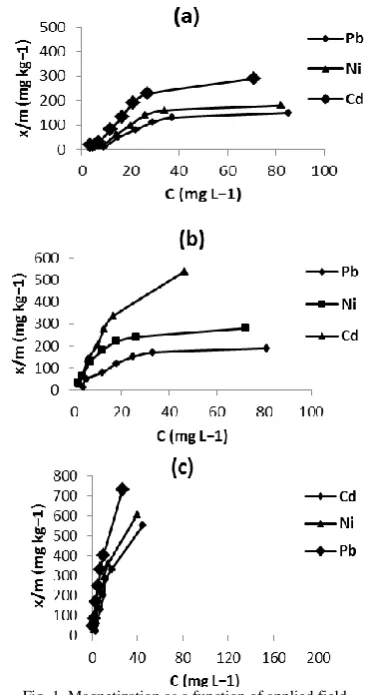
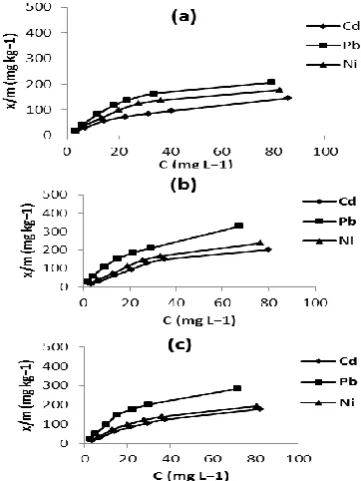
Fig. 1 and Fig. 2 illustrate the monometal and competitive adsorption isotherms, respectively for the studied metals by three contents of kiwi shell. On the 𝑦-axis, q represents the metal concentration sorbed onto kiwi shell and on the 𝑥-axis,
C represents metal equilibrium concentration in solution. As can be seen at Fig. 1 and 2, adsorption isotherms for the studied metals by the sorbent exhibited significant differences in shape and in the amount adsorbed.
Fig. 1. Magnetization as a function of applied field.
isotherms indicated a stronger affinity for Pb than Cd and Ni. Although, the metals had steeper slope at monometal system compared to competitive system, the three metals behaved identically in combination as they did when added individually; so that the both monometal and competitive adsorption isotherms of the metals were of the L-curve type at all of the sorbent contents, which characterized by a decreasing slope as concentration increases since vacant adsorption sites decrease as the adsorbent becomes covered. Such adsorption behavior could be explained by the high affinity of the adsorbent for the adsorptive at low concentrations, which then decreases as concentration increases [17].
Fig. 2. Competitive adsorption isotherms of Cd, Pb, and Ni n, Cd, and Cu in different contents of kiwi shell (a: 1, b: 3 and c: 5 g).
The distribution coefficient, the slope of a simple linear model, is often used to characterize the mobility of trace metals in aquatic environments; low Kd values imply that
most metal remains in solution, and high Kd values indicate
that the metal has great affinity for the sorbent [18], [19].
Distribution coefficient in the different contents of kiwi shell was in the order of 5 > 3 > 1 for all the metals.
The Kd values of the metals in monometal and competitive
systems (TABLE I) indicated that the order of reduced metal sorption was Pb > Ni > Cd in most of the cases.
Competition among the three metals reduced their Kd
values significantly in all contents of kiwi shell (TABLE I). Significant suppressive effects of competitive metals on the adsorption of a particular metal have also been reported by Antoniadis et al [20]. Although competition reduced sorption of all three metals, the magnitude of these effects was different for each metal. Cadmium Kdµ decreased by nearly
65% at contents of 1 gr due to competition, and by 61% at 2 gr and 64% at 5 gr. This compares to competition- induced reductions of around 51%, 50% and 47% for Pb at 1, 3 and 5 gr, respectively, and 59%, 58% and 57% for Ni at 1, 3 and 5 gr, respectively. This suggests that upon co-addition of the three metals to the kiwi shell, Pb, and to a lesser extent Ni, became preferentially adsorbed. It seems that preferential retention of Pb can be explained by the factors which are in favour of Pb, namely, electronegativity and first hydrolysis constant. According to McBride [21], selective metal retention can be explained by differences in electronegativity which, in this case, is higher for Pb (2.0) than Ni (1.72) and Cd (1.69).
Also, Kd values for each metal concentrations at both
monometal and competitive systems indicated that Kd
decreased with increrasing applied concentration of the metal (TABLE I). On the other hand, the differences in Kd of the
metals were low at the lower equilibrium concentrations in the sorbents. Thus, at low metal concentrations, preferential adsorption was not strong for Pb, Ni and Cd.
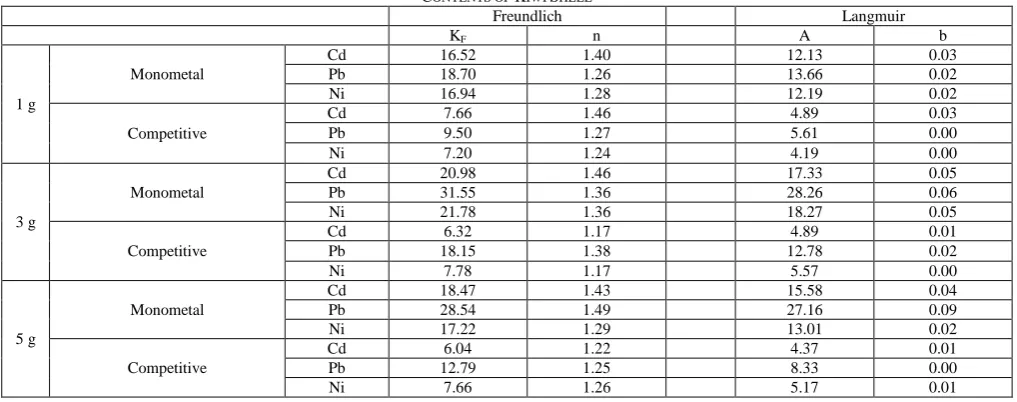
The Freundlich (kF and n) and Langmuir (am and b) constants for monometal and competitive systems were calculated and the values are given in TABLE II. All of the sorption isotherms were adequately described by both the Freundlich (R2 between 0.92 – 0.98) and Langmuir (R2 between 0.96 – 0.99) equations with a high coefficient of determinations.
TABLEI:DISTRIBUTION COEFFICIENTS,KD (LKG_1) FOR THE MONOMETAL AND COMPETITIVE ADSORPTION OF CD,PB, AND NI BY DIFFERENT CONTENTS OF KIWI SHELL IN THE DIFFERENT INITIAL CONCENTRATIONS
5 10 20 30 40 50 100 Kdµ
1 g
Monometal
Cd 1.17 1.07 0.96 0.78 0.70 0.60 0.40 0.81
Pb 1.36 1.33 1.21 1.29 1.18 1.01 0.55 1.13
Ni 1.22 1.15 1.07 1.10 1.01 0.90 0.45 0.99
Competitive
Cd 0.30 0.39 0.36 0.30 0.25 0.22 0.16 0.28
Pb 0.55 0.65 0.66 0.60 0.67 0.45 0.24 0.54
Ni 0.40 0.55 0.47 0.46 0.41 0.35 0.20 0.41
3 g
Monometal
Cd 1.66 1.34 1.16 1.03 0.93 0.74 0.53 1.06
Pb 2.75 2.31 2.05 1.91 1.89 1.37 1.15 1.92
Ni 1.80 1.27 1.35 1.32 1.22 0.90 0.56 1.20
Competitive
Cd 0.50 0.41 0.43 0.42 0.44 0.39 0.24 0.41
Pb 1.21 1.35 1.14 0.97 0.80 0.68 0.46 0.94
Ni 0.55 0.59 0.53 0.55 0.54 0.47 0.29 0.50
5 g
Monometal
Cd 1.50 1.24 1.05 0.95 0.90 0.82 0.42 0.98
Pb 2.59 1.71 1.42 1.35 1.22 1.05 0.58 1.42
Ni 1.31 1.05 1.12 1.09 1.02 0.91 0.46 0.99
Competitive
Cd 0.43 0.39 0.41 0.37 0.33 0.31 0.20 0.35
Pb 0.83 0.90 0.90 0.91 0.74 0.63 0.37 0.75
TABLEII:PARAMETERS OF THE MONOMETAL AND COMPETITIVE FREUNDLICH AND LANGMUIR OF THE ADSORPTION OF CD,PB, AND NI BY DIFFERENT
CONTENTS OF KIWI SHELL
Freundlich Langmuir
KF n A b
1 g
Monometal
Cd 16.52 1.40 12.13 0.03
Pb 18.70 1.26 13.66 0.02
Ni 16.94 1.28 12.19 0.02
Competitive
Cd 7.66 1.46 4.89 0.03
Pb 9.50 1.27 5.61 0.00
Ni 7.20 1.24 4.19 0.00
3 g
Monometal
Cd 20.98 1.46 17.33 0.05
Pb 31.55 1.36 28.26 0.06
Ni 21.78 1.36 18.27 0.05
Competitive
Cd 6.32 1.17 4.89 0.01
Pb 18.15 1.38 12.78 0.02
Ni 7.78 1.17 5.57 0.00
5 g
Monometal
Cd 18.47 1.43 15.58 0.04
Pb 28.54 1.49 27.16 0.09
Ni 17.22 1.29 13.01 0.02
Competitive
Cd 6.04 1.22 4.37 0.01
Pb 12.79 1.25 8.33 0.00
Ni 7.66 1.26 5.17 0.01
The adsorption capacities (kF) and the maximum adsorption capacities (am) for the metals determined by the Freundlich and Langmuir isotherms, respectively were in the order of Pb > Ni > Cd in the both monometal and multimetal conditions. The adsorption capacity and the maximum adsorption capacity of the metals in the multimetal condition were lower than the monometal condition. Generally, kF and
am values of both mono- and multimetal systems indicate that the sorption value of the metals by sorbent contents of 3 and 5 gr was higher than that of 1 gr. However, difference between adsorption capacity of Pb and Cd (kF,Pb – kF,Cd) or between Cu and Zn (kF,Pb – kF,Ni) at sorbent contents of 1 g is lower than the difference at 3 and 5 g. On the other hand, as can be seen in TABLE II, Langmuir binding strength for competitive system is more than monometal system for all the studied metals. In short, b reflects the retention intensity and the number of sites available for a sorbate. Higher b values have been related to specifically sorbed metals at high energy surfaces with low dissociation constants. Alternatively, lower
b values appear to be releated to sorption at low energy surfaces with high dissociation constants [21]. The multimetal isotherm b values in the sorbent may indicate that competition promotes the retention of the three metals on more specific sorption positions. As a result, although the maximum adsorption capacity (am) decreases for Cd, Pb and Ni, the metals are held more strongly. Generally, Ni and Cd retention is more dependent on electrostatic interactions with solid phase exchange sites. In contrast Pb retention is less dependent on this type of adsorption and more dependent on covalent interactions with the functional groups on the sorbent surface [21].
IV. CONCLUSION
In the present study the monometal and competitive adsorption behavior of Cd, Pb and Ni onto different contents of three contents of kiwi shell was investigated.
Based on the data presented in this study, we conclude as follows:
1) Kiwi shell has a considerable capacity to the heavy metal adsorption in the polluted solutions.
2) Kiwi shell has a stronger affinity for Pb than Ni and Cd
when introduced to the polluted solution individually or at the same time. This implies, when a water resource is rich in Cd, Ni and Pb, there is greater potential for toxicity of Cd and Ni than Pb, by their higher mobility and lower adsorption.
3) The presence of other cations decreases the sorption of all metals by kiwi shell; however the magnitude of these effects is different for each metal. Co-addition of the Cd, Pb and Ni to the solution, Pb, and to a lesser extent Ni became preferentially adsorbed.
4) The kiwi shell performance for adsorption of heavy metals is strongly affected by heavy metals initial concentration and content of sorbent. In addition, the sorption content of heavy metals by kiwi shell increase with the initial concentration of heavy metals, however the Kd decrease with increrasing applied concentrations
of the metal.
REFERENCES
[1] A. Esposito, F. Pagnanelli, F. Beolchini, V. Dovi, and F. Veglio, “Cadmium and copper biosorption on Sphaerotilus natans: Influence of pH and biomass concentration on the biosorption modeling,” Journal
of Hydrometallurgy, vol. 60, pp. 129-141, 2001.
[2] U. Förstner and G. T. W. Wittmann, Metal Pollution in the Aquatic
Environment, Springer Verlag, New York, 1981.
[3] A. Tessier and P. Campbell, “Partitioning of trace metals in sediments. In: Kramer, J R, Allen H. E. (Eds.), Metal Speciation: Theory, analysis and application,” Lewis Publs, Chelsea, MI, U.S.A., pp. 183-199, 1988.
[4] M. Jayaprakash, S. Srinivasalu, M. P. Jonathan, and V. Ram-Mohan, “A baseline study of physico-chemical parameters and trace metals in waters of Ennore creek, Chennai, India,” Journal of Marine Pollution
Bulletine, vol. 50, pp. 583-589, 2005.
[5] H. Demiral, I. Demiral, F. Tumsek, and B. Karabacakoglu, “Adsorption of chromium (VI) from aqueous solution by activated carbon derived from olive bagasse and applicability of different adsorption models,” Chem. Eng. J., 144, 188-196, 2008.
[7] H. Liu, C. Wang, J. Liu, B. Wang, and H. Sun, “Competitive adsorption of Cd (II), Zn (II) and Ni (II) from their binary and ternary acidic systems using tourmaline,” J. Environ. Manage., vol. 128, pp. 727-734, 2013.
[8] E. I. El-Shafey, “Removal of Zn (II) and Hg (II) from aqueous solution on a carbonaceous sorbent chemically prepared from rice husk,” J.
Hazard. Mater., vol. 175, pp. 319-327, 2010.
[9] Y. Zhu, J. Hu, and J. Wang, “Competitive adsorption of Pb (II), Cu (II) and Zn (II) onto Xanthate-modified magnetic chitosan,” J. Hazard.
Mater., pp. 221–222, 155-161, 2012.
[10] M. Zhang, “Adsorption study of Pb (II), Cu (II) and Zn (II) from simulated acid mine drainage using dairy manure compost,” Chem.
Eng. J., vol. 172, pp. 361-368, 2011.
[11] F. Yuan Wang, H. Wang, and J. Weima, “Cloud point extraction combined with high-performance liquid chromatography for speciation of chromium (III) and chromium (VI) in environmental sediment samples,” J. Hazard. Mater., vol. 177, pp. 114-118, 2010.
[12] L. D. Lü, Lu, L. Chen, and F. Luo, “Removal of Cd (II) by modified lawny grass cellulose adsorbent,” Desalination, vol. 259, pp. 120-130, 2010.
[13] F. Sabermahani., M. Khajehsadegh, and N. Madadi Mahani, “Removal of chromium (VI) ions from aqueous solutions by using Kiwi shell,”
Science Journal (CSJ), vol. 36, no. 3, pp. 2083-2089, 2015.
[14] M. K. Mondal, “Removal of Pb (II) from aqueous solution using activated tea waste: Adsorption on a fixed-bed column,” J. Environ.
Manage., vol. 90, no. 32, pp. 3266-3271, 2009.
[15] G. Moussavi and B. Barikbin, “Biosorption of chromium (VI) from industrial wastewater onto pistachio hull waste biomass,” Chem. Eng. J., vol. 162, pp. 893-900, 2010.
[16] B. Lorestani, C. Arjangi, and H. Merrikhpour, “Effect of kiwi shell and incubation time on mobility of lead and cadmium in contaminated clay soil,” Journal of Chemical Health Risks, vol. 4, no. 2, pp. 23–37, 2014. [17] D. L. Sparks, Environmental Soil Chemistry, Academic Press, San
Diago, 1995.
[18] T. H. Christensen, “Cadmium soil sorption at low concentrations: VIII. Correlation with soil parameters,” Journal of Water, Air and Soil
Pollution, vol. 44, pp. 71-82, 1989.
[19] D. C. Seo, K. Yu, and R. D. Deluane “Comparison of monometal and multimetal adsorption in Mississippi River alluvial wetland sediment: Batch and column experiments,” Chemosphere, vol. 73, pp. 1757–1764, 2008.
[20] M. B. McBride, Environmental Chemistry of Soils, Oxford Univ Press, New York, 1994.
[21] V. Antoniadis, C. D. Tsadilas, and D. J. Ashworth, “Monometal and competitive adsorption of heavy metals by sewage sludgeamended soil,” Chemosphere, vol. 68, pp. 489–494, 2007.