© 2017 IJSRST | Volume 3 | Issue 4 | Print ISSN: 2395-6011 | Online ISSN: 2395-602X Themed Section: Science and Technology
Was Galileo Right?
A Sfarti, 387 Soda Hall, UC Berkeley
ABSTRACT
An important scientific debate took place regarding falling bodies hundreds of years ago, and it still warrants close examination. Galileo argued that in a vacuum all bodies fall at the same rate relative to the earth, independent of their mass. As we shall see, the problem is more subtle than meets the eye -- even in vacuum. In principle the results of a free fall experiment depend on whether falling masses are sequential or concurrent, whether they fall side by side or diametrically opposed. In the current paper we will present both the classical mechanics treatment and the general relativity one. In the case of classical mechanics, we start from the basic equations of motion. On the other hand, the determination of particle equations of motion in gravitational fields in general relativity is done routinely via the use of covariant derivatives. Since the geodesic equations based on covariant derivatives are derived from the Euler-Lagrange equations and since the Euler-Lagrange formalism is very intuitive, easy to derive with no mistakes, there is every reason to use them even for the most complicated situations and this is exactly what we do in the second part of the current paper.
Keywords : Classical Mechanics, General Relativity, Schwarzschild Metric, Euler-Lagrange Formalism, PACS: 03.30.+p, 52.20.Dq, 52.70.Nc
I.
INTRODUCTION
Classical treatment of radial motion-Time to collision
In the early 17th century, Galileo [1] made the observation: "But I, Simplicia, who have made the test, can assure you that a cannon ball weighing one or two hundred pounds, or even more, will not reach the ground by as much as a span ahead of a musket ball weighing only half a pound, provided both are dropped from a height of 200 cubits."
Galileo argued that the slight difference in time could be ascribed to the resistance offered by the medium to the motion of the falling body. In air, feathers do fall more slowly than rocks. Galileo then made the idealization that in a medium devoid of resistance (a vacuum), all bodies will fall at the same speed. This idealization neglected the complexity of the fall of objects in media accessible to Galileo and was indeed a significant advance toward a deeper understanding of the motion of bodies. Galileo used experiments with an inclined plane to promote his view that heavy and light bodies fall equally fast. Another Italian, Galileo’s contemporary,
Torricelli, in his opus, De motu gravium , seeks to further demonstrate Galileo’s principle regarding equal velocities of free fall of weights along inclined planes of equal height. We ask ourselves, “were Galileo and Torricelli right?”. As we shall see in the next paragraph the answer is complex: within the experimental precision, they were right; from the point of view of a rigorous application of mechanics, they were both wrong. In Newtonian mechanics formulation, for the case of radial motion reduces to solving the equation of motion:
2
2 2
d z GMm
m
dt d
(1.1)
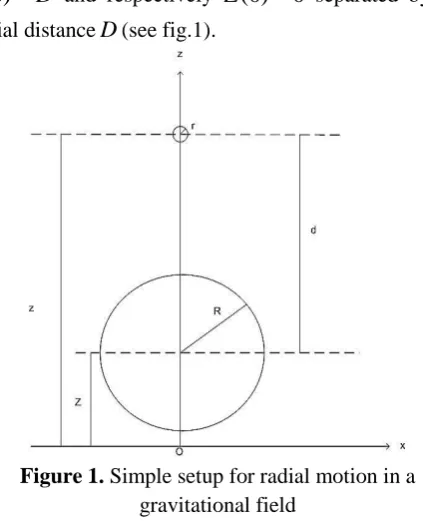
where z represents the radial coordinate and d is the distance between the centers of the attracting bodies (.
It is interesting to note that GR and Newtonian mechanics produce exactly the same equation of motion. Equation (1.1) gives us the tool for determining when
(0)
z
D
and respectivelyZ
(0)
0
separated by the initial distanceD(see fig.1).Figure 1. Simple setup for radial motion in a gravitational field
We would need to solve the system of differential equations:
2
2 2
2
2 2
(
)
(
)
d z
GM
dt
Z
z
d Z
Gm
dt
Z
z
(1.2)
with initial conditions:
0 0
(0)
(0) 0
|t |t 0
z D
Z
dZ dz
dt dt
(1.3) Z z R r
and find out the time when z t( )Z t( ) R r1 (i.e., when the two masses touch) by solving a transcendental equation in t. The system gets easily reduced to a single equation by subtracting the two equations:
2
2 2
(
)
(
)
(
)
d
z
Z
G M
m
dt
z
Z
(1.4)
Equation (4) has the general solution (see Appendix):
( )
( ( )( ( )))
( )
G M m z Z
t D arctg z Z D z Z
D D z Z
(1.5)
At the time of collision, z Z R r1 so:
3/2
1 1
1 1
( )( ( ))
( )
( )
( )
R r D R r R r
D
t arctg
D R r D
G M m
(1.6)
The time to collision does depend on the mass of the probe, so both Galileo and Torricelli were wrong. The reason is that, while the larger gravitating body attracts the smaller one, the effect is reciprocated by the smaller one. Thus, the time to collision is dependent on both masses. It is interesting to see that the effect is dependent on the sum of masses. We could not have demonstrated the above without solving , in a rigorous manner, the equations of motion. If we ask ourselves: “how big is the effect?” then (1.6) provides the answer,
the effect is of the order of
2
m
M
. To put things in perspective, if we dropped a 1000kg mass on the Moon,the effect would be of the order of
7 *10
21. This is why Galileo could not measure it, it is too small. But it is there.Figure 2. Two test probes side by side, dropped simultaneously
2
1 1 1 2
1 2 2 2 2
1 2 1 2 1
(
cos )
(
)
(
)
(
)
d z
Gm M
Gm m
m
dt
Z
z
z
z
r
r
2
2 2 2 1
2 2 2 2 2
2 2 1 2 1
(
cos )
(
)
(
)
(
)
d z
Gm M
Gm m
m
dt
Z
z
z
z
r
r
(1.7)2
1 2
2 2 2
1 2
(
)
(
)
(
)
GMm
GMm
d Z
M
dt
Z
z
Z
z
2 12 2
2 1 2 1
| |
cos
( ) ( )
z z
z z r r
,
being the angle of the central attraction force with the z-axis.The initial conditions are:
1 2
0 0
(0) (0)
(0) 0
| i | 0
t t
z z D
Z
dz dZ
dt dt
(1.8)
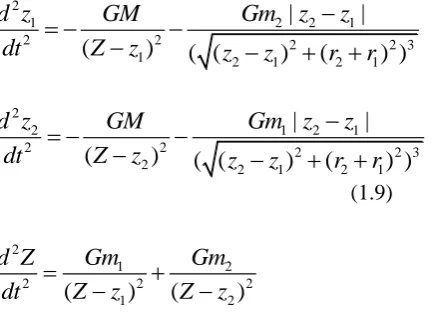
The above results into a complicated system::
2
1 2 2 1
2 2 2 2 3
1 2 1 2 1
|
|
(
)
( (
)
(
) )
d z
GM
Gm
z
z
dt
Z
z
z
z
r
r
2
2 1 2 1
2 2 2 2 3
2 2 1 2 1
|
|
(
)
( (
)
(
) )
d z
GM
Gm z
z
dt
Z
z
z
z
r
r
(1.9)
2
1 2
2 2 2
1 2
(
)
(
)
Gm
Gm
d Z
dt
Z
z
Z
z
While the above system may be very difficult to solve, we can still glean a very important physical property, the above system tells us that the two test probes will hit the Earth simultaneously. Indeed, subtracting the first two equations:
2
1 2 2 1 2 1
2 2 2 2 2 3
2 1 2 1 2 1
( ) ( ) | |
( ) ( ) ( ( ) ( ) )
d z z GM GM G m m z z
dt Z z Z z z z r r
(1.10)
We easily verify that z t1( )z t2( )0 is a solution. Using the observation the above system can be solved much easier since it simplifies to:
2
2 2
(
)
d z
GM
dt
Z
z
(1.11)
2
1 2
2 2
(
)
(
)
G m
m
d Z
dt
Z
z
Subtracting the first equation from the second one we obtain:
2
1 2
2 2
(
)
(
)
(
)
G M
m
m
d Z
z
dt
Z
z
(1.12)
0 0
(0)
(0) 0
|t |t 0
z D
Z
dZ dz
dt dt
(1.13)
We need to find out the time when Z t( )z t( ) R ri
(i.e., when the two masses touch):
3/2 1 2
( )( ( ))
( )
( )
( )
i i
i i
i
R r D R r R r
D
t arctg
D R r D
G M m m
(1.14)
If the test probes have equal radiuses, their times to collisions will be equal.
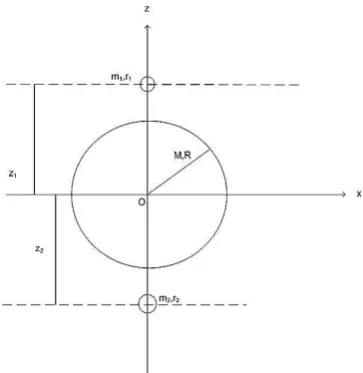
On the other hand, if the particles start simultaneously, diametrically opposed, the equations of motion are simpler (see situation depicted in fig.3):
Figure 3. Two test probes dropped simultaneously, diametrically opposed
2
1 1 1 2
1 2 2 2
1 2 1
(
)
(
)
(
)
d z
Gm M
Gm m
m
dt
Z
z
z
z
2
2 2 2 1
2 2 2 2
2 2 1
(
)
(
)
(
)
d z
Gm M
Gm m
m
dt
Z
z
z
z
(1.15) 21 2
2 2 2
1 2
(
)
(
)
GMm
GMm
d Z
M
dt
Z
z
Z
z
The initial conditions are:
1 2
0 0
(0)
(0)
(0) 0
| i | 0
t t
z D
z D
Z
dz dZ
dt dt
(1.16)
After some simplifications, equations (1.15) become:
2
1 2
2 2 2
1 2 1
(
)
(
)
d z
GM
Gm
dt
Z
z
z
z
2
2 1
2 2 2
2 2 1
(
)
(
)
d z
GM
Gm
dt
Z
z
z
z
(1.17) 2
1 2
2 2 2
1 2
(
)
(
)
Gm
Gm
d Z
dt
Z
z
Z
z
Though the equations of motion are simpler, our chances of solving system (1.17) are next to nil, at least symbolically. In this case we have means of determining which object collides first with the Earth. Nevertheless, we observe that by adding the three equations (1.17) we obtain an interesting relationship:
2
1 1 2 2
2 ( ) 0
d
MZ m z m z
dt
(1.18)
Given the initial conditions, (18) results immediately into:
1 1 2 2 ( 1 2)
MZm z m z D m m
(1.19)
The physical interpretation of the above is that the two test probes and the Earth all move in such a fashion that their center of mass is stationary:
1 1 2 2 1 2
1 2 1 2
( ) ( ) ( ) ( )
COM
MZ t m z t m z t D m m
Z
M m m M m m
The above means that the test probes and the Earth must move towards the COM such that they all reach it at the same instant or the COM would move, which is not allowed as per (1.20). This gives us an idea: if
1, 2
M m m then, as per (1.20), ZCOM 0, i.e. the
center of mass of the system coincides with the initial position of the Earth and does not move. Therefore, we can make
Z t
( )
0
in (1.17) such that the equations (1.17) simplify to:2
1 2
2 2 2
1
(
2 1)
d z
GM
Gm
dt
z
z
z
2
2 1
2 2 2
2
(
2 1)
d z
GM
Gm
dt
z
z
z
(1.21)
1 2 2 2 1 2
m m
z z
Substituting 2 1 2 1
m
z z
m
into the first equation we
obtain a form that we already know how to solve:
1 2 2 2
1 2
1
2 2
1
(
)
(
)
m m
G M
m
m
d z
dt
z
(1.22) The time to collision for the fist test probe is:
3/ 2
1 1
1 1
1 1 2
2
1 2
( )( ( ))
( )
( )
( )
( )
R r D R r R r
D
t arctg
D R r D
m m G M
m m
(1.23)
By symmetry, the time to collision for the second probe is:
3/ 2
2 2
2 2
2 1 2
2
1 2
( )( ( ))
( )
( )
( )
( )
R r D R r
R r D
t arctg
D R r D
m m G M
m m
(1.24)
If the two test probes have identical radii,r1r2, they will hit the Earth simultaneously if dropped simultaneously from the same height above the Earth,
diametrically opposed. The reason for this is that, by making the Earth the (stationary) center of mass, the heavier test probe cannot draw the Earth towards itself as in the previous example. This seems to contradict our earlier point that the two test probes must hit the Earth simultaneously since the COM is stationary. The contradiction is only apparent since, when drawing that conclusion, we have neglected a possible difference in the radii of the two test probes.
2. The GR treatment of the problem using the lagrangian method
While radial motion is the easiest type of motion to describe in natural language, it turns out that its equations are far from trivial [3]. We will show how to derive the equations of motion via a very accessible approach, requiring only elementary calculus and lagrangian mechanics. In order to find the equations of motion we start with the “reduced” Schwarzschild metric for the particular case of absence of rotation (
d
d
0
):2 2
1
21
sds
dt
dr
r
r
(2.1)
where
r
s2
GM
2c
is the Schwarzschild radius. Forexample, the Schwarzschild radius of the Earth is 9 millimeters. From the metric we obtain:
a) the lagrangian [2]
2 2
2 2
1
dt dr
L
ds ds
(2.2)
(
)
0
(
)
0
d
L
L
ds
t
t
d
L
L
ds
r
r
(2.3) and, respectively:
2 2
2 2 2 2 2
2 2 2
( ) 0
2 1
( ) ( ) ( )
2( ) 2
d dt ds ds
dt k ds
d L L d r d d
t r
ds r r ds dr dr
d d d
r dr dr d r dr d
r r t r t
dr dr
(2.4)
The over-dots signify derivative with respect to
s
. From the metric (2.1) we obtain:2
1
2(
dt
)
1
(
dr
)
ds
ds
(2.5) Substituting (2.5) into (2.4) we obtain
c) the equation of motion:
2 2
1
0 2
d r d
ds dr
(2.6) with the solution
/ 2
(
)
s
r
r
s
Darctg
r D r
D
D r
(2.7)
where
D
r
(0)
, exactly like in the classical case described in the previous paragraph. From (2.7) and thecondition r R r1we obtain the time to collision:
3/2
1 1
1 1
(
)(
(
))
(
)
(
)
R r D
R r
R r
D
arctg
D
R r
D
GM
(2.8)
Comparing the GR solution with the classical Newtonian solution we observe that the GR solution
does not depend on the mass of the test probe, so there is
a slight disagreement, of the order of
m
M
between the classical and the contemporary theory. This can be explained easily by remembering that, in GR, the test probes have negligible mass, so the answer in (2.8) is given for the case m0. This completely reconciles the Newtonian theory with GR.II.
CONCLUSION
When analyzing the free fall between bodies of comparable mass, one must apply precise analysis because the standard approximation would fail in many cases. As we've seen, one can sometimes look at something long taken for granted, and if one is patient enough one can uncover very interesting subtleties. For example, we have seen that Galileo’s claim was wrong for the case of two bodies of different mass dropped sequentially, in vacuum, from the same distance above the Earth, the more massive body impacts the Earth in a shorter time.
III.
REFERENCES
[1].
Galileo Galilei, "Dialogues Concerning Two New Sciences," (translation by H. Crew and A. Favaro. MacMillan. N.Y.) (1914) pp 62-64.[2].
Rindler,W. “Relativity-Special, General and Cosmological”, (2006) (Oxford Press) pp 238-239[3].
Ohta, T.; Mann, R. B. Phys. Rev. D 55 (8) (1997) pp4723–4747.Appendix:
2
1 1 2
2 2
2 1 3 2
2 2
( ) ( ) ( ) ( )
1
( ) ( ) ( ) ( )
2
d z d dz d dz dz d dt dt
dt dt dt dz dt dt dz dz dz
dt d t dt dt d t d dt
dz dz dz dz dz dz dz
(A1)
Applying the above, equation (28) becomes:
2 2
(
)
d
dt
k
dz dz
z
With the notation
y
(
dt
)
2dz
equation (A2) becomes:2
dy
k
dz
z
(A3)with the immediate solution:
0
k k
y
z z
(A4)
where z0 z(0). On the other hand,
y
(
dz
)
2dt
, so (A4)reduces to:
0
dz k k
dt zz (A5)
Finally, we are now ready to obtain the equation of motion by solving (A5) through variable separation:
0
dz
dt
k
k
z
z
(A6)
(A6) has the immediate solution:
0 0
0 0
( )
k z
t z arctg z z z