• Table of Contents
• Index
Exploiting Software How to Break Code
By Greg Hoglund, Gary McGraw
Publisher: Addison Wesley
Pub Date: February 17, 2004
ISBN: 0-201-78695-8
Pages: 512
How does software break? How do attackers make software break on purpose? Why are firewalls, intrusion detection systems, and antivirus software not keeping out the bad guys? What tools can be used to break software? This book provides the answers.
Exploiting Softwareis loaded with examples of real attacks, attack patterns, tools, and techniques used by bad guys to break software. If you want to protect your software from attack, you must first learn how real attacks are really carried out.
This must-have book may shock you—and it will certainly educate you.Getting beyond the script kiddie treatment found in many hacking books, you will learn about
Why software exploit will continue to be a serious problem
When network security mechanisms do not work
Attack patterns
Reverse engineering
Classic attacks against server software
Surprising attacks against client software
Techniques for crafting malicious input
The technical details of buffer overflows
Rootkits
• Table of Contents
• Index
Exploiting Software How to Break Code
By Greg Hoglund, Gary McGraw
Publisher: Addison Wesley
Pub Date: February 17, 2004
ISBN: 0-201-78695-8
Pages: 512
How does software break? How do attackers make software break on purpose? Why are firewalls, intrusion detection systems, and antivirus software not keeping out the bad guys? What tools can be used to break software? This book provides the answers.
Exploiting Softwareis loaded with examples of real attacks, attack patterns, tools, and techniques used by bad guys to break software. If you want to protect your software from attack, you must first learn how real attacks are really carried out.
This must-have book may shock you—and it will certainly educate you.Getting beyond the script kiddie treatment found in many hacking books, you will learn about
Why software exploit will continue to be a serious problem
When network security mechanisms do not work
Attack patterns
Reverse engineering
Classic attacks against server software
Surprising attacks against client software
Techniques for crafting malicious input
The technical details of buffer overflows
Rootkits
Exploiting Softwareis filled with the tools, concepts, and knowledge necessary to break software.
• Table of Contents
• Index
Exploiting Software How to Break Code
By Greg Hoglund, Gary McGraw
Publisher: Addison Wesley
Pub Date: February 17, 2004
ISBN: 0-201-78695-8
Pages: 512
Copyright
Praise for Exploiting Software
Attack Patterns
Foreword
Preface
What This Book Is About
How to Use This Book
But Isn't This Too Dangerous?
Acknowledgments
Greg's Acknowledgments Gary's Acknowledgments
Chapter 1. Software—The Root of the Problem
A Brief History of Software
Bad Software Is Ubiquitous
The Trinity of Trouble
The Future of Software
What Is Software Security?
Conclusion
Chapter 2. Attack Patterns
A Taxonomy
An Open-Systems View
Tour of an Exploit
Attack Patterns: Blueprints for Disaster
An Example Exploit: Microsoft's Broken C++ Compiler
Applying Attack Patterns
Attack Pattern Boxes
Conclusion
Chapter 3. Reverse Engineering and Program Understanding
Into the House of Logic
Should Reverse Engineering Be Illegal?
Reverse Engineering Tools and Concepts
Approaches to Reverse Engineering
Methods of the Reverser
Writing Interactive Disassembler (IDA) Plugins
• Table of Contents
• Index
Exploiting Software How to Break Code
By Greg Hoglund, Gary McGraw
Publisher: Addison Wesley
Pub Date: February 17, 2004
ISBN: 0-201-78695-8
Pages: 512
How does software break? How do attackers make software break on purpose? Why are firewalls, intrusion detection systems, and antivirus software not keeping out the bad guys? What tools can be used to break software? This book provides the answers.
Exploiting Softwareis loaded with examples of real attacks, attack patterns, tools, and techniques used by bad guys to break software. If you want to protect your software from attack, you must first learn how real attacks are really carried out.
This must-have book may shock you—and it will certainly educate you.Getting beyond the script kiddie treatment found in many hacking books, you will learn about
Why software exploit will continue to be a serious problem
When network security mechanisms do not work
Attack patterns
Reverse engineering
Classic attacks against server software
Surprising attacks against client software
Techniques for crafting malicious input
The technical details of buffer overflows
Rootkits
Exploiting Softwareis filled with the tools, concepts, and knowledge necessary to break software.
Decompilation in Practice: Reversing helpctr.exe
Automatic, Bulk Auditing for Vulnerabilities Writing Your Own Cracking Tools
Building a Basic Code Coverage Tool
Conclusion
Chapter 4. Exploiting Server Software
The Trusted Input Problem
The Privilege Escalation Problem
Finding Injection Points
Input Path Tracing
Exploiting Trust through Configuration
Specific Techniques and Attacks for Server Software
Conclusion
Chapter 5. Exploiting Client Software
Client-side Programs as Attack Targets
In-band Signals
Cross-site Scripting (XSS)
Client Scripts and Malicious Code
Content-Based Attacks
Backwash Attacks: Leveraging Client-side Buffer Overflows
Conclusion
Chapter 6. Crafting (Malicious) Input
The Defender's Dilemma
Intrusion Detection (Not)
Partition Analysis
Tracing Code
Reversing Parser Code
Example: Reversing I-Planet Server 6.0 through the Front Door
Misclassification
Building "Equivalent" Requests
Audit Poisoning
Conclusion
Chapter 7. Buffer Overflow
Buffer Overflow 101
Injection Vectors: Input Rides Again
Buffer Overflows and Embedded Systems Database Buffer Overflows
Buffer Overflows and Java?!
Content-Based Buffer Overflow
Audit Truncation and Filters with Buffer Overflow
Causing Overflow with Environment Variables
The Multiple Operation Problem
Finding Potential Buffer Overflows
Stack Overflow
Arithmetic Errors in Memory Management
Format String Vulnerabilities
Heap Overflows
Buffer Overflows and C++
Payloads
Payloads on RISC Architectures
Multiplatform Payloads
Prolog/Epilog Code to Protect Functions
• Table of Contents
• Index
Exploiting Software How to Break Code
By Greg Hoglund, Gary McGraw
Publisher: Addison Wesley
Pub Date: February 17, 2004
ISBN: 0-201-78695-8
Pages: 512
How does software break? How do attackers make software break on purpose? Why are firewalls, intrusion detection systems, and antivirus software not keeping out the bad guys? What tools can be used to break software? This book provides the answers.
Exploiting Softwareis loaded with examples of real attacks, attack patterns, tools, and techniques used by bad guys to break software. If you want to protect your software from attack, you must first learn how real attacks are really carried out.
This must-have book may shock you—and it will certainly educate you.Getting beyond the script kiddie treatment found in many hacking books, you will learn about
Why software exploit will continue to be a serious problem
When network security mechanisms do not work
Attack patterns
Reverse engineering
Classic attacks against server software
Surprising attacks against client software
Techniques for crafting malicious input
The technical details of buffer overflows
Rootkits
Exploiting Softwareis filled with the tools, concepts, and knowledge necessary to break software.
Subversive Programs
A Simple Windows XP Kernel Rootkit Call Hooking
Trojan Executable Redirection
Hiding Files and Directories
Patching Binary Code
The Hardware Virus
Low-Level Disk Access
Adding Network Support to a Driver
Interrupts
Key Logging
Advanced Rootkit Topics
Conclusion
References
• Table of Contents
• Index
Exploiting Software How to Break Code
By Greg Hoglund, Gary McGraw
Publisher: Addison Wesley
Pub Date: February 17, 2004
ISBN: 0-201-78695-8
Pages: 512
How does software break? How do attackers make software break on purpose? Why are firewalls, intrusion detection systems, and antivirus software not keeping out the bad guys? What tools can be used to break software? This book provides the answers.
Exploiting Softwareis loaded with examples of real attacks, attack patterns, tools, and techniques used by bad guys to break software. If you want to protect your software from attack, you must first learn how real attacks are really carried out.
This must-have book may shock you—and it will certainly educate you.Getting beyond the script kiddie treatment found in many hacking books, you will learn about
Why software exploit will continue to be a serious problem
When network security mechanisms do not work
Attack patterns
Reverse engineering
Classic attacks against server software
Surprising attacks against client software
Techniques for crafting malicious input
The technical details of buffer overflows
Rootkits
Exploiting Softwareis filled with the tools, concepts, and knowledge necessary to break software.
Copyright
Many of the designations used by manufacturers and sellers to distinguish their products are claimed as trademarks. Where those designations appear in this book, and Addison-Wesley was aware of a trademark claim, the designations have been printed in initial capital letters or in all capitals.
The authors and publisher have taken care in the preparation of this book, but make no expressed or implied warranty of any kind and assume no responsibility for errors or
omissions. No liability is assumed for incidental or consequential damages in connection with or arising out of the use of the information or programs contained herein.
The publisher offers discounts on this book when ordered in quantity for bulk purchases and special sales. For more information, please contact:
U.S. Corporate and Government Sales (800) 382-3419
For sales outside of the U.S., please contact:
International Sales (317) 581-3793
Visit Addison-Wesley on the Web: www.awprofessional.com
Library of Congress Cataloging-in-Publication Data
Hoglund, Greg.
Exploiting software : how to break code / Greg Hoglund, Gary McGraw. p. cm.
ISBN 0-201-78695-8 (pbk. : alk. paper)
1. Computer security. 2. Computer software—Testing. 3. Computer hackers. I. McGraw, Gary, 1966– II. Title.
QA76.9.A25H635 2004
005.8—dc22 2003025556
Copyright © 2004 by Pearson Education, Inc.
All rights reserved. No part of this publication may be reproduced, stored in a retrieval system, or transmitted, in any form or by any means, electronic, mechanical, photocopying, recording, or otherwise, without the prior consent of the publisher. Printed in the United States of America. Published simultaneously in Canada.
Dr. McGraw's work is partially supported by DARPA contract no. F30602-99-C-0172 (An Investigation of Extensible System Security for Highly Resource-Constrained Wireless Devices ) and AFRL Wright-Patterson grant no. F33615-02-C-1295 (Protection Against Reverse
Engineering: State of the Art in Disassembly and Decompilation). The views and conclusions contained in this book are those of the authors and should not be interpreted as representing the official policies, either expressed or implied, of DARPA, the US Air Force, or the US government.
For information on obtaining permission for use of material from this work, please submit a written request to:
Pearson Education, Inc.
• Table of Contents
• Index
Exploiting Software How to Break Code
By Greg Hoglund, Gary McGraw
Publisher: Addison Wesley
Pub Date: February 17, 2004
ISBN: 0-201-78695-8
Pages: 512
How does software break? How do attackers make software break on purpose? Why are firewalls, intrusion detection systems, and antivirus software not keeping out the bad guys? What tools can be used to break software? This book provides the answers.
Exploiting Softwareis loaded with examples of real attacks, attack patterns, tools, and techniques used by bad guys to break software. If you want to protect your software from attack, you must first learn how real attacks are really carried out.
This must-have book may shock you—and it will certainly educate you.Getting beyond the script kiddie treatment found in many hacking books, you will learn about
Why software exploit will continue to be a serious problem
When network security mechanisms do not work
Attack patterns
Reverse engineering
Classic attacks against server software
Surprising attacks against client software
Techniques for crafting malicious input
The technical details of buffer overflows
Rootkits
Exploiting Softwareis filled with the tools, concepts, and knowledge necessary to break software.
75 Arlington Street, Suite 300 Boston, MA 02116
Fax: (617) 848-7047
Text printed on recycled paper
1 2 3 4 5 6 7 8 9 10—CRS—0807060504
First printing, February 2004
Dedication
In memory of Nancy Simone McGraw (1939–2003).
• Table of Contents
• Index
Exploiting Software How to Break Code
By Greg Hoglund, Gary McGraw
Publisher: Addison Wesley
Pub Date: February 17, 2004
ISBN: 0-201-78695-8
Pages: 512
How does software break? How do attackers make software break on purpose? Why are firewalls, intrusion detection systems, and antivirus software not keeping out the bad guys? What tools can be used to break software? This book provides the answers.
Exploiting Softwareis loaded with examples of real attacks, attack patterns, tools, and techniques used by bad guys to break software. If you want to protect your software from attack, you must first learn how real attacks are really carried out.
This must-have book may shock you—and it will certainly educate you.Getting beyond the script kiddie treatment found in many hacking books, you will learn about
Why software exploit will continue to be a serious problem
When network security mechanisms do not work
Attack patterns
Reverse engineering
Classic attacks against server software
Surprising attacks against client software
Techniques for crafting malicious input
The technical details of buffer overflows
Rootkits
Exploiting Softwareis filled with the tools, concepts, and knowledge necessary to break software.
Praise for Exploiting Software
"Exploiting Software highlights the most critical part of the software quality problem. As it turns out, software quality problems are a major contributing factor to computer security problems. Increasingly, companies large and small depend on software to run their businesses every day. The current approach to software quality and security taken by software companies, system integrators, and internal development organizations is like driving a car on a rainy day with worn-out tires and no air bags. In both cases, the odds are that something bad is going to happen, and there is no protection for the occupant/owner.
This book will help the reader understand how to make software quality part of the design—a key change from where we are today!"
—Tony Scott Chief Technology Officer, IS&S General Motors Corporation
"It's about time someone wrote a book to teach the good guys what the bad guys already know. As the computer security industry matures, books like Exploiting Software
have a critical role to play."
—Bruce Schneier Chief Technology Officer Counterpane Author of Beyond Fear and
Secrets and Lies
"Exploiting Software cuts to the heart of the computer security problem, showing why broken software presents a clear and present danger. Getting past the 'worm of the day' phenomenon requires that someone other than the bad guys understands how software is attacked.
This book is a wake-up call for computer security."
—Elinor Mills Abreu Reuters' correspondent
"Police investigators study how criminals think and act. Military strategists learn about the enemy's tactics, as well as their weapons and personnel capabilities. Similarly, information security professionals need to study their criminals and enemies, so we can tell the difference between popguns and weapons of mass destruction. This book is a significant advance in helping the 'white hats' understand how the 'black hats' operate.
Through extensive examples and 'attack patterns,' this book helps the reader
understand how attackers analyze software and use the results of the analysis to attack systems. Hoglund and McGraw explain not only how hackers attack servers, but also how malicious server operators can attack clients (and how each can protect themselves from the other). An excellent book for practicing security engineers, and an ideal book for an undergraduate class in software security."
—Jeremy Epstein Director, Product Security & Performance webMethods, Inc.
"A provocative and revealing book from two leading security experts and world class software exploiters, Exploiting Software enters the mind of the cleverest and wickedest crackers and shows you how they think. It illustrates general principles for breaking software, and provides you a whirlwind tour of techniques for finding and exploiting software vulnerabilities, along with detailed examples from real software exploits.
Exploiting Software is essential reading for anyone responsible for placing software in a hostile environment—that is, everyone who writes or installs programs that run on the Internet."
• Table of Contents
• Index
Exploiting Software How to Break Code
By Greg Hoglund, Gary McGraw
Publisher: Addison Wesley
Pub Date: February 17, 2004
ISBN: 0-201-78695-8
Pages: 512
How does software break? How do attackers make software break on purpose? Why are firewalls, intrusion detection systems, and antivirus software not keeping out the bad guys? What tools can be used to break software? This book provides the answers.
Exploiting Softwareis loaded with examples of real attacks, attack patterns, tools, and techniques used by bad guys to break software. If you want to protect your software from attack, you must first learn how real attacks are really carried out.
This must-have book may shock you—and it will certainly educate you.Getting beyond the script kiddie treatment found in many hacking books, you will learn about
Why software exploit will continue to be a serious problem
When network security mechanisms do not work
Attack patterns
Reverse engineering
Classic attacks against server software
Surprising attacks against client software
Techniques for crafting malicious input
The technical details of buffer overflows
Rootkits
Exploiting Softwareis filled with the tools, concepts, and knowledge necessary to break software.
"The root cause for most of today's Internet hacker exploits and malicious software outbreaks are buggy software and faulty security software deployment. In Exploiting Software, Greg Hoglund and Gary McGraw help us in an interesting and provocative way to better defend ourselves against malicious hacker attacks on those software loopholes.
The information in this book is an essential reference that needs to be understood, digested, and aggressively addressed by IT and information security professionals everywhere."
—Ken Cutler, CISSP, CISA Vice President, Curriculum Development & Professional Services, MIS Training Institute
"This book describes the threats to software in concrete, understandable, and
frightening detail. It also discusses how to find these problems before the bad folks do. A valuable addition to every programmer's and security person's library!"
—Matt Bishop, Ph.D. Professor of Computer Science University of California at Davis Author of Computer Security: Art and Science
"Whether we slept through software engineering classes or paid attention, those of us who build things remain responsible for achieving meaningful and measurable
vulnerability reductions. If you can't afford to stop all software manufacturing to teach your engineers how to build secure software from the ground up, you should at least increase awareness in your organization by demanding that they read Exploiting
Software. This book clearly demonstrates what happens to broken software in the wild."
—Ron Moritz, CISSP Senior Vice President, Chief Security Strategist Computer Associates
"Exploiting Software is the most up-to-date technical treatment of software security I have seen. If you worry about software and application vulnerability, Exploiting Software is a must-read. This book gets at all the timely and important issues surrounding software security in a technical, but still highly readable and engaging, way.
Hoglund and McGraw have done an excellent job of picking out the major ideas in software exploit and nicely organizing them to make sense of the software security jungle."
—George Cybenko, Ph.D. Dorothy and Walter Gramm Professor of Engineering, Dartmouth Founding Editor-in-Chief, IEEE Security and Privacy
"This is a seductive book. It starts with a simple story, telling about hacks and cracks. It draws you in with anecdotes, but builds from there. In a few chapters you find yourself deep in the intimate details of software security. It is the rare technical book that is a readable and enjoyable primer but has the substance to remain on your shelf as a reference. Wonderful stuff."
—Craig Miller, Ph.D. Chief Technology Officer for North America Dimension Data
"It's hard to protect yourself if you don't know what you're up against. This book has the details you need to know about how attackers find software holes and exploit
them—details that will help you secure your own systems."
• Table of Contents
• Index
Exploiting Software How to Break Code
By Greg Hoglund, Gary McGraw
Publisher: Addison Wesley
Pub Date: February 17, 2004
ISBN: 0-201-78695-8
Pages: 512
How does software break? How do attackers make software break on purpose? Why are firewalls, intrusion detection systems, and antivirus software not keeping out the bad guys? What tools can be used to break software? This book provides the answers.
Exploiting Softwareis loaded with examples of real attacks, attack patterns, tools, and techniques used by bad guys to break software. If you want to protect your software from attack, you must first learn how real attacks are really carried out.
This must-have book may shock you—and it will certainly educate you.Getting beyond the script kiddie treatment found in many hacking books, you will learn about
Why software exploit will continue to be a serious problem
When network security mechanisms do not work
Attack patterns
Reverse engineering
Classic attacks against server software
Surprising attacks against client software
Techniques for crafting malicious input
The technical details of buffer overflows
Rootkits
Exploiting Softwareis filled with the tools, concepts, and knowledge necessary to break software.
Attack Patterns
Attack Pattern: Make the Client Invisible150
Attack Pattern: Target Programs That Write to Privileged OS Resources152
Attack Pattern: Use a User-Supplied Configuration File to Run Commands That Elevate Privilege153
Attack Pattern: Make Use of Configuration File Search Paths156
Attack Pattern: Direct Access to Executable Files162
Attack Pattern: Embedding Scripts within Scripts164
Attack Pattern: Leverage Executable Code in Nonexecutable Files165
Attack Pattern: Argument Injection169
Attack Pattern: Command Delimiters172
Attack Pattern: Multiple Parsers and Double Escapes173
Attack Pattern: User-Supplied Variable Passed to File System Calls185
Attack Pattern: Postfix NULL Terminator186
Attack Pattern: Postfix, Null Terminate, and Backslash186
Attack Pattern: Relative Path Traversal187
Attack Pattern: Client-Controlled Environment Variables189
Attack Pattern: User-Supplied Global Variables (DEBUG=1, PHP Globals, and So Forth) 190
Attack Pattern: Session ID, Resource ID, and Blind Trust192
Attack Pattern: Analog In-Band Switching Signals (aka "Blue Boxing")205
Attack Pattern Fragment: M anipulating Terminal Devices210
Attack Pattern: Simple Script Injection214
Attack Pattern: Embedding Script in Nonscript Elements215
Attack Pattern: XSS in HTTP Headers216
Attack Pattern: HTTP Query Strings216
Attack Pattern: User-Controlled Filename217
Attack Pattern: Passing Local Filenames to Functions That Expect a URL225
Attack Pattern: Meta-characters in E-mail Header226
Attack Pattern: File System Function Injection, Content Based229
Attack Pattern: Client-side Injection, Buffer Overflow231
• Table of Contents
• Index
Exploiting Software How to Break Code
By Greg Hoglund, Gary McGraw
Publisher: Addison Wesley
Pub Date: February 17, 2004
ISBN: 0-201-78695-8
Pages: 512
How does software break? How do attackers make software break on purpose? Why are firewalls, intrusion detection systems, and antivirus software not keeping out the bad guys? What tools can be used to break software? This book provides the answers.
Exploiting Softwareis loaded with examples of real attacks, attack patterns, tools, and techniques used by bad guys to break software. If you want to protect your software from attack, you must first learn how real attacks are really carried out.
This must-have book may shock you—and it will certainly educate you.Getting beyond the script kiddie treatment found in many hacking books, you will learn about
Why software exploit will continue to be a serious problem
When network security mechanisms do not work
Attack patterns
Reverse engineering
Classic attacks against server software
Surprising attacks against client software
Techniques for crafting malicious input
The technical details of buffer overflows
Rootkits
Exploiting Softwareis filled with the tools, concepts, and knowledge necessary to break software.
Attack Pattern: Alternate Encoding the Leading Ghost Characters267
Attack Pattern: Using Slashes in Alternate Encoding268
Attack Pattern: Using Escaped Slashes in Alternate Encoding270
Attack Pattern: Unicode Encoding271
Attack Pattern: UTF-8 Encoding273
Attack Pattern: URL Encoding273
Attack Pattern: Alternative IP Addresses274
Attack Pattern: Slashes and URL Encoding Combined274
Attack Pattern: Web Logs275
Attack Pattern: Overflow Binary Resource File293
Attack Pattern: Overflow Variables and Tags294
Attack Pattern: Overflow Symbolic Links294
Attack Pattern: MIME Conversion295
Attack Pattern: HTTP Cookies295
Attack Pattern: Filter Failure through Buffer Overflow296
Attack Pattern: Buffer Overflow with Environment Variables297
Attack Pattern: Buffer Overflow in an API Call297
Attack Pattern: Buffer Overflow in Local Command-Line Utilities297
Attack Pattern: Parameter Expansion298
• Table of Contents
• Index
Exploiting Software How to Break Code
By Greg Hoglund, Gary McGraw
Publisher: Addison Wesley
Pub Date: February 17, 2004
ISBN: 0-201-78695-8
Pages: 512
How does software break? How do attackers make software break on purpose? Why are firewalls, intrusion detection systems, and antivirus software not keeping out the bad guys? What tools can be used to break software? This book provides the answers.
Exploiting Softwareis loaded with examples of real attacks, attack patterns, tools, and techniques used by bad guys to break software. If you want to protect your software from attack, you must first learn how real attacks are really carried out.
This must-have book may shock you—and it will certainly educate you.Getting beyond the script kiddie treatment found in many hacking books, you will learn about
Why software exploit will continue to be a serious problem
When network security mechanisms do not work
Attack patterns
Reverse engineering
Classic attacks against server software
Surprising attacks against client software
Techniques for crafting malicious input
The technical details of buffer overflows
Rootkits
Exploiting Softwareis filled with the tools, concepts, and knowledge necessary to break software.
Foreword
In early July 2003 I received a call from David Dill, a computer science professor at Stanford University. Dill informed me that the source code to an electronic voting machine produced by Diebold Election Systems, one of the top vendors, had leaked onto the Internet, and that perhaps it would be worth examining it for security vulnerabilities. This was a rare
opportunity, because voting system manufacturers have been very tight with their
proprietary code. What we found was startling: Security and coding flaws were so prevalent that an attack might be delayed because the attacker might get stuck trying to choose from all the different vulnerabilities to exploit without knowing where to turn first. (Such delay tactics are not recommended as a security strategy.) There were large, complex chunks of code with no comments. There was a single static key hard wired into the code for encrypting vote tallies. Insecure pseudorandom number generators and noncryptographic checksums were used. And inspection of the CVS logs revealed an arbitrary, seemingly ad hoc source code management process. And then there were the serious flaws.
Was the Diebold voting machine example an isolated incident of poor quality control? I don't think so. Many companies such as Diebold are hard pressed to get their products to market before their competitors. The company with the best, functionally correct system wins. This incentive model rewards the company with the product that is available first and has the most features, not the one with the most secure software. Getting security right is very difficult, and the result is not always tangible. Diebold was unlucky: Their code was examined in a public forum and was shown to be completely broken. Most companies are relatively safe in the assumption that independent analysts will only get to see their code under strict nondisclosure agreements. Only when they are held to the fire do companies pay the kind of attention to security that is warranted. Diebold's voting machine code was not the first highly complex system that I had ever looked at that was full of security flaws. Why is it so difficult to produce secure software?
The answer is simple. Complexity. Anyone who has ever programmed knows that there are unlimited numbers of choices when writing code. An important choice is which programming language to use. Do you want something that allows the flexibility of pointer arithmetic with the opportunities it allows for manual performance optimization, or do you want a type-safe language that avoids buffer overflows but removes some of your power? For every task, there are seemingly infinite choices of algorithms, parameters, and data structures to use. For every block of code, there are choices on how to name variables, how to comment, and even how to lay out the code in relation to the white space around it. Every programmer is
different, and every programmer is likely to make different choices. Large software projects are written in teams, and different programmers have to be able to understand and modify the code written by others. It is hard enough to manage one's own code, let alone software produced by someone else. Avoiding serious security vulnerabilities in the resulting code is challenging for programs with hundreds of lines of code. For programs with millions of lines of code, such as modern operating systems, it is impossible.
However, large systems must be built, so we cannot just give up and say that writing such systems securely is impossible. McGraw and Hoglund have done a marvelous job of
explaining why software is exploitable, of demonstrating how exploits work, and of educating the reader on how to avoid writing exploitable code. You might wonder whether it is a good idea to demonstrate how exploits work, as this book does. In fact, there is a trade off that security professionals must consider, between publicizing exploits and keeping them quiet. This book takes the correct position that the only way to program in such a way that minimizes the vulnerabilities in software is to understand why vulnerabilities exist and how attackers exploit them. To this end, this book is a must-read for anybody building any networked application or operating system.
• Table of Contents
• Index
Exploiting Software How to Break Code
By Greg Hoglund, Gary McGraw
Publisher: Addison Wesley
Pub Date: February 17, 2004
ISBN: 0-201-78695-8
Pages: 512
How does software break? How do attackers make software break on purpose? Why are firewalls, intrusion detection systems, and antivirus software not keeping out the bad guys? What tools can be used to break software? This book provides the answers.
Exploiting Softwareis loaded with examples of real attacks, attack patterns, tools, and techniques used by bad guys to break software. If you want to protect your software from attack, you must first learn how real attacks are really carried out.
This must-have book may shock you—and it will certainly educate you.Getting beyond the script kiddie treatment found in many hacking books, you will learn about
Why software exploit will continue to be a serious problem
When network security mechanisms do not work
Attack patterns
Reverse engineering
Classic attacks against server software
Surprising attacks against client software
Techniques for crafting malicious input
The technical details of buffer overflows
Rootkits
Exploiting Softwareis filled with the tools, concepts, and knowledge necessary to break software.
Java runtime environment and the security issues surrounding the novel concept of untrusted mobile code running inside a trusted browser. McGraw's later book, Building Secure Software, was a classic, demonstrating concepts that could be used to avoid many of the vulnerabilities described in the current book. Hoglund has vast experience developing rootkits and
implementing exploit defenses in practice.
After reading this book, you may find it surprising not that so many deployed systems can be hacked, but that so many systems have not yet been hacked. The analysis we did of an electronic voting machine demonstrated that software vulnerabilities are all around us. The fact that many systems have not yet been exploited only means that attackers are satisfied with lower hanging fruit right now. This will be of little comfort to me the next time I go to the polls and am faced with a Windows-based electronic voting machine. Maybe I'll just mail in an absentee ballot, at least that voting technology's insecurities are not based on software flaws.
Aviel D. Rubin
Associate Professor, Computer Science
• Table of Contents
• Index
Exploiting Software How to Break Code
By Greg Hoglund, Gary McGraw
Publisher: Addison Wesley
Pub Date: February 17, 2004
ISBN: 0-201-78695-8
Pages: 512
How does software break? How do attackers make software break on purpose? Why are firewalls, intrusion detection systems, and antivirus software not keeping out the bad guys? What tools can be used to break software? This book provides the answers.
Exploiting Softwareis loaded with examples of real attacks, attack patterns, tools, and techniques used by bad guys to break software. If you want to protect your software from attack, you must first learn how real attacks are really carried out.
This must-have book may shock you—and it will certainly educate you.Getting beyond the script kiddie treatment found in many hacking books, you will learn about
Why software exploit will continue to be a serious problem
When network security mechanisms do not work
Attack patterns
Reverse engineering
Classic attacks against server software
Surprising attacks against client software
Techniques for crafting malicious input
The technical details of buffer overflows
Rootkits
Exploiting Softwareis filled with the tools, concepts, and knowledge necessary to break software.
Preface
Software security is gaining momentum as security professionals realize that computer security is really all about making software behave. The publication of Building Secure Software in 2001 (Viega and McGraw) unleashed a number of related books that have crystallized software security as a critical field. Already, security professionals, software developers, and business leaders are resonating with the message and asking for more.
Building Secure Software (co-authored by McGraw) is intended for software professionals ranging from developers to managers, and is aimed at helping people develop more secure code. Exploiting Software is useful to the same target audience, but is really intended for security professionals interested in how to find new flaws in software. This book should be of particular interest to security practitioners working to beef up their software security skills, including red teams and ethical hackers.
Exploiting Software is about how to break code. Our intention is to provide a realistic view of the technical issues faced by security professionals. This book is aimed directly toward
software security as opposed to network security. As security professionals come to grips with the software security problem, they need to understand how software systems break.
Solutions to each of the problems discussed in Exploiting Software can be found in Building Secure Software. The two books are mirror images of each other.
• Table of Contents
• Index
Exploiting Software How to Break Code
By Greg Hoglund, Gary McGraw
Publisher: Addison Wesley
Pub Date: February 17, 2004
ISBN: 0-201-78695-8
Pages: 512
How does software break? How do attackers make software break on purpose? Why are firewalls, intrusion detection systems, and antivirus software not keeping out the bad guys? What tools can be used to break software? This book provides the answers.
Exploiting Softwareis loaded with examples of real attacks, attack patterns, tools, and techniques used by bad guys to break software. If you want to protect your software from attack, you must first learn how real attacks are really carried out.
This must-have book may shock you—and it will certainly educate you.Getting beyond the script kiddie treatment found in many hacking books, you will learn about
Why software exploit will continue to be a serious problem
When network security mechanisms do not work
Attack patterns
Reverse engineering
Classic attacks against server software
Surprising attacks against client software
Techniques for crafting malicious input
The technical details of buffer overflows
Rootkits
Exploiting Softwareis filled with the tools, concepts, and knowledge necessary to break software.
What This Book Is About
This book closely examines many real-world software exploits, explaining how and why they work, the attack patterns they are based on, and in some cases how they were discovered. Along the way, this book also shows how to uncover new software vulnerabilities and how to use them to break machines.
Chapter 1 describes why software is the root of the computer security problem. We introduce the trinity of trouble—complexity, extensibility, and connectivity—and describe why the software security problem is growing. We also describe the future of software and its implications for software exploit.
Chapter 2 describes the difference between implementation bugs and architectural flaws. We discuss the problem of securing an open system, and explain why risk management is the only sane approach. Two real-world exploits are introduced: one very simple and one technically complex. At the heart of Chapter 2 is a description of attack patterns. We show how attack patterns fit into the classic network security paradigm and describe the role that attack patterns play in the rest of the book.
The subject of Chapter 3 is reverse engineering. Attackers disassemble, decompile, and deconstruct programs to understand how they work and how they can be made not to.
Chapter 3 describes common gray box analysis techniques, including the idea of using a security patch as an attack map. We discuss Interactive Disassembler (IDA), the state-of-the-art tool used by hackers to understand programs. We also discuss in detail how real cracking tools are built and used.
In Chapters 4, 5, 6, and 7, we discuss particular attack examples that provide instances of attack patterns. These examples are marked with an asterisk.
Chapters 4 and 5 cover the two ends of the client–server model. Chapter 4 begins where the book Hacking Exposed [McClure et al., 1999] leaves off, discussing trusted input, privilege escalation, injection, path tracing, exploiting trust, and other attack techniques specific to server software. Chapter 5 is about attacking client software using in-band signals, cross-site scripting, and mobile code. The problem of backwash attacks is also introduced. Both
chapters are studded with attack patterns and examples of real attacks.
Chapter 6 is about crafting malicious input. It goes far beyond standard-issue "fuzzing" to discuss partition analysis, tracing code, and reversing parser code. Special attention is paid to crafting equivalent requests using alternate encoding techniques. Once again, both real-world example exploits and the attack patterns that inspire them are highlighted throughout.
The whipping boy of software security, the dreaded buffer overflow, is the subject of Chapter 7. This chapter is a highly technical treatment of buffer overflow attacks that leverages the fact that other texts supply the basics. We discuss buffer overflows in embedded systems, database buffer overflows, buffer overflow as targeted against Java, and content-based buffer overflows. Chapter 7 also describes how to find potential buffer overflows of all kinds,
including stack overflows, arithmetic errors, format string vulnerabilities, heap overflows, C++ vtables, and multistage trampolines. Payload architecture is covered in detail for a number of platforms, including x86, MIPS, SPARC, and PA-RISC. Advanced techniques such as active armor and the use of trampolines to defeat weak security mechanisms are also covered. Chapter 7 includes a large number of attack patterns.
Chapter 8 is about rootkits—the ultimate apex of software exploit. This is what it means for a machine to be "owned." Chapter 8 centers around code for a real Windows XP rootkit. We cover call hooking, executable redirection, hiding files and processes, network support, and patching binary code. Hardware issues are also discussed in detail, including techniques used in the wild to hide rootkits in EEPROM. A number of advanced rootkit topics top off Chapter 8.
• Table of Contents
• Index
Exploiting Software How to Break Code
By Greg Hoglund, Gary McGraw
Publisher: Addison Wesley
Pub Date: February 17, 2004
ISBN: 0-201-78695-8
Pages: 512
How does software break? How do attackers make software break on purpose? Why are firewalls, intrusion detection systems, and antivirus software not keeping out the bad guys? What tools can be used to break software? This book provides the answers.
Exploiting Softwareis loaded with examples of real attacks, attack patterns, tools, and techniques used by bad guys to break software. If you want to protect your software from attack, you must first learn how real attacks are really carried out.
This must-have book may shock you—and it will certainly educate you.Getting beyond the script kiddie treatment found in many hacking books, you will learn about
Why software exploit will continue to be a serious problem
When network security mechanisms do not work
Attack patterns
Reverse engineering
Classic attacks against server software
Surprising attacks against client software
Techniques for crafting malicious input
The technical details of buffer overflows
Rootkits
Exploiting Softwareis filled with the tools, concepts, and knowledge necessary to break software.
• Table of Contents
• Index
Exploiting Software How to Break Code
By Greg Hoglund, Gary McGraw
Publisher: Addison Wesley
Pub Date: February 17, 2004
ISBN: 0-201-78695-8
Pages: 512
How does software break? How do attackers make software break on purpose? Why are firewalls, intrusion detection systems, and antivirus software not keeping out the bad guys? What tools can be used to break software? This book provides the answers.
Exploiting Softwareis loaded with examples of real attacks, attack patterns, tools, and techniques used by bad guys to break software. If you want to protect your software from attack, you must first learn how real attacks are really carried out.
This must-have book may shock you—and it will certainly educate you.Getting beyond the script kiddie treatment found in many hacking books, you will learn about
Why software exploit will continue to be a serious problem
When network security mechanisms do not work
Attack patterns
Reverse engineering
Classic attacks against server software
Surprising attacks against client software
Techniques for crafting malicious input
The technical details of buffer overflows
Rootkits
Exploiting Softwareis filled with the tools, concepts, and knowledge necessary to break software.
How to Use This Book
This book is useful to many different kinds of people: network administrators, security consultants, information warriors, developers, and security programmers.
If you are responsible for a network full of running software, you should read this book to learn the kinds of weaknesses that exist in your system and how they are likely to manifest.
If you are a security consultant, you should read this book so you can effectively locate, understand, and measure security holes in customer systems.
If you are involved in offensive information warfare, you should use this book to learn how to penetrate enemy systems through software.
If you create software for a living, you should read this book to understand how
attackers will approach your creation. Today, all developers should be security minded. The knowledge here will arm you with a real understanding of the software security problem.
If you are a security programmer who knows your way around code, you will love this book.
• Table of Contents
• Index
Exploiting Software How to Break Code
By Greg Hoglund, Gary McGraw
Publisher: Addison Wesley
Pub Date: February 17, 2004
ISBN: 0-201-78695-8
Pages: 512
How does software break? How do attackers make software break on purpose? Why are firewalls, intrusion detection systems, and antivirus software not keeping out the bad guys? What tools can be used to break software? This book provides the answers.
Exploiting Softwareis loaded with examples of real attacks, attack patterns, tools, and techniques used by bad guys to break software. If you want to protect your software from attack, you must first learn how real attacks are really carried out.
This must-have book may shock you—and it will certainly educate you.Getting beyond the script kiddie treatment found in many hacking books, you will learn about
Why software exploit will continue to be a serious problem
When network security mechanisms do not work
Attack patterns
Reverse engineering
Classic attacks against server software
Surprising attacks against client software
Techniques for crafting malicious input
The technical details of buffer overflows
Rootkits
Exploiting Softwareis filled with the tools, concepts, and knowledge necessary to break software.
But Isn't This Too Dangerous?
It's important to emphasize that none of the information we discuss here is news to the hacker community. Some of these techniques are as old as the hills. Our real objective is to provide some eye-opening information and up the level of discourse in software security.
Some security experts may worry that revealing the techniques described in this book will encourage more people to try them out. Perhaps this is true, but hackers have always had better lines of communication and information sharing than the good guys. This information needs to be understood and digested by security professionals so that they know the magnitude of the problem and they can begin to address it properly. Shall we grab the bull by the horns or put our head in the sand?
• Table of Contents
• Index
Exploiting Software How to Break Code
By Greg Hoglund, Gary McGraw
Publisher: Addison Wesley
Pub Date: February 17, 2004
ISBN: 0-201-78695-8
Pages: 512
How does software break? How do attackers make software break on purpose? Why are firewalls, intrusion detection systems, and antivirus software not keeping out the bad guys? What tools can be used to break software? This book provides the answers.
Exploiting Softwareis loaded with examples of real attacks, attack patterns, tools, and techniques used by bad guys to break software. If you want to protect your software from attack, you must first learn how real attacks are really carried out.
This must-have book may shock you—and it will certainly educate you.Getting beyond the script kiddie treatment found in many hacking books, you will learn about
Why software exploit will continue to be a serious problem
When network security mechanisms do not work
Attack patterns
Reverse engineering
Classic attacks against server software
Surprising attacks against client software
Techniques for crafting malicious input
The technical details of buffer overflows
Rootkits
Exploiting Softwareis filled with the tools, concepts, and knowledge necessary to break software.
Acknowledgments
This book took a long time to write. Many people helped, both directly and indirectly. We retain the blame for any errors and omissions herein, but we want to share the credit with those who have directly influenced our work.
The following people provided helpful reviews to early drafts of this book: Alex Antonov, Richard Bejtlich, Nishchal Bhalla, Anton Chuvakin, Greg Cummings, Marcus Leech, CC Michael, Marcus Ranum, John Steven, Walt Stoneburner, Herbert Thompson, Kartik Trivedi, Adam Young, and a number of anonymous reviewers.
• Table of Contents
• Index
Exploiting Software How to Break Code
By Greg Hoglund, Gary McGraw
Publisher: Addison Wesley
Pub Date: February 17, 2004
ISBN: 0-201-78695-8
Pages: 512
How does software break? How do attackers make software break on purpose? Why are firewalls, intrusion detection systems, and antivirus software not keeping out the bad guys? What tools can be used to break software? This book provides the answers.
Exploiting Softwareis loaded with examples of real attacks, attack patterns, tools, and techniques used by bad guys to break software. If you want to protect your software from attack, you must first learn how real attacks are really carried out.
This must-have book may shock you—and it will certainly educate you.Getting beyond the script kiddie treatment found in many hacking books, you will learn about
Why software exploit will continue to be a serious problem
When network security mechanisms do not work
Attack patterns
Reverse engineering
Classic attacks against server software
Surprising attacks against client software
Techniques for crafting malicious input
The technical details of buffer overflows
Rootkits
Exploiting Softwareis filled with the tools, concepts, and knowledge necessary to break software.
Greg's Acknowledgments
First and foremost I acknowledge my business partner and now wife, Penny. This work would not have been possible without her support. Big thanks to my daughter Kelsey too! Along the way, many people have offered their time and technical know-how. A big thanks to Matt Hargett for coming up with a killer idea and having the historical perspective needed for success. Also, thanks to Shawn Bracken and Jon Gary for sitting it out in my garage and using an old door for a desk. Thanks to Halvar Flake for striking my interest in IDA plugins and being a healthy abrasion. Thanks to David Aitel and other members of 0dd for providing technical feedback on shell code techniques. Thanks to Jamie Butler for excellent rootkit skills, and to Jeff and Ping Moss, and the whole BlackHat family.
• Table of Contents
• Index
Exploiting Software How to Break Code
By Greg Hoglund, Gary McGraw
Publisher: Addison Wesley
Pub Date: February 17, 2004
ISBN: 0-201-78695-8
Pages: 512
How does software break? How do attackers make software break on purpose? Why are firewalls, intrusion detection systems, and antivirus software not keeping out the bad guys? What tools can be used to break software? This book provides the answers.
Exploiting Softwareis loaded with examples of real attacks, attack patterns, tools, and techniques used by bad guys to break software. If you want to protect your software from attack, you must first learn how real attacks are really carried out.
This must-have book may shock you—and it will certainly educate you.Getting beyond the script kiddie treatment found in many hacking books, you will learn about
Why software exploit will continue to be a serious problem
When network security mechanisms do not work
Attack patterns
Reverse engineering
Classic attacks against server software
Surprising attacks against client software
Techniques for crafting malicious input
The technical details of buffer overflows
Rootkits
Exploiting Softwareis filled with the tools, concepts, and knowledge necessary to break software.
Gary's Acknowledgments
Once again, my first acknowledgment goes to Cigital (http://www.cigital.com), which continues to be an excellent place to work. The creative environment and top-notch people make going to work every day a pleasure (even with the economy in the doldrums). Special thanks to the executive team for putting up with my perpetual habit of book writing: Jeff Payne, Jeff Voas, Charlie Crew, and Karl Lewis. The Office of the CTO at Cigital, staffed by the hugely talented John Steven and Rich Mills, keeps my skills as sharp as any pointy-haired guy. The self-starting engineering team including the likes of Frank Charron, Todd McAnally, and Mike Debnam builds great stuff and puts ideas into concrete practice. Cigital's Software Security Group (SSG), which I founded in 1999, is now ably led by Stan Wisseman. The SSG continues to expand the limits of world-class software security. Special shouts to SSG members Bruce Potter and Paco Hope. Thanks to Pat Higgins and Mike Firetti for keeping me busy tap dancing. Also thanks to Cigital's esteemed Technical Advisory Board. Finally, a special thanks to Yvonne Wiley, who keeps track of my location on the planet quite adeptly.
Without my co-author, Greg Hoglund, this book would never have happened. Greg's intense skills can be seen throughout this work. If you dig the technical meat in this book, thank Greg.
Like my previous three books, this book is really a collaborative effort. My friends in the security community that continue to influence my thinking include Ross Anderson, Annie Anton, Matt Bishop, Steve Bellovin, Bill Cheswick, Crispin Cowan, Drew Dean, Jeremy Epstein, Dave Evans, Ed Felten, Anup Ghosh, Li Gong, Peter Honeyman, Mike Howard, Steve Kent, Paul Kocher, Carl Landwehr, Patrick McDaniel, Greg Morrisett, Peter Neumann, Jon Pincus, Marcus Ranum, Avi Rubin, Fred Schneider, Bruce Schneier, Gene Spafford, Kevin Sullivan, Phil Venables, and Dan Wallach. Thanks to the Defense Advanced Research Projects Agency (DARPA) and the Air Force Research Laboratory (AFRL) for supporting my work over the years.
• Table of Contents
• Index
Exploiting Software How to Break Code
By Greg Hoglund, Gary McGraw
Publisher: Addison Wesley
Pub Date: February 17, 2004
ISBN: 0-201-78695-8
Pages: 512
How does software break? How do attackers make software break on purpose? Why are firewalls, intrusion detection systems, and antivirus software not keeping out the bad guys? What tools can be used to break software? This book provides the answers.
Exploiting Softwareis loaded with examples of real attacks, attack patterns, tools, and techniques used by bad guys to break software. If you want to protect your software from attack, you must first learn how real attacks are really carried out.
This must-have book may shock you—and it will certainly educate you.Getting beyond the script kiddie treatment found in many hacking books, you will learn about
Why software exploit will continue to be a serious problem
When network security mechanisms do not work
Attack patterns
Reverse engineering
Classic attacks against server software
Surprising attacks against client software
Techniques for crafting malicious input
The technical details of buffer overflows
Rootkits
Exploiting Softwareis filled with the tools, concepts, and knowledge necessary to break software.
Chapter 1. Software—The Root of the
Problem
So you want to break software, leave it begging for mercy in RAM after it has relinquished all of its secrets and conjured up a shell for you. Hacking the machine is almost always about exploiting software. And more often than not, the machine is not even a standard
computer.[1] Almost all modern systems share a common Achilles' heel in the form of
software. This book shows you how software breaks and teaches you how to exploit software weakness in order to control the machine.
[1] Of course, most exploits are designed to break off-the-shelf software running on off-the-shelf
computers used by everyday business people.
There are plenty of good books on network security out there. Bruce Schneier's Secrets and Lies [2000] provides a compelling nickel tour of the facilities, filled to the brim with excellent examples and wise insight. Hacking Exposed, by McClure et al. [1999], is a decent place to start if you're interested in understanding (and carrying out) generic attacks. Defending against such attacks is important, but is only one step in the right direction. Getting past the level of script kiddie tools is essential to better defense (and offense). The W hitehat Security Arsenal [Rubin, 1999] can help you defend a network against any number of security problems. Ross Anderson's Security Engineering [2001] takes a detailed systematic look at the problem. So why another book on security?
As Schneier says in the Preface to Building Secure Software [Viega and McGraw, 2001], "We wouldn't have to spend so much time, money, and effort on network security if we didn't have such bad software security." He goes on to say the following:
Think about the most recent security vulnerability you've read about. Maybe it's a killer packet, which allows an attacker to crash some server by sending it a particular packet. Maybe it's one of the gazillions of buffer overflows, which allow an attacker to take control of a computer by sending it a particular malformed message. Maybe it's an encryption vulnerability, which allows an attacker to read an encrypted message, or fool an authentication system. These are all software issues. (p. xix)
• Table of Contents
• Index
Exploiting Software How to Break Code
By Greg Hoglund, Gary McGraw
Publisher: Addison Wesley
Pub Date: February 17, 2004
ISBN: 0-201-78695-8
Pages: 512
How does software break? How do attackers make software break on purpose? Why are firewalls, intrusion detection systems, and antivirus software not keeping out the bad guys? What tools can be used to break software? This book provides the answers.
Exploiting Softwareis loaded with examples of real attacks, attack patterns, tools, and techniques used by bad guys to break software. If you want to protect your software from attack, you must first learn how real attacks are really carried out.
This must-have book may shock you—and it will certainly educate you.Getting beyond the script kiddie treatment found in many hacking books, you will learn about
Why software exploit will continue to be a serious problem
When network security mechanisms do not work
Attack patterns
Reverse engineering
Classic attacks against server software
Surprising attacks against client software
Techniques for crafting malicious input
The technical details of buffer overflows
Rootkits
Exploiting Softwareis filled with the tools, concepts, and knowledge necessary to break software.
A Brief History of Software
Modern computers are no longer clunky, room-size devices that require an operator to walk
into them to service them. Today, users are more likely to wear computers than to enter them. Of all the technology drivers that have brought about this massive change, including the vacuum tube, the transistor, and the silicon chip, the most important by far is software.
Software is what sets computers apart from other technological innovations. The very idea of reconfiguring a machine to do a seemingly infinite number of tasks is powerful and
compelling. The concept has a longer history as an idea than it has as a tangible enterprise. In working through his conception of the Analytical Engine in 1842, Charles Babbage enlisted the help of Lady Ada Lovelace as a translator. Ada, who called herself "an Analyst (and Metaphysician)," understood the plans for the device as well as Babbage, but was better at articulating its promise, especially in the notes that she appended to the original work. She understood that the Analytical Engine was what we would call a general-purpose computer, and that it was suited for "developping [sic] and tabulating any function whatever.... the engine [is] the material expression of any indefinite function of any degree of generality and complexity."[2] What she had captured in those early words is the power of software.
[2] For more information on Lady Ada Lovelace, see http://www.sdsc.edu/ScienceWomen/lovelace.html. According to Webster's Collegiate dictionary, the word software came into common use in 1960:
Main entry: soft·ware
Pronunciation: 'soft-"war, -"wer
Function: noun
Date: 1960
: something used or associated with and usually contrasted with hardware: as the entire set of programs, procedures, and related documentation associated with a system and especially a computer system; specifically : computer programs..."
In the 1960s, the addition of "modern, high-level" languages like Fortran, Pascal, and C allowed software to begin to carry out more and more important operations. Computers began to be defined more clearly by what software they ran than by what hardware the programs operated on. Operating systems sprouted and evolved. Early networks were formed and grew. A great part of this evolution and growth happened in software.[3] Software
became essential.
[3] There is a great synergy between hardware and software advances. The fact that hardware today is
incredibly capable (especially relative to hardware predecessors) certainly does its share to advance the state of the practice in software.
A funny thing happened on the way to the Internet. Software, once thought of solely as a beneficial enabler, turned out to be agnostic when it came to morals and ethics. As it turns out, Lady Lovelace's claim that software can provide "any function whatsoever" is true, and that "any function" includes malicious functions, potentially dangerous functions, and just plain wrong functions.
As software became more powerful, it began moving out of strictly technical realms (the domain of the geeks) and into many other areas of life. Business and military use of software became increasingly common. It remains very common today.
• Table of Contents
• Index
Exploiting Software How to Break Code
By Greg Hoglund, Gary McGraw
Publisher: Addison Wesley
Pub Date: February 17, 2004
ISBN: 0-201-78695-8
Pages: 512
How does software break? How do attackers make software break on purpose? Why are firewalls, intrusion detection systems, and antivirus software not keeping out the bad guys? What tools can be used to break software? This book provides the answers.
Exploiting Softwareis loaded with examples of real attacks, attack patterns, tools, and techniques used by bad guys to break software. If you want to protect your software from attack, you must first learn how real attacks are really carried out.
This must-have book may shock you—and it will certainly educate you.Getting beyond the script kiddie treatment found in many hacking books, you will learn about
Why software exploit will continue to be a serious problem
When network security mechanisms do not work
Attack patterns
Reverse engineering
Classic attacks against server software
Surprising attacks against client software
Techniques for crafting malicious input
The technical details of buffer overflows
Rootkits
Exploiting Softwareis filled with the tools, concepts, and knowledge necessary to break software.
manages customer relationships. This means that software failure leads to serious problems. In fact, software that fails or misbehaves can now
Expose confidential data to unauthorized users (including attackers)
Crash or otherwise grind to a halt when exposed to faulty inputs
Allow an attacker to inject code and execute it
Execute privileged commands on behalf of a clever attacker
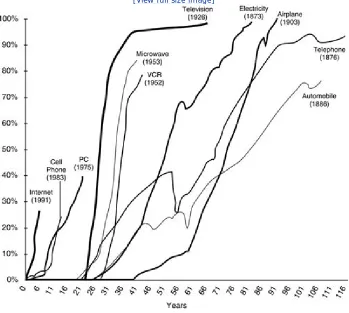
[image:23.557.105.454.395.708.2]Networks have had a very large (mostly negative) impact on the idea of making software behave. Since its birth in the early 1970s as a 12-node network called the ARPANET, the Internet has been adopted at an unprecedented rate, moving into our lives much more speedily than a number of other popular technologies, including electricity and the telephone (Figure 1-1). If the Internet is a car, software is its engine.
Figure 1-1. Rate of adoption of various technologies in years. The
graph shows years (since introduction/invention noted as year 0) on
the x-axis and market penetration (by percentage of households) on
the y-axis. The slopes of the different curves are telling. Clearly, the
Internet is being adopted more quickly (and thus with a more
profound cultural impact) than any other human technology in
history. (Information from Dan Geer, personal communication.)
• Table of Contents
• Index
Exploiting Software How to Break Code
By Greg Hoglund, Gary McGraw
Publisher: Addison Wesley
Pub Date: February 17, 2004
ISBN: 0-201-78695-8
Pages: 512
How does software break? How do attackers make software break on purpose? Why are firewalls, intrusion detection systems, and antivirus software not keeping out the bad guys? What tools can be used to break software? This book provides the answers.
Exploiting Softwareis loaded with examples of real attacks, attack patterns, tools, and techniques used by bad guys to break software. If you want to protect your software from attack, you must first learn how real attacks are really carried out.
This must-have book may shock you—and it will certainly educate you.Getting beyond the script kiddie treatment found in many hacking books, you will learn about
Why software exploit will continue to be a serious problem
When network security mechanisms do not work
Attack patterns
Reverse engineering
Classic attacks against server software
Surprising attacks against client software
Techniques for crafting malicious input
The technical details of buffer overflows
Rootkits
Exploiting Softwareis filled with the tools, concepts, and knowledge necessary to break software.
Connecting computers in a network allows computer users to share data, programs, and each others' computational resources. Once a computer is put on a network, it can be accessed remotely, allowing geographically distant users to retrieve data or to use its CPU cycles and other resources. The software technology that allows this to happen is very new and largely unstable. In today's fast-paced economy, there is strong market pressure on software companies to deliver new and compelling technology. "Time to market" is a critical driver, and "get it done yesterday" is a common mandate. The longer it takes to get a technology to market, the more risk there is of business failure. Because doing things carefully takes too much time and money, software tends to be written in haste and is poorly tested. This slipshod approach to software development has resulted in a global network with billions of exploitable bugs.
Most network-based software includes security features. One simple security feature is the password. Although the movie cliché of an easily guessed password is common, passwords do sometimes slow down a potential attacker. But this only goes for naive attackers who attempt the front door. The problem is that many security mechanisms meant to protect software are themselves software, and are thus themselves subject to more sophisticated attack. Because a majority of security features are part of the software, they usually can be bypassed. So even though everyone has seen a movie in which the attacker guesses a password, in real life an attacker is generally concerned with more complex security features of the target. More complex features and related attacks include
Controlling who is allowed to connect to a particular machine
Detecting whether access credentials are being faked
Determining who can access which resources on a shared machine
Protecting data (especially in transit) using encryption
Determining how and where to col