© 2016 IJSRST | Volume 2 | Issue 6 | Print ISSN: 2395-6011 | Online ISSN: 2395-602X Themed Section: Science and Technology
Effectiveness of Cement and Lime in Earth Bricks for Building
Construction
Sangeetha J Sankar*1, Vishnu Prasad T2, Nishila V3
Department of Civil Engineering, Ammini College of Engineering, Palakkad, Kerala, India
ABSTRACT
Earth, is an important building material which is present in the nature and is available in most of the regions. Currently people demand energy efficient and cost effective buildings that emphasize a healthy and balanced livelihood. In developing countries, a construction with earth is economically the most efficient means to meet the demand of the needy with least demand of the resources. Handmade unbaked bricks known as “mud bricks” or “adobes” are employed traditionally and they suffer from cracks and water attack which in turn need continuous maintenance to keep them in good condition. In order to improve the effectiveness of mud bricks stabilization is being practiced nowadays. This study is devoted to enhance the compressive strength and water absorption characteristics of mud bricks with the use of cement and lime as stabilizers at varying proportions to increase the properties of the basics earth mix for the making of mud bricks. The experimental results show that with the addition of stabilizers to a certain limit lead to an improved effectiveness of the mud bricks.
Keywords : Adobe, Stabilization, Cement, Lime, Compressive strength
I.
INTRODUCTION
Earth is the most widely known and abundant building material available for various constructions for the human needs. Earth is a main part of construction from the ancient time onwards. Local availability of earth makes its use advantageous and ease of its processing to mud block makes it one of the most energy efficient, cost effective and very reliable building material in general.
But construction practices of today highly depend on materials like cement, burnt bricks and other materials like steel, aluminium etc which cause negative impact on environment and economy in many ways. Thus it’s very much important to enhance the properties of traditional unbaked mud blocks. Looking towards this, the alteration was made to them by stabilizing the earth with stabilizers. It’s known that constructions with mud brick technology has been widely used in regions soil containing high silt and clay contents. Therefore this study aims to investigate the enhancing the properties of mud bricks after its stabilization with cement and lime which are the stabilizing agents. In this research the
compressive strength and water absorption characteristics of the mud blocks are investigated.
II.
METHODS AND MATERIAL
A. Materials
The materials used in this study for mud brick making were red soil and sand as the main matrix, and cement and lime as stabilizers.
B. Methods
various mix proportions of cement and lime to the mix of soil and sand. The proportions of cement and lime used were shown in the table 1.
Table 1. Mix Proportions of Cement And Lime
The raw materials were mixed to reach optimum brick properties (Fig: 1). These properties include compressive strength and water absorption without sacrificing the superior advantage of the ordinary brick.
Figure 1: Mixing of Raw Materials
As per IS 1725- 1982 brick moulds of size 19cm x 9cm x 9 cm were used (Fig: 2).
Figure 2 : Timber Brick Moulds
Six number of stabilized earth blocks were made for each proportion. Out of which three were taken for compressive strength test and rest three for water absorption test. The tests were done after 28 days of drying under shade. The blocks were dried under natural ventilation and lighting (Fig: 3).
Figure 3: Stabilized earth blocks kept for drying
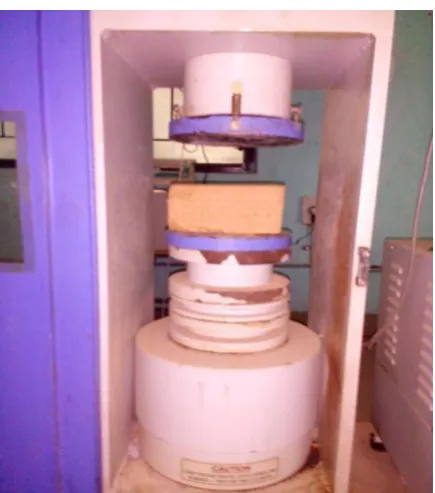
Figure 4: Compression test on Stabilized Brick
The water absorption test was done by Immersion Method by immersing the specimen in clear clean water at a temperature of 270C for 24 hours (Fig: 5).
Figure 5: Immersion Test on Stabilized Bricks
III.
RESULT AND DISCUSSION
Table 2 shows the compressive strength of stabilized earth blocks for all the mixes.
Table 2. Compressive Strength Of Stabilized Blocks
The compressive strength is low when the blocks were stabilised with lime only (Mix 1). With the addition of cement and by decreasing the percentage of lime usage the compressive strength is increasing. It can be found that the compressive strength is very much high if the block was stabilized with cement alone (Mix 7). It was found that minimum strength was obtained with Mix 4 and Mix 5. The Fig: 6 show the variation of compressive strength at various mixes.
As per IS 3494-1992 minimum compressive strength of a normal brick was 3.50 N/mm2. But the mix corresponding to mix 6 gives the optimum
Figure 6: Variation of Compressive strength
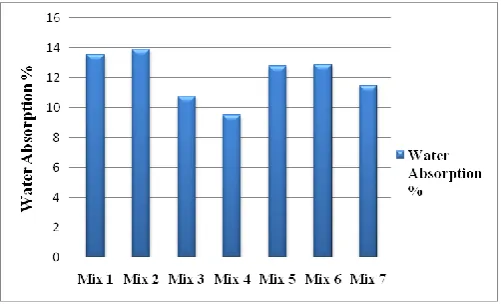
Table 3 shows the water absorption rates of stabilized earth blocks for the various mixes.
The rate of water absorption is very high for mix 1. The water absorption rate is decreasing with the addition of cement and also by decreasing the percentage of lime. But the water absorption is increasing with increase in the cement content also that is blocks made with Mix 7 has also got high water absorption. Low water absorption was obtained for mix 4. The Fig: 7 show the variation of the water absorption at various mixes.
As per IS: 3495-1992 water absorption shall not be more than 20% by weight of a brick. Thus all the mix proportions of stabilizers were acceptable for making of stabilized bricks.
Figure 7 : Variation of Water Absorption
Figure 8 : Variation of Water Absorption and Compressive Strength
IV.
CONCLUSION
Stabilized Earth Blocks are manufactured using stabilizers to provide adequate compressive strength and durability, so, as to make them suitable as building blocks. From the experiments, the obtained values of the physical properties of materials for the making of Stabilized Earth Block that is cement, soil and sand is within the range as per the Indian Standards. It is observed that while using cement as the stabilizer alone the compressive strength is found to be greater than that of ordinary brick. From the view point of compressive strength, the combination of stabilizers with 8% cement and 2% lime was found to have higher compressive strength of 3.74N/mm2 with water absorption of 12.9%.
And also it was found that the combination of stabilizers with 5% cement and 5% lime have the least water absorption with 12.52% having a compressive strength of 2.57N/mm2, which is less than the minimum
V.
REFERENCES
[1] Abhijeet D. Patil, "Compressed Stabilized Earth Blocks by using Lime", International Journal of Engineering Research and Technology, (September 2015)
[2] B. N. Patowary1, "Study of Compressed Stabilized Earth Block", International Journal of Scientific and Research Publications, (June 2015)
[3] Ibtehaj Taha Jawad, "Soil Stabilization Using Lime: Advantages, Disadvantages and Proposing a Potential Alternative", Research Journal of Applied Sciences, Engineering and Technology , (July 2014)
[4] Sihem Chaibeddra, "Study of sulphate attack on earth stabilized blocks", International Journal of Application or Innovation in Engineering & Management ,(January 2014)
[5] H.B.Nagaraj,"Role of lime with cement in long term strength of compressed stabilized earth blocks", International journal of sustainable built environment, (2014).
[6] Asma Muhmed, "Effect of Lime Stabilisation on the Strength and Microstructure of Clay", IOSR Journal of Mechanical and Civil Engineering, (May - Jun. 2013) [7] S.Chaibeddra, " Sustainability of Stabilized Earth Blocks
to water erosion", International Journal Of Engineering and Innovative Technology , (March 2013)
[8] Ankit Singh Negi, "Soil Stabilization Using Lime", International Journal of Innovative Research in Science, Engineering and Technology , (February 2013)
[9] A.B. Tchamba, "Building Potentials of Stabilized Earth Blocks in Yaounde and Douala (Cameroon)", International Journal of Civil Engineering Research, (2012)
[10] A. B. Tchamba "Building Potentials of Stabilized Earth Blocks", International Journal of Civil Engineering Research, (2012).
[11] Kabiraj. K, "Experimental investigation and feasibility study on stabilized compacted earth block using local resources", International Journal Of Civil And Structural Engineering, (2012)