© 2018, IRJET | Impact Factor value: 6.171 | ISO 9001:2008 Certified Journal | Page 4972
Evaluation of Characteristics Strength of Soil by Using Geo-grid
Kotesh Y D
1, Mahaboob Subhani A H
2, Manish Kumar R S
3, Satish A
4, Sudha P H
51,2,3,4UG Students, Dept of Civil Engineering, S T J Institute of Technology, Ranebennuru, Karnatak, India 5Asst Professor, Dept of Civil Engineering, S T J Institute of Technology, Ranebennuru, Karnatak, India
---***---Abstract –Road pavement are vulnerable (weak) to soil performance because the foundation of the pavement is a roads most important element. And if the sub grade layer of pavement consists of expansive soil (black cotton soil), due to changes in moisture content and subsequent shrinkage and swelling, it undergoes failure. Thus, for the construction on such type of soil it is required to improve the engineering properties of soil or to replace the soil itself. Replacing the existing soil might not be a practical and feasible option, thus it is required to stabilize the soil with suitable stabilizer. This paper determines the bearing capacity of four different types of soil and placing geo-grid at different depths. Soil is one of the main basic materials in design and construction in civil engineering works, due to the high demand on the maintenance and development of efficient infrastructure (railways, roads and buildings). This paper investigates basic property of different types of soils, such as Red soil (RS), Black cotton soil (BC), Laterite soil (LS) and Alluvial soil (AS) and increase the bearing capacity by using Bi-axial geo-grid. The soil samples were taken to the laboratory for experiments to determine Grain size, specific gravity, Atterberg limits, Compaction test (MDD & OMC), Direct shear test, unconfined compression test and California Bearing Ratio (CBR) by laying the geo-grid at different layers like Top, Bottom, Middle and 1/3rd & 2/3rd from the base of the mould to determine the
strength of soils. The bearing capacity of Laterite soil, Black cotton soil and Alluvial soil is increases when the geo-grid is placed at the top and bearing capacity of Red soil is increases when the geo-grid is placed at middle.
1. INTRODUCTION
In India area is occupied by black cotton soil, which absorbs water, swells, becomes soft and loses strength. This type of soil is easily compressible when wet; when dry, it shrinks in volume and develops cracks. These properties of soil make the soil poorer for construction work. Techniques are being used worldwide for stabilization of such expansive soil after stabilization with additives such weak soil using various admixtures. The geo-grid material has gained the attention in the field of geotechnical engineering as it is used to improve the bearing capacity of soil. For the last three decades, many studies have been carried out based on the beneficial effects of the geo-grid material on the load bearing capacity of the soil. Several researches have conducted that the bearing capacity of the soil is increases by the reinforcement of grid. A grid is defined as the geo-synthatic material consisting of connected parallel sets of tensile ribs with aperture of sufficient size to allow strike through surrounding soil or other geo-synthetic material. Geo-grid are made from high molecular weight, high tenacity
polyester with polymeric coating, the geo-grid sheets are permeable and flexible, the geo-grid carries tensile strength varying from 100 to 220KN. Soil alone carries compressive and shear forces however with the help of geogrid it is able to carry tensile forces also. In this study we have used bi-axial geo-grid as they- carry the strength both in X and Y directions. In this project we have used four different types of soils namely Red soil, Black cotton soil, Laterite soil and alluvial soil.
1.1 Types of Soils
RED SOIL: Red soil have two broad classes
1) Red loam with cloddy structure and allow content of concretionary materials
2) Red earths with loose, permeable top soil and a high content of secondary concretions.
LATERITE SOIL: These soils are red to reddish yellow in colour and low in N, P, K, lime and magnesia. These soils are formed in-situ under conditions of high rainfalls with alteration dry and wet periods.
BLACK COTTON SOIL: In India large area is occupied by the black cotton soil, which absorbs water , swells, becomes soft and loses strength. These are mostly clay soil and from deep cracks during dry season. These soils are deficient in nitrogen, phosphoric acid and organic matter but rich in calcium, potassium and magnesium.
ALLUVIAL SOIL: These soils occur along rivers and represent the soil materials that have been deposited by the rivers during flood. They are very productive soils but many are deficient in nitrogen, humus and phosphorous.
1.2 Objectives
To improve the structural integrity of soils in roadways, walls etc
To reduce pavement thickness and subsequently the cost of project.
To improve bearing capacity of soil.
To improve strength and stiffness of pavement which ultimately reduces pot holes in the road.
© 2018, IRJET | Impact Factor value: 6.171 | ISO 9001:2008 Certified Journal | Page 4973
2. LITERATURE REVIEW:
Mihai Iliescu and Ioan Ratiu : devised a new design methodology for stabilizing road sub-grade using geo-grid reinforcement. In their experiment , they found out that geo-grids can improve the performance of the sub-grade soil. They carried out extensive static and dynamic plate bearing testes on different condition based on the result of trail and the member theory of Giroud & Noiray , they developed design graphs for multifunctional geo-grid in unpaved and temporary road.
Rakesh Kumar and P. K. Jain: in their study of ground improvement techniques found that the construction of granular piles in expansive soil improves the load carrying capacity of the soil. They further made an attempt to investigate the improvement of load carrying of granular pile with and without geo-grid encasement through laboratory model tests and found that the load carrying capacity of granular pile increases by casing the pile with geo-grid.
Pradeep Singh and K.S. Gill: carried out experimental work to determine the optimum position of providing geo-grid reinforcement in sub-grade soil by conducting CBR test and unconfined compressive test. He found that by providing geo-grid reinforcement at 0.2H from top give considerable improvement in CBR values and stress strain behaviour of sub-grade soil.
3. MATERIALS
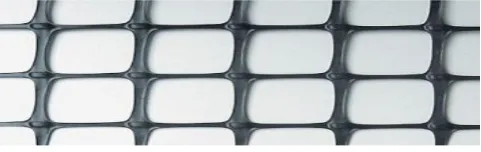
3.1 Polyethylene geo-grid: A grid is defined as the geo-synthetic material consisting of connected parallel sets of tensile ribs with apertures of sufficient size to allow strike through surrounding soil or other geo-synthetic material. Geo-grids are made from high molecular weight, high tenacity polyester with polymeric coating, the geo-grid sheets are permeable and flexible, the geo-grid carries tensile strength varying from 100 to 220KN.
3.2. Types Soil Used:
Red soil Black soil Laterite soil Alluvial soil
4. METHODOLOGY
The specific gravity of soil sample is determined by using IS 2720 (part-3)-1980 and the partical size distribution by
using sieve analysis as per IS 2720 (part-4)-1985. Three trials were conducted and average of three is obtained for the sake of accuracy. The standard proctor test was conducted to determine the optimum moisture content (OMC) and maximum dry density (MDD) as per IS 2720 (part-7 & 8)-1974. The Atterberg limits were calculated by using casagrandes for liquid limit and plastic limit of the soil samples s per IS 2720 (part-5)-1985. Tests had conducted to determine the angle of friction by unconfined compression strength (UCS) as per IS. And Direct shear to determine the cohesion of the soil sample as per IS. To carry out the CBR tests as per IS 2720 (part-16) on red soil, first the soil is kept for drying for 24 hrs in an oven for about 105-110 0.c and
cooled at room temperature. The weight of the soil is calculated by multiplying the volume of the CBR mould and MDD of the soil. The soil is mixed with the water upto optimum moisture content (OMC).
5. Results
The four different soil samples are collected in four different places such as Red soil collected from S.T.J.I.T campus in ranebennur, black cotton soil is collected from magod near ranebennur, alluvial soil is collected from Tungabhadra river near harihar, laterite soil is collected from sirsi. The results of the soil used in this study are presented in the below figures and tables.
SPECIFIC GRAVITY
Specific gravity is defined as the ratio of the weight of a given volume of soil solids at a given temperature to the weight of an equal volume of distilled water at that temperature. The specific gravity of soils used in this study as tabulated below.
GRAIN SIZE DISTRIBUTION
[image:2.595.38.279.545.621.2]The grain size distribution test was conducted to determine the particle size distribution of soil samples.
Table.1. Results of sieve analysis on Red soil
SL NO Sieve IS
size in mm
Weight of soil retained
(gm)
% weight
of soil retained
Cumulative % retained
C
Cumulative % of passing N=100-C
1 20 0 0 0 100
2 10 130 13 13 87
3 4.75 230 23 36 64
4 2 160 16 52 48
5 1 140 14 66 34
6 .6 70 7 73 27
7 .425 172 17.2 90.2 9.2
8 .3 34 3.4 93.6 6.4
9 .212 14 1.4 95 5
10 .150 22 2.2 97.2 2.8
11 .075 20 2.0 99.2 .8
© 2018, IRJET | Impact Factor value: 6.171 | ISO 9001:2008 Certified Journal | Page 4974
Table.2. results of sieve analysis on black cotton soil
SL NO IS Sieve size in mm Weight of soil retained (gm) % weight of soil retained Cumulati ve % retained C Cumulati ve % of passing N=100-C
2 10 280 28 36 64
3 4.75 220 22 58 42
4 2 100 10 68 32
5 1 100 10 78 22
6 0.6 60 6 84 16
7 0.425 80 8 92 8
8 0.3 20 2 94 6
9 0.212 10 1 95 5
10 0.15 26 2.6 97.6 2.4
11 0.075 16 1.6 99.2 0.8
[image:3.595.38.281.100.278.2]12 pan 8 0.8 100 0
Table.3. Results of sieve analysis on Alluvial soil
SL NO IS Sieve size in mm Weight of soil retained (gm) % weight of soil retained Cumulative % retained C Cumulative % of passing N=100-C
2 10 14 1.4 1.4 98.6
3 4.75 490 49 50.4 49.6
4 2 184 18.4 68.8 31.2
5 1 122 12.2 81 19
6 0.6 52 5.2 86.2 13.8
7 0.425 66 6.6 92.8 7.2
8 0.3 0 0 92.8 7.2
9 0.212 18 1.8 94.6 5.4
10 0.15 20 2 96.6 3.4
11 0.075 22 2.2 98.8 1.2
12 pan 12 1.2 100 0
Table.4. Results of sieve analysis on Laterite soil
SL NO IS Sieve size in mm Weight of soil retained (gm) % weight of soil retained Cumulative % retained C Cumulative % of passing
N=100-C
2 10 42 4.2 4.2 95.8
3 4.75 262 26.2 30.4 69.6
4 2 144 14.4 44.8 55.2
5 1 136 13.6 58.4 41.6
6 0.6 80 8 66.4 33.6
7 0.425 44 4.4 70.8 29.2
8 0.3 120 12 82.8 17.2
9 0.212 16 1.6 84.4 15.6
10 0.15 80 8 92.4 7.6
11 0.075 58 5.8 98.2 1.8
12 pan 18 1.8 100 0
ATTERBERG LIMIT TEST
Atterberg limits are initial tests conducted on soil sample. Liquid limit and plastic limit are shown in below table.
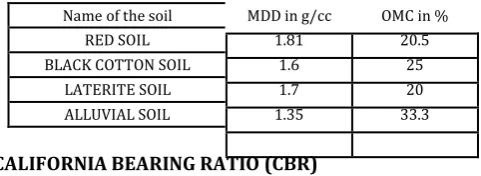
Name of the soil MDD in g/cc OMC in %
RED SOIL 1.81 20.5
BLACK COTTON SOIL 1.6 25
LATERITE SOIL 1.7 20
ALLUVIAL SOIL 1.35 33.3
CALIFORNIA BEARING RATIO (CBR)
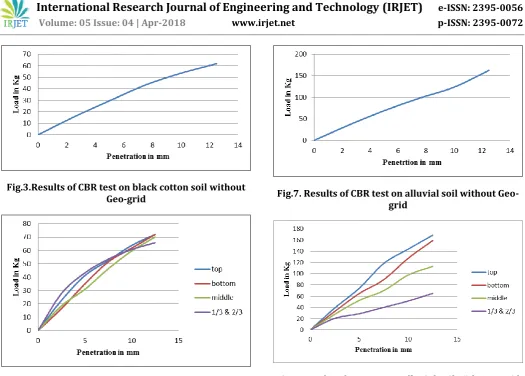
[image:3.595.312.553.250.338.2]The results of CBR without geo-grid at different depth and number of layers are shown in below figures. There was increase in bearing load in red soil when geo-grid placed at middle (1/2)H and in laterite , black cotton and alluvial soil when geo-grid is placed at top(H).
[image:3.595.34.288.308.493.2]Fig.1. Results of CBR test on Red soil without Geo-grid
Fig.2.Results of CBR test of soil with Geo-grid
SL
NO Name of the Soil LL in % PL in %
1 RED SOIL 28 40
2 BLACK COTTON SOIL 46 25
3 LATERITE SOIL 34 -
4 ALLUVIAL SOIL - -
[image:3.595.310.563.415.551.2]© 2018, IRJET | Impact Factor value: 6.171 | ISO 9001:2008 Certified Journal | Page 4975
[image:4.595.38.288.433.550.2]Fig.3.Results of CBR test on black cotton soil without Geo-grid
[image:4.595.34.290.508.727.2]Fig.4.Results of test on black cotton soil with Geo-grid
Fig.5.Results of CBR test on Laterite soil without Geo-grid
Fig.6.Results of CBR test on laterite soil with Geo-grid
Fig.7. Results of CBR test on alluvial soil without Geo-grid
Fig.8.Results of CBR test on alluvial soil with Geo-grid
6. CONCLUSION:
Although the research that has been performed on geo-grid reinforced soil gives wide varity of results on several issues. This study determines the application of geo-grid on the different type of soil. The geo-grid increases the bearing capacity of soils, which shows in the higher CBR value. The investigation shows that increase the bearing capacity of the different soils by placing of geo-grid at different depth. It was shows that the maximum bearing capacity is obtained when geo-grid is place at top of the mould in Laterite soil, Alluvial soil and Black cotton soil and geo-grid is placed at middle of the mould in Red soil. There is continuously an increase in the performance of the soil in the dry condition. A geo-grid reinforced soil is stronger and stiffer and more strength than the equivalent soil without geo-grid reinforcement.the use of geo-grid will allow forces to transfer throughout a much larger area. Biaxial geo-grid can be used in any direction and have equal strength on both directions.
REFERENCES
[1] A.K.Choudhary, K.S.Gill and J.N.jha (2011)”improvement
in CBR values of expensive soil sub-grades using geo-synthetics”IGCJ-233.
[2] Akinmusuru and Akinbolade (1981) “Stability of loaded
© 2018, IRJET | Impact Factor value: 6.171 | ISO 9001:2008 Certified Journal | Page 4976
[3] Dr.P.Senthil kumar & R. Rajkumar (2012)”Effect of
Geo-textile on CBR Strength of Unpaved Road with Soft Subgrade”EJGEVol.17
[4] Dash, S K et.al,(2007) “Behavior of geocell-reinforced
sand beds under strip loading “, 916, 905-916. Doi: 10.1139/T07-035.
[5] Evangelin RamaniSujatha and VigneshJayaraman (2012)
“Improving the strength of sub-grade using geo grids”.
[6] Rakesh Kumar and P.K.Jain (20130”Expansive soft soil
improvement by geo grid encased granular pile “. IJET
[7] Mihai Iliescu and IoanRatiu (2012) “Geo-grid reinforced
road sub-grade stabilization design methodology”.
[8] Pradeep Singh, K.S.Gill (2012) “CBR Improvement of