www.orientjchem.org
An International Open Free Access, Peer Reviewed Research Journal
2018, Vol. 34, No.(4): Pg. 2192-2196
This is an Open Access article licensed under a Creative Commons Attribution-Non Commercial-Share Alike 4.0 International License (https://creativecommons.org/licenses/by-nc-sa/4.0/), which permits unrestricted Non Commercial use, distribution and reproduction in any medium, provided the original work is properly cited.
Biosorption of Cu(II) Metal ions in Fixed Column by using
Coconut Husk Waste
HARMIWATI NH*, KHAIRUL AKLI, RITA YOUFA,
MARIA ISFUS SENJAWATI and MIFTAHUL KHAIRATI
Phytochemistry Department of Polytechnic ATI of Padang, Indonesia. *Corresponding author E-mail: [email protected]
http://dx.doi.org/10.13005/ojc/3404062
(Received: March 27, 2018; Accepted: May 19, 2018)
ABSTRACT
A new technology has been currently developed for the removal of heavy metal waste in water, called biosorption. Biosorption technology has been widely used to remove heavy metals from liquid waste. The potential biomass which can be used as biosorbent was activated coconut husk waste. By using the continuous flow method and activated coconut husk as biosorbent, the obtained optimum flow rate and bed height of biosorbent were 2 mL/min. and 0.1 g with adsorption capacity of 188.322 mg/g.
Keywords: Heavy metals, Biosorption, Biosorbent, Fixed bed column.
INTRODUCTION
The current rapid industrial development has caused pollution effects on the environment. The activities of metal coating industry have resulted in the increasing of heavy metals level in the water because the waste is discharged into water1, 2. The
heavy metals waste in aquatic environment can be dangerous for the living organism as it can lead to bio toxic effects, and cause the acute and chronic illness3.
Conventional technology has been widely used to remove heavy metals from liquid wastes such as chemical precipitation, filtration, ion exchange,
coagulation, extraction, and reverse osmosis4.
Nevertheless, these methods are limited by technical and economic factors. The new technology has been currently developed for the removal of heavy metal waste in water. Biosorption is an adsorption process where the heavy metal waste in liquid is adsorbed by a solid adsorbent from biomaterial waste, called as biosorbent. This technology has advantages in comparison with conventional technologies where the metal adsorption capacity is higher. Biosorbent used from agricultural wastes is widely available in nature, thus providing more benefits compared to previous conventional techniques mentioned, which are cheaper, faster in adsorption, higher efficiency, and can be regenerated5,6,7.
Some biomass have been widely used as biosorbents for heavy metals, such as wheat straw8,
peanut shells9, Acacia leucocephala bark10, banana
peel11, solid waste from olive oil production12, tobacco
dust13, rice husk14, Moringa oleifera leaves15, coconut
shell16,17, Annona muricata seeds18, almond shell19,
oil palm shell20, Nypa fruticans shell21, Lansium
domesticum fruit peel22, Phaleria macrocarpa23,
soybean24.
One of the potential biomass which can be used as biosorbent is activated coconut husk waste.
Coconut husk is a highly potential biosorbent because it contains cellulose and lignin. Cellulose and lignin are biopolymers which play an important role in the separation process of heavy metals. Carboxyl groups of cellulose and phenolic acid of lignin take part in the bonding of metals. Hence, the use of coconut husk waste as biosorbent to remove heavy metals from waste water especially in industrial waste water can be a promising potential. The novelty of this research was on the use of fixed column method for the biosorption of Cu (II) metal from industrial waste water using coconut husk waste as biosorbent.
MATERIAL AND METHODS
Tools and Materials
The materials used in this research were coconut husk, metal solution of Cu(NO3)2, NaOH, HCl, HNO3, and aquadest. The equipment used in
this research were glass column with diameter of 1 cm, length of 30 cm, peristaltic pump, scanning electron microscope with energy dispersive X-ray (SEM EDX), atomic adsorption spectrophotometer (AAS), fourier transformed infrared (FTIR), digital balance, pH meter, crusher, screening, paper strain, and glassware.
Biosorbent Preparation
The biosorbent raw materials, i.e. coconut husk was cleaned from sand and mud, washed with clean water, and dried in the open air. After dried, coconut husk was cut with size of 3 cm, then smoothed by using crusher with particle size of 425 μm. The pureed coconut husk was then activated by immersed in 0.01 M HNO3 solution for 2 h
while stirred occasionally. It was then washed with aquadest until the pH of 7. Activation was carried out to open the pores of the functional group, thus easily to be entered by metal ions, besides, it also aimed to remove contamination with other metal ions.
Coconut Husk Bio sorbent Characterization
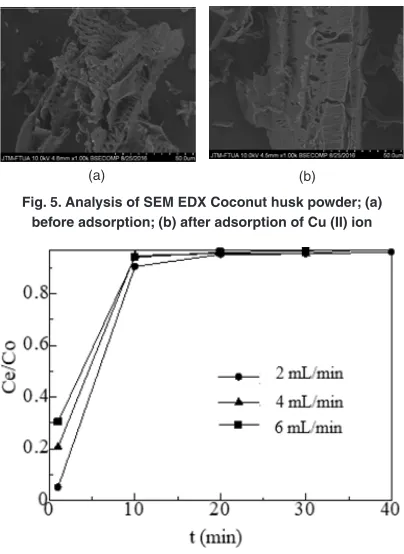
The characterization of coconut husk bio sorbent, i.e. FTIR and SEM EDX analysis, were done before and after adsorption. The analysis aimed to investigate the functional groups of biosorbent which play an active role in the adsorption, changes in bio sorbent surface morphology before and after adsorption, and changes in the chemical composition of biosorbent before and after adsorption.
(a) (b)
Fig. 1. Coconut Husk (a) before treatment (b) biosorbent
Fixed Column (fixed bed column)
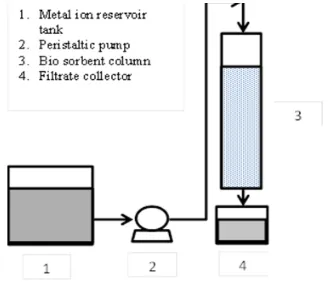
The study was conducted by continuous method using fixed bed column with initial concentration of 150 mg/L, solution pH of 4, biosorbent mass of 0.1 g with bio sorbent particle size of 425 μm. The adsorption of heavy metal ions was investigated by passing a solution containing metal on a fixed bed column containing biosorbent. The feeding solution was pumped into the column by varying the feed flow rate and the biosorbent mass.
RESULTS AND DISCUSSION
Biosorbent Characterization FTIR Analysis
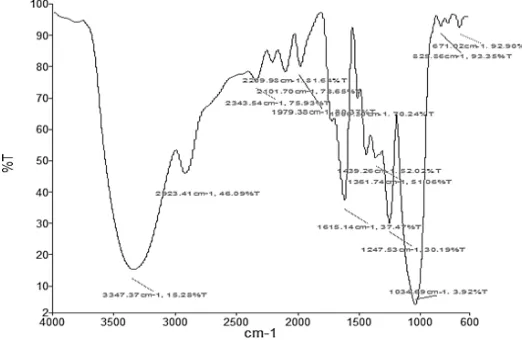
The result of FTIR analysis in Fig. 3 and Fig. 4 show that there was a shift of wave number
on OH and CH functional groups in coconut husk biomass before and after adsorption at several frequencies in FTIR analysis. The shift of wave numbers indicated the occurrence of metal ion binding on the OH and CH functional groups25.
Fig. 3. FTIR analysis of coconut husk before adsorption of Cu (II) ion
Fig. 4. FTIR analysis of coconut husk after adsorption of Cu (II) ion
SEM EDX Analysis Variation of Flow Rate
The biosorption of Cu (II) metal ions was done by using the variation of flow rate of 2 ml/min. 4 mL/min. and 6 mL/min. while other variations were kept constant, i.e. diameter of coconut husk biomass particles of 425 mm with mass of 0.1 g (1.5 cm) and metal ion concentration of 150 mg/L at pH = 4. The breakthrough curve for Cu (II) metal ion bio sorption was obtained from the relationship between the ratio of the filtrate
concentration and the initial concentration of the metal ion (Ce/Co) against the time (t).
the adsorption capacity was not good at the high flow rate because the contact time/mass transfer zone between the metal ion and biosorbent in the column was shorter. In this study, at the high flow rates, the columns were filled with many metal ions (flooding/ channeling), thus the concentration of metal ions were not detected properly26. This will be different
when research was conducted at the low flow rates. At flow rate of 2 mL/min. qe = 188,794 mg/g, while at flow rate of 4 mL/min. qe = 183.917 mg/g and at flow rate of 6 mL/min. qe = 130.665 mg/g. From the calculation, the best qe obtained was at flow rate of 2 mL/minute.
Fig. 6. Breakthrough curve of the Cu (II) ion adsorption of flow rate variations
Bio sorbent Mass Variation
The effect of the variations of biosorbent mass were examined. The biosorbent mass/high bed (m) used were 0.1 g (1.5 cm); 0.15 g (2.25 cm); 0.2 g (3 cm); 0.25 g (3.75 cm); and 0.3 g (4.5 cm), while other variations were kept constant, i.e. metal ion concentration of 150 mg/L with pH of 4, diameter of bio sorbent particle of 425 mm, and metal ion flow rate of 2 mL/minute. The breakthrough curve for Cu (II) metal ion biosorption was obtained from
the relationship between the ratio of filtrate concentration and the initial concentration of metal ion against the time.
There was a significant change in the shape and gradient of the breakthrough curve for some of the biosorbent mass variations used as shown in Fig. 7. On the breakthrough curve, it can be seen that the bio sorbent mass influence the saturation time of the adsorption. The adsorption of Cu (II) metal ions in the column depends on the mass of the biosorbent.
Breakthrough time was observed from the breakthrough curve as shown in Fig. 7. The larger bio sorbent mass caused the slope of the breakthrough curve was lower than that of the smaller biosorbent mass. This is due to the contact time/mass transfer zone of metal ions and biosorbents in the column to achieve saturation was longer at the larger biosorbent mass. Hence, as the mass of bio sorbent increased, it took longer time for the diffusion of metal ions into the pores of the biosorbent. As indicated by its maximum adsorption capacity (qe), at the mass variation of 0.1 g, the obtained qe was 83.699 mg / g, while at the mass variation of 0.15; 0.2; 0.25; 0.3 g, the obtained qe were 55,799; 41,850; 33,480; and 27,900 mg/g, respectively. From the calculation, the larger bio sorbent mass resulted in the smaller adsorption capacity27,8,28. The best adsorption
capacity of Cu (II) metal ion was at biosorbent mass of 0.1 gram.
Fig. 7. Breakthrough curve of Cu (II) ion adsorption of bio sorbent mass variations
CONCLUSION
Coconut husk biomass waste can be a potential biosorbent of Cu (II) metal ions in the waste
(a) (b)
water of metal industry. The optimum conditions of the continuous flow method of Cu (II) at flow rate of 2 mL/min. and biosorbent mass of 0.1 g with adsorption capacity of 188.794 mg/gram.
ACKNOWLEDGEMENT
This research was supported by the Ministry of Industry, Indonesia.
REFERENCES
1. Metcalf; Eddy. Mc Graw Hill Companies.,
2003.
2. Tiwari, M. K.; Bajpai, S.; Dewangan, U. K.; Tamrakar, R. K. Karbala International Journal of Modern Science., 2015, 1, 1–6.
3. SNI 7387., 2009.
4. Ashraf, M. A.; Mahmood, K.; Wajid, A. International Conference on Food Engineering and Biotechnology IPCBEE., 2011, 9, 60–68. 5. Amin, Y. Applied Biochemistr y and
Biotechnology., 2010, 160, 976–987. 6. Haidary, A. M. A.; Zanganah, F. H. H.;
Al-Azawi, S. R. F. Water, Air, and Soil Pollution.,
2011, 214, 73–82.
7. Abdullah, Z.; Kurniawan, M. I.; Zein, R.; Aziz, H.; Munaf, E. Research Journal of Pharmaceutical Biological and Chemical Sciences., 2013, 4, 1443–1451.
8. Doan, H. D.; Lohi, A.; Dang, V. B. H.; Dang-vu, T. Process Safety and Environment Protection., 2009, 6, 259–267.
9. OuYang, X.K.; Yang, L.P.; Wen, Z.S.
Bioresources Technology., 2014, 9, 2446-2458.
10. Munagapati, V. S.; Yarramuthi, V.; Nadavala, S. K.; Alla, S. R.; Abburi, K. Chemical Engineering Journal., 2010, 157, 357–365. 11. Ashraf, M. A.; Wajid, A.; Mahmood, K.; Maah,
M. J. Scientific Research and Essays., 2011,
6, 4055–4064.
12. Calero, M.; Bla, G. Journal of Chemical Engineering Data.m, 2011, 110, 3053–3060. 13. Qi, B. C.; Aldrich, C. Bioresources Technology.,
2008, 99, 5595–5601.
14. Zhang, Y.; Zheng, R.; Zhao, J.; Ma, F.; Zhang, Y.; Meng, Q. Biomed Research International.,
2014, 2014, 1-8.
15. Kumar, D. H.; Seshaiah, K.; Reddy, A. V. R.; Lee, S. M. Carbohydrate Polymers., 2012, 88, 1077–1086.
16. Acheampong, M. A.; Pereira, J. P. C.; Meulepas, J. W.; Lens, P. N. L. Journal of Chemical Technology and Biotechnology.,
2011, 86, 1184–1194.
17. Acheampong, M. A.; Pakshirajan, K.; Annachhatre, A. P.; Lens, P. N. L. Journal of Industrial and Engineering Chemistry., 2013,
19, 841–848.
18. Fauzia, S.; Furqani, F.; Zein, R.; Munaf, E.
Journal of Chemical and Pharmaceutical Research., 2015, 7, 573–582.
19. Dionisio, E.; Bla, G.; Calero, M.; Ronda, A.; Martı, M. A. Journal of the Taiwan Institute of Chemical Engineers., 2013, 44, 466–473. 20. Chong, H. L. H.; Chia, P. S.; Ahmad, M. N.
Bioresource Technology., 2013, 130, 181– 186.
21. Nazaruddin, N.; Zein, R.; Munaf, E.; Jin, J. Research Article., 2014, 6, 370–376. 22. Furqoni, F.; Zein, R.; Munaf, E. Journal of
Chemical and Pharmaceutical Research.,
2015, 7, 546–555.
23. Nasution, A. N.; Amrina, Y.; Zein, R.; Aziz, H.; Munaf, E. Research Article., 2015, 7, 189–196.
24. Harmiwati; Salmariza; Kurniawati, D.; Lestari, I.; Munaf, E.; Desmiarti, R.; Zein, R. Journal of Chemical and Pharmaceutical Research.,
2015, 7, 94-100.
25. Marin, A. B. P.; Aguilar, M. I.; Otruna, J. F.; Meseguer, V. F.; Saez, J.; Florenz, M. Journal of Chemical Technology and Biotechnology.,
2010, 85, 1310 - 1318.
26. Christoforidis, A. K.; Mitropoulos, A.C.
Chemical Engineering Journal., 2015, 277, 334 – 340.
27. Mata, Y. N.; Munoz, J. A. Journal of Hazardous Material., 2009, 166, 612 – 618.