IJEDR1403022
International Journal of Engineering Development and Research (www.ijedr.org)3016
Sequential Pattern Mining: A Comparison between
GSP, SPADE and Prefix SPAN
1
Manika Verma,
2Dr. Devarshi Mehta
1Assistant Professor, 2Associate Professor
1Department of Computer Science, Kadi Sarva Vishwavidyalaya, 2
GLS Institute of Computer Technology, Ahmedabad, India
________________________________________________________________________________________________________
Abstract - This paper presents a comparison between basically three kinds of algorithm GSP (Generalized Sequential Pattern), SPADE (An efficient Algorithm for mining Frequent Sequences) and Prefix Span (Prefix-projected Sequential Pattern Mining). GSP is the Apriori based Horizontal formatting method, SPADE is the Apriori based vertical formatting method and Prefix-SPAN is Projection-based pattern growth method. This paper elaborate step wise explanation of each algorithm demonstrating number of iterations required in each algorithm. Later a comparison is made between Total time required to execute algorithm, count of frequent sequences found and Max memory (in mb) required by algorithms GSP, SPADE and Prefix-SPAN. The above stated attributes i.e. total time; frequent sequences and Max Memory are obtained using SPMF (A sequential Pattern Mining Framework).
Keywords - GSP, SPADE, Prefix-Span, Apriori-based, Projection-based
________________________________________________________________________________________________________
I. INTRODUCTION
IJEDR1403022
International Journal of Engineering Development and Research (www.ijedr.org)3017
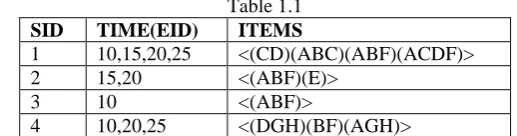
Figure 1To demonstrate step by step explanation of the algorithms GSP, SPADE and Prefixspan the above database shown in Figure 1 is used as input. For all the algorithms, minimum support is 2. The Candidate sets are denoted by C. Ckspecifies candidate sets having k items. For Eg C2 mean Candidate sets having 2 items. The Candidate sets that satisfy minimum support belongs to Lk. In Lk ,Kdenotes number of items in sequence.
II. ALGORITHMSOFSEQUENTIALPATTERNMINING A. Generalized Sequential Pattern (GSP) Algorithm[2]
GSP discovers sequential pattern. GSP scales linearly with the number of data sequences, and has very good scale-up properties with respect to the average data sequence size. [2]
Step by step explanation of how does GSP works:
The database in figure 1 is taken in following format to demonstrate step by step explanation of GSP. Table 1.1
SID TIME(EID) ITEMS
1 10,15,20,25 <(CD)(ABC)(ABF)(ACDF)> 2 15,20 <(ABF)(E)>
3 10 <(ABF)>
4 10,20,25 <(DGH)(BF)(AGH)>
IJEDR1403022
International Journal of Engineering Development and Research (www.ijedr.org)3018
Table 1.2Items No. of occurrence of Items
A 4
B 4
C 1
D 2
E 1
F 4
G 1
H 1
The items that satisfy minimum support are, A,B,D,F . So A,B,D,F are Frequent 1- Sequence 1. Frequent 1- itemsets are A,B,D,F
2. Using Apriori property, frequent itemsets obtained are shown in table below. C is used for denoting Candidate sets (Item sets). Ck denotes candidates having k items. For eg C1 denotes item sets (or candidate sets) having 1 item.
Table 1.3 C1 Items No. of occurrence of Items
A 4
B 4
C 1
D 2
E 1
F 4
G 1
H 1
The items that satisfies minimum support belongs to L1. Lk denotes candidate having k items. For eg L1 denotes items sets (or candidate sets) having 1 item.
Table 1.4 L1 Items No. of occurrence of Items
A 4
B 4
D 2
F 4
3. From above Table 1.4 we can see that a,b,c,d are the that satisfy minimum support.
C2 (where k=2 ) can be obtained by joining L1 X L1 but the condition is k-2 items must be common, so here while joining for obtaining items sets for C2 (2-2=0) items must be common
Table 1.5 C2
Items No. of occurrence of Items
A->A 1
A->B 1
A->D 1
A->F 1
IJEDR1403022
International Journal of Engineering Development and Research (www.ijedr.org)3019
AD 1
AF 3
B->A 2
B->B 1
B->D 1
B->F 1
BD 1
BF 4
D->A 2
D->B 2
D->F 2
D->D 1
DF 1
F->A 2
F->B 1
F->D 1
F->F 1
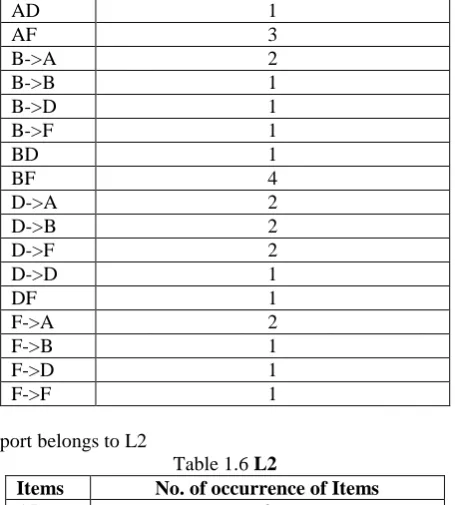
Candidates that satisfy minimum support belongs to L2
Table 1.6 L2
Items No. of occurrence of Items
AB 3
AF 3
B->A 2
BF 4
D->A 2
D->B 2
D->F 2
F->A 2
4. Now, in this step we have to achieve 3-sequence item-sets, i.e item-sets having 3 items. C3(where k=3) can be obtained by joining L2 X L2 but the condition is k-2 items must be common, so here while joining for obtaining items sets for C3 (3-2=1) items must be common.
Table 1.7 C3
Items No. of occurrence of Items
ABF 3
AB->A 1
AF->A 1
BF->A 2
D->B->A 2 D->F->A 2
D->BF 2
F->AF 1
D->FA 1
D->AB 1
IJEDR1403022
International Journal of Engineering Development and Research (www.ijedr.org)3020
B->AB 1
B->AF 1
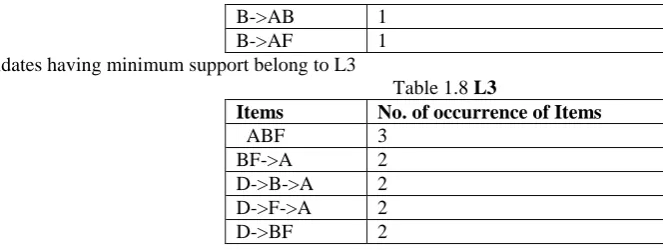
Candidates having minimum support belong to L3
Table 1.8 L3
Items No. of occurrence of Items
ABF 3
BF->A 2
D->B->A 2 D->F->A 2
D->BF 2
5. In this step we have to achieve 4-sequence item-sets, i.e item-sets having 4 items. C4(where k=4) can be obtained by joining L3 X L3 but the condition is k-2 items must be common, so here while joining for obtaining itemsets for C4 (4-2=2) items must be common.
Table 1.9 C4
Items No. of occurrence of Items D->BF->A 2
Candidates having minimum support qualify for moving into L4. Table 1.10 L4
Items No. of occurrence of Items D->BF->A 2
Here, we have obtained only 1, 4-sequence(Sequence of item set having 4 items) item set. B. SPADE(An efficient Algorithm for mining Frequent Sequences)[1]
SPADE is the algorithm used for fast discovery of Sequential pattern . Most of the sequential pattern mining algorithms assume horizontal database layout .Spade uses vertical database format, where we maintain a disk based id-list for each item, show in following figure. [1]
IJEDR1403022
International Journal of Engineering Development and Research (www.ijedr.org)3021
Consider the database shown in figure 1 above. For generating 1-sequence (single items) the occurrence of each item is being counted thus those items that satisfy the minimum support (here minimum support=2) belongs to L1.1-Sequence items are specified in above figure. Above figure specifies Id-List for the atoms.Step by step explanation of how does SPADE works:
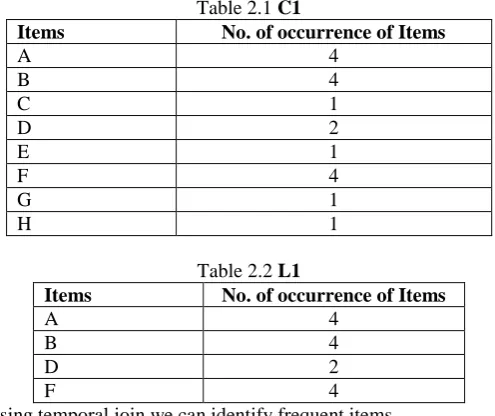
1. Items and count of their occurrence is given in table below
Table 2.1 C1
Items No. of occurrence of Items
A 4
B 4
C 1
D 2
E 1
F 4
G 1
H 1
Table 2.2 L1
Items No. of occurrence of Items
A 4
B 4
D 2
F 4
2. Following steps shows how using temporal join we can identify frequent items.
Here we wish to compute the support of sequence AB. The set is J= {A,B,D,F}. We can perform temporal join one at a time to obtain final-id list as shown in figure below. Here the relationship between AB is non-temporal one, which we call equality join, since they must occur at the same time. We thus find all occurrences of A and B with the same e-id and store them in id-list shown below.[7,page 40]
Table 2.3 Id-list for AB (Non-temporal join ) AB
SID EID A EID B
1 15 15
1 20 20
2 15 15
3 10 10
In above table, SID is same mean the sequence occurred two times but belongs to same customer, so in this case we ignore 1 count for sequence SID=1, so total number of occurrence of AB is 3. Thus minimum support is satisfied.
Table 2.4 Id-list for AD (Non-temporal join ) AD
SID EID A EID D
1 25 25
IJEDR1403022
International Journal of Engineering Development and Research (www.ijedr.org)3022
AFSID EID A EID F
1 20 20
1 25 25
2 15 15
3 10 10
For AF, the number of occurrence is 3, which satisfies minimum support. While counting number of occurrences here two sequences are for same SID-1, so one count is ignored and hence total number of occurrence is 3.
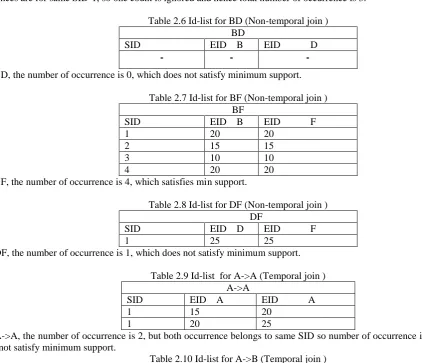
Table 2.6 Id-list for BD (Non-temporal join ) BD
SID EID B EID D
- - -
For BD, the number of occurrence is 0, which does not satisfy minimum support. Table 2.7 Id-list for BF (Non-temporal join )
BF
SID EID B EID F
1 20 20
2 15 15
3 10 10
4 20 20
For BF, the number of occurrence is 4, which satisfies min support.
Table 2.8 Id-list for DF (Non-temporal join ) DF
SID EID D EID F
1 25 25
For DF, the number of occurrence is 1, which does not satisfy minimum support. Table 2.9 Id-list for A->A (Temporal join )
A->A
SID EID A EID A
1 15 20
1 20 25
For A->A, the number of occurrence is 2, but both occurrence belongs to same SID so number of occurrence is actually 1, which does not satisfy minimum support.
Table 2.10 Id-list for A->B (Temporal join ) A->B
SID EID A EID B
1 15 20
IJEDR1403022
International Journal of Engineering Development and Research (www.ijedr.org)3023
A->DSID EID A EID D
1 15 25
1 20 25
For A->D, the number of occurrence is 1 and not 2 because both occurrences are for same SID so we would ignore one count and occurrence of A->D is 1 which does not satisfy minimum support.
Table 2.12 Id-list for A->D (Temporal join) A->F
SID EID A EID F
1 15 20
1 15 25
1 20 25
For A->F, the number of occurrence is 1 and not 3 because all the three occurrences are for same SID so we would ignore 2 counts and occurrence of A->F is 1 which does not satisfy minimum support.
Table 2.13 Id-list for B->A (Temporal join) B->A
SID EID B EID A
1 15 20
4 20 25
For B->A, the number of occurrence is 2, which satisfies the minimum support. Table 2.14 Id-list for B->B (Temporal join)
B->B
SID EID B EID D
1 15 15
1 20 20
For B->B, the number of occurrence is 2, but both occurrence belongs to same SID so number of occurrence is actually 1, which does not satisfy minimum support.
Table 2.15 Id-list for B->D (Temporal join ) B->D
SID EID B EID D
1 15 25
1 20 25
For B->D, the number of occurrence is 1 and not 2 because both the occurrences are for same SID so we would ignore 1 count and occurrence of B->D is 1 which does not satisfy minimum support.
Table 2.16 Id-list for B->F (Temporal join ) B->F
SID EID B EID F
1 20 25
IJEDR1403022
International Journal of Engineering Development and Research (www.ijedr.org)3024
Table 2.17 Id-list for D->D (Temporal join )D->D
SID EID D EID D
1 10 25
For D->D, the number of occurrence is 1 which does not satisfy minimum support. Table 2.18 Id-list for D->A (Temporal join )
D->A
SID EID D EID A
1 10 20
1 10 25
4 10 25
For D->A, the number of occurrence is 3, but 2 occurrences are for same SID so number of occurrence for D->A is 2, which satisfies the minimum support.
Table 2.19 Id-list for D->B (Temporal join) D->B
SID EID F EID D
1 10 15
1 10 20
4 10 20
For D->B, the number of occurrence is 2, which satisfies the minimum support. Table 2.20 Id-list for D->F (Temporal join)
D->F
SID EID D EID F
1 10 20
1 10 25
4 10 20
For D->F, the number of occurrence is 3, but two occurrences are for same SID, so the number of occurrence of D->F is 2 which satisfy the minimum support.
Table 2.21 Id-list for F->F (Temporal join) F->F
SID EID F EID F
1 20 25
For F->F, the number of occurrence is 1, which does not satisfy the minimum support. Table 2.22 Id-list for F->D (Temporal join)
F->D
SID EID F EID D
1 20 25
For F->D, the number of occurrence is 1, which does not satisfy the minimum support. Table 2.23 Id-list for F->B (Temporal join)
F->B
SID EID F EID B
IJEDR1403022
International Journal of Engineering Development and Research (www.ijedr.org)3025
For F->B, the number of occurrence is 1, which does not satisfy the minimum support.Table 2.24 Id-list for F->A (Temporal join) F->A
SID EID F EID A
1 20 25
4 20 25
For F->A, the number of occurrence is 2, which satisfies the minimum support.
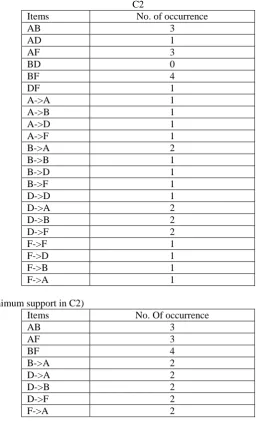
From non-temporal and temporal joins obtained above, below is the table showing count of occurrence of sequences of items.
C2
Items No. of occurrence
AB 3
AD 1
AF 3
BD 0
BF 4
DF 1
A->A 1
A->B 1
A->D 1
A->F 1
B->A 2
B->B 1
B->D 1
B->F 1
D->D 1
D->A 2
D->B 2
D->F 2
F->F 1
F->D 1
F->B 1
F->A 1
L2 (Sequences that satisfy minimum support in C2)
Items No. Of occurrence
AB 3
AF 3
BF 4
B->A 2
D->A 2
D->B 2
D->F 2
IJEDR1403022
International Journal of Engineering Development and Research (www.ijedr.org)3026
3. This step generates 3-sequenceTable 3.1 list for ABF (Non-Temporal join) ABF
SID EID A EID B EID
F
1 20 20 20
2 15 15 15
3 10 10 10
For ABF, the number of occurrence is 3, which satisfies the minimum support. Table 3.2 Id-list for AB->A (Temporal join)
AB->A
SID EID A EID B EID
A
1 15 15 20
1 20 20 25
2 15 15 -
3 10 10 -
For AB->A, the number of occurrence is 2, but as both sequence belongs to SID-1which does not satisfy the minimum support. In this case number of occurrence is 2 because we have sequence AB->A for SID 1, but for SID 2 and 3 we have AB together but AB is not followed by A, thus – (dash) is specified.
Table 3.3 Id-list for AF->A (Temporal join) AF->A
SID EID A EID F EID A
1 20 20 25
1 25 25 -
2 15 15 -
3 10 10 -
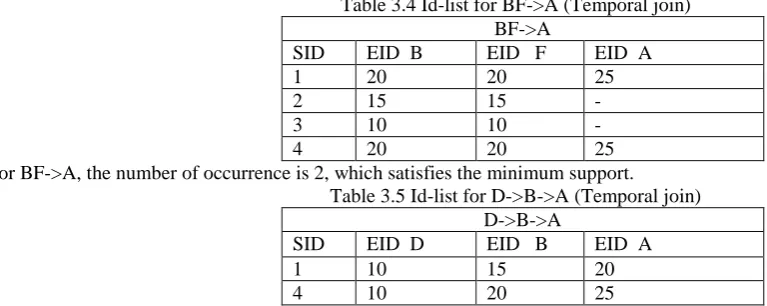
For AF->A, the number of occurrence is 1, which does not satisfy the minimum support. Table 3.4 Id-list for BF->A (Temporal join)
BF->A
SID EID B EID F EID A
1 20 20 25
2 15 15 -
3 10 10 -
4 20 20 25
For BF->A, the number of occurrence is 2, which satisfies the minimum support. Table 3.5 Id-list for D->B->A (Temporal join)
D->B->A
SID EID D EID B EID A
1 10 15 20
4 10 20 25
IJEDR1403022
International Journal of Engineering Development and Research (www.ijedr.org)3027
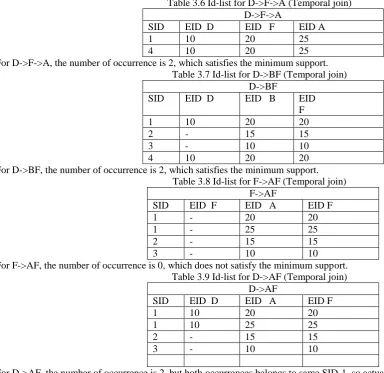
Table 3.6 Id-list for D->F->A (Temporal join)D->F->A
SID EID D EID F EID A
1 10 20 25
4 10 20 25
For D->F->A, the number of occurrence is 2, which satisfies the minimum support. Table 3.7 Id-list for D->BF (Temporal join)
D->BF
SID EID D EID B EID
F
1 10 20 20
2 - 15 15
3 - 10 10
4 10 20 20
For D->BF, the number of occurrence is 2, which satisfies the minimum support. Table 3.8 Id-list for F->AF (Temporal join)
F->AF
SID EID F EID A EID F
1 - 20 20
1 - 25 25
2 - 15 15
3 - 10 10
For F->AF, the number of occurrence is 0, which does not satisfy the minimum support. Table 3.9 Id-list for D->AF (Temporal join)
D->AF
SID EID D EID A EID F
1 10 20 20
1 10 25 25
2 - 15 15
3 - 10 10
For D->AF, the number of occurrence is 2, but both occurrences belongs to same SID-1, so actually number of occurrence is 1, which does not satisfy the minimum support.
Table 3.10 Id-list for D->AB (Temporal join)
For D->AB, the number of occurrence is 2, but both occurrence belongs to same SID-1, so actually number of occurrence is 1, which does not satisfy the minimum support.
Table 3.11 Id-list for F->AB (Temporal join) F->AB
D->AB
SID EID D EID A EID B
1 10 15 15
1 10 20 20
2 - 15 15
IJEDR1403022
International Journal of Engineering Development and Research (www.ijedr.org)3028
SID EID F EID A EID B1 - 15 15
1 - 20 20
2 - 15 15
3 - 10 10
For F->AB, the number of occurrence is 0, which does not satisfy the minimum support. Table 3.12 Id-list for B->AB (Temporal join)
B->AB
SID EID B EID A EID B
1 - 15 15
1 15 20 20
2 - 15 15
3 - 10 10
For B->AB, the number of occurrence is 1, which does not satisfy the minimum support. Table 3.13 Id-list for B->AF (Temporal join)
B->AF
SID EID B EID A EID
F
1 15 20 20
1 15 25 25
1 20 25 25
2 - 15 15
3 - 10 10
For B->AF, the number of occurrence is 3, but all the three sequences belongs to same SID, so number of occurrence is 1,which does not satisfy the minimum support.
From temporal joins obtained above, below is the table showing count of occurrence of sequences of items. C3
Items No. of occurrence
ABF 3
AB->A 1 AF->A 1 BF->A 2 D->B->A 2 D->F->A 2 D->BF 2 F->AF 0 D->AF 1 D->AB 1 F->AB 0 B->AB 1 B->AF 1
IJEDR1403022
International Journal of Engineering Development and Research (www.ijedr.org)3029
Items No. of occurrenceABF 3
BF->A 2 D->B->A 2 D->F->A 2 D->BF 2 4. This step generates 3-sequence
Table 4.1 Id-list for ABF->A (Temporal join) ABF->A
SID EID A EID B
EID F EID A
1 20 20 20 25
2 15 15 15 -
3 10 10 10 -
For ABF->A, the number of occurrence is 1, which does not satisfy the minimum support. Table 4.2Id-list for D->BF->A (Temporal join)
D->BF->A
SID EID D EID B EID F EID A
1 10 20 20 25
2 - 15 15 -
3 - 10 10 -
4 10 20 20 25
For D->BF->A, the number of occurrence is 2, which satisfy minimum support. C. Prefix-projected Sequential Pattern Mining (PREFIX SPAN) Algorithm[3]
PrefixSpan explores prefix-projection in sequential pattern mining. PrefixSpan mines the complete set of patterns but greatly reduces the efforts of candidate sequence generation.Prefix-projection substantially reduces the size of projected databases and leads to efficient processing. [3]
From the figure 1 of database, following given table is taken.
SID TIME(EID) ITEMS
1 10,15,20,25 <(CD)(ABC)(ABF)(ACDF)>
2 15,20 <(ABF)(E)>
3 10 <(ABF)>
4 10,20,25 <(DGH)(BF)(AGH)>
Figure 3 For below given example, consider minimum support as 2.
Step by step explanation of how does SPADE works: 1. Count number of occurrence for each itema
Items A B C D E F G H
No.of frequent items
4 4 1 2 1 4 1 1
IJEDR1403022
International Journal of Engineering Development and Research (www.ijedr.org)3030
2. Divide Search Space<A> <B> <D> <F> (_BC)(ABF)(ACDF) (_BC)(ABF)(ACDF) (ABC)(ABF)(ACDF) (ACDF)
(_BF)(E) (_F)(E) (E)
(_BF) (_F)
(_GH) (_F)(AGH) (_GH)(BF)(AGH) (AGH)
3. Find Subsets 3.1- Subsets for <A> <A>
(_BC)(ABF)(ACDF) (_BF)(E)
(_BF) (_GH) 3.1.1<A>
A B F C D E _B _C _F _G _H
1 1 1 1 1 1 3 1 2 1 1
The items that satisfy minimum support are shown in table below _B _F
3 2
<AB> <AF> (_C)(ABF)(ACDF) (ACDF)
(_F)E E
(_F)
The items Frequent 2-Sequence are AB and AF, as they comes under 2 sequences and thus satisfy minimum support.
Considering prefix AB for (_C)(ABF)(ACDF) for <AB> <AB>
(_C)(ABF)(ACDF) (_F)E
(_F) <AB>
A B C D E _F F _C
1 1 1 1 1 2 1 1
IJEDR1403022
International Journal of Engineering Development and Research (www.ijedr.org)3031
The items Frequent 3-Sequence is ABF, as it comes under 2 sequence and thus satisfy minimum support.Considering prefix AB for sequence (_F)(ACDF) <AB>
(_F)(ACDF) (_F)E (_F)
A C D F E _F
1 1 1 1 1 3
<ABF> <ABF> (ACDF) E
The items Frequent 3-Sequence is ABF, as it comes under 2 sequence and thus satisfy minimum support. Same is being detected in above example
<AF>
A C D E F
1 1 1 1 1
No items frequent. 3.2 –Subsets for <B>
<B>
(_BC)(ABF)(ACDF) (_F)(E)
(_F) (_F)(AGH) 3.2.1<B>
A _B C D E _F G B F H _C
2 1 1 1 1 3 1 1 1 1 1
Items that satisfy minimum support i.e. 2 are A, F
A _F
2 3
Considering prefix B->A for sequence (_BF)(ACDF) B->A
(_BF)(ACDF) (_GH)
B->A is frequent as it comes under two sequences
A _B C D _F _G _H F
1 1 1 1 1 1 1 1
IJEDR1403022
International Journal of Engineering Development and Research (www.ijedr.org)3032
Considering prefix B->A for sequence (_CDF)B->A (_CDF) (_GH)
B->A is frequent as it comes under two sequence _C _D _F _G _H
1 1 1 1 1
From above table no more items are frequent BF
(ACDF) E AGH
BF is frequent as it comes under two sequences A C D E F G H
2 1 1 1 1 1 1 BF->A
(_CDF) (_GH)
BF-> A is frequent as it occurs in two sequences.
_C _D _F _G _H
1 1 1 1 1
From above table no more items are frequent 3.1.3 Find Subsets
<D>
(ABC)(ABF)(ACDF) (_GH)(BF)(AGH)
A B C D F _G G _H H
2 2 1 1 2 1 1 1 1
D->A
(_BC)(ABF)(ACDF) (_GH)
D->A is frequent as it comes under 2 sequences. A B _B C _C D F _G _H
1 1 1 1 1 1 1 1 1
No item satisfy min support
Considering prefix D->B for for sequence (_C)(ABF)(ACDF) D->B
(_C)(ABF)(ACDF) (_F)(AGH)
IJEDR1403022
International Journal of Engineering Development and Research (www.ijedr.org)3033
A B C _C D F _F G H2 1 1 1 1 1 2 1 1
D->B->A (_BF)(ACDF) (_GH)
D->B ->A is frequent as it comes under 2 sequences. A _B C D F _G H _F _H
1 1 1 1 1 1 1 1 1
No more item from above table satisfy min support Considering prefix D->B for for sequence (_F)(ACDF)
D->B (_F)(ACDF) (_F)(AGH)
_F A C D F G H 2 2 1 1 1 1 1
D->BF ACDF AGH
D->BF is frequent as it comes under two sequences A C D F G H
2 1 1 1 1 1 D->BF-A
(_CDF) (_GH)
D->BF->A is frequent as it comes under two sequences
_C _D _F _G _H
1 1 1 1 1
No more item from above table satisfy min support D->B->A
(_BF)(ACDF) (_GH)
D->B->A is frequent.
A C D F _G _H _B _F
1 1 1 1 1 1 1 1
D->F (ACDF) (AGH)
IJEDR1403022
International Journal of Engineering Development and Research (www.ijedr.org)3034
2 1 1 1 1 1D->F->A (_CDF) (_GH)
D-> F->A comes under 2 02sequences so it is frequent _C _D _F _G _H
1 1 1 1 1
No more item from above table satisfy min support 3.1.4 Find Subsets
<F> (ACDF) (E) (AGH)
A C D E F G H 2 1 1 1 1 1 1
F->A (_CDF) (_GH)
F->A is frequent as it comes under 2 sequences so it is frequent _C _D _F _G _H
1 1 1 1 1
No more item from above table satisfy min support.
III. COMPARISONBETWEENGSP,SPADE AND PREFIXSPAN
GSP SPADE PrefixSpan
Purpose GSP algorithm is used for extracting frequently occurring sequences and is proposed by Agrawal and Srikant[2]
SPADE algorithm is used for fast (faster than GSP) discovery of sequential pattern and is proposed by MOHAMMED J. ZAKI[1]
PrefixSpan algorithm is used for discovery of sequential pattern and performs better in mining large sequences.It is proposed by Jian Pei et.al[3]
PPerformance GSP is an iterative algorithm. It scans the database number of times depending on the length of the longest frequent sequences in database. The I/O cost is substantial (large) if database contains very long frequent sequences. [2]
Spade outperforms the GSP by a factor two, and by an order of magnitude with precomputed support of 2-sequences. It has excellent scaleup properties with respect to a number of parameters such as number of input-sequences, the number of events per-input sequence, the event size and the size of potential maximal frequent events and sequences. [1]
PrefixSpan mines the complete set of patterns but greatly reduces the efforts
of candidate sequence
generation.prefix-projection
substantially reduces the size of projected
Databases and leads to efficient processing.[3]. A comprehensive performance study shows that PrefixSpan, in most cases, outperforms the a
IJEDR1403022
International Journal of Engineering Development and Research (www.ijedr.org)3035
and SPADE[5]Format of database
Uses Horizontal Format Database[2]
Uses Vertical Format Database [1] Uses Horizontal Format Database [3]
Approach Apriori Based[2] Apriori Based[1] Prefix-Projecte Pattern-Growth
Based[3] Candidate
Sequence
Candidate Sequence generation required[2]
Candidate Sequence generation required.[1]
Candidate Sequence generation is not required. It uses prefix projection.[3] IV. ANAYSIS
Using the SPMF (A Sequential Pattern mining framework) [9] algorithms, the above mentioned three algorithms GSP,SPADE and PrefixSpan were executed on the same dataset. The result of analysis is displayed below:
The Table below shows the comparison among algorithms. Algorithms were executed on a text file named ContextSpade. Size of the file was 145 bytes.
Attribute s
GSP SPADE PrefixSpan
(Max Pattern Length 4) Total
Time
~ 140 ms ~ 78 ms ~ 15ms Frequent
Sequence s Count
3917 3917 700
Max Memory( mb)
8.1845855 71289062
8.39794158 9355469
6.29127502441 40625700
The following chart shows comparison among attributes of GSP,SPADE and PrefixSpan
1 10 100 1000 10000
Algorithms
Total Time
Frequent Sequences Count
Max
IJEDR1403022
International Journal of Engineering Development and Research (www.ijedr.org)3036
Figure 3V. CONCLUSION
This paper made the comparison among GSP, SPADE and PrefixSpan algorithms. This paper presented the concept and explanation of the above mentioned algorithms. Using SPMF it is determined that PrefixSpan is better than GSP and SPADE in performance as it takes lesser time than GSP and SPADE. SPADE takes less time than GSP but it takes quite more time than PrefixSpan. The memory required by PrefixSpan is much less than GSP and SPADE while the memory required by GSP and SPADE is same. Various attributes like Total Time required for executing algorithm, frequent sequences found by algorithms and Maximum memory used by algorithm
REFERENCES
[1] Mohammed J Zaki. (2001). SPADE: An efficient algorithm for Mining Frequent Sequences.In Journal Machine Learning, Volume 42 Issue 1-2, January-February 2001 Pages 31-60.
[2] Ramakrishna Srikant, Rakesh Agarwal (1996). Mining Sequential Patterns: Generalizations and Performance Improvements. In proceedings of the 5th International Conference on EDT:Advances in Database Technology Pages 3-17 [3] Jian Pei Jiawei Han Behzad Mortazavi-Asl Helen Pinto, Qiming Chen Umeshwar Dayal Mei-Chun Hsu.(2001).PrefixSpan: Mining Sequential Patterns Efficiently by Prefix-Projected Pattern Growth, , published in Data Engineering, 2001. Proceedings. 17th International Conference on , Page(s):215 - 224
[4] A GSP based efficient algorithm for mining frequent sequences, Minghua Zang, Ben Kao, Chi-Lap Yip, David Cheung
[5] Jian Pei, Behzad Mortazavi-Asl, Jianyong Wang, Helen Pinto, Qiming Chen,Umeshwar Dayal. (2004). Mining Sequential Patterns by Pattern-Growth:The PrefixSpan Approach. In IEEE TRANSACTIONS ON KNOWLEDGE AND DATA ENGINEERING, VOL. 16, NO. 10, OCTOBER 2004
[6] ThabetSlimani and Amor Lazzez.(2013). SEQUENTIAL MINING:PATTERNS AND ALGORITHMS ANALYSIS.In International Journal of Computer and Electronics Research [Volume 2, Issue 5, October 2013]
[7] R. Srikant et.al. Data Mining:Concepts and Techniques Mining sequence patterns in transactional databases. http://www.cs.nyu.edu/courses/spring08/G22.3033-003/8timeseries.ppt