IJSRR, 8(3) July. – Sep., 2019 Page 420
Research article Available online www.ijsrr.org
ISSN: 2279–0543
International Journal of Scientific Research and Reviews
A GUI Model of Secured Fingerprint Authentication Using Image
Fusion
Priyashree Firke
*1and Nilesh Gupta
2¹M.Tech Scholar,CSE Department, Chouksey Engineering College Lalkhadan Bilaspur(c.g). ²Assistant Professor ,CSE Department,Chouksey Engineering College LalkhadanBilaspur(c.g).
ABSTRACT
A fingerprint in its narrow sense is an impression left by the friction ridges of a human finger. The recovery of fingerprints from a crime scene is an important method of science.Fingerprint recognition is the most popular methods used for identification.This project explores the possibility of mixing two different fingerprints, pertaining to two different fingers, at the image level in order to generate a new fingerprint. In the enrollment, two fingerprints are captured from two different fingers. We extract the minutiae positions from one fingerprint, the orientation from the other fingerprint, and the reference points from both fingerprints. Based on this extracted information, a combined minutiae template is generated and stored in a database. In the authentication, the system requires two query fingerprints from the same two fingers which are used in the enrollment. A two-stage fingerprint matching process is proposed for matching the two query fingerprints against a combined minutiae template. This approach has following benefits: (a) it can be used to generate virtual identities from two different fingers (b) it can be used to obscure the information present in an individual’s fingerprint image prior to storing it in a central database. In project stage 1, extraction of minutiae positions from one fingerprint is performed. So in stage 1, we propose a system for detecting minutiae positions from fingerprint images which can later be used for fingerprint protection.
KEY WORDS
: Combination, biometrics, fingerprint, minutiae, privacy, protection.*
Corresponding Author
Priyashree Firke
Department of computer science and Engineering,
Chouksey Engineering College,
Bilaspur (C.G) india
IJSRR, 8(3) July. – Sep., 2019 Page 421
INTRODUCTION
Due to the event of computers and increased usage of web, leakage of personal information
has become a heavy drawback. With the arrival of Electronic Banking, E-Commerce and smart cards
and an increase emphasis on the privacy and security of information stored in various databases,
Automatic Personal Identification has become a very important topic which is applied in a wide
range of civilian applications involving the use of passports, cellular phones and ATMs.
Traditionally, passwords (knowledge-based security) and ID cards (token-based security) have been
used to restrict access to systems. However these approaches are not based on any inherent attributes
of an individual to make a personal identification thus having number of disadvantages like tokens
may be lost, stolen, forgotten, or misplaced; PIN may be forgotten or guessed by impostors. Given
the inefficiency of PIN based systems, it has become increasingly important that a person be
identified on the basis of some Bio-metric feature which is unique to him.
Bio-metrics is the measurement of a unique physical characteristics and acts as an ideal
solution to the problem of digital identification. The advantages of Fingerprint Bio-metrics over
other identification procedures are: Each of our ten fingerprints is unique, different from another and
from those of every other person. Unlike passwords, PIN codes and smart cards that we depend upon
today for identification our fingerprints are impossible to lose or forget, and they can never be stolen.
We have ten fingerprints as oppose to two eyes, one face and one voice. Hence fingerprints have
been used for centuries upon which one can make a claim on the uniqueness of each fingerprint.
In today’s modern world authentication and security is of major concern. Finger print recognition
is one of the most widely used biometric security system as it is easy to access and implement. The
existing finger print technology does not provide much accuracy thus resulting into implementation
of fusion techniques in the existing technology. Fusion at sample level finger print recognition also
called as finger print recognition using hybrid technology provides high security at low cost.With the
widespread applications of fingerprint techniques in authentication systems, protecting the privacy of
the fingerprint becomes an important issue. Traditional encryption is not sufficient for fingerprint
privacy protection because decryption is required beforethe fingerprint matching, which exposes the
fingerprint to the attacker. Therefore, in recent years, significant efforts have been put into
IJSRR, 8(3) July. – Sep., 2019 Page 422
PROPOSED SYSTEM
The motivation behind this project is protecting fingerprint privacy by combining two
different fingerprints into a new identity. In this work, an input fingerprint image is mixed with
another fingerprint (e.g., from a different finger), in order to produce a new mixed image that
obscures the identity of the original fingerprint.
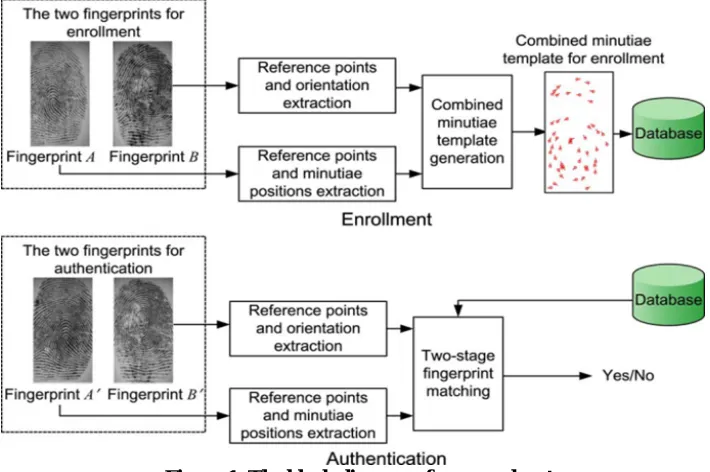
Figure 1: The block diagram of proposed system
Fig. 1 shows our proposed fingerprint privacy protection system. In the enrolment phase, the
system captures two fingerprints from two different fingers. We extract the minutiae positions from
1st fingerprint, orientation from 2nd fingerprint and reference points from both fingerprints. Then, by
using coding strategies, a combined minutiae template is generated based on the minutiae positions,
the orientation and the reference points detected from both fingerprints. Finally, the combined
minutiae template is stored in a database. In the authentication phase, two query fingerprints are
required from the same two fingers. As what we have done in the enrolment, we extract the minutiae
positions from the 1st fingerprint and the orientation from 2nd fingerprint. Reference points are
detected from both queryfingerprints. This extracted information will be matched against the
corresponding template stored in the database by using a two-stage fingerprint matching.
METHODOLOGY
IJSRR, 8(3) July. – Sep., 2019 Page 423
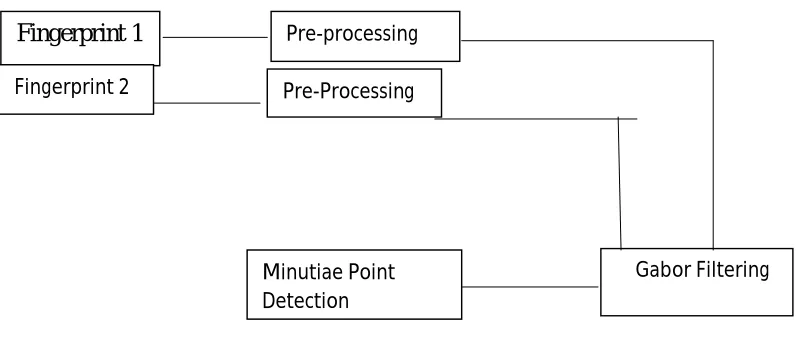
Figure 2: Work of Proposed System
The above figure shows thework (process) of proposed system. In this phenomenon firstly we
have to input first fingerprint than second fingerprint after that pre-processing had been perform of
the input fingerprints.
The pre-processing follows few steps which is required for the detection of minutiae.first the
conversion of grey scale image had been performed of the original image.Then histogram
representation had been done. That act as a graphical representation of the tonal distribution in a
digital Image. After that morphological closing and opening of image had been performed.The
closing operation can expand image and remove peak by background noise and the opening
operation can shrink image and eliminate small cavities. Then the dilation had been performed,
dilation add pixels to the boundaries of object in image.After that the histogram equalization had
been done. The idea behind this is that the pixel should be distributed evenly over whole intensity
range.
The next step is Gaborfiltering, which is named after, DennisGabor, and is used for the edge
detection. At last we perform the minutiae points detection. Comparison of one finger with another
can be made using minutiae.
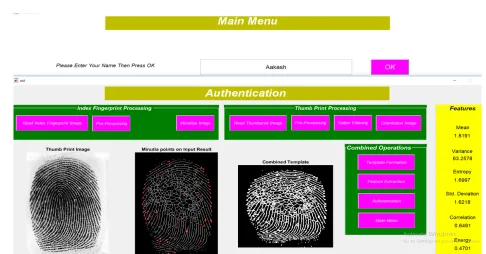
GRAPHICAL USER INTERFACE FOR FINGERPRINT RECOGINTION AND
AUTHENTICATION USING IMAGE FUSION WITH FOLLOWING
ALGORTHIM
Step 1-Collection of Database.
Step 2- The main menu to enter name from database
Step 3- The authentication menu in which fingerprint of candidate enter Fingerprint 1 Pre-processing
Fingerprint 2
Gabor Filtering Pre-Processing
IJSRR, 8(3) July. – Sep., 2019 Page 424 Step4- The firstfingerprint should be entered
Step 5- The first fingerprint converted to grayscale
Step 6- The first fingerprint is minutia extracted
Step 7- The second fingerprint should be entered
Step 8- The second fingerprint is minutia extracted
Step 9- The first and second fingerprint performGabor filtering
Step 9- The first and second fingerprint perform orientation image
Step 10- The first and second fingerprint perform template formation
Step 11- The first and second fingerprint perform feature extraction.
Step 12-The authentication of user found in database.
COMPARISON
In the traditional systems, finger prints are scanned single finger. The traditional pattern
matching method for fingerprint verification verifies the identity of the patterns by directly
comparing the objective fingerprint images with the registered image. Traditional encryption is not
sufficient for fingerprint privacy protection because decryption is required before the fingerprint
matching, which exposes the fingerprint to the attacker. To avoid thissituation, we propose here a
system for protecting finger print privacy by combining two totally different fingerprints into a new
identity.
RESULT AND
DISCUSSION
.
IJSRR, 8(3) July. – Sep., 2019 Page 425
The fingerprint minutia matching is implemented in MATLAB. The fingerprint of different
person is collected in database in the form of image. The image is than converted to MATLAB code.
The analysis are done on totally different collection of fingerprint image. These images are applied
Gabor flitering method for better matching.
CONCLUSION
The above proposed methodology was really an effort to understand how the Fingerprint
Recognition is used in many applications like biometric measurements, solving crime investigation
and also in security system. From minutiae extraction to minutiae matching all stages are included in
this proposed method which generates a match score. Various standard techniques are used in the
intermediate stage of processing.
REFERENCES
1. F. Chen, J. Feng, A. K. Jain, J. Zhou, and J. Zhang, “Separatingoverlapped fingerprints,”
IEEE Trans. Inf. Foren. Secure 2011; 76(10): .346–359.
2. J. Feng, Y. Shi, J. Zhou, “Robust and efficient algorithms for separating latent overlapped
fingerprints”, IEEE Trans Inf Forensics Secure, 2012; 7(5): 1498–1510
3. Q. Zhao, A. Jain, “Model based separation of overlapping latent fingerprints”, IEEE Trans
Inf Forensics Secure 2012; 7(3): 904–918,.
4. N. Zhang, Y. Zang, X. Yang, X. Jia, J. Tian, “Adaptive orientation model fitting for latent
overlapped fingerprints separation”, IEEE Trans Inf Forensics Secure, 2014; 9(10):1547–
1556
5. S. Jeyanthi, N.U. Maheswari and R. Venkatesh. "Neural network based automatic fingerprint
recognition system for overlapped latent images." Journal of Intelligent & Fuzzy Systems,
2015; 28(6): 2889-2899.
6. Ross and A. Othman, “Visual cryptography for biometric privacy,” IEEE Trans. Inf.